Path to the Maypole of Wisdom

A Choice for Spiritual Ethics,Virtues and Uprightness in our times

Path to the Maypole of Wisdom

The Cosmos in Stone: the Ascent of the Soul

From Beshara

Artist–geometer Tom Bree explores the symbolism embodied in the design of two major centres of worship – the Dome of the Rock on Jerusalem’s Temple Mount and Wells Cathedral in Southern England.

Tom Bree is an artist–geometer who for many years has been researching the sacred principles which underlie some of the great historic buildings of the world. He studied with Professor Keith Critchlow at the Prince’s Foundation School of Traditional Arts in London, where he himself now teaches. His recent book The Cosmos in Stone: Sacred Geometry of a Master Mason [1] is a magnus opus in which he explores the intricate and harmonious geometry behind the structure of Wells Cathedral in Somerset UK. In this article he suggests that there is a connection between some aspects of the cathedral’s design and the geometry of the Dome of the Rock on the Temple Mount in Jerusalem; both buildings, he shows, emphasise the vertical axis, and thus symbolise the ascent of the human soul to the divine.

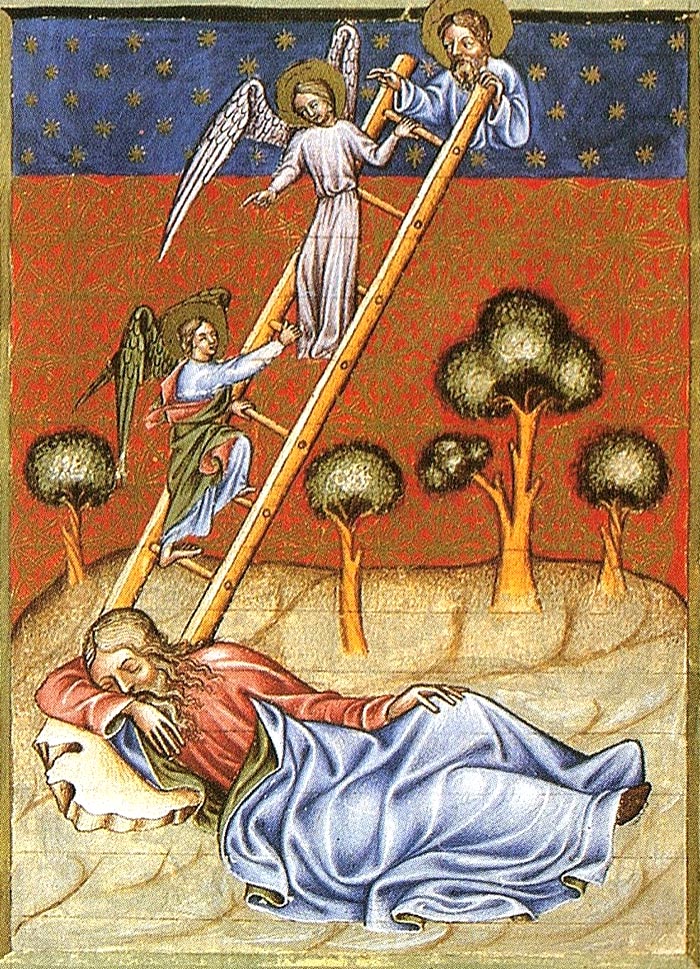
The symbolism of the soul’s ascent can be found in many different religious and philosophical traditions, such as in the Torah’s description of Jacob’s ladder or in the contemplative use of the Sephirotic tree-of-life in the Kabbalistic traditions of Judaism. In the Christian tradition, St Paul’s description of his ascent to the third and highest heaven in 2 Corinthians,(] New Testament, 2 Corinthians 12.1–10)and more generally, the key influence of Platonism on Christianity, has led to various stories relating in some way to the soul’s ascent. These include Dionysius’ The Celestial Hierarchy and Dante’s Divine Comedy as well as Boethius’ The Consolation of Philosophy.

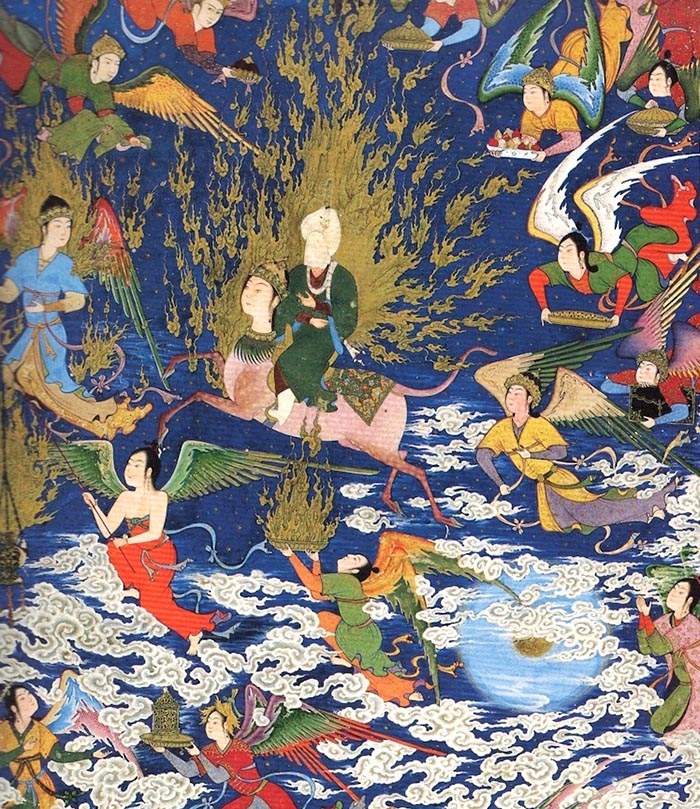
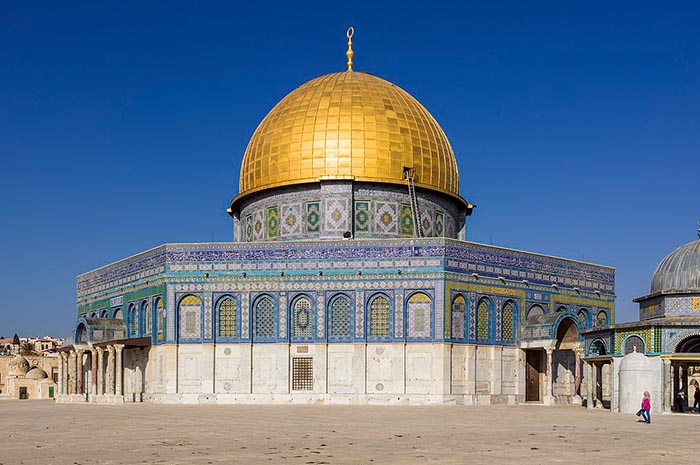
An Islamic story involving ascent is the Prophet Muhammad’s Night Journey, or miʿrāj, in which he ascends through the seven heavens, within each of which he meets various other Islamic prophets. There is an Islamic building that is associated with this particular storyline – The Dome of the Rock in the Al Aqsa Mosque compound on Jerusalem’s Temple Mount. Analysing the design of this ancient building according to the principles of sacred geometry reveals that it could be described as emphasising a vertical axis – which, as I will show, symbolises ascent – within its very structure. I will go on to suggest that a symbolic layout of the same sort can also be recognised in the design of the chancel and chapter house area of Wells Cathedral, the first gothic cathedral to be built in England.

– The Relationship between Heaven and Earth

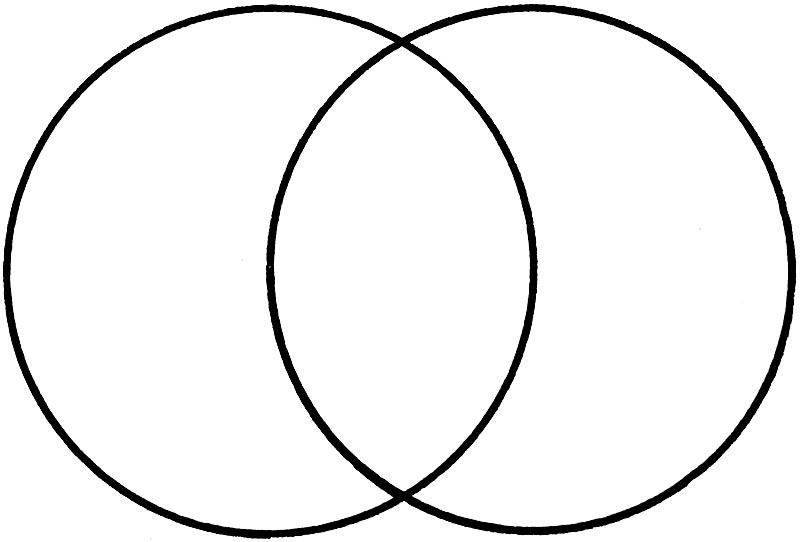
Before embarking upon a detailed analysis of these buildings, it is necessary to give a little background. When geometric symbolism is used as a way of contemplating the relationship between heaven and earth, there are a variety of different geometric forms that can be used. If two circles are overlapped in such a way that the circumference of each circle passes through the centre of the other circle, a so called ‘vesica pisces’ is produced. The Vesica Pisces is the name given to the area where the two circle’s overlap. It symbolises an area of mediation or relationship between polar opposites.

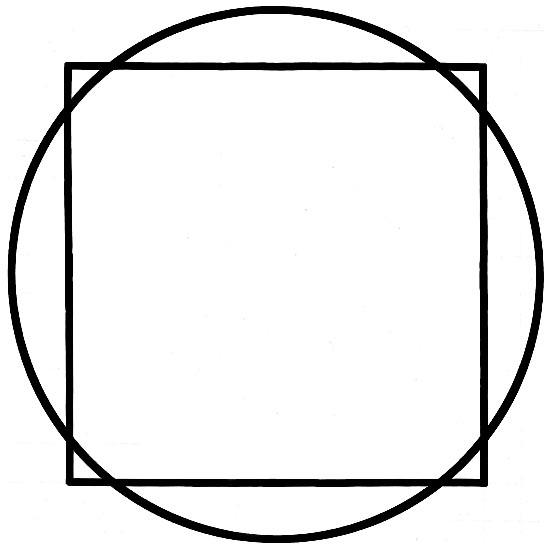
So, in this sense one of the circles symbolises heaven and the other earth. But in another use of geometric heaven/earth symbolism, the circle symbolises heaven whereas earth is symbolised by a square. This is the case within the symbolic process known as ‘the squaring of the circle’. The square is derived from the circle, which has either the same peripheral measurement or the same area as the circle. This is understood to present an image of balance or likeness and thus ‘relationship-ness’ between the circular heaven above and ‘four corners’ of the earth down below.

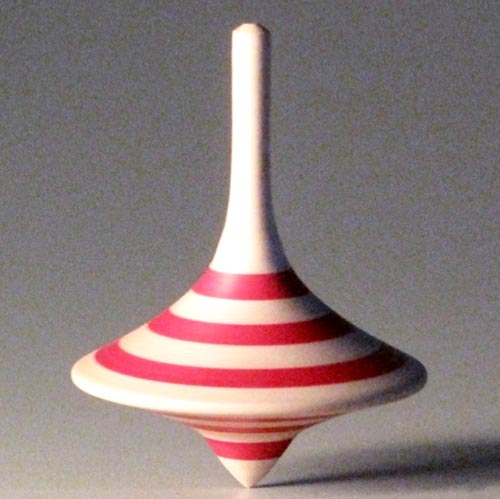
Another example of heaven–earth symbolism can be seen in the use of the cross as a form that presents an interaction between a vertical and a horizontal line. The vertical line could be described as an ‘ontological’ axis, whereas the horizontal line symbolises a ‘cosmological’ expansion outward from the vertical axis into the ‘horizontal’ material world. A useful way of seeing such a metaphysical symbolism in a more direct and material form is to understand the ontological axis as the invisible or indefinitely thin vertical line about which a spinning top revolves. The material form of the spinning top is then the visible cosmos and its turning movement presents an external image of the inner workings of the hidden ontological axis.

See The Thread of life: Wisdom for our Times

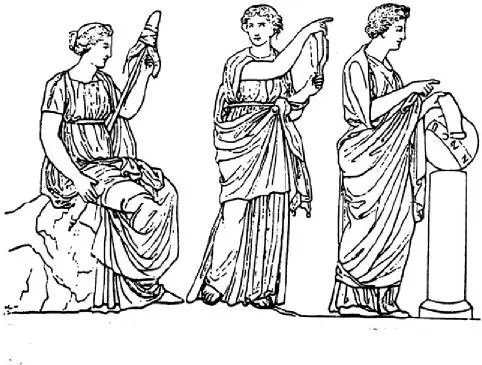
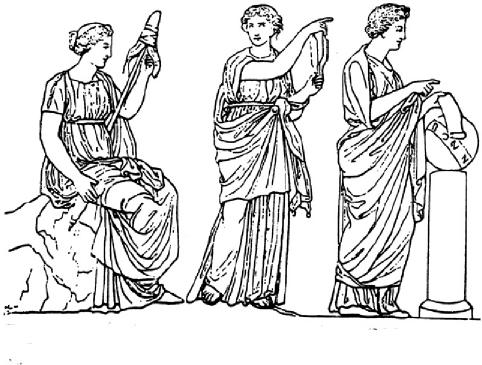
Or the symbolism of the Moirai

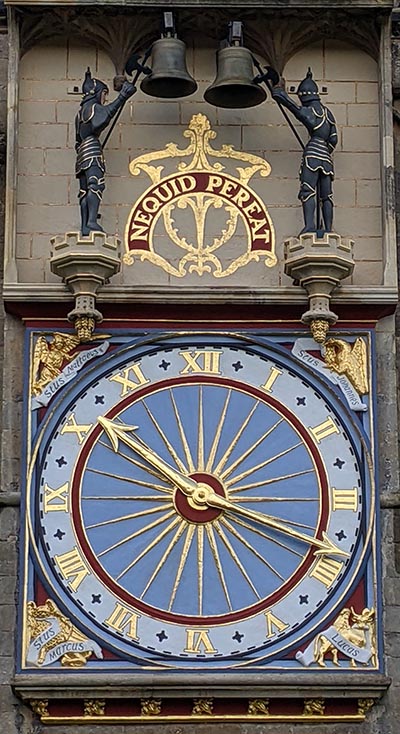
This is not entirely dissimilar to Plato’s description of time as a moving image of eternity. This can be seen very nicely in the most common present-day image of time, the clock. The turning hands on a clockface obediently externalise the knowledge of the clock’s hub, which is itself at the unmoving centre of the clock’s circular face. The hub could accordingly be described as the ‘unmoved mover’ because it is stationary at the centre of the face – and therefore outside of the cycle of time – yet, concurrently, it is also turning and causing the clock’s hands to externally express a sequential image of time.

Wells Cathedral exterior clock. The Latin motto says: ‘He does not perish’.
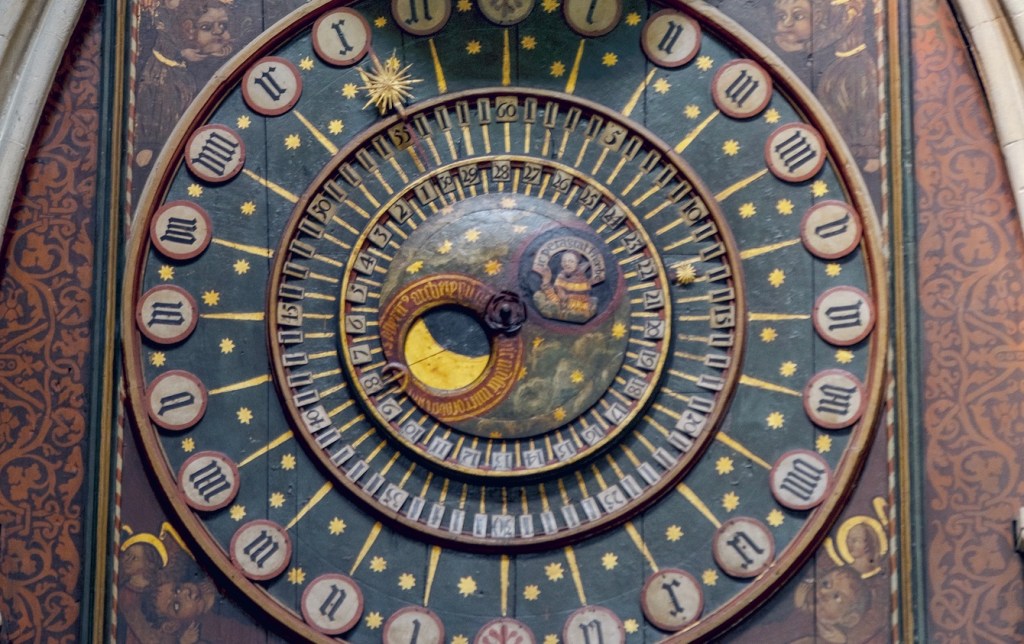
Look also the Astronomical clock – Wells Cathedral

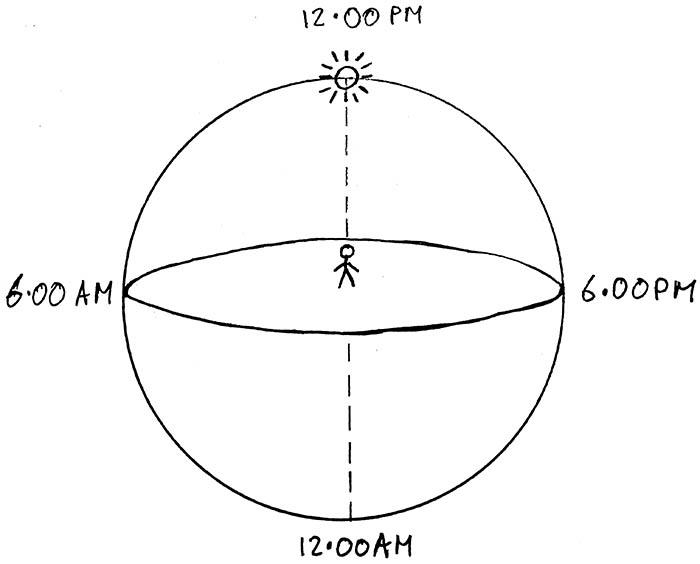
In the same way, the soul’s descent into the underworld or ascent through the heavens is very readily symbolised by a vertical axis. Such an axis could be looked upon as piercing the central point of a circular earthly plane: indeed this would be at the central point of a circular earthly plane that is demarcated by our visible circular horizon. Each one of us is accordingly forever located at such a central point because wherever we move in any direction the circular horizon moves with us. So, we are forever physically present at the ‘centre of the world’ from where we bear witness to the workings of the world around us.

Further, if one then imagines that the horizon encircling us is the equator of a sphere, then it is possible to perceive the blue sky, stretching upwards from the horizon, as being the sphere’s upper half or hemisphere – in other words the ‘dome’ of heaven. There is then an imagined hidden hemisphere below the circular plane upon which we stand, and this is the underworld through which the sun passes during the night-time having encircled the upper hemisphere during the hours of daylight.

With such an imaginal way of seeing things we become the still point, like the clock’s hub, about which the sun is moving and marking out time. It could also be said that our vertical presence – with head up in heaven and feet down on earth – reflects a miniature image of the sphere’s ontological axis about which these circular heavenly cosmic movements are effected. The sun’s ascending and descending movements, between the sphere’s zenith and its nadir, accordingly become external cosmic images of similar movements taking place within the soul – much like the ascending and descending angels that Jacob saw in his dream of the ladder. In this sense the heavenly bodies present the soul with an image of its own inner workings. Thus to look out into the universe, or ‘macrocosm’, as far as it is possible for the human eye to see, becomes analogous to looking inwards toward the deepest and most hidden reaches of the ‘microcosmic’ human soul.

– Ascent as a Ladder

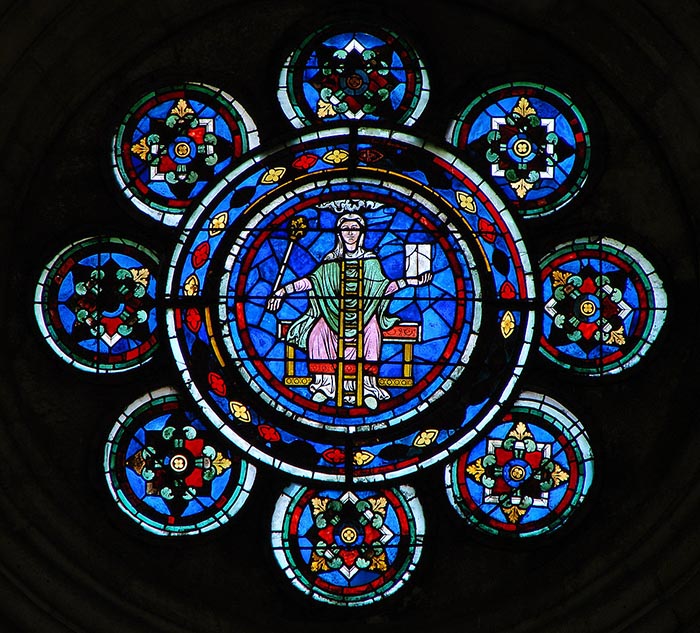
A vertical axis, therefore, inevitably implies movements of ascent and descent and in this sense it can also be viewed as a ladder. Such a ladder may have a particular number of rungs, and within the sacred traditions the most common is perhaps seven, which together symbolise the seven planetary spheres or, alternatively, in the ancient Sumerian poem, the descent of Inanna through seven levels into the underworld. If it is an ascent through the seven planetary spheres then the eighth sphere of the fixed stars and the ‘first moved’ ninth sphere can be added so that the number becomes nine.

Lady Philosophy, in the centre of the rose window in the north transcept of the Cathedral of Notre Dame, Laon, France, dated 1200–1210.

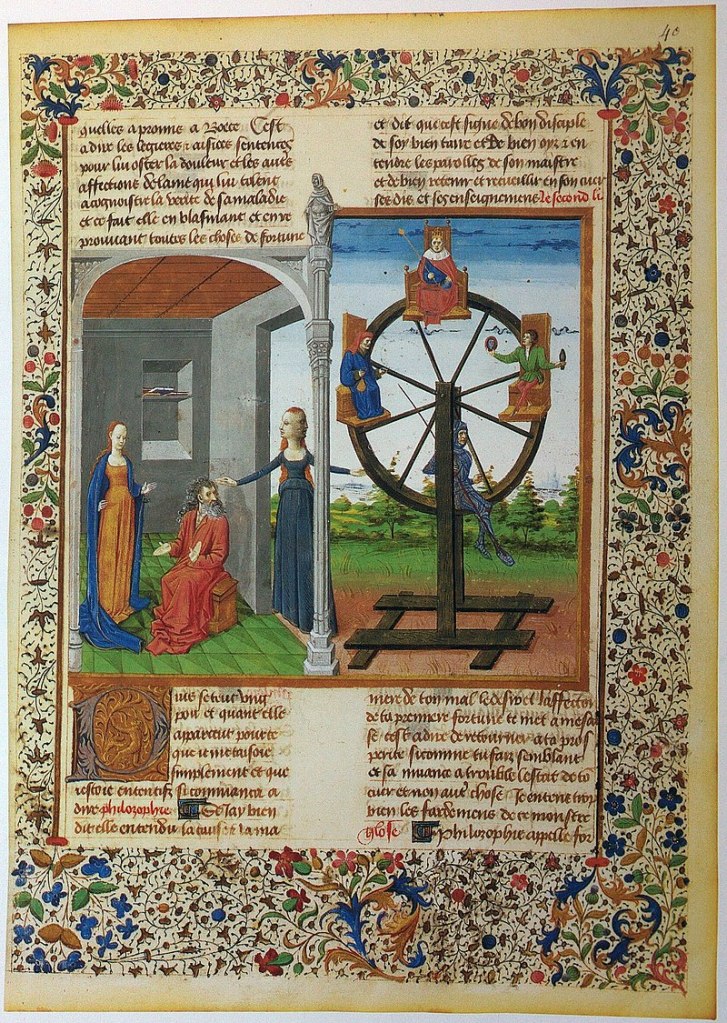
A beautiful example of this is the depiction of Boethius’ Lady Philosophy in the centre of the north rose window at Laon Cathedral in France. The story behind this is that at the beginning of the Consolation of Philosophy, Lady Philosophy presents herself to a distraught Boethius as a consolatory inward ladder of ascent through which his soul can look upwards and rise above and beyond the corrupt and tragic predicament of his condemned state. At the time, through having fallen out of favour in the grimy world of politics, Boethius was imprisoned and awaiting execution, and this was the setting in which his providential meeting with Lady Philosophy took place. It subsequently led to him writing one of the most important and read books in the whole of the medieval Christian era. The message is that it is often when the soul reaches its very lowest point that a vision can be witnessed which raises it up aloft, into the heavens.

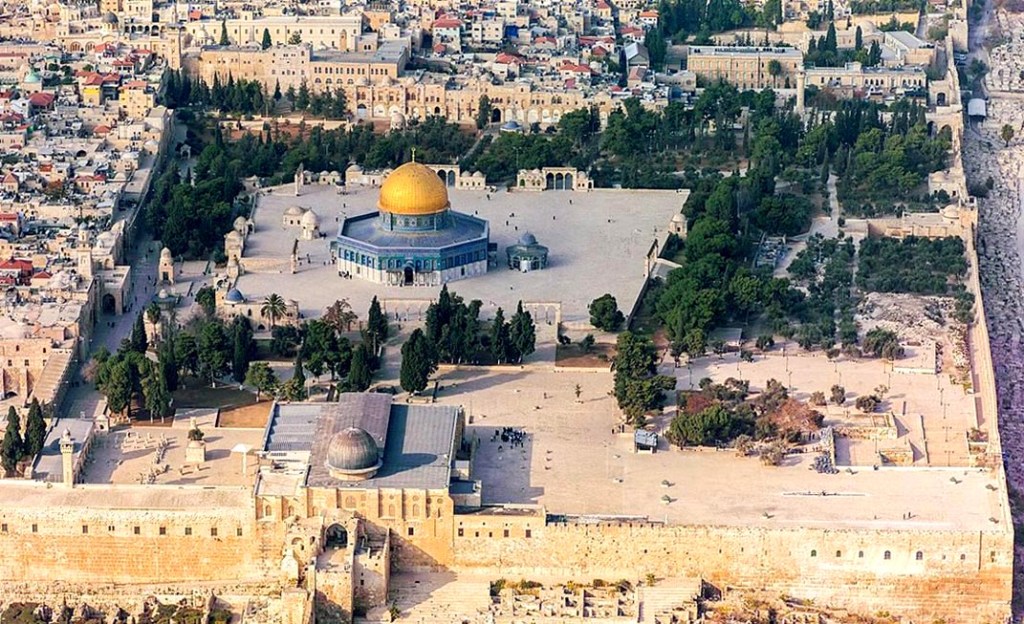
The Dome of the Rock on the Temple Mount in Jerusalem, built 691–2CE.

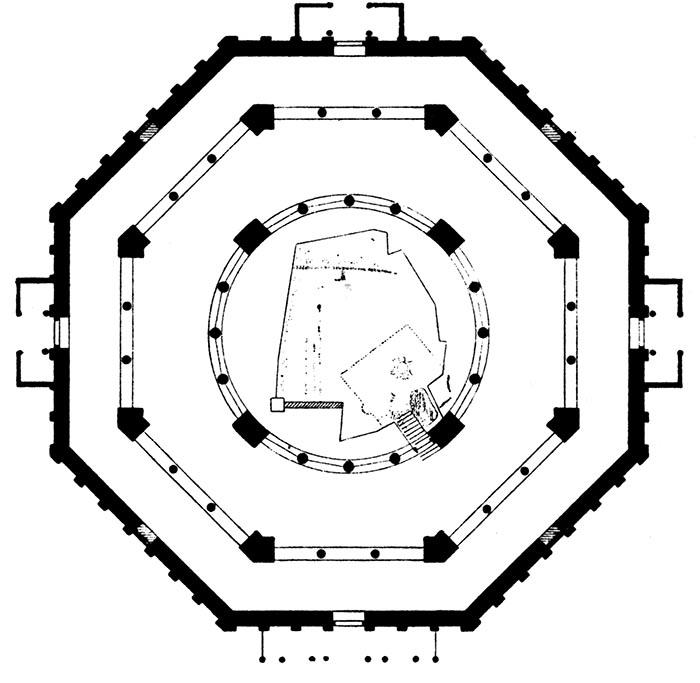
The Dome of the Rock can be described as ‘centrally planned’ in the sense that its architectural plan (i.e. its ground plan) emphasises a central point. This is because it is octagonal.

This is notable, because the places of religious worship used in the three Abrahamic religions of Judaism, Christianity and Islam can generally be described as emphasising a horizontal ‘linear axiality’ rather than a single central point. This is aided by the fact that churches face eastwards towards the rising sun and morning star, whereas synagogues and mosques respectively face Jerusalem and Mecca which in geographical terms are the focal points for these two religions.

In each of these examples there is a focal point, far off in the distance, towards which the place of religious worship is orientated. This naturally emphasises a linear or ‘axial’ relationship between the place of worship and a point in the distance, and this relationship will also generally show itself in the design and layout of the building. But this is not the case with the Dome of the Rock, which is a shrine rather than a mosque. It is true that there is a very early mihrab in the cave (the Well of Souls) below the rock, but this is not the main focal object of the building. Rather the central focus is the rock itself, which is at the centre of the building directly underneath the dome. This means that the building’s ‘focality’ is centrally located and so the rock becomes the ‘immanent centre’ rather than a point that ‘transcends’ our visible horizon.

But having said this, it could be suggested that there is actually a linear axiality that is expressed by the centrally planned architecture, but this is vertical rather than horizontal. In this view, the rock is the starting point of a vertical axial movement upwards towards the dome which symbolises the heavens. This movement naturally reflects the Prophet Muhammed’s miʿrāj.

During the Crusader Kingdom of Jerusalem (1099–1187) the Dome of the Rock was made into a church and was referred to by Crusader culture as ‘The Temple of the Lord’. This was in recognition of the belief that it stood upon the original site of Solomon’s Temple. Another interesting association is that it was also understood by Crusader culture to be the place where Jacob had his dream of the ladder. This event had no prior association with Jerusalem, and indeed the relationship was denied by the Christian Pilgrim John of Würzburg in his 12th century Description of the Holy Land:

…Wiith all respect to the Temple, this [its being the site of Jacob’s ladder] is not true, although the following verse is written there: ‘Jacob, this thy land shall be, And thy children’s after thee.’ But this did not take place here, but a long way off, as he was on his way to Mesopotamia. (p. 14)

The point here is that despite the religious usage of the building briefly changing from Islam to Christianity, within the understanding of Crusader culture the association with the soul’s ascent remained in place.

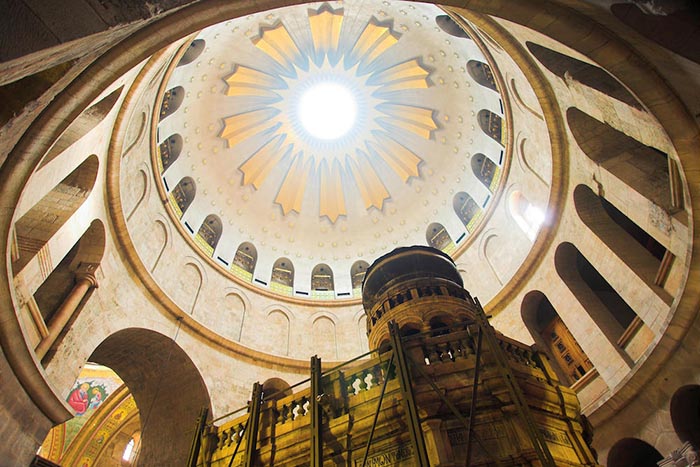
Dome in the church of the Holy Sepulchre.

The Church of the Holy Sepulchre

The other famous centrally-planned building in Jerusalem forms the western end of the church of the Holy Sepulchre. This focal area of the church – the Anastasis – is understood to be the place where Christ was interred after his crucifixion and from where he was resurrected. Again, it is a centrally planned building with a dome on top, with the focal point lying at the centre of the building down below the dome in the form of the shrine or ‘aedicule’ where Christ’s body was interred after the crucifixion.

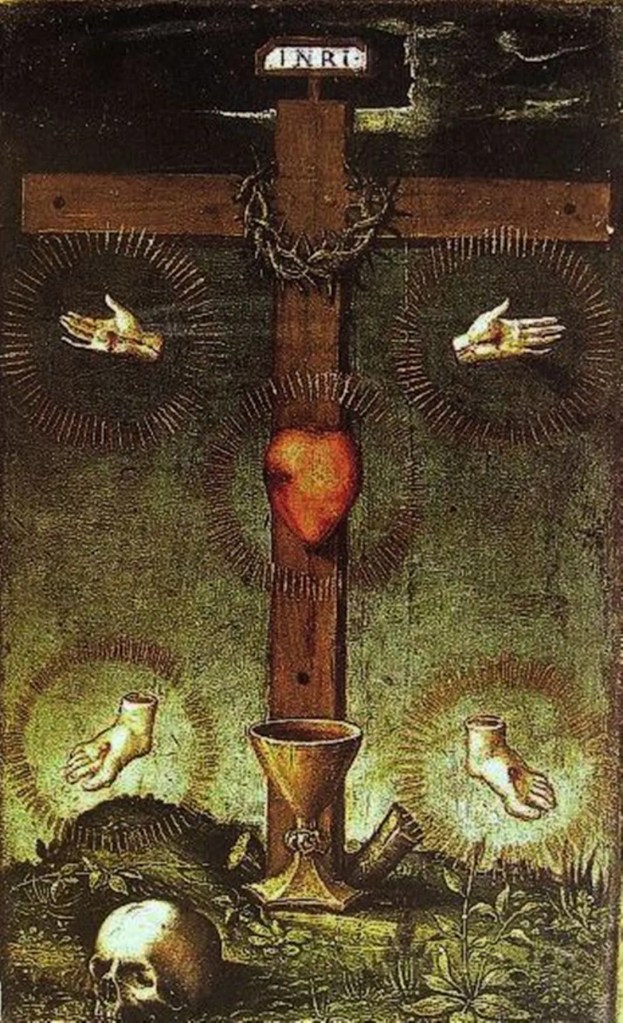
The aftermath of the crucifixion is symbolically ‘vertical’ insofar as Christ first descends into Sheol for the Harrowing of Hell and then re-ascends and resurrects on the third day. Intimately related to the symbolism of the cross and the crucifixion is the association of Christ’s ascent with the image of an ascending serpent, and this still persists today, as can be seen by the fact that both of the Biblical readings concerning the ‘ascending-serpent’ are read on the Feast of the Holy Cross on September 14th. The first reading is the Old Testament description of Moses raising a serpent in the wilderness.[4] The other one is from the Gospel of John in which Christ associates his resurrection and ascension with Moses raising the serpent.[5]

The further reading on the feast of the Holy Cross is St Paul’s description in his letter to the Philippians of Christ’s salvific humility as understood through his ‘kenosis’ or ‘self-emptying’ which thus leads to his exaltation. One interpretation of these two related stages is that they can be understood symbolically as a descent followed by an ascent. In this sense Christ’s ‘kenotic’ descent to the ‘lowest point’ – or ‘the heart of the earth’ as it is described in Matthew 12:40 – subsequently leads to his exaltation to the highest point. St Paul effectively describes this in another of his letters (to the Ephesians) through a meditation on Psalm 68.

        But unto every one of us is given grace according to the measure of the gift of Christ.

Wherefore he saith, When he ascended up on high, he led captivity captive, and gave gifts unto men.

(Now that he ascended, what is it but that he also descended first into the lower parts of the earth?

He that descended is the same also that ascended up far above all heavens, that he might fill all things

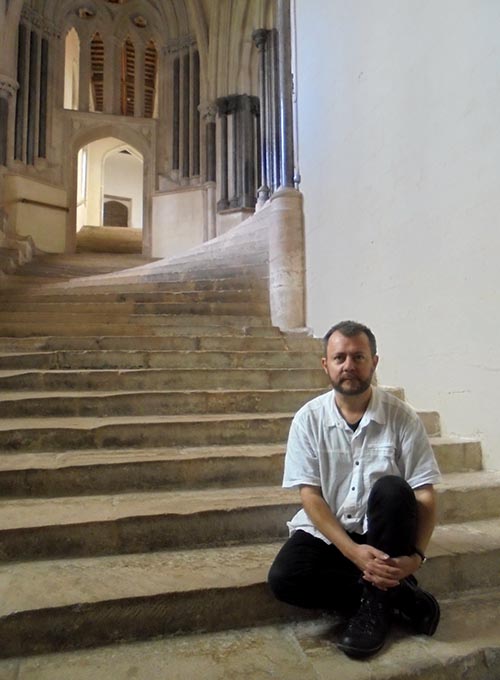
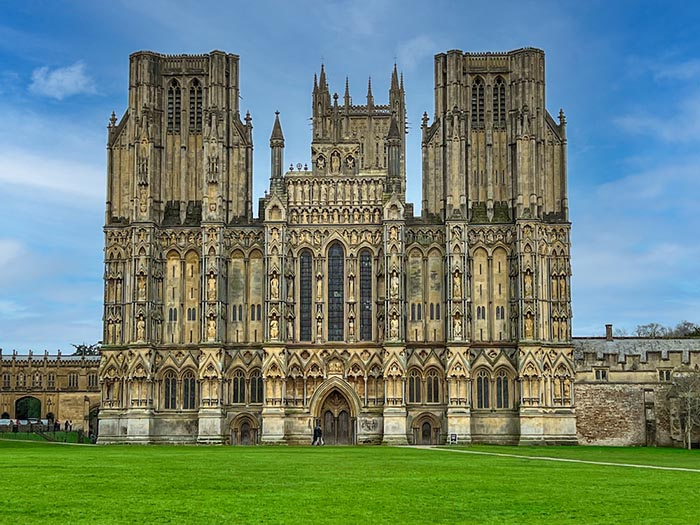
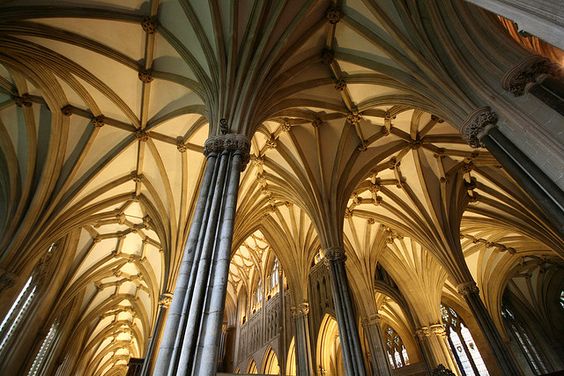
Wells Cathedral (Cathedral Church of Saint Andrew), Wells Abbey Somerset, England

– Wells Cathedral

Returning to the Dome of the Rock, and the brief period of time during the 12th century in which it was used as a Church, there is a fascinating possibility that its ground plan was symbolically incorporated into the design of the first English Gothic cathedral at Wells in Somerset. This is feasible because at the time when the cathedral was first built in 1176 both the Dome of the Rock and the Al Aqsa Mosque would have been considered to be Christian buildings in the Crusader Kingdom of Jerusalem. A key element of this religious mix – in the sense of ‘Christianised’ Islamic buildings – is that both buildings on the Temple Mount were understood symbolically, by Crusader culture, to be images of the old Jewish Temple of Solomon; the Al Aqsa Mosque was known as the ‘Temple of Solomon’ and as already mentioned, the Dome of the Rock was the ‘Temple of the Lord’. The Knights Templar were based in the Al Aqsa Mosque and indeed this is seemingly how they came to be known as the ‘Knights Templar’; the Order’s original title was ‘The Poor Fellow-Soldiers of Christ’.

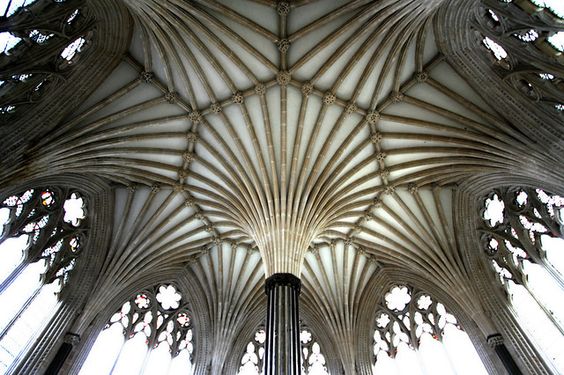
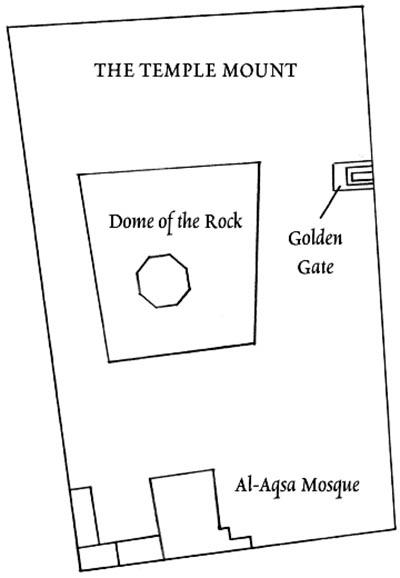
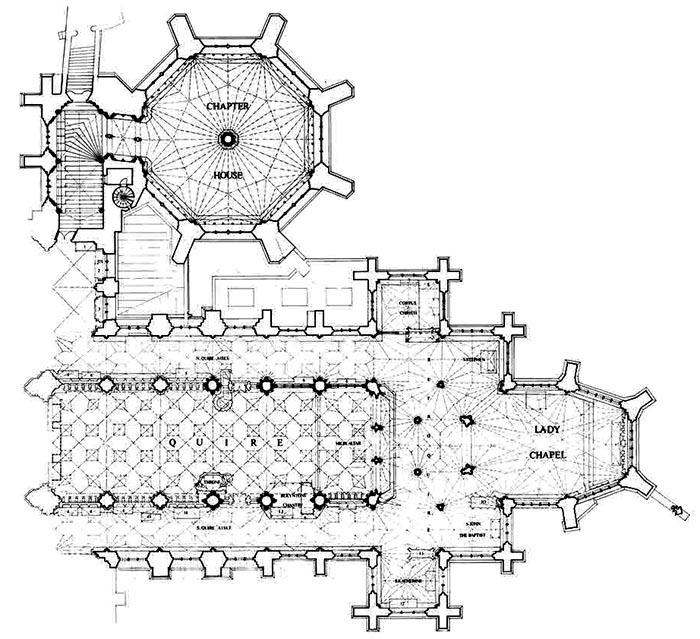
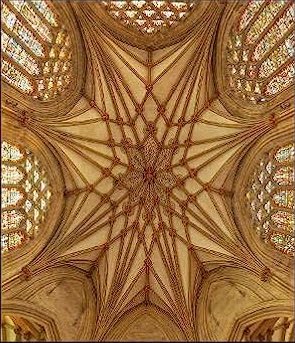
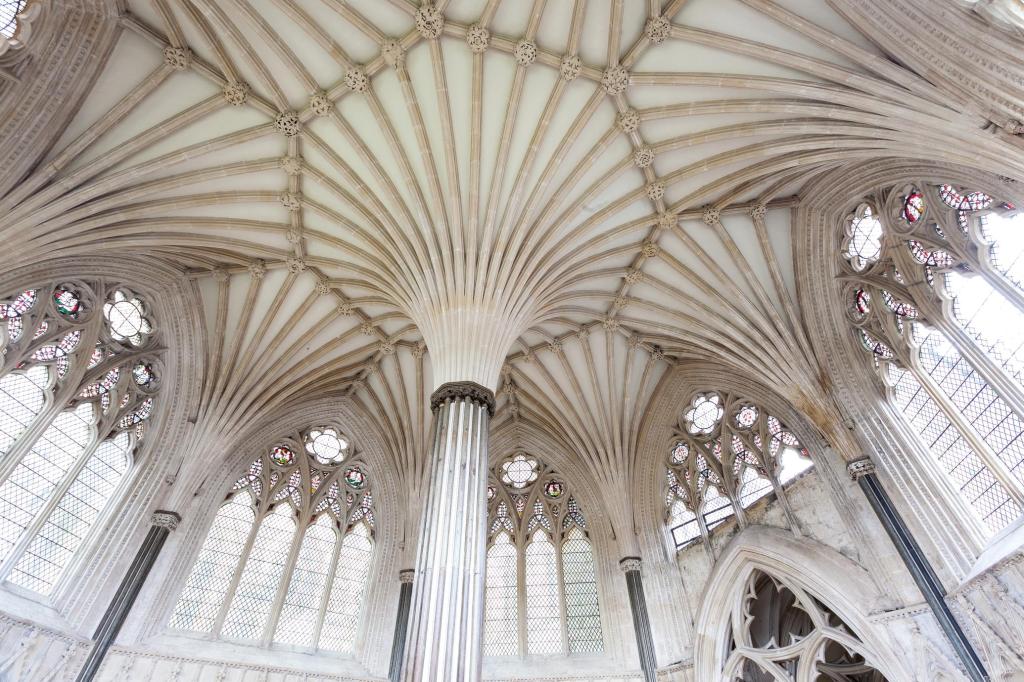
The topographical layout of the Temple Mount was the same in the 12th century as it is now, with the Dome of the Rock – which, as we have said, is an octagonal building – lying to the north of the Al Aqsa. A layout of this sort can also be recognised in the design of the chancel and chapter house area of Wells Cathedral, where there is an octagonal chapter house immediately to the north of the quire which forms the liturgical heart of the cathedral. This quire is the same shape and size as the biblical description of Solomon’s Temple, which in the Book of Kings is depicted as having a rectangular ground plan that measures 20 x 60 cubits – exactly the dimensions of the Wells’ quire.

The Ascent of the Soul as the North

Another consideration is that these two elements in the Cathedral’s design are also connected by the ancient understanding that the direction ‘north’ symbolises the soul’s ascent into heaven. This understanding can be seen in the many descriptions, within various different traditions, of a ‘polar’ mountain that is in the far north. The summit of this ‘northern mountain’ can be understood cosmologically as the celestial north pole which is the central point in the night sky around which the fixed stars circulate. In Jewish scripture it is Zion – the ‘highest point’ – described at the beginning of Psalm 48: ‘Mount Zion in the far north is beautiful and high’. This polar mountain is also described in Isaiah 14:13 as the ‘mountain on the farthest sides of the north’ and according to medieval Christian cosmic mythos it is the highest point to which Lucifer, the fallen angel, ‘egoically’ aspires towards elevating himself. But his hubris causes him to fall ‘southwards’, as it were, to the centre of the Earth or Sheol which, as mentioned earlier, is the ‘lowest point’ to which Christ must descend for his harrowing of hell.

The polar opposition of the movements of Christ – the ascending serpent – and Lucifer – the descending serpent – lies in the fact that, whereas Lucifer hubristically attempts to elevate himself to the highest point – and thus falls to the lowest point – Christ voluntarily descends to the lowest point, becoming completely empty of any egoic self-interest, which thus leads to his exaltation to the highest point. In other words…

For those who exalt themselves will be humbled, and those who humble themselves will be exalted.New Testament, Matthew 23.12.

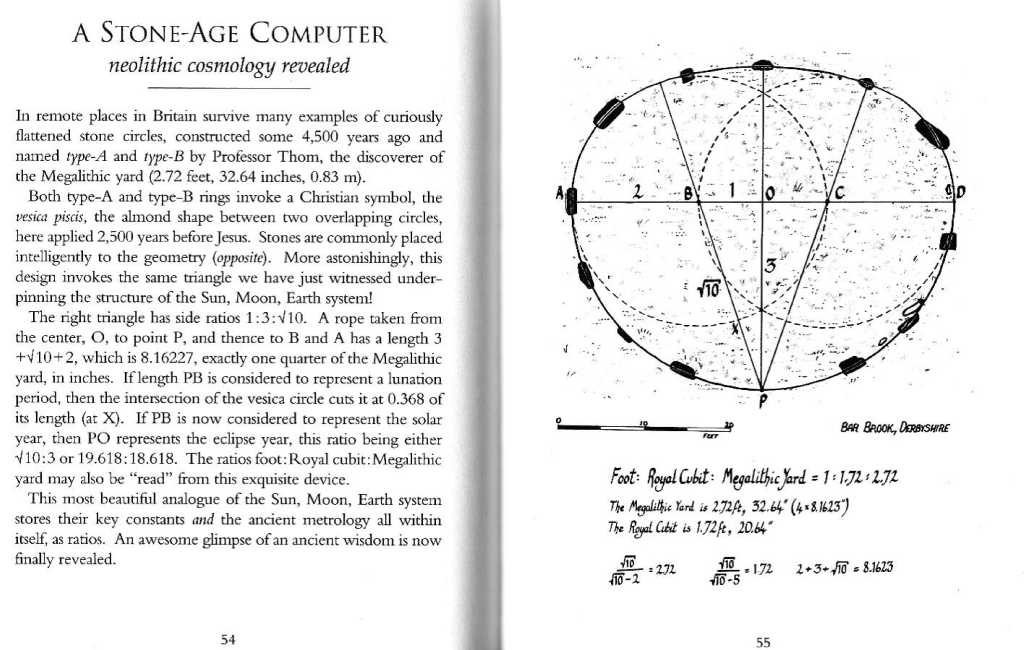
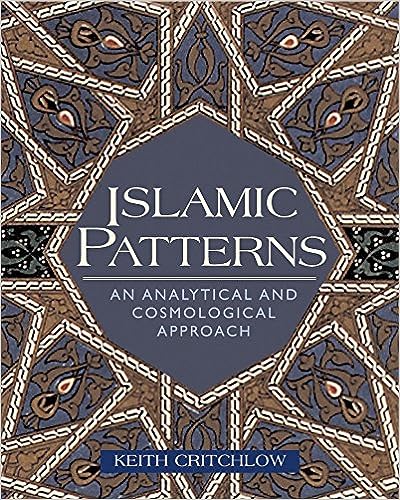
This correlation of ‘north’ with ascent is represented by a cosmological diagram –the Earth–Moon Pyramid diagram – which my analysis indicates may well have been used in the design of Wells Cathedral. An introduction to this diagram briefly takes us to the English New Age scene of the late 1960s and early 1970s. My geometry teacher, the late Professor Keith Critchlow, was an old friend of the maverick counterculture writer and artist, John Michell. Critchlow’s profound focus upon sacred geometry rubbed off on Michell, and around 1970 Michell came up with this Earth–Moon diagram that appears to have also been known and used in the ancient and medieval worlds. For example, Michell presented good circumstantial evidence, based on simple and concordant geometry, arithmetic and metrology, that the diagram underlies the designs of both the Great Pyramid in Egypt and Stonehenge in the south-west of England.

In The Cosmos in Stone, I have presented more circumstantial evidence that the diagram was also known by some of the Gothic cathedral designers. I suggest that it was used in the design of Wells, which is of course not far from Stonehenge, and also appears to have been used in the building of two other English Gothic cathedrals, those of York and Southwell.

Unfortunately, the antagonistic relationship between Michell and academic archaeologists appears to have led to this diagram not coming to much prominence in the wider academic world, even though it is highly concordant in its mathematical relationships – albeit only if the so-called ‘English mile’ is the unit of measure that is used to make the calculations. This is a large subject which I cannot go into here but it is well-developed in my book.

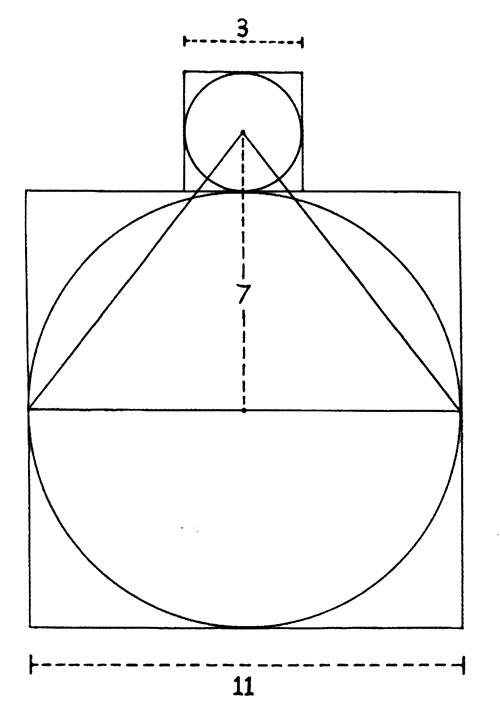
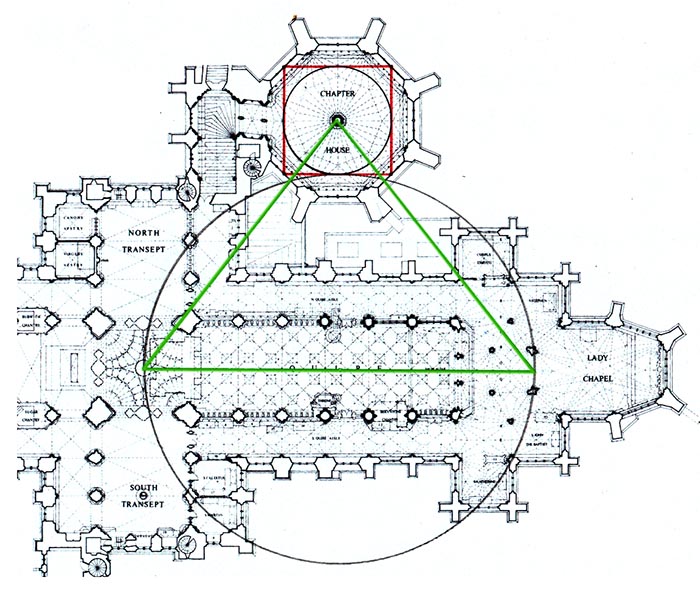
The diagram involves the relationship of size between the Earth and the Moon, which then generates a particular type of triangle that is also found in the cross-section of the Great Pyramid. The way in which the diagram appears to have been used in the design of Wells Cathedral is such that the quire – the very heart of the cathedral – is located within the earth circle and the octagonal chapter house is at the centre of the moon circle.

Thus there is a suggestion that the way in which the quire, at the heart of the cathedral, relates to the octagonal chapter house on its north side symbolises an ascent northward from the central place on earth up to the moon and thus to the heavens. A particularly happy synchronicity in relation to the diagram is that the pyramid triangle has a height of seven units, and so therefore the symbolic ascent of the triangle, from its baseline up to its apex, consists of seven steps.

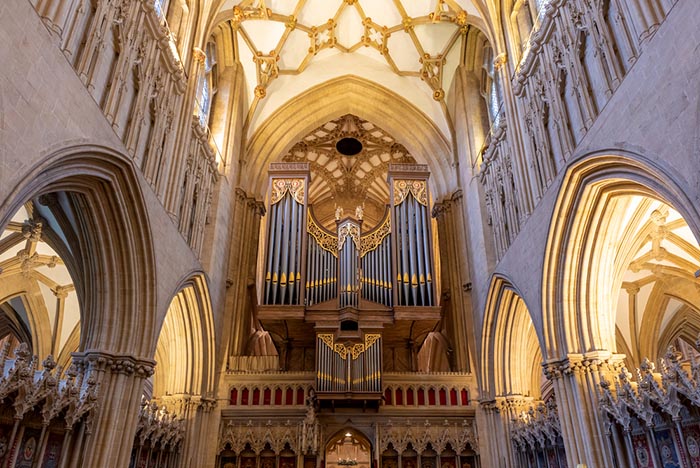
Wells.Somerset.United Kingdom.December 30th 2021.View of the quire inside of Wells cathedral in Somerset

Being in the ‘Here and Now’

The key point to take away from all of this is that the physical experience within our immediate spatial surroundings, as well as in relation to the wider cosmos, plays an essential part in the soul’s inner life. To orientate oneself and one’s architectural designs according to the the directions of north, south, east and west is to place the soul at the ‘centre of the world’ in the ‘here and now’. To have one’s head up in the starry heaven and feet down on the sacred earth is to embody the spiritual hierarchy or ladder within which each rung plays its own particular and essential part in the soul’s ascent. And to design one’s architecture according to the eternal and unchanging truths of geometry is to use boundaries as a way of contemplating the boundless.

Tom’s new book, The Cosmos in Stone – Sacred Geometry of a Master Mason (The Squeeze Press, 2023) goes into all of the subjects that have been mentioned in this article. The book is printed with full colour and contains over 400 images and diagrams.

Note: Look also How Islamic Architecture Shaped Europe

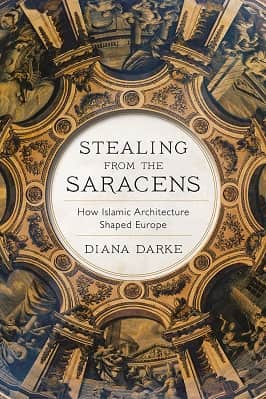
Read here Stealing from the Saracens : How Islamic Architecture shaped Europe

Tom Bree – Friends of Sophia Fifth Annual Virtual Conference ‘Wisdom in Stone’

– Greenness and the Golden Ratio by Tom Bree

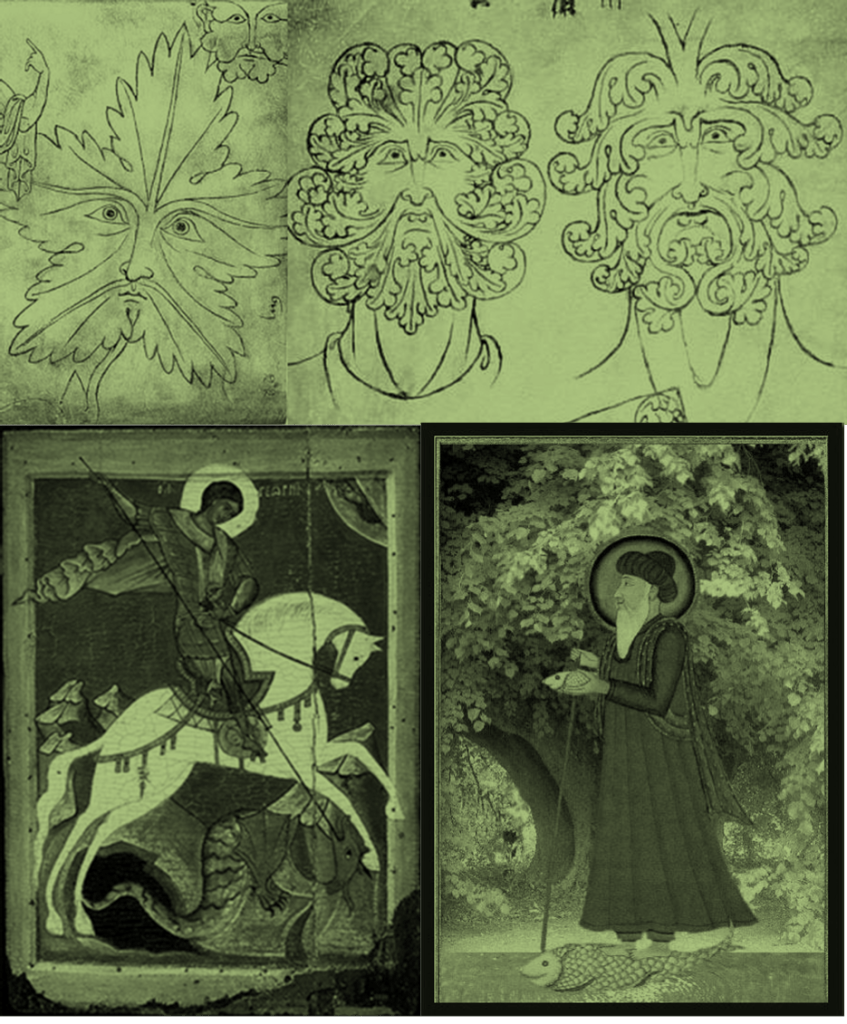
In this talk, the first of a series and part of the Launching Day, Tom will introduce a variety of themes including geometry and greenness and the symbolism of the Green Knight in cosmology and spirituality across the different religions, which will all be expanded upon in subsequent talks.

The Geometry of Nature and Cosmos – Divine Mind Made Manifest – Tom Bree

  • Tom Bree – Dante’s Journey In Gothic Cathedral Design

The eastward journey through a cathedral forms a symbolic ascent climbing towards the place of the rising sun. However for the soul to return to its heavenly origin a certain lightness and buoyancy is required as attested to by the image of St Michael in which he weighs human souls on judgement day.

Within Dante’s poem, Commedia, such a preparation for ascent requires him to first descend to the Inferno so as to face the very lowest reaches of the soul’s potential. Only then can he slowly begin his rise back upwards, first to the surface of the earth followed then by an ascent to Eden which lies at the summit of the Mountain of Purgatory. Finally he ascends through the heavens to the Empyrean where he becomes reunited with the soul’s divine origin.

Dante’s journey is made in emulation of Christ because he descends to the inferno from Jerusalem on the afternoon of Good Friday and then re-ascends to the surface of the earth again on the morning of Easter Sunday. In this way he personally re-encounters the Harrowing of Hell which is Christ’s necessary descent into the underworld prior to His Resurrection on Easter Sunday and eventual ascent into heaven 40 days thereafter.

This illustrated talk will demonstrate how the three stages that characterise Dante’s journey are also present in the design of the ground plan of the first English Gothic cathedral. In this sense the beginning of the journey through Wells Cathedral is actually one of descent and only then can there subsequently be an eastward ascent towards the rising of the Bright Morning Star.

Cosmic Pyramid Geometry in Gothic Cathedral Design – Fintry Trust Talk 1 (of 3)

Tom Bree – Plotinus and the Planets

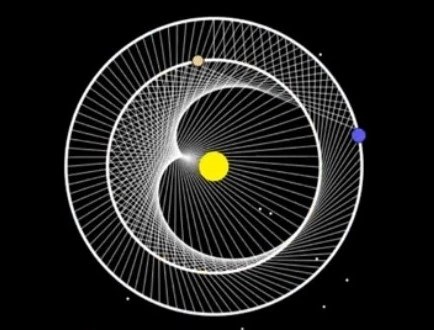
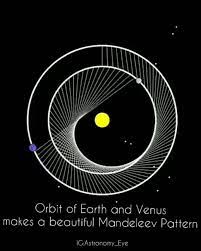
The Greek word Kosmos means ‘order’. But it also means ‘adornment’ in the sense of an externally visible apparel. In a similar way the eternally ordered truths of mathematical theory become visibly apparent through manifesting in geometric form.It can accordingly be understood that the numerical thoughts, forever contemplated in the Divine Mind, become visible through the ordered numerical movements of the planets and the stars.The idea that the periodic circular movements of the heavens embody mathematical patterns is not a new one. It pervades the thought of the ancient and medieval worlds. But even in more recent years this idea has been re-emphasised yet again from new angles within the research of people such as John Michell, John Martineau and Hartmut Warm. This talk will look at the geometric relationships that exist between the Sun and the first three planets – Mercury, Venus and Earth – and how these relationships naturally reflect Plotinus’ description of the three Hypostases plus ensouled nature along with their emanation from the One.

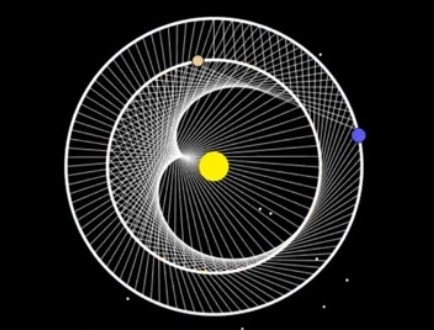
The Pentagram Dance of Earth and Venus

Look also The Vision of Heavenly Harmony

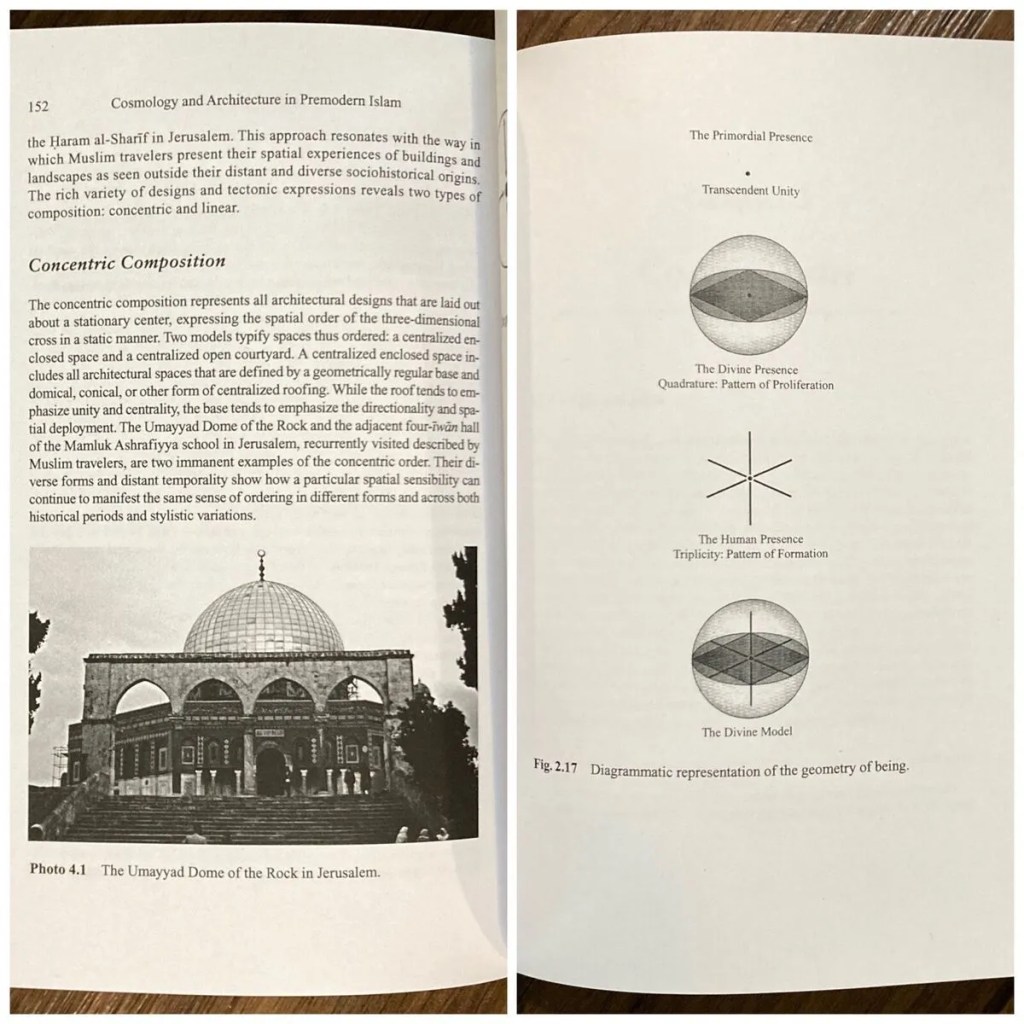
  • Cosmology and Architecture in Premodern Islam: An Architectural Reading of Mystical Ideas Read book here

This fascinating interdisciplinary study reveals connections between architecture, cosmology, and mysticism. Samer Akkach demonstrates how space ordering in premodern Islamic architecture reflects the transcendental and the sublime. The book features many new translations, a number from unpublished sources, and several illustrations.

Referencing a wide range of mystical texts, and with a special focus on the works of the great Sufi master Ibn Arabi, Akkach introduces a notion of spatial sensibility that is shaped by religious conceptions of time and space. Religious beliefs about the cosmos, geography, the human body, and constructed forms are all underpinned by a consistent spatial sensibility anchored in medieval geocentrism. Within this geometrically defined and ordered universe, nothing stands in isolation or ambiguity; everything is interrelated and carefully positioned in an intricate hierarchy. Through detailed mapping of this intricate order, the book shows the significance of this mode of seeing the world for those who lived in the premodern Islamic era and how cosmological ideas became manifest in the buildings and spaces of their everyday lives. This is a highly original work that provides important insights on Islamic aesthetics and culture, on the history of architecture, and on the relationship of art and religion, creativity and spirituality.

In his famous Ihya Ulum al-Din (Reviving the Sciences of Religion), al-Ghazali (d. 1111), the celebrated Muslim theologian and mystic, cites an intriguing analogy. He says: “As an architect draws (yusawwir) the details of a house in whiteness and then brings it out into existence according to the drawn exemplar (nuskha), so likewise the creator (f atir) of heaven and earth wrote the master copy of the world from beginning to end in the Preserved Tablet (al-lawh al-mahf uz) and then brought it out into existence according to the written exemplar.”In many ways, this book is a commentary on, and an exposition of, this statement, an attempt to explore the philosophical and theological contexts that give sense to such an analogy in premodern Islam. In broad terms, the book is concerned with the question of art and religion, creativity and spirituality, with how religious thought and ideas can provide a context for understanding the meanings of human design and acts of making. In specific terms, it is concerned with the cosmological and cosmogonic ideas found in the writings of certain influential Muslim mystics and with their relevance to architecture and spatial organization.

Read more here :Cosmology in Sufism

The Thread of life: Wisdom for our Times

Thread-Spirit: The Symbolism of Knotting and the Fiber Arts by Mark Siegeltuch

Written after years of studying both the textile arts and traditional symbolism, The Thread-Spirit is a compendium of the wisdom of both essential human exercises. Inasmuch as we express who we are through what we create and use, through our technologies, we are the human beings described in this book.

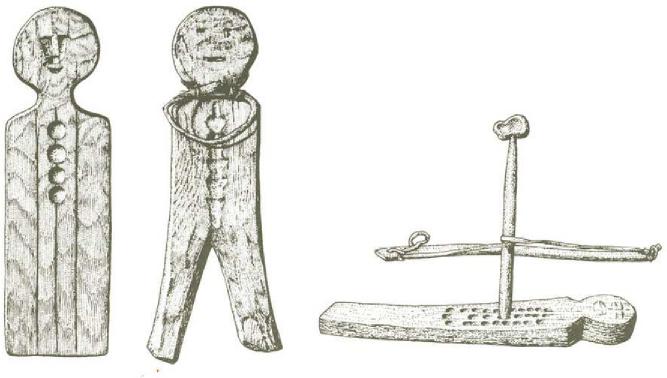
The technology of traditional societies is based on the application of metaphysical principles to practical ends. This is particularly clear in the case of the fiber arts— knotting, weaving, spinning, basketry, and the like—where a worldwide symbolism exists which appears to have its origins in Paleolithic times.

There is an underlying historical continuity to this symbolism that survives, but has been forced underground with the rise of rationalism. These traditions survived into the 20th century in more remote parts of the world, but they were generally no longer understood. The Thread-Spirit attempts to examine the traditions, as they existed and continue to exist, and reunite them with their ancient meanings.

The technology of traditional societies is based on the application of metaphysical principles to practical ends. This is particularly clear in the case of the fiber arts— knotting, weaving, spinning, basketry, and the like—where a worldwide symbolism exists which appears to have its origins in Paleolithic times. Dr. A. K. Coomaraswamy referred to this symbolic complex as the sutratman (thread-spirit) doctrine and it is well documented by the literary, artistic and archeological remains.

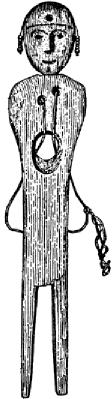
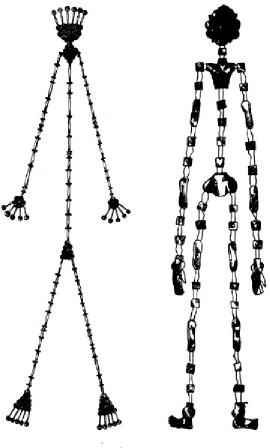
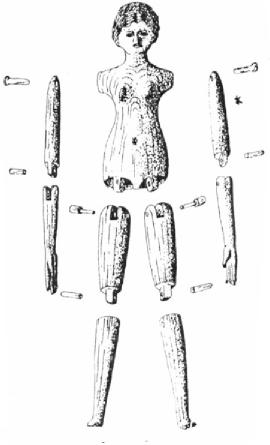
Using a consistent set of symbols, our ancient ancestors sought to explain the relations governing the social order, the workings of the cosmos, and the mysteries surrounding birth and rebirth. The eye of the needle, for example, was understood as the entrance to heaven while the thread was the Spirit that sought to return to its Source. Creation is a kind of sewing in this version of the story as God wields his solar, pneumatic needle. Man is conceived as a jointed creature similar to a marionette or puppet but held together by an invisible thread-spirit. When this thread is cut, a man dies, comes “unstrung,” and his bones separate at the joints.

It was the American art historian, Carl Schuster who first discovered the significance of body joints in this symbolism and he believed that it was based on an analogy with the plant world where regeneration is possible from a shoot or sprout. Body joints play a role in such diverse matters as labyrinths, continuous-line drawings, cat’s cradles, dismemberment and cannibalism, and various rituals meant to ensure rebirth and the continuity of the social order.

Joints were also conceived as the knots of the body. It was originally believed that the spirit of a specific ancestor inhabited each body joint. The body as a whole served as a map of the social order, and by extension, the cosmic order. Joints were later used for counting, an extension of their original role in identifying social relations. Joints were replaced or supplemented by bones or knots and by Neolithic times we find a widespread distribution of knot technologies for counting and record keeping. The Inca quipu is the best-known example. These technologies preceded and supported the growth of numbers. Knotted cords were also used for measurement and for teaching music.

Cosmologically, it was believed that the earth turned around a pole (axis mundi) and this provided a model that was applied to all devices or natural phenomena that rotated (spindle whorls, drills, mills, wheels, whirlpools, whirlwinds, etc.). Because the seasons were brought on by this rotation, these devices became models of birth and death, time and Eternity.

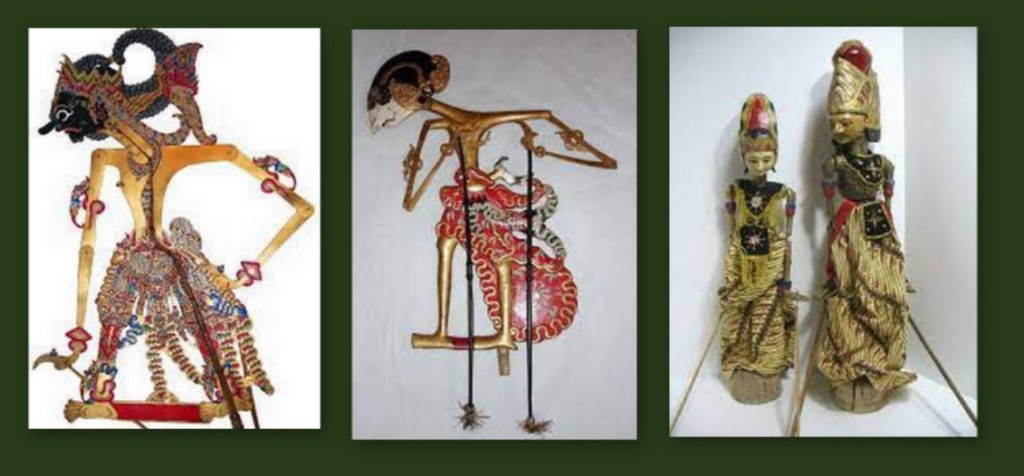
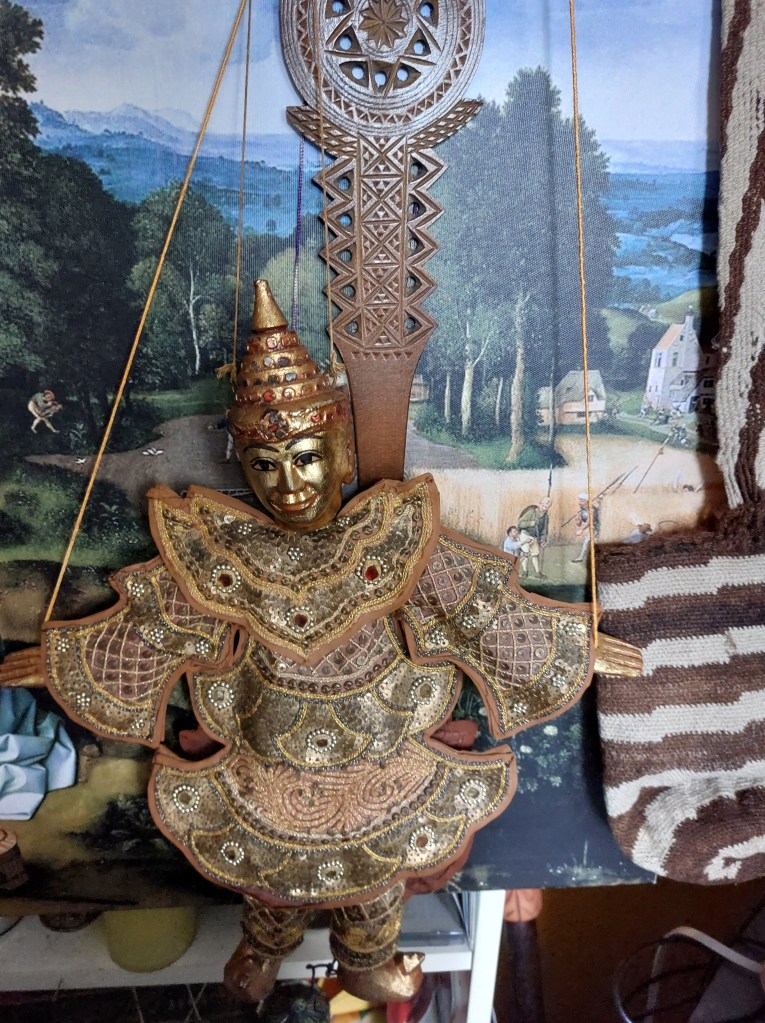
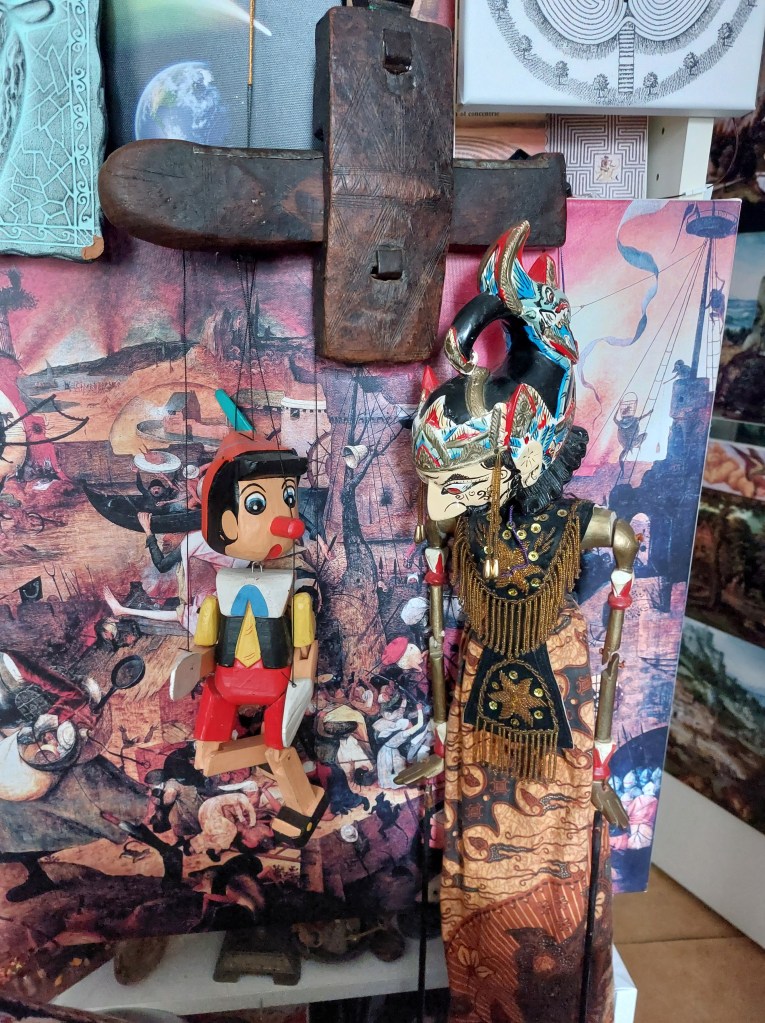
traditional wooden puppets in bali indonesia

Interlacing and knotting were meant to signify marriage bonds within the group and an especially elaborate symbolism was worked out to specify these relations. It was Carl Schuster’s belief that this symbolism was derived from the use of tailored fur garments, man’s first clothing.

There is much more to this story but what is clear is that there is an underlying historical continuity to this symbolism that survived from the earliest times until it was weakened by writing and finally forced underground with the rise of rationalism, at least in the West. These traditions survived longer in the East and into the 20th century in more remote parts of the world, but they were generally no longer understood.

  • The Thread-Spirit Doctrine : An Ancient Metaphor in Religion and Metaphysics with
    Prehistoric Roots
    by Mark Siegeltuch
  • The symbolism connected with the fiber arts is remarkably consistent throughout the world and
    contains a number of common themes of which the most important is the “Thread-Spirit” doctrine. The great expositor and interpreter of these matters was the art historian, folklorist, and metaphysician, Ananda K. Coomaraswamy (1877-1947) who first identified the doctrine and who applied the Sanskrit term sutratman to the entire tradition.
    Despite its name, which is derived from the Sanskrit words sutra (thread) and Atman (Spirit), the Thread-Spirit doctrine is found in many cultures—Hindu, Islamic, European, Chinese, Amer- Indian—suggesting great antiquity. The doctrine, once understood, gives meaning to the varied symbolism derived from the related arts of knotting, sewing, spinning and weaving. The doctrine is expressed both in language and art and appears in various forms in the folktales of the world as well as in the sacred writings of the world’s major religions.
  • This paper will explain the doctrine and some related symbols and attempt to demonstrate its
    antiquity and distribution. It’s Paleolithic origins will be the subject of a separate paper.
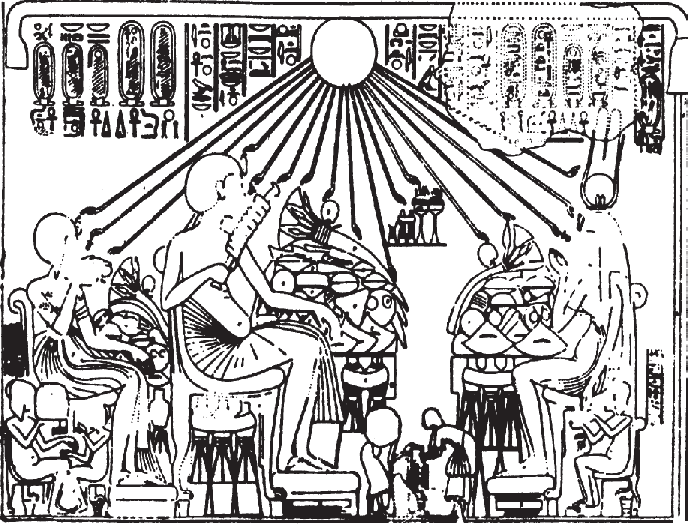
    The Solar Breath In the Rg Veda (1.115.1) we read: “The Sun is the Spirit (Atman) of all that is in motion or at rest” and that the Sun connects all things to Himself by means of a thread of spiritual light. It is important to understand that these are symbolic, not scientific statements. The Sun refers to God, and not the sun we see with our eyes. In all the contexts in which “Sun” has been capitalized the reference is, of course, to the “inward Sun” as distinguished from the “outward sun, which receives its power and lustre from the inward” The traditional distinction of intelligible from sensible, invisible from visible “suns” is essential to any adequate understanding of “solar mythologies” and “solar cults.” This “solar breath” is not to be identified with our physical breath that depends upon it. The invisible world of the Spirit can only be explained by analogies rooted in the world of the senses. Plotinus expresses the same vision in the Enneads (vi.4.3): But are we to think of this Authentic Being as, itself, present, or does it remain detached, omnipresent in the sense only that powers from it enter everywhere? Under the theory of presence of powers, souls are described as rays; the source remains self-locked and these are flung forth to impinge upon particular living things. God is connected to each of his own by a ray or thread of pneumatic light upon which life depends. This ray is bestowed at birth as a gift and revoked at death, while abiding eternally in divinis. All things under the Sun are in the power of death. In the Upanishads we find that the “Sun’s light has many rays (sons)” and that “He fills the world by a division of his essence.” More succinctly: “God is one in himself, many in his children” and “He divides himself while remaining undivided.” We alone experience the division. The solar ray is our guide to salvation, the road back to the Source. The generative power of the Sun is central to many traditions from the Pharaoh who “came forth from the Rays” to the French Sun King. Here the life-giving blessing of the Sun is extended like a hand toward Pharaoh Akhenaten and his family .
  • Puppets of God
    In an essay titled, “‘Spiritual Paternity’ and the ‘Puppet Complex,’” Coomaraswamy explains the
    metaphysical ideas behind the symbolism of puppetry.
    Puppets seem to move of themselves, but are really activated and controlled from within by the thread from which they are superseded from above, and only move intelligently in obedience to this leash: and it is in this automatism, or appearance of free will and self-motion, that the puppet most of all resembles man.
    We are the puppets or toys of God, an image taken up by Plato in Laws where the Athenian explains true education.
    Let us suppose that each of us living creatures is an ingenious puppet of the gods, whether contrived by way of a toy of theirs or for some serious purpose—for as to what we know nothing; but this we do know, that these inward affections of ours, like sinews or cords, drag us along and, being opposed to each other, pull one against the other to opposite actions; and herein lies the dividing line between goodness and badness. For, as our argument declares, there is one of these pulling forces which every man should always follow and nohow leave hold of, counteracting thereby the pull of the other sinews: it is the leading-string, golden and holy of “calculation,” entitled the [common law of the individual]; and whereas the other cords are hard and steely and of every possible shape and semblance, this one is flexible and
    uniform, since it is of gold. With that most excellent leading-string of the law we must needs co-operate always; for since calculation is excellent, but gentle rather than forceful, its leading-string needs helpers to ensure that the golden kind within us may vanquish the other kinds.
    If we are the puppets of God then we ought to act accordingly, following His direction and not our own urgings. We should avoid the disorder created by our desires that pull us where they will and instead, hang onto this “golden cord.”
    Our powers of perception, expression, thought and action must be guided by Reason; not what we mean by reason—which Plato calls opinion and assigns a merely pragmatic value—but rather the Divinity within us. The Stoic Marcus Aurelius was of the same mind.
    Become conscious at last that thou hast in thyself something better and more godlike than that which causes the bodily passions and turns thee into a mere marionette. What is my mind now occupied with? Fear? Suspicion? Concupiscence? Some other thing?
    It is God who controls the central cord that guides the others.
    Bear in mind that what pulls the strings is the Hidden thing within us: that makes our speech, that our life, that, one may say, makes the man Our goal is to identify with the true source of all perception and action and so become a witness to our own fate. This is accomplished through a kind of automatism, not of the mechanical kind, but through grace—both spiritual and physical — as in the case of the Balinese . It is by means of this automatism that an intelligent and spontaneous life may be lived; an active life in the moment, in preference to a passive subjection to one’s emotions. …..

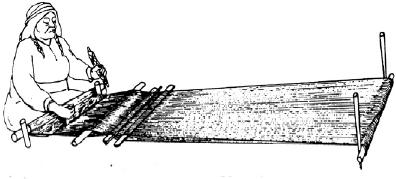
Coomaraswamy comments on the symbolism associated with primitive looms: In weaving, the warp threads are the “rays” of the Intelligible Sun (in many primitive looms they proceed from a single point), and the woof is the Primary Matter of the cosmic “tissue .”

The tree or pole to which the warp threads are attached is conceived as a Sun Pillar, Shaft of Light, World Tree, or Sacrificial Post, and serves as the axis mundi through which the ethereal countercurrents flow from Heaven to earth and back. It is only appropriate that these currents or rays—the source of all being— are physically attached to the weaver, whose work becomes an act of creation in the fullest sense.
Vertical and horizontal looms vary in design but their construction is equally symbolic. Horizontal looms are often pegged into the ground while vertical ones are sometimes hung from trees. Both kinds may employ one or more beams to provide the necessary tension for the woof threads. It is no coincidence that the word “beam” refers both to a shaft of light and to a piece of wood, with the attendant notion that the fire is immanent in the wood.

René Guénon investigated the manifold but consistent symbolism of weaving in the Hindu, Islamic, Buddhist and Taoist traditions in an article entitled “The Symbolism of Weaving.” He noted the close relationship between sacred books (texts) and cloth (textiles). The Indian sacred books are composed of sutras (threads) and the same may be said for the Koran where the Arabic word sûrat refers to the chapters. A book is formed of threads in the same way a cloth is. These ideas derive from a more ancient tradition in which knotted cords were used for mnemonic purposes.
Continuing the analogy, the Chinese associate the warp threads (king) with a fundamental text and the weft (wei) with the commentaries on it. In Hindu terminology the shruti or fruit of direct
inspiration is associated with the warp and the smriti, the product of reflection and commentary on the text, is associated with the weft. More generally, the warp threads represent the divine,
immutable element and the weft threads the human and contingent. It is the coming and going of the shuttle that makes possible the application of eternal principles to given conditions.
[The symbolism of weaving] is also used to represent the world, or more precisely, the aggregate of all the worlds, that is, the indefinite multitude of the states or degrees that constitute universal Existence.

What begins as an ideal pattern unextended in time and space, becomes fabric by the actions of the weaver, who creates a reflection of the divine prototype. Weaving, like all the traditional arts, has both a spiritual and material component and represents the re-creation of things as they were in the beginning. The intersection of a warp thread with a woof thread forms a cross, representing the juncture of the Universal Spirit—which links all possible states of being—with a particular state of existence. Each human existence results from the intersection of these two threads.
The warp thread also represents the active or masculine principle (Purusha in the Hindu tradition) while the weft represents the passive or feminine (Prakriti). Or astronomically, the warp threads may be conceived as solar (direct) light and the weft lunar (reflected) light. In either case, what is stressed is creation from complementary or contrary forces. One interesting application of this symbolism is found in the field of number theory, formulated in ancien times and bequeathed to the Middle Ages through the quadrivium.
By definition the square is four equal straight lines joined at right angles. But a more important definition is that the square is the fact that any number [sic], when multiplied by itself, becomes a square. Multiplication is symbolized by a cross, and this graphic symbol itself is an accurate definition of multiplication. When we cross a vertical with a horizontal giving these line-movements equal units of length, say 4 for example, we say that this crossing generates a square surface: a tangible, measurable entity coming into existence as a result of crossing. The principle can be transferred symbolically to the crossing of any contraries such as the crossing of the male and female which gives birth to the individual being, or the crossing of a warp and weft which gives birth to a cloth surface, or the crossing of darkness and light which gives birth to tangible, visible form, or the crossing of matter and spirit which gives birth to life itself. So the crossing is an action-principle which the square perfectly represents.

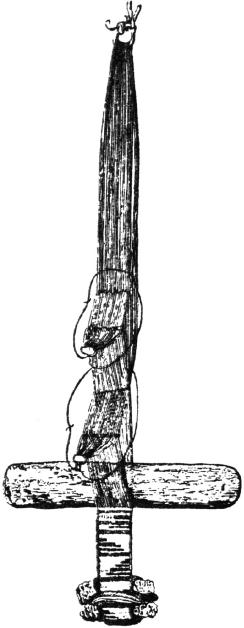
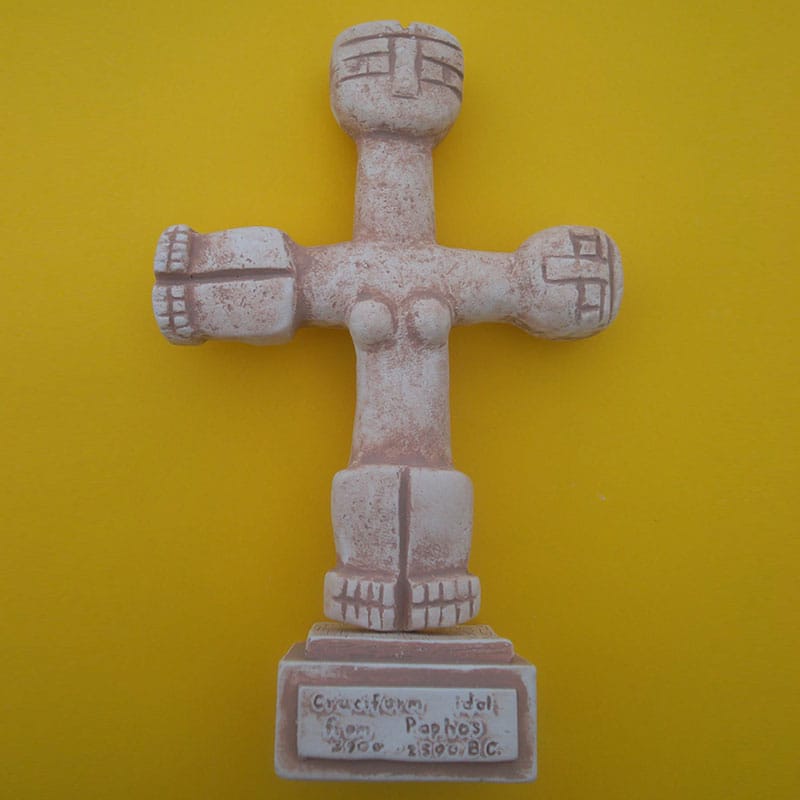
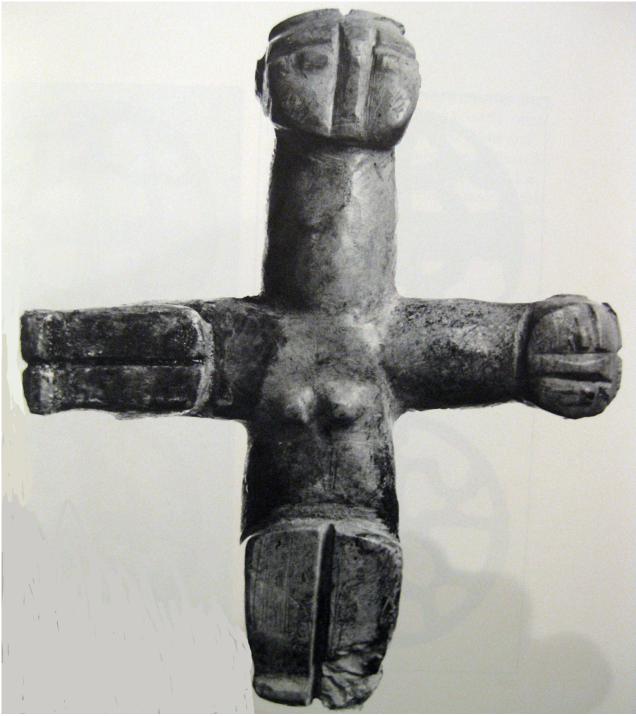
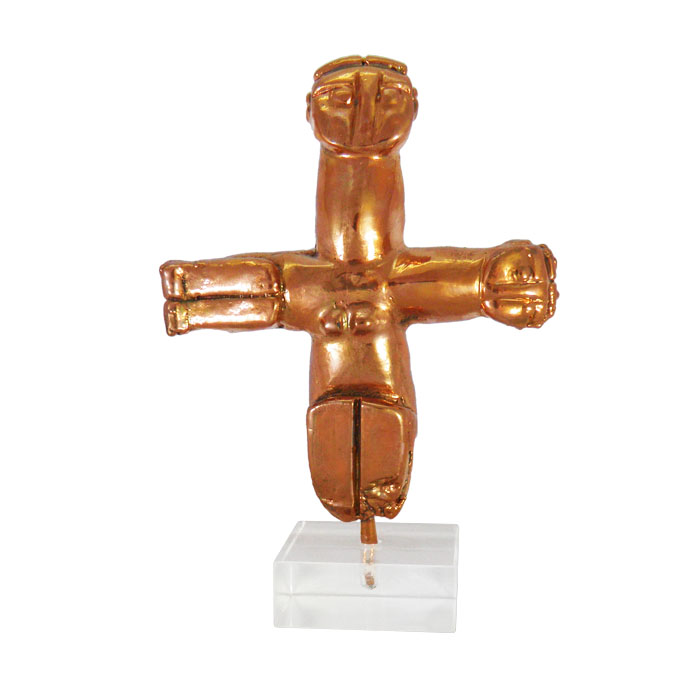
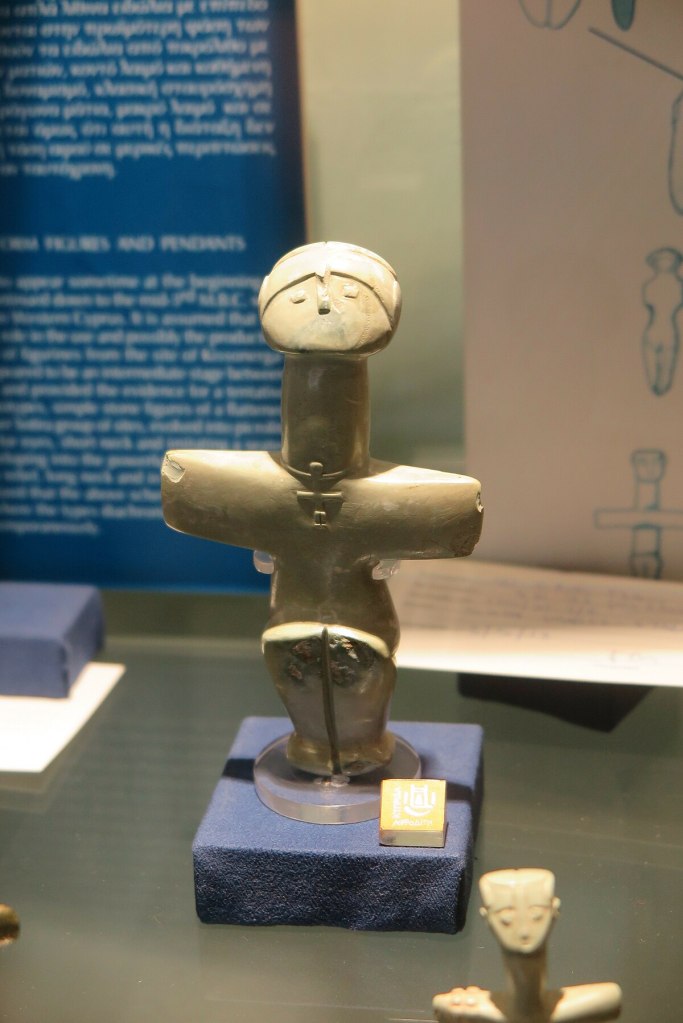
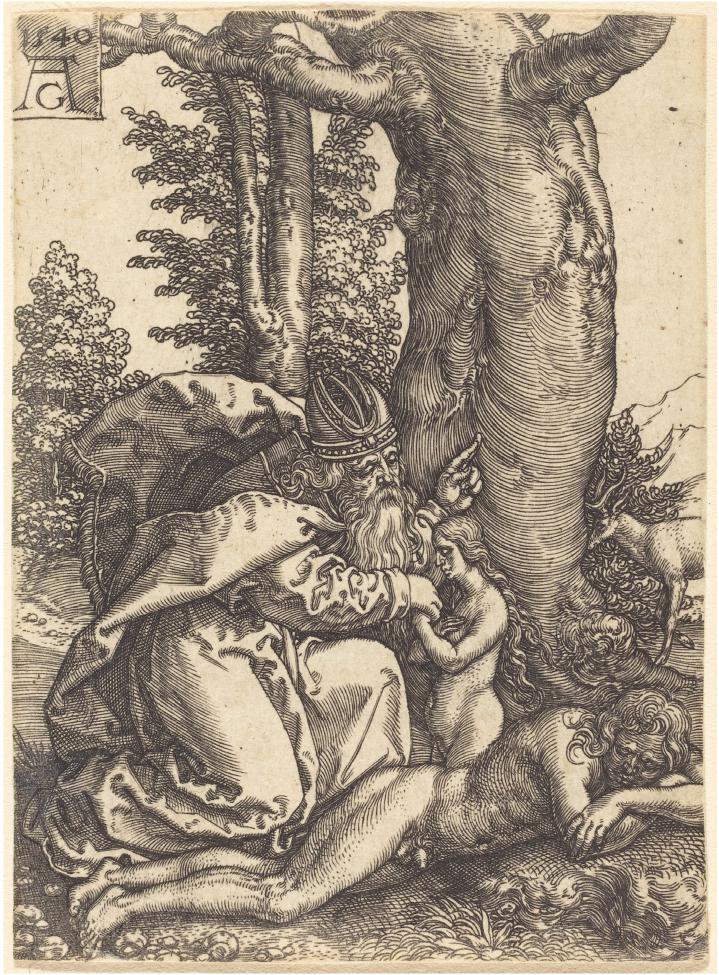
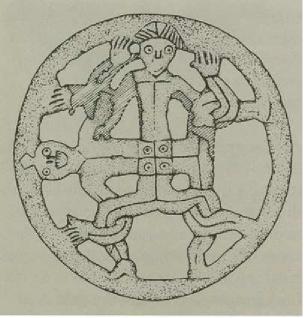
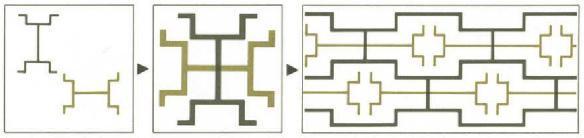
Carl Schuster was interested in crossed figures and collected examples from many cultures and time periods . He believed such figures represented the first Man and Woman of the
tribe or group—like Adam and Eve—and their crossing signified the act of creation .

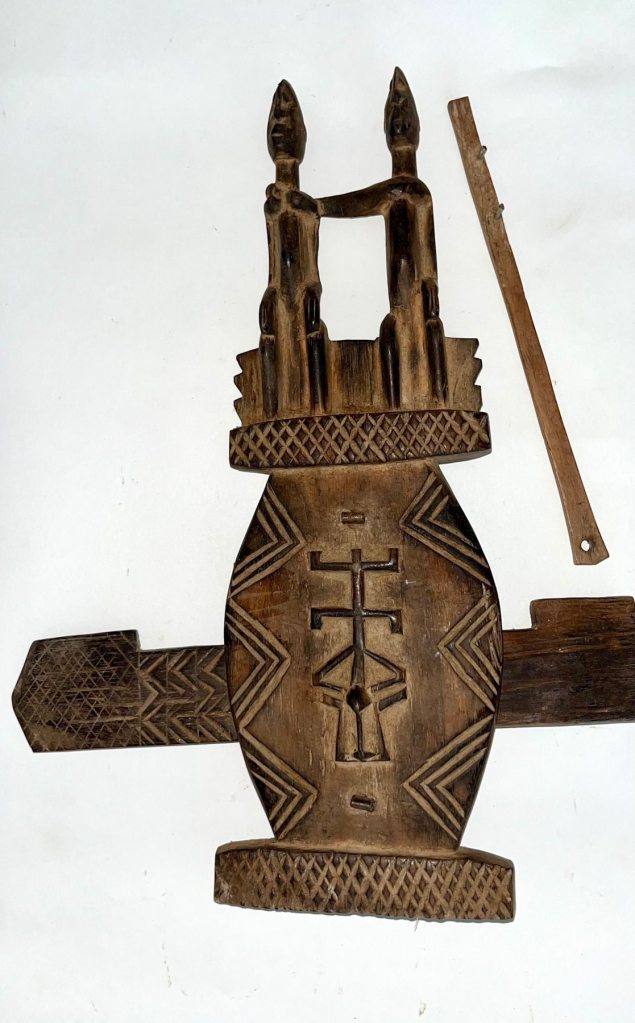
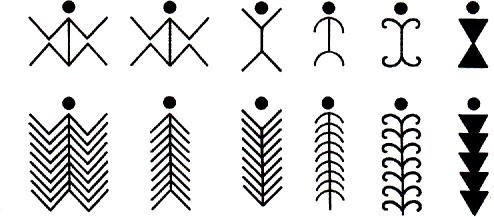
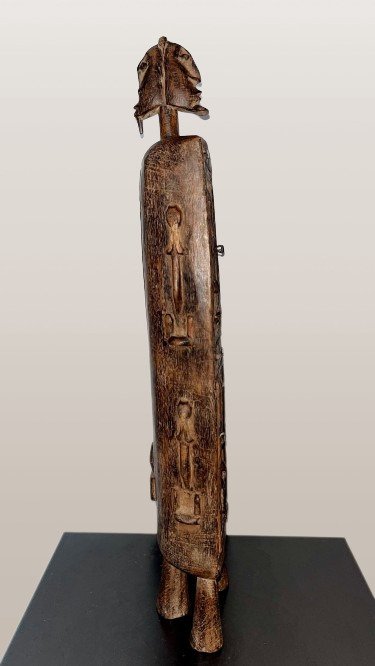
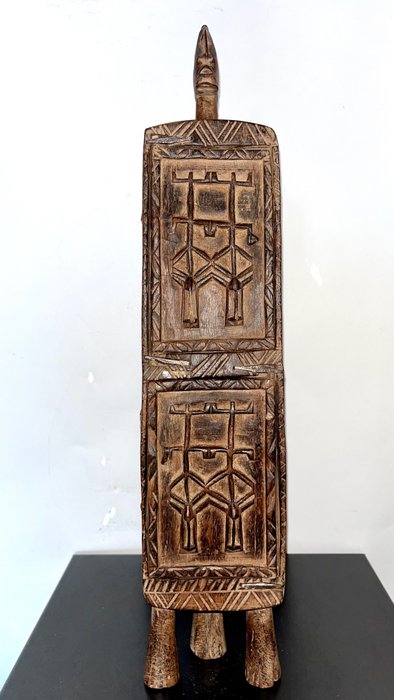
The same symbols ares used by the Dogon here few examples:

The point of crossing was the center or navel of the world where creation began. In later periods, a square or checkerboard was placed at this point and used for divination or gambling .


Crossed male and female figures would appear to be the root of the idea that all creation comes from contraries. It is at heart, a social idea, describing the generation of society and the cosmos from a First Man and a First Woman. Time does not permit an expansion of this important idea which is addressed in a separate paper, “Crossed Figures.”


If the intersection of each warp and weft thread represents a human existence then we need only recall the Njals Saga to understand the significance of loom weights, used to provide tension for warp threads in some vertical looms. ….

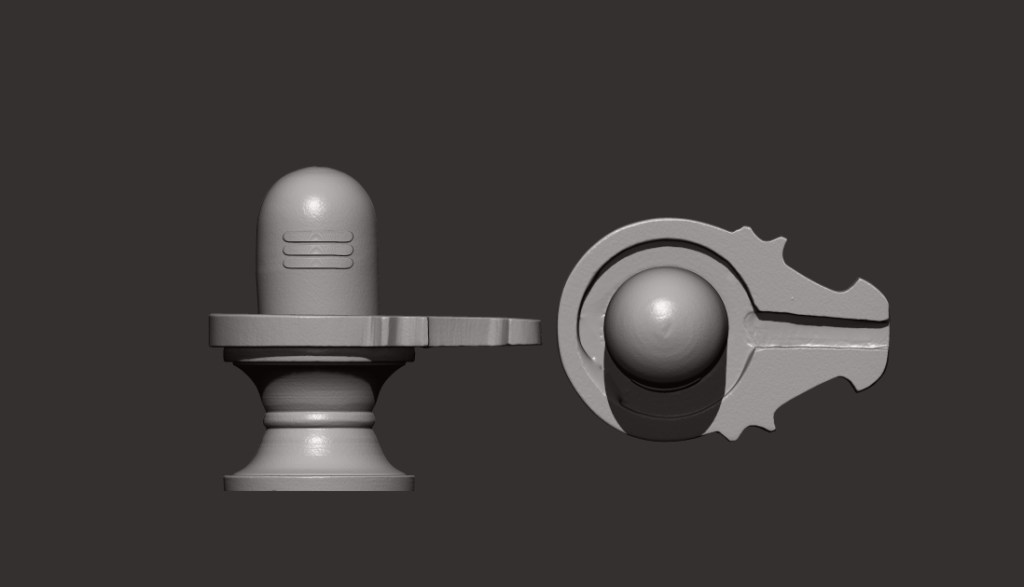
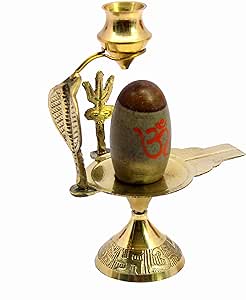
The lingam of the Shaivism tradition is a short cylindrical pillar-like symbol of Shiva, made of stone, metal, gem, wood, clay or precious stones.[ According to Encyclopædia Britannica, the lingam is a votary aniconic object found in the sanctum of Shiva temples and private shrines that symbolizes Shiva and is “revered as an emblem of generative power”. It often is found within a lipped, disked structure that is an emblem of goddess Shakti and this is called the yoni. Together they symbolize the union of the feminine and the masculine principles, and “the totality of all existence”, states Encyclopædia Britannica.[

According to Alex Wayman, given the Shaiva philosophical texts and spiritual interpretations, various works on Shaivism by some Indian authors “deny that the linga is a phallus”.[] To the Shaivites, a linga is neither a phallus nor do they practice the worship of erotic penis-vulva, rather the linga-yoni is a symbol of cosmic mysteries, the creative powers and the metaphor for the spiritual truths of their faith. For example, according to Swami Sivananda, the corelation of the linga and phallus is wrong; the Lingam is only the external symbol of Lord Shiva’s formless being. He further states that it is the light or power of consciousness, manifesting from Sadashiva.]

The popular belief is that the Siva Lingam represents the phallus or the virile organ, the emblem of the generative power or principle in nature. This is not only a serious mistake but a grave blunder. In the post-Vedic period, the Linga has become symbolic of the generative power of Lord Siva. Linga is the differentiating mark. It is certainly not the sex mark.[34]

According to Sivaya Subramuniyaswami, the lingam signifies three perfections of Shiva.The upper oval part of the Shivalingam represents Parashiva and lower part of the Shivalingam, called the pitha, represents Parashakti.[35] In Parashiva perfection, Shiva is the absolute reality, the timeless, formless and spaceless. In Parashakti perfection, Shiva is all-pervasive, pure consciousness, power and primal substance of all that exists and it has form unlike Parashiva which is formless. According to Rohit Dasgupta, the lingam symbolizes Shiva in Hinduism, and it is also a phallic symbol. Since the 19th century, states Dasgupta, the popular literature has represented the lingam as the male sex organ. This view contrasts with the traditional abstract values they represent in Shaivism wherein the lingam-yoni connote the masculine and feminine principles in the entirety of creation and all existence.

According to Sivananda Saraswati, Siva Lingam speaks unmistakable language of silence: “I am one without a second, I am formless”.Siva Lingam is only the outward symbol of formless being, Lord Siva, who is eternal, ever-pure, immortal essence of this vast universe, who is your innermost Self or Atman, and who is identical with the Supreme Brahman, states Sivananda Saraswati.

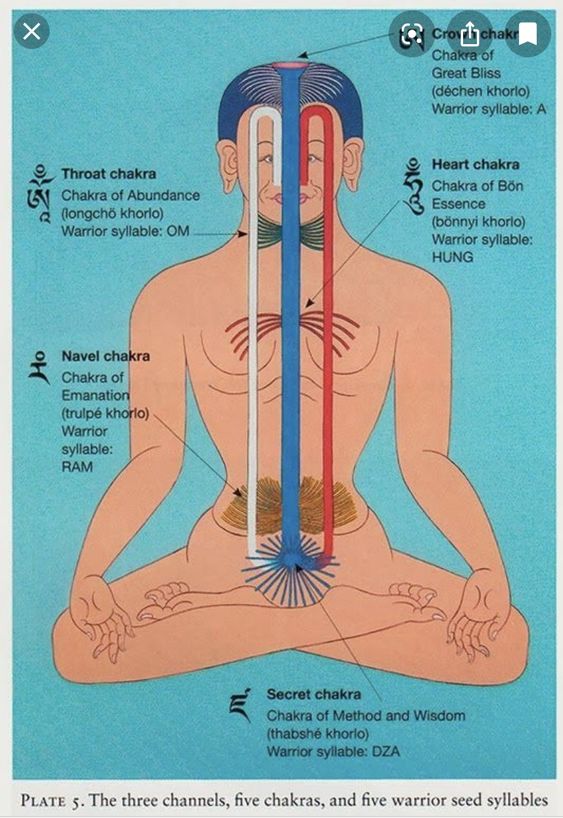
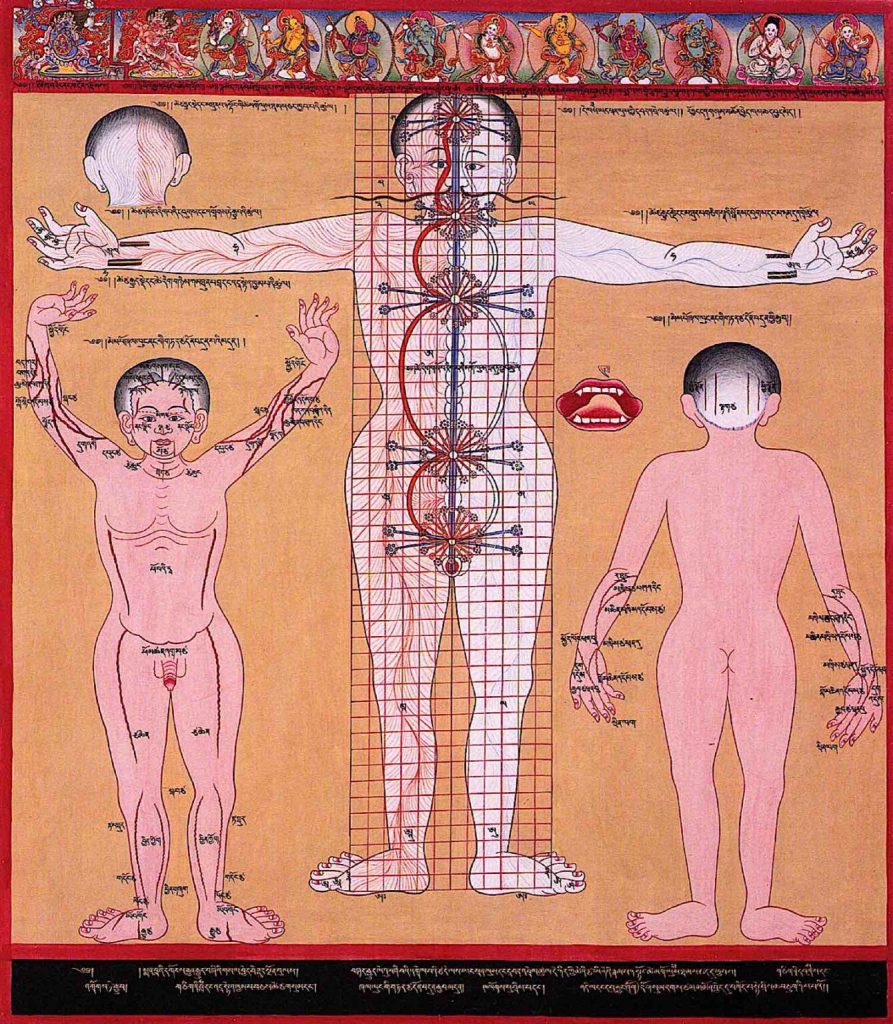
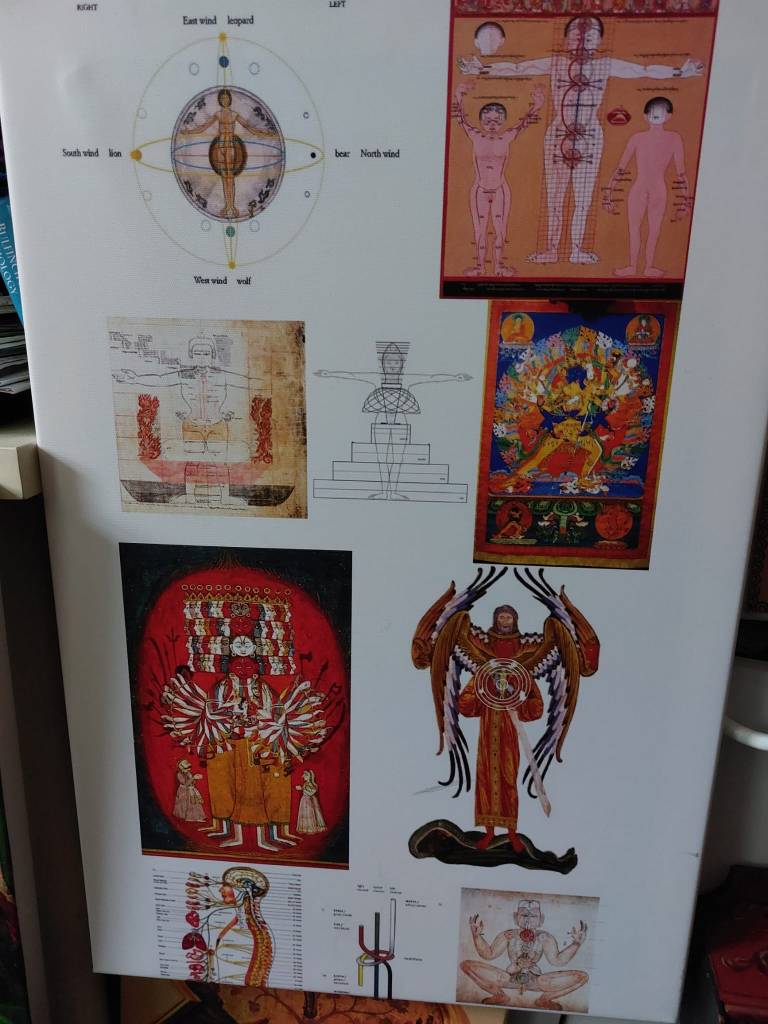
See also the thread of life as explained in Tibetan Buddhism in The inner Kalachakra

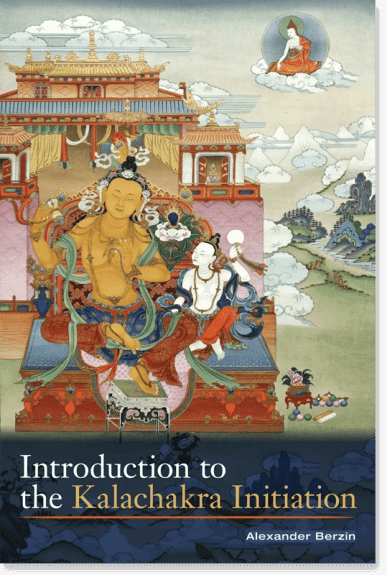
Kalachakra is a system of highest tantra practice for overcoming the limitations imposed by historical, astrological, and biological cycles so as to become a Buddha for the benefit of all. His Holiness the Dalai Lama and other great Tibetan teachers have been conferring the Kalachakra initiation in the West, empowering prepared practitioners to engage in its meditations. Large numbers of people also attend this initiation as interested observers and gain inspiration for their spiritual growth. Introduction to the Kalachakra Initiation explains on a practical level and in everyday language the theory of tantra, the vows, commitments, and their implications, the factors to consider in deciding if one is ready to attend a Kalachakra initiation as a participant, how to visualize during the initiation, and the most important thoughts and feelings for participants and observers at each step of the empowerment. In preparing this guidebook, Alexander Berzin has done a great service to everyone interested in the Kalachakra initiation. It will help people to prepare for the ceremony and understand the essential points of each step of the procedure. Read here

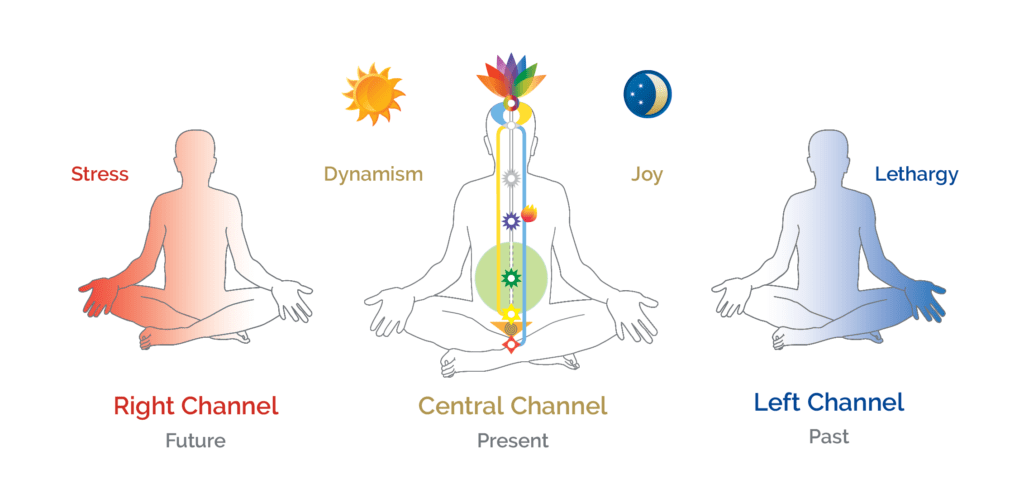
Or the kunalinini principles used also in Alchemy in the West or the Kareeza practices used in Europe in 17th century but were corrupted by elites of Western Secret societies in 18th and 19th century till now.

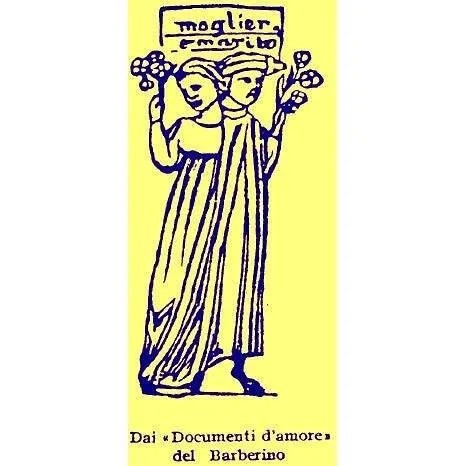
This can be expained by the double meaning of androgyny and as the work with Mercury in alchemy …etc. This is the path as Titus Burckardt explains to The Ascent of the Soul through the spheres

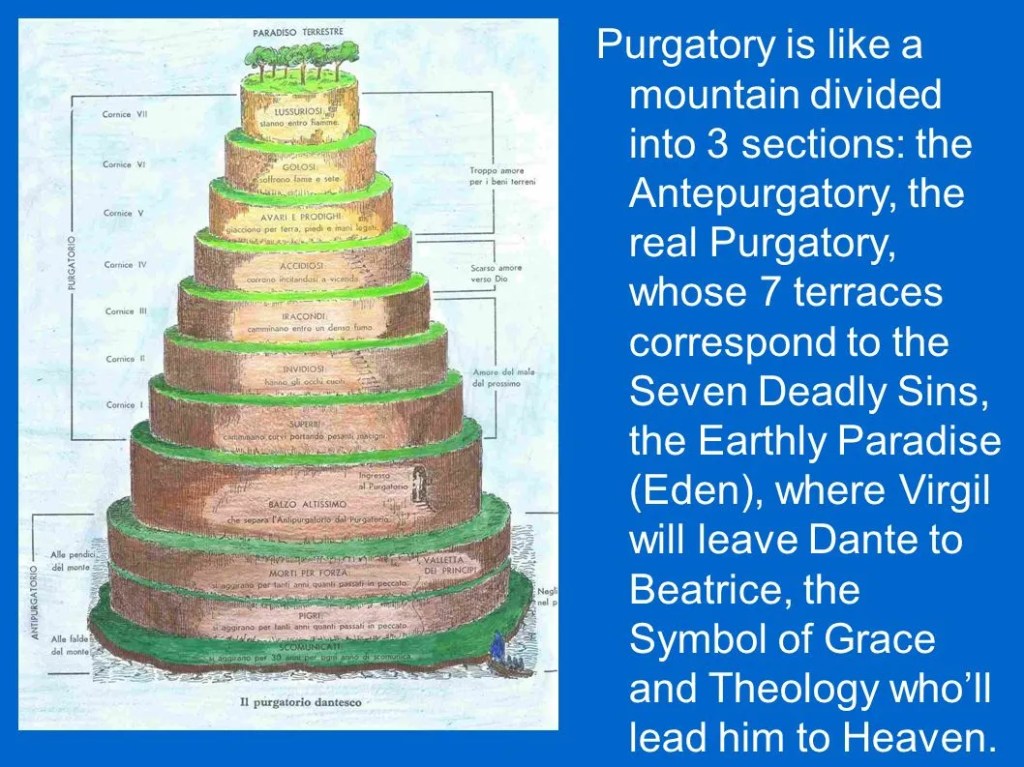
These practices can be resumed very clearly by the path which dante takes in the Purgatorio climbing the mountain of Virtues

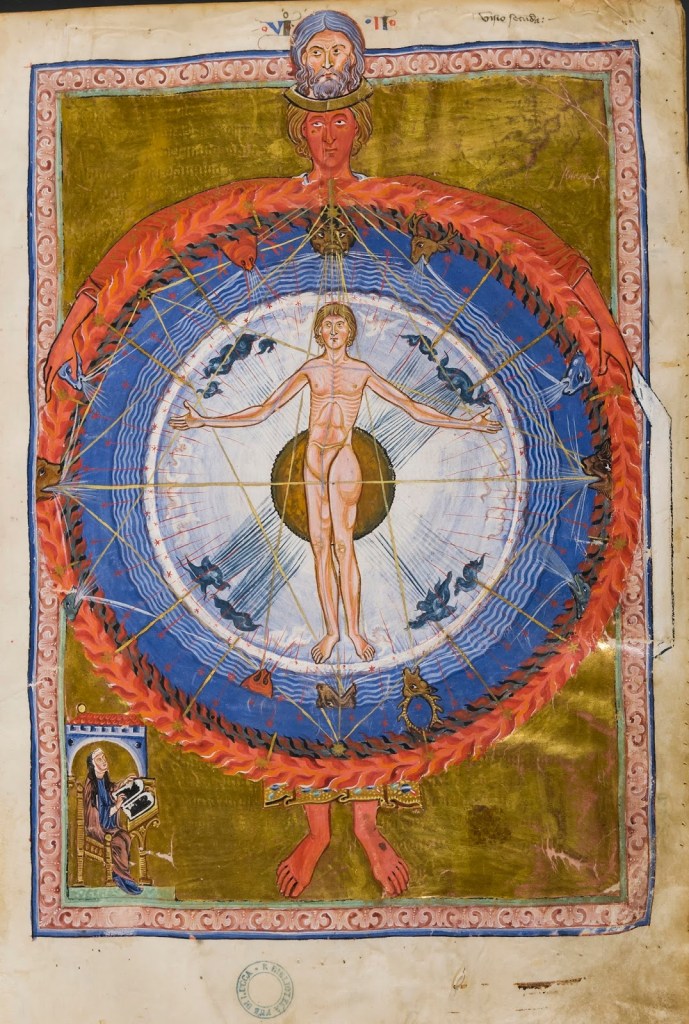
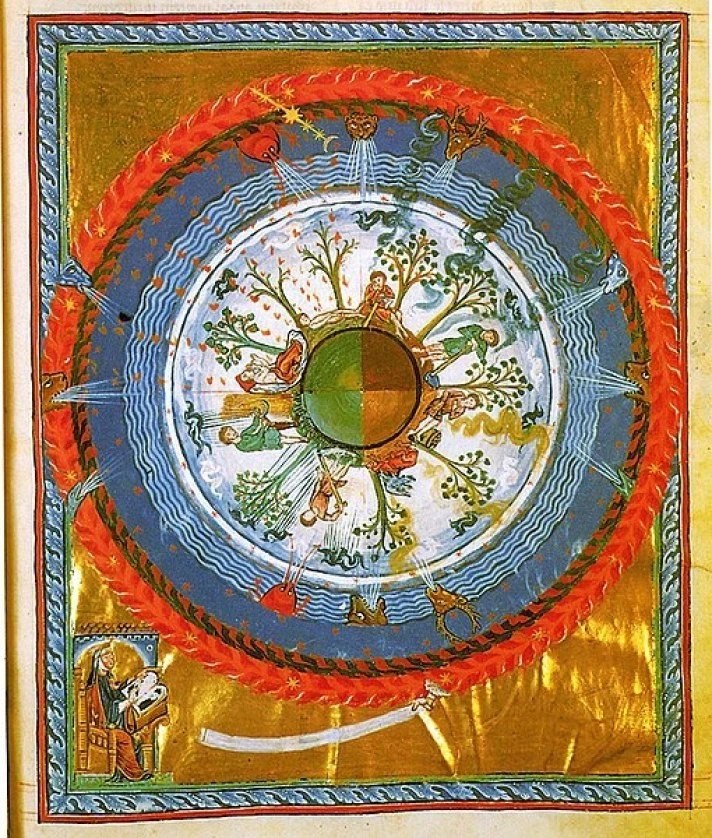
This is also expain by Hildegard of Bingen with Viriditas and Ordo Virtutum

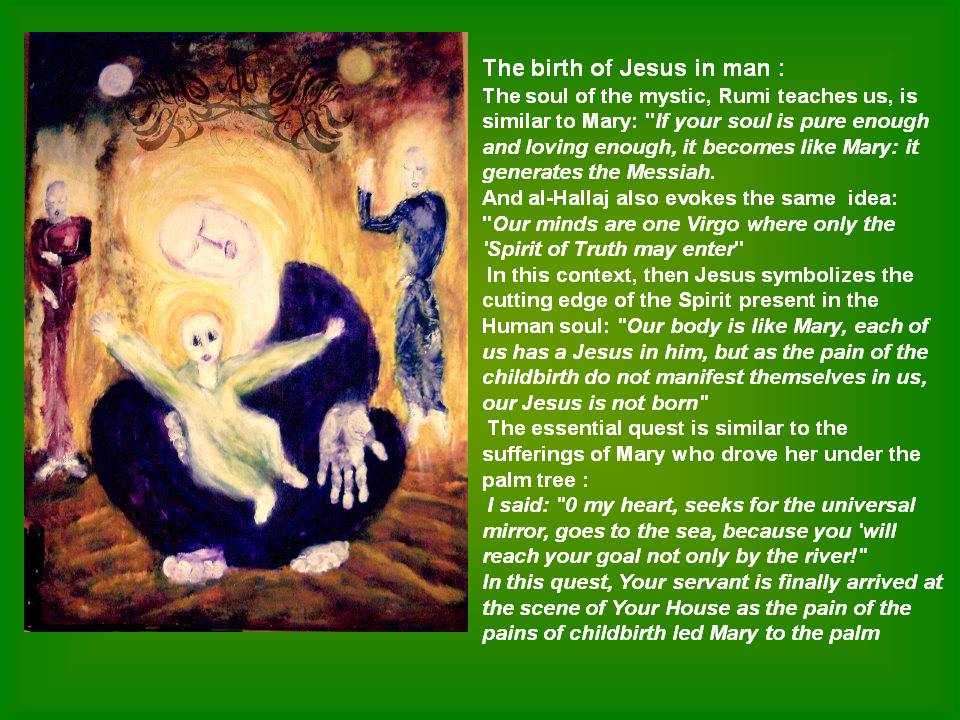
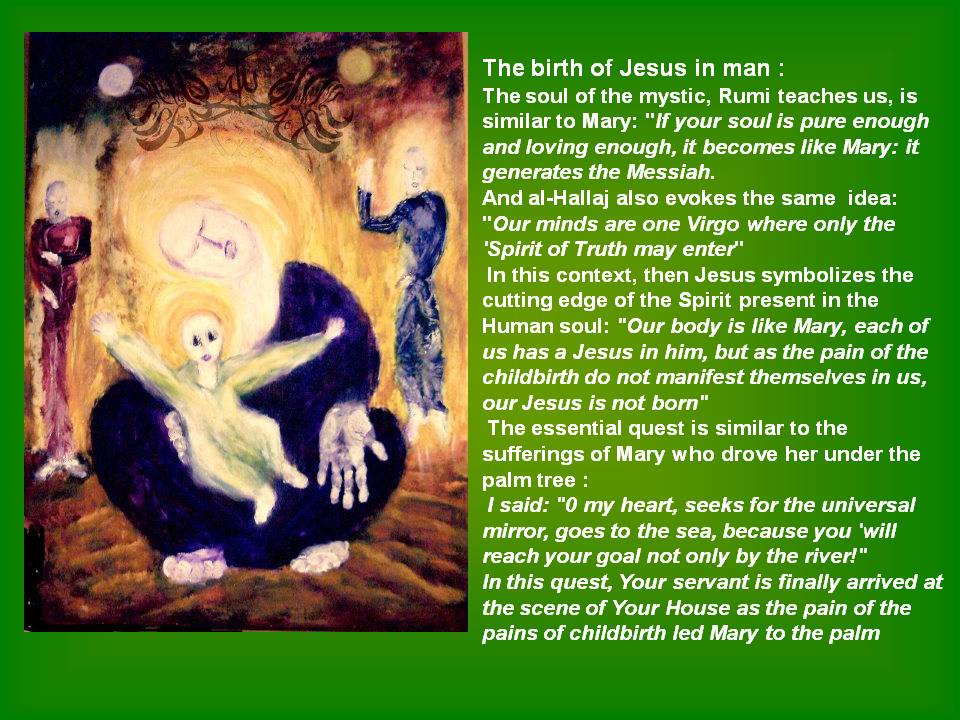
In Sufism and Islam, Rumi explains this principle in the Body is like Mary

Look also: Metaphysical Order in Sufism

Note 2: The Cross of St Brigid

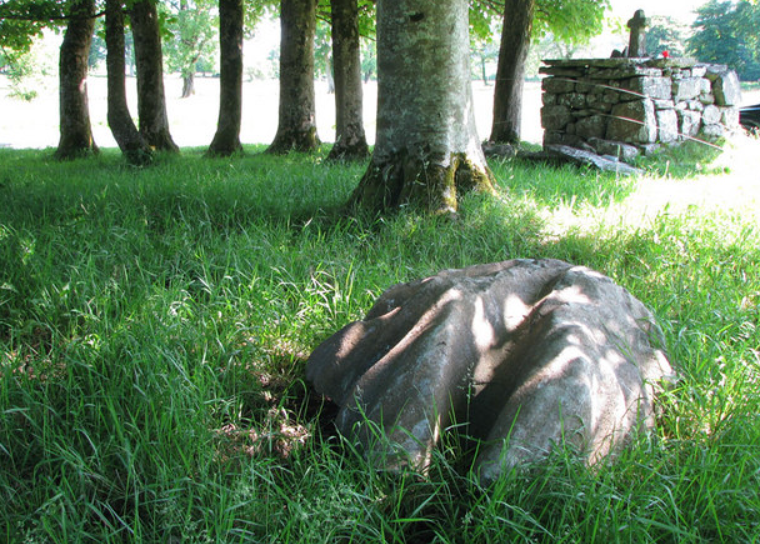
At the birth of Saint Aid, his head had hit a stone, creating a hole that collected rainwater that cured all ailments and because of this, the stone was identified with the tradition of bullaun stones. In Irish it is a bullán or bollán. The name is related to the word bowl and French bol. Bullaun stones have depressions that are often filled with water.

Local folklore often attaches religious or magical significance to bullaun stones, such as the belief that the rainwater that collects in a stone’s cavity has healing properties. Bullaun stones are found in Ireland. Two bullauns have also been found in Scotland. They later became known as Butterlumps.

Dromagorteen’s bullaun is directly adjacent to a Fulacht Fia. A Fulacht Fia can be translated as “burnt mound”, in England also known as Burnt Mound and in Scandinavia these structures are known as Skärvstenshögar. Fulacht Fias are interpreted as the remains of breweries, cooking places, textile production facilities or saunas.

The original purpose of the bullauns is unknown, but they have an undeniable connection with water and the worship of Brigid or Brigit: a goddess of pre-Christian Ireland and member of the Tuatha Dé Danann (the people of the goddess Danu). Her name is interpreted as “the bright one”, “the shining one” or “the warrior”.

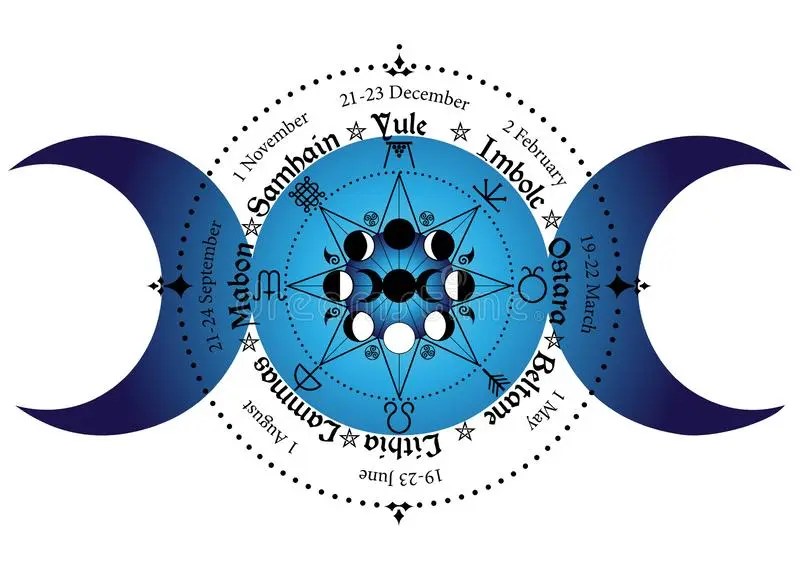
Imbolc is dedicated to this goddess of light. It is one of the four major festivals of the pre-Christian Celtic calendar associated with the fertility of the earth. Imbolc means ‘in the belly’, which refers to pregnancy or conception (birth occurs at a different time, during the festival of Beltane). Imbolc is traditionally celebrated on the eve of February 1.

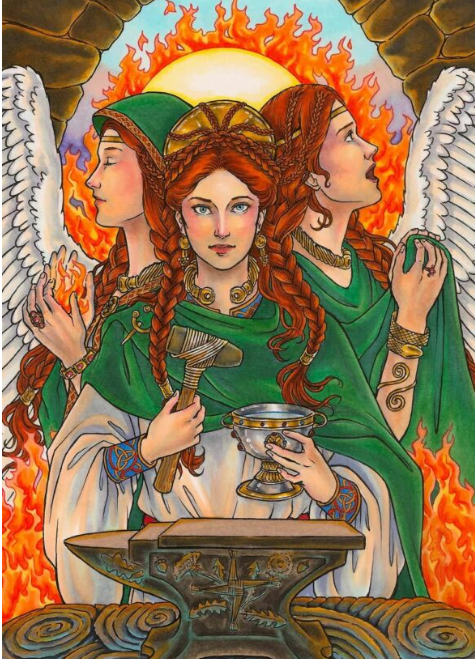
Brigid is associated with wisdom, poetry, healing, protection, blacksmithing and domesticated animals. Cormac’s glossary, written in the 9th century by Christian monks, says that Brigid was “the goddess worshiped by poets” and that she had two sisters: Brigid the healer and Brigid the blacksmith.

This suggests that she was a triple deity. Also called Bríg, Bríde or Brighde, she is associated with the British Celtic goddess Brigantia.

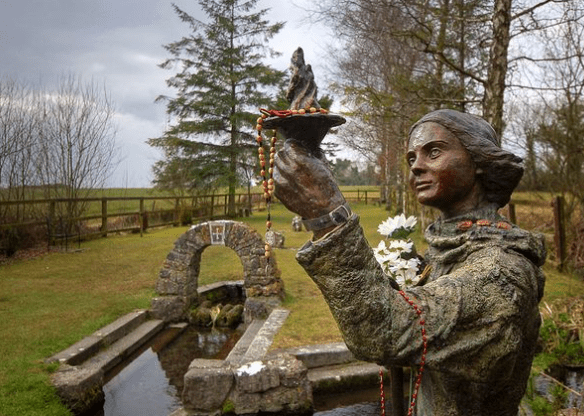
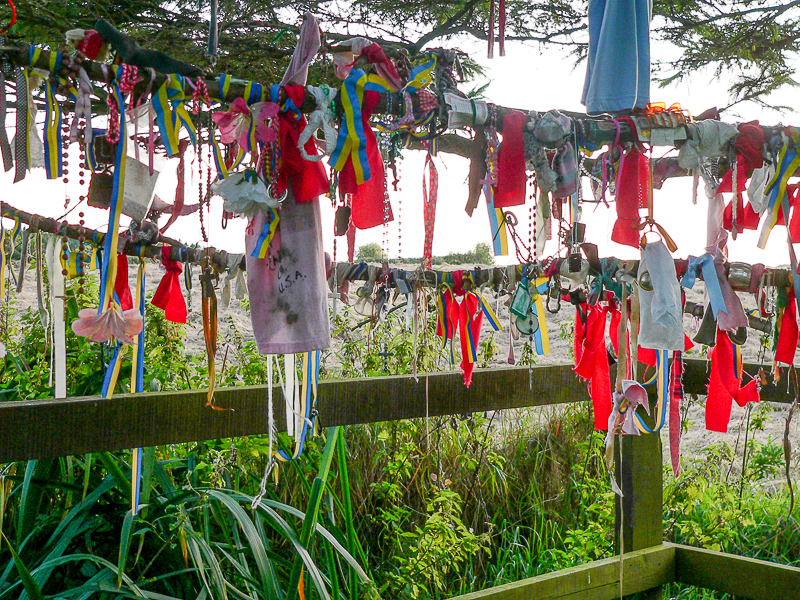
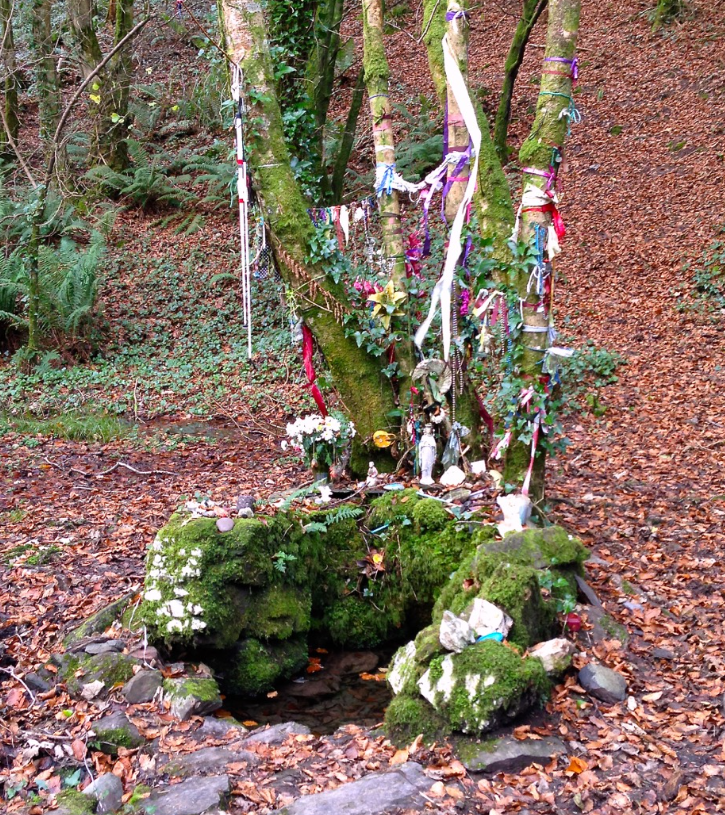
Decorating the well or well, tying strips of cloth around trees at healing springs, and other methods of beseeching or honoring Brigid are still prevalent in Celtic areas. In Scotland these wells are known as ‘Clootie Wells’, sometimes dedicated to saints other than Saint Brigid and in pre-Christian times to a goddess or local nature spirit. There is almost always a tree next to the source, the Clootie Tree. The sites were historically visited before sunrise and on holy festival days.

As one of the most popular goddesses worshiped by Celtic peoples, including the Druids, many of Brigid’s stories and symbols survive in the character of Saint Brigid.

Saint Brigid is venerated in churches all over Ireland and she gives her name to many a village ‘Kilbride’, which literally means ‘Church of Brigid’. Imbolc was later incorporated into Irish Christianity as Saint Brigid’s Day with the highlight of the festival being the Roman Catholic Candlemas.

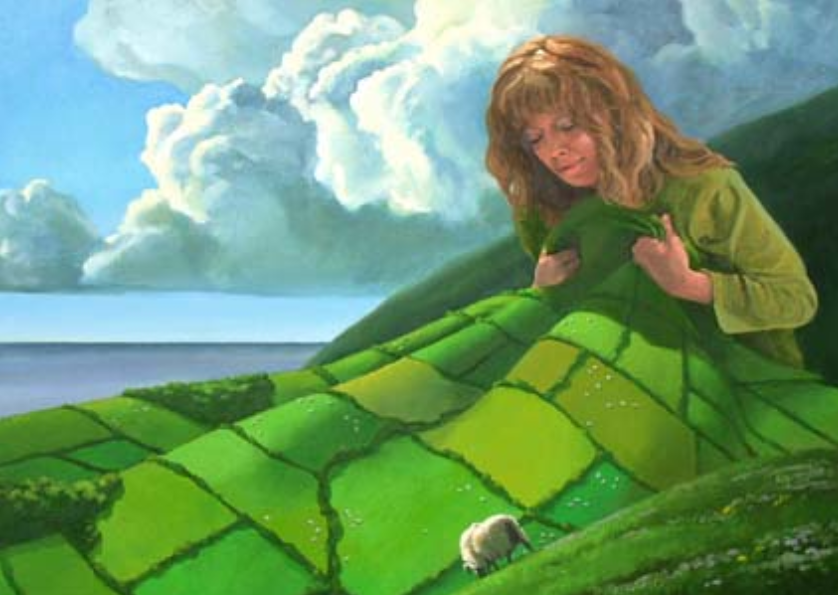
Saint Brigid was given land to set up her monastery in Kildare. The story goes that the local chieftain would only give her the land covered by her cloak. Then she spread her cloak on the floor. The shocked chieftain watched as the cloak miraculously began to spread. The chieftain begged her to stop it for fear of losing all his lands. She did so and the land under her cloak became the land for her monastery. Another story tells that the ground was leveled by her spreading mantle to form the Kildare plain known as the Curragh.

For centuries, pilgrims visit the Holy Well in the churchyard on Faughart Hill, believed to be the birthplace of Saint Brigid, and they also visit Saint Brigid’s Stream (where a series of penances are performed). The stones have signs associated with the story of Brigid. Like the way she tried to escape from a lover. She pulled out one of her eyes to make herself less attractive.

The stones have names that can be translated as the kneeling stone, the hoof stone, the waist stone, and the eye stone (the stone that healed the eye that took them out).

It is believed that the stones have the power to cure certain ailments. At the old stations, numbers 6 to 10, there are some very old-looking stones. Station 6 is called the Hoof Stone (Cloch na Crúibe or horseshoe stone), a horseshoe shape can be seen in it. Station 7, known as the Kneeling Stone, is actually a double bullaun stone. The stone at Station 8 (The Waist Stone) appears to be a mushroom stone, its shape being caused by water erosion and by the pilgrims rubbing it. Station 9 could cure eye problems and station 10 (Headstone) has a bowl with white circle around it.

Saint Brigid died on February 1, 525 and this date is still celebrated as Saint Brigid’s Day.

The holiday and eve of this day, Saint Brigid’s Eve, is surrounded by various customs and rituals. Sean O Suilleabhain, the archivist of the National Folklore Collection, recorded many pilgrimages to sacred springs, sacred streams and ruins for Saint Brigid.

The traditions of the feast are included in both the National Folklore Collection (NFC) and the Schools Collection.

For example, it is customary to hang a cloth or ribbon outside before sunrise to catch dew. It was especially useful for head pain such as headaches, earaches or toothaches. A symbolic extra place may be arranged for the visiting saint or a bed of straw may be prepared for her. These places are inspected in the morning to look for the traces of the bride’s wand or especially the woman’s footprints. This seems to point to Christian-Pagan synchronism

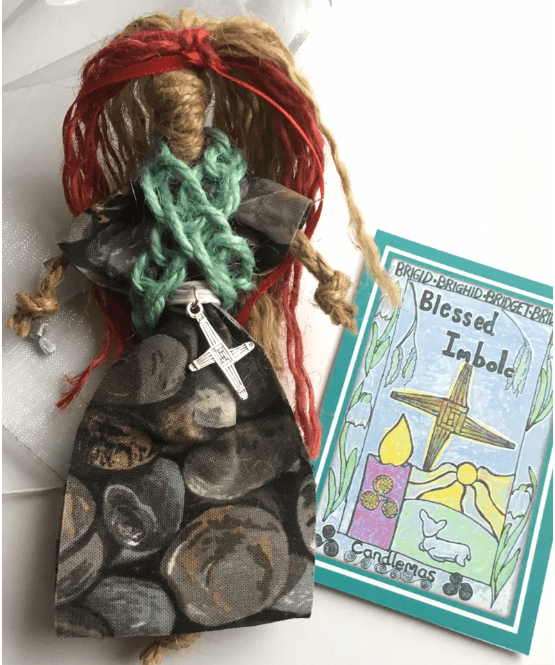
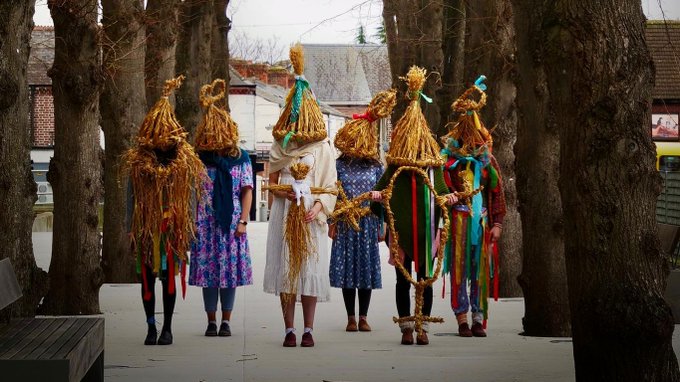
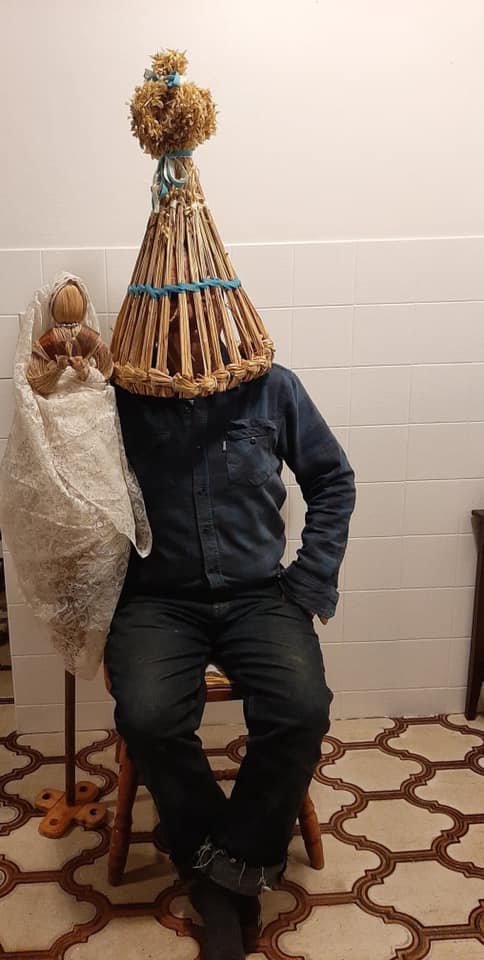
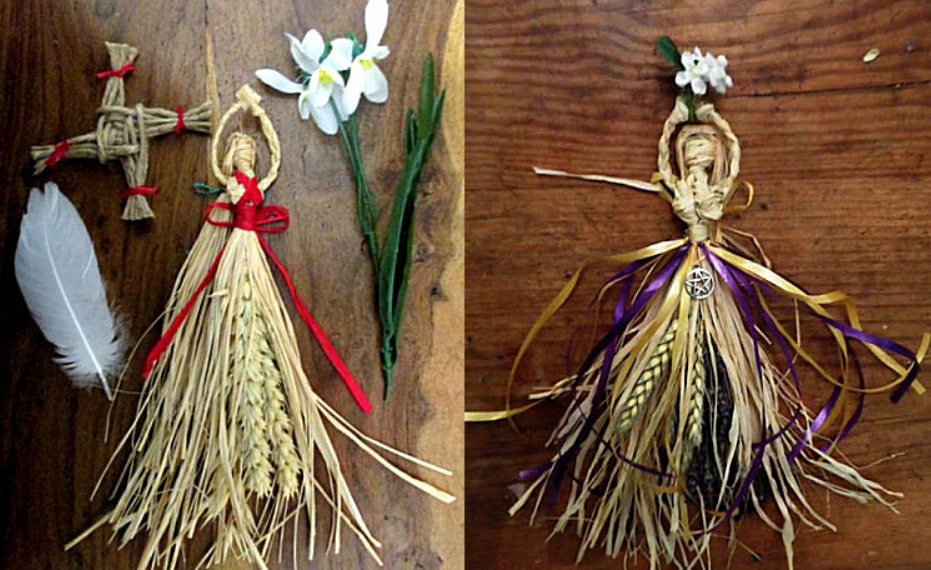
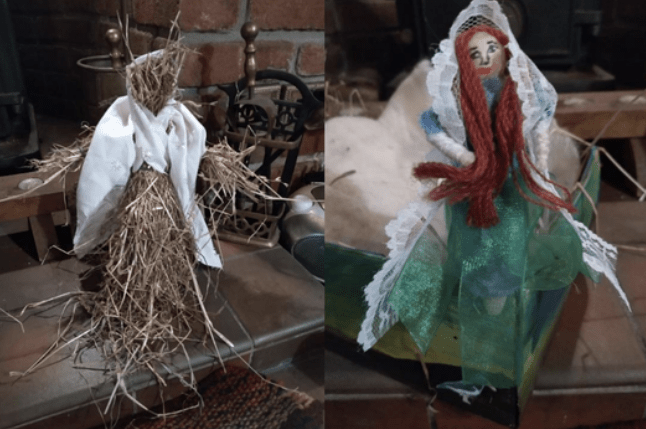
During the festivities, Brigid was usually represented by a doll, dressed in white, with a crystal on her chest. This doll, usually a Corn Dolly, was carried in procession by girls who were also dressed in white. Sometimes it involved dressing part of a churn (a household item used by our ancestors in the production of butter) as an effigy of the saint. Other materials are also used to make Brigid’s doll.

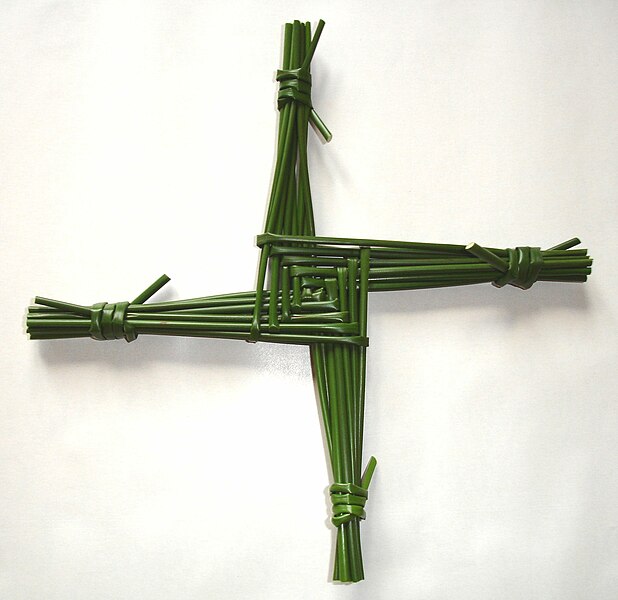
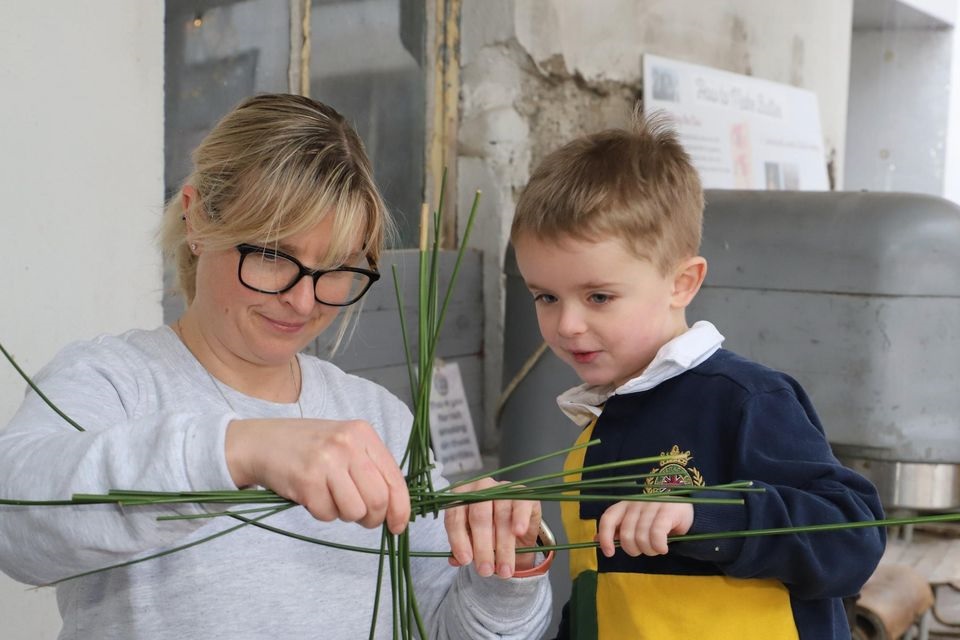
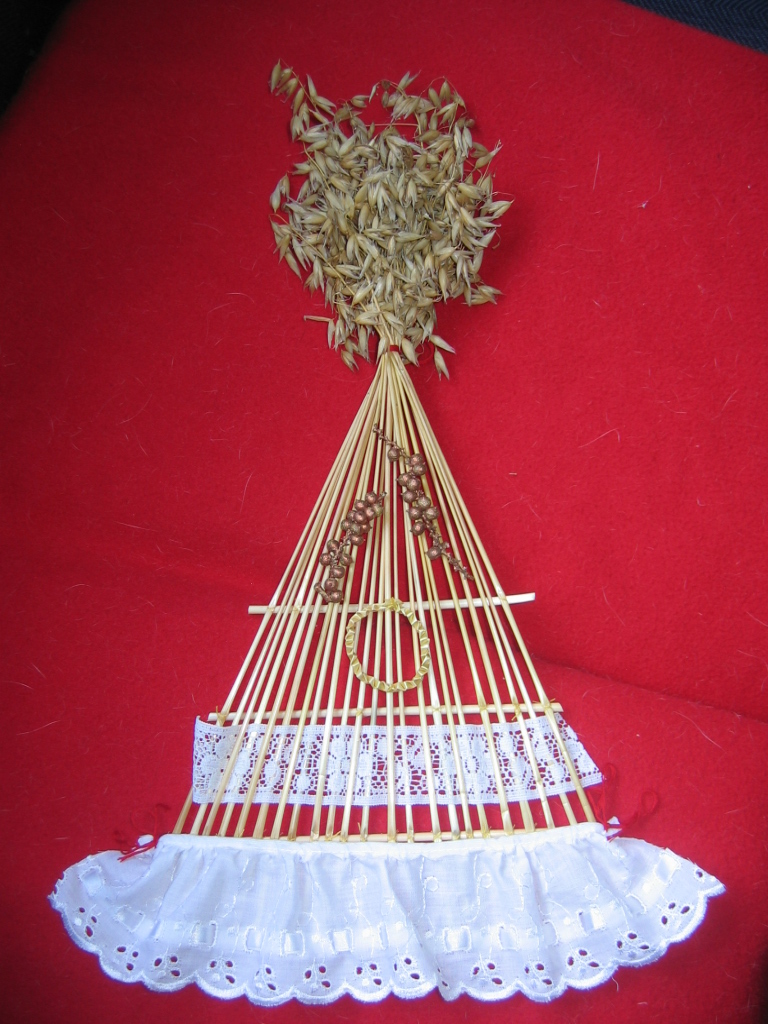
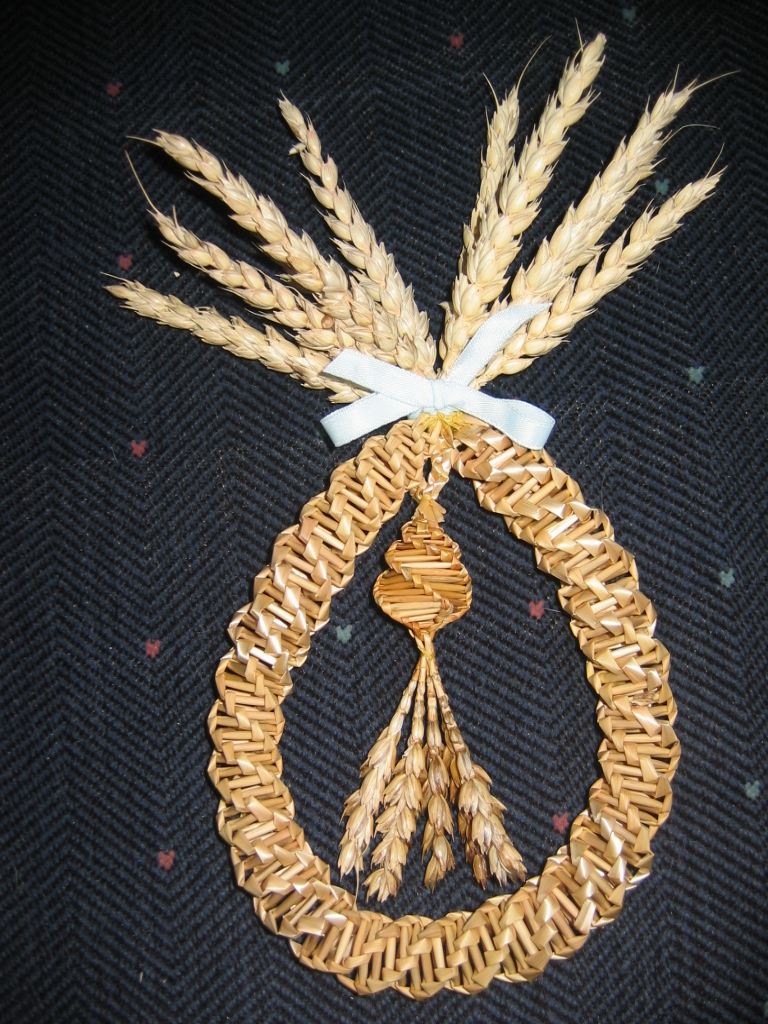
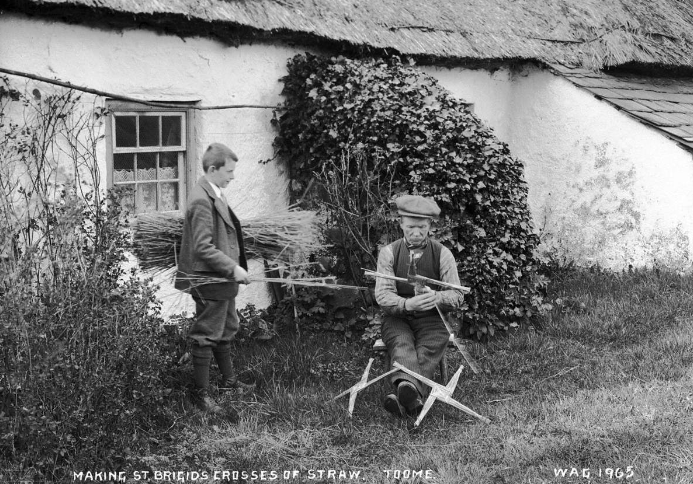
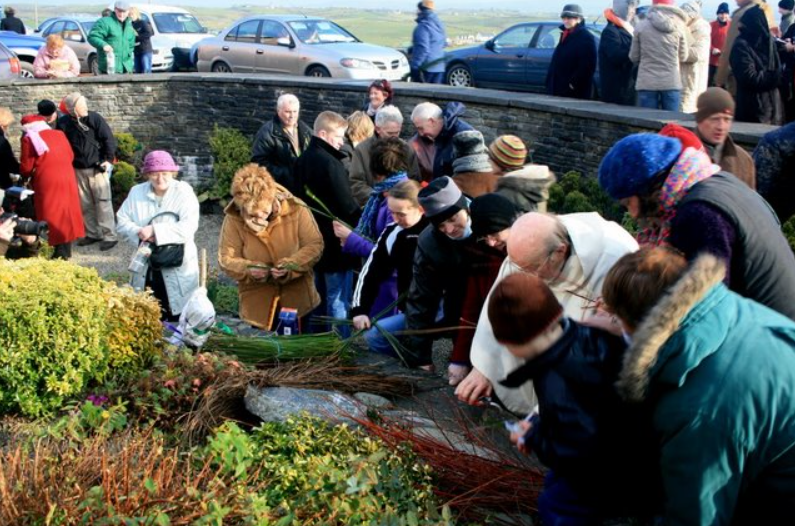
The most famous is Brigid’s Cross (also known as Cros Bríde, Crosóg Bríde or Bogha Bríde). These crosses are usually made of straw or rushes. Families gathered rushes on January 31, the eve of Brigid’s feast day. After an evening feast, the head of the household supervised the rest of the family as they wove crosses from the collected material. These crosses were left out at night to receive Brigid’s blessing and crosses were hung in the main residence, outbuildings and stables on February 1.

The exact shape of a Brigid’s Cross varies greatly. The National Museum of Ireland has identified seven basic categories of crosses: the diamond type (which is divided into single or multiple), the “swastika” type (with four or three arms), the wheel type, the interlaced type, the traditional Latin cross made of straw or rushes, bare wooden crosses in Latin or Greek style tied with straw and a category of “miscellaneous”.

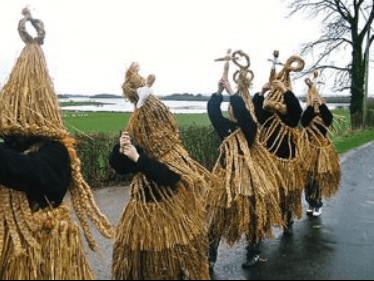
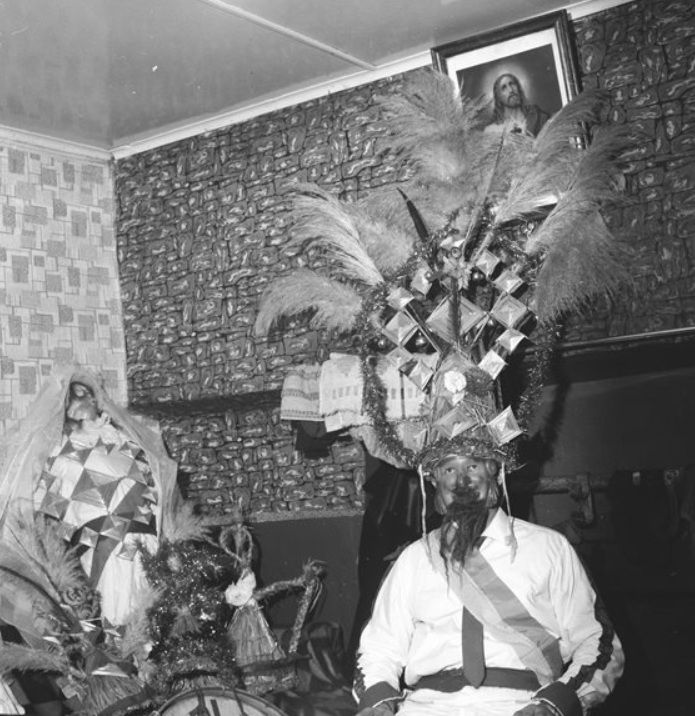
The Biddy Boys are a group of men who dress up in straw hats and women’s clothes and go through houses with a straw doll or Brideog, also called Biddy. They demand entry into the house and entertain the residents with music and song, then demand a reward. A short documentary from 1965 can be seen here. A local man, Mr. O’Siochru, outlines the traditions related to the Biddy Boys, the dolls and costume and the Brideog are traditionally made here with their grandmothers’ hair. A Brideog is also formed by a carved turnip that is painted with soot or the doll is made of rags.

The tradition of the Biddy boys is largely confined to South Kerry, parts of County Cork, County Kildare and County Fermanagh.

More generally, children are going around the houses nowadays. Just as in the Netherlands children go around the houses and sing songs with Sint Maarten, there are also rhymes with St. Brigid’s Day:

“Here comes poor Brigid both deaf and blind,
Put your hand in your pocket and give her a coin
If you haven’t a penny, a half penny will do
If you haven’t a halfpenny god bless you”

Something for poor Biddy
Her Clothes are torn
Her shoes are worn
Something for poor Biddy
Here is Brigit dressed in white
Give her a penny for her tonight
She is deaf, she is dumb
She cannot talk without a tongue
For Gods sake, give her some”

Biddy Boys 1970s. Killorlgin Co Kerry Ireland. February 2nd festival to celebrate the Celtic Saint Bridgid. A doll – St Bridgid – is taken from house to house by teams of Biddy Boys. They are in dfisguise often and the leaders where the traditional straw conocal hat.

Pancakes are traditionally eaten on Saint Brigid’s Eve. There was an abundance of butter and milk on the table and oats (or cake) thrown at the door. There used to be no ceilings in the houses so it was customary to fix the Brigid’s Cross to the inside of the reeds and new ones were added year after year. If they could no longer be preserved, they should not be thrown away under any circumstances. They had to either be buried (to give a blessing to the crops) or burned in the fire.

There was a tradition in parts of Antrim of the excess rushes being formed into a ring and hung on the spinning wheel to bring a blessing on the work for the coming year.

Sometimes you have to look for the place where Saint Brigid knelt and left imprints of her knees in the rock. There are many Saint Brigid wells and offerings are left here. This often involves rags and ribbons around the source. Traditionally, rags were used to wash the affected part of the body with water from the well and then tied to the tree or bush. As the patch worsened, the pain faded. In some parts of Ireland, if the rag is tied to the tree, the tree itself would take the pain of the pilgrim…

The ritual use of some bullaun stones continued well into the Christian period and many are found at early churches, such as the Deer Stone in Glendalough, County Wicklow. The ‘Deer Stone’ is located next to the main ecclesiastical settlement in Glendalough. It is located on the south side of the Glenealo River, directly across from the ruins of the Church of St. Ciarán.

  • The Loom of Life
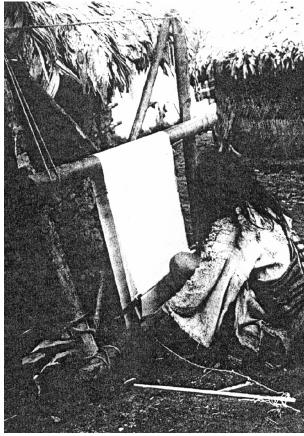
    The sutratman doctrine has managed to survive among a few remote peoples like the Kogi of the Sierra Nevada de Santa Marta in northern Columbia. Weaving and spinning are spiritual activities and occupy a central role in the religious life of the Kogi. Men do the weaving, producing simple, course, cotton garments on an upright loom for themselves and their families.

The Kogi are well aware of this technical simplicity and soberness of their dress.
Almost all their material possessions, all the artifacts and utensils, are sturdy and
devoid of ornamentation. The pottery, the few household goods, and even the
houses themselves are bare and undifferentiated. And with an aloof expression their owners will say, “Yes, our things are simple, but they live.”
Despite this Shaker-like aesthetic, the objects of daily life are symbolically meaningful, acting as microcosmic models of the universe, the inner life, and the afterlife. …these objects or phenomena contain a mass of condensed information, a wealth of associations and meanings that make of each object a storehouse of detailed codes that are linked into interrelated concepts. These objects or phenomena, then, “speak” to the beholder; they can even answer his questions and guide his actions; they are his memory, his points of reference.
The spindle, the loom and the act of weaving itself are central symbols to the Kogi and contain
multiple meanings. This is in keeping with the nature of all traditional symbolism where, in the
words of Réne Guénon, “the same symbol is always applicable to different levels in virtue of the correspondences that exist between them.”
Among the Kogi, this symbolism is known to everyone but is understood in depth by only a few.
For this reason, a loom is kept in the temple and used for teaching purposes by Kogi priests. An examination of the symbolism of the spindle and loom reveals roots firmly within the ancient sutratman doctrine.


In the Kogi creation myth, it was the Great Mother who first taught men to weave. In the beginning she pushed an upright spindle into the newly created earth in the center of the Sierra Nevada Mountains. This formed the central post or axis mundi. Then, drawing a length of yarn from the spindle she drew a circle around the spindle whorl and said, “this shall be the land of my children.”

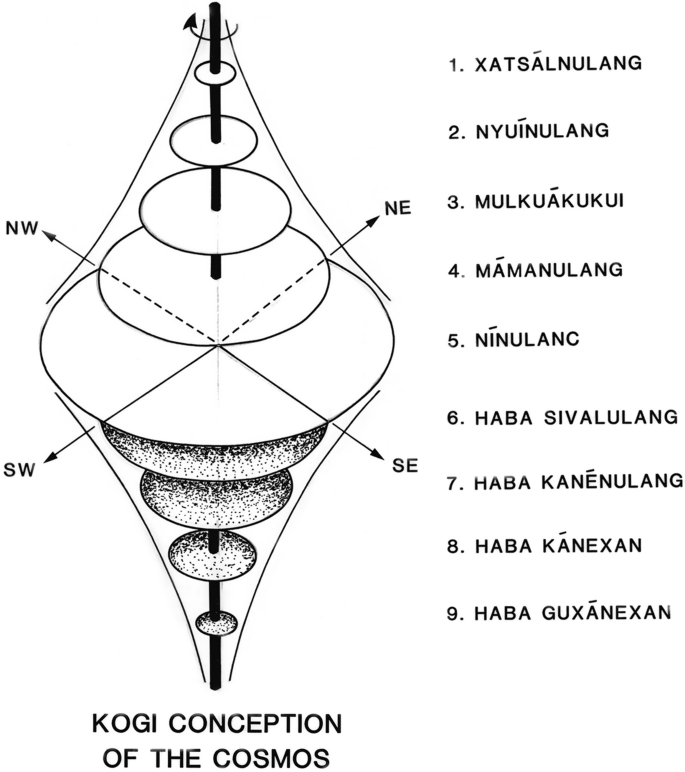
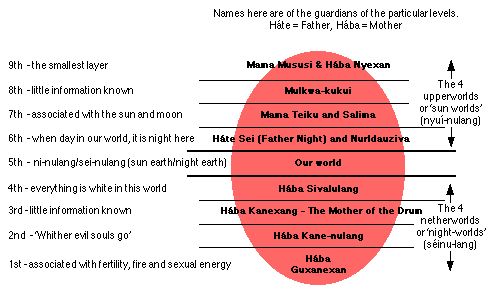
The spindle serves as a model of the cosmos; the flat whorl is the earth on which rests a coneshaped body of white yarn wound around the world axis. The yarn, described as the “thought of
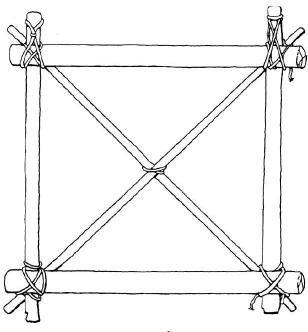
the sun,” represents life, light and the masculine seminal element of fertility and growth. The white cone is divided horizontally into four ascending levels that form the Upper World. Underneath the disk rests an invisible, inverted cone of black yarn also divided into four levels that forms the corresponding Lower World. The sun, by spiraling around the world, spins the Thread of Life and twists it around the cosmic axis: during the day a left-spun white thread and during the night a rightspun black one.The Kogi loom consists of a strong rectangular frame reinforced by two cross-poles .

The structure forms a Saint Andrew’s cross (or hourglass figure) within a four-sided square framework.
A number of meanings are associated with this design. Topographically, the loom is a map of certain features of the Sierra Nevada. The four corners of the square are the four Colombian cities in the region: Santa Marta, Riohacha, Fundación and
Valledupar. The center of the square where the cross-poles meet represents the snow peaks. Other geographical landmarks such as rivers can then be located within this conceptual framework.

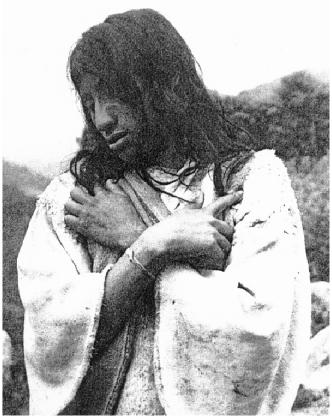
Anatomically the loom is a model of the human body from the shoulders to the hips. The five points where the wooden pieces are lashed together represent, from the top, the left and right shoulders, the heart in the center, and the left and right hips at the bottom. To represent a loom, a man crosses his arms over his chest with the outstretched fingers of his right hand touching his left shoulder and his left hand touching his right shoulder . This is considered a ritual posture.

See more about Kogi : Message from The Heart Of The World:

The five cross-points are also identified with the five main ceremonial centers of the Kogi founded by the five principal sons of the Mother Goddess. It is these “Lords of the World-Quarters” who rule over the five points of the loom and the human body.
The progenitive power of the solar thread is reflected in the sexual symbolism associated with
spinning and weaving. The spindle combines a “male” shaft that pierces a perforated “female”
whorl. Further, the Kogi compare the act of weaving to copulation, with the warp thread conceived as the female element and the shuttle the male. Cosmically, Father Sun as Great Wr uses a beam of impregnating light to weave on the cosmic loom or Mother. Read full paper here

Dogon Ritual gesture

San People Dream Catcher
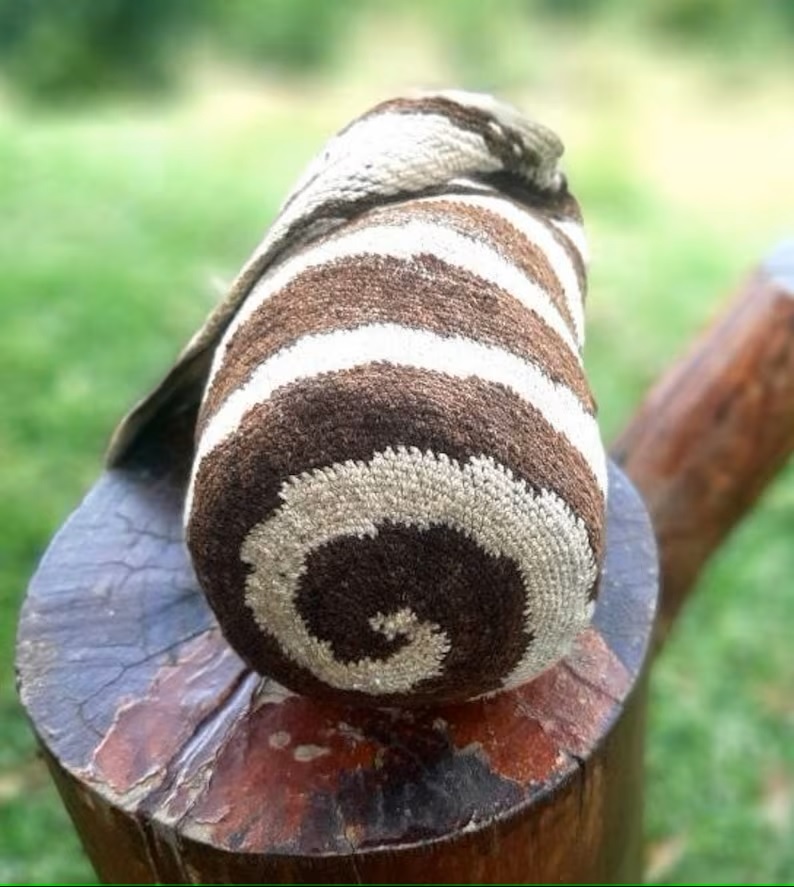
Kogi weaving

  • Birth from the Knee

Most of the ideas presented here are based on a simple metaphor: the equation of human
reproduction, descent, and affinity with trees and plants. We would do well to remember that
before writing externalized knowledge, the image had a fundamental role in communicating ideas.
We think in images, at least in part, and this innate capacity was used in full by our ancestors. This enables art historians, with the aid of other disciplines such as linguistics and anthropology, to venture where no written records exist. When we do find literary evidence in later periods, it sometimes gives voice to these older ideas since they persisted, though often in confused or debased forms.

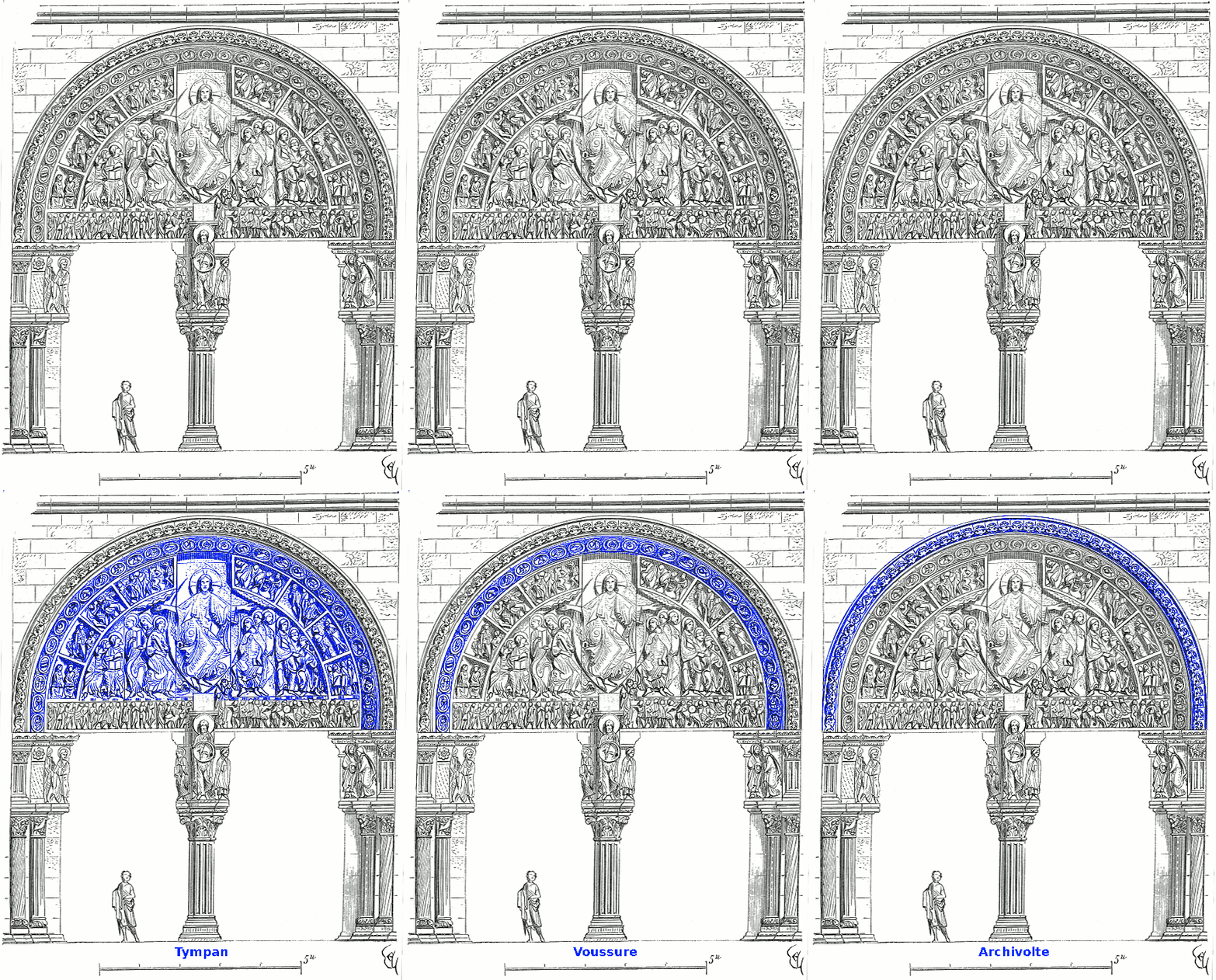
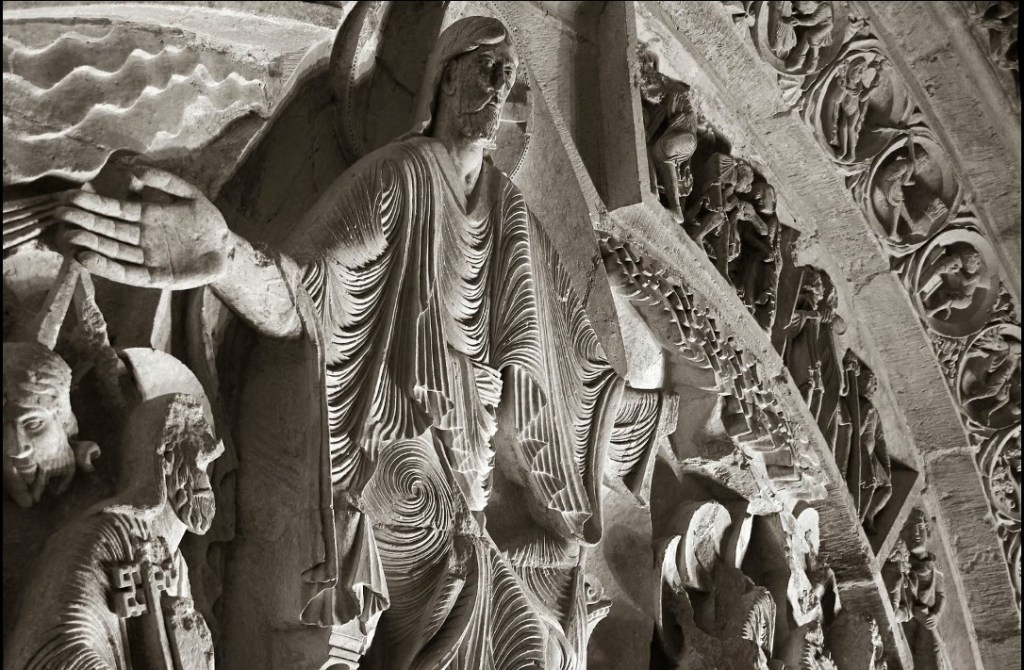
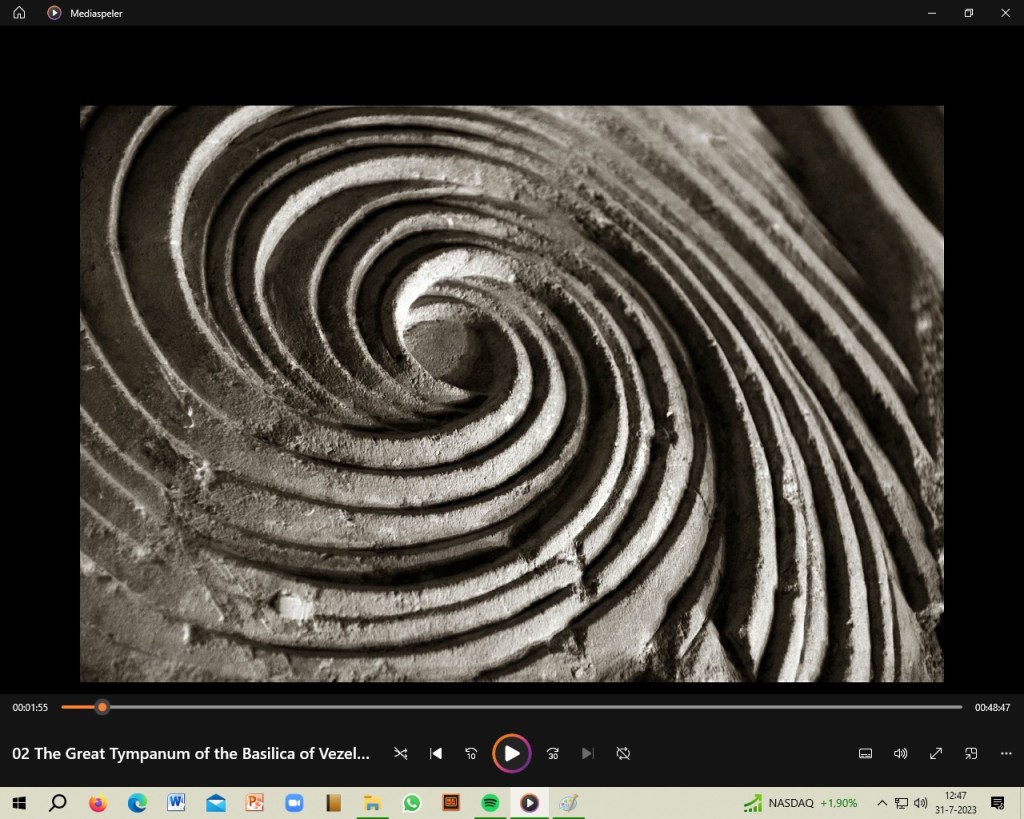
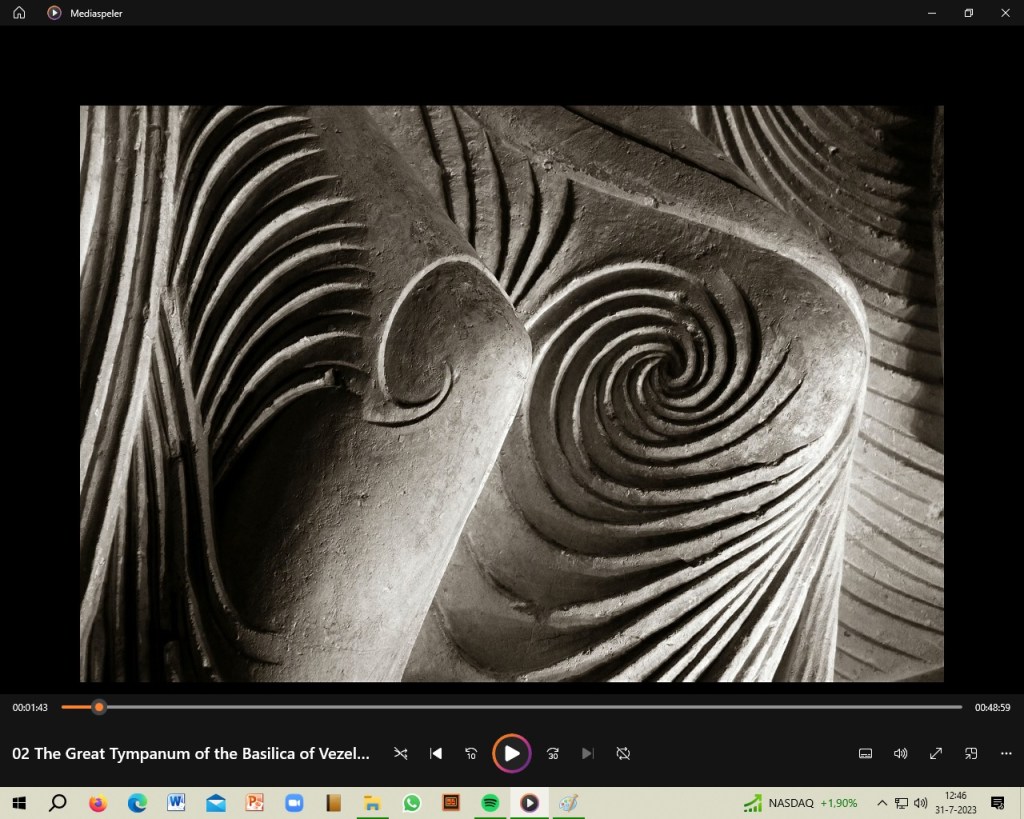
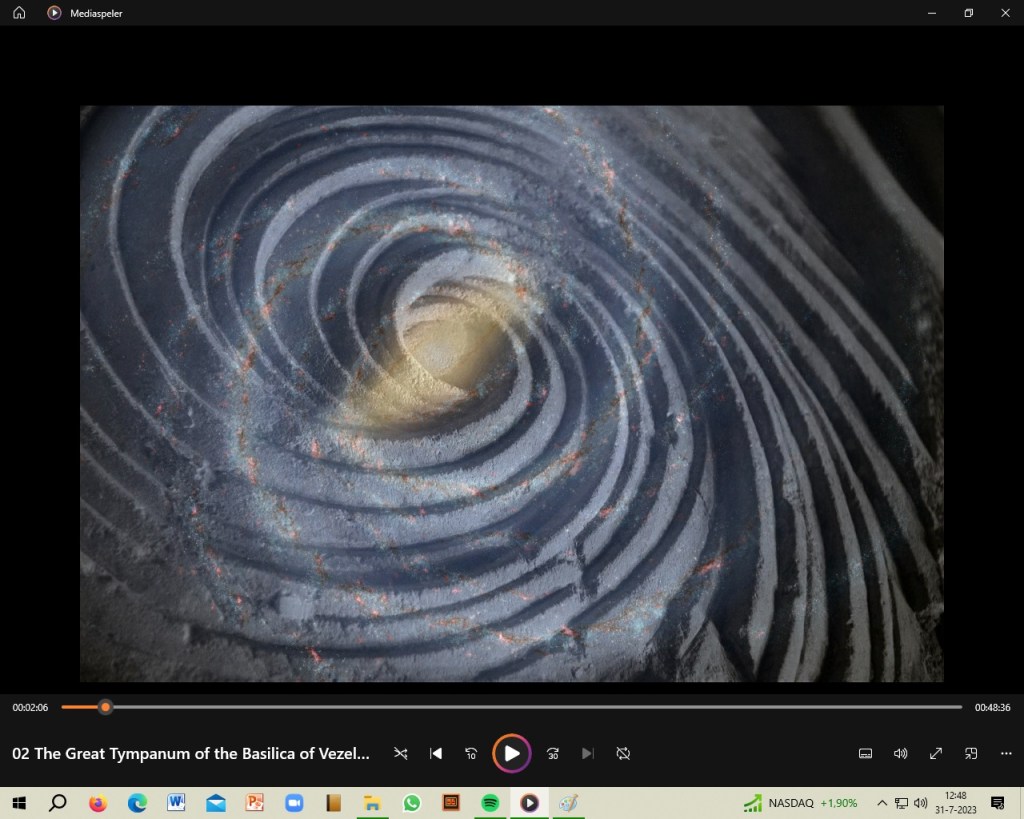
Vezelay


Birth from the Father
The original belief was that children are born from the right knee of their father. The seed or
perhaps small child (homunculus) travels by some mysterious process into the penis from whence it is “planted” in the woman. The metaphor is consistent with ideas about how heaven (male) and earth (female) were separated in the beginning and that the rain or dew from heaven fertilizes the earth. These are the kind of binary structures that interested Claude Levi Strauss and which he used as a basis for structuralism. Another anthropologist and theorist, Gregory Bateson, has some relevant comments in his discussion of totemism:

Their ideas about nature, however fantastic, are supported by their social systems; conversely, the social system is supported by their ideas of nature. It thus becomes very difficult for the people, so doubly guided, to change their view either of nature or of the social system. For the benefits of stability, they pay the price of rigidity, living as all human beings must, in an
enormously complex network of mutually supporting presuppositions.

Another reason for conceiving of the knee as a generative organ was the significance once attached to the body joints in early times, a matter we will summarize later. The articulation of bodies, both human and animal, was related to the nodes of plants, which can be cut and replanted to grow another plant. Many myths tell of children conceived from severed fingers and toes or from seeds or plants. The knee is the most prominent joint in the body and contains synovial fluid, which was equated with the sap in trees, the juice in plants, or the sperm in humans and animals.

Most significantly, both the knee and the head played a crucial role in an ancient system of
graphical representation developed by Paleolithic peoples to express their ideas about genealogy and descent. We will begin by summarizing the elements of this iconography. I will not attempt to justify Schuster’s ideas other than to show their connection to the other ideas discussed in this paper. Interested readers can consult the Wikipedia entry on Carl Schuster for further references. Read also Schuster 1958 Genealogical Patterns Old and NewWorlds

Genealogical Iconography
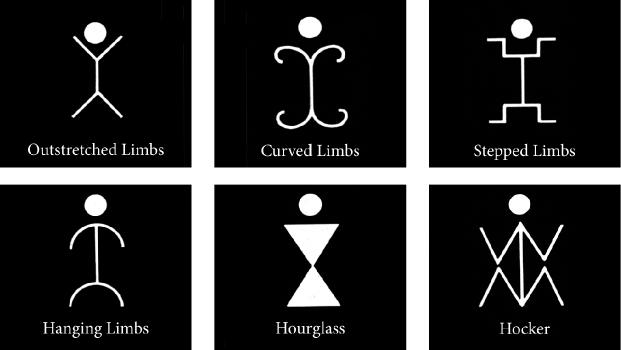
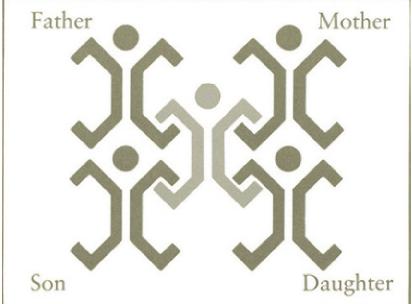
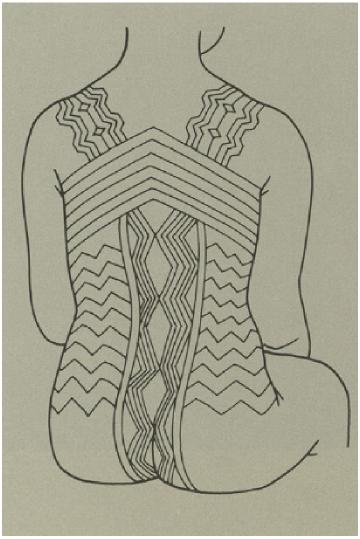
Carl Schuster believed that Paleolithic peoples developed a system for illustrating their ideas about genealogy. Not a kinship system — which depicts actual relations — but an idealized system linked to certain cosmological ideas. The resulting designs were used to decorate the body, clothing, and tools. Their function was to clothe the individual in his/her tribal ancestry. The basic units of the system were conventionalized human figures, linked like paper dolls, arm to arm to depict relation within the same generation, and leg to arm to depict descent. Linked together, these human bodies formed patterns, often of astonishing complexity . Read full paper here

  • The Social Symbolism of Horns


There are so few people who pay any serious attention to design as a cultural document, in a deeper, more significant sense, with a historical view, that I feel my existence is justified—or will be eventually.
Carl Schuster


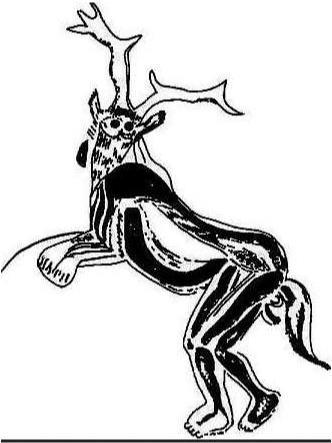
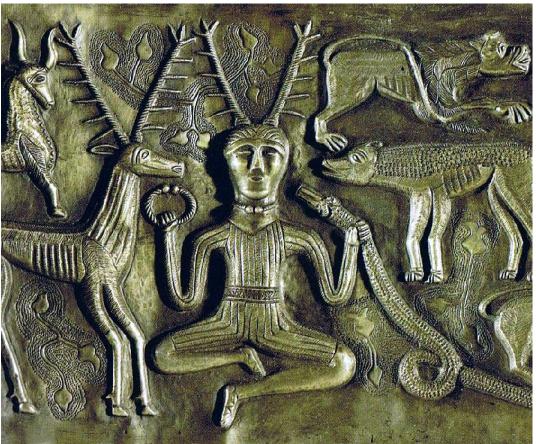
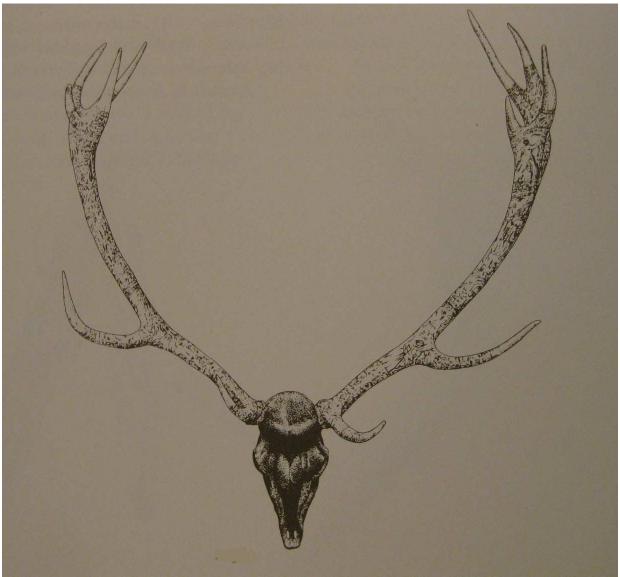
The antlers and horns of animals have served a symbolic function from the earliest times. I will
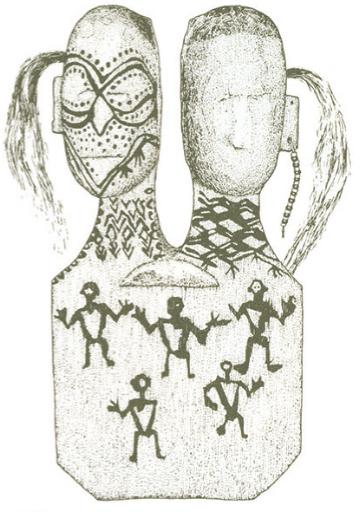
summarize the existing evidence and expand it using the researches of the American art historian, Carl Schuster (1904-1969), who collected and analyzed a number of related symbols, including Yposts, two-headed figures, and shaved sticks. In this way, I hope to get at the basic ideas that lie behind the various manifestations of the symbolism of horns. Read more here

  • Knots and notes

John Cargill was a leading memorial designer for the Charles G. Blake Company in Chicago. A
student of Celtic culture and an expert stone carver. In the 1930s, he wrote a number of
monographs on the art of ancient Celtic crosses.

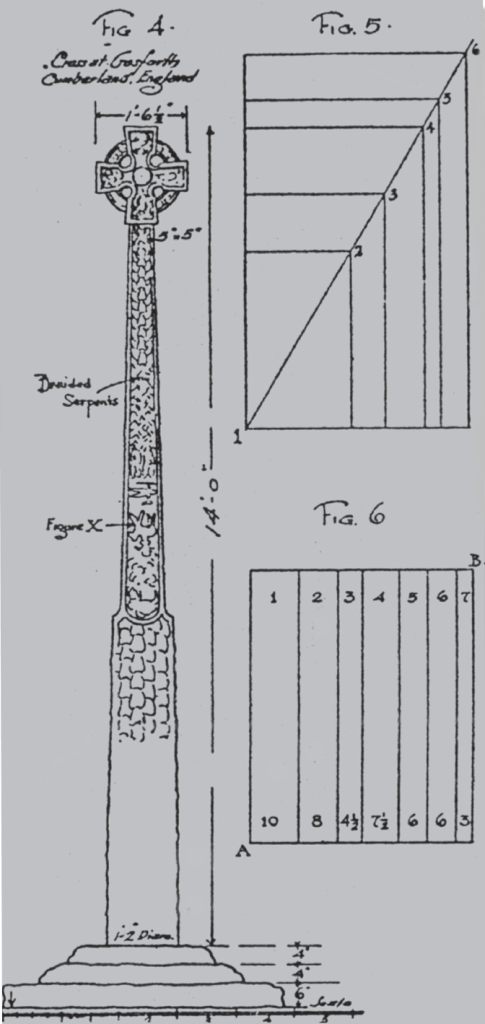
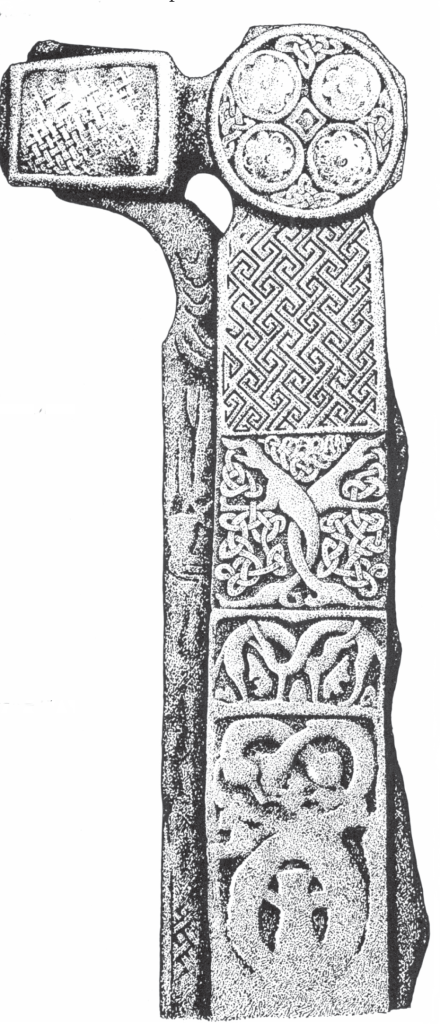
Cargill had made a study of Celtic stone crosses and reached the conclusion that their designers used “the intervals of the musical string to fix the outlines of monuments.” These rectilinear crosses exhibited the same regularities of proportion observed in Greek temple architecture, both having been derived from the numeric intervals of the diatonic scale (Step, step, step, half-step,step, step, step, half).
Take the stretched string for example. Everyone knows that the shorter the string the higher the pitch and each note requires its appropriate length and the differences between the various lengths are called intervals. If the full string measures 90 (inches, quarters or halves) then the intervals of the Diatonic scale would be 10, 8, 4 1/2, 7 1/2, 6, 6, and 3, and these sizes have
been used in the construction of rectangles These rectangles have been used in cross design to give the ratio of width to height of the shaft.

All of this “music in stone” was in keeping with the principles of Pythagoras, who saw numbers as the basic principle of order in the universe. How the Celts came into possession of these ideas is a matter of some debate, but it can be argued that the practical applications of geometry upon which Pythagorean speculation was based are older than the philosophy itself. John Burnett makes the point that the Greeks excelled at developing theories from the practices of others. …and we can see how far the Greeks soon surpassed their teachers from a remark by Demokritos. It runs (fr. 299): “I have listened to many learned men, but no one has yet surpassed me in the construction of figures out of lines accompanied by demonstrations, not even the Egyptian arpedonapts, as they call them.” Now the word αρπİįοναπIJηı is not Egyptian but Greek. It means “cord fastener,” and it is a striking coincidence that the oldest Indian geometrical treatise is called the Sulvasutras or “rules of the cord.Once knotted, a cord can be chalked, hung by a weight, and then snapped like a stringed instrument to mark a stone for cutting.


Certainly such practices were not common but it is worth noting that knotted cords were used in India and elsewhere as mnemonic devices to teach sacred music. Cargill’s findings might be considered as interesting, but of no particular importance, were it not for the deeper connections they reveal between knots and joints. In fact, his findings prove to be the tip
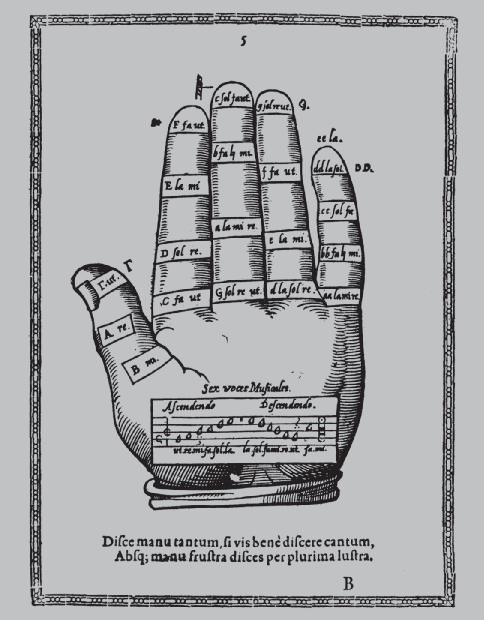
of a very large iceberg. The human hand was also used as an aid for teaching music in China, Japan, India, and among the Arabs and Jews. References to the practice in Europe date from classical times and numerous illustrations of the different techniques employed are preserved in manuscripts and early printed works. But one of the most ubiquitous images of the Middle Ages and Renaissance relating to memory and the learning of music is the so-called Guidonian
hand, associated with the eleventh-century music theorist and pedagogue, Guido of Arezzo, who is credited with developing modern staff notation where lines signify pitches a third apart and a method of sight-singing (solmization) that became associated with a hand that later bore his name.

A 17th century German manuscript, written in Latin, uses the joints as well as the tips of the fingers and thumb to depict the syllables used in solmization

Finger joints are probably man’s oldest memory aid. From an original association with ancestors and kinship, they ultimately externalized as knotted cords and used for a wide variety of purposes including accounting, geometry, and apparently, the encoding and teaching of music. Read full paper here

  • Sex, Gender and the Androgyne:A Metaphysical, Linguistic and Anthropological View

This paper will examine the concept of androgyny from a metaphysical, linguistic and
anthropological perspective. Androgyny has often been represented by the figure of the
hermaphrodite, a human with both male and female physical characteristics. I hope to show that androgyny originated first as a social idea and later as a metaphysical explanation for cosmology, creation, and the relationship.

Androgyne and Hermaphrodite

The word “androgyne” is a combination of the Greek words for man (andro-) and woman (gyné). The word comes into English via the Latin word androgynus. The word “hermaphrodite” is derived from Greek god, Hermaphroditos, son of Hermes and Aphrodite, whose body was merged with the nymph Salmacis to achieve a more perfect form with both male and female attributes. Like many Greek myths the earliest forms are lost to us but we do have evidence that the idea of dual sexuality has some antiquity in Greece.
The oldest traces of the cult in Greek countries are found in Cyprus. Here, according to Macrobius (Saturnalia, iii. 8), there was a bearded statue of a male Aphrodite, called Aphroditus by Aristophanes. Philochorus in his Atthis (ap. Macrobius loc. cit.) further identified this divinity, at whose sacrifices men and women exchanged garments, with the Moon. A terracotta plaque from the 7th century BC depicting Aphroditos was found in Perachora, which suggests it was an archaic Greek cult.


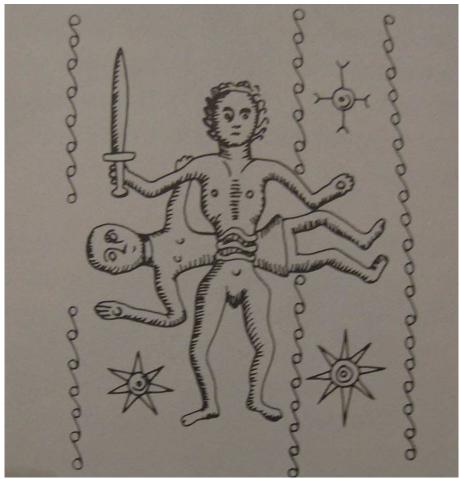
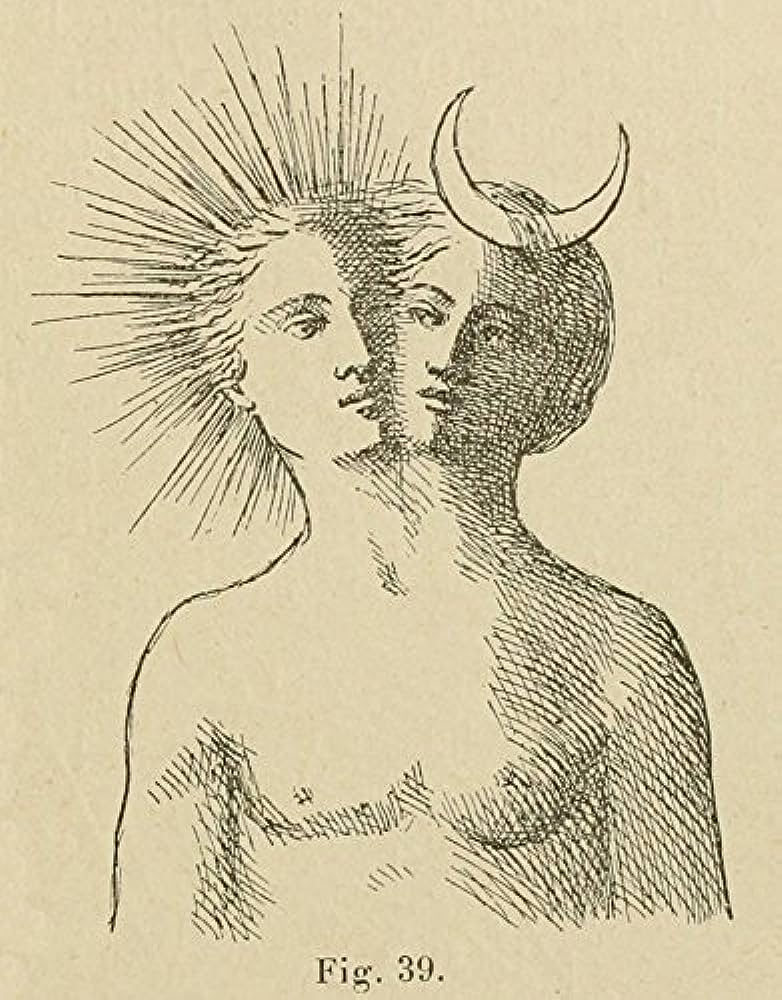
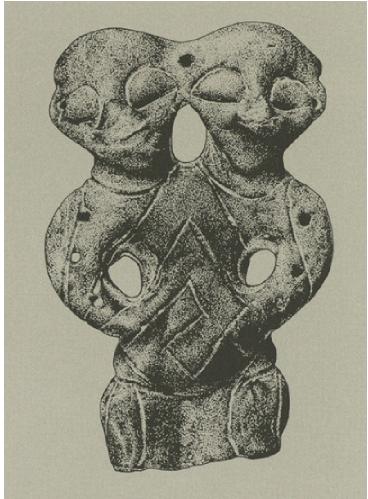
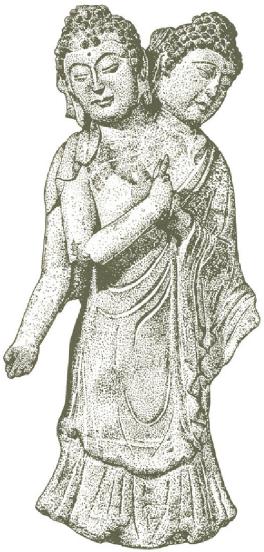
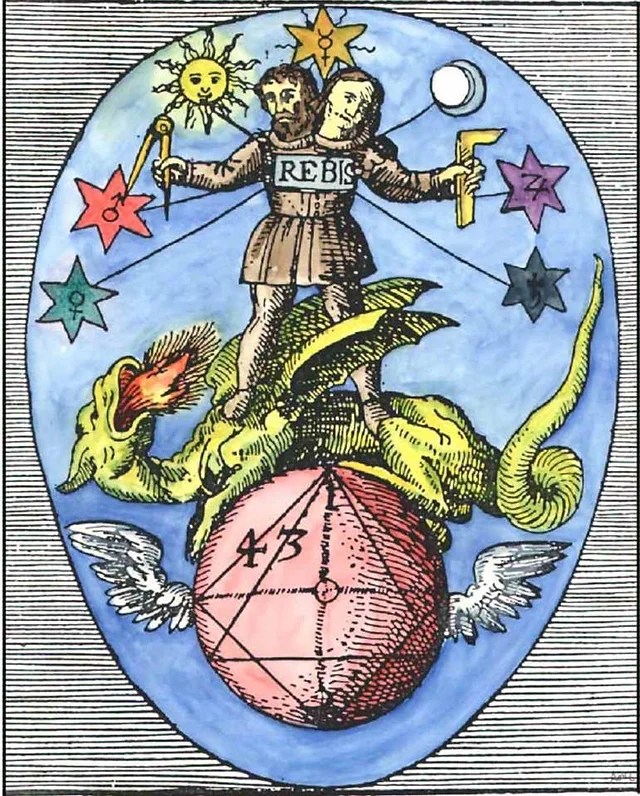
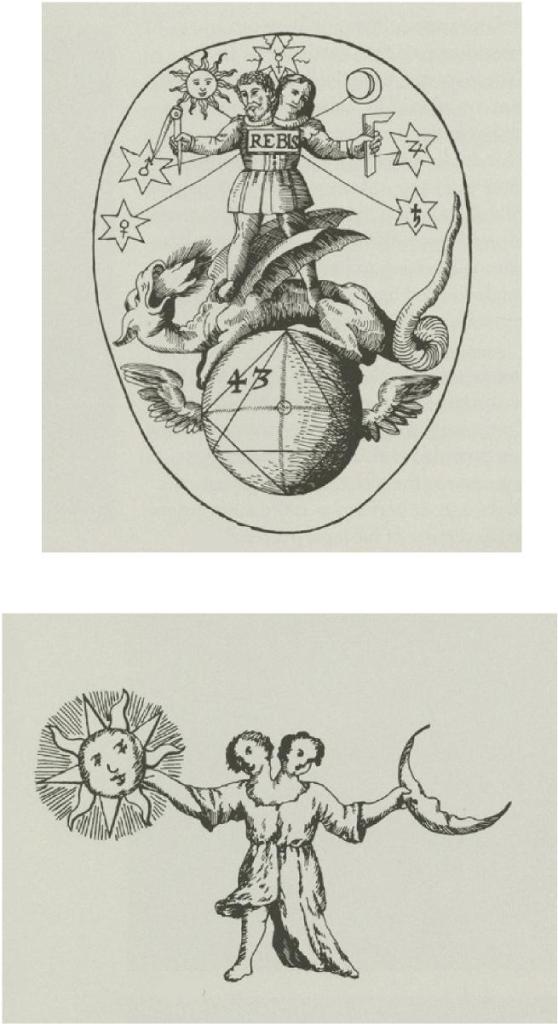
Both the androgyne and the hermaphrodite represent a common idea expressed in medieval and Renaissance alchemy by the figure of the “Rebis” (from the Latin res bina, “double matter”), depicted as a double-headed figure . The Rebis was the end product of the “Great Work” in which opposing qualities were reunited. This “Chemical Wedding” was a union of opposites: hot and dry sulphur and cold and moist mercury where the color red represented the male and the color white represented the female parts. Another common element in the symbolism was the depiction of the Sun (male) and Moon (female) above, or in the hands of the figure.

The androgynous figure does represent a kind of marriage in religious, metaphysical and
alchemical thought but the idea is not a social one. It is an ontology or more properly, a
pneumatology, in which the psychic nature of the individual is represented as two “souls” which
are reflexions of the role of humans as mediators between the world of the senses and God. To
achieve salvation the lower soul must be subordinated to the higher thus revealinig the Divinity
within us. In the eastern traditions this is referred to as “non-attachment”.


The social ideas of early humans underwent a transformation in Neolithic times with the
emergence of writing and the breakdown of tribalism in certain parts of the world. What is
essentially a social identity becomes an individual one. Writing allowed a measure of detachment which made these older ideas conscious for the first time but which turned them into religious doctrines and practices which came to replace the older unselfconscious tribal values. The religion of the city state could serve as a new form of tribe with more explicit beliefs and written laws. Most of the ideas and artistic concerns of the world’s major religions have roots in the tribal world but the emphasis has been transferred to the individual who must achieve salvation (rather than rebirth) through the religious teachings. The older idea of rebirth via reconnection to the body of one’s ancestors is abandoned in favor of personal resurrection. Resurrection in God made sense to newly detribalized peoples, one of the reasons that the major religions were successful in converting people from a more ancient way of life. God the Father came to replace the First. Ancestor and the religious community (the body of Christ) replaced the social body. The image of the androgyne in later periods reflects these changes.

Read here the full paper

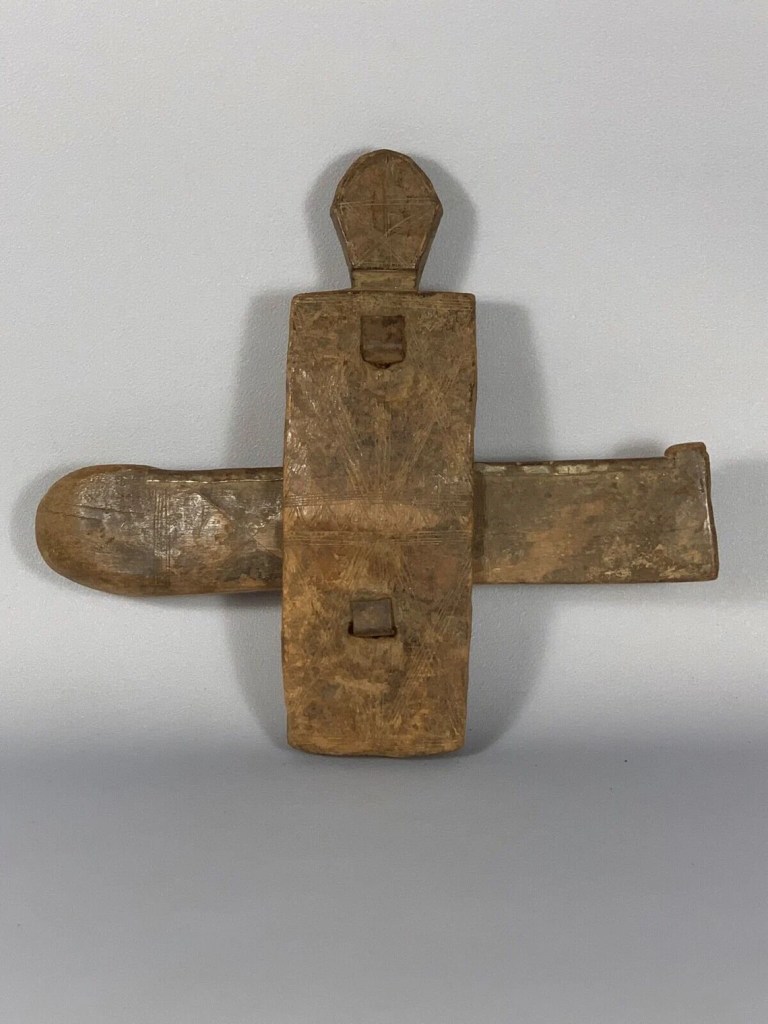
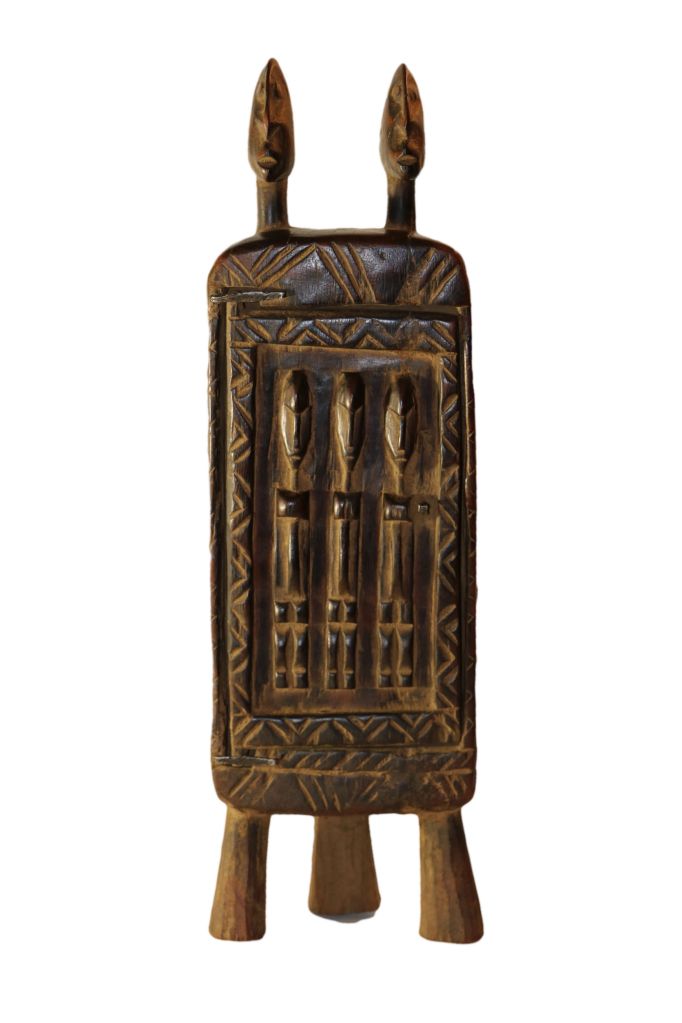
Dogon Medicine cabinet


Endless Divine Bliss

The two Wings to Endless Divine Bliss: Purify your ego and keep on the Path respecting everybody rights with great Patience.

The Titmouse and the Dove (Tale)

 Tell me how much does a snowflake weigh? the Titmouse asked the dove. “Nothing else but nothing,” was the reply.

And the Titmouse then told the dove a story: “I was on the branch of a fir tree when it started to snow. Not a storm, no, just like a dream, gently, without violence. Since I had nothing better to do, I started counting the snowflakes that fell on the branch where I was standing. 3,751,952 fell. When the 3,751,953 fell on the branch (nothing else but nothing, as you said), it broke.” With that, the titmouse flew away.

The dove, an authority on peace since the time of a certain Noah, thought for a moment and finally said to herself: “Perhaps there is only one person missing for everything to change and for the world to live in peace

The Body is Like Mary

The Body is Like Mary

The body is like Mary, and each of us has a Jesus inside.
Who is not in labour, holy labour? Every creature is.

See the value of true art, when the earth or a soul is in
the mood to create beauty;

for the witness might then for a moment know, beyond
any doubt, God is really there within,

so innocently drawing life from us with Her umbilical
universe – infinite existence …

though also needing to be born. Yes, God also needs
to be born!

Birth from a hand’s loving touch. Birth from a song,
from a dance, breathing life into this world.

The body is like Mary, and each of us, each of us has
a Christ within.

 – Mevlana Jalaluddin Rumi

“Quid tourmenta contemplaris?
nunquid mundo sat grauaris blande mi animule?
trabs haec crucis est virilis
nec corona puerilis:
cresce prius pariuule”
What torments do you contemplate? Is it enough for the world to go down gently, my soul? This beam is a manly cross nor a child’s crown: grow a little first ( Arma Christi)

The archetypal figure of the “Divine Child” has great importance in myth and psychology. The child archetype is an emanation from the collective unconscious, meaning that “divine” child figures arise from it, in miraculous births .

A child represents the “potential future”). Within us, the Divine Child represents “the preconscious, childhood aspect of the collective psyche”, meaning content of the collective unconscious that is not yet integrated with ego consciousness.

The Divine Child is a “symbol of unity” to be born from the tension of opposites , thus giving hope of change for the better. Hence he is a savior figure who promises to provoke integration and redeem us.

But the Divine Child does more than represent potential: His coming actually initiates the individuation process because of the incarnation.

The Divine Child is a numinous symbol resulting from this moment, representing the wholeness that can achieved from it. Since in this moment humans feel the divine, it is only natural that it will be mythologized, historicized, and celebrated through a sacred holiday.

When unconscious content rises up, it needs to be recognized and accepted by ego consciousness in order to be integrated and embodied as soul.

Thus, when the Divine Child appears he must be recognized, accepted, and adored.

In the Christmas story, we see this process at work in the accounts of the adorations of the magi and the shepherds, as well as the chorus of angels (Corbett 1996, p. 149). This also appears to be happening when the fetus John the Baptist leaps in his mother’s womb just as the pregnant Mary appears before John’s mother Elizabeth (Lk 1:41).

When confronted with such powerful unconscious material, ego consciousness will suffer. When the Divine Child appears, inevitably he will clash with “the establishment” of our ego consciousness – the Pharisees, scribes, priesthood, and Romans of our self – which will oppose and reject him in order to preserve the status quo (i.e., the ego’s dominant position).

This is why in the “birth of the hero” mythological motif the special child is abandoned back to nature (i.e., back to the unconscious), often to be brought up by animals or otherwise in primitive conditions.

This same process is reflected in the story of Herod and the massacre of the innocents and the flight to Egypt. Herod, the reigning King of the Jews, fears Jesus as a threat to his kingship; he and the Romans are ego consciousness running rampant. Such is the precariousness of individuation.

But the nature of culture heroes is to overcome this opposition in order to bring benefits to humankind, including higher consciousness.  Accordingly, the child-hero inevitably breaks free and evolves toward independence, and so in the “birth of the hero” motif he is often described as gaining in wisdom and accomplishing extraordinary deeds at a young age, like Jesus.

Man of Sorrows:

The various versions of the Man of Sorrows image all show a Christ with the wounds of the Crucifixion, including the spear-wound. Especially in Germany, Christ’s eyes are usually open and look out at the viewer; in Italy the closed eyes of the Byzantine epitaphios image, originally intended to show a dead Christ, remained for longer. For some the image represented the two natures of Christ – he was dead as a man, but alive as God.

The soul of the mystic, Rûmi teaches us, is similar to Mary: “If your soul is pure enough and full of love enough, it becomes like Mary: it begets the Messiah”.

And al-Halláj also evokes this idea: “Our consciences are one Virgin where only the Spirit of Truth can penetrate

In this context, Jesus then symbolizes the cutting edge of the Spirit present in the human soul: “Our body is like Mary: each of us has a Jesus in him, but as long as the pains of childbirth do not appear in us, our Jesus is not born” ( Rumi, The Book of the Inside, V).

This essential quest is comparable to suffering of Mary who led her under the palm tree (Koran XIX, 22-26): “ I said:” 0 my heart, seek the universal Mirror, go towards the Sea, because you will not reach your goal by the only river! ”

In this quest, Your servant finally arrived at the place of Your home as the pains of childbirth led Mary towards the palm tree “(RÛMi, Mathnawî, II, 93 sq.)

Just as the Breath of the Holy Spirit, breathed into Mary, made him conceive the Holy Spirit, as so when the Word of God (kalám al-haqq) enters someone’s heart and the divine Inspiration purifies and fills his heart (see Matthew V, 8 or Jesus in the Sermon of the Mountain exclaims: “Blessed are pure hearts, for they will see God! “) and his soul, his nature becomes such that then is produced in him a spiritual child (walad ma’nawî) having the breath of Jesus who raises the dead.

Human beings,” it says in Walad-Nama ( French translation, Master and disciple, of Sultan Valad and Kitab al-Ma’ârif  the Skills of Soul Rapture), must be born twice: once from their mother, another from their own body and their own existence. The body is like an egg: the essence of man must become in this egg a bird, thanks to the warmth of Love; then it will escape its body and fly into the eternal world of the soul, beyond space.

And Sultan Walad adds: “If the bird of faith (imán) is not born in Man during its existence, this earthly life is then comparable to a miscarriage.

The soul, in the prison of the body, is ankylosed like the embryo in the maternal womb, and it awaits its deliverance. This will happen when the “germ” has matured, thanks to a descent into oneself, to a painful awareness: “The pain will arise from this look thrown inside oneself, and this suffering makes pass to beyond the veil. As long as the mothers do not take birth pains, the child does not have the possibility of being born (. Rumi, Mathnawî, II, 2516 sq.) (…) My mother, that is to say my nature [my body], by his agony pains, gives birth to the Spirit … If the pains during the coming of the child are painful for the pregnant woman, on the other hand, for the embryo, it is the opening of his prison ”(Ibid., 3555 sq)

Union with God, explains Rûmi, manifests itself when the divine Qualities come to cover the attributes of His servant:

God’s call, whether veiled or not, grants what he gave to Maryam. 0 you who are corrupted by death inside your body, return from nonexistence to the Voice of the Friend! In truth, this Voice comes from God, although it comes from the servant of God! God said to the saint: “I am your tongue and your eyes, I am your senses, I am your contentment and your wrath. Go, for you are the one of whom God said: ‘By Me he hears and by Me he sees!’ You are the divine Consciousness, how should it be said that you have this divine Consciousness? Since you have become, by your wondering, ‘He who belongs to God’.

I am yours because ‘God will belong to him. Sometimes, I tell you: ‘It’s you!’, Sometimes, ‘It’s me!’ Whatever I say, I am the Sun illuminating all things. “(Mathnawî, I, 1934 sq).

Once the illusion of duality has been transcended, all that remains in the soul is the divine Presence: the soul then finds in the depths of its being the divine effigy.

It has become the place of theophany. This is what Rumi calls the spiritual resurrection: “The universal Soul came into contact with the partial soul and the latter received from her a pearl and put it in her womb. Thanks to this touch of her breast, the individual soul became pregnant, like Mary, with a Messiah ravishing the heart. Not the Messiah who travels on land and at sea, but the Messiah who is beyond the limitations of space! Also, when the soul has been fertilized by the Soul of the soul, then the world is fertilized by such a soul “( Ibid., II, 1184 sq.).

This birth of the spiritual Child occurs out of time, and therefore it occurs in each man who receives him with all his being through this “Be!” that Marie receives during the Annunciation: “From your body, like Maryam, give birth to an Issa without a father! You have to be born twice, once from your mother, another time from yourself. So beget yourself again! If the outpouring of the Holy Spirit dispenses again his help, others will in turn do what Christ himself did: the Father pronounces the Word in the universal Soul, and when the Son is born, each soul becomes Mary (Ibid., III, 3773.)

So Jesus can declare: “O son of Israel, I tell you the truth, no one enters the Kingdom of Heaven and earth unless he is born twice! By the Will of God, I am of those who were born twice: my first birth was according to nature, and the second according to the Spirit in the Sky of Knowledge!  » (Sha’ranî, Tabaqat, II, 26; Sohrawardî, ‘Awarif, I, 1)
The second birth corresponds to what we also gain in Sufism as the “opening (fath) of the eye of the heart“: “When Your Eye became an eye for my heart, my blind heart drowned in vision ; I saw that You were the universal Mirror for all eternity and I saw in Your Eyes my own image. I said, “Finally, I found myself in His Eyes, I found the Way of Light!” (Rumi, Mathnawî, II, 93 sq.)

This opening is the promise made by God to all those who conclude a pact with the spiritual master, pole of his time, like the apostles with Jesus or the Companions when they pledged allegiance to Muhammad:God was satisfied with believers when they swore an oath to you under the Tree, He knew perfectly the content of their hearts, He brought down on them deep peace (sakina), He rewarded them with a prompt opening ( fath) and by an abundant booty  which they seized ”(Coran XLVIII, 18-19).(The abundant loot indicates Divine Knowledge (mari’fa).

Read more: Jesus and the Sufi Traditon

We can find the same Symbol of  Divine Child, Peace and Mercy in Islam and Sufism:

Bism ‘Lláh al-Rahmán al-Rahim

Bism ‘Lláh al-Rahmán al-Rahim

In the Name of God, the Compassionate, the Merciful

Bismillah

Now the letter ب  ba’ of the bismillah (meaning in)   implies connection, and it is itself connected (directly) to God (Llah); the word ‘Name” (Ism) does not separate them, since it is identical with the Named according to the Sufis as well as most of the Ash’aris.

Note: When the bismillah اسم الله‎, is written in Arabic, the letter ba’ ‘in’, is directly connected to the word ism, ‘Name’. ب س م ل    What the Shaykh al-Alawi is saying is that since the Name (Ism) is identical with the Named, i.e. God Himself Ism does not really separate the letter bá’ from the Divine Name Allah. الله

Thus the beginning is in God (bi’llah): from Him all begins and to Him all returns.

Traditions affirm that everything in the Book is encapsulated in the words ‘In the Name of God, the Compassionate, the Merciful’ ; this symbolises how all things are contained in the Being of their Being-Giver; that is, that everything in them branches from what is in Him: Nor is there anything but with Us are the treasuries thereof [Q.15.21]. That the Divine Name (Allah] comes before the other Beautiful Names  symbolises the precedence of the Essence, and how the Names and   Qualities are contained in Its treasury.see Commentary on the Bismillah.

Mary, figure of spiritual achievement in Rumi’s teachings
Mary appears in several parts of the Mathnawî of Jalâl al-dîn Rûmî (ob. 1273) the great
Persian speaking mystical poet of Konya in Seldjukide Empire. She is mentioned in every of the
six volumes of Mathnawî, his huge didactic poem. However, it is in the third volume that her
figure is more developed, and additionnaly in the second. The story of Mary appears as a major
narrative of spiritual realisation, and moreover the last stages. Read here more

The Vision of Heavenly Harmony

Biological life is now thought to have appeared on this planet not long after its formation. It seems that the bacterial reeds for the process may have flown in on the tail of a cornet or meteor. Speculation is again rife about life under the surface of Mars, on jupiter’s icy moon Europa and indeed anywhere the sacred substance of liquid water is known to exist.
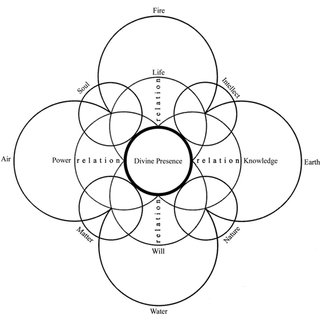
(Earth Matters) Plant growth is governed by the Fibonacci sequence, which can be understood as a law of accumulation. The role of the Fibonacci sequence in the growth of plants is an intriguing example of the unifying order behind all creation. These patterns exist at all levels and permeate the universe, reminding us that the same swirling energy is shaping, sunflowers, whirlpools, spinning galaxies, and our own DNA.
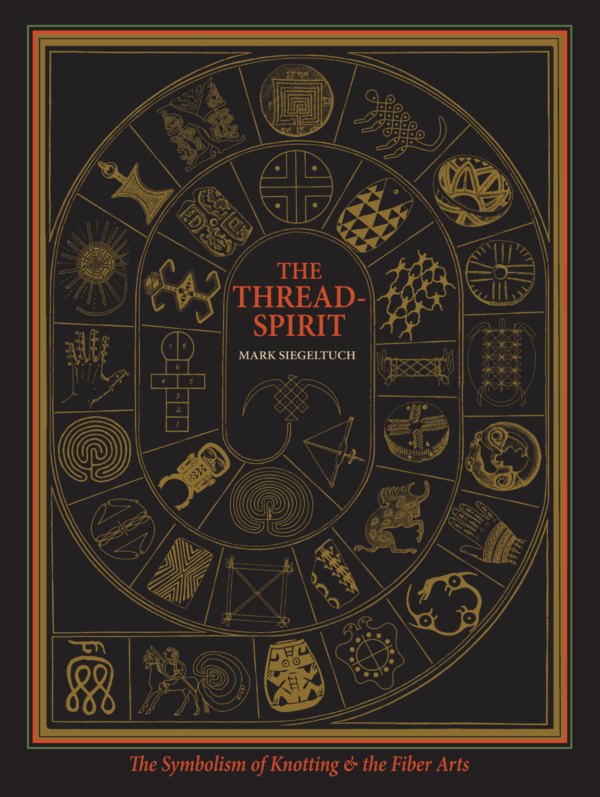
The science of the cosmos has changed irnmeasurably since the (Greek and medieval vision of circles of planetary spheres. But with great cosmic schemes out of fashion, and with dragons and unicorns dismissed, the Earth has become a modern mystery.

No modem theory exists to explain the miracle of conscious life nor the cosmic “coincidences” which surround our planet. Why do the Sun and Moon appear the same size in the sky? There are ancient answers to such questions, however, and these invoke liberal arts like music and geometry. See Geometry of Human Life ,Geometry of pants, and Geometry of zoology

This suggests there is fundamental relationships between space, time and life which have not yet been understood or forgotten. These days we scan the skies listening for intelligent radio signals and looking for remote planets a little like our own. Meanwhile, our closest planetary neighbours are making the most exquisite patterns around us, in space and in time and no scientist has yet explained why. Is it all just a coincidence or do the patterns perhaps explain the scientists’s educated ignorance without wisdom?

– Dance of Planets:

Ujjwal Suryakant Rane from India says :” A picture is worth a thousand words and an animation? . . . probably as many pictures! That’s what this channel uses – graphics and animation – to deliver core concepts in Physics, Math, Engineering and Astronomy. Such geometric/graphical approach results in an intuitive and deeper understanding, that is retained better. Used in classrooms and in one to one sessions at levels ranging from middle school to engineering, this approach yielded success in both India and the United States over a period of 24 years.

I f you want to learn more look here

  • The kiss of Venus

Venus and Earth form a beautiful Spirograph pattern with their orbits. The pattern of Venus around the Earth portrays a 5-petalled rose when viewed from the geocentric position. This beautiful pattern reveals the essence of Venus in her role of celestial guardian of love and beauty to those of us here on Earth. Have a look…

Other than the Sun and Moon, the brightest point in the sky is Venus, morning and evening star. She is our closest neighbour, ldssing us every 584 days as she passes between us and the Sun. Each time one of these kisses occurs the Sun, Venus and the Earth line up two-fifths of a circle further around the starry zodiacal circle so pentagram of conjunctions is drawn. Seen from Earth the Sun moves round the zodiac white Venus whirls around the Sun drawing an astonishing pattern over exactly eight years (99.9%) (01 thirteen Venusian-years (99_9%)). Small loops are made when Venus in her dazzling kiss seerns briefly to reverse direction against the background Stars (shown below as seen from Earth).

Notice the Fibonnacci numbers we have just met, 5, 8 and 13. The periods of Earth and Venus are also loosely related as 1.618:1 (99.6%). This `phi’-fold nature of Venus and Earth’s dance extends to their closest and furthest distances from each other. Opposite we see Venus’ perigee and apogee defined by two pentagrams, 2.618:1 (99.9%). All these diagrams also apply to Venus’ experience of Earth.

If you want more look Here

Modern astronomers peer at distant galaxies, but know that they have lost track of human meaning. We are here concerned with what is seen and experienced within our local region of space; and have argued that, using modern observations to four or even five-figure accuracy, we are in some way re-gaining a Pythagorean/Platonic view. Twenty-five centuries ago, Greeks took the word Kosmos which meant beauty, as in ‘cosmetic’, and applied it to the universe. Heracleitos the ancient Greek philosopher wrote, in that century:
‘For those who are awake the cosmos is one and common, but those who sleep turn away each into a private world. We should not speak and act like sleeping men.’

Herakleitos lived circa 545BC to 485BC – exactly at the time Greek civilisation began to rise towards its Golden Age. But Herakleitos was not a great statesman or soldier or sculptor; he looked at the world without wanting to change it or bring it under his control or make beautiful stone images of it. He simply wanted to understand it. So he thought about it: how things come to be and how things pass away…and he saw that nothing is really separate at all – all matter, everywhere, simply changes form, in an endless cycle of transformation. What we experience as individual forms are but fleeting interlocking brush strokes in a picture too big for our normal human vision to grasp. Herakleitos, though, did grasp this mystic vision of unity. And he intuitively understood that every brush stroke in the picture can only occur if there is an underlying unseen pattern. This pattern he called the Logos. Observing that human problems and failures are caused by living separately, and thus out of harmony with Logos to the attention of all. The methods he chose were the methods anyone might resort to when describing something previously unknown: similes, riddles, metaphors, aphorisms, allegories and…when those failed, browbeating and exasperated criticism! Herakleitos’ own words are the starting place as the reader is taken on a voyage of discovery through philosophy and physics, through time and space, through human behaviour and consciousness – to arrive at a new vision of the nature of reality.. Look here Herakleitos : Logos Made Manifest

Read here: Heraclitus on Logos Language, Rationality and the Real; and DE BETEKENIS VAN LOGOS BIJ HERAKLEITOS VOLGENS DE TRADITIE ( Dutch)

The Logos of the Greek is the same as the Viritas of Hildegard of Bingen: the greening power of the Divine:

Read Here King Charles : Harmony – A New Way of Looking at Our World and King Charles III , Green Man and Viriditas

Many legends and mythologies are full of admirations for these beautifull “coincidences” of the Divine Logos Look at :

About Venus, Virgin Mary and “The Pentacle” of Sir Gawain

or at Mythology, Legends and Fairy Tale of Friesland

or look at Mythology of Easter: Resurrection

Evidence of Minoan astronomy and calendrical practices

An acclaimed geometer explores the fundamental connections between space, time, and life that have not yet been fully understood.

A most unusual guide to the solar system, A Little Book of Coincidence suggests that there may be fundamental relationships between space, time, and life that have not yet been fully understood. From the observations of Ptolemy and Kepler to the Harmony of the Spheres and the hidden structure of the solar system, John Martineau reveals the exquisite orbital patterns of the planets and the mathematical relationships that govern them. A table shows the relative measurements of each planet in eighteen categories, and three pages show the beautiful dance patterns of thirty six pairs of planets and moons. Read Here

The essential pocket guide to the marriage of the Sun and the Moon. Read here

The principles of the universal order are traced through the religiophilosophical reasoning of how Being emerged from non-Being, and how original Unity gave birth to an inexhaustible multiplicity. Here explore specifically the generative “move” from unity to triplicity and quadrature, seen as a central cosmogonic paradigm of simultaneous proliferation and synthesis. The move is explored in a variety of contexts and manifestations.

The first trace of this move unfolds the metaphysial order, which is then traced in the cosmic order, which is in turn traced in the architectural order.

Spatially, the move refers to the deployment of space from a central point along the three axes of what the French philosopher and metaphysician René Guénon describes as the “threedimensional cross.” This study shows how this conception formed the cornerstone of spatial sensibility in premodern Islam. It also shows how the manifold manifestations and interrelatedness of this primary spatial order unfold a complex web of meanings and intricate patterns of correspondence that at once govern the world and materialize the order inscribed in the divine exemplar…. Read more here: Cosmology in Sufism and Islam

The classic study of the cosmological principles found in the patterns of Islamic art and how they relate to sacred geometry and the perennial philosophy. Read here

Science vs. Religion: The Debate Ends

By Abdulla Galadari

Science and religion seem to have been at odds with each other throughout history. This has
affected the course of humanity and how society has prejudice towards either science or religion. Atheist scientists believe in what they know because they believe in reason and think that theists are unreasonable. The paper brings the problems facing humanity today between science, religion, and secularism within societies. The followers of each could be fanatics of their own group.

The paper tries to reconcile the debate between atheists and theists, under the microscope of science. This study makes an analogy of G-d and gravity. It shows that the power of reason used by scientists to deduce gravity is the exact same reasoning that theists use to believe in G-d. The study goes beyond philosophical arguments and travels deep into the core principles of the human intellect of scientists and theologians to understand what they believe. It unravels the truth behind the reasoning of why different humans believe in what appears to be completely different things. The study uses elements of modern science and its cosmological worldview, such as singularity, spacetime, black holes, and quantum physics. It shows parallelism of modern scientific theories with various world Scriptures, such as Hindu and Islamic texts. This study does not argue the truth of any specific religion, but rather argues
the existence of G-d from a broader perspective, using the exact same principles scientists use to formulate their worldview of the universe. This study shows the rationality and irrationality in the argumentative battle between science and religion. It attempts to end the debate and dispute between science and religion by understanding the truths behind them. It concludes that anyone who believes that the other is wrong is irrational, and that in reality science and religion complement one another. A theologian must also be a scientist, and a scientist must also be a theologian Read Here

On Self knowledge, Divine Trial, and Discipleship

By Mukhtar Ali

This paper examines one of the key themes of Islamic spirituality, self-knowledge (maʿrifat al-nafs) and its relationship to divine trial and discipleship. Knowledge of the soul has been the focal point for Islamic philosophers, mystics and sages as they have included it in every discussion on spirituality. Self-knowledge constitutes knowing how to discipline and transform the soul (nafs), and thereafter, actualize the higher human faculties of the heart and intellect. Because the soul is illusive and recalcitrant in nature, spiritual teachers have devised various stratagems to discipline and rectify the soul.

Sufi in a Landscape

There are two aspects to that training, human and divine.

On the human side, one disciplines himself through the intellectual faculty and/or is trained by an expert who is considered the spiritual physician, shaykh or sage (ḥakīm). On the divine side, God is the teacher who trains His servant through bounties or trials. The trial is the mirror through which the believer sees his own soul, rectifies his behavior and awakens to God-consciousness. Read Here

Remarks on Evil, Suffering,and the Global Pandemic


Remarks on Evil, Suffering, and the Global Pandemic*
Seyyed Hossein Nasr

*This piece is an edited transcription of Professor Nasr’s keynote address delivered at the conference upon which the present volume is based: In From the Divine to the Human: New Perspectives on Evil, Suffering, and the Global Pandemic, edited by M. Faruque and M. Rustom. London and New York: Routledge, 2023.


The general problem of evil is a subject about which many books have been written for thousands of years and much of great depth has been said already. It also became very critical with the rise of modernism in the sense that a lot of people in the West and even in Western Christianity in general have left religion because they could not answer the question, “If God is good, why is there evil in the world which is created by Him?
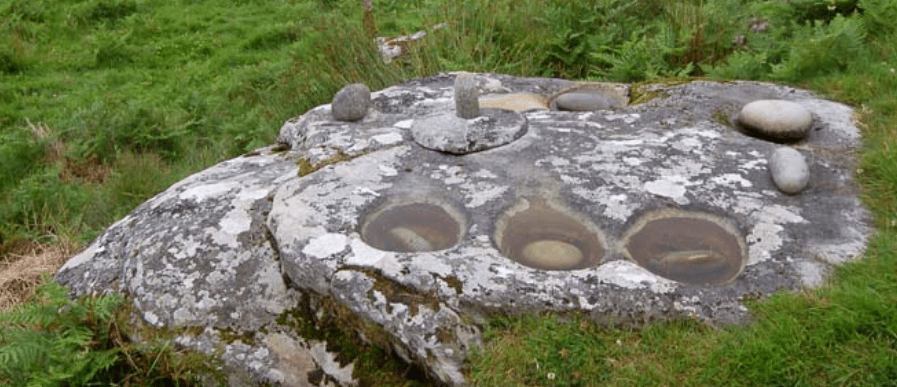
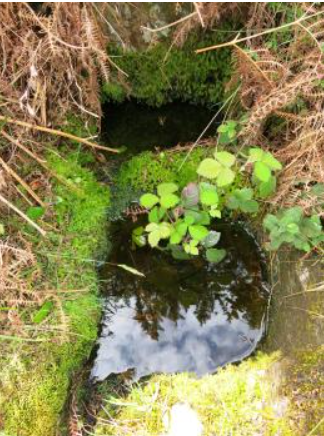
Many variations of this question thus permeate both Western philosophy and Western literature, not to speak of Christian theology. The Islamic perspective on the problem of evil is in general very different from what one finds in the mainstream in the West. You cannot find Muslims who turn against God because of the presence of evil in the world; and the few who do are Westernized Muslims who think that to be fully modernized and Westernized, one should also have the same “pains” in facing the world from which many Westerners suffer. Such Muslims do not turn to their own tradition’s intellectual and spiritual resources to deal with this issue, such as the remarkable and also diversified discussions in the writings of al-Ghazālī, Fakhr al-Dīn al-Rāzī, Ibn Sīnā, Ibn ʿArabī, and others.

These authors always deal with the problem of evil on the basis of their complete acceptance that God is real and that He is good. Thus, their attempts to solve the problem of the existence of evil did not affect their belief in the reality of God. With these words in mind, allow me to now delve into this very contentious and difficult issue.
First of all, let us ask the question, “What is evil?” Let me point out that in the Islamic tradition, a common word for “evil” is the Arabic term qubḥ; the word that is opposed to it is ḥusn or “goodness.” But these terms, moreover, also mean “ugliness” and “beauty,” respectively. Thus, from the Islamic point of view, you could say that goodness is that which is beautiful and evil is that which is ugly.


The dualism of pre-Islamic Iranian religions such as Zoroastrianism, that is, dualism between good and evil as two independent realities, between Ahura Mazda and Ahriman, works perfectly well on the ethical and practical level, but not so on the metaphysical level, for there cannot be two Divine Principles. This explains why there have been certain metaphysicians and Sufis in the Islamic world who have gone so far as to say that there is no evil in the ontological sense. Rūmī, for example, speaks about this issue and defends it; but one must understand what he means. Since the Divine, the Absolute (al-muṭlaq), who is also the All-Good, is ultimately all that there is and there is no evil in It, evil as such does not exist. This is what Rūmī and others mean when they say there is no evil. In the Absolute, there is only the Absolute; there is nothing else. A famous Hadith tells us that “God was and there was nothing with Him” (kāna Allāh wa-mā kāna maʿahu shayʾun). And to this saying the Islamic metaphysicians add, “And it is now as it was” (wa’l-ān kamā kān ). So evil does not have the same ontological basis as does goodness. From the metaphysical point of view, there is therefore no equivalent ontological juxtaposition between good and evil.

Nevertheless, if there is no evil per se in the absolute sense, that does not negate the fact that evil is real on the level of relative existence, which is that of this world. Otherwise, the Quran would not affirm the reality of some form of evil on practically every other page, such as when it warns man not to perform evil acts. Evil is as real as the shadow under a tree beneath which a person sits in order to protect himself from the sun. This shadow does have an ontological reality, but it is essentially the absence of light. On the plane of the relative, evil is as real as we are as fallen human beings; but on the level of the Absolute, it is as unreal as we are.
Now, there is also this point to add about which the Sufis have always spoken, and which is the most important way to understand why there is evil. If we conceive of God as Light—after all He Himself says that He is the “Light of the heavens and the earth” (Q 24:35)—and we conceive of Him as the Light of lights (nūr al-anwār), as we move away from It, the illumination of this Light becomes less and less, and darkness becomes more and more pervading until we get so far from the source of Light that there is only darkness. But darkness is not a substance, as is light. Darkness is simply the absence of light. Evil is seen in Islamic inner teachings in this way. Only God is Good, but He also creates. Creation implies separation—separation from the Source—and that separation means the gradual weakening of the Light of the Divine Sun. The crystallization of this separation is what we call “evil.” To understand in depth this one principle is to understand everything about the root of the existence of evil in this world of separative existence.

Satan being judged by Christ as the apostles pray for him. From Le Livre de la Vigne nostre half 15th century. France. Bodleian Library MS Douce 134 Seigneur. First fol. 67v.


Ultimately, evil is the result of separation from the good: Dante said so beautifully in the Divine Comedy that evil is separation from God. On the human plane, being the ordinary human beings that we are, we live in separation from God, which is why evil is as real as we are. If there were no separation from God, there would be no creation and no evil. Creation implies limitation—limitation because of separation from that which is Absolute and Infinite, hence limitless. From this separation there arises evil in various forms.

We must at the same time be careful not to trivialize evil, which is one of the great errors of modernism. It not only relativizes both good and evil in denying the Absolute as well as the relatively absolute, but often denies the ultimate significance of both by relating them simply to social norms and the like; that is, rather than denying evil on the level of the Absolute, this tendency in question seeks to deny it on the level of the relative. Yet denying evil on the level of relativity is like absolutizing the relative, which is of course the cardinal sin of modern atheism from a theological point of view and an error from the metaphysical point of view.

I have in mind here those people who say that everything is relative, except of course their statement that everything is relative. How remarkable it is that Islamic thought, even before modern times, was fully aware of the problem of relativizing the relative which derives its reality from the One who alone is Real, and also the problem of confusing the relative with the Absolute. This view is totally different from what some sages such as Frithjof Schuon have called, as just mentioned, the “relatively absolute,” namely the manifestation of the Absolute in a relative way that retains something of that absoluteness in it. An example of this reality would be the Quran itself. There is something absolute about it as revelation coming from God, the Absolute. There are no other books that compare to it; yet the Quran is not the Absolute as such, but a reality that eflects the Divine Reality and the Will of God. Only God is the Absolute.

Allow me to come back to the question of beauty and ugliness, for it is not a superficial matter. One of the most remarkable features of traditional civilizations is the presence of so much beauty and so little ugliness. The stable in which Christ was born was much more beautiful than any one of these modern churches built on M street in Washington, DC; there is no doubt about it. That is why we go and visit those old sites which were simple, even stables where horses or animals were kept.
This idea of the centrality of beauty was especially strong in Islam, where you have the famous Hadith, “God is beautiful, and He loves beauty.”So our whole attachment to God involves God’s beauty and also love. If you love God, you must love what God loves, and thus you must love beauty. Islamic civilization was remarkably successful in creating things of beauty, from the carpets on which people sat to the minarets from which the call to prayer was made, and nearly all the objects, buildings, and surfaces in between.

From the Islamic point of view aesthetics and ethics are not separated from each other; although evil has to do with ethics, whereas ugliness has to do with aesthetics, the two are closely related. This is totally different from the view that is now prevalent in many religious circles in the West and even to some extent in some parts of the Islamic world where Muslims have done a good job in matching Westerners in building ugly mosques, not to speak of other elements from inte-rior design to everyday utensils. Traditionally, goodness was also associated with the beauty of the soul and evil with its ugliness. Even in English when one says, “I did something ugly” or “This was an ugly act,” it refers to an evil act and not a
good one.
A comment is also in order concerning our responsibility before evil. In Islam, we are always responsible for our actions. If something happens for which we are not responsible, we will not be judged by God for its consequences. The question of responsibility involves not only the act itself but also the conditions in which the act is performed. What is evil? It is what we know to be evil and nevertheless commit with our free will. If we had no free will, we could not commit evil. So the question of responsibility in relation to evil is very important, and this fact necessitates saying something about knowledge. Without knowledge, there cannot really be evil; we have to know what is good and bad before being responsible for our actions, which is why all sacred scriptures emphasize this point so much. We have to know what God wants of us. Without this knowledge, one would be innocent; ignorance is innocence in this sense. However, we are also required to try to not be ignorant, which takes us back to responsibility.

I now turn to the question of suffering. One might say that suffering comes ultimately from separation from God. When we were in Paradise, close to God, we did not suffer; suffering comes from separation from who we really are, from our fiṭra or primordial nature. We have fallen on earth and have fallen away from who we are really, but nevertheless we carry something of that reality within us.
The whole of the religious life is based on us seeking to return to the real us, to how God created us. Suffering thus has to do with a loss of identity in a sense, more than anything else. That is the height of it. With it comes all other forms of suffering human beings experience: physical pain, psychological pain, economic suffering, wars, pestilence, etc. There is, however, a very important difference in the use and interpretation of this universal human experience in the religious life, and this reality is important to mention these days because, despite the prevalence of secularism for many Westerners, Christianity is still the dominant religion and
Christian ethics and ideals are still prevalent even among secularists.
Christ suffered in a way that the Prophet of Islam did not. The Prophet also suffered, but Christ suffered on the cross. He suffered excruciating pain, and the image of Christ in the Christian mind—the cross being the sacred symbol of Christianity— is that of Christ suffering. Has one ever seen a picture of Christ laughing on the cross? The famous paintings of Velazquez, Michelangelo, or even Giotto are scenes of Christ’s life where Christ is smiling. But on the cross He is suffering; He is in pain, sometimes with His head down. And so, suffering plays a special religious role in Christianity that it does not in Islam. Moreover, Buddhism shares this perspective to some extent with Christianity, paying specific attention to the fact that this world is characterized by suffering, although images of the Buddha himself are characterized by the state of bliss rather than pain. For Muslims, therefore, suffering does not pose the same theological significance as it does for Christians, although it is considered to be a part of human life.
Some people suffer more, some less; some people know why they suffer, some do not; and so on. In any case, we must remember that ordinary human beings only know so much of the trajectory of their lives—they do not really know what came before and they do not know what is going to come after. We cannot judge our relationship with God and His Presence or the lack thereof in our lives only in relation to what we remember of the acts that we have performed or not performed, since this type of awareness concerns only a small part of the trajectory of our lives that extends to before our coming into this world and after our departing from it.
When Muslims think of the Prophet, they think of all the difficulties he had, all the problems that he and his Companions faced. But they do not identify his life essentially with suffering. The Prophet came to bring knowledge of the One (lā ilāha illā’Llāh), as he said, “Say, ‘There is no god but God,’ and be saved.” That is it.
That was his message. He came to the world to reveal that basic truth. Everything else in Islam comes from this one teaching concerning the reality of God and our relation to Him.
Spiritually speaking, suffering should always be an occasion for us to draw closer to God. The word dard in Persian, which can mean “pain” or “suffering,” was often used by Sufis in a positive sense. There are many Sufi texts about this matter, and there is even a famous Sufi poet of India whose takhalluṣ or penname was Dard. Suffering should always have a spiritual element connected to it. We should accept pain and suffering as part of our destiny and should not rebel against Heaven because we suffer and question God by asking why if one is good do bad things happen to him or her, and the like. This type of attitude is prevalent in the modern world, but it is an error from the Islamic point of view. God knows best— He has created us. Suffering should bring us closer to Him.
This brings me to the final issue, namely the pandemic. The pandemic is a very concrete lesson about what I have already discussed. From the human point of view, yes the pandemic is evil. But from the point of view of the viruses that created the pandemic, it is not evil at all because it is the expansion of their kingdom. And I hate to say this, but with respect to the preservation of the natural environment, the pandemic has not been negative. Yes, we are sad that several million people have died. Yet we should also look at how much waste several
million people can create over a period of two years. It is very tragic to say it, but we human beings are living in such a way that our very existence is a danger to the continuation of life on earth, and the pandemic should first and foremost be a reminder to us that we are not the lords of nature. Nature can play the same game, and little viruses that mean nothing to you can outwit you and rob you years of a healthy life, leaving even the best scientists unable to do something about them. In helping us to realize our limited power over nature, the experience of the pandemic should also remove some of the hubris of the modern natural sciences which has percolated into the whole of modern society. It should bring about a sense of humility. This triumphalism which has been wed to modern science since before the time of Galileo in the early 17th century needs to be changed, as it is very dangerous for human life and the future of the earth.
With this humility should come an awareness of how precious life is, of how we usually take everything for granted. Three years ago, when we walked in the street we did not constantly think about viruses, wear masks, wash our hands, wipe down surfaces, etc. The suddenness of the pandemic alone should make us more humble and should make us realize that life is not to be taken for granted. It is one of the great sins of modern man that he takes existence itself and all the blessings that God has given to him for granted, thinking that it is his right to exist and have blessings, and always wanting more. He should rather ask himself these questions:“Did I create myself?” No. “Can I make my own liver?” No. “What did I do that makes me who I am?” Nothing. Yes, he eats to make his body grow; but even when he eats, he does not know how his body grows. The cells in his body that are absorbing the food, applying the oxygen, and so forth are not under his control; they are performing their own functions according to their nature. These observations are important to keep in mind in order to bring about within us an appreciation of the preciousness of life and along with it a sense of inwardness. You cannot have happiness by relying only on outward factors, as the outward world around you might crumble at any moment.

We have to find our joy within ourselves. “The Kingdom of God is within you,” Christ said, and the Prophet said, qalb al-muʾmin ʿarsh al-Raḥmān, “The heart of the faithful is the Throne of the All-Merciful.”
Finally, the experience of the pandemic should bring about in us greater tawakkul, greater reliance upon God and less reliance upon the absoluteness of human will and capability. This is not to say that we should not rely on the gifts which God has given to us, because the fact that we can do something itself comes from God. I use the Arabic term tawakkul, the idea of total reliance upon God, because it is so important in Islam. What is negative, what belongs to the shadows, namely the evils of the pandemic, can also bring about some good. There is nothing in life that happens from which one cannot draw a positive lesson, and happy are those whom God allows to do so.


For an exposition of this Hadith, see Seyyed Hossein Nasr, “The Heart of the Faithful Is the Throne of the All-Merciful,” in Paths to the Heart: Sufism and the Christian East, ed. James Cutsinger (Bloom- ington: World Wisdom, 2004), 32–45.

Look also: The Prayer of the Heart in Hesychasm and Sufism


Bringing the Land Back to Life

Alan Ereira talks about the wisdom of the Kogi Indians and an important new UNESCO project in the Sierra Nevada de Santa Marta in Colombia From Beshara magazine

The Guachaca River valley, where the Kogi undertook a restoration project in 2001. It is now a flourishing ecosystem where the forests have been regenerated and the water courses, which had dried up, are flowing. Image: from the video Kogi Knowledge: Learning Planet Festival, 27 January 2023
Diagram from the book Shikwakala, showing what the landscape looks like to the Kogi mamas. They see it as network of interconnecting ‘threads’ which interact at certain points to create ‘hubs’ which have particular kinds of energy. Image: from the video Kogi Knowledge: Learning Planet Festival, 27 January 2023

In 1991, in the last edition of the original Beshara Magazine, we published an article by journalist Alan Ereira about an extraordinary people living in the Sierra Nevada de Santa Marta in the north of Colombia (to read it click here). The descendants of a great civilisation which fled to the hills as the Spanish took over their lands, the Kogi had lived for 400 years in isolation, led by a class of priests called ’the mamas’. They asked Alan to help them make a film in order to communicate with us – ‘the younger brother’ – and warn us about the ecological destruction we are wreaking upon the earth. The result was a BBC documentary and a book entitled ‘The Heart of the World’. Thirty years later, the Kogi are making another attempt to communicate their wisdom, this time through a regeneration project, Munekan Masha, under the auspices of the UNESCO Bridges initiative. Alan talked to Jane Clark and Richard Gault about what it involves and the unified vision which underlies it. At the end of the article we include a video of a recent talk he gave on the project which you might want to watch before reading the interview.

Video: Kogi Knowledge: Learning Planet Festival, 27 January 2023. Duration: 54 mins

Alan Ereira with a group of Kogi mamas

Jane: It is about 30 years since we did an article on the Kogi in the last printed edition of Beshara Magazine and you made your first film about the Kogi for the BBC, From the Heart of the World.[1] So can we begin by doing a little bit of catching up. For instance, since we last spoke you have set up a charitable foundation, the Tairona Heritage Trust [/], which has enabled the Kogi to preserve their culture, and in particular, acquire more land.

Alan: Yes, we established the Trust immediately after making the film. Its job was to allow people to channel their expressions of support for the Kogi in a way that the Kogi would know about. We explored various options, and the most practical was the recovery of ancestral land and sites of importance to the Kogi, along with other things attached to it, such as money for health care and administration. But the great thing about land is that it is permanently there, whereas the rest all disappears into the soil as you spend the money.Over the years, lots of people have helped the Kogi acquire further land, including other NGOs and the Columbian government. So the area of territory has greatly expanded. What is more, the new government, which as far as I know is the first socialist government that Colombia has ever had, has just announced a massive expansion of the Tairona National Park, which gives a degree of protection to lands within the area. This includes the traditional territory of the Kogi and the other peoples of the Sierra. But it only gives a degree of protection; it doesn’t actually transfer any ownership to them, although it limits the things that can be done on the land.

Read the complete interview here

  • Message from The Heart Of The World:

Don’t Say They Didn’t Tell Us’ – MESSAGE From the  Elder Brothers (03/27/2020)

  • Voices from the Sacred Mountains

The Arhuaco indigenous peoples of the Sierra Nevada de Santa Marta, Colombia, are known for their century-long track record of environmental protection, but their cultural survival and conservation of this sacred mountain’s ecosystems are at risk. Read more here