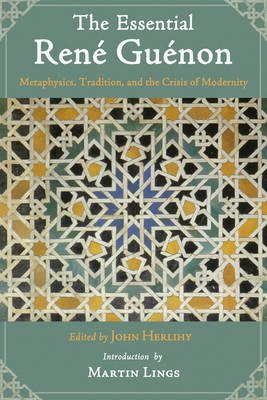
René Guénon (1886-1951) was one of the founders of the Perennialist/Traditionalist school of comparative religious thought. In a time of unquestioning belief in the dogmas of progress and evolution, Guénon issued a devastating critique of the modern world. A pioneering philosopher, he also provided the intellectual keys for a reclamation of the West’s spiritual riches through an exposition of the Eastern metaphysical doctrines. This anthology of his essential writings is divided into four parts: 1. The Modern World; 2. The Metaphysical World; 3. The Hindu World; and 4. The Traditional World. Read here
Book Review – The Essential René Guénon: Metaphysics, Tradition, and the Crisis of Modernity By Samuel Bendeck Sotillos
“It is truly strange that people ask for proof concerning the possibility of a kind of [transcendent] knowledge instead of searching for it and verifying it for themselves by understanding the work necessary to acquire it.” —René Guénon
“The civilization of the modern West appears in history as a veritable anomaly”—written in 1924, this statement typifies the prophetic eschatology of the French metaphysician René Guénon (1886-1951). At last such a work as this one has come to pass in order to bring together the magisterial and erudite oeuvre of Guénon, the founder, along with Frithjof Schuon (1907-1998), of what has become known as the “Traditionalist” or “Perennialist” school of thought. Other notable luminaries of this school were Ananda Kentish Coomaraswamy (1877-1947) and Titus Burckhardt (1908-1984). It may surprise readers unfamiliar with Guénon that he was referred to as the “Great Sufi” by a definitive sage of the nineteenth Century, Sri Ramana Mahar shi.
Coomaraswamy, the seminal art histo rian, pointed out that Guénon was not an “Orientalist” but what in India would be deemed as a “master.” Schuon affirmed that Guénon was intrinsically pneumatic or a jñānic type and stated that “On symbolism Guénon is unbeatable.” Seyyed Hossein Nasr (b. 1933) wrote the following regarding Guénon’s first book: “It was like a sudden burst of lightning, an abrupt intrusion into the modern world of a body of knowledge and a perspective utterly alien to the prevalent climate and world view and completely opposed to all that characterizes the modern mentality.”
The praise for Guénon is not limited to these statements, but is extended by deci- sive intellects and philosophers of the twentieth century. Who René Guénon was as a person is a complex question that has puzzled the curious and frustrated the trivial, yet “individualist considerations” pertaining to his person, including biography, meant little or nothing to Guénon. A remarkable point to note is that Guénon did not put forward, or even attempt to create, a “new” or “novel” theory, nor was he interested in the “originality” of his ideas. His role and significance in the modern world was to wholeheartedly illuminate the universal metaphysics of the Primordial Tradition—known as the philosophia perennis or the perennial ph losophy—“[Truth is one, and it is the same for all who, by whatever way, come to know it.” He was to re-establish its primacy for contemporaries who were authentically seeking this uncompro- mised truth that was—“in conformity with the strictly traditional point of view”—known by many different names. This will appear odd to those living in the present time as novelty, not to mention monetary gain, as he noted with mathematical precision in the work THE REIGN OF QUANTITY, are central motivating fac tors to all current activity. Contrary to the timeless and universal tradition in the present weltanschauung is the endless talk of “change” as if present-day terrestrials have realized the inherent bankruptcy of the times—“disequilibrium cannot be a condition of real happiness.” What kind of change is being suggested is not clear, yet change from the present conditions itself is surely beckoned.
The “change,” if we could so term it, was for Guénon not change in a future orientated “progress” but change for the realignment of the first principles underlying the traditional doctrines of the world’s spiritualities. In this sense, the direction of change was not going forward or even backward but points to what is rooted in the immutable and eternal. Guénon suggested that if those in the current era could perceive the per- ilous end of “progress,” it would unequivocally come to a halt: “If our contemporaries as a whole could see what it is that is guiding them and where they are really going, the modern world would at once cease to exist as such.” Some might question the relevance of such an obscure metaphysician in the context of today’s world and suggest that establishing an “intellectual elite” to counter the perilous crisis of a disintegrating era—“the growing disorder in all domains”—is a utopian ideal, indicating his extreme naïveté or blatant ignorance.
Hitherto, the largescale crisis that Guénon astutely perceived did not only come to light and continue to unfold, but has palpitated into further disarray since he first identified and diagnosed the “intellectual myopia” or “intellectual atrophy” of an age that was well into— the Kali-Yuga or “Dark Age”—“what has no parallel is this gigantic collective hallucination by which a whole section of humanity has come to take the vainest fantasies for incontestable realities.” Along with a vital introduction by Martin Lings (1909-2005), who was a close associate of Guénon for many years while living in Egypt, there is also a key preface by John Herlihy, author of numerous books on traditional spirituali- ty and the modern world. This work consists of four parts: The Modern World, The Metaphysical World, The Hindu World, and The Traditional World. This book also contains two help ful appendices to better acquaint those unfamiliar with Guénon. They include an overview of his life via a “Biography of René Guénon” and also a concise list of both French and English publications: “The Works of René Guénon.” A defining and axial feature of the tradi- tionalist or perennialist critique of the modern and post-modern world is the reduction of the intellect or intellectus with reason or ratio. Rationalism in all its forms is essentially defined by a belief in the supremacy of reason, proclaimed as a veritable “dog ma,” and implying the denial of every- thing that is of a supra-individual order, notably of pure intellectual intuition; this carries with it logically the exclusion of all true metaphysical knowledge.
This reductionism has given rise to a whole host of other confusions and mis- understandings such as the inversion of the “Self” with “ego” or “Personality” with “individuality,” which is apropos contextualized with what has been termed the “multiple states of being”: the human individual is both much more and much less than is generally sup- posed in the West: much more, by reason of his possibilities of indefinite extension beyond the corporeal modality, to which, in short, everything belongs that is commonly studied; but he is also much less, since far from constituting a complete self- sufficient being, he is but an outward manifestation, a fleeting appearance assumed by the true being, which in no way affects the essence of the latter in its immutability. In his monumental essay “Eastern Metaphysics” Guénon demonstrated that the integral metaphysics of the perennial philosophy was neither of the East nor West, but found unanimously at the heart of all sapiential traditions regardless of time or place: [I]n truth, pure metaphysics being essen- tially above and beyond all form and all contingency is neither Eastern nor Western but universal.
The exterior forms with which it is covered only serve the necessi- ties of exposition, to express whatever is expressible. These forms may be Eastern or Western; but under the appearance of diversity there is always a basis of unity, at least, wherever true metaphysics exists, for the simple reason that truth is one. With regard to the universal meta- physics Guénon makes it clear that: “Exoterism and esoterism, regarded not as two distinct and more or less opposed doctrines, which would be quite an erro- neous view, but as the two aspects of one and the same doctrine.” This differs radically from New Age thought, which seeks to abolish transcendence in favor of immanence, and thereby loses any guar- antee of truth and objectivity, that is to say the necessary “right-thinking” that is the first item on the noble Eightfold Path of Buddhism. (The opposite error, the abolition of immanence in favor of transcendence, is that of “Deism”; this renders any contact between God and man impossible.)
For Guénon, as for the perennial philosophy, it is necessary that one be practicing an orthodox spiritual form and it was in this orientation that both the “outer” and “inner” dimen- sions of exoterism and esoterism can become available—“the same teaching is not understood in a equal degree by all who receive it…there are therefore those who in a certain sense discern the esoter- ism, while others, whose intellectual horizon is narrower, are limited to the exoterism.” THE ESSENTIAL RENÉ GUÉNON brings together the broad and illuminating spectrum of Guénon’s corpus in a single volume like no other anthology currently available, which could very well realign the collec- tive nucleus of sapiential wisdom to truly and integrally shift the predominant par adigm. Paradoxically, the more the current dissolution of what appears as the— “eleventh hour”—gains way, the evermore relevant and indispensable Guénon’s work is. It is with our hope that this recent anthology will provide an antidotal remedy to the “intellectual myopia” of the times in order to reaffirm the sophia perennis—“multiple paths all leading to the same end.” On a concluding note, although the present crisis is skillfully veiled and exclusively contextualized in economic terms, Guénon would indefatigably confirm that it is rather a prolongation of the very same Kali-Yuga accelerating in its steadfast progression: “it can be said in all truth that the ‘end of a world’ never is and never can be any- thing but the end of an illusion.”
 Path to the Maypole of Wisdom