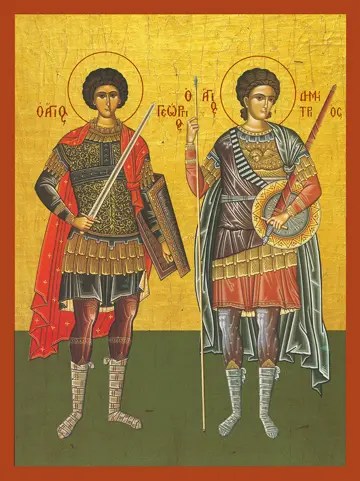
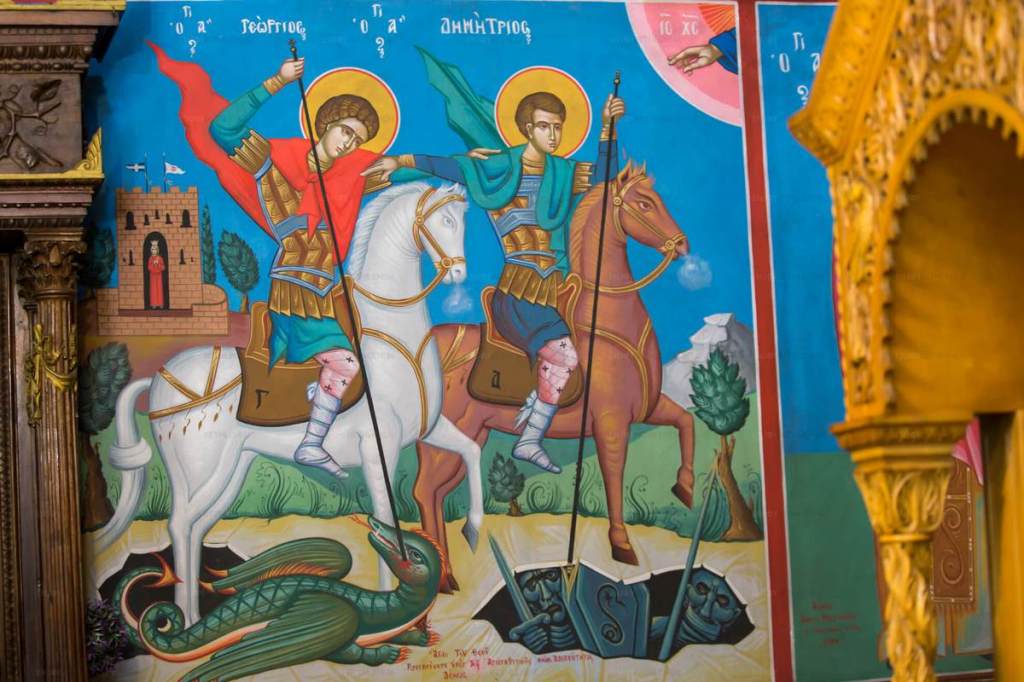
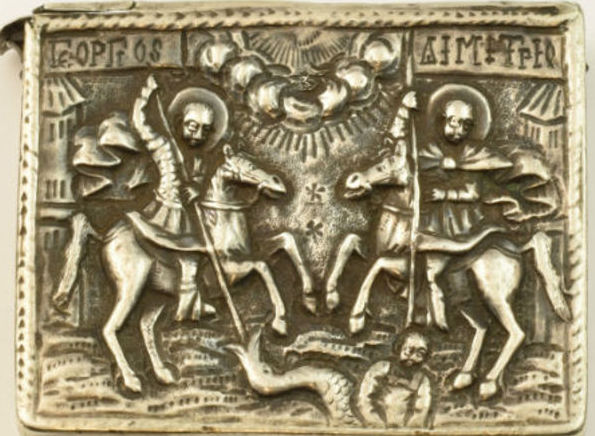
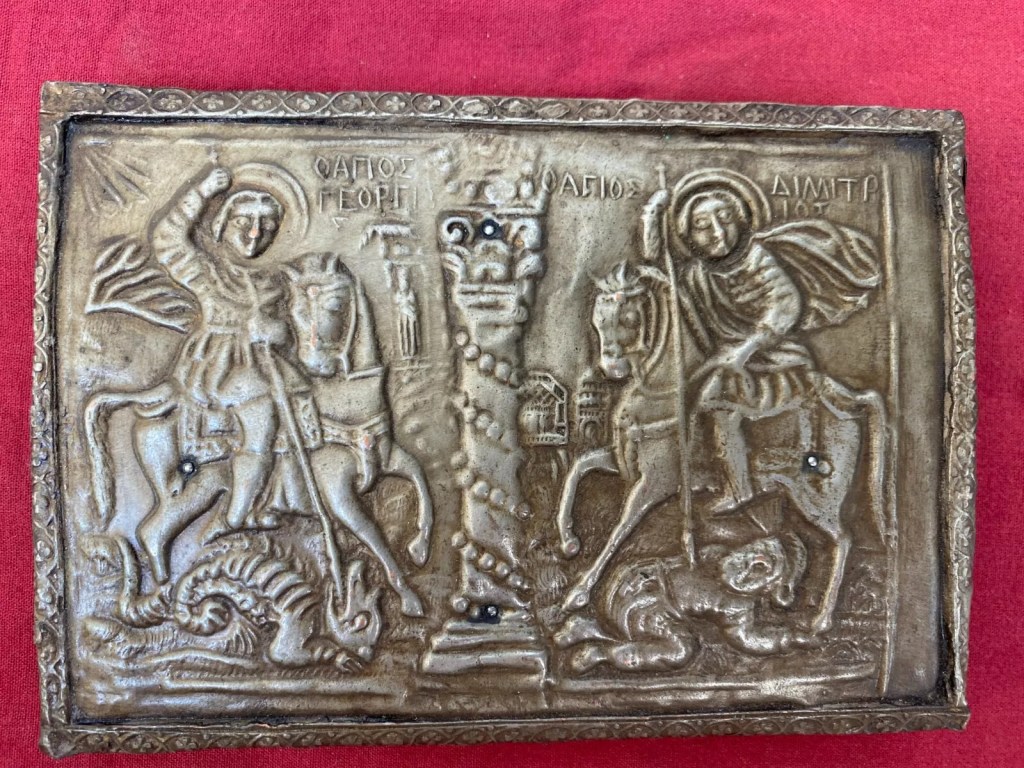
St Geoges and St demetrios … the twin Brothers
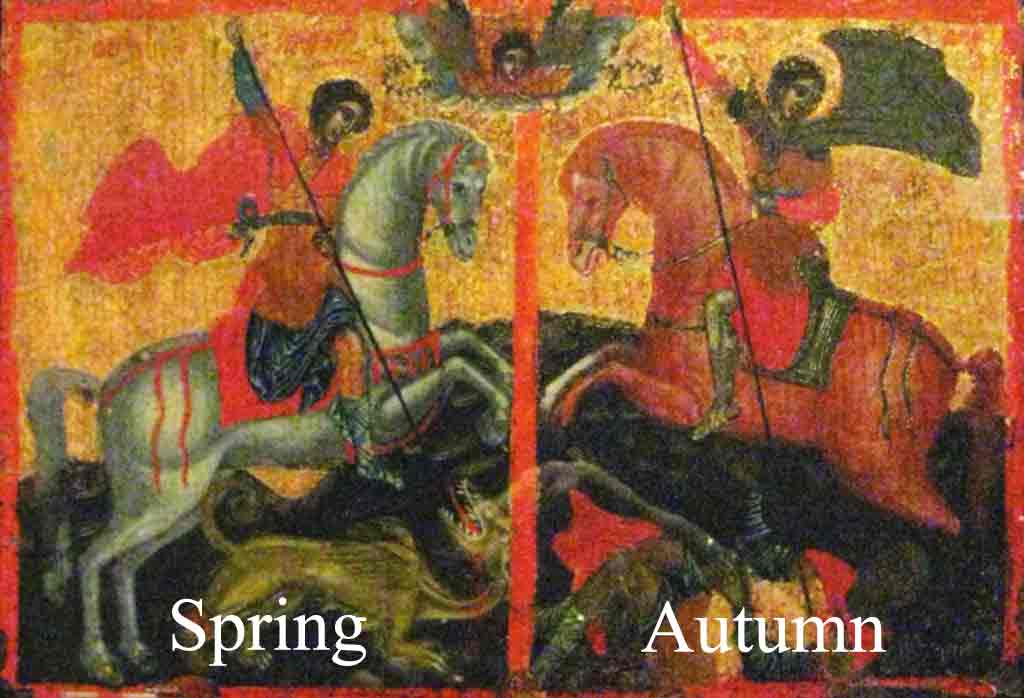
The traditional calendar of Bulgarians in the past had several important dates in the transitional period between the change of seasons. Climatic conditions on Bulgarian lands quite naturally split the cycle of nature into two major parts. The first part starts on May 6th, or Saint George’s Day, when spring arrives and all nature awakens for life. The second borderline is October 26th, or the Day of Saint Demetrius. This is deemed to be the end of the active agricultural season, the start of winter, evening gatherings and engagements of young couples. Just as every new beginning, Saint Demetrius’ Day was a source of much hope. On this day, people would make predictions as to the future fertility, health, love and the weather at the coming Saint George’s Day. Because in folk beliefs, George and Demetrius were twin brothers, that is why the predictions made on Saint Demetrius’ Day were valid for the day of his twin brother.
Saint Demetrius’ Day is a big Christian holiday. On this day, Bulgarians traditionally venerate the memory of the holy martyr Demetrius who was born in Thessaloniki in the 3rd century AD. He died as a martyr for the Christian faith, and upon his grave in Thessaloniki a small church was erected. At the place of this small church, a magnificent basilica stands today, where the relics of St. Demetrius are kept. This is, in a nutshell, his official Christian role in Bulgarian beliefs. In Bulgarian folklore, however, St. Demetrius has been given a special place, and the whole month of October is sometimes called the Month of Demetrius.
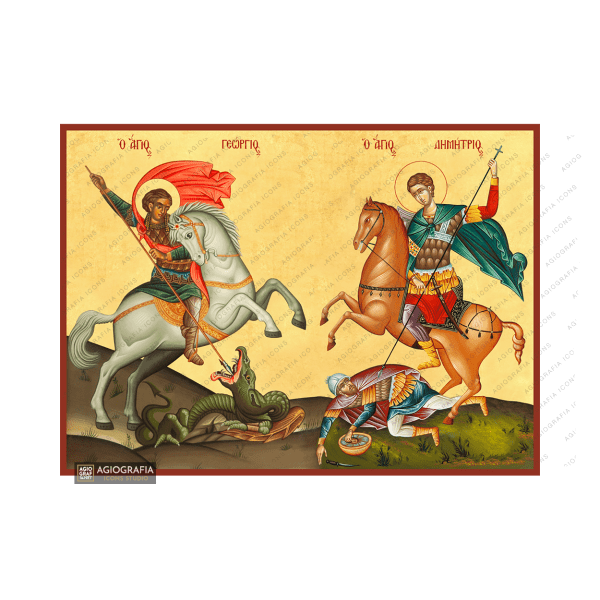
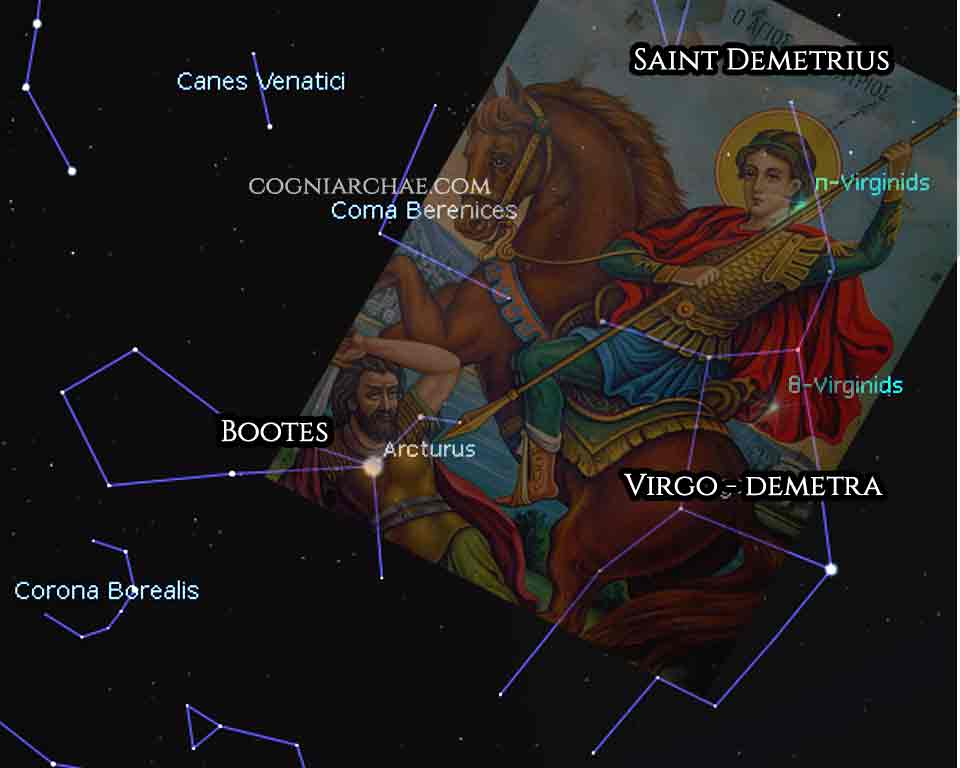
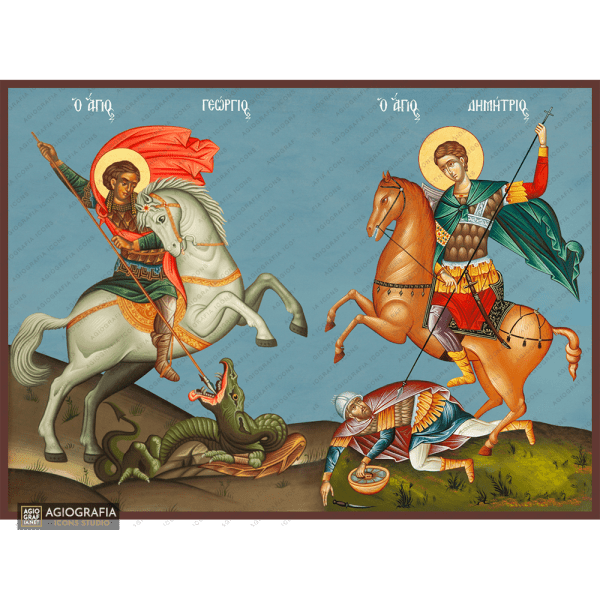
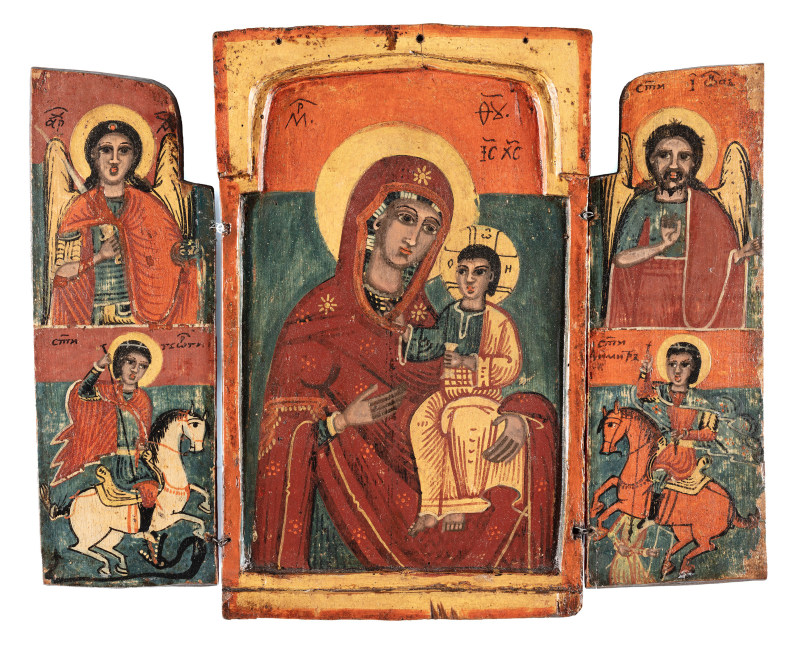
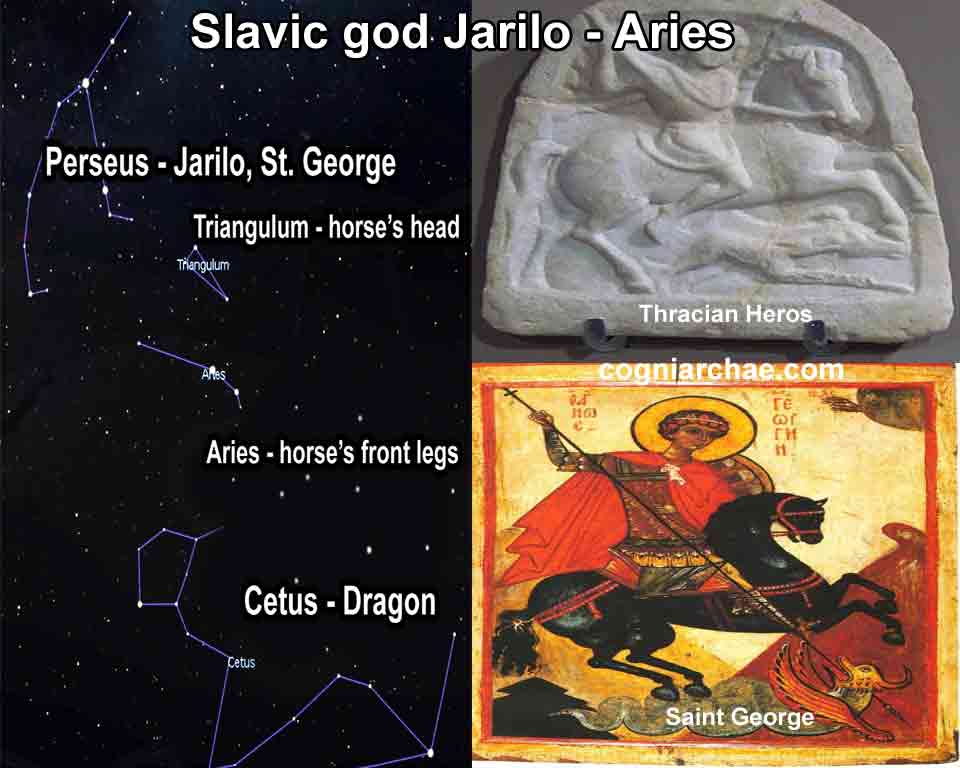
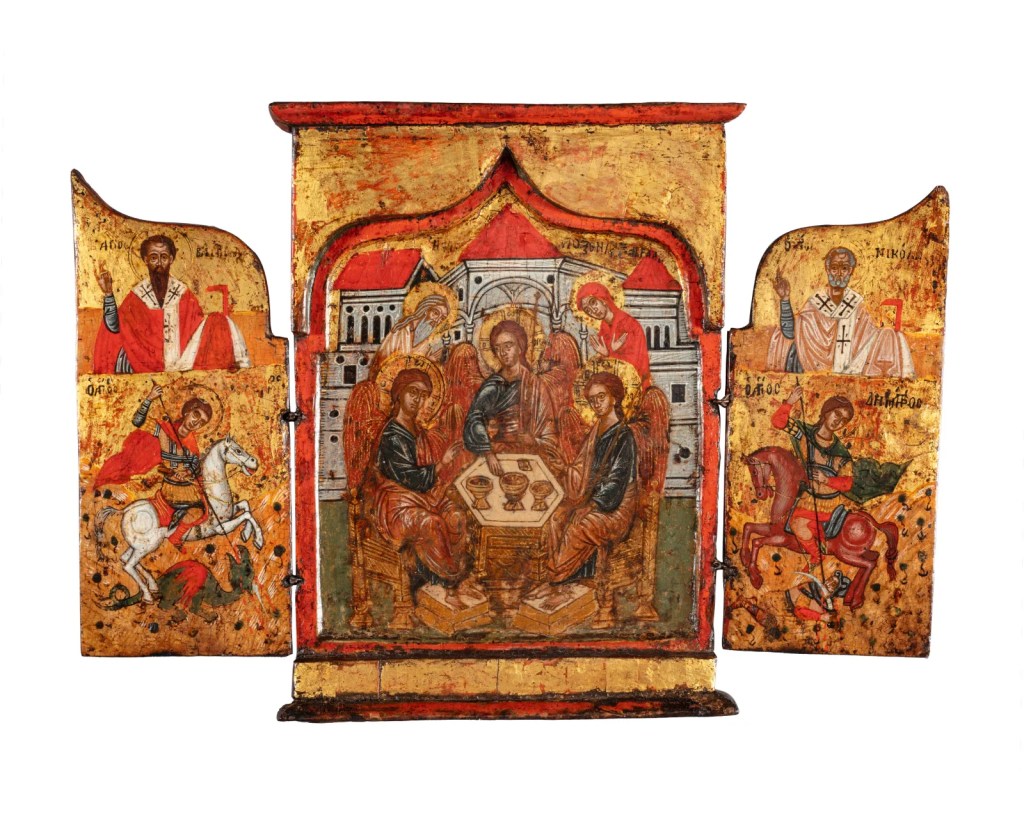
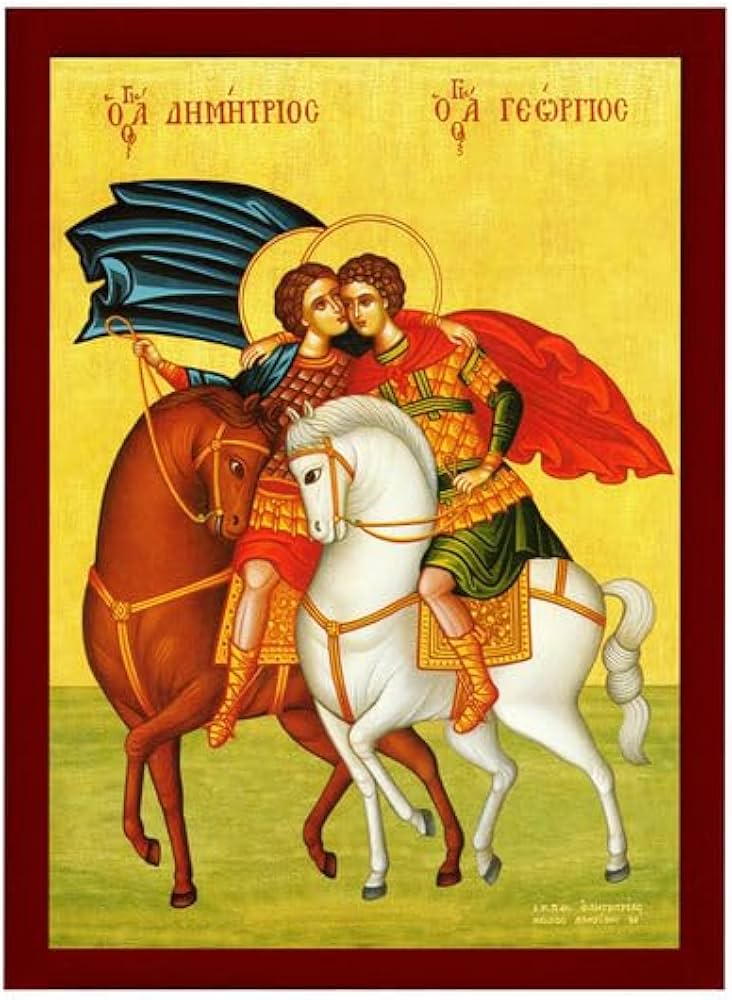
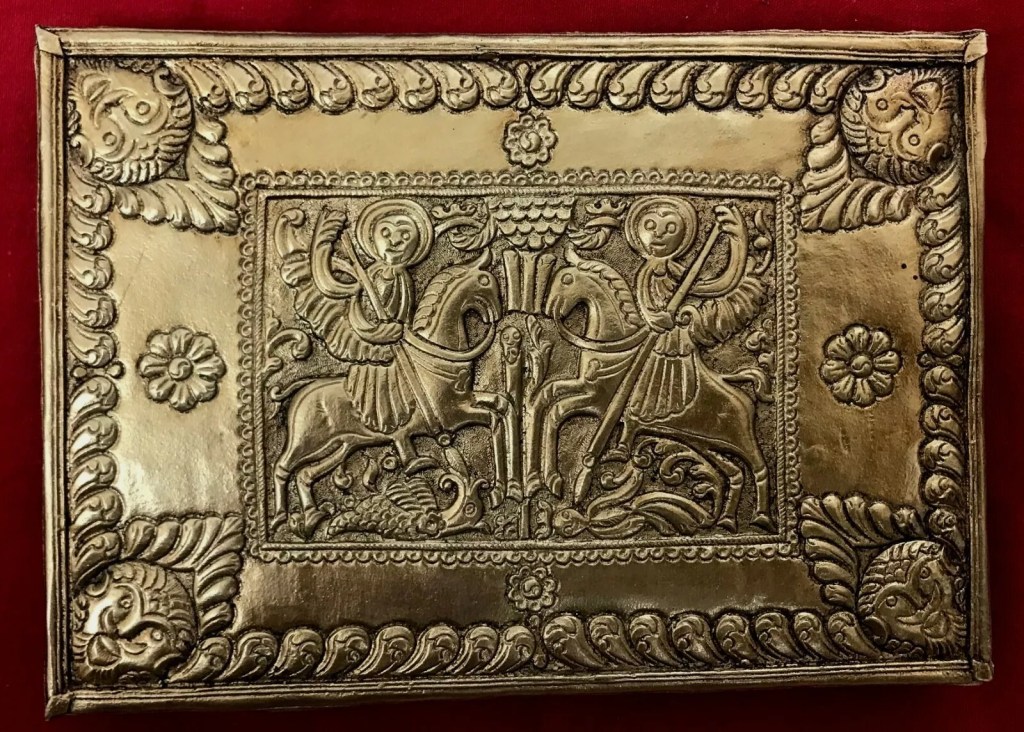
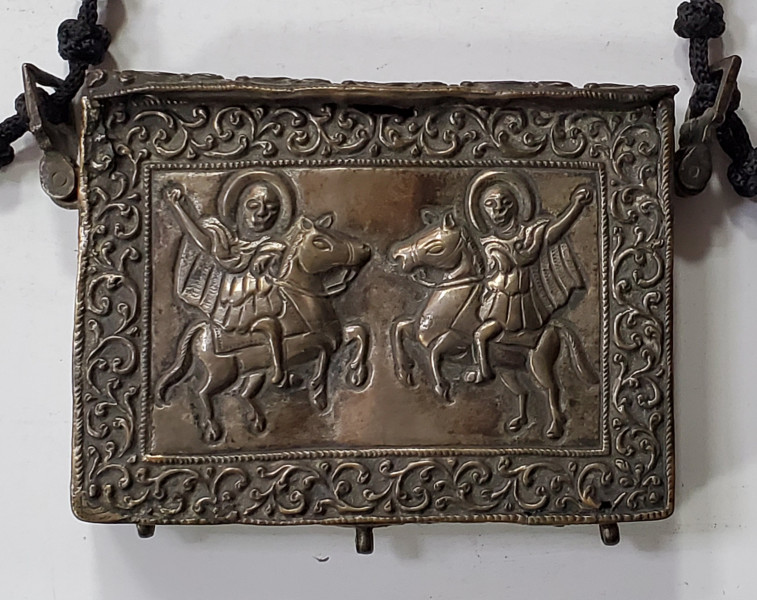
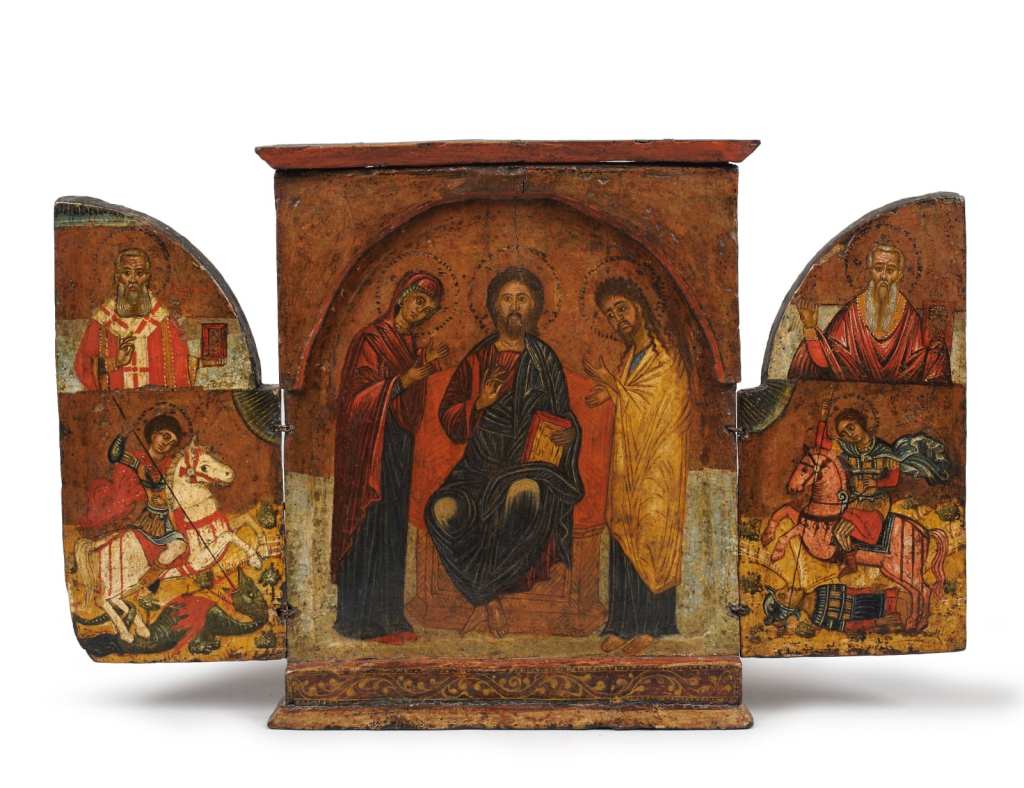
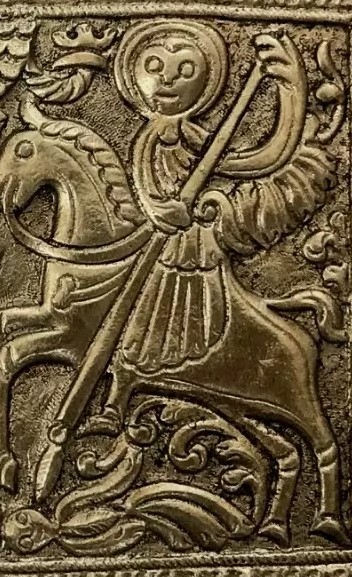
In folk beliefs, Saint Demetrius is the elder twin brother of St. George. Both are strong, beautiful and fearless men. Along with St. Theodore and St. Elijah, they are the Christianized equivalent of the brave men in Bulgarian mythology. Strong and dexterous in the battle, with their fast horses they can jump over mountains, conquer evil, and fight dragons. In folk tales and legends, the two saints have the power to open and close heaven, make rain and snow and ensure fertility. The task of St. Elijah was to protect the fields of corn from the evil creatures who stole the harvest. His brothers, twins George and Demetrius, were also strong enough to defeat the mythical monsters. They are represented as warriors and victors also in Christian iconography. Saint George is riding a white horse and Saint Demetrius a red one, both holding a spear in hand.
The most popular legend of the brothers George and Demetrius contains facts from the life of St. Demetrius. It tells about the family of a poor fisherman who had no children. The man and his wife constantly prayed to God to give them offspring. One day, the fisherman caught only a very small fish which spoke with a human voice and begged him to let it go. The man did so. The next day, he had no luck again. He caught only the small fish again. On the third day, the same thing happened. This time the fish asked the man to take it to his house. He did so and after a while, his mare gave birth to two foals, and his wife – to two boys. They named them George and Demetrius. When they grew up, they set off on a long journey. They agreed they would divide the world into two halves and everyone would live in his own half. Once, when Saint George was in danger, Saint Demetrius fought with a dragon and saved his life. Then, they mounted their horses, flew to heaven and became saints.
In Bulgarian fairytales, St. Demetrius is also endowed with unearthly spiritual powers. His image is reminiscent of Proto-Bulgarian high priests, legendary healers and fortune-tellers. And he can even predict the weather – that is why Bulgarians used to believe that if the weather on Saint Demetrius Day was nice, so would be it also on St. George’s Day. And who knows, these predictions may as well be true. Or they could be seen just as another bridge between the known and unknown reality that has for centuries put man in anticipation, suspense and hope for a better future.
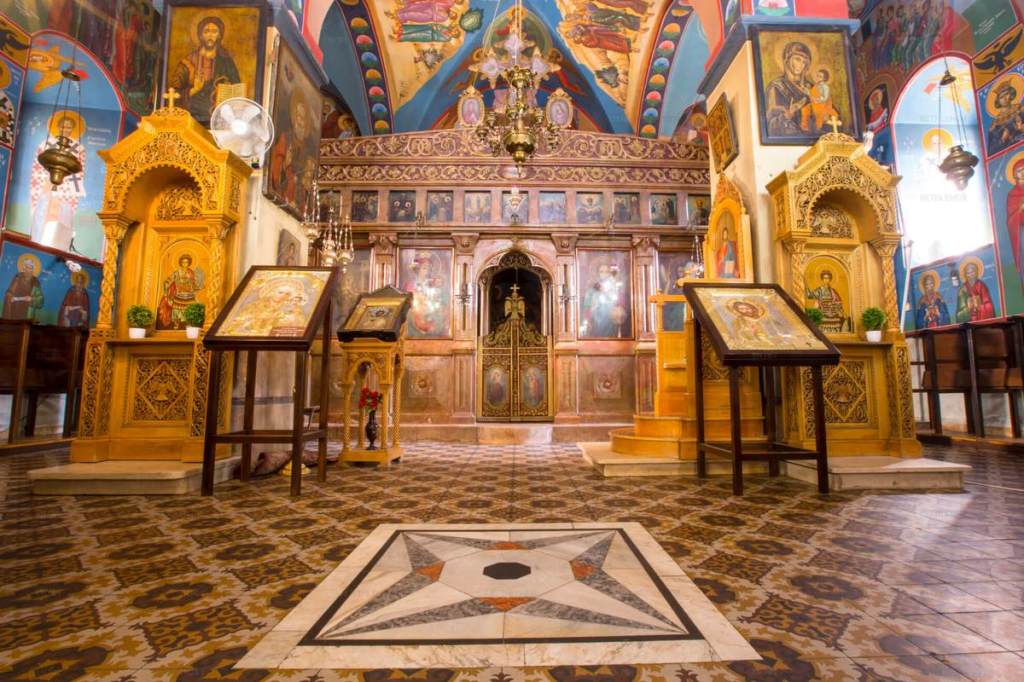
The best place to admire At Georges and his twin brother Demetrios is in St. George’s Monastery, in Al-Khader .The Monastery and Church of Saint George in Al-Khader (Arabic: سﻮﯿﺟروﺎﺟ ﺲﯾﺪﻘﻟا ﺔﺴﯿﻨﻛو ﺮﯾد)[1] is an Eastern Orthodox Christian religious site in the Palestinian town of al-Khader, near Beit Jala and Bethlehem, in the central West Bank of the State of
Palestine. The town of Al-Khader is named after Saint George, who in Arab culture is known as “alKhadr”; the church is considered to be the most important sanctuary to al-Khadr in Palestine.According to local tradition, Saint George was imprisoned in the town of al-Khader, where the current church stands. The chains holding him were relics that were said to hold healing power.

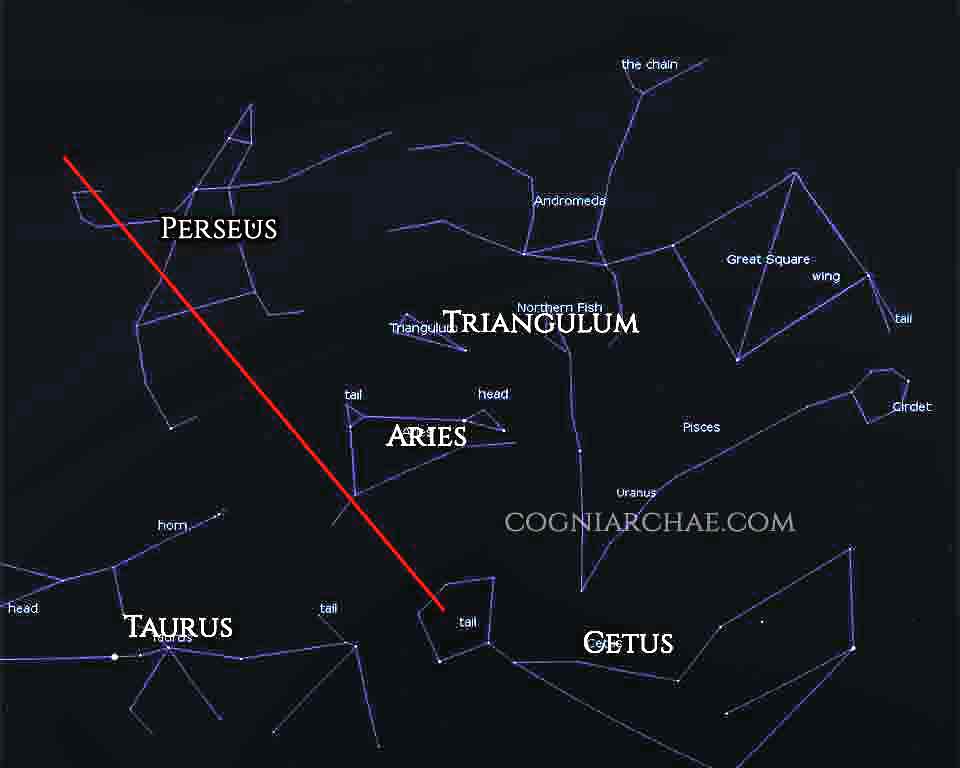
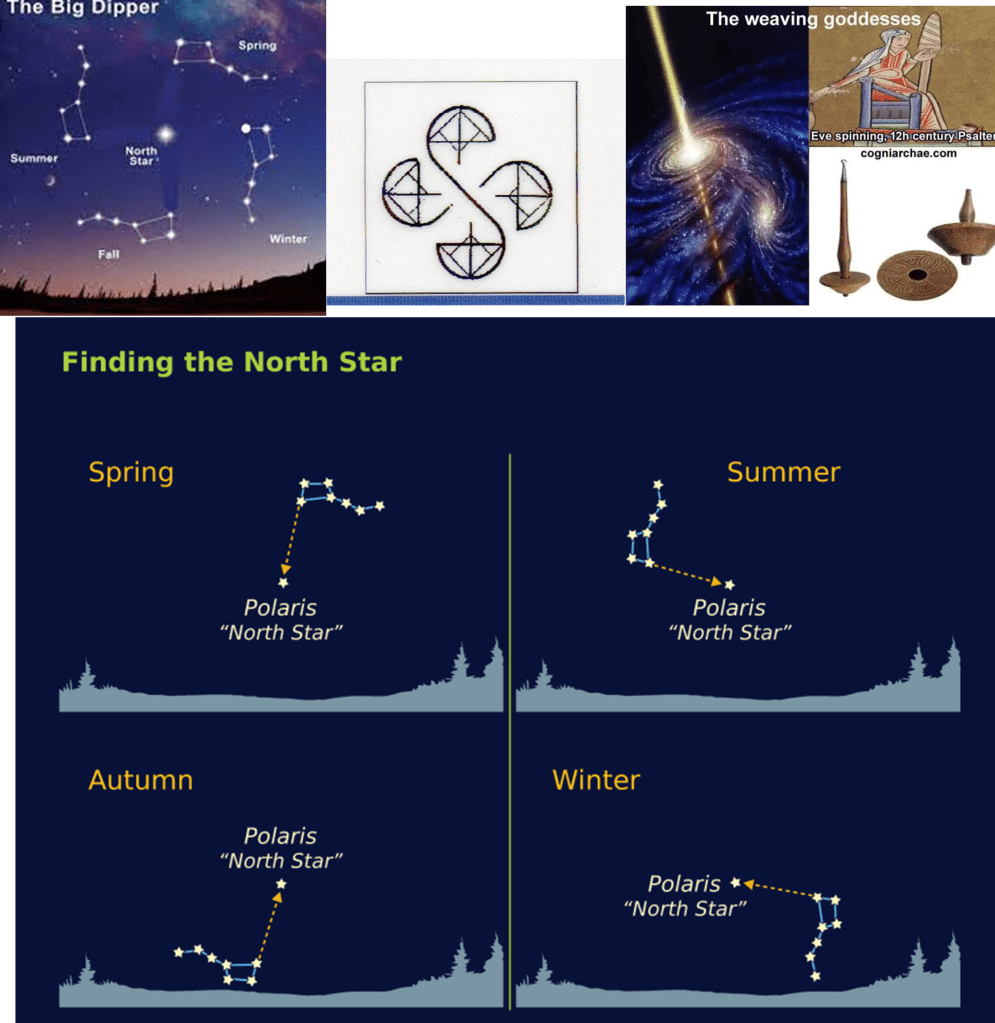
Note: in Horus, St. George, Jarilo, and the star-lore of the equinoxes Cogniarchae explains: “Supposedly, merely a century after the arrival of his cult to Thessaloniki from the territory of modern Serbia, Slavs came to Balkans, following the same route as St. Demetrius only to be repelled by this Saint in Thessaloniki. I highly doubt this – in fact, I believe that it was the Slavs who brought his cult to Greece, whether this means that they were present in Balkans before the official history accepts or not”.

Look also: Green Man, the Legend of the Rood and the Grail
St George: The Art of Dragon Taming
Paul Broadhurst in “the Green Man and the Dragon”told about the art of Taming the dragon in Britain:
One of the best-selling books of all time was The Golden Legend, written by the Bishop of Genoa Jacobus de Voragine. In it he provided the medieval world with a definitive account of the lives of the saints, which everyone at the time believed to be historical facts gleaned by his scholarship from ancient records. In reality, like so many others that were to follow down the centuries, it was a motley mix of fact and, where there were no facts, a liberal dose of fiction. There was also an agenda.But it was a formula that gripped the attention of its readers, who preferred to believe in the fabulous and miraculous exploits of their heroes, just as in Celtic times when people loved to hear of the wondrous world of giants, gods and the Land of Faery. The saints were all these, and more, for they did the work of the one true God.
Printed in English in 1230 it contained a detail of St George’s career that had strangely hitherto gone unmentioned in the voluminous annals of the saint’s life. Almost a thousand years after his supposed death George was to become famous all over the world for what was his most fabulous exploit of all—the slaying of a dragon.

Jacobus’ story is a classic mix of fairytale heroic deeds and propaganda aimed at the conversion of previously pagan believers to the true faith. In it St George came upon the city of Silene in Libya where a terrible dragon ‘envenomed all the country’. Read more here
The “Great Martyr” Demetrios of Thessaloniki
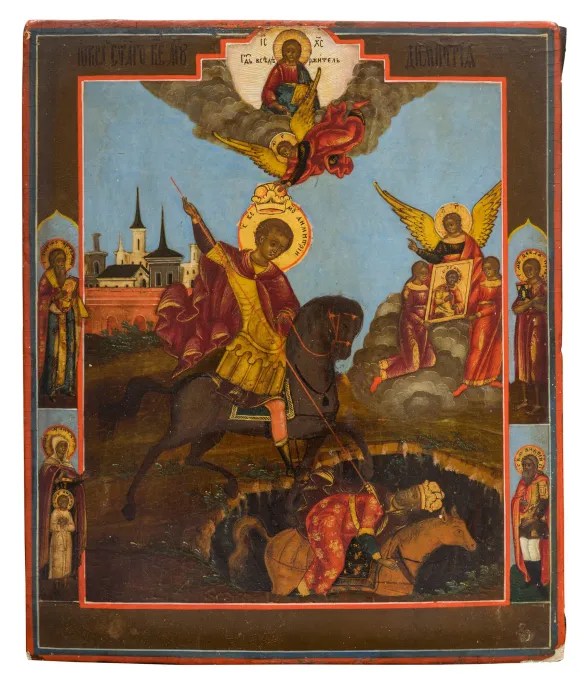
Icons of Dmitriy/ Demetrius also depict him riding a horse and thrusting his lance at an enemy beneath him, but in this case the enemy is not a dragon, but rather a figure sometimes vaguely called the “King of the Infidels,” a symbol of the invaders who threatened the city of Thessaloniki (Salonika), which was considered to be under the saint’s protection and has a church dedicated to him. In Slavic countries, the fallen King is identified as a Bulgarian Voevod called Kaloyan, supposedly defeated by Dmitriy, but history says he was actually assassinated by another Voevod named Manastras.
Return of Spring Sacrifice

The ancient custom of sacrificing divine kings is played out in both Bulgarian and Sardinian festivals in the Dionysian mode by distributing virtual fragments of their mutilated bodies over village fields, thus ensuring the return of a fertile spring. The tradition, which associates the sacrifice of the king or his children with a great scarcity of crops, points to the belief that the king is responsible for the weather and harvests. The spilled blood evokes rainfall for the parched earth, essential for collective survival. According to Frazer, when gods are killed, they take on the role of scapegoat, sweeping away disease, death, and sin from the community, and are eaten symbolically in order to be assimilated.
In the carnival enacted in Samugheo, Sardinia, a related character called S’urtzu-Dioniso, symbolizes the god to be sacrificed. He appears as a goat, which according to legend, is how Dionysus often appeared. Under the goat skin is a bladder filled with blood and water. When he is hit and falls, the bladder breaks and red blood soaks the ground. After this sacrifice, new life emerges.
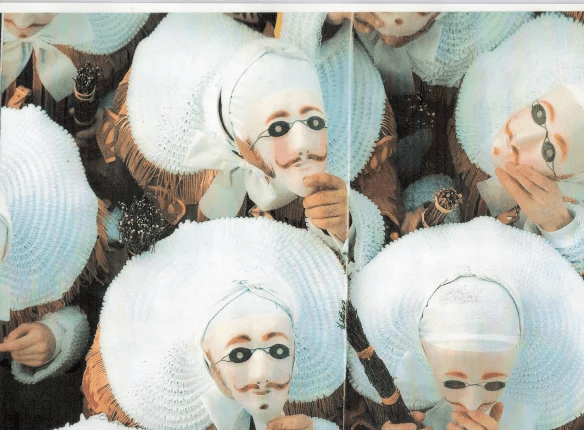
Kukerovden, which translates as ‘Day of the Kukers’, is a Bulgarian mystery play within the festival, in which each player bears a strong symbolic connection to an archetypal aspect of nature. The Neolithic ritual is designed to bind heaven and earth together by telling a human story that echoes the greater, universal drama. See Dance Away Evil Spirits : Folklores of the Kukeri in Bulgaria, the Mamuthones in Sardinia and St Georges in Europe
Cosmic cycles and time regeneration: immolation rites of the ‘King of the Old Year”
Mircea Eliade wrote that “the main difference between the man of archaic and traditional societies and the man of modern societies, strongly marked by Judeo-Christianity, consists in the fact that the former feels solidarity with the cosmos and cosmic rhythms, while the second is considered in solidarity only with history “. This “cosmic life” is connected to the microcosm by a “structural correspondence of planes arranged in hierarchical order” which “together constitute the universal harmonic law in which man is integrated”
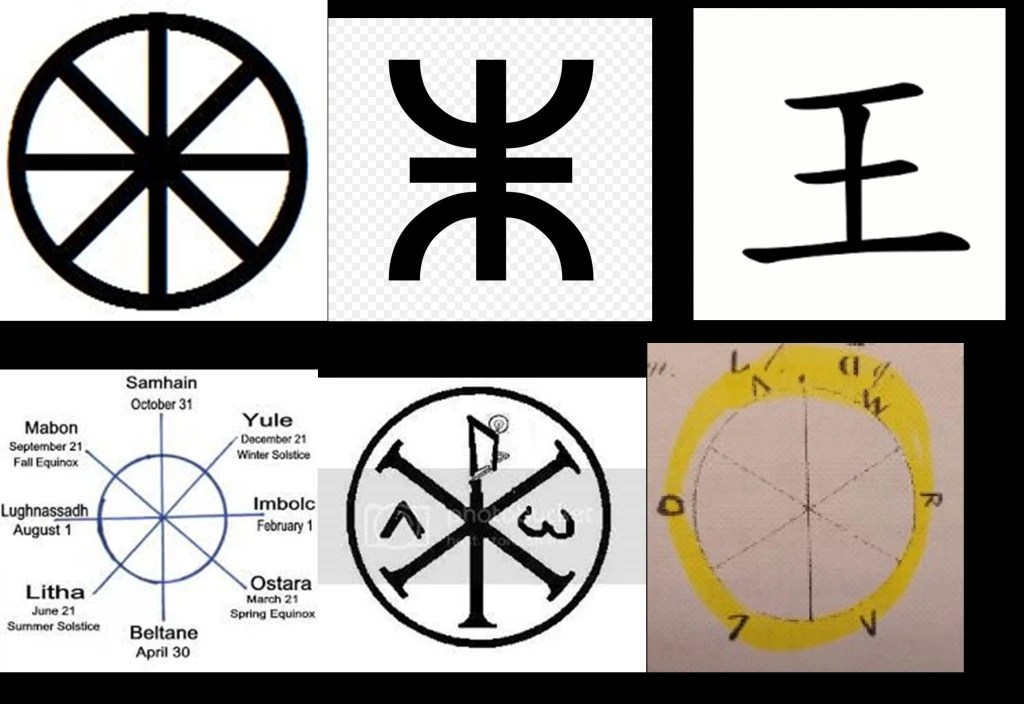
Archaic man especially took into consideration the solstices and equinoxes, as well as the dates between them: it was believed that in these particular days, which marked the passage from one phase of the cycle to the next of the “wheel of the year”, the energy of the cosmos flowed more freely, and therefore they chose such dates to perform their own rituals. Here we are especially interested in certain dates between the Winter Solstice and the Spring Equinox, that is to say the calendar phase in which the Sun appears die: the so-called “solstice crisis” or “winter crisis”.
Traditional man believed that when the “wheel of the year” had reached its winter phase, it would have to be done relive the heliacal star with special rituals, in order to ensure fertility and fecundity for the year to come. It can also be said that, in every part of the world, traditional societies knew and applied ritual methods to obtain the regeneration of time.[ For example, the thinkers of ancient India, from the Vedic period onwards, in an attempt to give structure to the shapeless chaos of the universe, forged with their intuitions a very dense web of mythical and ritual connections and correspondences, mainly centered on the sacrifice, exoterically represented with the death of a human and, later, animal victim, as a symbol of the death of the old year and its consequent renewal and rebirth as a “new year”.
Prajàpati is the year. *
The year is death. He who knows this is not touched by death.**
* Aitareya Br., 7,7,2
** Qat. Brahmin, 10,4,3,1
The immolation of the “King of the Waning Year”
We know that in ancient times the year for the Hindus — as well as for the Celts, Romans and other Indo-European peoples — began on the vernal equinox, “when fawns are born.” Then the king of the old year, adorned with cervine horns like Actaeon, was put to death by angry women, called “queens” . The king, in these ancient rituals, was the center of the cult, and as such was responsible for the harvests and prosperity of the communities from an archaic point of view that saw in the king the son and vicar of the divinity on earth, he was considered responsible for the regularity of the rhythms of nature and the good progress of the whole society: it is therefore not surprising to note that, through his sacrifice, he believed that time was regenerated and fertility assured for the year to come . In particular, the killing of the king was necessary, among various ancient populations, when a calamity or a famine: the sovereign was then sacrificed because it was believed that his “mystical strength of fortune” had failed and, for this reason, in order to born again the community following the calamity, it was necessary to sacrifice the king who had failed in his task to appoint a new one . The community ritually infused all negative nfluences into the person of the old king (the “King of the Old Year”), whose elimination was considered an act of purification and renewal of the world.
Even in the rest of Europe there are extremely suggestive traditions that seem to confirm the validity of the hypotheses: during the “Dance of the Horns” by Abbots Bromley (Staffordshire), the ritual phase of the celebrations dedicated to the Celtic god Lugh , God of sunlight,” the dancers, who wear two appendages on their heads corniforms, surround a ghostly creature dressed in buckskin and bearing a deer skull on its head with a huge antler stage “. The dance mimics the killing of the central character, personification of the burgeoning power and the sun weakened over the course of the year , or rather Lugh himself. In this way, the god would have regained strength by regenerating himself in another representative of him; just as the cervid loses its horns every autumn and develops new ones — hence the significance of the deer as a symbol of the dying and reborn Sun (and Year).
Traces of similar ceremonies are also found in 440th-century Ireland, another region that boasts a traditional Celtic substratum. Graves reports a story about a ritual of this type, in Tyrconnell, during which the “coronation of an Irish king” was carried out and which in the preliminary rites contemplated the sacrifice and quartering of a white mare. After being killed and quartered, the animal was put to boil in a cauldron: the king entered the container, sipped the broth and ate the meat. In this rite, the white mare was seen as the incarnation of the Solar Year, and therefore was sacrificed as a representative of the King of the Waning Year, to allow the rise of the new ruler, representing the King of the Increasing Year. Similar ceremonies are also documented among the Britons of the Bronze Age, in Gaul and in medieval Denmark
“Solstitial Crisis” and subversion of the Cosmos
The explanation of certain rituals is obtained by considering that,words, “in critical situations, which always express a transgression, therefore an emblematic reversal, symbolically subverting the terms of the relations helps to resolve the crisis itself. When order fails and equilibrium is broken, a new rupture is necessary, a new event out of the ordinary… so that we can be reintroduced into equilibrium ”]. In other words, the opposition of two transgressions cancels them.
For this reason, in the Roman Saturnalia (Saturn corresponds to Kronos / Cernunno) there was an inversion of customs and the subversion of roles: profane time was suspended and the paradoxical coexistence of the past (the return of the souls of the dead) with the present, in a situation of undifferentiated chaos. The last days of the past year, during which the Saturnalia took place, were in fact identified with the chaos preceding creation. The close relationship with the agrarian dimension of these rituals (it should always be borne in mind that in this period of the year we are in the midst of the “solstice crisis”) should make it clear that, as Eliade affirms, “both on the plant level and on the human, we are faced with a return to primordial unity, the establishment of a “nocturnal” regime in which limits, profiles, distances become indiscernible “: the dissolution of form conveyed externally by orgiastic chaos and the suspension of the law. Every license was allowed, laws and prohibitions are suspended, and “while awaiting a new creation, the community lives close to the divinity, or more exactly lives of total primordial divinity .
Regarding the orgy, it is supposed that it circulates vital energy because it takes place precisely in moments of “cosmic crisis” (eg during drought) or opulence (during some archaic vegetation festivals), as if, in the eliadian thought, it was practiced during the crepuscular periods of the history of the world. These moments “see not only a decrease in vital energies which therefore need to be regenerated, but also a” contraction “of the same duration of life, and all this therefore determines a unique situation of degeneration of all planes. existential “. Magnone,also reports the common opinion that “Tantrism, although a late phenomenon, represents the re-emergence of concepts linked to ancient fertility cults”, also underlining that “even in Tantrism the value of the orgy is reinterpreted as an instrument of reintegration of the original unity between Śiva and Śakti .
This vision of the cosmos in Rome permeated, in addition to the Saturnalia, also other rites: in February there was the ritual expulsion of Mamurius Veturius, the “horned god of the year”, “double” of Mars and demon of vegetation, who finally, through the his masked representative underwent the immolation rite . In the oldest Roman calendar, the year began in March: therefore, February was originally the last month of the year. This fact allows us to frame without fear of denial the ritual expulsion of Mamurio Veturio within this complex of end-of-year rites, all contemplating the return to an undifferentiated and orgiastic chaos and the killing of a sacrificial victim as a representative of ‘”Old Year”. Thus Eliade: “Since, in the old Roman calendar, February was the last month of the year, it participated in the fluid, ‘chaotic’ condition that characterizes the intervals between two time cycles: the rules were suspended and the dead could return to earth ; also in February the ritual of the Lupercalia took place, collective purifications that prepared the universal renewal symbolized by the “New Year” (= ritual recreation of the world) “.
The ancient wild party of Saturnalia has moved into today’s Carnival (*krn), so much so that in the character of the same name we can recognize “a continuer of the King of Saturnalia” : “Like this one, who, assuming the role of the God Saturn and the” King of Spree “, was finally sacrificed, so the Carnival character, after having taken part in all the manifestations of joy and revelry, was tried, condemned and burned.
– St George, St Demetrios and Al Khidr
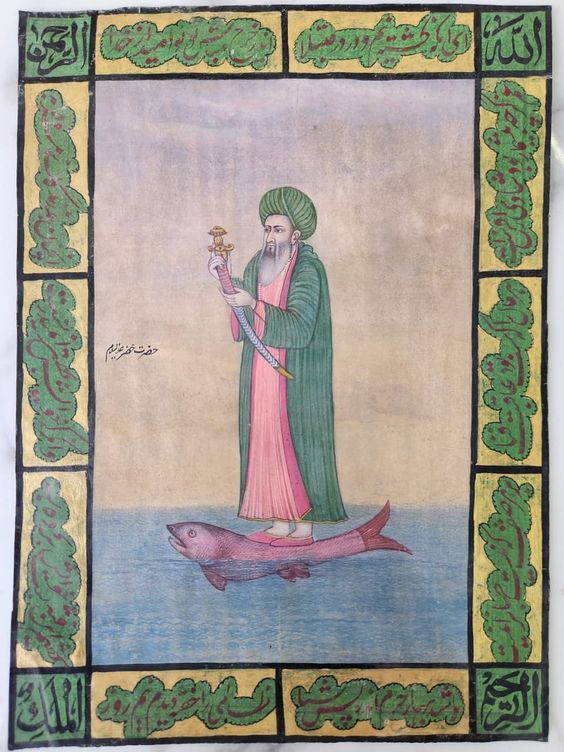
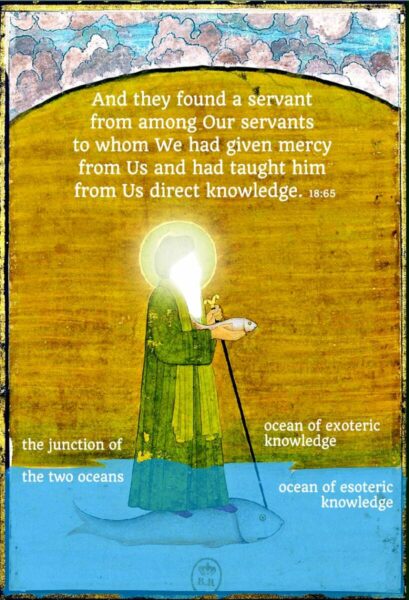
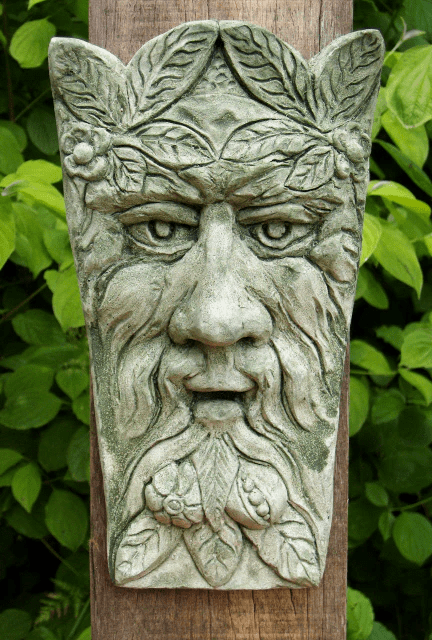
Note on Al khidr: His original name seems to have been al-Khadir (“the green one”), which over time in many places became al-Khidr or Khidr or Hizr. In the modern Middle East the spelling is Khodor is often used as a person’s name. We shall use the shortened form, Khidr.
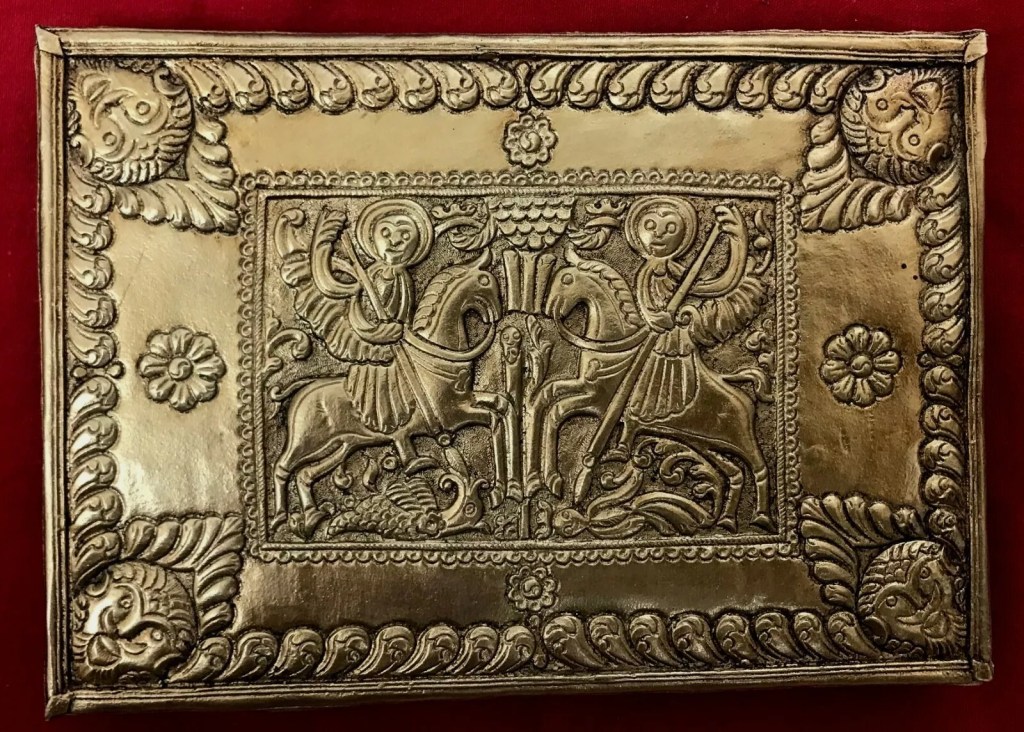
At first sight there seems to be little connection between Elijah, George, Demetrius and Khidr, apart from the fact that in the Middle East they are frequently associated with the same place by different religious traditions. Is it then a simple case of overlapping traditions, Jewish, Christian and Muslim, all of whom focus on the Holy Land as part of their own heritage and take Abraham as their forefather?
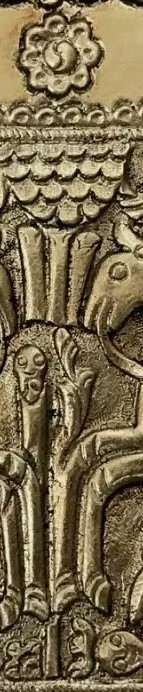
Certainly there is a view which suggests that Khidr is to Muslims what Elijah is to Jews, in respect of them both acting as initiator to the true believer, and which in itself is testimony to attempts to find common ground between the three traditions.
—————————
Of St. Elijah, hail and thunder storms in Bulgaria:
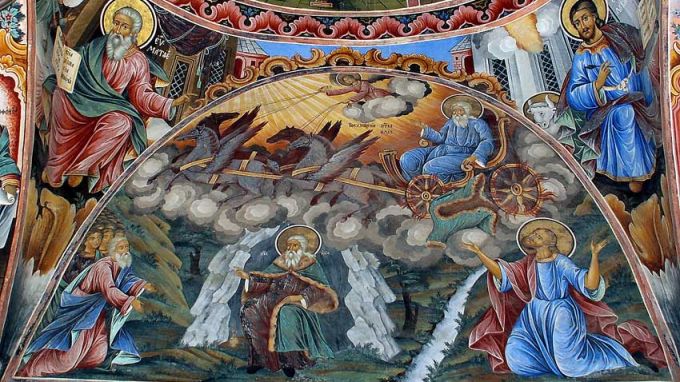
Ilinden, or St. Elijah’s day falls on July 20 (old style calendar) – the day of the Old Testament prophet Iliya (Elijah). When God decided to take him up to the heavens, a chariot of fire came down to Earth and whisked him up, alive. Because of his prophecies, his sanctity and the purity of his earthly life, in biblical texts Elijah is described as a “divine man” and an “earthly angel”.
In folklore the saint is painted as a very different figure – he is strong, powerful and quick-tempered. He is the master of the summer celestial elements – the clouds, the rain, the thunder, hailstorms… He is evidently heir to the pagan deities, rulers of rain and thunder, Perun and Tangra.
According to legend, when God gave out the world, St. Elijah got the summer thunder and lightning. To protect the crops, he would traverse the skies in a chariot of gold in pursuit of the dragon, because it was the dragon that fed on the wheat. While the bolts of lightning were the flames that came out of the horses’ nostrils and from under their hooves. Or the arrows he used to try and transfix the dragon. So, in folklore tradition he has many names that speak for themselves – Grumovnik, Grumolomnik, Grumodol – all of them derived from the word grum – thunderclap. When he is angry or happy he can work miracles. That is why his sister – St. Mary (some call her Fiery Mary) kept the date of his patron saint’s day a secret from her brother for fear of his unleashing the elements on the world. The saint carries hailstones up his sleeves. And when he encounters sinners or infidels, he works up a hailstorm. St. Mary’s day is two days after Ilinden, on July 22. That is when the church celebrates the memory of Mary Magdalene, the bringer of peace. According to one folklore legend, on her day, Mary put on her best clothes to go to church. She met her brother on the way who asked her where she was going, “Today is my day, so I shall go and light a candle,” she answered. “When will my day come, so I could have some fun too!” St. Elijah sighed. “Your day has come and gone,” his sister laughed.
They call Ilinden “high summer” because it was said July 20 marked a turning point in the weather. People living by the Black Sea say that is when the sea “turns”, to become stormy and cold and claim human lives. That is why on Ilinden fishermen do not go out to sea, and no one bathes in its waters. No work should be done on Ilinden and this is a ban that was, on the whole, observed across the Bulgarian lands. To this day, on July 20, fetes with votive offerings were organized in many towns and villages. According to tradition, the animal sacrificed on this day was the old rooster or “father rooster”. Women would make ritual loaves called bogovitsa or kolach and dedicate them to St. Elijah. In some parts of Southern Bulgaria a bull would be chosen for the sacrifice. The table would be laid near old hallow ground or an age-old tree, close to the village. It was believed that the votive meal on I linden would safeguard the people and the crop from thunder and hailstorms.
There are different stories describing how and where hailstorms are born. In Bulgaria, the guardians of hail are called Krivcho, Slepcho and Gluhcho – derived from the words for blind, deaf and crooked. According to some of the most popular legends, hailstorms are made by what are known as hail-saints. Besides the all-powerful St. Elijah, they include the saints Germain, Bartholomew, Theodore and Elisha. Just as with all natural elements, the ice storms are brought down on men for the sins they have committed, for failure to observe bans on major church holidays or for disrespecting the hail-saints.
Eagles are also thought to be connected with hailstorms. It is said that there is an eagle “leading” every hail-cloud, and that is why eagles’ nests must not be disturbed. Whenever a black cloud appears, the men would take their rifles and take shots at it to frighten the eagle into taking the cloud somewhere else. People also believed that if they were to look at the cloud through the willow-twig wreath they have kept since Palm Sunday or through a sieve, the hailstorm would pass them by. In some parts of Bulgaria, the candle from the St. George’s day lamb would be lit or the first egg dyed red at Easter – taken out of the house.
Ilinden – St. Elijah’s day is a day celebrated by all people named Iliya, Ilian, Iliana and their derivatives – Ilka, Lina, Licho etc. It is also the day of curriers, fur-dressers, saddle and tile makers.
——————————
The sacred sites associated with Elijah, the twin brother George and Demetrius and Khidr over centuries seem to have accumulated worship in various forms, so that one sits quite literally on top of or next to another. The sites often exhibit similar attributes: for instance, the presence of water and greenness, suggesting fertility in a barren land; or perhaps a cave, which represents a meeting-place of two worlds, the manifest and the hidden (and on occasion both elements are present, as at Banyas).
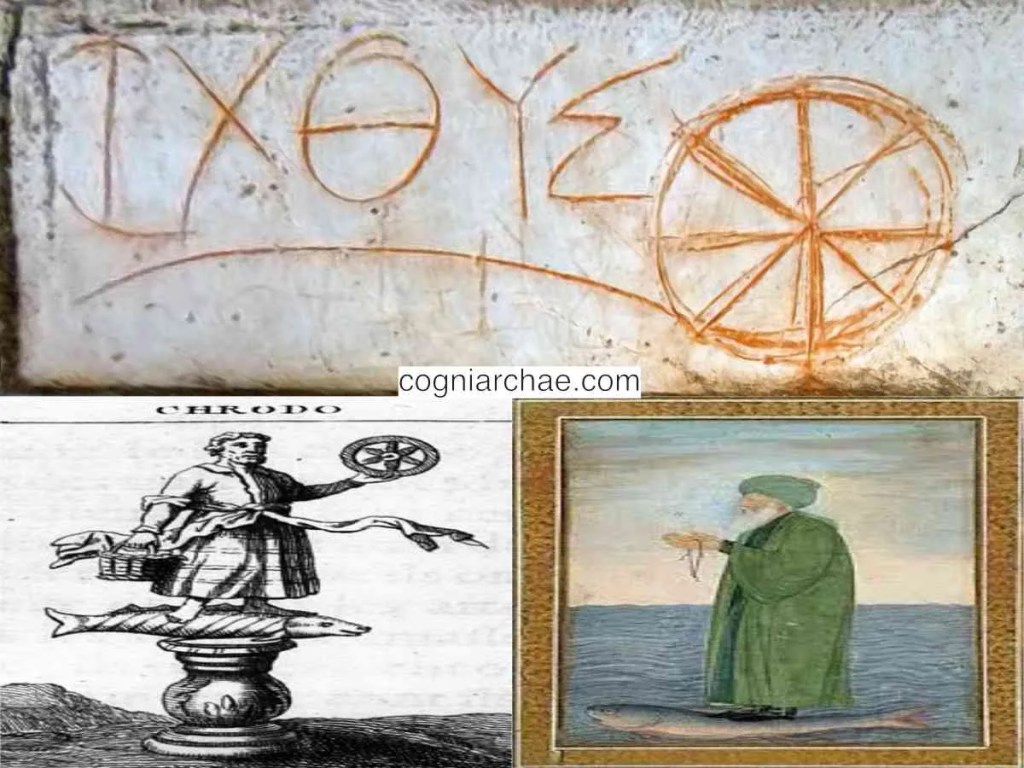
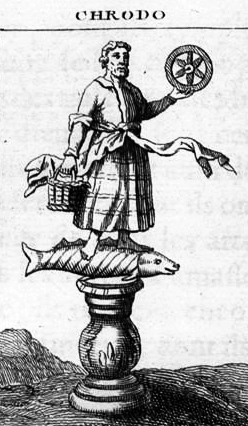
Then there is the ancient theme of the spiritual side of man being dominant over the material, as suggested in the stories by the holy rider on a chariot or horse (or in the case of Khidr, a fish).
This is a clear picture of the divinised human, who comes to deliver mankind:
Elijah is zealous for God and the destroyer of false prophets, while St George is the conqueror of animality in the form of the dragon; and Demetrios kill the Bad King
Khidr’s role is rather less vividly martial – he brings real self-knowledge, delivering the individual from the false and base nature of the soul.
In all three cases one can remark the polarity of the monotheist or true believer and the pagan or ignorant: Elijah and the prophets of Baal, St George, st Demetrios and the emperor Diocletian, for example and perhaps most strikingly in this respect, Khidr who points out the interior meaning of this opposition and is thus the educator of Moses.
However, we should note significant differences in their status, which in part reflect the religious context in which they appear: Elijah is a prophet, in a long line of prophecy; St George and his brother are saints, martyred for their faith in the tradition of Christianity; Khidr, however, is almost a nobody – he is neither saint nor prophet, but an ordinary person graced with immortality and initiatic significance. While the first three are usually portrayed as mounted, Khidr has his feet upon the ground (or just above it in some stories) or walks on water; as we shall see, he has a most particular role to play in mystical teaching. Read more here
See also: THE ELIATIC FUNCTION IN THE ISLAMIC TRADITION: KHIDR AND MADHI
- Between Spring and Autumn St george and St Demetrius give us advices:
The Spiritual Traditions, Saints and Folklores learn us to understand who we are and will be.
Advice of St George: Kill your Dragon
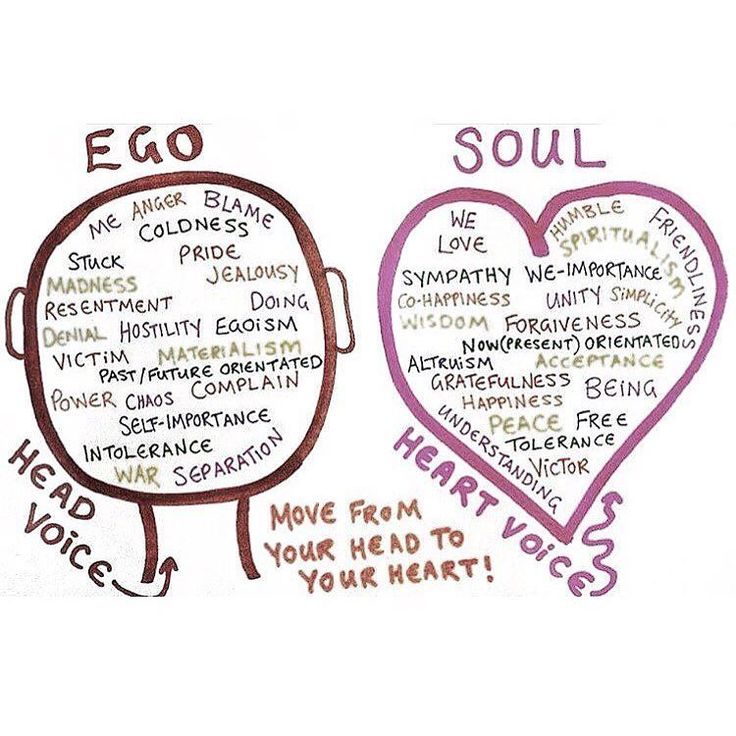
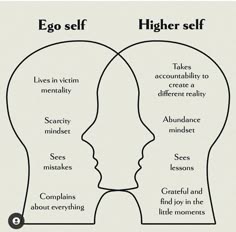
Our only purpose is to give our love, respect and service to God. But if given the opportunity every person would be a pharaoh. His ego would declare itself the highest lord. We must kill the dragon that is our ego and then we will find God with us and around us and within us.
Kill your ego before it kills you
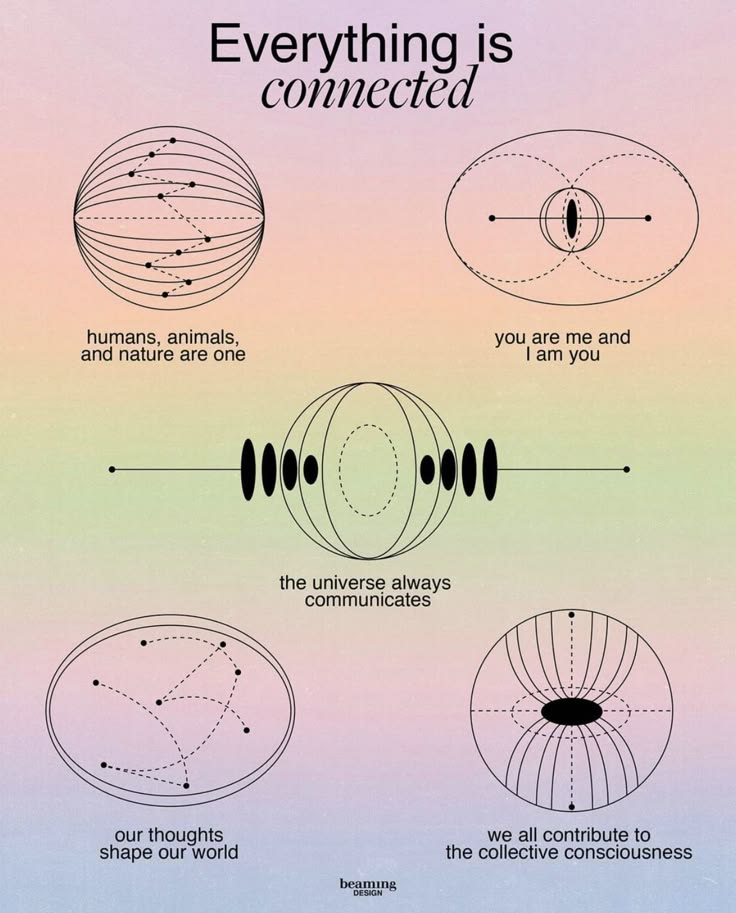
We are meant to be connected to our fellow travelers. Pride separates us. Let’s work to see ourselves as we truly are and love others as ourselves.
Advice of St Demetrius: Putting to Death the Old Man:
In the book of Ephesians, Paul addressed the subject of “the old man.” “But you have not so learned Christ, if indeed you have heard Him and have been taught by Him, as the truth is in Jesus: that you put off, concerning your former conduct, the old man which grows corrupt according to the deceitful lusts, and be renewed in the spirit of your mind, and that you put on the new man which was created according to God, in true righteousness and holiness” (Ephesians 4:20-24).
The words put off in this verse essentially mean “putting away” or “renouncing.” Paul was instructing the members to put away their old man—the selfish, sinful way we naturally think and act in this evil world. Our old man is deceitful (Jeremiah 17:9), even convincing us that we don’t need to change or that God’s way is too hard. It is naturally opposed to God and His laws (Romans 8:7). Our old man produces what Paul called “the works of the flesh” in Galatians 5:19-21, including adultery, hatred, jealousies, selfish ambitions and drunkenness.

We can do this by Prunning the brain with the wisdom of the Heart
According to the great formulator of Sufi psychology, Al-Ghazalli:
There is nothing closer to you than yourself. If you don’t know your self, how will you know others? You might say, “I know myself,” but you are mistaken…. The only thing you know about your self is your physical appearance. The only thing you know about your inside (batin, your unconscious) is that when you are hungry you eat, when you are angry, you fight, and when you are consumed by passion, you make love. In this regard you are equal to any animal. You have to seek the reality within yourself…. What are you? Where have you come from and where are you going. What is your role in the world? Why have you been created? Where does your happiness life? If you would like to know yourself, you should know that you are created by two things. One is your body and your outer appearance (zahir) which you can see with your eyes. The other is your inner forces (batin). This is the part you cannot see, but you can know with your insight. The reality of your existence is in your inwardness (batin, unconscious). Everything is a servant of your inward heart.
In Sufism, “knowing” can be arranged in seven stages. These stages offer a comprehensive view of the various faculties of knowledge within which the heart comprises the sixth level of knowing:
1. Hearing about something, knowing what it is called. “Having a child is called ‘motherhood.’”
2. Knowing through the perception of the senses. “I have seen a mother and child with my own eyes.”
3. Knowing “about” something. “This is how it happens and what it is like to be a mother.”
4. Knowing through understanding and being able to apply that understanding. “I have a Ph.D. in mothering and my studies show…”
5. Knowing through doing or being something. “I am a mother.”
6. Knowing through the subconscious faculties of the heart. “It’s difficult to put into words everything a mother experiences and feels.”
7. Knowing through Spirit alone. This is much more difficult to describe and perhaps it’s foolhardy to try, but it may be something like this: “I am not a mother, but in the moment when all separation dissolves, I am you.”
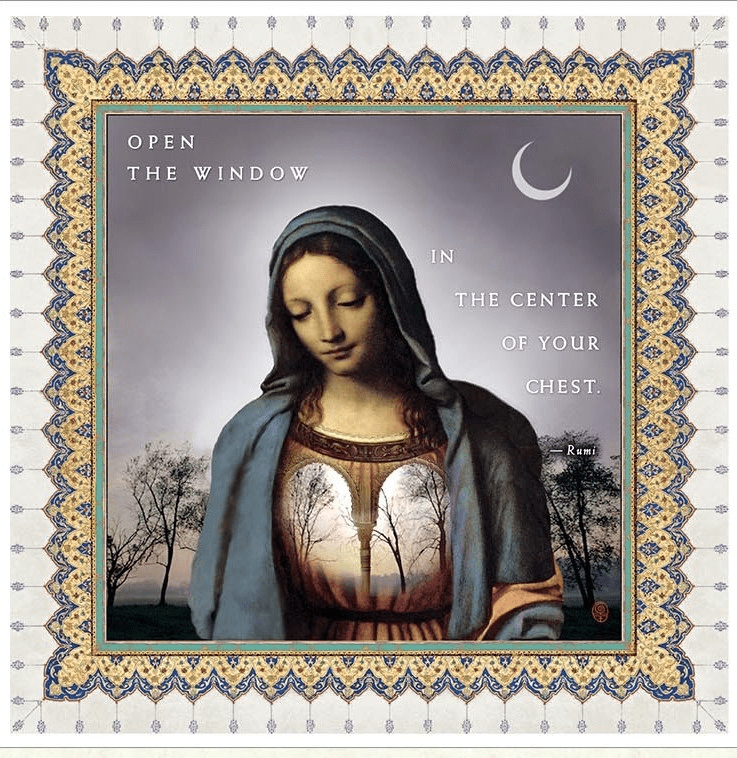
The outer world of physical existence is perceived through the physical senses, through a nervous system that has been refined and purified by nature over millions of years. We can only stand in awe of this body’s perceptive ability.
On the other hand, the mystery of the inner world is perceived through other even subtler senses. It is these “senses” that allow us to experience qualities like yearning, hope, intimacy, or to perceive significance, beauty, and our participation in the unity.
When our awareness is turned away from the world of the senses, and away from the field of conventional human thoughts and emotions, we may find that we can sense an inner world of spiritual qualities, independent of the outer world.
Our modern languages lack precision when it comes to describing or naming that which can grasp the qualities and essence of this inner world. Perhaps the best word we have for that which can grasp the unseen world of qualities is “heart.” And what we understand by the word “heart” is an intelligence other than intellect, a knowing that operates at a subconscious level. The sacred traditions have sometimes delineated this subconscious knowing into various modes of knowing. What are known in some Sufi schools as the latifas (literally, the subtleties, al-lataif) are subtle subconscious faculties that allow us to know spiritual realities beyond what the senses or intellect can offer. This knowing is called subconscious, because what can be admitted into consciousness is necessarily limited and partial.
These latifas are sometimes worked on by carrying the energy of zhikr (remembrance) to precise locations in the chest and head in order to energize and activate these faculties. Once activated, they support and irradiate each other.

Conclusion:
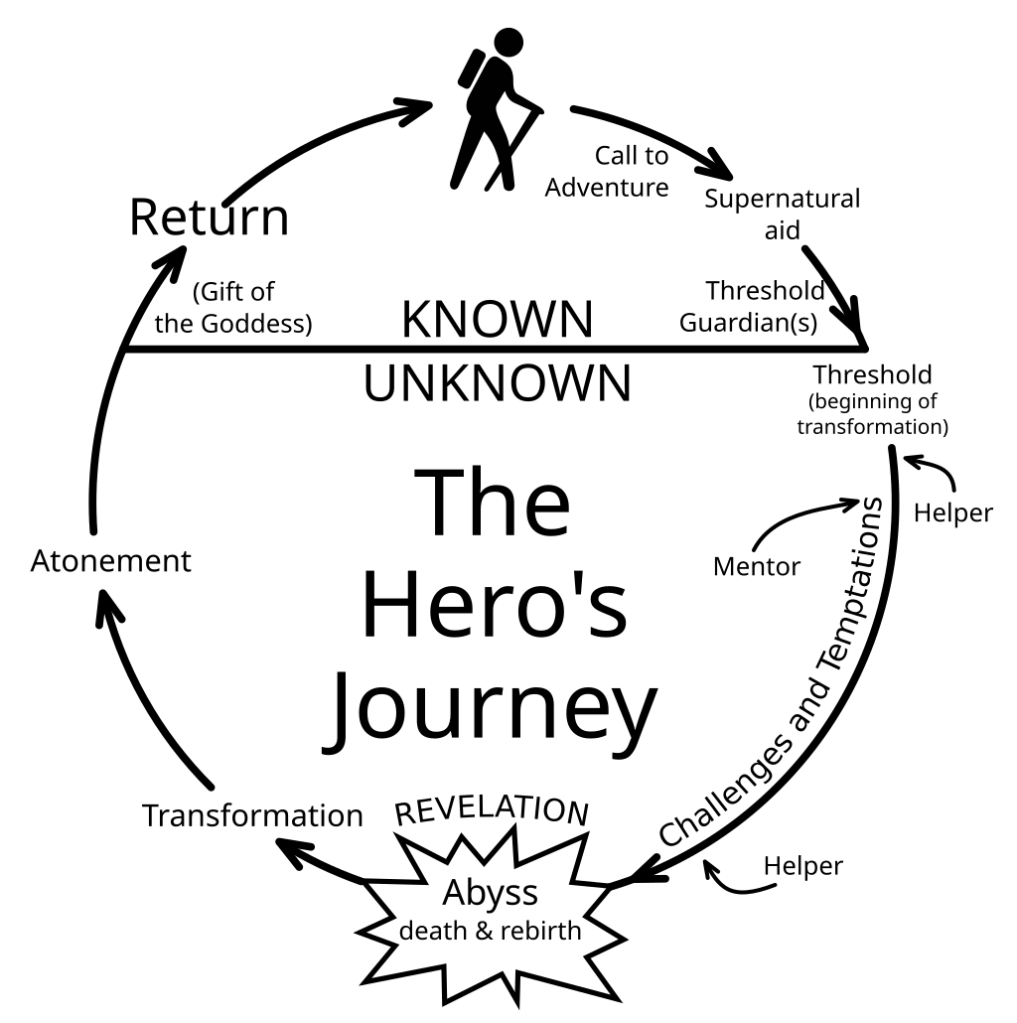
In his book The Hero with a Thousand Faces (1949), Campbell describes 17 stages of the monomyth. Not all monomyths necessarily contain all 17 stages explicitly; some myths may focus on only one of the stages, while others may deal with the stages in a somewhat different order.[14] In the terminology of Claude Lévi-Strauss, the stages are the individual mythemes which are “bundled” or assembled into the structure of the monomyth.[15]
The 17 stages may be organized in a number of ways, including division into three “acts” or sections:
- Departure (also Separation),
- Initiation (sometimes subdivided into A. Descent and B. Initiation) and
- Return.
In the departure part of the narrative, the hero or protagonist lives in the ordinary world and receives a call to go on an adventure. The hero is reluctant to follow the call but is helped by a mentor figure.
The initiation section begins with the hero then traversing the threshold to an unknown or “special world”, where he faces tasks or trials, either alone or with the assistance of helpers. The hero eventually reaches “the innermost cave” or the central crisis of his adventure, where he must undergo “the ordeal” where he overcomes the main obstacle or enemy, undergoing “apotheosis” and gaining his reward (a treasure or “elixir“).
In the return section, the hero must return to the ordinary world with his reward. He may be pursued by the guardians of the special world, or he may be reluctant to return and may be rescued or forced to return by intervention from the outside. The hero again traverses the threshold between the worlds, returning to the ordinary world with the treasure or elixir he gained, which he may now use for the benefit of his fellow man. The hero himself is transformed by the adventure and gains wisdom or spiritual power over both worlds.
Read here:Joseph Campbell and The Power of Myth
- Ego rules the World: Anti-“God”, Anti-“Humanity”, Anti-“Nature“
Our civilization is in decay. Because we have blown-up our ego. Cosmic Balance has been disturbed. The Origin – Cosmic Womb/Vacuum – “doesn’t tolerate” this. With the help of Her two Cosmic Forces of “Death and Rebirth” (“Stirb und Werde” – “Die and Become”-J.W. von Goethe) She breaks down our ego-accumulations, thus restoring the Original Balance.
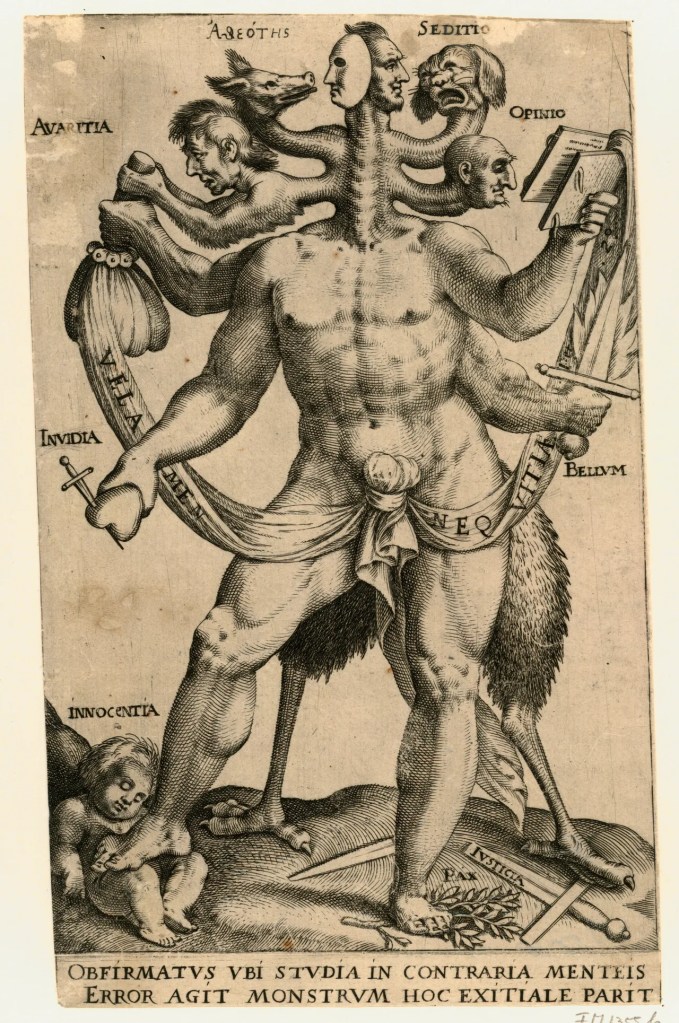
While the crisis of modernity has progressively escalated into a global meltdown and the masses are besieged by—the tyranny of mindless distractions, obsessive consumption of unnecessary goods, the insatiable thirst for unrestrained quantity, exploitation by illogical mechanisms of fear, the assault by hostile economic policies devised by the corporate hegemony virtually bloodletting the populace, the endless perpetuation of the war machine, the ever quickening of time, and the collapsing ecosystems of planet earth to name only a few—these are none other than reflections of the inner disarray, if not an utter eclipse of the human microcosm itself. One wonders where the regulatory agencies of today are to be found in this late hour and who would be the appropriate authority to be contacted regarding the imploding world that appears to be on an inescapable trajectory of self-destruction for it is not a simple question to answer and rightfully deserves considerable reflection.
The struggle for physical survival palpably includes the psychological but there appears to be very little response to the ruptured spiritual compass from which all these compounding crises derive.
Regrettably and sadly in our times, if we look in the mirror, we can see an image of a totally disturbed, disrupted and disconnected human being who has forgot all his past and denied it consequently. He forgets his Soul and prepares unconsciously and inevitably the end of times or end of a World .
 Path to the Maypole of Wisdom