Myths and Consciousness: Bill Moyers interviews Joseph Campbell ( 1987). In six episodes. English, Dutch subtitles. With thanks to Roy Hartgers for the digitization of the video material.
What is shown is impressive. The structure, content and explanations show the unimaginably rich stature and erudition of Joseph Campbell at the end of his life with crystal clarity.
As he says: “At the beginning of my search I wrote about what I had read and studied, now I know from a lifelong experience that it is so“. Quests with a completely open mind: no dogmas.
And the emphatic message that the purpose of life cannot really be described ‘scripturally’, because it can ultimately only be experienced internally, beyond the words. The myths refer to this.
That is where everyone’s own inner treasure lies. Which everyone can only dig up themselves. Myths are very helpful in this. Very educational material, therefore, to be used for education, joint study with discussion and human development in a much broader sense. The six episodes are titled as follows:
1: The Hero’s Adventure
2: The Myth’s Message
3: The First Storytellers
4. Sacrifice and Bliss
5. Love and the Goddess
6. Masks of Eternity
(Note: The formal request for permission to the Joseph Campbell Foundation [Joseph Campbell Foundation, PO Box 705, Fleischmanns, NY 12430] to place this Dutch subtitled version on You-Tube has so far remained unanswered.)
Joseph Campbell believes that every person receives a call in their life to realize their deeper desires. This often goes against newly acquired or already established interests and requires courage. Choices have to be made. Potential heroism unfolds.
According to Campbell, the spiritual poverty of today’s society lies, among other things, in the fact that people no longer want and/or can hear this call. This leads to alienation from our own nature, with all its consequences. “Follow your bliss, really, follow your bliss”, he says, “Find out where it lies and the universe will open doors where there were only walls”. His own life story* is a good example of this.
During his life, Joseph Campbell met Jiddu Krishnamurti, Carl Gustav Jung and Heinrich Zimmer, among others. If he had such a thing, Campbell said, the latter was his guru. Here a subtle line emerges to the tradition of advaita vedanta, because the guru of Heinrich Zimmer ( 1943) was Ramana Maharshi ( 1950).
However, Joseph Campbell’s material is infinitely broader, with approaches and contributions from countless peoples, cultures and times. Mysticism, myths, mystical stories… What are they about? Joseph Campbell says:
“This ancient information (the myths) deals with themes that have supported human life for thousands of years, that have shaped civilizations and that have inspired religions. And that information concerns deep inner problems and mysteries, inner thresholds and inner transformation… “.
“And”, says Campbell, “if it grabs you, then you always draw such a deep, rich inspiring inspiration from these traditions that you will never give up. If you do not know where and what signposts are along the way, you have to figure it out for yourself and find your own way”.
His own life story is also a good example of this.
- The Masks of God:
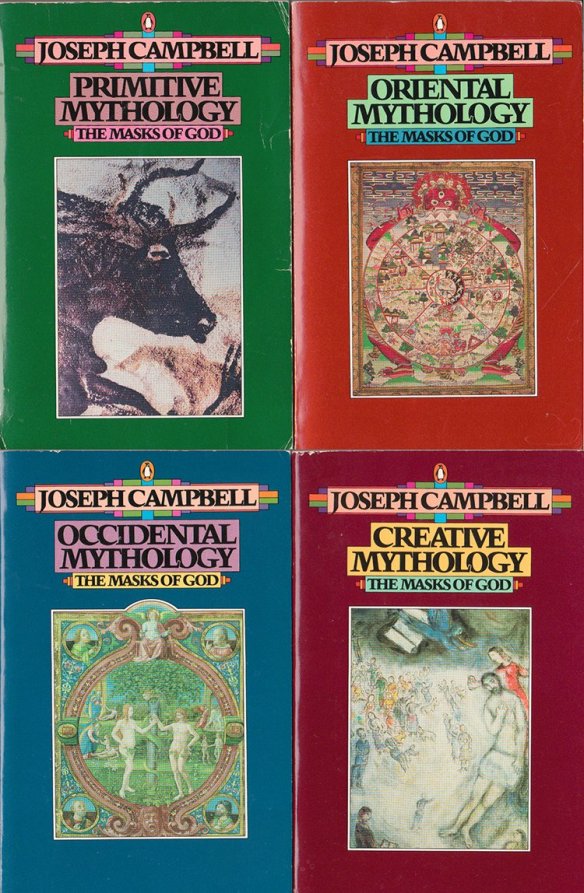
The Masks of Godtraces mankind’s history as a search for meaning through ideas, themes and quests of culture and religion.
The Masks of Godis the summation of Joseph Campbell’s lifelong study of the origins and function of myth. In volume 1 of the series, The Masks of God, Campbell examines the primitive roots of spiritual beliefs among our ancient ancestors. Drawing on anthropology, archaeology and psychology Primitive Mythology confirms the fundamental unity of mankind (not only biologically but in shared spiritual history).
In volume 2 of the series, Oriental Mythology, Campbell examines Eastern mythology as it developed in the distinctive religions of Egypt, India, China and Japan. Campbell examines Eastern mythology as it developed in the distinctive religions of Egypt, India, China and Japan. While Western religions dwell on good and evil, Eastern religions focus on the promise of eternal life. Oriental Mythology explores how Eastern religions came to manifest their varying modes of thought and expression.
In volume 3 of the series, Occidental Mythology, Campbell examines the themes that underlie the art, worship and literature of the Western world. , Campbell examines the themes that underlie the art, worship and literature of the Western world. Occidental Mythology traces European consciousness from the Levantine earth-goddesses of the Bronze Age and the subsequent tribal invasions that shaped Judaic and Greek myth before examining the influence of Persia, Rome, Islam and Christian Europe on ancient beliefs.
In volume 4 of the series,The Masks of God, Creative Mythology, Campbell examines the entire inner story of modern culture, spanning its philosophic, spiritual and cultural history since the Dark Ages and investigating modern man’s unique position as the creator of his own mythology.
Creative Mythology deepens our understanding of the post-medieval culture we have inherited. The Masks of God traces mankind s history as a search for meaning through the ideas, themes and quests of culture and religion.
- The Hero with a Thousand Faces
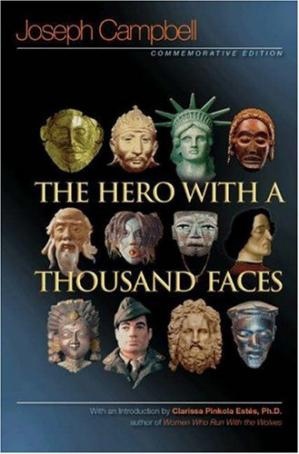
The Hero with a Thousand Faces (first published in 1949) is a work of comparative mythology by Joseph Campbell, in which the author discusses his theory of the mythological structure of the journey of the archetypal hero found in world myths.
Since the publication of The Hero with a Thousand Faces, Campbell’s theory has been consciously applied by a wide variety of modern writers and artists. Filmmaker George Lucas acknowledged Campbell’s theory in mythology, and its influence on the Star Wars films.
The Joseph Campbell Foundation and New World Library issued a new edition of The Hero with a Thousand Faces in July 2008 as part of the Collected Works of Joseph Campbell series of books, audio and video recordings. In 2011, Time placed the book in its list of the 100 best and most influential books written in English since the magazine was founded in 1923.
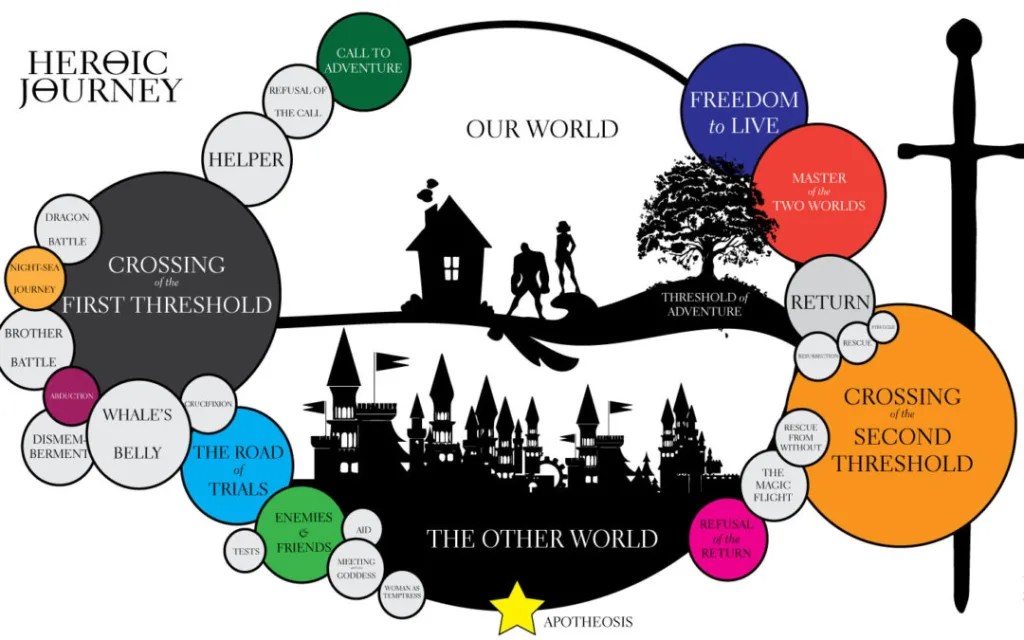
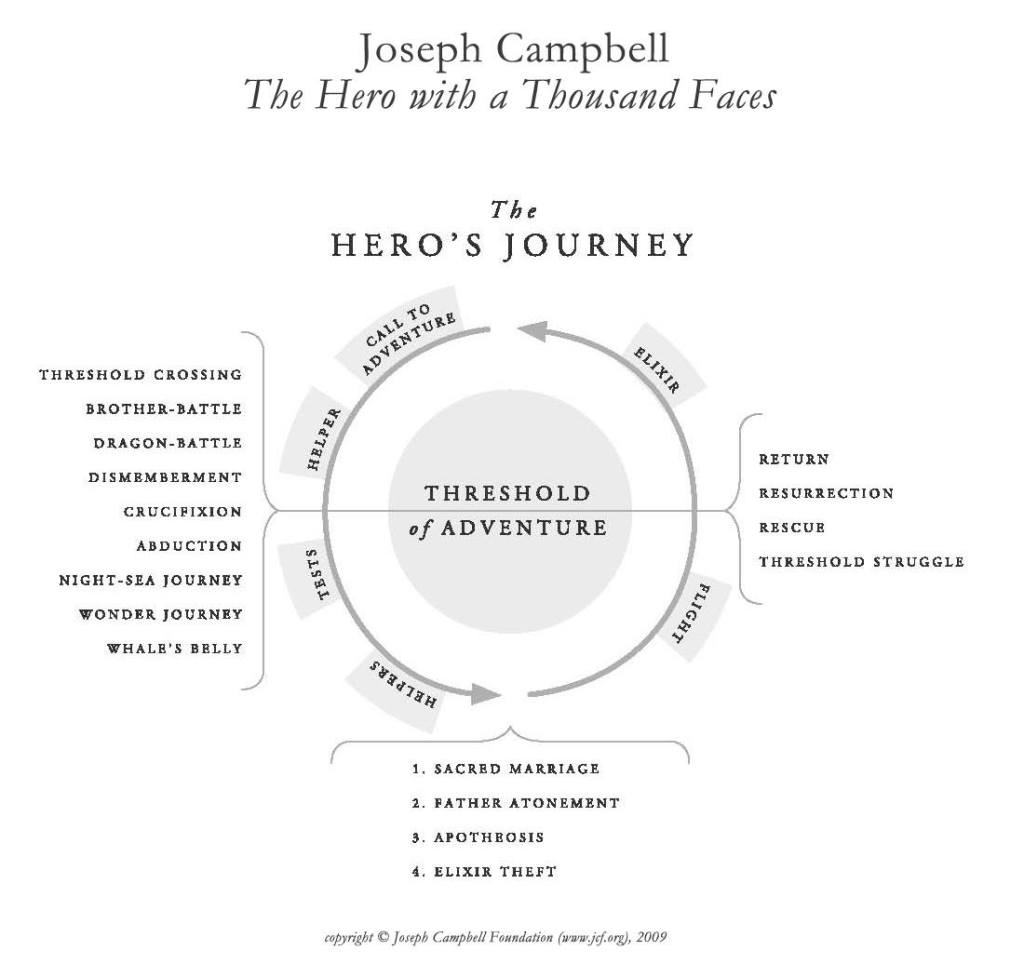
Campbell explores the theory that mythological narratives frequently share a fundamental structure. The similarities of these myths brought Campbell to write his book in which he details the structure of the monomyth. He calls the motif of the archetypal narrative, “the hero’s adventure”. In a well-known quote from the introduction to The Hero with a Thousand Faces, Campbell summarizes the monomyth:
A hero ventures forth from the world of common day into a region of supernatural wonder: fabulous forces are there encountered and a decisive victory is won: the hero comes back from this mysterious adventure with the power to bestow boons on his fellow man]
In laying out the monomyth, Campbell describes a number of stages or steps along this journey. “The hero’s adventure” begins in the ordinary world. He must depart from the ordinary world, when he receives a call to adventure. With the help of a mentor, the hero will cross a guarded threshold, leading him to a supernatural world, where familiar laws and order do not apply. There, the hero will embark on a road of trials, where he is tested along the way. The archetypal hero is sometimes assisted by allies. As the hero faces the ordeal, he encounters the greatest challenge of the journey. Upon rising to the challenge, the hero will receive a reward, or boon. Campbell’s theory of the monomyth continues with the inclusion of a metaphorical death and resurrection. The hero must then decide to return with this boon to the ordinary world. The hero then faces more trials on the road back. Upon the hero’s return, the boon or gift may be used to improve the hero’s ordinary world, in what Campbell calls, the application of the boon.
While many myths do seem to follow the outline of Campbell’s monomyth, there is some variance in the inclusion and sequence of some of the stages. Still, there is an abundance of literature and folklore that follows the motif of the archetypal narrative, paralleling the more general steps of “Departure” (sometimes called Separation), “Initiation”, and “Return”. “Departure” deals with the hero venturing forth on the quest, including the call to adventure. “Initiation” refers to the hero’s adventures that will test him along
Campbell studied religious, spiritual, mythological and literary classics including the stories of Osiris, Prometheus, the Buddha, Moses, Mohammed, and Jesus. The book cites the similarities of the stories, and references them as he breaks down the structure of the monomyth.
The book includes a discussion of “the hero’s journey” by using the Freudian concepts popular in the 1940s and 1950s. Campbell’s theory incorporates a mixture of Jungian archetypes, unconscious forces, and Arnold van Gennep’s structuring of rites of passage rituals to provide some illumination.[4] “The hero’s journey” continues to influence artists and intellectuals in contemporary arts and culture, suggesting a basic usefulness for Campbell’s insights beyond mid-20th century forms of analysis. The Hero with a Thousand Faces Read here

 Path to the Maypole of Wisdom