Dr. William Stoddart has written over the years several books and many articles dealing with religion, spirituality, philosophy, and the modern world. No less important, he has also kept up a constant and voluminous correspondence about these same subjects with many people from many countries. The standpoint from which Stoddart writes is that of the perennial philosophy or sophia perennis, whose main exponents in the last century were René Guénon, Ananda Coomaraswamy, Titus Burckhardt and, towering above them all, Frithjof Schuon. An idea as to what the perennial philosophy is, the reader will acquire, precisely, by reading this book. Stoddart has devoted all his life to understanding this philosophy, and to living in accordance with it. It is certainly as a result of this that, in his writings-books, essays, and letters-we find three very important characteristics: precision, simplicity, and essentiality. Precision, one has to say, because Stoddart understands. He does not write about what he does not know, or knows only partially or superficially. He is not “discussing ideas”, but expounding truths, be they concepts or facts. He knows that imprecision is contrary to Truth. Simplicity, because he writes to help others to learn, and he knows-both in principle and from experience-that simplicity is the key to learning. He knows also that Truth is simple. Essentiality, because he realizes that, to really understand religion, spirituality, and the perennial philosophy -and, on this basis, to understand the errors of the modern world- it is necessary to go to the essence of things, and not let oneself be dispersed in their multiple manifestations. He knows that it is always in the essential that we can find the true. In this book, the reader will be sure to find the same characteristics. In a precise, simple, and essential way, it will help him to remember the most important truth -those which uncover the highest, and at the same time, the deepest meaning of man- and to apply them to the many aspects of human life. Read Here
While the crisis of modernity has progressively escalated into a global meltdown and the masses are besieged by—the tyranny of mindless distractions, obsessive consumption of unnecessary goods, the insatiable thirst for unrestrained quantity, exploitation by illogical mechanisms of fear, the assault by hostile economic policies devised by the corporate hegemony virtually bloodletting the populace, the endless perpetuation of the war machine, the ever quickening of time, and the collapsing ecosystems of planet earth to name only a few—these are none other than reflections of the inner disarray, if not an utter eclipse of the human microcosm itself.
One wonders where the regulatory agencies of today are to be found in this late hour and who would be the appropriate authority to be contacted regarding the imploding world that appears to be on an inescapable trajectory of self-destruction for it is not a simple question to answer and rightfully deserves considerable reflection. The struggle for physical survival palpably includes the psychological but there appears to be very little response to the ruptured spiritual compass from which all these compounding crises derive.
Regrettably and sadly in our times, if we look in the mirror, we can see an image of a totally disturbed, disrupted and disconnected human being who has forgot all his past and denied it consequently. He forgets his Soul and prepares unconsciously and inevitably the end of times or end of a World .
Mirror of moder man: The drawing shows the five-headed and four-legged monster. This monster has the heads of Avarice (Avaritia), Stupidity (Stupiditas), Deceit (Fraus), Sedition (Seditio) and Opinion (Opinio). In his hands, he bears attributes of Envy (Invidia) and War (Bellum). Under his feet, he tramples the Innocence and Peace (Pax) and Justice (Justitia). With inscriptions in Dutch and Latin. (1616)
Erasmus: In Praise of Folly …. Keep your month Shut
“Despite everything, there are still present, even in the [postmodern] West, men who, by their ‘interior constitution’, are not ‘modern [or postmodern] men’ but who are instead able to understand what the tradition essentially is and who do not agree to consider lay error as a fait accompli; it is only to such men that we have always wanted to turn.” – René Guénon
While the crisis of modernity has progressively escalated into a global meltdown and the masses are besieged by—the tyranny of mindless distractions, obsessive consumption of unnecessary goods, the insatiable thirst for unrestrained quantity, exploitation by illogical mechanisms of fear, the assault by hostile economic policies devised by the corporate hegemony virtually bloodletting the populace, the endless perpetuation of the war machine, the ever quickening of time, and the collapsing ecosystems of planet earth to name only a few—these are none other than reflections of the inner disarray, if not an utter eclipse of the human microcosm itself. One wonders where the regulatory agencies of today are to be found in this late hour and who would be the appropriate authority to be contacted regarding the imploding world that appears to be on an inescapable trajectory of self-destruction for it is not a simple question to answer and rightfully deserves considerable reflection. The struggle for physical survival palpably includes the psychological but there appears to be very little response to the ruptured spiritual compass from which all these compounding crises derive.
For those who are familiar with the works of the Traditionalist or Perennialist authors, principally the French philosopher René Guénon (1886-1951), the answer to this question is tangible yet no less consoling, for the prognosis is that we are living at the end of a temporal cycle known as the Kali-Yuga or Dark Age. This diagnosis, while often contextualized within the—Hindu tradition also known as the sanātana dharma—primordial, eternal code of conduct disclosed at the conception of this temporal cycle culminates in its equivalent expression al-hikmat al-khalidah or din al-qayimah within the Islamic tradition, the last revealed sapiential tradition of this cycle. One could suggest that René Guénon, functioned as such a regulator however not in the conventional sense as he was indefatigably monitoring and illuminating single,handedly one might add, in an unparalleled fashion the most neglected conspiracy of all—the spiritual crisis of modern man.
Shaykh ‘Abd al-Wahid Pallavicini, born in 1926 in Milan, Italy, as a young seeker was moved by Guénon’s oeuvre, and although he perceived the importance of theory he also perceived its indispensable and corresponding practice of an authentic spiritual form. This work discloses the serendipitous events that led Shaykh Pallavicini to embrace Islam which incidentally took place on January 7th, 1951, when he was twenty-five years old and was given the name ‘Abd al-Wahid, “servant of the One”. Shortly after, Shaykh Pallavicini learned that Guénon had passed away in Cairo on the same day, this event served as an omen indicating that he needed to carry on this vital work.
For the next twenty years Shaykh Pallavicini lived and traveled in the East and was in proximity to some of the most illumined masters of Islamic spirituality known during this generation. While he was initiated into the Alawiyah Sufi brotherhood, through a European branch that was in touch with René Guénon, he also received authorization to conduct an independent branch of Sufism—Ahmadiyyah Idrisiyyah Shadhiliyyah—in Europe and in the mid-eighties he founded the Center for Metaphysical Studies, the Comunità Religiosa Islamica or the Italian Islamic Religious Community (CO.RE.IS.). He is extensively engaged in interfaith dialogue with numerous representatives of diverse religious traditions and has also participated in many noteworthy projects in order to spread truthful information on authentic Islam.
Sparing no time and mincing no words Shaykh Pallavicini underscores the distinct challenges of living one’s spiritual tradition in the contemporary era: “[W]e do not reject life or the world in itself, but instead denounce the parts of the modern [and by extension postmodern] world that are anti-traditional and thus inhibit our spiritual development.” While this book is presented within the context of his own spiritual tradition, that of Islam and its inner dimension known as Sufism (tasawwuf), he never deviates his attention from the integral metaphysics of the—Primordial Tradition—the source from which all authentic traditions originate in divinis. The inner dimension, what is often referred to as the Heart of Islam, has a unique eschatological implication for seekers in this era, when understood in light of the Primordial Tradition: “Sufism, the living initiatory expression of the last revealed tradition, Islam.” Shaykh Pallavicini explains that if men and women were closer to the Primordial Tradition, as was the case in earlier ages, most evident in the Krita-Yuga or Satya-Yuga known as the Golden Age in Western cosmology, there would be no need for the exoteric or the outer dimension of religion. Due to the extreme level of decadency in the contemporary psyche—the lost sense of transcendence—one needs the outer dimension of religion to realign with the sacred if the esoteric dimension is to be sought. Clearly, there is no Zen without Buddhism, and although the inner or esoteric dimension of every religion necessarily has affinities with those of other religions, there is also no Yoga without Hinduism, no Kabbalism without Judaism, or Sufism without Islam, nor is there true Hesychasm (the last surviving form of Christian esoterism) outside the Orthodox Church.
While Shaykh Pallavicini, like Guénon, acknowledges the universality of all authentic spiritual revelations, he astutely illuminates the essential unanimity of the three Abrahamic traditions: “‘monotheism’ should not have a different meaning than that of ‘universality,’” which etymologically refers ‘to the One,’ the one God of Abraham.” He continues to express the common ground between the Abrahamic traditions: “Nothing in the shari‘ah (compilation of Islamic Law) could abrogate the Ten Commandments nor could the Commandments constitute an obstacle to spiritual fulfillment.” A very contentious subject that greatly needs elucidating is that of “conversion” and what this signifies when understood according to the Primordial Tradition, which has implications beyond the three Abrahamic faiths:
The perspective of some born Muslims, any conversion to Islam should imply a repudiation of Christian beliefs. Their repudiation, in the best cases, denies Christianity’s validity in its esoteric and exoteric forms because of its pre-Islamic origin, despite the completely opposing statements of the Qur’an itself.
While monotheism intrinsically reveals universalism and universalism essentially discloses monotheism, both ipso facto are derivatives of orthodoxy and orthodoxy is none other than doctrinal purity which provides discernment and illuminates the path in order to prevent deviation. The importance of authentic or orthodox doctrine at the core of the Primordial Tradition for present-day seekers is its ability to cut through and recognize the radical errors of New Age pseudo-spirituality. This is what Guénon termed “counter-tradition” the ill-fated succession of “anti-tradition”, and it also applies to particular trends in interfaith dialogue that all too often endorse syncretism or a mixture of traditional forms which gravely distort the understanding of both the outer and inner dimensions of religion:
It is very important to understand that the right metaphysical Path, and the primordial Tradition that constitutes its formally revealed expression, are not to be looked for in a hypothetical essence, nor in an even more hypothetical “quintessence” located somewhere above the revealed religions. There is not a “transcendent unity” of religions that can be extracted, or abstracted, from forms. There does not exist an “eternal wisdom,” or a sophia perennis, independent of the messages of the Prophets that would be sufficient to study in these so-called “post-Prophetic” times in order to inherit knowledge.
The book—A Sufi Master’s Message—pays homage to one of the great luminaries of the XXth century René Guénon who played a providential role in resuscitating the integral metaphysics of the Primordial Tradition for contemporary seekers. While some might argue that Guénon’s mission to establish an “intellectual elite” to thwart the spiritual crisis in the modern and now postmodern world has failed, to the contrary this work is a living demonstration that the intellectual elite has taken root in the West and is diligently working to confront the militantly anti-spiritual forces that have been systematically unleashed into the current era.
Paradoxically, the good news is that the dissolution of the present world can be slowed down by the presence of integral spirituality which this work reaffirms and acts as a rich well for sincere seekers to drink from—the waters of the Primordial Tradition, the tributary from where all sapiential traditions derive. In closing, the significance of this much needed work of Shaykh Pallavicini dedicated to the remarkable figure of René Guénon could be summarized per the memorable saying of Prophet Muhammad: “God will not withdraw all knowledge with an act that will take it away from all men, but will withdraw it by reducing the number of the wise until no more are left.” And let it be known that René Guénon was regarded as such a one.
This is an impressive image by Rumi, for it portrays the human condition, the fact that the only creature with a certain amount of free will is situated between beast and angel, between the world of pure matter and that of pure spirit. If he follows his lower instincts, he will fall deeper than any animal, for the animals are constrained in their actions and have no choice. If, however, he purifies himself and develops his God-given spiritual qualities, he will reach a station higher than the angels, for angels, too, cannot act according to their own inclination; their role of constant worship and obedience is once and for all prescribed. Humans, however, have to wander along an extremely narrow path as they choose between good and evil, matter and spirit; they are, as Maulana says, like ducks, which belong to both water and earth; or else they are half honeybee, half snake, capable of producing both honey and venom. Did not the angels cry out in horror when the Lord told them at the beginning of time that He would place a vice-regent on earth, whereupon they foresaw that the new creature would he “bloodshedding and ignorant” (Sura 2/31)?
But God knew better what He was planning, and so the angels had to prostrate themselves before the newly created Adam, who thus became masjud al-mala’ika, “the one before whom the angels fell down.” He was singled out by the Divine Word in the Koran: karamna, “We have honored the children of Adam” (Sura 17/70). Maulana reminds his listeners time and again of this Divine Word, and he sees the greatest danger to humanity in the risk of their forgetting the high position allotted to them by God. God “taught Adam the names” (Sura 2/32). Read more here….
This study ( an hermeneutic exploration of Rene Guenon) examines how the architecture of the various sacred traditions, all manifest in their built expressions a universal symbolic content, while at the same time being absolutely unique in their own inherent particular spiritual dispensation.
One major aspect of this symbolic content is the embedding of the three-dimensional cross in its various modes within their built arrangements. The correlation between the three dimensions of space and the metaphysical symbolism of the cross was the subject of a short but important work by the French traditional metaphysician Rene Guenon titled Symbolism of the Cross (Le Symbolisme de Ia Croix).
In describing the purpose of the work Guenon wrote that it was ‘to explain a symbol that is common to almost all traditions, a fact that would seem to indicate its direct attachment to the great primordial tradition’.
While several authors on sacred architecture acknowledge the importance of Guenon’s work, it has generally been applied only in limited considerations and to particular traditions. However, there remains many levels to this work that require further general elaboration and exploration. Guenon uses the symbolic potential of three-dimensional space as a coherent and indispensable means of developing traditional metaphysics. An hermeneutic exploration and study of Guenon’s Symbolism of the Cross, allows insights into various aspects of all sacred architecture, even when the tradition is unfamiliar. Equally, exploring various themes related to spatial symbolism in sacred architecture can give insights into the interpretative reading of Symbolism of the Cross.
The Cycles of the Sun
The resolution of complementary and opposite dualities is a major theme of Symbolism of the Cross. While the Sun as a symbol of Being, its motion is perhaps the clearest example of these dualities. What follows is an examination of the Sun’s apparent movements and its symbolic characteristics, as well as other celestial motions, and how this resolution follows the traditional notion of the ‘Will of Heaven’.
The first and most obvious motion of the Sun is its daily rising in the East and setting in the West (Diagram 9.1(a)). This motion has four nodes: sunrise, midday and sunset and the inferred but invisible node of midnight. These nodes form a spatial and temporal cross superimposed on the Sun’s circular path. The second motion is annual, demonstrated by the Sun’s rise to a maximum angular elevation at midday in Summer followed by a minimum angular elevation in Winter (Diagram 9.1(b)). This change in angular elevation occurs on a meridian that is due North in the Southern Hemisphere and due South in the Northern Hemisphere. This meridian is the first naturally determinable direction caused by the seasonal displacement of the Sun. The seasonal motion of the Sun for areas outside the tropics occurs between the zenith of the visible hemisphere of the sky and the North for the Southern Hemisphere and the zenith and the South for the Northern Hemisphere. For those areas within the tropics, the motion is entirely North and South of the zenith. The position of the Sun’s rising and setting points on the horizon move correspondingly. These angles change according to the latitude of the place considered and constitute the azimuth of the Sun’s annual movement in the horizontal plane.
T h e S o l s t i t i a l & E q u i n o c t i a l Cross
Just as the Sun’s diurnal cycle is divided into temporal quarters, so too is the annual cycle. This division of the annual cycle is determined by the highest and lowest meridian crossings of the Sun, when the days at each extreme of the cycle are respectively the longest (mid-summer) and shortest (mid-winter) days of the year. Between these two extremes lie the median points when the days and nights last 12 hours each. Thus the four annual time divisions reflect the four diurnal time divisions (Diagram 9.2(a)). Midday reflects the summer solstice, midnight reflects the winter solstice and sunrise and sunset reflect the spring and autumn equinoxes. The diurnal and annual motions of the Sun are thus homologous with the division of space and time into quarters, which can be summarised graphically as the spatial cross. The East-West axis symbolises the equinoctial axis of the Sun, which is the result of its rising in the East and setting in the West, and this axis corresponds to the horizontal or passive arm of the cross. The North-South axis corresponds to the motion of the Sun as it travels between the extremes of the winter and summer solstices and corresponds to the active, vertical arm of the cross (Diagram 9.2(b)).
The cross of the equinoctial axis and solstitial axis configure a pair of what Guénon terms ‘complementary opposites’. This symbolic relation between the Sun’s annual motion and the points of the compass can be expanded into a complex array of symbolism. (In the I Ching it is stated: ‘Thus men divide the uniform flow of time into the seasons, according to the succession of natural phenomenon, and mark off infinite space by the points of the compass. In this way nature in its overwhelming profusion of phenomenon is bounded and controlled.’ T’ai (Peace) Hexagram No. 11)
This is particularly significant in the Chinese and Indian traditions but finds application in other traditions as well. In the Hindu tradition it is the motion of the sun that ‘paces out’ the quartering of space and time and is mythologised as the three steps of Vishnu who in order to achieve the prized unity with the sun, strode across the three worlds emulating the Sun on its daily journey. The important consideration relevant to this study however is that the Sun alone is responsible for the quaternary divisions of space and of time. It is the Sun that quarters first time and then by implication the undifferentiated directions of space, bringing structure to the corporeal domain. The crossing of the equinoctial with the solstitial axis is an important configuration of the cross and is often incorporated into sacred architecture and will soon be developed.
The celestial vault or sphere which forms the backdrop of the sky from the perspective of the Earth has projected upon it what is known as the celestial equator. This band or belt is a celestial ‘great circle’ which is the projection of the equator onto the outer sphere of the sky. Although theoretically a geometric projection, this belt or band is real and the locus of the greatest stellar movements in the night sky. It lies at exactly 90° from the celestial pole, which is the projection of the North and South Poles on the celestial sphere. The significance of the celestial equator is not evident during the day, when the brilliance of the Sun diminishes everything else, but at night its theoretical projection becomes apparent. However, the passage of the Sun across the sky coincides with the celestial equator only at the equinoxes. From a geocentric view, the Sun’s passage relative to the (unseen) starry vault is the ecliptic plane and inclines at 23° 27′ (termed the ‘obliquity of the ecliptic’) to the equatorial plane. This is not apparent during the day but the Sun’s position relative to the stars and the celestial sphere can be determined just before sunrise and just after sunset. From a heliocentric view, the ecliptic plane is the plane of the Earth’s rotation around the Sun (Diagram 9.3(a) & (b)).
When these two planes, or ‘great circles’, are considered from either perspective, two points are significant; these are the points where the two great circles or planes intersect and they coincide at the equinoxes. Thus they are the points in space and time where and when the Sun’s path lies on or crosses the celestial equator or congruently in the heliocentric perspective when the Earth’s rotation plane crosses its orbital plane. Each point can be either ascending (☊) or descending (☋). The passage of the Sun through this point into the northern celestial hemisphere is the vernal equinox (around 23rd March in the Northern Hemisphere) and the autumnal equinox (around 22nd September in the Northern Hemisphere) when it crosses into the southern celestial hemisphere. In terms of generalization and to avoid confusion with which hemisphere is the viewing point, it is often referred to simply as the March equinox and the September equinox. The March (vernal) equinox is that point which is known as the ‘First Point of Aries8 and is the point from which the celestial Right Ascension is measured. It is also the vernal equinox that is the point of reference from which all the zodiac divisions, and indeed the sky in general, are composed.
Within a certain perspective, the two equinoxes correspond to two states of equilibrium or balance in the celestial machinery and are an external projection of the equinoctial and solstitial cross. From this perspective, one could say that the two points of the equinoxes lie at the intersection of the two arms of the cross and represent the balance between the equatorial and the ecliptic circles. These circles are responsible for the diversity of the seasons and it is their difference or non-correspondence that causes variety in the seasons and hence the calendar. This is symbolically significant, for if the two great circles of the celestial equator and the solar ecliptic coincided, there would be complete uniformity. The divergence of the two circles ruptures the equilibrium, and this in turn engenders variable order throughout manifestation. Further, manifested existence is subject to an indefinite projection of complementary and opposite dualities because of this variable order. Each day becomes a manifestation of the disequilibrium and is therefore unique in the annual cycle. The Earth’s two cycles, its rotation on itself and its rotation round the Sun, diverge most at the solstice points. There is no equilibrium between the two cycles at these points; only opposition and contrast (Diagram 9.4). ( This point used to coincide with the zodiacal constellation of Aries some 2,200 years ago but because of he precession of the equinoxes it now coincides with the constellation of Pisces. This transition is not without its symbolic consequence.)
Without trying to labour this point unduly, all of manifest existence is subject to this complementary and contrasting projection, all manifestation being as it were composed of limited projections of the Universal complementary Principle of Essence and Substance. Each pole is universally reflected within each individual manifestation.
Whilst so far the cross has been used as a spatial symbol to characterize the opposition and unification of complementary but opposite principles, it is now shown equally to be applicable in a temporal sense. In fact, it is in the temporal context that the distinction between the opposing and complementary natures of the cross can be fully appreciated. In a complementary mode, the cross combines the annual orbital cycle with the equinoctial cycle of the Earth such that they are not oppositional. One cycle is compared to or superimposed on the other, both cycles exist in their own right and both are distinct in nature in the same way that Essence is distinct from Substance. This combination produces a unity of complementary principles, the centre being the exact point of unison of these principles (Diagram 9.5(a)). In opposition mode, the cross combines two pairs of equal but opposite tendencies (Diagram 9.5(b)). The summer solstice is opposed to the winter solstice and the vernal equinox is opposed to the autumnal. Rather than being two axes, the cross can be viewed as two pairs of opposing but complementary arms. Rather than being the point of union between the two tendencies, the centre becomes the pivotal point of symmetry around which the opposing tendencies are arranged. The two pairs are arranged about the centre or polar opposites; one pole is complementary to but opposite to the other, and both poles form the extreme positions inherent in the complete axis. In this way, the winter and summer solstices and their association with the ascending and descending nodes and achieve balance along the solstitial axis. The same holds true for the equinoctial axis. The centre of the cross in this instance becomes the resolution of opposites and the point of reconciliation, of synthesis, of all contrary terms, for points of crossing are contrary only from viewpoints that see only extremes and separate identities.10
Any sacred building orientated to the points of the compass symbolically manifests the balance of the Sun’s movements. The building plan laid out in the four directions of space on the ground becomes an architectural nomogram for the movements of the Earth and Sun. There is another aspect of solar symbolism related to the equinoxes. The equinoxes or nodes can symbolise ‘gateways’ or ‘doors’ in time that mark the transition of the Sun across from North to South and as such are spatial symbols for celestial mechanics. The symbol of the ‘gateway of the Sun’, referring to the Sun’s journey, can thus be taken spatially and or temporally. ( It could be said that this corresponds to the meaning of the word ‘cross’ as a noun or as a static configuration in space or as a verb as a ‘crossing’ in an active mode of the cross in time.)
How all this can be incorporated into an architectural configuration can be seen in the distribution of iconographic images and sculpture in some Gothic cathedrals and is related to the principles of the static and dynamic modes of the Duad. The two principle axes of a cathedral can support complementary and oppositional symbolic couplets. For example, iconography, in the form of sculpture or stained glass windows, in opposing positions across the North-South axis, could depict the complementary polarisation of the Old and New Testaments. The East-West axis could symbolise the polarity of the birth of Christ as Saviour and the formation of the New Jerusalem (Diagram 9.6).
There is a variation of such a schema at Chartres Cathedral, where the northern Rose Window depicting the 24 kings, priests and prophets of the Old Testament faces the southern window depicting the 24 elders of the New Testament Apocalypse. Thus a temporal transformation occurs across the aisle, that is, in space (Images 9.1(a) & (b)). The East-West axis for its part conforms to the Immanent Principle within, of Christ’s mission in the world under the stations of Christ the Child (Man), Christ resurrected and Christ in Judgement.
T h e C h i – R h o
Related to the use of the quadripartite division of the annual solar cycle and the symbolic ‘cross of solar motion’ is one of the most complex and enigmatic ancient Christian symbols, the Chi-Rho (Image 9.2). The Chi-Rho is a combination of the ancient Greek letters Chi (X) and Rho (P) superimposed such that the ideogram becomes a monogram. While the monogram was associated with Early Christianity, being a form of crux dissimulata ( The term the crux dissimulata is supposedly an attempt by early Christians to use the cross as a Christian symbol of faith but in a mode that was disguised or dissimilar) and Chrismon, ( Chrismon comes from a Latin phrase, Christi Monogramma, or monogram of Christ and are a family of symbols that relate the different aspects of the Person, life and ministry of Christ.) the symbol was already well established in Ancient Greece as part of the Orphic- Pythagorean Mysteries and was associated with Aeon Chronos and later Kronos. It was also an abbreviation of the Greek Chreston, meaning ‘a good thing’, and used by scholars to mark important passages of text. . The superficial connection with Christianity is twofold. First, Ch are the first letters of the Greek Christós (χρῑστός), later latinised as Christus and Christ. The figurative association with the crucifix or the cross of the crucifixion is obvious. Second, the Chi-Rho has an historical association with the Emperor Constantine I (306-337 CE) conversion to Christianity after his vision of the symbol and which he then used as a labarum or military standard.
The Chi or X component of the Chi-Rho in the more ancient examples depict a more flattened figure with the arms at a more obtuse angle than a right angle (Image 9.3(a)). There is an association of the more ancient and pre-Christian Chi or X to the ‘World Soul’ in Plato’s Timaeus.18 Plato relates that:
This entire compound he divided lengthways into two parts, which he joined to one another at the centre like the letter X, and bent them into a circular form, connecting them with themselves and each other at the point opposite to their original meeting-point; and, comprehending them in a uniform revolution upon the same axis, he made the one the outer and the other the inner circle. Now the motion of the outer circle he called the motion of the same, and the motion of the inner circle the motion of the other or diverse. The motion of the same he carried round by the side to the right, and the motion of the diverse diagonally to the left. And he gave dominion to the motion of the same and like, …19
The ‘circular form’ is most likely a metaphor for the great circles of the heavenly sky, the ecliptic circle and the celestial equator. The Chi is the point at which the celestial image of the supernal Sun crosses the celestial equator from one hemisphere to the other. The crossing paths coincide at the equinoxes. Thus Plato was seen by later church fathers as prefiguring the cosmic Chi or cross in the sky in a very Christian perspective, with St. Justin Martyr proclaiming that Plato ‘gives the second place to the Logos which is with God, who he said was placed crosswise in the universe’. The Chi-Rho takes on a greater symbolic potency when combined within the circle. The symbolism of the turning wheel combined with the turning of the great heavenly circles places Christ as the Logos, the centre of the cosmos (Images 9.3).
Images 9.3 (a) (Top left): Chi-Rho combined with the Anastasis, a symbolic representation of the resurrection of Christ. Panel from a Roman lidless sarcophagus from the excavations of the Duchess of Chablais at Tor Marancia (350 CE). (Top right): Chi-Rho symbol, detail from an altar stone. Limestone, third quarter of the 4th century. From Khirbet Um el ’Amad, Algeria .(Bottom left): Detail of Chi-Rho, from the Sarcophagus of St. Drausinus (Bottom right): Central panel of a Roman mosaic including the Chi-Rho found at Hinton, St. Mary, Dorset, UK.
J a n u a C o e l i & J a n u a I n f e r n i
The two gateways previously discussed are known as Janui Coeli and Janui Inferni or the gates of Janus, the two-headed Roman god of openings, of beginnings and, more specifically, of passage and transitions.21 The first month of the Roman calendar year, January, retain this association as the beginning or opening of the year. The Janui Coeli is also spoken of in a broader context as the opening in heaven which is limited not only to space and time but is the subtle gateway to the empyrean, the gateway of ascension into heaven. Janus is the God of the doorway (januae) and archways (jani), symbolising the dual power of opening and closing.
The two faces of Januswere carved above archways and doorways of the city and his temples; they also symbolise the midwinter and midsummer ‘openings’ in the year. The temple of Janus itself was unique, a simple vaulted passageway that faced two ways and had two openings, a passageway from one world to another, from inside to outside, from war to peace. In this last context, it is not that far removed from the triumphal arch, exemplified by the Janus Quadrifrons arch, which however has four cardinal directions, rather than two arches (Image 9.4).
A different aspect of the duality is expressed by the terms Janua Coeli and Janua Inferni. Both relate to Janus and the world temple. The summer solstice, which occurs in the zodiacal constellation of Cancer, is the inferior gate, the gateway for men and symbolises the dying potency of the Sun, symbolised by the Janua Inferni. The winter solstice is in the sign of Capricorn and is the doorway of the gods. The Janua Coeli it is door of the Sun and its increasing power, the doorway identified with the opening from this world into heaven. The two terms define the two extreme points of the Sun’s passage around the ecliptic plane; they represent the opposing tendencies of advancing and retreating. The significance of the Janua is that they are the subtle doorways through which the cosmic ebb and flow of life proceeds in the wake of the Sun’s movement. As the entry doors of the solar extremes, they represent on one hand the opening door through which the Sun radiates existence and on the other hand the closing door which sees the Sun recede. ‘The Sun advances from the one gate, by the other he recedes,’ states Isidore of Seville. In other words the Januae Coeli and the Janua Inferni symbolize the regulating of the flux of existence, the inward and outward breath of creation (Diagram 9.7) ( The ideas of the janua coeli and the janua inferni have been absorbed into the Christian tradition intact. Burckhardt comments that ‘the two faces of Janus become identified in Christianity with the two Saint Johns, while a third face, the invisible and eternal countenance of the God, showed itself in the person of Christ’. Sacred Art East and West. There is also the related theme of the two crossed keys of St. Peter, one of gold (solar) and the other of silver (lunar) and the two pillars of Boaz and Jachin.
Po l a r & S t e ll a r M o t i o n
The motion of the sun was previously discussed and it now follows to look at the symbolic motion of the starry vault itself and its particular application in the Chinese tradition in a sacred configuration known as the Ming T’ang. Simple observation of the stars shows that they progress during the night in a westerly direction, similar to the sun. This rotation presupposes a centre, called the celestial pole (Diagram 9.8), around which the stars rotate. The celestial poles are the points in the sky where the extension of the Earth’s axis would touch the outer limit of the starry sphere.28 To a night-time observer, the motion of the various ‘heavenly bodies’ is every bit as significant as the daily diurnal motion of the Sun across the sky, perhaps even more so as the celestial pole is revealed by all those motions that do not rise or set on the horizon. These stars are the circumpolar stars and vary depending on the latitude of the observer or place (Image 9.5).
Diagram 9.8 The great wheel of the turning sky pivots around the northern or southern celestial pole, depending on the hemisphere from which it it is viewed. Those stars that do not rise or set below the horizon are the circumpolar stars. These stars, star groups (asterisms) or constellations symbolically present as special class stars that are not subject to the annual motion of rising and setting.
Image 9.5 The great wheel of the turning sky pivots around the North or southern celestial pole depending on the hemisphere. Those stars that do not rise or set below the horizon are the circumpolar stars. These individual stars, star groups (asterisms) or constellations symbolically present as something other than the annual stars that are subject to the annual motion of rising and setting.
The celestial pole is the apparent pivot of the heavens, that is, the stars and other heavenly bodies appear to rotate about this point. This phenomenon is symbolically significant for traditional cultures that are familiar with the night sky. The celestial point is symbolically the hub or pivot of heaven and the fixed point of heaven. In the Chinese tradition in particular it has great significance. The pole star Pei-Ch’en has its image on earth as the royal palace, or the Ming T’ang, in China’s imperial cities. (The cycle of the precession of the equinoxes varies and is slowing down. The cycle is about 25,772 years or about one degree every 71.6 years. The reason why this is significant is that the current pole star Polaris is for the current era only. In 300BC the closest star to the North celestial pole was Thuban or Alpa Draco in the constellation of Draconis. By the year 3000 CE the pole star will be Alrai or Gamma Cephei )
The celestial pole in the Southern Hemisphere at the present is not located sufficiently close to a star to be termed a ‘pole star’ for the current era.
The celestial pole is the apparent pivot of the heavens, that is, the stars and other heavenly bodies appear to rotate about this point. This phenomenon is symbolically significant for traditional cultures that are familiar with the night sky. The celestial point is symbolically the hub or pivot of heaven and the fixed point of heaven. In the Chinese tradition in particular it has great significance. The pole star Pei-Ch’en has its image on earth as the royal palace, or the Ming T’ang, in China’s imperial cities.(‘The “Pivot of the Law” is what almost all traditions refer to as the “Pole”. Also ‘In the Far-Eastern tradition, the “Great Unity” (Tai-i) is represented as residing in the pole star which is called Tien-ki, that is, literally “roof of Heaven”.)
This location is also the axis-mundi the ti-chung. It is the ‘ridgepole’, or ji, of the world and is the axis-mundi and the pole itself, as well as the point that stabilises earth and heaven. The word ‘pole’ in English also has the dual meaning of being at once a vertical shaft and a terminus or pivot, such as the North Pole or the Celestial Pole. This leads to a strong symbolic association between the vertical axis on one hand and the pole at the end of the axis on the other. It is the symbol of order and stability, the ‘pillar to heaven’, or tianzhu.32 The pole star is to the heavens what the omphalos is to the earth. This location upon the earth is ‘the place where earth and sky meet, where the four seasons merge, where wind and rain are gathered in, and where yin and yang are in harmony’ (Diagram 9.9). On the other hand, the Infinite and Ultimate are without a ridgepole, or Wuji, which is non-duality and Ultimate Nothingness, prior even to Taiji, the Supreme Ultimate (ridge) pole.It is through this relationship that the ‘Will of Heaven’ unfolds upon the earth.
T h e L o S h u & H o T ‘ u D i a g r a m s
To illustrate in the Chinese tradition how the ‘Will of Heaven’ manifests, it is necessary to discuss briefly the cosmological diagram known as the Lo shuwhich is also known as the Lo River Writing or the Nine Halls Diagram. The Lo shu is related to another diagram known as theHo T’uor the Yellow River Map. It is through these two complementary diagrams that the action of the ‘Will of Heaven’ takes place. Both diagrams have mythical origins in ancient Chinese antiquity. The diagrams also constitute the basis of several schools of feng-shui. The relationship with feng-shui and architecture is another entire topic but the primary correspondence here is with the relationship and understanding of qualitative number as symbol. Qualitative number or what in the Western traditions are referred to as Platonic Numbers sees number as expressive of principial action and relationships. Earlier in Chapter 2
of the example of the Octad was discussed in relation to form. This could be called an expression of ‘formal number’ and the Duad and Triad are similar expressions but taken at a more principial level. In the Chinese tradition, the use of formal and principial numbers is expressed in the disposition of space and related relationships and movements and is comprehensively applied to architecture.
The Lo Shu diagram represents a number of metaphysical considerations. ( The Lo Shu diagram according to some sources, was associated with the legendary emperor Fu Hsi and his discovery of the markings on the back of a tortoise and in fact there are numerous traditional depictions of the Lo Shu associated with the tortoise. As noted earlier the tortoise is a symbol of heaven above the earth and is a symbol of mediation, and the natural location for Man.)
According to the legend, there was once a huge flood in ancient China, while a turtle emerged from the sea with a curious pattern on its shell: a 3×3 grid in which circular dots of numbers were arranged, such that the sum of the numbers in each row, column and diagonal was the same: 15. This square, called “Lo Shu Square” is fundamental in feng shui and Taoist tradition. Thereafter people were able to use this pattern in a certain way to control the river and other natural energies.
First, the diagram is made up of a number of open white or unfilled circles and black or filled circles. The white circles representing heavenly or yang odd numbers, while the black circles represent the earthly or yin even numbers. At the centre of the diagram is the number 5 expressed as a cross of white circles and, bearing in mind the number series 1 to 9, the number 5 lies midway and is the natural middle or mean. Above and below the central 5 are the numbers 9 and 1, to the left and right are the numbers 3 and 7, all as white or unfilled circles. The heavenly odd numbers in their figuration form a cross. At each corner of the diagram are the even, yin, or earthly numbers, also forming a cross but on the diagonal (Image 9.6).
The cosmological diagram known as the Ho T’u or Yellow River Diagram (Image 9.7) is supposedly more ancient than the Lo Shu diagram. At its centre it also has the symbolic heavenly number 5. Arranged around the perimeter are two outer squares of numbers. The bottom pair are the couplet 6/1, the top the couplet 7/2, the couplet 8/3 is at the left and the couplet 9/4 is to the right. Each couplet contains an odd, yang, or heavenly number and an even, earthly or yin number. The sum of the couplets correspond to the numbers 7, 9, 11 and 13 respectively.
The distribution of the numbers in the Lo Shu diagram can be arranged into a 3×3 square known as the Lo Shu magic square, with the number 5 at the centre (Diagram 9.10(a)). The sum of each row, each column and each diagonal is 15. The number 15 is the number of the supreme principle, the Great Tao or T’ai Chi, the summation or unity of Heaven and Earth. The Lo shu magic square thus becomes a figuration of the action of Heaven on Earth. There is a complementary magic square to the Lo Shu that reflects the action of Earth upon Heaven (Diagram 9.10(b)). It may seem contradictory that Earth can influence Heaven, but it should be understood as the Principial nature of earth, not the physical earth. The diagrams thus show in numeric terms the reciprocity between Heaven and Earth. This reciprocity sees the Heavenly number 5 within the Earthly Lo Shu mirrored as the Earthly 6 within the centre of its Heavenly counterpart.
Diagrams 9.10 (a) Left: The Lo Shu magic square derived from the Lo Shu or Lo River Writing. The summation of each column, row and diagonal equals 15 (or =3×5).
(b) Right: The heavenly or reciprocal counterpart to the Lo Shu. The summation of each column, row and diagonal equals 18 (or =3×6).
The Lu Shu has the outer couplets of the Ho T’u, namely, 6/1, 2/7, 8/3 and 4/9, arranged in its outer matrix in pairs, thus relating the two diagrams graphically. The four couplets in the Lu Shu form a swastika configuration when joined through the central square of 5, i.e., 6/1/5/9/4 and 2/7/5/3/8 (Diagram 9.11(a)). The same configuration of couplets and the arms of the swastika are present in the reciprocal celestial Ho T’u matrix, i.e., 7/2/6/10/5 and 9/4/6/8/3 (Diagram 9.11(b)).
Diagrams 9.11 (a) Left: The Lo Shu magic square with the Ho T’u couplets indicated as boxed rectangles form the basis of a swastika arrangement when connected through the central square of 5. (b) Right: Similarly the celestial counterpart to the Lo Shu magic square has the same Ho T’u couplets in the form of a swastika through the central square of 6.
In this sense the ‘magic squares’ are a true ‘matrix’. The word ‘matrix’ is derived from the Late Latin matrix meaning ‘womb’ and is related to mater meaning ‘mother’ from the Greek mētra meaning ‘womb’. The word matrix here is entirely appropriate with its productive associations more so then ‘magic square’.
Viewed another way, the matrices are the same, only the centre hub of the two crosses differs. Nor are the hubs themselves absolute in the sense that they are inverted images of each other. A total matrix would take into account a superimposition of one matrix on the other. If this is done, the centres 5 and 6 total 11. The same earthly and heavenly totals are expressed by the corresponding numbers if the two diagrams are superimposed. Thus 4+7=11, 9+2=11 etc, each number in turn expressing a reciprocal antinomic relationship of the permutations of unity expressed by the number 11.
The two diagrams are thus superimposed swastika mandalas, the axis of which is the invariable middle (the 5 and the 6) of each matrix. In the context of what has been said previously about complementary opposites, such as the cross of the solstitial and equinoctial axes applied to the annual motion of the Sun, the totality of the two superimposed principles constitute the union of the two solar modes in question. The same applies to the two modes of the Lo Shu, the reciprocal activity of heaven on earth and earth on heaven that results in manifestation and can be held in balance only by reciprocal principles. Man, located between the two matrices, views the two from a position of centrality; while the earthly matrix is turning clockwise, the heavenly matrix (viewed from below) rotates anti-clockwise. The interaction of the two numeric matrix mandalas with their swastikas can also be seen as the rotation of one upon its reciprocal counterpart, producing an endless array of superimposed dynamic relationships.
Symbolically, this interaction results in the unfolding of Universal Possibilities, including the temporal cycles as part of the ‘Will of Heaven’ over the Earth. In another mode, this is the fundamental significance of Yin and Yang, in which the totality is expressible only by the symbol of the unity of the two complementary principles, as in the interpenetrating diagram of the taijitu.
The above considerations also need to be examined in relation to the ninefold division of agricultural land known as Jingtianzhi (or jǐngtián zhìdù) and the Middle Kingdom of China. This 3×3 matrix of division was not so much an actual plan of subdivision but a principial template applied to geography, cities, towns, palaces and houses alike. The template has the central controlling square with eight ‘houses’ or four quadrants and four intermediate quarters following the eight points of the compass. The points of space also correspond with the seasons in a fourfold division (Image 9.8).
Image 9.8 The Chinese character jing or ching, meaning ‘well’, is the central figure in the Jingtianzhi system of land division. It lies at the heart of the ‘well field’ or holy field.
The 3×3 or ninefold Jingtianzhi division of land was applied to cities in ancient China. The capital city or seat of the emperor had a walled area of 81 li squares or 9 x9 li. Other older cities for minor royalty had to be based on 5×5, 4×4 and 3×3 li. The ‘Holy Field’ was also embodied in sacred ritual by the emperors to respect various agricultural rites. The emperor himself initiated the agricultural season by ritually ploughing the first furrow. The ritual field was a square of four mu and was divided into the 3×3 or nine sections, the number 4 corresponding to the yin principle and the number 9 to the yang principle. The ritual was thus carried out in the context of cosmological balance.
Churning of the Sea of Milk’
This is another example of ‘hierogamic exchange’ of qualitative numbers in the same way as the action of the Asuras and Devas in the Samudra Manthan(the ‘Churning of the Sea of Milk’). It is an interaction of consanguine entities that are from a certain perspective, mirror opposites but unified through exchange.
The Holy Field matrix may be related to the curious ancient Chinese ritual object known as the bi, which have been manufactured in China from neolithic times, generally in jade (Image 9.9). Early examples from the Zhou dynasty are regulated by the 3×3 matrix and result in the centre hole being proportionally regulated by the overall radius of the bi. The outer circle of the bi symbolises heaven and the inner circle is regulated by the earth, albeit depicted as a circle but also as a square in many ancient Chinese coins. Thus, yin and yang are in balance and the centre is a manifestation of order and heaven’s influence on the earth.43
Image 9.9 A Chinese jade bi disc from the Zhou dynasty. The relationship of the inner circle to the outer circle appears to be regulated by the 3×3 matrix of the Jingtianzhi or ‘Holy Field’.
The symbolic knowledge that led to the formulation of the Jingtianzhi can also be found in city and town planning (Images 9.10-9.13) layout of later palaces and many of the traditional architectural forms throughout Chinese history.
T h e Swastika
Guénon, devotes a chapter in Symbolism of the Cross to a discussion of the swastika but concludes that ‘We cannot think of developing all the considerations to which the symbolism of the swastika can give rise’.46 Such is the complexity of this symbol. Similarly here the discussion will have to be one limited primarily to the Chinese tradition in this Chapter.47 However, similar metaphysical considerations could be applied to the Hindu and Buddhist traditions and in a limited context to Islam and even Christianity (Images 9.14, 9.15, 9.16 & 9.17).
In Chinese astronomy, the realm of the circumpolar stars was called the Purple Forbidden Enclosure and is one of the San Yuan or Three Enclosures of the night sky.49 It is the function of the axis-mundi to link the heavens with the earth, to link the centre of the heavenly vault, the pole star, with the centre of the earthly plane, the omphalos. From this perspective, the axis-mundi, like a giant axle, forms the pivot around which the heavens and earth revolve like two giant wheels. Important among the asterisms of this group are the seven stars of the Northern Ladle, or the Pei-tou constellation. The ‘cup’ end of the group always points toward the northern celestial pole and Pei-Ch’en. The group rotates like seasonal clock hands around the immovable centre of Pei-Ch’en.50 The Great Chinese historian Ssu Ma Ch’ien (Sima Qian, 145-87 BCE) wrote of the Pei-tou (northern Ladle) constellation:
The Dipper is the Thearch’s carriage. It revolves around the central point and majestically regulates the four realms. The distribution of Yin and Yang, the fixing of the Four Seasons, the coordination of the Five Phases, the progression of rotational measurements, and the determining of all celestial markers — all of these are linked to the Dipper
The configuration of the Northern Ladle set in the sky and considered as simultaneously superimposed over the four seasons, is the configuration of the swastika (Diagram 9.12) so the pole star is totally assimilable to the swastika. The swastika (when viewed toward the heavens is arranged in a counterclockwise configuration but as discussed in regard to the Lo Shu magic square with the Ho T’u couplets can also be seen as projected upon the earth in an inverse way. Together they establish the celestial axis. At the centre resides the Supernal Lord and Thearch, Shang-di driving his heavenly chariot in the constellation of Pei-tou (Image 9.18).
Diagram 9-12 The rotating asterism of the northern Ladle or Pei-tou taken at the four seasonal positions forms the configuration of the swastika rotating in the sky.Image 9.18 Drawing based on the stone carving from the Wu Liang Shrine, Shandon (2nd c. CE) showing the Supernal Lord or Thearch, Shang-di, driving his heavenly chariot within the asterism of the northern Ladle or Pei-tou. (Note the representation is an inverted image of the asterism as seen from the earth which is entirely appropriate as the Thearch is outside the heavenly stellar vault).
It should be noted that the depiction of Pei-tou is inverted in Diagram 9.12 compared to that of Image 9.18. This is a common transposition with depictions of the night sky. Even today, the depiction of stars can be viewed either as inverted, which makes sense when looking at a star map in a horizontal plan, or in the direct relationship when holding the map up to the night sky, such as when using an orrery or planisphere. This is a common question with representations of the heavens on earth: is it from the viewpoint of heaven or of earth? Apart from technical considerations, there is a profound symbolism at work here. Transparency, reflections and mirror image are attributes only of the world and not the celestial realm. The complex symbolism in regard to inversion and the mirror was discussed earlier. As was discussed with the inversion of the counterclockwise and clockwise swastika, it is only the two aspects that present the entire symbol, as does the combination of the Lo Shu magic square with its complement, the Ho T’u (Diagram 9.13). The significance of the Lo Shu matrix with the Ho T’u can only be touched on here and the implications of its incorporation into the integrated vision of Chinese science and metaphysics is indeed profound.
Note: The handedness of the swastika can be explained as its turning, an action that can be related to its dynamic nature as a horizontal cross on a pole with four flags attached. The clockwise turning is the flags or arms trailing behind the cross, such as in Image 9.16, or trailing fire, as in a spinning Catherine Wheel. Whone, Church Monastery Cathedral: A Guide to the Symbolism of the Christian Tradition (Tisbury: Compton Russell Element, 1977), 161. Technically the swastika is the counterclockwise rotating mode and the clockwise rotating mode is the sauwastika.)
T h e Ming T ’ a n g & t h e ‘ W ill of H e a v e n ‘
The Chinese cosmological and architectural schema known as the Ming T’ang embodied all the above considerations and more. The form of the Ming T’ang was the embodiment of a spatio-temporal and cosmological template that derived from the interaction of principial number configured upon a cruciform plan. As a subtle form rather than an architectural manifestation, the Ming T’ang exists as a formal idea as the abode of the Emperor. It is located at the ‘Invariable Middle’ or Ching-Yung. As the earthly ‘Hall of Light’ it represented the palace in which the Emperor dwelt as representative of Man situated midway between Heaven and Earth. The Ming T’ang comprised either 9 or 5 rooms, depending on the source consulted. The 9-room plan corresponded to the Lo shu and the 5-room plan to the Ho T’u diagrams (Diagram 9.14).
In other related versions of the Ming T’ang there are twelve ‘rooms’ or ‘views’ facing the four cardinal directions. To be represented in corporeal space, a limited representation is needed to reconcile the cross of the Ho T’u, the Lo shu and the twelve rooms or openings of the Ming T’ang. One way is to consider three openings on each of the four sides of the 3×3 matrix of the Lo shu square as the 3×4=12 openings. Alternatively, each corner room is divided into two and with the four centre rooms giving the twelve rooms of the Ming T’ang. In another possible arrangement, the twelve rooms could be seen as rooms surrounding a central Ho T’u, the cross of the Ho T’u acting as hallways, not rooms (Diagram 9.15).
The Emperor dwelling within the Ming T’ang moved ritually around its rooms (houses), following the cycles of the Sun and seasons and emulating his ritual tours of the empire every five years. Thus the Emperor’s role was to be a ‘regulator’ of space, time and the universe, to be an intermediary between Heaven and Earth and all according to primordial numbers. The Ming T’ang was built during various periods of Chinese early history. However, there are no Ming T’ang palaces remaining, although there are archeological remains that correspond strongly to the geometric models discussed here. For the purposes of this research, however, its significance lies not in its historical execution but in its mathematical and symbolic formulation (Images 9.19, 9.20(a) & (b).
Lo-Shu and the labyrinth
A journey from the primordial China of the legendary rulers to the maze of the palace of Knossos to the sovereignty of Saturn, in an attempt to unravel a plot which – like a dance – turns out to be based on rules animated by a lost science of rhythm whose vestiges are manifested in diagrams cosmological information informed by the observation of the highest heaven: the circumpolar region as it must have appeared in 3000 BC, different from the current one due to the precessional cycle.
We do not know how the original concept of the labyrinth, probably Minoan, was born. In any case, it was more concrete than the Greek references cited indicate, because the definition of “remarkable (stone) structure” sounds derivative and vaguely metaphorical. It is conceivable that the name of a certain structure attributed to Daedalus became a generic designation — as happened, for example, with the proper name “Caesar,” which came to mean the epitome of sovereign power and rank, as reflected in the German word “Kaiser” and the Russian word “tsar”.
Kern thinks it more likely that the primary use of the word was related to a dance, whose pattern would “crystallize” much later in permanent forms, such as graffiti, petroglyphs and – finally – built structures. However plausible it may seem, this hypothesis does not shed much light on the first meaning of this drawing and on the reasons for its established form, the one we usually refer to as Cretan o knossian. Nor does it explain why such an important “structure” as a king’s palace should have the shape of a dance path.
While it is true that a Latin given name such as Caesar has come to mean “the epitome of sovereign power and rank”, on the other hand we may find that the English word King and the German one King may share a common root with the word having the same meaning in the Turkic and Mongolian languages: Khan
Is there any evidence that the Cretan-type labyrinth owes its shape to some earlier archetype? An appendix at the end of the first chapter of Kern’s book suggests a possible relationship between the design of the labyrinth and the “magic squares” made up of an odd number of squares on each side. The origin of the custom of associating magic squares of different sizes with the seven “heavens” is extremely difficult to determine, both historically and geographically. We find mention of it in the treatise De Occulta Philosophia libri tres by Cornelius Agrippa . Albeit based on earlier works , is the first to have known a great diffusion in the western world. According to these accounts, the elements of the sequence are ordered as follows:
Regarding this order, understood from the highest to the lowest sky, it can be noted that it differs from the one traditionally used to number the seven days of the week: in this regard it is worth mentioning one of the two explanations provided by the Roman historian Cassio Dione in his monumental work Roman history:
As for the custom of referring the name of the days to the seven stars called planets, we know that it was invented by the Egyptians, but it is also practiced by all peoples. Its introduction is relatively recent: in fact the ancient Greeks, as far as I know, did not know it. Since we find it among all peoples and among the Romans themselves, who now consider it their own in a certain way, I want to speak briefly about it and say how and in what manner it was formed. I have heard that there are two explanations, not really difficult to understand, which rest on a different criterion. In fact, if one were to apply the so-called «tetrachord» harmony, which we agree in considering the basis of music, to those stars which make up the decoration of the sky, in the order according to which each star moves, and starting from Saturn, whose circle is the farthest, and then skipping the two stars that follow, stops on the fourth, and after it, skipping two other stars, reaches the seventh, and retracing all the planets in the same way, assigned the days the names of the gods who oversee the planets, he would find that all days agree in a certain musical way with the harmony of heaven.
Tracing this double sequence reveals, surprisingly, the same logic illustrated by another cosmological diagram belonging to one of the few ancient civilizations that lasted to the present day: that Chinese.
The striking feature of magic squares composed of an odd number of squares is that the arrangement of the odd numbers forms the generating pattern from which a seven-circuit Cretan-type maze can be derived. This fact becomes more evident in larger magic squares [8].
The study of kingship in early China reveals a close relationship with astronomy, which in turn is associated with an institution known as Ming T’ang, Hall of Illumination, of Light or, literally, Luminous Hall, where things were clarified. The character Ming (明) of his name is composed of the two great luminaries of the sky, the sun and the moon, placed in opposition, and is significantly applied to the room in which they were observed.
On what principles was this institution founded? Who was its founder and when was it founded?
[…] the authority of the Ming T’ang resided “in Yi of Fu Hsi”, the first legendary ruler, whose dating is fixed by the ancient tradition around 2852 BC, and who was one of the Five Ti deified as rulers of the seasons. The Touched (literally: “The eight diagrams”) attributed to him was the octagonal shape of the Yi, or astronomical “changes,” for which it appears to have been invented. [10]
The design of the Ming Tang was based on Touched, usually octagonal in shape, but traditional sources use to correlate it numerologically to Lo-shu, the magic square of order three. Its figurative representation recalls the shape of a turtle. The middle number is a cross made up of five connected dots. The corresponding element of the Pa-kua is the symbol yin-yang.
Marcel Granet highlighted the presence of one swastika implied is in the Lo-shu than in another magic square which is its celestial counterpart. The two were engraved on wooden tablets, free to rotate around a common central axis. This tool was used for the ritual orientation of buildings.
A parallel has been considered between the meander of the swastika and the drawing of the Labyrinth (Kern, Cook):
Only the influence of the swastika’s rectangular meanders can explain the singular fact that most of the early coin labyrinths from Knossos resemble the swastika in their rectangular shape. With this in mind, Arthur Cook may be right in regarding the swastika as a symbol of the labyrinth.
This is particularly noteworthy, if we keep in mind that – at least originally – the swastika it is not a symbol of the sun. Confucius says:
Governing with Numb it means to be like the North Star, which remains in place while all other stars bow towards it.
This idea is closely related to the Taoist notion of Wu Wei (literally translated as “without action”), which is not a passive attitude but – on the contrary – it is the ideal condition from which the sovereign can exercise his polar activity. The ideal ruler must be to the kingdom what the North Star is to the sky. This achievement requires the ruler to conform to the divine mandate e the loss of this conformity necessarily implies a loss of legitimacy for the ruler himself. Ecosystem’s staff is Lo-shu it is a synthetic diagram of the Divine Commission.
American archaeologist and anthropologist Zelia Nuttal was the first academic author to support the theory of the polar origin of the svasta with empirical observations]. However, she associated this design with a stylization of only the two bears. This might give an idea of the origin of the double meander motif in its square shape, but it might not be as satisfactory in explaining the design of the symbol yin-yang: if there was an exact match between lo swastika and yin-yang what would the colon represent? Because the latter consists of a double meander and two points instead of four points or four meanders ? The answer could come from an unexpected source: Bianchini’s planisphere, a map of the sky from the Hellenistic era whose fragments were found in Rome during excavations on the Aventine Hill in 1705 .
The core of the sky map is centered in the center of a dragon, which coils around Ursa Minor on the dragon’s head side and Ursa Major on the opposite side. Due to a phenomenon known as the precession of the equinoxes, the position of the North Star has changed over the millennia. The time when it was halfway between Ursa Major and Ursa Minor can be fixed at around 3000 BC, the time of Fu Hsi, the first of the three rulers to whom the Touched – according to tradition – it owes its origin. Needham was unable to find any documentary evidence to date the Lo-shu before the XNUMXst century AD ], but — as the American sinologist John Major later noted — the diagram of the five processes (Wu xing) could be derived from it. The exact correspondence between numbers and elements in their traditional association would otherwise be an extraordinary coincidence. This would allow you to backdate the Lo-shu of five centuries.
The Ming T’ang was first built according to the design of Shên Nung”, the Divine Farmer and legendary second emperor, whose date is traditionally given between 2736 and 2705 BC, and who was the second of the Five Ti.[19]
Shen Nung, the Divine Farmer, who taught men how to plow and basic agriculture. The Book of Lord Shang he speaks of his times as one of golden age and plenty, when he could rule without the need for a judicial system or public administration and could reign without the need for arms or armor. Sometimes he is symbolically represented with the head of an ox on a human body . Shên Nung is credited with “sacrifices to predecessors” nei Ming Tang. The “five grains” that grew in the summer, harvested in the autumn and stored in the winter were tasted and offered to the Five Ti, the rulers of directions and seasons .
The Ming T’ang was the first national song center and the dances were accompanied by musical instruments. It was music that brought down spirits; and this belief, or at least this practice, has continued down to the present day, especially on the occasion of the most important sacrifices. Music has always been used to call the spirits on the occasion of the two solstice sacrifices, the equinoxes and the welcoming of the four seasons.
It is worth noting that in ancient China (since at least the XNUMXth century BC, according to Sung dynasty historians) the death of a chief was followed by a dance known as “Dance of the Crane“, and eventually the dancers could be buried alive along with the dead leader ]. The Dance of the Crane (Greek: Γερανός) is the same name that we find associated with the celebration of the killing of the Minotaur by Theseus, performed by young Athenian men and women, otherwise destined to be ritually sacrificed to the foreign ruler.
An Architectural Reading of Mystical Ideas By Samer Akkach
As a cosmic prototype based on numeric symbolism, the Ming T’ang is related to Chinese tradition at all levels of science, mathematics, geography and the geopolitical foundation of the Kingdom. It was a symbolic schema and embodied a traditional early Chinese worldview. The Ming T’ang is essentially a cosmological symbol in a crystallised form, a mandala, pure and simple. As Guénon comments, ‘The Ming T’ang was an image of the Universe not only in a spatial but also in a temporal sense, because in it the spatial symbolism of the cardinal points was directly associated with the temporal symbolism of the seasons and the annual cycle’. Its entire form is based on the resolution of the complementary opposites of Heaven and Earth, Sun and Moon, Winter and Summer and Autumn and Spring in order to express the Will of Heaven.
The planning of some of the early Islamic cities, such as al-Kufa, al-Basra, and Baghdad also follow the model of a centralized open courtyard. As described by Muslim chroniclers, they were laid out around a large open court (sahn) centered by one or two buildings—a mosque in al-Kufa and al-Basra and a mosque and the caliph’s palace in Baghdad, revealing the same underlying spatial order at a larger urban scale.
Fig. 4.4 The centralized open courtyard model.
The courtyard of the Sultan Hasan school in Cairo showing the geometry and spatial order of the centralized open courtyard model.
Linear Composition
The linear composition is a variation on the concentric composition involving repetition. The repetition of a concentrically ordered unit generates a linear com-position, conveying motion and extensionality. The linear composition can be seen primarily in premodern bazaars, such as those still existing in Isfahan,
Kashan,
Aleppo,
and Jerusalem.
The repetitive form might have been generated by structural necessities, yet the spatial characteristics of the linear spaces are expressive of the same spatial sensibility that underlies the concentric compositions. While maintaining the order of centrality, axiality, and quadrature, the linear composition is created when the stationary center of a concentric space “moves,” so to speak, manifesting through this motion a linear space that joins two or more points.
In contrast to the concentric composition, the linear composition represents all spaces that are focused by a “moving” center, expressing the underlying spatial order in a dynamic way. Movement enables reiterative exposure to a similar formal unit and spatial structure, the arched base and domed roof, creating a sense of monotony and repetition. Colonnades, porticoes, and spaces covered with a multidomed structure, typical of Ottoman architecture, share with the bazaar its linear, dynamic characteristic.
Fig. 4.5 The geometry of the linear composition.
Architecturally, the linear composition is formed by the repetition of a spatial unit, creating a number of individual concentric spaces or “spatial pulses.” These units are linked together in a manner analogous to the way beads of a rosary are connected upon its thread. The monotony of linearity is often interrupted when the main route of the bazaar intersects with another or when the entry to a building is emphasized. These interruptions produce a series of nodal points that break the regulating monotony of linearity.
Whereas the static unfolding of space in the concentric composition reveals one center in a pictorially unified space, the dynamic nature of the linear composition manifests a multitude of centers, all of which are of more or less equal importance.
As a series of “spatial pulses” they embody in a repetitive manner the same underlying spatial order and reveal similar spatial characteristics. An architectural composition that is concentrically ordered may also comprise a multitude of centers, but usually varying degrees of importance can be distinguished. A geometrical analysis of the plan and form of Taj Mahal, for example, shows how the central space is distinguished in size and articulations from the other similar but smaller spaces, which nonetheless reveal the same underlying spatial order as the whole.
From an analogical perspective, one may observe that the concentric composition is the basis from which the linear composition derives, just as the point is thought of as the prin-ciple from which the line extends and stillness (sukun) as the state from which motion (haraka) proceeds.
Note: Spatial Connection Systems of the Bazaar
The form of a traditional city is based on its movement systems, of which the most important architecturally is the order of the bazaar. Each system, like a mode or dastgáh in music, is the most stable and least changeable part of a given expressive form.
Essentially, the bazaar is the line which ties the city into a totality as it moves between two points, the entrance and exit to the city itself.
As the musical mode gives scale and structure to the overall composition, so too the line of the bazaar gives the overall scale and structure of the city’s form.
Each mode (dastgáh) of Persian music has its own special repertoire of melodies (gashah-ha) which explore the most characteristic aspects of the mode. The melodies evolve from the mode in a system corresponding to the traditional spatial connection system.
The spatial connection system of the bazaar dictates how one moves between encounter points. While traversing the line of the bazaar you meet first the dependent indoor spaces. These spaces rely for their existence upon the primary, secondary or nodal spaces, such as stores and shops along the bazaar route.
Occasionally you come upon another kind of opening, and this leads to nodal spaces. Nodal outdoor spaces, as seen in the caravanserai which sterns from the primary movement system, are essentially rooms around a courtyard. Nodal indoor spaces, as seen in the timchah, are essentially rooms around a covered courtyard; there is usually a centra] pool, and the roof often has an open oculus. Read more here
Cosmic Order in Sufism
The Original Idea
In ‘Uqlat al-Mustawfiz Ibn ‘Arabï asks us to consider the situation of a person seeking shade and protection, who thought of the idea of a canopy. To build the canopy, however, he first had to prepare the ground and lay down the foundations. In seeking shade and protection, the foundations are the last thing to be thought of yet first to exist.
The canopy, by contrast, is the first thing to occur in the mind but last to exist. This is the situation of the world, Ibn ‘Arabï says. When God thought of revealing his “hidden treasures,” the first thing that occurred in his mind was the idea of humanity. To fulfill this idea, he first had to bring the entire world into existence to form the foundation for human existence. Although last in existence, humanity was the original idea.
Humanity could not have existed without the world, just as the canopy cannot stand up without the foundations. And just as the foundation alone without the canopy is meaningless, for it provides neither shade nor protection, so likewise the world without humanity is purposeless, for it lacks the core being for whose purpose it was brought into existence.
The celebrated thirteenth-century Sufi Jalâl al-Dïn Rtimï restates Ibn ‘Arabï’s idea in a poetic manner, drawing our attention to the fact that the outward appearance of things often conceals the inner reality. He writes:
Externally, the branch is the origin of the fruit;
intrinsically the branch came into existence for the sake of the fruit.
Had there been no hope of the fruit, would the gardener have planted the tree? Therefore in reality the tree is borne of the fruit,
though it appears to be produced by the tree.
The Sufis along with most premodern Muslim thinkers advocate the view of a purpose-built cosmos designed by God for the accommodation of humankind. Man is at once the center, the model, and the ultimate aim of existence. The ontological correspondence between man and the cosmos was complex and multilayered. It was conceived and presented in a variety of ways in premodern Islamic sources, although the structural core concerning the three-dimensional cross was consistent. Texts such as, for example, the Ikhwân’s Rasâ’il, Ibn Tu-fail’s, Hayy bin Yaqzân, Ibn ‘Arabï’s al-Tadbïrât, and al-Jïlï’s al-Insân al-Kâmil, reveal rich and sophisticated conceptions underpinned by a firm belief in a universal order and structural resonance among the various levels of being. This was not peculiar to the Islamic tradition, of course. In fact the term cosmos, from Greek kósmos, denotes the idea of “order” and “ornament,” meaning the universe as an ordered and ornamented whole. The Arabic equivalent, kawn, as already discussed in the Tree of Being, designates the “cosmos” as an embodiment of the metaphysical order. “Cosmic formation” (takwïn) refers to the materialization of the immutable essences (al-a’yân al-thâbita) in the form of the external essences (al-a’yân al-khârijiyya), revealing the last three states in al-Hindï’s hierarchy: the world of spirits, the world of similitude, and the world of bodies. These worlds correspond to the three modes of cosmic existence: spiritual (jabarüt), angelic (malaküt), and human (nâsüt).
In the metaphysical order, the human presence was presented as mediating between God and the world. This is as far as the designative mode of creation (taqdïr) is concerned. In the cosmic order, it is the cosmos that mediates between God and man, as far as the productive mode of creation (ijad) is concerned. The patterns of universal manifestation project into the realm of existence through the production of cosmic forms (al-suwar al-kawniyya).
Acting as a link between God and man, the cosmos comprises the formal, imaginable, and communicable vocabularies, which constitute the alphabet of the language of symbolism. By means of this alphabet human imagination is able to function, as already discussed, and by means of the governing order one is able to retrace the geometry of existence according to which the world is fashioned. Read more here
Saint George and the dragon Cult, culture and foundation of the city
The figure of St. George fighting the dragon is an icon in the Eastern and Western world: the topos of the glorious and sacred image, the Saint on horseback with shield and spear, opposite to the winged monster comes from ancient times and places, subject to devotion and dedication.
From Palestine to England, from the Balkans – the sources agree that George was born in Cappadocia – to Catalonia (San Jordi), the figure of the saint also defines morphologically one of the most important martyrological cults in Mediterranean area.
Following the insights of René Girard, which describes the violent origins of human culture, I propose to analyze through the traditional image of St. George, the foundation of the “enclosed city”, model of the Mediterranean city during the Middle Ages, with particular reference sacrificial origins of living space.
The term “enclosed city” refers, specifically, the priority establishment of the Mediterranean city in the sacral area Christian. We recall, among other things, that the cult, the culture of the people who grow and the civilization of who builds the city limits are linked from the common reference to the cult, and not just etymologically.
Worship, cult and culture are, in fact, even the mythical-ritual moments of a single human being on earth, in its anthropological, historical and institutional and political-symbolic.
The continuity between the ancient world, medieval and modern can be analyzed and understood through the cults, the stories and legends of the patron saints and the rituals related to the different moments of the organization of the medieval city space, and their persistence politico-religious in the modern city.
The construction of the city is symbolically oriented toward a centre, the centre of forces and the centre from which it receives direction and strength. The town we are dealing with is enclosed, “strengthened” in a double sense: as an area defended by walls erected in a perimeter boundaries, and as a place founded by a collective force. Thus, from the ancient rite of moenia signare aratro, yet there was no distinction between the figure as supreme military chief, king and priest, the first form of a built space defines, unambiguously, the peaceful order that, within walls, exercises control over nature undifferentiated….
The city
In Judeo-Christian tradition, the city is considered as a negative reality.
The first mention we find in the Bible about the city, is the story of Cain and Abel, where Cain is described as a builder of cities. ( Genesis 4, 17.)
After his crime, Cain is presented as the ultimate wanderer who tries to mend its ties with the earth and the human community cut off from his violent act. ( See R. Girard, La Violence et le sacré, Paris, Grasset, 1972. On Cain and Abel, see also M. S. Barberi, Adamo ed Eva avevano due figli, in D. Mazzù (editor), Politiche di Caino. Il paradigma conflittuale del potere, Transeuropa, Ancona-Massa, 2006, and id. Misteryum e ministerium. Figure della sovranità, Giappichelli, Torino, 2002. On violence and Bible, see Giuseppe Fornari, L’albero della colpa e della salvezza. La rivelazione biblica della violenza in D. Mazzù (editor), Politiche di Caino. Il paradigma conflittuale del potere, cit. p. 159 ss. See also Enzo Bianchi, Adamo, dove sei?, Qiqajon, Bose, 1990. Couriously, the legend of ROme foudation tells about two brothers, Romulus and Remo. The history is so well known, but the collective memory of a violent city’s foundation bring back to a sort of geological stratification, where ritual, tale and myth are postponed continually. See the insights of Michel Serres, on: Roma, il libro delle fondazioni, Hopefulmonster, Firenze, 1991.)
Instead of being considered the place where humans reside, the city is presented as an artificial product, made by men to protect themselves, following a transgression that has destroyed the organic bonds of community. This view becomes explicit in the second quotation of a biblical city.
This view becomes explicit in the second quotation of a biblical city. Figures of the Tower of Babel (Genesis 11, 1-9) and the city of Sodom (Genesis 18-19) we have a situation similar to the story of the garden of Eden, in which human beings aspire to build their fate entirely, hence moving away from the precepts of the Lord. Later, another city made its appearance.
This is Jerusalem, the city of God, based not on human wisdom but on the divine promise. But even here, in the practice of injustice, the holy city can become a prostitute, just like in the cities of pagans, Babylon the Great. (See Isaia, 2, 2-4. The book of Revelation, by St. John, will take back the image of Babylon as a satanic model of the city. and Surate 2 Al Baqrah, the Cow)
In the New Testament, the disciples recognize Jesus as a righteous king. But Jesus himself dies thrown out of the city (Heb. 13, 12-14), and confirm with his death shocking not belong to the Kingdom of this world.
Christians staying since then as “strangers and pilgrims” in the city of man. (See. 1 Pt 2,11). S. Augustinus will be to clarify, through the doctrine of two cities, the relationship between membership in human community and sequela Christi: the Civitas Dei and the Civitas homini, opposite, but not conflicting, in hoc saecula.
This image of the two cities is crystallized in Rome: the Eternal City will be an expression of a conflict, that between the new Babylon – home of disorder, chaos, the Antichrist – and the new Jerusalem, the Universal Church, the heaven, the patria beata.
Just from Book X of De Civitate Dei we can trace a genealogy of the city. From Cain and Abel to the martyr, as mediator and life-giving of urban medieval centre, ordered from the new worship’s places. Writes Peter Brown: “The Mediterranean Christian and its eastern and northwestern foothills came to be dotted loci clearly indicated where they met the sky and earth. The shrine contains a tomb, or, more often, a relic in the form of fragments, was often called simply ‘the place’ loca sanctorum, O to ος”( P. Brown, The cult of the Saints. Its rise and functcion in Latin Christianity, University of Chicago Press, 1980.)
Thus, the transition from pagan to Christian worship is dedicated to adaptation to local conditions. In particular, for urban areas, we can speak about a “mythical-ritual graft” of Christian foundation upon the pagan; of “political achievement” of the extra-urban areas characterized by religious superstition, “process of acculturation” – which includes a number of stations intermediate, which lasts for centuries, and which is marked by more than direct confrontation with paganism, the demystification through evangelization.
Icon
In a massive production of paintings and images, the cycle of Carpaccio at the Scuola di San Giorgio Schiavoni in Venice, is the occasion for a reflection on the anthropological and theological-political figure of the Holy Knight in battle with the dragon on the foundations of space, in his sense of ritual, political and cultural. Example of the sixteenth century, the large canvases of St. George is a model of representation plans.
The series of paintings – made between 1502 and 1507 – includes, in addition to the well known panel of
St. George fighting the dragon (Fig. 1), and
he Triumph of St. George (Fig. 2)
The baptism of Selenitis (Fig. 3),
St. Tryphon tames the basilisk (Fig. 4),
St. Jerome and the lion in the monastery (Fig. 5),
The funeral of St. Jerome (Fig. 6),
The Calling of St. Matthew (fig. 7),
The Agony in the Garden (Fig. 8) and
St. Augustine’s vision (Fig. 9).
The story of George is directly inspired by medieval hagiographical texts of the martyrs, especially by the Passiones (around the year 1000), the records of the Acta Sanctorum, and especially the story of the Legenda Aurea by Jacopo da Varagine (1293). The epic of Holy Martyr on horseback in the act of defeating the dragon and saving the girl, with the fortified town standing in the background, is a recurring theme since the ancient iconographic applicant.
Over time and places, many similarities are found in the iconography of Saint Micheal (its begin in Gargano, south of Italy, then that spread throughout Europe), St Mercurial (or St. Mercurius, of oriental origin), Saint Theodorus (as is documented in the same Acta Sanctorum) and going backward, the legend of St. George could recall similar images in the Egyptian cosmogonythe solar god Horus in the shape of a knight’s head hawk while stabbing a crocodile, a symbol, like the dragon devil, the destructive energies of chaos.
This figure connected to chaos, undifferentiated sea is present in many stories of origin. The dragon, the crocodile, depicting the sea monster, in the cosmogony of Phoenician origin, the enemy that the deity can repel the abyss during creation. The fight with the dragon, the depiction of evil, brings us back to biblical themes, Egyptian and Mesopotamian, and before that, but it is an image that we find, moreover, also in sagas and Indian and Chinese cosmologies is for this reason that ‘ icon of Saint George and the Dragon speaks of man, and more specifically of human culture, not just of some traditions and devotions, scattered randomly in various parts of the world. The two canvases of St. George and St. Tryphon are elongated, as if to emphasize the character of the epic story that is going to tell: the first “step” of reading is described.
Violent foundation
The desolate landscape, symbolizing a space not treated, undifferentiated, marks the morphology of an intra and extra Moenia, a determinatio negatio, in Baruch Spinoza’s definition. ( B. Spinoza, Epistola L (edited by C. Gebhardt): “Quia ergo figura non aliud, quam determinatio, et determinatio negatio est; non poterit, ut dictum, aliud quid, quam negatio, esse”. Every thing because of its existence is a negation of something else, writes the philosopher. Equally, the dimension of intra moenia exists as a negation of extra moenia.)
The work of the man on himself, this slow dressage described by Nietzsche in Zur Genealogie der Moral, comes here by a spatial form: the founding of the city, its places bearers of meaning, its lines, its boundaries and walls. A defined space, determined through dialectical oppositions: inside-out, order-chaos, sacred-profane, differentiated-undifferentiated. An absolute negation, saving, exclusive, definitive. Interior space exists only differing from the outside. As mentioned, the outdoors and nature areas in the strict sense, not reached, namely, no civilization, nor any Zivilitation process.
Our culture, represented in the image of the bridge, it is summarized in this figure. George, we have seen, Saint, martyr and soldier. But his name means “farmer”. A farmer in arms to defend the faith. Or, a soldier of Christ, cleric devoted to the cultivation of fields. Culture comes from colere, same root of religion and culture: the act of defining the ground, creating an enclosed space, bounded, a boundary sacred. And ‘here we find the original relationship between employment and demarcation of land, religious rituals and birth culture. Following Carl Schmitt, “the creation of a primordial nomos, a law, but also a well-defined spatial location, with their own cults and rites: this is the first meaning of culture”. A culture that has had, “needs its martyrdoms”. The morphology of the area brings us so close to the triple figure commemorated in George, the farmer’s myth of the soldier of God, bearer of the three fundamental aspects of our culture, presented emblem. Is well known, of course, the theory by George Dumézil, that the institutions of the Indo-European civilization can be summarized into three major functions: Jupiter, the priest and the saint; Mars, the warrior, and Quirinus, the manufacturer. Dumézil writes: “The main elements and gears of the world and society are broken down into three areas that are harmoniously related, in descending order of dignity, sovereignty with its magical aspects and legal ceiling in a kind of expression of the sacred, the physical strength and value, whose most visible manifestation is the war victory, fertility and prosperity, with all sorts of conditions and consequences, almost always meticulously analyzed and represented by a large number of related but different deities, including one or the other by enumerating briefly describe the divine worth of formula. The grouping Jupiter Mars Quirinus, with nuances peculiar to Rome, corresponds to the lists prototypical observable in Scandinavia as in Vedic India and predictable.” The Holy Knight puts them together in one person, articulating with its image as a composite expression combat with spear and shield, protect the ritual function and production, the “three needs that are everywhere the essential: the power and sacred knowledge, the attack and defences, nutrition and well-being for all”. Read more here
The secret of the old city: a quest for the symbolism in the structure of ‘s-Hertogenbosch
‘s-Hertogenbosch is eight hundred years old. It is a beautiful city, intensely alive and resilient . The city is one of the most fascinating in our country and is one of the coolest that the past has left us. There is a great charm in the special and friendly atmosphere that hangs around the people of ‘s-Hertogenbosch and their city. Over the last twenty-five years it has become apparent that the population is prepared to stand up for the preservation of its beauty and character.
What could be the reason for this? Is there a mysterious force at work in this city too? A Genius Loci that has contributed to its formation, its prosperous development and the well-being of its inhabitants throughout the centuries?
The reason for this is that the street walls are characterised by simple, mainly late 19th century facade architecture. Its simplicity does not make it very appealing. We are spoiled by the beauty of the rich 17th and 18th century facade architecture in many of our other old cities. Moreover, the late 19th century is still too close to our present time to be experienced as a period for which much value could be attributed. The secret of the beauty of ‘s-Hertogenbosch therefore lies ‘not so much in the architecture of its facade walls, but rather in the street plan of the city that possesses a beauty that can only belong to a work of art of great allure. To attempt to fathom this secret, we will have to go back to the time when the city was founded.
Fig. 1. ‘s-Hertogenbosch around 1300. In the middle the Market with the Franciscan monastery on the west side (1). On the north side of the Market the house de Moriaan (2). In the north the Hoge Steenweg with the Brussels gate (3) and the road to Orthen. On the south-west side the Antwerp gate (4) with the Vughtereind. On the east side the Lovense (Leuvense) gate (5) with the Hinthamereinde. Directly outside this gate the new Hof van de dutosch (6) and further on the Peper with the Romanesque Sint Janekerk (7).
Of these more than a thousand year old settlements, a large number have managed to maintain themselves in their original form to this day. A visit to some of these settlements provides a pleasant and surprising afternoon. It is almost unimaginable that at a distance of barely forty kilometres from Den Bosch one can see what the twelfth century city probably looked like.
What is the value of our old city centers? Why do they deserve our respect?
Using the construction and demolition history of ’s Hertogenbosch as an example , architect Jan van der Eerden unfolds his original vision on this. Based on his detailed knowledge of the city, but also of surprising connections, old stories and forgotten phenomena, he exposes the pattern that connects the city of ’s Hertogenbosch with the cosmos in a seemingly miraculous way. In doing so, he demonstrates that the preservation of our age-old built environment, especially in our rapidly changing times, is of vital importance to us all.
Utensils do not simply exist. They are made of matter arranged in a certain way. This arrangement is done by an intelligent being, a designer, who starts by creating and imagining the object in his imagination. He uses the laws according to which matter exists, after which the object as we can see and use it is concretely created, while it is nothing more than a collection of ever-changing molecules and atoms that are arranged in a certain way. .
According to beliefs dating back thousands of years, it is the same in the Cosmos and nature in fact emerged from the Earth in a similar way. The Earth was seen as an animated being that was formed into tangible matter from the dream world of a higher Consciousness. In turn, the Earth similarly created nature. Plato described the Earth as the living being from which all other separate living beings are split-off parts. That is why we speak of her as Mother Earth who rewards us with her gifts if we take good care of her, but punishes us if we abuse her Nature .
This way of thinking is still very much alive today among the Australian aborigines , the American Indians and all other peoples connected to nature . When the whites were colonizing North America, around 1850 they had to deal with Seattle, the Indian chief after whom the city of the same name was later named. This Indian, probably born in 1786 , had already become chief of no fewer than six tribes at the age of 21 due to his strategic qualities . Impressed with the realization that the conquest of his country by the whites could not be stopped, he managed to prevent much unnecessary bloodshed by concluding treaties. During a meeting of 2,300 Indians from different tribes in preparation for yet another agreement, he is said to have given a dramatic speech in 1854, the text of which has been preserved. However, the Belgian researcher Gert Fabré noted that the solidarity expressed herein with nature is striking because of its similarity with the views of the French philosopher Jean-Jacques Rousseau who had only recently promoted the value of life with and in nature . This certainly appealed to the guilt of the white conquerors and the text of a speech typical of European romanticism could be attributed to a man like Seattle, who, according to Fabré , did not actually correspond at all to the image that emerges of him. . But although it may be doubted whether Seattle wrote the text itself , the views in it are certainly part of Indian thought. A small fragment of the speech is sufficient to clarify this:
‘The Earth is our mother. What happens to the Earth also happens to the children of the Earth. When people spit on the ground, they spit on themselves. We know one thing for sure: the Earth does not belong to humans. Man belongs to the Earth. So we also know: everything is connected to everything, just as blood unites the members of a family . There is a connection between everything. The web of life is not woven by man. He’s just a thread in it. What he does to the web, he also does to himself.’
Equally old was the idea that the Consciousness that created the Earth did so in the form of a pentagon dodecahedron. This is a stereometric crystal shape consisting of twelve faces of regular pentagons.
Socrates describes how, according to him, the Earth should originally have looked like a crystal from above, consisting of twelve connecting pentagonal faces . Later, through technical deformation and erosion, this crystal would have become the globe as we now know it as our planet . The places where the corner points of this crystal were originally located are said to be collection points for energy originating from the Cosmos. And from these corners the network of lines of force known to the Chinese as ‘dragon paths’ would have developed. These were the paths, invisible to the eye, along which the hidden earth energy flowed. They could through Feng Shui , that is the art of creating landscapes, can be traced.
In addition, a network of straight ‘spirit paths’, which were made visible by all kinds of structures such as obelisks, ceremonial bridges and temples. In China, these ghost paths were carefully maintained until the fall of the Chinese Empire in 1912. The British researcher Paul Devereux points out, among other things, that these paths, which, like the dragon paths, occur all over the world, were probably used by shamans and witches in a trance, whose spirits emerge from the universe during an out-of-body experience. They moved their body over great distances along those spirit paths. The monumental landmarks placed on these lines for the traveling spirits must also have stood on energy -radiating points of the dragon paths.
Related to these spirit paths are the paths that were known in the Middle Ages as (still existing here and there) ‘death paths’. These led straight to cemeteries because the deceased had to be carried there in a straight line . Some of these spirit paths are used (and sometimes abused) by the souls of the earthbound dead who do not yet realize that they have already died.
In Western Europe, and especially in England, much research has been carried out over the last three-quarters of a century into the existence of dragon and spirit paths. In 1925 Alfred Watkins published his book The old straight track in which he drew attention to a large number of ghost paths or, as he called them, jeylines . These ley lines were to be seen as straight lines deliberately set out in the land that would later be marked by architectural marks. The most known ley line turned out to be ‘Saint Michael’s’ , later discovered by John Michell leyline ‘to be, who herself straight as an arrow over a length of 585 km, stretching from Land’s End the extreme western point of Cornwall to Hopton on the east coast just south of Great Yarmouth . In the sun and the serpent Hamish Miller and Paul Broadhurst report on them in 1987/89 conducted research with the dowsing rod of this leyline . They found two dragon paths: one charged with positive ones, the other with negative energy, which wind around the ley line and cross each other at different places on the ley line .
The terms ‘positive’ and ‘negative’ do not imply any value judgement. They are comparable in contrast to the concepts of the same name in electrical engineering. On both dragon paths they found quite a few shrines that turned out to be dedicated to Saint Michael, then to Saint George on the positive one, and Saint Mary on the negative . At important intersections of the two streams, such as Avebiry Henge , Glastonbury and Saint Michael’s Mount in Cornwall appeared to be experiencing an increased outflow of earth energy. In the older cultures than the Christian, the junctions in the energy flows often appear to be marked by menhirs. These are upright monolithic columns, sometimes up to ten meters high , such as the unfortunately fallen and broken menhir of Locmariaquer in Brittany, which was over twenty meters high.
These menhirs were probably intended to merge the energy of the Earth with the energy of the Sun. They occur all over the world and this indicates that belief in this energy system was widespread.
The bed of the flow of power as a living energy channel of Mother Earth (known to Celts and Greeks as the goddess Gaia ) was seen as a winding snake or a dragon. That is why the Chinese talk about dragon paths. The Celts called her Wouivre ( Nwywre ), which means more like a snake.
Het verband tussen ‘s-Hertogen-bosch en de leylijnen in Zuid-Engeland. Land’s End Othery Glastonbury Hopton West Mersey Great Holland Haringvlietdam Den Bommel ‘s-Hertogenbosch.
One of these energy flows runs from Peru to Mongolia. After leaving South America it crosses the Atlantic Ocean to largely coincide with the course of the aforementioned Saint Michael’s from Land’s End in Cornwall. Just west of Glastonbury there is a branch that continues further south to the English east coast, from where it crosses the European mainland and continues to the Harz Mountains . There is a break here due to earthquakes, but beyond this point the line can be followed again into Mongolia. The part through our region turns out to run through the Bossche Markt. –
you reach the Den Bosch area on the west side to leave the city in the southeast
.The line passes the village of Den Bommel on Overflakkee, including Wigholt Vleer’s book Ley Lines and Ley Centers in the Low Countries noticed that there is a strong radiant energy center directly west of the church. Moreover, there is said to have been a menhir on this site until 1639, which was later used to strengthen the sea wall. In addition to sanctuaries, settlements were often founded at points that radiated strong energy, of which ‘s-Hertogenbosch was one of many. In order for this to function properly for the benefit of the residents, the earth’s energy had to be transported to the upper side or be removed to allow it to merge with the energy of the Sun. This was done by driving a wooden or iron rod into the ground using the energy flow under the proposed location.
That was not that simple and it is understandable that legends have arisen around the associated ritual. To this we probably owe the story of the legendary Saint George who defeated the dragon, bringing peace and prosperity to the people in the nearby settlement.
Legend of Saint George and the Dragon
Once Saint George came to the city of Silena in Libya. In a large lake near that city lived a poisonous dragon. He came right under the walls of the city and spoiled everything with his poisonous breath. To appease his anger, the citizens fed him two sheep every day. When they were almost gone, they agreed to give the dragon a sheep and a person every day. The lot decided who was to be sacrificed to the dragon. At one point, the lot also fell on the king’s only daughter.
This made him very sad, and he tried to bribe the people with gold and silver and half of his kingdom, but the people became furious and cried out: “Your Majesty, we have lost almost all our children, and now you want to spare your daughter? If you do not keep your own agreements, we will burn you alive and your whole house with it!” The king saw how serious they were. He began to weep for his daughter, and to the people he said: “I ask you for one more favor: that I may have eight days to weep for her.” They agreed. On the eighth day exactly, the people gathered in front of his house again. The king realized that there was no saving his daughter. He embraced her warmly. Then she fell on her knees before her father and asked for his fatherly blessing. He gave it to her with tears. Then she went to the lake.
Just then Saint George rode up. He asked why she had to cry so. She answered: “Dear young man, get away quickly, or you will go to your destruction with me.” And George again: “Do not be afraid, dear child, but rather tell me what you are waiting for here in front of all the people.” She answered: “Lord, I see that you have a good heart. But surely you do not want to die here with me? Therefore, get away quickly.” And George again: “I will not leave here until I know what is happening to you.” Then she told him the whole story. Then he said: “Dear child, do not be afraid. I will help you in the name of Christ.” She said: “Dear knight, I do not want you to die with me. That I should perish is bad enough. You cannot save me; at most you can perish with me.” And while they were still talking to each other, the dragon suddenly stuck his head out of the water. The girl trembled with fear and cried: “Come now, good man, flee as quickly as you can.” But George jumped on his horse, made a large sign of the cross and rode towards the dragon, who was already heading towards him. He raised the lance with all his might and entrusted himself to God in the meantime. The collision with the dragon was so hard that he fell to the ground. Then he said to the girl, “Take your belt and throw it around the monster’s neck. You need not fear anything!” She did so, and the dragon followed her like a lap dog. When she entered the city in this way, the people were terrified and fled in all directions. The people cried, “Woe to us, now we are all lost.”
But Saint George waved to them and shouted, “You don’t have to be afraid, because the Lord God has sent me to you to deliver you from this dragon. You only have to believe in Christ and be baptized. Only then can I defeat the dragon.” Then the king was baptized, and with him the whole population. Saint George then drew his sword and killed the dragon. Then he ordered the beast to be taken outside the city. That day twenty thousand men were baptized.
Font st Jan Church
The king had a church built in honor of the Virgin Mary and Saint George. On the altar bubbled up a spring of living water. It made all the sick who drank from it healthy again. The king offered St. George incredible treasures. He would not accept them but had them distributed among the poor. Then he kissed the king goodbye and left. Cleodelinde ’s shawl as a collar around the dragon’s neck and led it as a prisoner to the city.
The latter seems strange, because the dragon’s pierced head was still pinned to the earth and therefore the dragon should have been killed. The explanation is that this is about the logic that prevails in the world of dreams, in which the external facts depicted therein are never important. Those facts are only the symbols for inner realities that are shaped in this way that is understandable to humans. The intention was not to actually kill the dragon, but to transform its energy through a kind of rebirth and make it useful to the people. To celebrate the good outcome, this people gratefully converted to Christianity and venerated Saint George for centuries as one of their most important saints.
the Dragon in Den Bosch
The legend of Saint George is the Christianized representation of the countless stories about dragon slayers . In his book The View Over Atlantis, John Michell extemporaneously mentions twenty-five of them by name in England alone. So indicates the aforementioned Saint Michael’s leyline shows how the energies of the dragon paths that run along it appear to be transformed again and again by Saint George for the well-being of the population living along the ley line.
In the legendary case of Saint George, the pinning down of the Earth’s energy flow only happened, to the detriment of the population, after the city had already existed for some time. Actually, this should have happened before the city was founded , as was common practice in antiquity . Before this ritual, the place had to be found where the earth spirit in the form of a dragon radiated the powers of Mother Earth. Then the character of the earth spirit had to be determined. This character was what the Romans described as the genius loci, the spirit of the place, which in later times was seen as a God revealing himself in that place. Later still in the western world this God was Christianized and replaced by a Christian patron saint.
We find a beautiful allegory of this process in the history of the oracle of Delphi in ancient Greece. At Delphi, which before the arrival of the Greeks was called Pytho , there existed from time immemorial an oracle of the earth goddess, which was guarded by the dragon Python. When the sun god Apollo was blocked from accessing the oracle, he defeated the dragon, allowing him to merge the sun’s energy with the earth’s energy and take over the oracle. It will therefore come as no surprise to hear that much of this oracle’s good advice had to do with finding the right place to found a settlement .
The formidable scientific knowledge of ancient Egypt led , via ancient Greece, to the shaping of our Western culture. That the science of ancient Egypt was not only known in the West is evident from the fact that the omphalos is a mark that occurs in all kinds of forms all over the world to indicate that the dragon had been defeated by a ritual act. and the energies of Sun and Earth had merged.
In many places this had of course happened much earlier. Following this example, Plato in his Republic advised people settling in a new country to first locate the sanctuaries and holy places of the local gods and to rededicate them to the corresponding principles of the faith of the new residents. This created continuity in the holy places and the roads that connected them. That is why our oldest churches were usually built on prehistoric cult sites . Such as the church of Elst in the Betuwe in the Netherlands, where the excavations of 1947 not only found the remains of a prehistoric sacrificial site, but also the foundations of several Roman temples.
Ther place of the slaying of the dragon and the erection of the omphalos were possible, while the design of the settlement was also not always the same. But the principle remained the same: the earth spirit had to be traced, tamed and connected to the spiritual energy of heaven, after which the design of the settlement had to be determined according to cosmic laws in order to function optimally.
In Man and its symbols by Carl Jung. Aniela Jaffé notes how, according to the historian Plutarch, Romulus had builders come from Etruria before the foundation of Rome . These taught him the ritual that had to be applied to the construction of a city based on the sacred customs and written rules. In the future center they dug a round pit and threw symbolic offerings of field fruits into it. Then each man threw a clod of earth from the land he came from into the pit called mundus (which also meant cosmos). With the pit as the center, Romulus moved with a plough, which passed through a bull and a cow was drawn, the boundary of the city was in the shape of a circle. The city was then divided into quarters by two main roads leading to the four gates in the circular wall. The mundus was covered with a large stone which was called ‘soul stone’.
On certain days this was removed so that the spirits of the deceased ancestors could emerge from the underworld . At this point the Earth’s surface was crossed by the axis mundi that connects the three cosmic spheres of heaven, earth and underworld. It is still clearly visible in many Western European cities such as Trier and Chichester . The location of the axis mundi was always marked there by a remarkable building. Jaffé sees this as ‘the transformation of the city into an ordered cosmos; a sacred place connected to the other world through its center . The city, the fortress and the temple built in this way therefore became symbols of psychic totality. They thus exert a special influence on the people who visit or live in this place.’ Jaffé compares this city form to a magical circle or mandala , the omphalos or well as the center. ‘The mandala,’ like that she continues, ‘is the expression of the totality of humanity psyche including the relationship between man and all of nature. His presence always indicates the very best – most important aspect of life, namely its ultimate totality .’
If we accept that visible Creation is the materialization of a divine thought, then the spirit of this can also be perceived in the Earth. In other words: the Earth is an animated living being with its own consciousness. And that is why we may consider her, together with the Indians and all ‘primitive’ natural peoples, as our mother .
The dragon paths are the energy channels in the skin of the Earth. They are comparable to the invisible energy lines in the subtle part of the human body as known from acupuncture. The silver needles used in this medical practice are used to heal disturbed energy flows through the skin are inserted into the energy channels can be compared to the
for the mentioned menhirs. It should be noted that the energy channels of the gross body are the visible blood vessels. There are vessels and nerves, which can be compared to the senses visually observable transport paths of the Earth such as railways and highways. To tap into the energies flowing along the dragon paths.
To make man subservient, the dragon must be defeated again and again. This, among other things, gave rise to the legend of Saint George. But also the ritual as described in Plutarch ’s story about the founding of Rome.
As mentioned, one of the world-wide dragon paths appears to run through ‘s-Hertogenbosch and it is therefore not surprising that one of the sacred places referred to by Jaffé can be found on the Bossche Markt. Just like the course of the aforementioned dragon path, he saw that there is a particularly strong radiation of earth energy on the Bossche Markt, which can be observed with the dowsing rod. Apparently this is one of the energy-radiating places on Earth where the axis mundi is marked by a special building.
The well house is depicted there in the 16th century painting of the Bossche Lakenmarkt that is in the North Brabant Museum depicted with a double eagle that refers to the eagles of Zeus on the omphalos in Delphi. The shutters depicted in the painting around the well house refer to the “”soul stone ” described above . In the modern 1980 reconstruction of the well house , the ” soul stone” has been replaced by a heavy wooden lid. Above the eagles is the crown of the city maiden who in ancient times was seen as the representative of Mother Earth – and was therefore often depicted with a crown on her head in the shape of a walled city.
This collection brings together some of the most outstanding and representative writings of Martin Lings (1909–2005), drawn from his broad span of works. He was former Keeper of Oriental Manuscripts at the British Museum, as well as being a distinguished translator, scholar, and poet.
This volume is divided into six themes—Metaphysics; Hermeneutics; Tradition and Modernity; Traditional Psychology; Islam; and Art and Poetry, which contain some of Lings’ most compelling writings on these subjects. For example, there are essays on comparative spirituality, such as ‘Do the Religions Contradict One Another?’, which show how each spiritual tradition is akin to points on a circle that connect to the center through diverse radii, representing their mystical dimensions, and how they all come together in a unitary Divine Essence. It is this metaphysical perspective that could be said to be his point of departure for this anthology. The essay ‘Oneness of Being’is an unsurpassed distillation of waḥdat al-wujūd, a doctrine associated with Ibn ‘Arabī (1165–1240). While central to Sufism, it is found across all spiritual traditions, most evidently in their esoteric dimensions. Lings maintains that the waḥdat al-wujūd is ‘the Supreme Truth and therefore the ultimate goal of all mysticism’ (p. 8). He demonstrates parallels between the formulations of Sufism and those of other traditions, while demonstrating a truly universal perspective that deepens one’s orientation toward this ‘Supreme Truth’.
In the section ‘Hermeneutics’, we witness Lings’ impressive command of the science of symbolism. He supervised the English translation of the consummate work Fundamental Symbols: The Universal Language of Sacred Science (1995) by René Guénon (1886–1951) and, as his mentor, Frithjof Schuon (1907–1998), haddone, he too sought to interweave symbols into the depths of the human psyche, with a view to actualizing them spiritually. Through the keys provided by the science of symbolism, we may come to see that the Absolute clothes itself in salvific self-revelations. ‘Tradition and Modernity’ explores the rise of desacralization in modernity, particularly the psyche of ‘fallen’ humanity. We are shown how traditional cosmology informs epistemology which, in turn, defines our connection to the cosmos and all sentient beings. Although the errors of the Zeitgeist are thoroughly exposed, so too are the compensations; for example, we now have extraordinary access—more than ever before—to the world’s sapiential traditions (whether or not we take advantage of this boon). The section ‘Traditional Psychology’ (not to be confused with its modern aberrations) pertains to the ‘science of the soul’ as informed by the spiritual traditions of the world; it presents a fundamentally different approach to conventional psychology in that it includes a fully integrated approach which unifies the tripartite structure of the human being, consisting of spirit, soul, and body. A key essay that illustrates this theme is ‘The Decisive Boundary’ (1991). The anthology includes sections from Lings’ writings on the Islamic tradition and its inner dimension of Sufism: notably, his magisterial account of the life of the Prophet Muhammad; his acclaimed biography of the Algerian Sufi master, Ahmad al-ʿAlawī (1869–1934); his pioneering work on the Qurʾānic art of calligraphy and illumination; and his celebrated translations (from the Arabic) of classics from the field of Sufi mystical poetry. Both biographical and theoretical information are provided here, with explanations of basic elements in Islamic spirituality. The final section, ‘Art and Poetry’ provides rich insights into the genius of William Shakespeare (1564–1616). Lings worked as a university lecturer in Cairo for many years and had the opportunity to produce many of Shakespeare’s plays. In this way, he not only acquired a practical understanding of how to present such works on stage, but was also able to shed light on the spiritual dimension of these plays.
In his preface, Reza Shah-Kazemi elucidates the many important themes contained in Lings’ œuvre, yet observes: ‘To extract from these writings those which are “essential” is, therefore, a very difficult task’ (p. vii). Nevertheless, he has accomplished this undertaking admirably, making Lings’ work more accessible to new audiences, while offering a rich compendium to those already familiar with his writings.
In these deeply troubled times, the enduring insights of Martin Lings appear as ‘Light upon Light’ (nūr ‘alā nūr) which serve to dispel the paralyzing nihilism and profane outlook of the present day. By way of conclusion, we cite Shah-Kazemi’s observation that the character of Martin Lings ‘invited in the very core of his being the truth manifested by the splendor of beauty’ (p. vii). It is a fitting tribute to a saintly figure who, through his far-reaching vision, will continue to influence sincere seekers for generations to come.
During the autumn equinox light and darkness are precisely in balance with each other. Subsequently the influence of the darkness begins to increase more and more as the power of the light is fading. The darkness is the deepest around Christmas and we can only wait in confidence until the light is born again. That is how people of yore experienced the alternation and struggle between the light and the darkness in their own lives.
Before villages and towns were bathed in electric light, the increasing darkness was almost tangible to the inhabitants and they could not help but eagerly await the new light. They heard stories about the miraculous birth that took place in this darkness in the distant past: God’s son was born in a hidden place in order to liberate humanity from the darkness. The light that would soon become stronger again was a sign of this birth. It was not only an external light but could also be experienced as an inner light that pierced the darkness of everyday life. Christmas has always been interpreted in a spiritual way in the Christian mystical movements. It is not so much important whether the son of God ever came to be born on earth or not; what matters is that his birth is going to take place within us. Not until the increasing influence of the writings of Jacob Boehme was the inner meaning of Christmas discussed more and more outside the monastery walls: Christmas is not so much the commemoration of an historical event but rather a miracle that can happen to all of us:
it is the birth of this son within us.
The Christian Theosophical tradition of Jacob Boehme relates that we are living in darkness as long as there has not been an inner transformation or rebirth. What to our ordinary eyes is light, is deep darkness to the inner being.
This tradition emphasizes that we should make a radical distinction between the outer and the inner man. We are the outer being, as it is functioning in our daily lives. Our attention is constantly drawn to our sensory experiences.
But above all we are governed by the incessant flow of our thoughts, feelings, fantasies and desires. Although we believe that we ourselves are the source of this continuous flow, we are unable to stop it.
Consequently we are determined by this stream, rather than the opposite.
Since this condition is comparable to the dream state, most traditions emphasize that we are not awake in our daily lives, but rather still asleep. The only difference between daytime sleep and the ‘normal’ night time sleep is that during the former we do respond to all kinds of sensory stimuli. And just as during sleep we believe to be awake, even in our so-called waking state we are still in a kind of sleep.
But what or who, then, is the inner man? It is the soul which can be born within us. Just as Jesus was born of Mary, so may the soul be born of us, external people. For that reason, Angelus Silesius, a pupil of the Christian Theosophical and Rosicrucian tradition , wrote:
What good does Gabriel’s “Ave, Mary” do Unless he give me that same greeting too?
We can – like Mary – learn to no longer identify ourselves with the incessant flow of thoughts, feelings and desires. But that implies that we, outer beings, need to wake up and be willing to listen to the words that Gabriel and other messengers speak to us. Living in our darkness, but awakened by these messengers, we learn to say in complete self-surrender: let it be to me according to Your word. Therefore, Angelus Silesius said:
Be silent, silent, dearest one, Only be silent utterly. Then far beyond thy farthest wish God will show goodness unto thee
In order to receive this message, it should become silent within us so that we can become focused. It means that we no longer automatically respond to whatever we are being told, but that we are really going to listen, and – like Mary – keep the words in our hearts like a seed that will later be able to unfold.
This attentive attitude of life is a necessary condition for the inner man – the Son of God – to be born within us. Such an attitude to life means that we learn to listen and observe in a responsive manner. Usually, however, we have already made up our minds before the other person has finished speaking and we do not really listen to what he or she is telling us. Only rarely do we let ourselves be surprised by what presents itself to us in the world. For we have seen it all so many times; by now we know what the world looks like.
A receptive mode of perception, however, suddenly allows the everyday things to present themselves to us in new and refreshing ways.That is the beginning of the return of the light! When we are waiting, being quiet and receptive, then the light can penetrate into the darkness of our waking consciousness; then the moment of the inner Christmas has arrived.
The outer human being lives mainly from the head; hence the incessant stream of thoughts that constantly drags us along. On the other hand, the heart takes the central place, often symbolized by the rose. The heart will open, to the extent that we learn to live our lives with attention. As Angelus Silesius said: Thy heart receives God’s dew and all that with Him goes When it expands toward Him as does an opening rose.
Dew is an alchemical symbol. When the dew descends from heaven on the outer man who has died, then the resurrection will take place: the soul – the son of God – will arise from the earthly shell of the outer man.
Indeed, this process means that the outer man must die. If we no longer speak and act from our own will and desire, but instead become attentive and receptive to the soul, then the outer man actually begins to die. Without this process of dying – without the darkness that precedes the birth of the light – the birth of the soul cannot take place: If He should live in you, God first Himself must die. How would you, without death, inherit His own life? Without this birth, our life as an outer human being is infertile. The outer man is composed of dust and will return to dust. This ‘dust’ refers not only to the physical body but to our entire personality, to everything with which we usually identify ourselves. We should learn to let go of all this, because: Though Christ a thousand times in Bethlehem were born, but not within thy self, thy soul will be forlorn.
That sounds serious, and it is. But the annual return of the light which we celebrate at Christmas reminds us ever again of the light that can be born within us. The annual – and daily – return of the outer light nourishes our hope and our confidence that the miracle of the birth can also take place in us.
In English, the time period following Christmas has a meaningful name: ‘holidays’, which literally means ‘holy days’, days that can be seen as a gift to focus on healing in the broadest sense of the word. These days, when you can be ‘vacant’ from all your usual worries, allow you to be filled with healing powers. The word ‘vacant’ means ‘empty’, while the word ‘holy’ is related to ‘being whole’.
PLATO’S Cosmic X: Heavenly Gates at the Celestial Crossroads
Zodical light , crossroads to Heaven
Zodiacal light, band of light in the night sky, thought to be sunlight reflected from cometary dust concentrated in the plane of the zodiac, or ecliptic. The light is seen in the west after twilight and in the east before dawn, being easily visible in the tropics where the ecliptic is approximately vertical. Sunlightscattered by interplanetary dust causes this phenomenon. Zodiacal light is best seen during twilight after sunset in spring and before sunrise in autumn, when the zodiac is at a steep angle to the horizon. However, the glow is so faint that moonlight and/or light pollution often outshine it, rendering it invisible.See Plato’s Visible God: The Cosmic Soul Reflected in the Heavens
Plato describes gates to the afterlife in the Myth of Er at the end of Republic – infernal gates like the cave of Hades at Eleusis, as well as celestial portals that would be located at the intersections in the sky that he describes in Timaeus. The initiated Cicero’s translation into Latin of a section of Timaeus – The initiated Cicero’s translation into Latin of a section of Timaeus – the part with Plato’s celestial X – suggests an astronomical aspect to the Mysteries. Read more here
The Twelve Holy Nights
According to several traditions the cosmic ‘gates to the divine’ are wide open during the period from December 24 until January 6. This time period from Christmas until Epiphany is also referred to as the twelve holy nights.This idea is not based on historical events of more than two thousand years ago; rather it concerns cosmic processes. Where did the idea of the twelve nights originate?
Long before Christianity arrived in Europe, the Germanic and Celtic peoples celebrated a midwinter feast (or Jul-feast) sometimes lasting eleven days and twelve nights, following the winter solstice.
That time period is exactly the difference between twelve revolutions of the moon around the earth, in 29.5 days (354 in total), and the 365 days it takes the earth to complete one rotation around the sun: 365-354 = 11 days and 12 nights.
The number twelve expresses fullness and completeness. Think of the 12 signs of the Zodiac, the 12 hours of the day and the 12 hours of the night. Consider also the 12 tribes of Israel, the 12 disciples of Jesus and the 12 Knights of the Round Table. Twelve is the product of three and four: 3 x 4 = 12. The twelve holy nights can be seen as stages along the path of spiritual development, symbolically indicated in the twelve hours of the Nuctemeron of Apollonius of Tyana, the twelve labours of Hercules and the thirteen songs of repentance in the Gospel of the Pistis Sophia.
In many traditions three is considered a divine number, while four is considered an earthly number. From this point of view the number 12 encompasses both the earthly and the divine. Humanity also holds both the earthly and the divine within itself. Human beings as we know them are indeed manifestations of the divine, but they themselves are not divine and never will be. Our physical bodies will eventually die. The physical body is dust and will return to dust.
The bridge between time and eternity
Several wisdom teachings speak about an immortal divine principle, lying dormant in every human being, that is just waiting to wake up and be active. Based on that awakened and active divine principle, the human being can become a bridge between time and eternity. What matters is not that we will enter eternity, but that the eternal being within us may be vivified. That is the core of all Gnostic teachings and also of esoteric Christianity: the human being is twofold.
“The sleep of the body becomes the sobriety of the soul” are the profound words of Hermes Trismegistus. By directing ourselves inwardly, the quiet of the body can become the freedom of the soul. In the spatiotemporal nature there is no place of rest for the soul.
During sleep, however, it may travel to the place where the turmoil of the opposites cannot exist: the Temple of Silence. In that sacred place, it is nourished with the essence of a higher human life and receives the rich teachings of universal wisdom. Upon awakening, the soul will transfer the inner certainty obtained to the physical human being. In this way sleep can be a blessing for those who seek for the truth. Read more Here
Draumkvedet and the medival English Dream Vision
Draumkvedet” (“The Dream Poem”; ) is a Norwegian visionary poem, probably dated from the late medieval age.[ It is one of the best known medieval ballads in Norway. The first written versions are from Lårdal and Kviteseid in Telemark in the 1840s.
The protagonist, Olav Åsteson, falls asleep on Christmas Eve and sleeps until the twelfth day of Christmas. Then he wakes, and rides to church to recount his dreams to the congregation, about his journey through the afterlife. The events are in part similar to other medieval ballads like the Lyke Wake Dirge: a moor of thorns, a tall bridge, and a black fire. After these, the protagonist is also allowed to see Hell and some of Heaven. The poem concludes with specific advice of charity and compassion, to avoid the various trials of the afterlife.
The Medieval English dream vision evidence influences from a variety of earlier vision literature, notably the apocalyptic vision and narrative dream. Philosophical visions by Plato, Cicero and Boethius, and Christian revelations of John and Paul contain traits that found their way into the dream poems by Langland, the Pearl poet and Chaucer. The Norwegian ballad Draumkvedet exhibits features that mirror these English visions. Notable characteristics pertaining to the character of the dreamer, the interplay between dreamer and dream, imagery of the vision, and structure, point to a common set of generic influences. Comparing Draumkvedet with its English counterparts demonstrates that they stem from the same tradition. Draumkvedet bares special resemblance to the Dream of the Rood, Piers Plowman and Pearl in its exploration of Christian doctrine and its appeal to the audience. Read more here…
The Mystical Nativity is a painting of circa 1500-1501 by the Italian Renaissance master Sandro Botticelli, in the National Gallery in London. Botticelli built up the image using oil paint on canvas. It is his only signed work, and has a very unusual iconography for a Nativity.
It has been suggested that this picture, the only surviving work signed by Botticelli, was painted for his own private devotions, or for someone close to him. It is certainly unconventional, and does not simply represent the traditional events of the birth of Jesus and the adoration of the shepherds and the Magi or Wise Men.
Rather it is a vision of these events inspired by the prophecies in the Revelation of Saint John. Botticelli has underlined the non-realism of the picture by including Latin and Greek texts, and by adopting the conventions of medieval art, such as discrepancies in scale, for symbolic ends. The Virgin Mary, adoring a gigantic infant Jesus, is so large that were she to stand she could not fit under the thatch roof of the stable. They are, of course, the holiest and the most important persons in the painting. Read more here
The Prayer of the Heart in Hesychasm and Sufism
Dear friend, your heart is a polished mirror. You must wipe it clean of the veil of dust that has gathered upon it, because it is destined to reflect the light of divine secrets.”
Symbol of Divine Child, Peace and Mercy in Islam and Sufism.
We can find the same Symbol of Divine Child, Peace and Mercy in Islam and Sufism:
Bism ‘Lláh al-Rahmán al-Rahim
In the Name of God, the Compassionate, the Merciful
Bismillah
Now the letter بba’of the bismillah (meaning in) implies connection, and it is itself connected (directly) to God (‘Llah); the word ‘Name”(Ism) does not separate them, since it is identical with the Named according to the Sufis as well as most of the Ash’aris.
Note: When the bismillah اسم الله,is written in Arabic, the letter ba’ ‘in’, is directly connected to the word ism, ‘Name’.ب س م لWhat the Shaykh al-Alawi is saying is that since the Name (Ism) is identical with the Named, i.e. God Himself Ism does not really separate the letter bá’ from the Divine Name Allah. الله
Thus the beginning is in God (bi’llah): from Him all begins and to Him all returns.
JURIDICAL :Four rulings can be deduced from the basmala:
Firstly, all who write or recite the Qur’án must begin with the bismillah; this is inferred from that fact that the Almighty Himself begins the Book with it.
Secondly, we understand from this that God wishes us to praise Him for His Beauty more so that His Majesty ; this is inferred from how He begins with the two Holy Names ‘the Compassionate’ (al-Rahmán) and ‘the Merciful’(al-Rahim), describing His Essence (Dhát) thereby.
Thirdly, we learn that there is a difference between the two Names, though they are derived from a single Quality (They are both derived from rahma); for otherwise, to list both ‘the Compassionate’ and ‘the Merciful’ would be nothing but repetition.
Fourthly, we learn that the Name is identical with the Named; otherwise, it would not be proper to seek aid in it rather than its object, God (Allah).
ALLEGORICAL : The way the letter ba’ is fastened to the Divine Name(Ism al-Jalála, the ‘Name of Majesty’ ), though it is not part of it, inspires in us a consciousness of how everything in existence, with all its different realities and divergent paths, is fastened to God.
Do not imagine that it touches Him—for in His transcendence, our Lord is not touched by any contingent thing, and such could not occur without the contingent thing vanishing altogether because of its lack of permanence in the presence of Him who is Eternal—rather, we mean that it is connected to Him and given being through Him: it subsists through God; not through itself. Its being is borrowed from that of its Being-Giver (mujid), as it has been said:
That which has no being in and of itself Could not be at all, were it not that He is.
The way the ba’ of the bismillah is lengthened where otherwise it is not, is because it is connected to the Name, and the one who is connected to the Named—and is thus one of God’s Folk—is worthy of being raised above the other members of his kind. As for the lengthened bá”s standing in for the elided letter alif of the word ism, it symbolises the representationi of God by he who possesses the Muhammadan inheritance: 0 David, We have made you a vicegerent on earth [Q.38- 26]; Whoso obeys the Messenger has obeyed God [Q.4- 8 0] .
Note: In the bismillah, the first downward stroke of the letter ba’ is often lengthened, particularly in North African orthography, so that it is as tall as a letter alif, because it serves the function of representing both the letter bei’ and the alif of the word ism, ‘Name.’ See Martin Lings, A Sufi Saint, p. 156.
We have translated the word niyába as both ‘standing in’ and ‘representation‘. The Shaykh is saying that the letter ba’ is lengthened to represent the alif in the same way that a prophet or saint is God’s intermediary and His representative .
As for the position of the bismillah at the head and summit of the Book, it symbolises how God is raised above His Throne; and since this `rising’ (istiwa ) does not mean, as ordinary people think, that He is `contained’ by the Throne, but rather that He is present in every element of existence, the bismillah is placed at the head of every Chapter of the Qur’án (Sura), whether short or long: And Heis with you, wherever you are [Q.57-.4]. (In fact it is placed at the head of all Chapters but one, the exception being Surat al-Tawba – Chapter9)
Traditions affirm that everything in the Book is encapsulated in the words ‘In the Name of God, the Compassionate, the Merciful’ ; this symbolises how all things are contained in the Being of their Being-Giver; that is, that everything in them branches from what is in Him: Nor is there anything but with Us are the treasuries thereof [Q.15.21]. That the Divine Name (Allah] comes before the other Beautiful Names symbolises the precedence of the Essence, and how the Names and Qualities are contained in Its treasury.see Commentary on the Bismillah.
“Peace” shall be the word conveyed to them from their Merciful Lord.” Surah yasin 36-58
Surah Yasin: Heart of the Quran
It has been proposed that yā sīn is the “heart of the Quran”.The meaning of “the heart” has been the basis of much scholarly discussion. The eloquence of this surah is traditionally regarded as representative of the miraculous nature of the Qur’an. It presents the essential themes of the Qur’an, such as the sovereignty of God, the unlimited power of God as exemplified by His creations, Paradise, the ultimate punishment of nonbelievers, resurrection, the struggle of believers against polytheists and nonbelievers, and the reassurance that the believers are on the right path, among others. Yā Sīn presents the message of the Qur’an in an efficient and powerful manner, with its quick and rhythmic verses. This surah asserts that Muhammad was not a poet, rather he was the greatest and the Last Messenger of Allah (the “Seal of the Prophets”)
There are three main themes of yā sīn: the oneness of God (tawhid); Risala, that Muhammad is a messenger sent by God to guide His creations through divine revelation; and the reality of Akhirah, the Last Judgment.[12] 36:70 “This is a revelation, an illuminating Qur’an to warn anyone who is truly alive, so that God’s verdict may be passed against the disbelievers.” [13] The surah repeatedly warns of the consequences of not believing in the legitimacy or the revelation of Muhammad, and encourages believers to remain steadfast and resist the mockery, oppression, and ridicule they receive from polytheists and nonbelievers.[14] The arguments arise in three forms: a historical parable, a reflection on the order in the universe, and lastly a discussion of resurrection and human accountability.
The chapter begins with an affirmation of the legitimacy of Muhammad.[12] For example, verses 2-6, “By the wise Qur’an, you [Muhammad] are truly one of the messengers sent of a straight path, with a revelation from the Almighty, the Lord of Mercy, to warn a people whose forefathers were not warned, and so they are unaware.”[15] The first passage, verses 1-12, focuses primarily with promoting the Qur’an as guidance and establishing that it is God’s sovereign choice who will believe and who will not. It is stated that regardless of a warning, the nonbelievers cannot be swayed to believe. 36:10 “It is all the same to them whether you warn them or not: they will not believe.”[15]
Surah Yāʾ-Sīn then proceeds to tell the tale of the messengers that were sent to warn nonbelievers, but who were rejected.[12] Although the messengers proclaimed to be legitimate, they were accused of being ordinary men by the nonbelievers. 36:15-17 “They said, ‘Truly, we are messengers to you,’ but they answered, ‘You are only men like ourselves. The Lord of Mercy has sent nothing; you are just lying.”[16] However, a man from amongst these people beseeched them to believe in the messengers. “Then there came running, from the farthest part of the City, a man, saying, ‘O my people! Obey the messengers: Obey those who ask no reward of you (for themselves), and who have themselves received Guidance.’”[Quran36:20] Upon his death, the man entered Paradise, and lamented the fate of the nonbelievers. 36:26 “He was told, ‘Enter the Garden,’ so he said, ‘If only my people knew how my Lord has forgiven me and set me among the highly honored.”[17] This surah is meant to warn the nonbelievers of the consequences of their denial. Verse 36:30 goes on to state: “Alas for human beings! Whenever a messenger comes to them they ridicule him.”[18] Ultimately, it is God’s will who will be blind and who will see.[12]
The following passage addresses the signs of God’s supremacy over nature.[12] This is presented by the sign of revived land, the sign of day and night, the sign of the arc and the flood, and the sign of the sudden blast that arrives on the day of judgement. 36:33-37 The sign of revived land follows:
There is a sign for them in this lifeless earth: We give it life and We produce grains from it for them to eat; We have put gardens of date palms and grapes in the earth, and We have made water gush out of it so that they could eat its fruit. It is not their own hands that made all this. How can they not give thanks? Glory be to Him who created all the pairs of things that the earth produces, as well as themselves and other things they do not know about.[17]
The disbelievers do not recognize God’s power in the natural world, although He is the one Creator.[12]
The surah further addresses what will happen to those who reject the right path presented by Muhammad and refuse to believe in God. On the last day, the day of reckoning, the nonbelievers will be held accountable for their actions and will be punished accordingly.[12] God warned the nonbelievers of Satan, and yet Satan led them astray. 36:60-63 “Children of Adam, did I not command you not to serve Satan, for he was your sworn enemy, but to serve Me? This is the straight path. He has led great numbers of you astray. Did you not use your reason? So this is the fire that you were warned against.”[19] Although God warned them against following Satan, the nonbelievers were deaf, and so now they will suffer the consequences of their ill judgements. 36:63 “So this is the Fire that you were warned against. Enter it today, because you went on ignoring [my commands].”[19]
The surah proceeds to address the clear nature of the revelation and assure that Muhammad is a legitimate prophet.[12] 36:69 states, “We have not taught the Prophet poetry, nor could he ever have been a poet.”[13]Yāʾ-Sīn concludes by reaffirming God’s sovereignty and absolute power. 36:82-83 “When He wills something to be, His way is to say, ‘Be’—and it is! So glory be to Him in whose Hand lies control over all things. It is to Him that you will all be brought back.” [13] It is to God, the one Creator who holds everything in His hands, that everything returns. The closing passage is absolute and powerful and carries an essential message of the Qur’an. Read more : Commentary of surah Yasin or Heart of the Qur’an: A Commentary to Sura Yasin
“All that is on the earth will perish: But the face of thy Lord willabide forever – full of Majesty, Bounty, and Honor.” (Qur’an, lv. 26-27).
The birth of Jesus in man
Faouzi Skali in his book Jesus and the Sufi Traditon explains in the 10 chapter,The birth of Jesus in man:
The soul of the mystic, Rûmi teaches us, is similar to Mary: “If your soul is pure enough and full of love enough, it becomes like Mary: it begets the Messiah”.
And al-Halláj also evokes this idea: “Our consciences are one Virgin where only the Spirit of Truth can penetrate”
In this context, Jesus then symbolizes the cutting edge of the Spirit present in the human soul:“Our body is like Mary: each of us has a Jesus in him, but as long as the pains of childbirth do not appear in us, our Jesus is not born” ( Rumi, The Book of the Inside, V).
This essential quest is comparable to suffering of Mary who led her under the palm tree (Koran XIX, 22-26): “ I said:” 0 my heart, seek the universal Mirror, go towards the Sea, because you will not reach your goal by the only river! ”
In this quest, Your servant finally arrived at the place of Your home as the pains of childbirth led Mary towards the palm tree “(RÛMi, Mathnawî, II, 93 sq.)
Just as the Breath of the Holy Spirit, breathed into Mary, made him conceive the Holy Spirit, as so when the Word of God(kalám al-haqq) enters someone’s heart and the divine Inspiration purifies and fills his heart (see Matthew V, 8 or Jesus in the Sermon of the Mountain exclaims: “Blessed are pure hearts, for they will see God! “) and his soul, his nature becomes such that then is produced in him a spiritual child (walad ma’nawî) having the breath of Jesus who raises the dead.
“Human beings,” it says in Walad-Nama ( French translation, Master and disciple, of Sultan Valad andKitab al-Ma’ârif the Skills of SoulRapture), must be born twice: once from their mother, another from their own body and their own existence. The body is like an egg: the essence of man must become in this egg a bird, thanks to the warmth of Love; then it will escape its body and fly into the eternal world of the soul, beyond space. ”
And Sultan Walad adds: “If the bird of faith (imán) is not born in Man during its existence, this earthly life is then comparable to a miscarriage.”
The soul, in the prison of the body, is ankylosed like the embryo in the maternal womb, and it awaits its deliverance. This will happen when the “germ” has matured, thanks to a descent into oneself, to a painful awareness: “The pain will arise from this look thrown inside oneself, and this suffering makes pass to beyond the veil. As long as the mothers do not take birth pains, the child does not have the possibility of being born (. Rumi, Mathnawî, II, 2516 sq.) (…) My mother, that is to say my nature [my body], by his agony pains, gives birth to the Spirit … If the pains during the coming of the child are painful for the pregnant woman, on the other hand, for the embryo, it is the opening of his prison ”(Ibid., 3555 sq)
Union with God, explains Rûmi, manifests itself when the divine Qualities come to cover the attributes of His servant:
“God’s call, whether veiled or not, grants what he gave to Maryam. 0 you who are corrupted by death inside your body, return from nonexistence to the Voice of the Friend! In truth, this Voice comes from God, although it comes from the servant of God! God said to the saint: “I am your tongue and your eyes, I am your senses, I am your contentment and your wrath. Go, for you are the one of whom God said: ‘By Me he hears and by Me he sees!’ You are the divine Consciousness, how should it be said that you have this divine Consciousness?Since you have become, by your wondering, ‘He who belongs to God’.
I am yours because ‘God will belong to him. Sometimes, I tell you: ‘It’s you!’, Sometimes, ‘It’s me!’ Whatever I say, I am the Sun illuminating all things. “(Mathnawî, I, 1934 sq).
Once the illusion of duality has been transcended, all that remains in the soul is the divine Presence:the soul then finds in the depths of its being the divine effigy.
It has become the place of theophany. This is what Rumi calls the spiritual resurrection: “The universal Soul came into contact with the partial soul and the latter received from her a pearl and put it in her womb. Thanks to this touch of her breast, the individual soul became pregnant, like Mary, with a Messiah ravishing the heart. Not the Messiah who travels on land and at sea, but the Messiah who is beyond the limitations of space! Also, when the soul has been fertilized by the Soul of the soul, then the world is fertilized by such a soul “( Ibid., II, 1184 sq.).
This birth of the spiritual Child occurs out of time, and therefore it occurs in each man who receives him with all his being through this “Be!” that Marie receives during the Annunciation: “From your body, like Maryam, give birth to an Issa without a father! You have to be born twice, once from your mother, another time from yourself. So beget yourself again! If the outpouring of the Holy Spirit dispenses again his help, others will in turn do what Christ himself did: the Father pronounces the Word in the universal Soul, and when the Son is born, each soul becomes Mary (Ibid., III, 3773.)
So Jesus can declare: “O son of Israel, I tell you the truth, no one enters the Kingdom of Heaven and earth unless he is born twice!By the Will of God, I am of those who were born twice: my first birth was according to nature, and the second according to the Spirit in the Sky of Knowledge! » (Sha’ranî, Tabaqat, II, 26; Sohrawardî, ‘Awarif, I, 1)
The second birth corresponds to what we also gain in Sufism as the “opening (fath) of the eye of the heart“: “When Your Eye became an eye for my heart, my blind heart drowned in vision ; I saw that You were the universal Mirror for all eternity and I saw in Your Eyes my own image. I said, “Finally, I found myself in His Eyes, I found the Way of Light!” (Rumi, Mathnawî, II, 93 sq.)
This opening is the promise made by God to all those who conclude a pact with the spiritual master, pole of his time, like the apostles with Jesus or the Companions when they pledged allegiance to Muhammad: “God was satisfied with believers when they swore an oath to you under the Tree, He knew perfectly the content of their hearts, He brought down on them deep peace (sakina), He rewarded them with a prompt opening ( fath) and by an abundant booty which they seized ”(Coran XLVIII, 18-19).(The abundant loot indicates Divine Knowledge (mari’fa)
Twelve Days of Christmas Predict the Future… Weather or more
Just about everyone has heard The Twelve Days of Christmas song: that one about partridges and pear trees. And maybe you’re familiar with Shakespeare’s play entitled, Twelfth Night. But during the Middle Ages the twelve days of Christmas were also important for predicting the weather in the coming year.
If you thought the Christmas season ended on December 25, you would be wrong: That’s just the beginning of the twelve days of Christmas.
In the sixth century, the days between Christmas and Epiphany (6 Jan) were set aside for sacred festivities. It was a reminder of the Biblical Nativity story and a celebration of the time between Jesus’ birth and the visit of the kings (or magi). So Christmas day, 25 Dec, is the first day of Christmas and the day before Epiphany, 5 January, is the twelfth (and last) day of Christmas.
Medieval Predictions
Today we mostly associate partridges and pear trees with the twelve days of Christmas, but according to Medieval tradition, these twelve days would forecast the weather for the entire coming year: The first day of Christmas gives us an indication of the weather in January, the second day for February, the third day for March, and so on…
But in addition to predicting the weather, the 12 days of Christmas also foretold of economic fortunes, health, political unrest, crop success, etc. with the main indicators being wind, sunshine, and thunder.
25 December – First Day of Christmas The weather on this day is a forecast for the month of January. Wind: A windy Christmas means there will be good weather in the year ahead. But it could also indicate a financially difficult year for the wealthy. Sun: Sunshine means everyone will enjoy a happy and prosperous year.
26 December – Second Day of Christmas The weather on this day is a forecast for the month of February. Wind: Wind means it will be a bad year for fruit. Sun: Sunshine on the second day of Christmas is a good sign: money will come easily in the new year.
27 December – Third Day of Christmas The weather on this day is a forecast for the month of March. Wind: If it’s windy, the coming year will be good for cereal crops. Sun: A sunny day means economic gain. However the poor will fight among themselves while the rulers make peace.
28 December – Fourth Day of Christmas The weather on this day is a forecast for the month of April. Wind: If it’s a windy day, it’ll be a bad year for cereal crops and finances. Sun: Sunshine predicts wealth and plenty in the coming year.
29 December – Fifth Day of Christmas The weather on this day is a forecast for the month of May. Wind: Strong winds mean the coming year will bring many storms at sea. Sun: Sunshine forecasts plenty of flowers and fruit.
30 December – Sixth Day of Christmas The weather on this day is a forecast for the month of June. Wind: A windy day predicts political unrest and scandal. Sun: Sunshine means it will be a good year for dairy cattle
31 December – Seventh Day of Christmas – New Year’s Eve The weather on this day is a forecast for the month of July. Winds: A windy day means there is a high risk of fire in the first half of the coming year. Sun: Sunshine means it’ll be a good year for trees. Thunder: Thunder toward the end of the day, bad times are on the way.
If New Year’s Eve night’s wind blows south It betokeneth warmth and growth; If west, much milk and fish in the sea; If north, much cold and storms there will be; If east, the trees will bear much fruit; If north east, flee it man and brute.
1 January – Eighth Day of Christmas – New Year’s Day The weather on this day is a forecast for the month of August. Wind: A windy day means ill health for the elderly. Sun: Sunshine means that mercury will be easy to get in the coming year. (This must have been important in medieval times.) Thunder: Thunder during the early part of New Year’s Day means good times, and afternoon thunder means successful crops.
2 January – Ninth Day of Christmas The weather on this day is a forecast for the month of September. Wind: Strong wind means damaging storms. Sun: Sunshine on this day predicts a very good year for our feathered friends. Thunder: is same as New Year’s Day.
3 January – Tenth Day of Christmas The weather on this day is a forecast for the month of October. Wind: Storms are in the forecast. Sun: Sunshine foretells a prosperous year with a good supply of fish. Thunder: Thunder is the same as on New Year’s Day.
4 January – Eleventh Day of Christmas The weather on this day is a forecast for the month of November. It seems that wind, sun and thunder all predict terrible events on this day. So let’s hope for a nice mild, cloudy day.
5 January – Twelfth Day of Christmas The weather on this day is a forecast for the month of December. Wind: A windy day means political troubles. Sun: A sunny day means a year of hard work is ahead. Thunder: Thunder warns of mighty storms.
And then there are some general predictions:
If it rains much during the twelve days of Christmas, the coming year will also be a wet one.
If there’s thunder during Christmas week, The winter will be anything but meek.
If it’s dark and foggy between Christmas and Epiphany, there will be a lot of sickness next year.
Thunderstorms on any day in late December could be a good omen for the coming year. But it depends on when the thunder booms: Early-afternoon thunder is the best, mid-afternoon is still good, but thunder later in the day just indicates storms.
Personal Good Luck
If the twelve days predict dire things for your part of the world, there’s a delicious and easy way to guarantee your own personal good luck: Eat mince pies. A medieval legend says that for every mince pie you eat during the twelve days of Christmas you will have one month of good luck in the new year.
the Yule Log
The Yule log, Yule clog, or Christmas block is a specially selected log burnt on a hearth as a winter tradition in regions of Europe, particularly the United Kingdom, and subsequently North America. The origin of the folk custom is unclear. Like other traditions associated with Yule (such as the Yule boar), the custom may ultimately derive from Germanic paganism.
American folklorist Linda Watts provides the following overview of the custom:
The familiar custom of burning the Yule log dates back to earlier solstice celebrations and the tradition of bonfires. The Christmas practice calls for burning a portion of the log each evening until Twelfth Night (January 6). The log is subsequently placed beneath the bed for luck, and particularly for protection from the household threats of lightning and, with some irony, fire. Many have beliefs based on the yule log as it burns, and by counting the sparks and such, they seek to discern their fortunes for the new year and beyond.[1]
Watts notes that the Yule log is one of various “emblem[s] of divine light” that feature in winter holiday customs (other examples include the Yule fire and Yule candle).[1]Read more here
Historical and archaeological evidence suggests ancient pagan and polytheist peoples varied in their cultural observations; Anglo-Saxons celebrated the solstices and equinoxes, while Celts celebrated the seasonal divisions with various fire festivals.[4] In the tenth century Cormac Mac Cárthaigh wrote about “four great fires…lighted up on the four great festivals of the Druids…in February, May, August, and Novembe
– Blowing mid-winter horns to ward off evil spirits
Did you know that it is a long time tradition in parts of the rural east of the Netherlands to blow mid-winter horns between the first Sunday of Advent and Epiphany?
During sunset farmers take long horns made from hollow elder-tree branches and blow them while standing over water wells to amplify the sound. Some say the mid-winter horn is used to herald the coming of Christ while others believe it is blown to ward off evil spirits.
The yule goat
The Yule goat is a Scandinavian and Northern EuropeanYule and Christmas symbol and tradition. Its origin may be Germanic pagan and has existed in many variants during Scandinavian history. Modern representations of the Yule goat are typically made of straw.
The Yule goat’s origins go back to ancient Pagan festivals. While its origins are unclear, a popular theory is that the celebration of the goat is connected to worship of the Norse god Thor, who rode the sky in a chariot drawn by two goats, Tanngrisnir and Tanngnjóstr, it goes back to common Indo-European beliefs. The last sheaf of grain bundled in the harvest was credited with magical properties as the spirit of the harvest and saved for the Yule celebrations, called among other things Yule go at (Julbocken).[2]
This connects to ancient proto-Slavic beliefs where the Koliada (Yule) festival honors the god of the fertile sun and the harvest. This god, Devac (also known as Dazbog or Dažbog), was represented by a white goat,[3] consequently the Koliada festivals always had a person dressed as a goat, often demanding offerings in the form of presents.[4] A man-sized goat figure is known from 11th-century remembrances of Childermas, where it was led by a man dressed as Saint Nicholas, symbolizing his control over the Devil.[2]
Other traditions are possibly related to the sheaf of corn called the Yule goat. In Sweden, people regarded the Yule goat as an invisible spirit that would appear some time before Christmas to make sure that the Yule preparations were done right.[2] Objects made out of straw or roughly-hewn wood could also be called the Yule goat, and in older Scandinavian society a popular Christmas prank was to place this Yule goat in a neighbour’s house without them noticing; the family successfully pranked had to get rid of it in the same way.
– The World Turned Upside Down: Feasts of Fools, Lordsof Misrule
Taylor’s almost 900-page long A Secular Age (2007) . I would highly recommend it to anybody who is seriously interested in the past five hundred years of Western history and culture – whatever their belief system and persuasion. If you can’t afford to buy it, try locating it in a library.
The central story and question of the book goes something like this: “how did man go from purposefully living in an enchanted cosmos” to “being merely included in an disenchanted universe”? This main strand branches into several sub-themes and the author makes use of a variety of disciplines as he puts forward his ideas – philosophy, theology, sociology, science and technology, art and aesthetics.
There’s a lot in A Secular Age that I find interesting, for example, the porous v/s buffered self distinction – more on that sometime later perhaps. For now, I want to concentrate on one particular topic in the book that I keep thinking of again and again and from which, I believe, we can learn something for our time – Taylor’s discussion of a set of medieval European feasts of “misrule” during which “the world was turned upside down”, that is, strict social hierarchies were subverted in some way or another, the ordinary order of things was inverted, and a temporary sense of equilibrium was achieved. These events were certainly Carnival-like in their theatrical display of mockery and mayhem but not necessarily celebrated immediately before Lent. Many were observed around December or January. Among these festivities were the Feast of Fools (rooted in the Roman Saturnalia), the Feast of the Ass, the customs of the Boy Bishop, the Lord of Misrule or the Abbot of Unreason and, to an extent, Charivari. The primary logic was this – parodying the religious and political authorities and/or catapulting into limelight for just a day those who lived in subordinate positions, flipping the high and low ranks.
Rene Guenon. The message of French Sufi
Guenon is the founder of a unique direction in metaphysics – integral traditionalism. The main concept of his teachings is Primordial (lat. Primordialis) Tradition. And pathos of teachings is a tradition against the modern world. Tradition is a single truth from which secondary truths – all world religions originate. But the fragmentation of the original tradition into secondary religious forms was regarded by Genon as a fall, a degradation that, after all, led humanity to a modern world of antitradition, profanation and lies.
From this position, progress is an illusion, and history develops from better state to worse. Guenon took this idea from Hinduism, according to which the whole human cycle steps through four epochs: golden, silver, bronze and iron ages. You and I live in the Iron Age or otherwise in Kali Yuga. In this dark era of total oblivion of tradition, “the profane considers itself entitled to evaluate the sacral, the lowest judges the highest, ignorance evaluates wisdom, delusion dominates the truth, human displaces the divine, the earth puts itself above heaven, etc.”
In short, in the modern world everything is put upside down, the highest principles are violated, spiritual criteria are lost. Because of this radical nonconformism Guenon’s contemporaries tried to ignore him, were afraid and silenced the works of this mystic. But his criticism of the modern world from the position of tradition is logically verified, mathematically accurate, ethically impeccable and relies on strict and pure truths of ancient teachings. And if we take into account the current global crisis of capitalism, which affects the foundations of the world view of the new time (and it is from the 16th century that European civilization broke up with spiritual tradition), now is the time to turn to the message of the great French Sufi, to his fundamental works, where you can also find an answer to the always relevant question “what to do?” In brief, to stand on the path of tradition revival. To tirelessly explore yourself here and now, to go from the outside world, where noise is terrorizing, to the royal silence of the inner universe, to listen to the whisper of intuition and the beat of your own heart, to understand that the core of tradition is not somewhere, in the outer mazes of the historical past, but in the caches of our genetic memory, in the spiritual nerves of each individual soul… read more here
The Feast of Fools
The Feast of Fools (Latin: festum fatuorum, festum stultorum) was a feast day celebrated by the clergy in Europe during the Middle Ages, initially in Southern France, but later more widely. During the Feast, participants would elect either a false Bishop, false Archbishop or false Pope.[1][2] Ecclesiastical ritual would also be parodied and higher and lower level clergy would change places.[2][1] The passage of time has considerably obscured modern understandings of the nature and meaning of this celebration, which originated in proper liturgical observance, and has more to do with other examples of medieval liturgical drama than with either the earlier pagan (Roman) feasts of Saturnalia and Kalends or the later bourgeois lay sotie.[3]Read more here
This feast mLord of Misruleay represent a Christian adaptation of the pagan feast, Cervulus, integrating it with the donkey in the nativity story.[2] In connection with the biblical stories, the celebration was first observed in the 11th century, inspired by the pseudo-AugustinianSermo contra Judaeos c. 6th century.
In the second half of the 15th century, the feast disappeared gradually, along with the Feast of Fools, which was stamped out around the same time. It was not considered as objectionable as the Feast of Fools. Read more Here
here the concert René Clemencic – La Fête de L’ Âne : Procession (IV)
Lord of Misrule
In England, the Lord of Misrule – known in Scotland as the Abbot of Unreason and in France as the Prince des Sots – was an officer appointed by lot during Christmastide to preside over thttps://www.youtube.com/watch?v=lOJ0OrqyiZohe Feast of Fools. The Lord of Misrule was generally a peasant or sub-deacon appointed to be in charge of Christmas revelries, which often included drunkenness and wild partying. In the spirit of misrule, identified by the grinning masks in the corners, medieval floor tiles from the Derby Black Friary show a triumphant hunting hare mounted on a dog.
The Church in England held a similar festival involving a boy bishop.[1] This custom was abolished by Henry VIII in 1541, restored by the Catholic Mary I and again abolished by Protestant Elizabeth I, though here and there it lingered on for some time longer.[2] On the Continent it was suppressed by the Council of Basel in 1431, but was revived in some places from time to time, even as late as the eighteenth century. In the Tudor period, the Lord of Misrule (sometimes called the Abbot of Misrule or the King of Misrule)[1] is mentioned a number of times by contemporary documents referring to revels both at court and among the ordinary people.[3][4][5]
In the spirit of misrule, identified by the grinning masks in the corners, medieval floor tiles from the Derby Black Friary show a triumphant hunting hare mounted on a dog.
Boy bishop is the title of a tradition in the Middle Ages, whereby a boy was chosen, for example among cathedral choristers, to parody the adult Bishop, commonly on the feast of Holy Innocents on 28 December. This tradition links with others, such as the Feast of Fools and the Feast of Asses.
The commemoration of the massacre of the Holy Innocents, traditionally regarded as the first Christian martyrs, if unknowingly so,[20][b] first appears as a feast of the Western church in the Leonine Sacramentary, dating from about 485. The earliest commemorations were connected with the Feast of the Epiphany, 6 January: Prudentius mentions the Innocents in his hymn on the Epiphany. Leo in his homilies on the Epiphany speaks of the Innocents. Fulgentius of Ruspe (6th century) gives a homily De Epiphania, deque Innocentum nece et muneribus magorum (“On Epiphany, and on the murder of the Innocents and the gifts of the Magi”).[c]
In the Middle Ages, especially north of the Alps, the day was a festival of inversion involving role reversal between children and adults such as teachers and priests, with boy bishops presiding over some church services.[25] Bonnie Blackburn and Leofranc Holford-Strevens suggest that this was a Christianized version of the Roman annual feast of the Saturnalia (when even slaves played “masters” for a day). In some regions, such as medieval England and France, it was said to be an unlucky day, when no new project should be started.[26]
There was a medieval custom of refraining where possible from work on the day of the week on which the feast of “Innocents Day” had fallen for the whole of the following year until the next Innocents Day. Philippe de Commynes, the minister of King Louis XI of France tells in his memoirs how the king observed this custom, and describes the trepidation he felt when he had to inform the king of an emergency on the day.[27]
In Spain, Hispanic America, and the Philippines,[28] December 28 is still a day for pranks, equivalent to April Fool’s Day in many countries. Pranks (bromas) are also known as inocentadas and their victims are called inocentes; alternatively, the pranksters are the “inocentes” and the victims should not be angry at them, since they could not have committed any sin. One of the more famous of these traditions is the annual “Els Enfarinats” festival of Ibi in Alacant, where the inocentadas dress up in full military dress and incite a flour fight.[29]
Tudor Lord of isrule: How Edward VI Resurrected a Raucous Christmas Tradition
Antiquary John Stowe wrote of the popular Medieval tradition of the Lord of Misrule, explaining that:
“In the feast of Christmas, there was in the King’s house, wheresoever he was lodged, a Lord of Misrule, or Master of merry disports, and the like had ye in the house of every noble man of honour, or good worship, were he spiritual or temporal.”
He went on to explain that the Mayor of London and his sheriff also had their Lords of Misrule and that these lords would begin their ‘rule’ and organise “the rarest pastimes to delight the beholders” on All Hallows Eve (Hallowe’en) and end their rule on the day after Candlemas Day, at the beginning of February. The revelry, Stowe explained, consisted of “fine and subtle disguisings, maskes and mummeries, with playing at cards for counters, nails and points in every house, more for pastimes than for gain.”
Oxford and Cambridge universities, and Lincoln’s Inn, would also appoint Lords of Misrule, as would the royal court, although their ‘rule’ tended to be limited to the 12 days of Christmas. Henry VII, the first Tudor monarch, continued the Medieval tradition, electing a Lord of Misrule for every Christmas of his reign. His son, Henry VIII, also embraced the tradition, going so far as to appoint a separate Lord of Misrule for the young Princess Mary’s household at Christmas, 1525. However, it was in the reign of Henry VIII’s son, the boy king Edward VI, that the tradition reached its zenith under the patronage of John Dudley, Duke of Northumberland, who was Lord President of the Privy Council from 1550 to 1553. The tradition had declined in the latter years of Henry VIII’s reign – an ambassador to Edward VI’s court remarked in January 1552 that a Lord of Misrule had not been appointed for “15 or 16 years” – but it was resurrected with great gusto at the royal court in the Christmas seasons of 1551-1552 and 1552-1553, the final Christmases of Edward’s reign.
Portrait miniature of Edward by an unknown artist, c. 1543–46
While the king’s uncle, Edward Seymour, Duke of Somerset and former Lord Protector, languished in the Tower of London awaiting execution as a traitor to the crown, the Duke of Northumberland sought to distract and divert both king and court with a programme of entertainment and revelry for the 12 days of Christmas. In December 1551, Northumberland appointed George Ferrers, a lawyer, courtier, MP, former servant of Somerset and a poet of some renown, as Lord of Misrule. Sir Thomas Cawarden, Master of the Revels, was informed of the appointment and asked to do all he could to aid Ferrers. Cawarden, who may well have felt slighted by the appointment of Ferrers instead of himself, had to be spurred into action by letters of complaint from both Northumberland and Ferrers regarding his inaction and the quality of items he had provided. In Cawarden’s defence, he was expected to provide a long list of apparel and items at very short notice indeed.
Although the Revels Accounts in the Loseley Manuscript are incomplete, they do show that the revels of these two Christmas seasons took the tradition of Lord of Misrule to new heights. Never before had the Lord of Misrule entered the City of London in a huge and elaborate procession that mimicked the procession of a monarch. Ferrers demanded a large retinue which, in January 1553, included no fewer than six councillors, a ‘dizard’ (talkative fool), jugglers, tumblers, a divine, a philosopher, an astronomer, a poet, a physician, an apothecary, a master of requests, a civilian, friars, two gentleman ushers and “suche other” as he needed. The fools included the “Lord Misrule’s ape”, his “heir apparent” and children. Both of Edward VI’s final Christmases were spent at Greenwich Palace, the 15th century abode situated on the bank of the River Thames. Ferrers made his entry to the royal court at the palace under a canopy, presumably like a royal canopy of estate, and in one piece of pageantry at court he appeared “out of the moon”.
On 2 January 1552, Ferrers presided over a drunken mask at court for which he was furnished with eight “visars” (perhaps vizards or masks), eight swords and daggers, headpieces decorated with serpents and clubs that were full of “pykes” (spikes). The Christmas festivities also included the “Tryumphe of Horsemen”, in which 18 answerers ran six courses each against the Earl of Warwick, Henry Sidney, Sir Henry Gates and Sir Henry Neville as challengers. “Rich hangings” from the “King’s timber houses” were cut up and used for 12 bards for the challengers’ great horses, and caparisons and trappings for their eight light horses. A mock Midsummer Night festival was held that night and the furnishing of “as many Counterfett harnesses & weapons as ye may spare and hobby horsses” suggests that the entertainment included a mock joust. According to the Revels Accounts, other entertainment over the Christmas period included a mask of “Greek worthyes”, a mask of apes, a mask of bagpipes, a mask of cats and “a mask of medyoxes, being half man, half deathe.”
Two masked revellers by Jacob de Gheyn, circa 1595. Courtesy of the Rijksmuseum
On the night of 3 January 1552, there was a mock midsummer that required six hobby horses to be supplied, and then on 4 January the Lord of Misrule made his entry into the City of London. WR Streitberger points out that this entry was not only a parody of traditional royal entries into the capital but also “partly a burlesque of the power vested in royalty to dispense justice”. Diarist and merchant Henry Machyn gives a detailed contemporary account of Ferrers’ entry, writing of how Ferrers landed at Tower Wharf with a great number of young knights and gentlemen on horseback, “every man having a baldric of yellow and green about their necks”. They went first to Tower Hill, accompanied by a procession consisting of a standard of yellow and green silk with St George, guns and squibs, trumpet players, bagpipe players, flautists and other musicians, morris dancers, and the Lord of Misrule’s councillors in “gownes of chanabulle lyned with blue taffata and capes of the same”. Then came the Lord of Misrule, apparelled in a fur-trimmed cloth of gold gown, 50 men of the guard dressed in red and white, and a cart carrying a pillory, gibbet and stocks. The procession then made its way to the Cross at Cheapside where a great scaffold had been erected. There, a proclamation was made of Ferrers’ “progeny”, his “great household” and his “dignity”, before a beheading took place. Thankfully, it was a symbolic beheading; the ‘head’ of a hogshead of wine was “smitten out” for everyone to drink. After that, the Lord of Misrule enjoyed a sumptuous feast with the Lord Mayor before visiting the Lord Treasurer at Austin Friars and then taking a barge back from Tower Wharf to Greenwich.
As well as the pillory, gibbet and stocks described by Machyn as being part of the Lord of Misrule’s entry into London, the Revels Accounts list joints for a pair of stocks with hasps and staples, locks for the pillory and stocks, keys, manacles with a hanging locks, a “hedding ax” and “hedding block”. As well as symbolising the power of the monarch – or the Lord of Misrule at Christmas – to dispense justice, these items and the scaffold at Cheapside my well have alluded to the forthcoming execution of the Duke of Somerset.
On Twelfth Night 1552, a tourney was held during the day, and that evening, following a play performed by the King’s Players, there was a contest or feat of arms between Youth and Riches, with them arguing over which of them was better. It is thought to have been devised by Sir Thomas Chaloner, the statesman and poet. Sir Anthony Browne, Lord Fitzwater, Ambrose Dudley, Sir William Cobham and two other men fought on Youth’s side against Lord Fitzwarren, Sir Robert Stafford and four others on the side of Riches. “All these fought two to two at barriers in the hall. Then came in two apparelled like Almains [Germans]. The Earl of Ormonde and Jacques Granado, and two came in like friars, but the Almains would not suffer them to pass till they had fought. The friars were Mr Drury and Thomas Cobham.” It is not clear whether this contest between Germans (Protestants) and Catholic friars was, in fact, devised to ridicule the Catholic Church. This mock combat was followed by a mask of men and a mask of women, and then a banquet of 120 dishes. “This was the end of Christmas”, is how the account ends.
Two masked musicians perform for a noblewoman, by Jacob de Gheyn, circa 1595. Courtesy of the Rijksmuseum
The allusion to the Duke of Somerset’s scheduled execution was not the only controversial element of the Lord of Misrule’s programme of entertainment that year. Jehan Scheyfve, the imperial ambassador, recorded what he obviously saw as an anti-papist display. According to Scheyfve, a procession of mock priests and bishops “paraded through the Court, and carried, under an infamous tabernacle, a representation of the holy sacrament in its monstrance, which they wetted and perfumed in most strange fashion, with great ridicule of the ecclesiastical estate”. He wasn’t the only one upset about this affront to the Catholic Church; he wrote that “Not a few Englishmen were highly scandalised by this behaviour; and the French and Venetian ambassadors, who were at Court at the time, showed clearly enough that the spectacle was repugnant to them”. One can only assume, however, that the king was happy with this procession and the programme of festivities, for, as historian Jennifer Loach points out, the Revels Accounts show that the king took an active involvement in directing the entertainment and that changes were often made as “declared and commaunded by his highenes or his pryvie counsell” in order “to serve the kinge and his counsells pleasure and determinacion”. The King’s Printer, Richard Grafton, in writing about how well Ferrers was received at court as the Lord of Misrule, commented that he was “very well liked… But best of al by the yong king himselfe, as appered by his princely liberalitie in rewarding that service.” Ferrers was rewarded for his service with a payment of £50 from Northumberland and in September 1552 was appointed as Lord of Misrule for the 1552-1553 Christmas season.
The Christmas season of 1552-1553 began on with Ferrers sending his “solemn ambassador” to court, accompanied by a herald, trumpeter, “an orator speaking in a straunge language” and an interpreter. The ambassador’s mission was to speak to the king and ask for an audience for the Lord of Misrule. This audience was granted and the next day, Ferrers travelled to court along the Thames in the king’s brigantine, which was decorated in blue and white, escorted by other vessels and boys dressed as Turks and playing drums. At Greenwich, he was met by Sir George Howard, the Lord of Misrule’s Master of the Horse, who had come with a horse for Ferrers and who was accompanied by four pages of honour carrying Ferrers’ headpiece, shield, sword and axe. Ferrers writes of how he had taken Hydra, the serpent with seven heads, as his coat of arms, a holly bush as his crest and ‘Semper ferians’ (always keeping the holiday) as his motto.
Entertainments over Christmas and New Year included a pageant in which Ferrers emerged from “vastum vacuum” (a vast airy space), which must have been some kind of pageant car; a feat of arms; a mock midsummer show and joust of hobby horses, presumably like the previous year; a day of hunting and hawking, and masks of “covetus men with longe noses”, “women of Diana hunting”, “babions faces of tinsel black and tawny”, “pollenders”, “matrons” as well as soldiers.
University of Leicester Special Collections. ‘Lord of Misrule’ from: William Sandys, Christmastide: its History, Festivities and Carols, (London, [1852], SCM 12913.Ferrers ordered five different suits of apparel via Cawarden for the festive season: one to wear on both his entry to court and his entry into London, two for the next “hallowed daies”, another for New Year and a final one for Twelfth Night. He also ordered a fool’s coat and hood for John Smith, who was playing the Lord of Misrule’s “heir apparent”, a hunting costume consisting of a coat of cloth of gold decorated with red and green checkerwork, a cloth of gold hat decorated with green leaves, and six sets of outfits complete with horns for his attendants. Other items included “Irish apparel” for both a man and woman, costumes for members of his retinue, maces for his sergeant-at-arms, and hobby horses, one of which he ordered to be made with three heads.
Henry Machyn records the Lord of Misrule’s entry into London on 4 January 1553, writing that he was met at Tower Wharf by the Sheriff’s Lord of Misrule, who took a sword and bore it before Ferrers, who was dressed in royal purple velvet furred with ermine, his “robe braided with spangulls of selver full”. Ferrers was accompanied by a large retinue dressed in a livery of blue and white. As well as musicians, fools and morris dancers, there were once again gaolers armed with a pillory, stocks, an axe, shackles and bolts, and prisoners, presumably actors, who were “fast by the leges and sum by the nekes”. They processed through Gracechurch Street and Cornhill, and once again made their way to a scaffold. After a proclamation had been made, Ferrers gave the Sheriff’s Lord of Misrule a gown of gold and silver before knighting him. The two Lords of Misrule toasted each other and as they proceeded onwards, Ferrers’ cofferer distributed silver and gold. The day ended with a feast at the Lord Mayor’s home, a visit to the Sheriff’s house and a banquet course at the Lord Treasurer’s house. Twelfth Night was celebrated with “The Triumph of Cupid, Venus and Mars”, which, according to Cawarden’s correspondence, was a play devised by Sir George Howard, who was also Master of the Henchmen. Enid Welsford believes that this play was an imitation of the Italian ‘trionfi’, a triumphal procession, and it appears that Venus did indeed enter in a triumphal chariot accompanied by a mask of ladies followed by the marshal and his band. Venus rescued Cupid from the marshal with some kind of mock combat, and at some point, Mars also made his triumphal entry. Thus ended the Twelve Days of Christmas. Once again, the King was pleased his Lord of Misrule and George Ferrers was granted an estate at Flamstead in Hertfordshire.
Although Sydney Anglo makes the point that few records survive detailing the Lord of Misrule’s entertainments in other years, we know from the accounts of Edward VI’s reign that £500 was spent on the revels of Christmas 1551-1552 and £400 on that of 1552-1553, compared to £150 in 1547-1548 and £11 in 1548-1549. The entertainment of George Ferrers’ time as Lord of Misrule was pageantry at its most lavish. Historian Ronald Hutton concludes that the spectacle of Ferrers’ entries into London, for example, “was one of the most elaborate in Tudor history”. It is a shame that the incomplete records only give us a tantalising glimpse into the revelry.
The ancient custom of sacrificing divine kings is played out in both Bulgarian and Sardinian festivals in the Dionysian mode by distributing virtual fragments of their mutilated bodies over village fields, thus ensuring the return of a fertile spring. The tradition, which associates the sacrifice of the king or his children with a great scarcity of crops, points to the belief that the king is responsible for the weather and harvests. The spilled blood evokes rainfall for the parched earth, essential for collective survival. According to Frazer, when gods are killed, they take on the role of scapegoat, sweeping away disease, death, and sin from the community, and are eaten symbolically in order to be assimilated.
In the carnival enacted in Samugheo, Sardinia, a related character called S’urtzu-Dioniso, symbolizes the god to be sacrificed. He appears as a goat, which according to legend, is how Dionysus often appeared. Under the goat skin is a bladder filled with blood and water. When he is hit and falls, the bladder breaks and red blood soaks the ground. After this sacrifice, new life emerges.
Kukerovden, which translates as ‘Day of the Kukers’, is a Bulgarian mystery play within the festival, in which each player bears a strong symbolic connection to an archetypal aspect of nature. The Neolithic ritual is designed to bind heaven and earth together by telling a human story that echoes the greater, universal drama.
Sacrifice of S’urtzu-Dioniso
The wine-fueled Kukerovden ritual includes a tsar or king and a human couple along with a team of attendant kukeri. In an act of bawdy pantomime, the groom impregnates his bride as the kukeri charge, dance and interact with the crowd, jabbing, thrusting, and chasing girls with their long, red poles. Two kukeri are then yoked to a wooden plow, goaded by the tsar as they ritually till three concentric rings. The tsar scatters grain seeds symbolizing the sowing of fields.
Kukerovden Plow with Male, Female and Tsar
The heated climax occurs when the tsar is struck down with the spindle of destiny. Raising his body announces the arrival of spring. By now the bride, a male disguised with kerchief and comically bulging dress is ready to give birth. When the child pops out, usually represented by an androgynous rag doll, the ceremony is complete.
Maimone Dragging Plow, Sardinia Solo Maimon Dragging Plow
The ritual seems to have originated as an initiation for young Kukeri, historically, boys and young bachelors. Through phallic thrusting and sowing movements. older men would convey the ways of the world and their community. Maimon is the name by which Dionysus is invoked in Sardinia. In Orotell, Maimones mime cultivation by dragging a plow behind them. The deep, indissoluble bond is indicated by ropes that bind the farmers to the yoke. It is no coincidence that Dionysus was especially adored by farmers who considered him the inventor of the plow and the one who had taught men how to lure oxen to ease their labour.
The Koukeri tradition recreates the connection between Nature and Man: earth – woman; ploughing the soil – taking the woman; sowing – inseminating; grain – semen; passing of winter – killing of the Tsar; coming of spring – the Tsar’s resurrection. The Koukeri’s moves bear the signs of sacral code: The stabbings with the red-painted swords represent the phallic copulation moves; the hopping and jumping are to make the wheat grow tall; the body swaying – to make the wheat sway with heavy grain; the rolling on the ground – for Man to take from Earth’s strength; the bells noise – to scare and chase away the evil spirits.
The Koukeri custom was part of the game cycle that prepared the young men for their future roles of husbands and land workers. It was an important rite-of-passage, which gave them the opportunity to learn about and experience life after marriage. A lad, who had not participated in the Koleda, Sourva and Koukeri games, would be considered a “second rate” marriage candidate, and would be put in the same group with the nwith the non-healthy and widowed men. He could only marry a “second rate’ woman – non-healthy, widowed, or one left by her husband.
The main actors of the Koukeri group are: a Tsar (king), a newly wedded couple or an elderly couple, koukeri. They have a chariot or a cart, in which they drive the Tsar around; a plough, with which they ritually till the soil; a wooden pot, full of grain, which the Tsar sows; wooden swords and a club, perceived as phallic symbols; a doll. Despite the regional variances, in the past, the ritual comprised the following sequence of actions: The Koukeri, only young single men, led by the Tsar, a man of respectable age and social standing – prosperous, with a family and children, gathered in the centre of the village, from where, with the musicians in front, they would go to all houses, offering blessings for health, fertility and prosperity. The Bride tries to sweep and clean up the front yard, but does it so clumsily that only causes disorder. The Hosts give the Koukeri food, wine and/ or money, and thank them cordially for the blessings. In turn, the Bride kisses the Host’s hand. After the house rounds have been completed, the Koukeri group, followed by villagers, return to the village square, where they perform their ancient ritual. First, they engage in a battle with the evil spirits by running around, waving arms and swords wildly, and making noise with their bells, thus chasing the evil forces away. The Groom / Old Man use the scuffle to “make love to and inseminate” the Bride / Old Woman. The Koukeri return from the battle and give their Tsar three pieces of bread. Then three circles of ritual ploughing take place. The Tsar walks behind the plough and sows grain, followed by the main group, who are jumping and waving their swords in the air. Upon completion of the tilling, the Tsar blesses the congregation for good health and prosperity, and is then killed by a Kouker. All Koukeri gather above him and resurrect him. The Bride/ Old Woman gives birth to a child, and the Koukeri celebrate with hopping and dancing. During the enactment of the custom, the Koukeri exchange jokes with the spectators. At the end, the Koukeri gather for a dinner with the food and wine, given to them by the villagers. It’s a joyous and elevating event.
In our days, the Koukeri Day is just a festive reminder of times gone by, a merry holiday, whose main importance is to gather people for a joyful celebration of life.
The Sardinian version of carnival is called Carrasecare,’meat carried in a cart to be dismembered’. But the term care does not mean meat for butchery, which is always called petta or petza. The term suggests human meat, revealing the arcane function of traditional Sardinia carnivals. Maskers continue to play out the roles, though with different intentions. They are sad events that require a victim or a stand-in effigy to be torn apart, incarnating the deity who had been eaten by Titans, then resurrected by his mother.
Demeter and Dionysus in Kukeri Festival Cart, Bulgaria
The cart also serves as the platform for enacting the consummation of the divine union between the Neolithic Great Mother and her consort-son in Bulgaria. They reappear in Minoan myth as either Demeter or Semele, depending upon the version, as the stand-in for the Great Mother and her consort- son, Dionysus in bull form, representing male virility. Ensured through these mini-dramas is the fertility of the fields, fruit trees and grape vines, the source of the wine that keeps the excitement of the festivals alive. The magic of these long-repeated rituals seem to be regarded as guarantee for a rich harvest, health and fertility for humans and their domesticated animals with chaos subdued and evil spirits chased away. Read more here
The corresponding Western season of preparation for Christmas, which also has been called the Nativity Fast[2] and St. Martin’s Lent, has taken the name of Advent. The Eastern fast runs for 40 days instead of four (in the Roman Rite) or six weeks (Ambrosian Rite) and thematically focuses on proclamation and glorification of the Incarnation of God, whereas the Western Advent focuses on three comings (or advents) of Jesus Christ: his birth, reception of his grace by the faithful, and his Second Coming or Parousia.
The Three Young Men in the Fiery Furnace, celebrated during the Nativity Fast as a reminder of the grace acquired through fasting (15th century icon of the Novgorod school).
January 14 is “Feast of the Ass” Day
On January 14, medieval Christians celebrated Feast of the Ass Day, although perhaps not the type of “ass” you may be thinking of! It actually celebrated the various accounts in the Bible where a donkey (or ass) is mentioned, especially the one that supposedly carried Mary and the baby Jesus to Egypt.
Digging Deeper
Not surprisingly, like many or even most Christian holidays, the Feast of the Ass had its origins in Paganism, being derived from the religious feast called Cervulus.
Flight into Egypt by Gentile da Fabriano
During this bestial-based holy day, a ceremony often took place in which a girl with a baby (or a pregnant girl) was led through a village on a donkey, followed by churchgoers answering the priest with “hee-haws” during the related church service or Mass. In some accounts, the priest himself would bray.
Amazingly, this nifty holiday fell out of favor around 1500 along with its sister feast, the Feast of Fools. Apparently some thought the titles and actions of these two celebrations were less than “Christian.”
Perhaps they should bring this particular feast back and give people a valid excuse, at least one day a year, to make an “ass” / donkey of themselves and ourselves in church or everywhere else in life outside.
Landscape as an Image of the Pilgrimage of Life :
Look at the donkey in The Rest on the Flight into Egypt of the “Holy Refugees” by Joachim Patinir…
..he is smiling in his heart…
It depends of the sturburness of our Ego, the Donkey.
In the Spiritual Land of Peace, the donkey, our ego is quiet, he submits totally to the “Holy Refugee” and eats the “Greenness” of the spiritual field of the Land watered by the Eternal Water of Life….
Corona or Covid- is like a rehab intervention that breaks the addictive hold of normality. To interrupt a habit is to make it visible; it is to turn it from a compulsion to a choice. The phenomenon follows the template of initiation: separation from normality, followed by a dilemma, breakdown, or ordeal, followed (if it is to be complete) by reintegration and celebration. Now the question arises: Initiation into what? What is the specific nature and purpose of this initiation? The popular name for the pandemic offers a clue: coronavirus. A corona is a crown. “Novel coronavirus pandemic” means “a new coronation for all.” A Choice or a possible migration to the Spiritual Land of Peacet
To become a Refugee, a Holy Refugee through an emigration to Sincerity or uprightnees of Love
We are not the first generation to know that we are destroying the world. But we could be the last that can do anything about it, not with the vanity of earthly knowledge and so called democratic solidarity and wisdom here on earth as the commercial of WWF wants to convince us, but with asking humbly the help of Divine Wisdom so realising in us the image of the man who painfully transcends his material ego: The birth of his soul. It is a test. It’s time to decide!
Treatise on Unification by Ibn al Arabi In the name of God, the Merciful, the Compassionate. Blessings upon our master, Mu¢ammad, and upon his family and companions. This is a noble treatise in which I have consigned a tremendous discourse. From my incompleteness to my completeness, and from my inclination to my equilibrium From my grandeur to my beauty, and from my splendour to my majesty From my scattering to my gathering, and from my exclusion to my reunion From my baseness to my preciousness, and from my stones to my pearls From my rising to my setting, and from my days to my nights From my luminosity to my darkness, and from my guidance to my straying From my perigee to my apogee, and from the base of my lance to its tip
From my waxing to my waning, and from the void of my moon to its crescent From my pursuit to my flight, and from my steed to my gazelle From my breeze to my boughs, and from my boughs to my shade From my shade to my bliss, and from my bliss to my wrath From my wrath to my likeness, and from my likeness to my impossibility From my impossibility to my validity, and from my validity to my deficiency. I am no one in existence but myself, so – Whom do I treat as foe and whom do I treat as friend? Whom do I call to aid my heart, pierced by a penetrating arrow, When the archer is my eyelid, striking my heart without an arrow? Why defend my station? It matters little to me; what do I care? For I am in love with none other than myself, and my very separation is my union. Do not blame me for my passion. I am inconsolable over the one who has fled me.
In this book I never cease addressing myself about myself and returning in it to myself from myself. From my heaven to my earth, from my exemplary practice to my religious duty,
From my pact to my perjury,
from my length to my breadth.
From my sense to my intellect and from my intellect to my sense, – From whence derive two strange sciences, without doubt or confusion. From my soul to my spirit and from my spirit to my soul, – By means of dissolution and coagulation, like the corpse in the tomb. From my intuition to my knowledge and from my knowledge to my intuition, – Continuous is the light of knowledge; ephemeral the light of intuition. From my sanctity to my impurity and from my impurity to my sanctity, – Sanctity is in my present and impurity is in yesterday.
From my human-nature to my jinn-nature, and from my jinn-nature to my human-nature, – For my jinn-nature seeks to disquiet me and my humannature seeks to set me at ease. From the narrowness of my body to the vastness of my soul, And from the vastness of my soul to the prison of my body, – For my soul denies my intellect and my intellect my soul. From my entity to my nonentity, and my nonentity to my entity, – Where I rejoice to find my composition and lament to find my dispersion. From my likeness to my opposite and from my opposite to my likeness, – Were it not for Båqil no light of excellence would shine in Quss. From my sun to my full moon and from my full moon to my sun, – So that I might bring to light what lies hidden in night’s core. From Persian to Arab and from Arab to Persian, – To explain the mysteries’ roots and express the realities’ enigmas. From my root to my branch and from my branch to my root,
For the sake of a life that was buried in death, animate or inanimate. Pay no heed, my soul, to the words of that jealous spitemonger, Or to the remarks of that ignorant presumer, O myrtle of my soul! How many ignoramuses have slandered us spiritual beings! While my revelation descends from the Spirit of inspiration and sanctity, He is like a man possessed by a demon whose touch makes him tremble.18 On the matter of spiritual realization mankind does not cease to err, For God’s secret is poised between the shout and the whisper. I have called this treatise “Cosmic unification in the presence of essential witnessing, through the assembling of the Human Tree and the Four Spiritual Birds.” I have dedicated it to Ab¬ al-Fawåris Íakhr ibn Sinån, master of the reins of generosity and eloquence. I seek help from God. He is my support and my assistance, glory be to him!
Om! Blessed be the animal, With its horns and members. Om! Tie it to the somber pillar, That sunders Life from Death Om! Tie this animal very well, For it represents the universe.
Markandeya Purana(91:32)
Introduction
In Vedic India, the greatest of sacrifices was the Ashvamedha (or Horse Sacrifice). Kings spent fortunes in the elaborate rituals, which sometimes required hundreds of officiating priests and lasted for several weeks at a time. The sacrifice of the horse was often associated with the sacrifice of the goat, as we discuss further below. Both these sacrifices were often associated with Tantric practices, and even today this ritual is often accompanied by the goat sacrifice.
The objective of the present essay is to discuss the esoteric meaning of these strange rituals, which date from Vedic times in India, from where they passed into the rest of the world. Hindu myths are particularly profound and, hence, extremely difficult to penetrate in their esoteric contents. This is due to the fact that the holy tongues in which they were originally composed mainly Sanskrit and Dravida are polysemic languages, where words may have several entirely different meanings, depending on the context.
Myths, symbols and rituals work at several different levels, simultaneously, according to the 48 Fundamental Sciences: Philosophy, Metaphysics, Ethics, Theology, Religion, History, Geography, Astronomy, etc.. In other words, myths work not according to so-called Aristotelian logic, but to “fuzzy logic”, where concepts and ideas are somewhat diffuse and vague, as in Quantum Mechanics.
We Westerners are not used to this kind of logic, in contrast to the ancients and to the Orientals, and the Hindus in particular. Our difficulty in understanding myths and their hidden truths derives above all from the essence of our monosemic tongues, which accustom our minds to reason literally, rather than “diffusedly”.
We hope that the present essay will shed some light on the way myths work, in order to embody the important revelations concerning Atlantis. The story of Atlantis is never told, except under the disguise of the Evangels and the religious symbols and rituals, or in the initiatic sagas and romances or, even, in the trivial anecdotes, fables and fairy tales that came to us from antiquity.
The Hindus who composed the ancient myths which later diffused to the other nations of the world never speak, except to the Initiates, being bound by a most sacred oath that has never been violated. So, we must all learn to understand their sacred myths by our own effort if we indeed want to understand the secrets of humanity’s past and, perhaps, the future as well. The wisdom of the ancient Atlanteans is ours for free, as a heritage, if only we have the fortitude required to rescue it from within the often foolish arcanes where it is has been hidden for so many millennia.
1- The Cosmic Hierogamy
The passage of the Markandeya Purana quoted above discloses the secret. The sacrifice of the animal represents that of the Universe. And the association with Tantric practices is symbolic of the Cosmogonic Hierogamy, another image of the Primordial Sacrifice of the World. Tantra with its emphasis on sex is far more than the ritualized orgy that Westerners associate with this peculiar form of worship.
Tantric practices are a ritual enactment of the Cosmogonic Hierogamy. Far more than a fertility ritual, such hierogamies are a symbolic representation of the dissolution of the World in the Marriage of Fire and Water, the two incongruals. The maithuna the mystic union of the worshippers is not an invention of modern Tantrism. The ritual dates back to Vedic times and probably to pre-Vedic, Dravidian epochs. Indeed, Tantrism is spurned by the Aryan castes in India, and is only popular in Southern India, where the Dravidian races prevail.
The Ritual Mating of the King and the Whore
However, the Vedic cults often tolerated an erotic union, though disguisedly. As related by the Taitiriya Samhita (V:5:9) and by the Apastamba Shrauta Sutra (21:17:18, etc.), in certain Vedic rituals a young brahman priest mated with a pumchali (hierodule) hidden inside the altar of the temple.
The ritual closely recalls the one celebrated in Sumer and Babylon on the occasion of the New Year Festival (Akitu). In this ritual, the king would ritually mate with a sacred prostitute (hierodule) inside a shrine on top of the ziggurat. This building, a sort of stepped pyramid, represented the Cosmic Mountain, itself a replica of the Cosmos. Hence, the couple united inside the temple or the altar represented the Primordial Couple buried inside the Cosmic Mountain, in Paradise.
Very likely, the Heb Sed festival of the Egyptians, as well as the secret ceremonies celebrated inside the Egyptian temples and pyramids, were also ritual enactments of the Cosmogonic Hierogamy, the Sacred Marriage of the King and the Sacred Prostitute, the Hierodule of Bastit or of some other similar goddess, as we shall see further below.
In the ashvamedha, the wife of the officiating priest the mahishi simulated a ritual mating with the sacrificial horse. The mahishi (lit. “the Great Cow”) represented the Earth, much as the horse symbolized the Sun. Indeed, she also stood for the queen as the Primordial Whore, just as her husband (the mahisha) was an alias of the Horse, the Sun, the Primordial Male (or buffalo). The couple stood for Heaven and Earth and, more exactly, for Yama and Yami, the Primordial Couple of paradisial times.1
After the horse sacrifice was performed, the mahisha mated with the mahishi. And so did the other four couples of priests, representing the Four Guardians of the World (Lokapalas) and placed around the royal couple.
The ritual enacted the destruction of the world (the deaths of the horse and the goat) due to the mystic union of Heaven and Earth (the union of the horse and the mahishi). But it also symbolized the rebirth of Nature, renewed by the drastic event (the union of the couples just after the sacrifice).
Interestingly enough, a similar ritual was performed in ancient Celtic Ireland. This ritual is closely related to the Vedic ashvamedha. In the occasion of his enthronement (a “renewal” of the world), the king would ritually mate with a mare, which was subsequently sacrificed. From its remains a broth was made, which was served communially to all. Clearly, the ritual is also an alias of that of Christian Mass and Communion, whose symbolism can also be traced back to the Vedic archetypes, the rituals of Soma preparation and of the ashvamedha.
Note: The Great Indo-European Horse Sacrifice – 4000 Years of Cosmological Continuity from Sintashta and the Steppe to Scandinavian Skeid
The great Indo-European horse sacrifice is one of the most enduring and widespread traditions in world history. This study presents a historic overview of Indo-European studies and shows the cosmological continuity of the horse-sacrificial tradition based on specific cultural innovations and ecological adaptations over time. It also sheds new light on cultural history through in-depth analysis of horse sacrifice in culture and cosmology. From Sintashta in Russia and the steppes to the legendary ashwamedha ritual in India and horse sacrifices in Roman, Greek and Irish traditions, the analysis finds that horse sacrifice appears to have been most successful in Scandinavia, with classic sites and funerals such as Sagaholm, Kivik and Håga in the Bronze Age and Old Uppsala, Rakne and Oseberg in the Iron Age. The horse-sacrifice tradition shows that these cosmological rituals were closely related to the region’s ecology, the weather and the availability of water that was required for a successful harvest. In the cold north, the sun was important for cultivation, but it was the relation between water and winter that defined the seasons and called for horse rituals, as recent skeid traditions show. Understanding horse sacrifice as an institution therefore provides new insights into prehistoric religion from the Bronze Age to recent folklore in rural Scandinavia. Read here full study
The Far Oriental Archetypes
In his remarkable study of the Mexican and the Cambodian pyramids (Stufen Pyramiden in Mexico and Kambodscha, Paideuma, VI (1958), 473-517), W. Mueller makes important observations. To start with, the German archaeologist notes that these pyramids share several features which are also often observed everywhere these enigmatic monuments are found. These generally include:
A surrounding wall, oriented along the Four Cardinal Directions.
A small temple or shrine at the top.
Roads of access along the four Cardinal Directions, forming a Cross.
A lake or dam that is referred to as a “sea”, and which surrounds the pyramid, turning it into an island.
With small differences, the Egyptian pyramids and, in particular the first one of them, that of King Zozer, also obeyed this paradigm. Mueller notes that this scheme corresponds to an ancient conception of the Cosmos, where the earth is considered an island or mountain rising from the primeval waters. In the Egyptian cosmogony, this scheme corresponds to the Tatenen, the Primordial Hill rising out of the waters of the Nun, the Primordial Abyss.
In Hindu conceptions, this mountain is the Holy Mountain, Mt. Meru, rising from the waters of the Primeval Ocean. More exactly, as we discuss in detail elsewhere, this idealized model corresponds to the sacred geometry of Atlantis. This connection among the Mexican pyramids, the Egyptian pyramids and the Cambodian pyramids, placed in regions almost antipodal in the world, attest the universality and, hence, the extreme antiquity of the Atlantean paradigm.
But what interests us here is the connection between pyramids and the Cosmogonic Hierogamy. The reader interested in more details in this regards should read the magnificent book by my Argentianian friend, Prof. José Alvarez Lopez (El Enigma de las Piramides, Buenos Aires, 1978), who treats the matter in depth. In the pyramid of Angkor there is an inscription in Sanskrit, in the northwestern corner of its wall, which reads: “Angkor is the young bride of the King, who just took her home, blushing with desire, and dressed with the sea”.
This beautiful poetic license is closely paralleled in the Book of Revelation, where the Celestial Jerusalem is described in similar terms, as the Bride of the Lamb the King of the City that is no other than the citadel of Atlantis itself. In fact, this quaint imagery is taken directly from the Ramayana, where it is applied to Lanka, about to be ravished by Rama and Hanumant. And the “dressing with the sea”, in a white dress that is even today ritually worn by the brides, is in reality an allegory of the Flood that engulfed the capital of Ravana s worldwide empire.
All this bespeaks of the Cosmogonic Hierogamy, of Atlantis fate, and of its origin in the Far East, in the dawn of times. These images derive directly from the of the Ramayana as can be seen by comparison. But the connection can be carried even further. As Mueller and Alvarez Lopez pointed out, the shrine on the top of the Angkor pyramid was used for a strange Tantric ceremony akin to the Cosmogonic Hierogamy celebrated in the holy of holies of the Egyptian pyramids and temples, and in those of Babylonian ziggurats: the ritual mating of the King and the Whore, the priestess of Bastit.
In Angkor, the king mates with the hierodule, the sacred prostitute that impersons the Nagini, the female Naga, whose role we discuss further below in the present article. The Nagini is the fateful blonde of Hindu traditions, the very same “Goldilocks” that we also encounter in the Egyptian myths which we detail below and elsewhere. In Egyptian traditions too the Whore is connected with the pyramids, for instance in the report of Herodotus concerning the whorish daughter of pharaoh Cheops, or in that related by Diodorus Siculus and the Arab historians, which ascribes the third pyramid of Giza to Naukratis, to Rhodopis, or to other such courtesans of fair countenance.
All these are, as we just said, Tantric rituals similar to the heb sed and the akitu. They replicate the Cosmogonic Hierogamy, and thus insure the periodic renovation of the Cosmos, after the model of the archetypal one which occurred with Atlantis. Alvarez Lopez notes the essential structural, symbolic and ritual identity of the American pyramids found in Mexico, Guatemala, Salvador, Bolivia, and Peru, with the ones of Angkor and Egypt.
The great Argentinian researcher even remarks the unequivocal connection of the American pyramids with the Atlantean myth, which had already been noted by Russian archaeologists such as Jaguemeister and others. For instance, one should note that the Egyptian pyramids essentially use three colors of stones with remarkable regularity: the white limestone of Tura and Mokatan, the red granite of Aswan, and the black basalt of the Sinai and elsewhere.
Now, these three colors of stones, obtained at great pains and at great distances, are precisely the ones mentioned by Plato, as composing the walls and buildings of Atlantis. We could believe in a coincidence were it not for the fact that the pyramids of Mexico are also built with these three colors of stones: red, white and black, precisely as in Atlantis. Very obviously, those colors had a ritual significance, probably related to the three races of Mankind, which also have similar colors.
In fact, the Mexicans often used a fourth color, yellow stones, completing the four colors of the human races. Again, as usual, this motif is Hindu in origin, the four colors being the four varnas (“castes”, “colors”) of the Hindus and, indeed, also those of the Egyptians as well. Now, to believe that this series of coincidences, and a myriad others we have been pointing out, can be ascribed to chance borders the irrational. So, what other conclusion can we reach but that of prehistoric contacts and of an Atlantean influence when we consider matters such as the above in detail?
Father Sky and Mother Earth
Far more than a fertility cult based on sympathetic magic, such rituals reenacted the destruction of the world in the Primordial Sacrifice. The mystic mating of King and the Whore or that of the Celestial Horse with the Cow-Mother represents the union of Father Sky and Mother Earth. This union, the Egyptians inverted into that of Mother Sky (Nut) and Father Earth (Geb), an operation permissible according to the “fuzzy logic” of myths.
This ritual mating is the same one as that described by Hesiod in his Theogony(155f.). The Greek bard tells how, in the beginning, Ouranos (the sky) detested his children. He oppressed them, leaving them no breathing space as he clung closely to his wife, Gaia (the Earth). His children were kept in the dark, somber recesses of the Earth until Kronos, helped by his mother, castrated his father, Ouranos, freeing them all.
The castrated phallus of Ouranos, thrown down into the Ocean by Kronos, became the Primordial Land. From the froth and blood it spilled in the waters, was born Aphrodite (“born of the scum (or seafroth)”). The words of Hesiod are worth quoting:
Inside herself, she posted Kronos, waylaid. His father s genitals he grabbed with the left hand, And with the right, the sickle sharp and toothed. He cut the penis off, and threw it over his back,
Down into the sea, where it floated for long. From the immortal spoils a white froth arose And from it a girl was born most beautiful… Her name Aphrodite, for from the froth she rose.
Did Hesiod Invent His Cosmogony?
Hesiod was not inventing this strange Cosmogony. In a Hittite myth dating from the second millennium BC, a similar story is told. In the Hittite myth, Anu, the Sky God, is castrated and deposed by Kumarbi, who bites off and swallows his phallus. Kumarbi becomes pregnant, and later “spits” the Tempest God, Ullikumi. In time, the Tempest God, helped by the deposed Anu, defeats and ousts Kumarbi, becoming the new Sky God.
The Hittite myth is clearly related with the Greek myths concerning the sequential castrations and oustings of Ouranos by Kronos and of Kronos by Zeus. The “stone” swallowed by Kronos is visibly a linga or omphalos, the same as the phallus swallowed by Kumarbi. But both the Greek and the Hittite myths ultimately derive from Hindu myths, as we show elsewhere.
In the Rig Veda, Indra castrates and deposes his father Vritra, certainly from inside his mother s vagina, where he was forced to live. The myth of sequential castrations and deposals were also recurrent in ancient India. Vritra is castrated by Indra, who is in turn castrated by his own son, and so on. Likewise, Brahma is castrated by Shiva, his son, who is in turn castrated, becoming the linga.
Varuna the archetype of Ouranos as the sky-god is also castrated and thrown down into the Ocean, of which he became the lord. Varuna is an archetype of Poseidon, and it is likely that Poseidon was the earlier sky god defeated and deposed by Zeus, his dual and elder and enemy. The Vedic myths are unclear, as they are known only from the obscure Vedic hymns. But later literature is ample, and details the earlier forms. It is clear that the ashvamedha and the ritual Tantric matings relate to these early variants of the myth, and that they symbolize the same Cosmogonic events.
Indeed, they all obviously derive from a common source. This source can only be extremely ancient, as the concept was already present in an elaborate form in the Sumerian New Year festival of the akitu, which dates from 3,000BC or even earlier, and which may very well have been brought by the Sumerians from the Indies, whence they originally came, as their language and traditions attest. In other words, the East Indies and, particularly Indonesia, in its sunken region were indeed the same as the legendary continent of Atlantis where Civilization first sprung to life.
Moreover, as we just saw, the myth and ritual was present in extremely distant ancient nations of the most diverse peoples: the Hittites, the Irish, the Sumero-Babylonians, the Vedic Aryans, the ancient Greeks, etc.. Its equivalence to the Soma Sacrifice also affords a link with the Eucharist of Judeo-Christianism and with the Persian haoma ritual, to mention just two of an unending series.
Most certainly, the Egyptian myths of the castration and deposing of Osiris by Seth and of Seth by Horus, the son of Osiris, who this avenges his father, belong to the same mythical motif. As we saw above, in a footnote, Osiris, after his castration, was buried inside the Holy Mountain. There, he unendingly celebrates his phallus-less, ritual mating with his consort, Isis, the Great Mother of both gods and men.
This ritual mating of the god and the goddess is known in Hinduism and Tantric Buddhism as the Yabh-Yum, the mystic union of the Father and the Mother in the innermost room of the Celestial Palace, the one inside the Holy Mountain of Paradise. This motif is endlessly reproduced in their mandalas, particularly in those of the Tibetan Buddhists.
Avalokiteśvara is an important deity in Tibetan Buddhism. He is regarded in the Vajrayana teachings as a Buddha.[
In Tibetan Buddhism, Tãrã came into existence from a single tear shed by Avalokiteśvara.[3] When the tear fell to the ground it created a lake, and a lotus opening in the lake revealed Tara. In another version of this story, Tara emerges from the heart of Avalokiteśvara. In either version, it is Avalokiteśvara’s outpouring of compassion which manifests Tãrã as a being.
Certain living tulku lineages, including the Dalai Lamas and the Karmapas, are considered by many Tibetan Buddhists to also be manifestations of Avalokiteśvara.
The Thousand Armed Avalokiteshvara is one of many manifestations of the Bodhisattva of Great Compassion. According to legend, the Bodhisattva Avalokiteshvara made a vow to liberate all beings in all the realms of suffering, and would not rest until this task is done. After working for countless eons, the Bodhisattva realized that there were still innumerable beings yet to be saved. Having received the blessing from the Buddha Amitabha, Avalokiteshvara manifested into the bodhisattva of eleven heads, and a thousand arms. In this form, the Bodhisattva of loving- kindness is able to see in all directions to continue his work to save all beings. The image of Avalokiteshvara, depicted with a thousand arms and eleven heads has the following meanings:
The head on top portrays the Buddha Amitabha, symbolizing the dharmakaya nature of Avalokiteshvara. The second head from the top represents Mahakala, the wrathful aspect of Avalokiteshvara, who helps practitioners to fight against negative forces and to overcome obstacles on their path. The nine remaining heads being set in three rows represent the directions: one being the center and the remaining eight represent the cardinal directions.
Avalokiteshvara’s first two hands are at his heart, holding a wish-fulfilling gem to grant wishes to all beings. On his right, the second hand holds a rosary composed of 108 beads; the third right hand at the lowest row is in the gesture of giving; the fourth hand, in the middle holds a Dharma wheel, symbolizing the teachings. On his left, the second hand holds a lotus, symbolizing bodhicitta and purity; the third hand on the first row holds a vase of nectar of compassion and wisdom; the fourth holds a bow and arrow to defeat negative forces. The remaining 992 hands with one eye in each of the palms exhibit Avalokiteshvara’s pervasiveness.With the thousand arms in his sambhogakaya form, Avalokiteshvara as a shining wish-fulfilling gem represents the supreme Bodhicitta and the awakened mind, the enlightened thought wishing to benefit all sentient beings. Many Buddhists believe that the Dalai Lama is a reincarnation of Avalokiteshvara in his nirmanakaya form, visible to human beings. The Dalai Lama embodies virtuosity through his principles of peace and compassion.
The Horse Sacrifice was the privilege of great monarchs, as it was fabulously expensive and demanding. Its importance can be gauged from the fact that a full chapter (the 14th) of the Mahabharata is dedicated to the ceremony, of which it bears the name. This sacrifice was performed in order to commemorate the victory of Yudishthira and the Pandus in the great war of the Mahabharata.
The reason why the ritual was so expensive is that, through it, the King claimed universal kingship, and thereby declared that he would wage war on all possible opponents. The sacrificial horse was released, and roamed freely through all lands, followed by the royal army. It was an act of open provocation.
Any king who resisted and refused to comply, was forced to fight with the invading army. If he lost or complied, he was invited to the sacrifice, and attended in full pomp and with his full court, at the host s expensive. The whole ritual lasted a full year, and many thousands of persons attended it. Yudishthira s sacrifice was so expensive that he had to send Arjuna to fetch the enormous treasures of Kubera in the Himalayas, in order to finance the expenses.
As we said, the sacrificial horse represented the entire Cosmos. The monarch that ordered the sacrifice was the Universal Monarch (Chakravartin), the ruler of the whole Cosmos. In other words, he was bringing about the Millennium and the Universal Conquest just as does the White Knight of the Book of Revelation. This epoch-making conquest would only end with the death of the old Cosmos represented by that of the sacrificed horse and of its often neglected dual, the goat, its humble dual.
The Goat Sacrifice
As we said above, in the ashvamedha a goat was also sacrificed, together with the horse. The two animals probably correspond to the two castrated gods of the above discussed myths. Farther below, we shall see their exact meaning and their connection with Atlantis and the bull sacrifice that was celebrated there, according to Plato.
As the supreme symbol of the victorious Aryans, the horse looms large in the Rig Veda. Celestial gods are often compared to horses there: Indra, Surya, Agni, Soma, etc.. The horse often a flying-horse like Pegasus was also equated to the Sun and to Fire. The humble goat was, instead, the symbol of the defeated Dravidas, who were thereby likened to the infernal asuras.
Indeed, the goat was deemed the sacrificial victim of excellence. It was considered the scapegoat for the dead (RV 10:16) and for the horse of the ashvamedha (RV 1:162). This hymn describes the horse-sacrifice in detail and tells how the horse and his scapegoat are processioned in pomp to the sacrificial spot. The goat is the share of Pushan, an early sun-god who fell into disgrace, whereas the horse is the share of the Celestial gods.
The Symbolism of the Goat and the Horse
The Goat and the Horse represent the dual aspects of Creation. They represent, as we already said, the Universe. But, more exactly, they represent the twin Atlantises, as will become clear in what follow below. The Horse is Celestial and supreme, whereas the Goat is Infernal and humble.
The Goat represents Capricornus, the Water-Goat. In other words, he is the Fallen Sun, fallen from the supreme position down into the seas, into the infernal depths of the great abyss.
Greek myths tell how Pan, during the war of the gods with Typhon and his hosts, assumed the shape of a goat (Capricornus), and jumped into the Nile river in order to escape the fearful giant. In other versions, the god is substituted by Eros and Aphrodite who become the fishes of Pisces, in the Zodiac. Here, the allegory of the death by drowning of the twin Atlantises commemorated by the goat and the horse is even more transparent. And the story is cribbed verbatim from the myth of Matsya and Matsyâ (the male fish and his female), which is a celebrated motif in India from the dawn of times, as we comment in more detail further below.
Of course, the fall of Pan is an allegory of the fall of the Celestial God who, from a mountain goat a dweller in the summits fell into the seas, and became a sort of fish or marine deity. Capricornus is the makara, the Hindu sea monster that causes the Flood. The makara (or sishumara) is a sort of dolphin or sea monster. It is the same as Matsya, the fish avatar of Vishnu. Matsya personifies Paradise or rather, Lanka, the Hindu archetype of Atlantis fallen from the skies, from the Celestial heights of Mt. Meru, into the ocean, where it disappeared forever, turned into Hell.
But the makara is also Kama, the Hindu love god who was the archetype of Eros-Cupid. Kama is also the son and lover of Rati. And Ratio is an alias of Aphrodite, the mother and lover of Eros, his Greek counterpart. As we see, the Greek myths are not only a close copy of the Hindu ones. They also have the same esoteric, initiatic meaning. They relate the death of Atlantis and its Lemurian Mother in the primordial cataclysm that we call by the name of Flood. The two animals image the twin Atlantises fallen from the skies from the summit of Mt. Atlas, the Pillar of Heaven and subsequently drowned in the ocean.
The Goat Represents Atlantis as the Fallen Sun
The goat is often identified to Indra in India. Indra is also called meshanda (“whose testicles are those of a goat”). This epithet is due to the fact that Indra once made love to his master s wife, a most grievous sin. In consequence of his incontinence, Indra was castrated and covered with yonis. Later, he was restored with an implant of a goat s testicles, earning the above epithet. In fact, this allegory represents the fact that the Aryans (Indra) appropriated the creative role (the Phallus) of the Dravidas (the Goat), claiming that the second Atlantis was greater than the first one, the Great Mother (Amalthea).
The goat is a symbol of the Sun in India, where the day star is called Aja Ekapad (“the goat of the single foot”). Aja means not only “goat”, but also “unborn” (a-ja). As such, it is the symbol of primordial, unorganized matter, the same as Prakriti. The goat is also associated with the vajra, an image of the Fallen Sun. Interestingly enough, this association prevailed not only in India, but also in China, Tibet, and even Greece.
The Aegis and Aja Ekapad
The association of the goat with the Devil is too well known to require elaboration. The Aegis the shield of Zeus and Minerva was fashioned by Hephaistos from the unpierceable skin of the she-goat Amalthea. The word “aegis” derives from the Greek aigis (“goat skin”), related to the Sanskrit aja and to the name of the Aegean Sea.
Allegedly the name Aegean derives from Aegeus, the father of Theseus, who drowned there. Aegeus, the father of Theseus, was deemed to be a son of Poseidon. He is indeed the same as Poseidon, who was so named in Euboea.
According to Homer, the submarine golden palace of Poseidon the very archetype of the Eldorado and of the sunken Atlantis was called Aigaia, meaning the same as “Aegaea” or “Aegea”. What these legends are hinting at is that Aegeus who was a marine god himself is the same as Poseidon or Neptune and, more exactly, as Atlas, the son of that god that personifies Atlantis.
More likely the name of the Aegean sea has to do with the legend of the Golden Fleece and the drowning of Helle. Helle drowned there when she fell off the Golden Lamb while flying over that sea with her brother Phrixus, mounted on it. This lamb seems to be the same as the she-goat Amalthea. Its skin is also the Golden Fleece quested by the Argonauts, itself an allegory of Atlantis.
The drowning of Pan, of Aegeus, of Helle, of Atlas, of the she-goat Amalthea, and so on all seem to be an allegory of the sinking of Atlantis, as myths tend to repeat themselves ad infinitum, under different forms. The word aigis also means “tempest”, “flood”, and tends to identify the cataclysm with that of the Flood. And the true Aegean Sea the sea of Aegeus (or Poseidon) where the Golden Lamb (or Eldorado) sunk away is indeed the Indian Ocean. It should not at all be confused with its replica recreated by the Greeks in the Mediterranean when they moved into that region of the world, having come from the Indies. The true “Atlantic Ocean”, the primeval “Ocean of the Atlanteans”, was originally the Indian Ocean, as we argue in detail elsewhere.
The Origin of the Cross
Both sacrificial victims of the ashvamedha the horse and the goat were killed, impaled and roasted. Then the worshippers ate communially their roasted meat and the broth prepared from their remains. Before their sacrifice, the victims were tied to the sacrificial pole, called skambha or stambha or, yet, stavara.
The skambha (lit. “prop”, “pillar”) was considered the Pillar of Heaven, the axis or support of the skies. It was identified with Brahma and with Shiva, the two world-supporters, as well as with Purusha, the Primordial Sacrifice. The skambha had the shape of a cross or, also, of a Y, precisely that of the Cross or Rood.
Like the Cross, it was equated both to the Pillar of Heaven and to the Tree of Life. Many authorities such as F. Max Mueller, have pointed out the fact that the name of the Cross in the original Greek is stauros, and that this word derives from the Sanskrit stavara (pronounced “stawara”), its Hindu archetype in the ashvamedha sacrifice.
Of course, all such coincidences are the result of diffusion, and we see how the Evangelic notion was derived from Hindu archetypes. This is further rendered plausible by the fact that, in the earliest iconographies, the crucified Christ had a horse s head like that of the Ashvins and other Solar gods burnt at stake, in a sort of primordial ashvamedha. And this primordial sacrifice is no other than the one of Atlantis, as we just said.
Note:Crossed Figures A prehistoric motif and its relation to later artistic, metaphysical and mathematical ideas
The motif of crossed male and female figures is of great antiquity if we can judge from its widespread distribution. The American art historian, Carl Schuster (1904-1969) collected examples from many cultures and time periods. He believed that these figures represented the first Man and Woman of the tribe or group—like Adam and Eve—and that their crossing signified the act of creation. Their point of intersection, indicated by a checkerboard pattern in later periods, marked the center of the world, where creation began. We will also look at some related forms such as two-headed figurines and Y-posts which cast light on the ideas that evolved from this simple image and which were expressed in diverse ways in art, divination, astrology, metaphysics and mathematics. Read more here
The Ashvin Twins and the Vedic Flying Horse
The Ashvins (lit. “horses” or “centaurs”) are the Twins of Hindu myths. They are the primordial pair responsible for Creation. They are also the aliases of Yama and Yami. Yama, the Lord of the Dead, is the king of Atala, the Hindu archetype of Hades, the Hell that corresponds to sunken Atlantis. Yama is also the same as the Fallen Sun. Yama is also personified as Pushan or Vishvasvat, after their fall. In fact, the Fallen Sun is not the Day Star or even the Morning Star, the elder sun, but Atlantis, which it personifies.
Birth of the Ashvins
Pushan forms a pair of Twins with Aryaman, and is often confused with Chandra or with Vishnu. He is often associated with goats, which draw his car, much as the Sun s chariot are pulled by horses. The Horse is often equated to Dadhikra, the Flying Horse of the ancient Vedic Hindus. Dadhikra is the Celestial Horse, a personification of the Rising Sun (RV 4:38-40; 7:44; 10:177; 10:123, etc.).
Like the Sun, he rises out of the waters where he has sunk and “enveloped in a cloud of light, he spans out the realm of space” (RV 10:123).3
The Sun Horse (or Bird) is also equated with the Gandharva and with Soma itself. He is called by a myriad Sanskrit names such as Vena and Tarkshya. Vena (“desire”) may be the archetype of Eros (“desire”) who, in Hesiod s Theogony (120) is paradoxically born of the darkness of Tartarus. Golden-winged Eros closely recalls Vena rising likewise from the bottom of the Ocean. Vena is also the archetype of the Phoenix bird of the Greeks, born of its own ashes.
Note: The Double Spiral by Rene Guenon from the Great Triad We feel it would be not altogether without interest for the reader if we were to make a digression here – or at least an apparent digression- to take a look at a symbol that is closely related to the yin-yang.
This is the symbol of the double spiral , which plays an extremely important role in the traditional art of the most diverse cultures, but particularly in the traditional art of ancient Greece. This double spiral ‘can’, as has been said very aptly, ‘be viewed as the projection onto a plane surface of the two hemispheres of the Androgyne, providing an image of the alternating rhythm of evolution and involution, birth and death-in short, as portraying manifestation in its dual aspect’.
This symbol can be interpreted both ‘macrocosmically’ and ‘microcosmically’; and owing to the analogy between these two perspectives it is always possible to switch from the one to the other by making the appropriate transposition. However, it is primarily with the ‘macrocosmic’ viewpoint that we will be specifically concerning ourselves here. For it is by comparing the double spiral with the symbolism of the ‘World Egg’ (which has already been mentioned in connection with the yin-yang) that the most notable parallels reveal themselves.
From this macrocosmic point of view the two spirals can be considered as indicative of a cosmic force acting in an opposite direction in each of the two hemispheres. In their broadest application the hemispheres are of course the two halves of the ‘World Egg’, and the points around which the two spirals coil themselves are the two poles. One can see at once the close connection between this and the two directions of rotation of the swastika
which essentially represent one and the same revolution of the world around its axis, viewed now from one of the poles and now from the other.4 In fact these two directions of rotation express very well the dual action of the cosmic force with which we are concerned: a dual action which is basically identical to the duality of yin and yang in all their aspects. Returning to the yin-yang symbol in general, and in particular to the two semi-circumferences that together make up the line dividing off the light and dark sections of the diagram, it is not hard to perceive that these semi-circumferences correspond exactly to the two spirals, while the central dots -dark in the light part, light in the dark-correspond to the two poles.
The double spiral is the main element in certain types of talisman that are very widespread in Islamic countries. In one of its most complete forms, the two points in question are represented by stars symbolising the two poles; situated on a median vertical which corresponds to the plane dividing the two hemispheres we find, above and below the line connecting the two spirals, the Sun and Moon; and at the four angles are four quadrangular devices corresponding to the four elements: these are therefore the four ‘angles’ (arkan) or foundations of the world.
This brings us back again to the idea of the ‘Androgyne’ that we drew attention to earlier; and here we will repeat once more that the two principles of yin and yang must always be thought of as complementary, even if the ways they both act in the various realms of manifestation might give the outward appearance of being opposed.
Accordingly, we may speak either (as we were doing above) of the dual action of a single force or else of two different forces, deriving from the polarisation of this single force and centred on the two poles, and bringing about in turn, through those very actions and reactions that result from their differentiation, the development of the virtualities contained or ‘enveloped’ in the ‘World Egg’ . This development comprises all the modifications of’the ten thousand beings’. It is worth drawing attention to the fact that these two forces are also depicted in a different-although fundamentally equivalent-way in other traditional symbols. The most notable example is the portrayal of the forces by two helicoidal lines coiling in opposite directions around a vertical axis. This can be seen for instance in certain forms of the Brahma-danda or Brahminical staff, which is an image of the ‘Axis of the World’ that clearly shows the relationship between this double coiling action and the two contrary orientations of the swastika. Within the human being, these two lines are the two nadis or subtle currents-right and left, positive and negative (ida and pingala).
Yet another, identical motif is the two serpents of the caduceus. This is related to the general symbolism of the serpent in its two mutually opposing aspects; and viewed from this angle, the double spiral itself can also be regarded as portraying a serpent coiled around itself in two opposite directions. The serpent in question will therefore be an ‘amphisbaena’8-its two heads corresponding to the two poles, and equivalent in itself to the two opposing serpents of the caduceus combined.
Those who take pleasure in trying to discover points of contact with the profane sciences could-as an example of a ‘microcosmic’ parallel–compare these symbols with the phenomenon of ‘Karyokinesis’, which is the initial stage in the division of cells.
There is a story which explains the formation of the caduceus: Mercury saw two serpents fighting each other (an image of chaos) and separated them (differentiation of the opposites) with a stick (determination of an axis along which chaos will organise itself in order to become the Cosmos) around which the serpents coiled themselves (equilibrium of the two opposing forces acting symmetrically relative to the ‘World Axis’). An additional point worth noting is that the caduceus (kerukeion, insignia of the heralds) is the characteristic attribute of the two complementary functions of Mercury or Hermes: on the one hand the function of interpreter or messenger of the Gods; on the other, the function of ‘psychopomp’ guiding beings through their changes from one state to another, or in their passage from one cycle of existence to another. These two functions in fact correspond to the descending and ascending directions (respectively) of the currents that the two serpents represent.
In pursuing these analogies we have not let ourselves be sidetracked from the subject of the ‘World Egg’, for the simple reason that in various traditions the ‘World Egg’ is frequently linked with the symbolism of the serpent. One has only to think of the Egyptian Kneph, depicted in the form of a serpent producing the egg out of its mouth, which is an image of manifestation being produced by the Word; or of the druidic symbol of the ‘serpent’s egg’. On the other hand the serpent is often specifically described as living in the waters, as in the case of the Nagas in the Hindu tradition; and floating on these very same waters we find the ‘World Egg’. These waters symbolise possibilities, and the development of these possibilities is represented by the spiral: hence the close association that sometimes exists between the spiral and the symbolism of the waters. In certain cases, then, the ‘World Egg’ is a ‘serpent’s egg’; but it can also sometimes be a ‘swan’s egg’ ( We may add that the swan is also reminiscent of the serpent because of the shape of its neck. In some respects this makes it a kind of amalgam of the two symbols of the bird and the serpent, which often appear together in a relationship either of opposition or of complementarity) .
We are thinking here particularly of the symbolism of Hamsa, the vehicle of Brahma in the Hindu tradition:
Note :This symbol is still used for union for mariage in Sri Lanka :
…. But we can also find it back in Germany and Friesland:
—————-
But it is also not at all uncommon (especially in Etruscan art) to encounter the double spiral surmounted by a bird. This bird is clearly the equivalent of Hamsa, the swan that sits on the Brahmanda upon the primordial Waters; and Hamsa in turn is none other than the ‘spirit’ or ‘divine breath’ (for Hamsa also means ‘breath’) that, according to the opening of the Hebrew Genesis, ‘was borne upon the face of the Waters’.
No less worthy of mention is the fact that according to the Greeks the Dioscuri, Castor and Pollux, emerged from the egg of Leda which was engendered by Zeus in the form of a swan. Symbolically Castor and Pollux correspond to the two hemispheres, and therefore also to the two spirals we are considering. They will therefore represent the differentiation of the two hemispheres within this ‘swan’s egg’-in short, the splitting of the ‘World Egg’ into its upper and lower halves. (To make this symbolism more explicit the Dioscuri are shown wearing hemispherically-shaped caps.)
To attempt to elaborate further on the symbolism of the Dioscuri would be outside of our scope. It is a very complex matteras indeed is the symbolism of all comparable couples comprising one mortal and one immortal, one of them often depicted as white, the other as black, just like the two hemispheres of which one is illuminated while the other remains in darkness. We will confine ourselves to observing that this symbolism is basically very close to the symbolism of the Devas and Asuras. Here the opposition is bound up with the dual significance of the serpent, depending upon whether it moves in an upwards or a downwards direction around a vertical axis, or alternatively on whether it is uncoiling itself or coiling around itself, as in the image of the double spiral.
—————
Note: Twins Cautes and Cautopates – Mithras mysteries
the twin torchbearers in the classic scene of Mithras slaying the bull? They’re named Cautes and Cautopates, and just like Gemini, they’re sometimes referred to as ‘The Starry Twins.’
These twins often frame the scene, with one holding a torch upward and the other pointing theirs downward. This suggests contrasting energies, reflecting the common theme in divine twin myths. The torch symbolism is particularly intriguing given Gemini’s esoteric associations with both fire and the sun.
In some cultures, Gemini wasn’t seen as twin brothers but as two sticks used to make a fire. Some believe that these twins, with their opposing torches, represent the rising and setting sun or the equinoxes specifically.
mystical: terminology
The origin of the word is Greek, to mystikón, or better ta mystiká, to point out “the experience of a profound, mutual interference between the two divine and human planes, both in the sense of the participation of certain divinities in a partially human event (disappearance and return, life and death), and in the sense of a ritual participation of men to events and ways of being connected with the divinitie
Within the ‘mystical’ concept, a further differentiation was then reached:
a first form, in which the participation or interference between divine and human is temporary and characterized by enthusiasm, as in the practices of Dionysian and Metroaco menadism (relating to the goddess Cybele, called by the Greeks simply Meter, hence the adjective. See S. Ribichini, The secret rite. Ancient mystery cults, handouts);
a second form, the so-called ‘mystery cults’, stands out because it additionally implies the “presence of an initiatic ritual, graduated and esoteric, inside sanctuaries destined for this purpose (telesterion, mithraeum, penethral) in view of an even extra-worldly bliss of which the initiate receives promise and anticipation by witnessing and associatinghimself with the story and destiny of the mystery god“. The Eleusinian mysteries are the model of this typology, to which the mysteries of Mithra, Isis and Cybele attested respectively by Apuleius, Clement of Alexandria and Firmico Materno are added with novelty of structure.
Finally, a third form of the ‘mystic’ is the ‘mysteriosophical’ religiosity, where the subject of the story of fall and rebirth is not so much the mystery god as thedivine soul, who are “a celestial element which, from the most ancient Orphic-Pythagorean formulations to Hermeticism and Gnosticism, through Platonic dualism, is found imprisoned in the tomb of the body and in the cave that is the world. Here the initiatory and salvific value is not so much found in a ritual of repetition of the story of the god, but in a sofia and in one gnosis which, moreover, is not without a certain rituality».
The specificity of Mithra
The mysteries of the Persian god in the Roman Empire have a peculiar character that disregards the ancient mystery cults of Greece: everything in Roman Mithraism belongs to the mystery structure, everything is based on initiation without any part open to public celebration.
Yet the mysteries of Mithra were able to fulfill a function that went beyond the initiatory environment (as evidenced by the popularity of the solar cult), and when it took on the characteristics of officialdom it became an instrument for the army, administration and notables. to show political-religious loyalty to the emperors – some of whom did not hide their adherence or sympathy to the Mithriac cult, as in the case of the dedication of Carnuntum placed by Diocletian, in which the emperor calls Mithra supporter of empires; in reverse, “the cults of the Magna mater or of Isis only in certain cases involved esoteric initiation and specific soteriological perspectives and had a large part that concerned public worship“; moreover Mithra was a foreign god, of a nation traditionally enemy of Rome where the Magna mater it had long been the national deity and the Egyptian gods were now incardinated in Roman worship.
The mystery cults of the Hellenistic-Roman world are an expression of movements of a supranational and cosmopolitan dimension, consistent with an era in which the individual and his aspirations for salvation go beyond the national and citizen moment of ancient religion as in the mysteries of Eleusis. and privilege of the Athenian state. “The Eleusinian mysteries continue to attract aspiring initiates to the famous, only sanctuary, which knows imitations but not branches, while the spelaea, the Mithraic conventicles multiply excessively, administered by employees of various geographical and social origins” (see the Roman temple of Mithra in London, the “greatest archaeological discovery” of the English capital, Museum of London) – something very different from Eleusis where the cult is entrusted to people of noble extraction and only the solemn autumn ceremony is managed by the state and concerns the different categories of population.
However, we are not always authorized to suppose the allusion to an effectively mysterious cult, that is, involving an initiation of an esoteric type with prospects of salvation, in the inscriptions in which reference is made to mystery, mystai, myesis, orgy, looms or myths and rites aporrhetoi, ‘which is not lawful to disclose’; the hints on Egyptian sarcophagi, for example, or the famous testimony of Herodotus (II 171) are not enough to suppose that in Pharaonic Egypt the Osiric rites had the character of mystery cults, because the privilege of bliss in the hereafter was not assured. to the individual still alive but to the dead, transformed into Osiris, through funeral rituals; not even the rich iconography of the Villa of the Mysteries in Pompeii can guarantee that we are faced with a real initiation ritual rather than an imaginative fantasy on a mythical-ritual theme. “these aporrheta Greeks, Egyptians or others we will define them with the adjective ‘mystics’, because they refer to the story and suffering of a god in a context of seasonal rite, without however implying the initiatory structures and the individual soteriology of the mysteries».
On the other hand, it is true that the cults of Isis and Osiris, Cybele and Attis do not hide their ‘vocation’ or mystery predisposition, even in continuity with theethos deriving from their specific traditions; formerly Plutarch in chap. 27 of De Isis «mentions the institution by the goddess of a rite that remembers and depicts her and Osiris’s events for the purpose of consolation for those, men and women, who were in similar painful contingencies“. Or the Homeric hymn to Demeter, when the goddess makes known and institutes the orgy misterici ‘for all’, and which recalls the mystery formula of an unspecified cult reported by Firmico Materno: “trust, or mixed, in the saved god: for you too there will be salvation from pain “.
Mithra presents some continuity with the original god, as well as in the name also in some ritual term as in the exclamation us or in the iconography and, above all, in the same distinction / identity between Mithra and the Sun, which appears, in different ways, in Rome and in Persia. But, for the rest, everything is new in Roman Mithraism, starting from the exclusively mysterious, esoteric nature of the cult, while the cult of Isis, deeply rooted in the terrain of Egyptian popular festivities connected with the seasonal cycle, could easily assume in the Ptolemaic period and then Roman a meaning of popular cult widely practiced: Isis and Osiris, Cybele and Attis imposed themselves in Rome as ‘mystical’ gods before being mysterious, because they were connected to a story of loss and discovery. Mithra instead is «devoid of mystical connotations in Persia, and only emerged as such during his long journey to the West».
Repetita mortis imago
Therefore the myth foresees an end for the two divine characters, the rite instead foresees that they return seasonally in the celebration of their presence-absence story, and when they return they are married with the goddess of all fertility, accompanying and guaranteeing earthly fertility. The gardens of Adonis were planted on purpose to melancholy withering immediately afterwards, signifying the rapidity and prematurity of the disappearance of the god, who died prematurely and without children; but Adonis and Attis still exist somewhere and have not ceased their function, they do not disappear even if the center of gravity of their mythical story is absence. For this, especially the weak and defeated Attis acquired cosmic attributes towards the end of antiquity that make him the great and powerful holder of a mystery cult.
Finally, in the Orphic and later Platonic doctrine, man exists in this world to ‘suffer his Hands’, that is, to atone for an ancient sin; this doctrine is founded on the dualism of Orphic mysteriosophy, which will have continuation in one of the central dogmas of Gnosticism according to which man is the fruit of a culpable event or a primordial accident that occurred in the divine world, before the creation of the world (different from sin original of Adam, formerly man). Still at the end of the fourth century, in Rome we are witnessing a rebirth of a noble style of the cults dedicated to the Great Mother, when Christianity had already been present in this city for some centuries.
Twins St Georges and St demetrius:
St George, St Demetrios and Al Khidr
Note on Al khidr: His original name seems to have been al-Khadir (“the green one”), which over time in many places became al-Khidr or Khidr or Hizr. In the modern Middle East the spelling is Khodor is often used as a person’s name. We shall use the shortened form, Khidr.
At first sight there seems to be little connection between Elijah, George, Demetrius and Khidr, apart from the fact that in the Middle East they are frequently associated with the same place by different religious traditions. Is it then a simple case of overlapping traditions, Jewish, Christian and Muslim, all of whom focus on the Holy Land as part of their own heritage and take Abraham as their forefather?
St Eliyah in Bulgaria
Certainly there is a view which suggests that Khidr is to Muslims what Elijah is to Jews, in respect of them both acting as initiator to the true believer, and which in itself is testimony to attempts to find common ground between the three traditions.
—————————
Of St. Elijah, hail and thunder storms in Bulgaria:
Ilinden, or St. Elijah’s day falls on July 20 (old style calendar) – the day of the Old Testament prophet Iliya (Elijah). When God decided to take him up to the heavens, a chariot of fire came down to Earth and whisked him up, alive. Because of his prophecies, his sanctity and the purity of his earthly life, in biblical texts Elijah is described as a “divine man” and an “earthly angel”.
In folklore the saint is painted as a very different figure – he is strong, powerful and quick-tempered. He is the master of the summer celestial elements – the clouds, the rain, the thunder, hailstorms… He is evidently heir to the pagan deities, rulers of rain and thunder, Perun and Tangra.
According to legend, when God gave out the world, St. Elijah got the summer thunder and lightning. To protect the crops, he would traverse the skies in a chariot of gold in pursuit of the dragon, because it was the dragon that fed on the wheat. While the bolts of lightning were the flames that came out of the horses’ nostrils and from under their hooves. Or the arrows he used to try and transfix the dragon. So, in folklore tradition he has many names that speak for themselves – Grumovnik, Grumolomnik, Grumodol – all of them derived from the word grum – thunderclap. When he is angry or happy he can work miracles. That is why his sister – St. Mary (some call her Fiery Mary) kept the date of his patron saint’s day a secret from her brother for fear of his unleashing the elements on the world. The saint carries hailstones up his sleeves. And when he encounters sinners or infidels, he works up a hailstorm. St. Mary’s day is two days after Ilinden, on July 22. That is when the church celebrates the memory of Mary Magdalene, the bringer of peace. According to one folklore legend, on her day, Mary put on her best clothes to go to church. She met her brother on the way who asked her where she was going, “Today is my day, so I shall go and light a candle,” she answered. “When will my day come, so I could have some fun too!” St. Elijah sighed. “Your day has come and gone,” his sister laughed.
They call Ilinden “high summer” because it was said July 20 marked a turning point in the weather. People living by the Black Sea say that is when the sea “turns”, to become stormy and cold and claim human lives. That is why on Ilinden fishermen do not go out to sea, and no one bathes in its waters. No work should be done on Ilinden and this is a ban that was, on the whole, observed across the Bulgarian lands. To this day, on July 20, fetes with votive offerings were organized in many towns and villages. According to tradition, the animal sacrificed on this day was the old rooster or “father rooster”. Women would make ritual loaves called bogovitsa or kolach and dedicate them to St. Elijah. In some parts of Southern Bulgaria a bull would be chosen for the sacrifice. The table would be laid near old hallow ground or an age-old tree, close to the village. It was believed that the votive meal on I linden would safeguard the people and the crop from thunder and hailstorms.
There are different stories describing how and where hailstorms are born. In Bulgaria, the guardians of hail are called Krivcho, Slepcho and Gluhcho – derived from the words for blind, deaf and crooked. According to some of the most popular legends, hailstorms are made by what are known as hail-saints. Besides the all-powerful St. Elijah, they include the saints Germain, Bartholomew, Theodore and Elisha. Just as with all natural elements, the ice storms are brought down on men for the sins they have committed, for failure to observe bans on major church holidays or for disrespecting the hail-saints.
Eagles are also thought to be connected with hailstorms. It is said that there is an eagle “leading” every hail-cloud, and that is why eagles’ nests must not be disturbed. Whenever a black cloud appears, the men would take their rifles and take shots at it to frighten the eagle into taking the cloud somewhere else. People also believed that if they were to look at the cloud through the willow-twig wreath they have kept since Palm Sunday or through a sieve, the hailstorm would pass them by. In some parts of Bulgaria, the candle from the St. George’s day lamb would be lit or the first egg dyed red at Easter – taken out of the house.
Ilinden – St. Elijah’s day is a day celebrated by all people named Iliya, Ilian, Iliana and their derivatives – Ilka, Lina, Licho etc. It is also the day of curriers, fur-dressers, saddle and tile makers.
——————————
The sacred sites associated with Elijah, the twin brother George and Demetrius and Khidr over centuries seem to have accumulated worship in various forms, so that one sits quite literally on top of or next to another. The sites often exhibit similar attributes: for instance, the presence of water and greenness, suggesting fertility in a barren land; or perhaps a cave, which represents a meeting-place of two worlds, the manifest and the hidden (and on occasion both elements are present, as at Banyas).
Then there is the ancient theme of the spiritual side of man being dominant over the material, as suggested in the stories by the holy rider on a chariot or horse (or in the case of Khidr, a fish).
This is a clear picture of the divinised human, who comes to deliver mankind:
Elijah is zealous for God and the destroyer of false prophets,while St George is the conqueror of animality in the form of the dragon; and Demetrios kill the Bad King
Khidr’s role is rather less vividly martial – he brings real self-knowledge, delivering the individual from the false and base nature of the soul.
However, we should note significant differences in their status, which in part reflect the religious context in which they appear: Elijah is a prophet, in a long line of prophecy; St George and his brother are saints, martyred for their faith in the tradition of Christianity; Khidr, however, is almost a nobody – he is neither saint nor prophet, but an ordinary person graced with immortality and initiatic significance. While the first three are usually portrayed as mounted, Khidr has his feet upon the ground (or just above it in some stories) or walks on water; as we shall see, he has a most particular role to play in mystical teaching. Read more here
The traditional calendar of Bulgarians in the past had several important dates in the transitional period between the change of seasons. Climatic conditions on Bulgarian lands quite naturally split the cycle of nature into two major parts. The first part starts on May 6th, or Saint George’s Day, when spring arrives and all nature awakens for life. The second borderline is October 26th, or the Day of Saint Demetrius. This is deemed to be the end of the active agricultural season, the start of winter, evening gatherings and engagements of young couples. Just as every new beginning, Saint Demetrius’ Day was a source of much hope. On this day, people would make predictions as to the future fertility, health, love and the weather at the coming Saint George’s Day. Because in folk beliefs, George and Demetrius were twin brothers, that is why the predictions made on Saint Demetrius’ Day were valid for the day of his twin brother.
Saint Demetrius’ Day is a big Christian holiday. On this day, Bulgarians traditionally venerate the memory of the holy martyr Demetrius who was born in Thessaloniki in the 3rd century AD. He died as a martyr for the Christian faith, and upon his grave in Thessaloniki a small church was erected. At the place of this small church, a magnificent basilica stands today, where the relics of St. Demetrius are kept. This is, in a nutshell, his official Christian role in Bulgarian beliefs. In Bulgarian folklore, however, St. Demetrius has been given a special place, and the whole month of October is sometimes called the Month of Demetrius.
In folk beliefs, Saint Demetrius is the elder twin brother of St. George. Both are strong, beautiful and fearless men. Along with St. Theodore and St. Elijah, they are the Christianized equivalent of the brave men in Bulgarian mythology. Strong and dexterous in the battle, with their fast horses they can jump over mountains, conquer evil, and fight dragons. In folk tales and legends, the two saints have the power to open and close heaven, make rain and snow and ensure fertility. The task of St. Elijah was to protect the fields of corn from the evil creatures who stole the harvest. His brothers, twins George and Demetrius, were also strong enough to defeat the mythical monsters.
They are represented as warriors and victors also in Christian iconography. Saint George is riding a white horse and Saint Demetrius a red one, both holding a spear in hand.
The most popular legend of the brothers George and Demetrius contains facts from the life of St. Demetrius. It tells about the family of a poor fisherman who had no children. The man and his wife constantly prayed to God to give them offspring. One day, the fisherman caught only a very small fish which spoke with a human voice and begged him to let it go. The man did so. The next day, he had no luck again. He caught only the small fish again. On the third day, the same thing happened. This time the fish asked the man to take it to his house. He did so and after a while, his mare gave birth to two foals, and his wife – to two boys. They named them George and Demetrius. When they grew up, they set off on a long journey. They agreed they would divide the world into two halves and everyone would live in his own half. Once, when Saint George was in danger, Saint Demetrius fought with a dragon and saved his life. Then, they mounted their horses, flew to heaven and became saints.
In Bulgarian fairytales, St. Demetrius is also endowed with unearthly spiritual powers. His image is reminiscent of Proto-Bulgarian high priests, legendary healers and fortune-tellers. And he can even predict the weather – that is why Bulgarians used to believe that if the weather on Saint Demetrius Day was nice, so would be it also on St. George’s Day. And who knows, these predictions may as well be true. Or they could be seen just as another bridge between the known and unknown reality that has for centuries put man in anticipation, suspense and hope for a better future.
St George: The Art of Dragon Taming
Paul Broadhurst in “the Green Man and the Dragon”told about the art of Taming the dragon in Britain:
One of the best-selling books of all time was The Golden Legend, written by the Bishop of Genoa Jacobus de Voragine. In it he provided the medieval world with a definitive account of the lives of the saints, which everyone at the time believed to be historical facts gleaned by his scholarship from ancient records. In reality, like so many others that were to follow down the centuries, it was a motley mix of fact and, where there were no facts, a liberal dose of fiction. There was also an agenda.But it was a formula that gripped the attention of its readers, who preferred to believe in the fabulous and miraculous exploits of their heroes, just as in Celtic times when people loved to hear of the wondrous world of giants, gods and the Land of Faery. The saints were all these, and more, for they did the work of the one true God.
Printed in English in 1230 it contained a detail of St George’s career that had strangely hitherto gone unmentioned in the voluminous annals of the saint’s life. Almost a thousand years after his supposed death George was to become famous all over the world for what was his most fabulous exploit of all—the slaying of a dragon.
Jacobus’ story is a classic mix of fairytale heroic deeds and propaganda aimed at the conversion of previously pagan believers to the true faith. In it St George came upon the city of Silene in Libya where a terrible dragon ‘envenomed all the country’. Read more here
The “Great Martyr” Demetrios of Thessaloniki
Icons of Dmitriy/ Demetrius also depict him riding a horse and thrusting his lance at an enemy beneath him, but in this case the enemy is not a dragon, but rather a figure sometimes vaguely called the “King of the Infidels,” a symbol of the invaders who threatened the city of Thessaloniki (Salonika), which was considered to be under the saint’s protection and has a church dedicated to him. In Slavic countries, the fallen King is identified as a Bulgarian Voevod called Kaloyan, supposedly defeated by Dmitriy, but history says he was actually assassinated by another Voevod named Manastras.
Return of Spring Sacrifice
Sacrificed ‘Tsar’ or King of Kukerovden, Bulgaria
The ancient custom of sacrificing divine kings is played out in both Bulgarian and Sardinian festivals in the Dionysian mode by distributing virtual fragments of their mutilated bodies over village fields, thus ensuring the return of a fertile spring. The tradition, which associates the sacrifice of the king or his children with a great scarcity of crops, points to the belief that the king is responsible for the weather and harvests. The spilled blood evokes rainfall for the parched earth, essential for collective survival. According to Frazer, when gods are killed, they take on the role of scapegoat, sweeping away disease, death, and sin from the community, and are eaten symbolically in order to be assimilated.
In the carnival enacted in Samugheo, Sardinia, a related character called S’urtzu-Dioniso, symbolizes the god to be sacrificed. He appears as a goat, which according to legend, is how Dionysus often appeared. Under the goat skin is a bladder filled with blood and water. When he is hit and falls, the bladder breaks and red blood soaks the ground. After this sacrifice, new life emerges.
Cosmic cycles and time regeneration: immolation rites of the ‘King of the Old Year”
Mircea Eliade wrote that “the main difference between the man of archaic and traditional societies and the man of modern societies, strongly marked by Judeo-Christianity, consists in the fact that the former feels solidarity with the cosmos and cosmic rhythms, while the second is considered in solidarity only with history “. This “cosmic life” is connected to the microcosm by a “structural correspondence of planes arranged in hierarchical order” which “together constitute the universal harmonic law in which man is integrated”
Archaic man especially took into consideration the solstices and equinoxes, as well as the dates between them: it was believed that in these particular days, which marked the passage from one phase of the cycle to the next of the “wheel of the year”, the energy of the cosmos flowed more freely, and therefore they chose such dates to perform their own rituals. Here we are especially interested in certain dates between the Winter Solstice and the Spring Equinox, that is to say the calendar phase in which the Sun appears die: the so-called “solstice crisis” or “winter crisis”.
Traditional man believed that when the “wheel of the year” had reached its winter phase, it would have to be done relive the heliacal star with special rituals, in order to ensure fertility and fecundity for the year to come. It can also be said that, in every part of the world, traditional societies knew and applied ritual methods to obtain the regeneration of time.[ For example, the thinkers of ancient India, from the Vedic period onwards, in an attempt to give structure to the shapeless chaos of the universe, forged with their intuitions a very dense web of mythical and ritual connections and correspondences, mainly centered on the sacrifice, exoterically represented with the death of a human and, later, animal victim, as a symbol of the death of the old year and its consequent renewal and rebirth as a “new year”.
Prajàpati is the year. * The year is death. He who knows this is not touched by death.**
* Aitareya Br., 7,7,2 ** Qat. Brahmin, 10,4,3,1
The immolation of the “King of the Waning Year”
We know that in ancient times the year for the Hindus — as well as for the Celts, Romans and other Indo-European peoples — began on the vernal equinox, “when fawns are born.” Then the king of the old year, adorned with cervine horns like Actaeon, was put to death by angry women, called “queens” . The king, in these ancient rituals, was the center of the cult, and as such was responsible for the harvests and prosperity of the communities from an archaic point of view that saw in the king the son and vicar of the divinity on earth, he was considered responsible for the regularity of the rhythms of nature and the good progress of the whole society: it is therefore not surprising to note that, through his sacrifice, he believed that time was regenerated and fertility assured for the year to come . In particular, the killing of the king was necessary, among various ancient populations, when a calamity or a famine: the sovereign was then sacrificed because it was believed that his “mystical strength of fortune” had failed and, for this reason, in order to born again the community following the calamity, it was necessary to sacrifice the king who had failed in his task to appoint a new one . The community ritually infused all negative nfluences into the person of the old king (the “King of the Old Year”), whose elimination was considered an act of purification and renewal of the world.
Even in the rest of Europe there are extremely suggestive traditions that seem to confirm the validity of the hypotheses: during the “Dance of the Horns” by Abbots Bromley (Staffordshire), the ritual phase of the celebrations dedicated to the Celtic god Lugh , God of sunlight,” the dancers, who wear two appendages on their heads corniforms, surround a ghostly creature dressed in buckskin and bearing a deer skull on its head with a huge antler stage “. The dance mimics the killing of the central character, personification of the burgeoning power and the sun weakened over the course of the year , or rather Lugh himself. In this way, the god would have regained strength by regenerating himself in another representative of him; just as the cervid loses its horns every autumn and develops new ones — hence the significance of the deer as a symbol of the dying and reborn Sun (and Year).
Traces of similar ceremonies are also found in 440th-century Ireland, another region that boasts a traditional Celtic substratum. Graves reports a story about a ritual of this type, in Tyrconnell, during which the “coronation of an Irish king” was carried out and which in the preliminary rites contemplated the sacrifice and quartering of a white mare. After being killed and quartered, the animal was put to boil in a cauldron: the king entered the container, sipped the broth and ate the meat. In this rite, the white mare was seen as the incarnation of the Solar Year, and therefore was sacrificed as a representative of the King of the Waning Year, to allow the rise of the new ruler, representing the King of the Increasing Year. Similar ceremonies are also documented among the Britons of the Bronze Age, in Gaul and in medieval Denmark
“Solstitial Crisis” and subversion of the Cosmos
The explanation of certain rituals is obtained by considering that,words, “in critical situations, which always express a transgression, therefore an emblematic reversal, symbolically subverting the terms of the relations helps to resolve the crisis itself. When order fails and equilibrium is broken, a new rupture is necessary, a new event out of the ordinary… so that we can be reintroduced into equilibrium ”]. In other words, the opposition of two transgressions cancels them.
For this reason, in the Roman Saturnalia (Saturn corresponds to Kronos / Cernunno) there was an inversion of customs and the subversion of roles: profane time was suspended and the paradoxical coexistence of the past (the return of the souls of the dead) with the present, in a situation of undifferentiated chaos. The last days of the past year, during which the Saturnalia took place, were in fact identified with the chaos preceding creation. The close relationship with the agrarian dimension of these rituals (it should always be borne in mind that in this period of the year we are in the midst of the “solstice crisis”) should make it clear that, as Eliade affirms, “both on the plant level and on the human, we are faced with a return to primordial unity, the establishment of a “nocturnal” regime in which limits, profiles, distances become indiscernible “: the dissolution of form conveyed externally by orgiastic chaos and the suspension of the law. Every license was allowed, laws and prohibitions are suspended, and “while awaiting a new creation, the community lives close to the divinity, or more exactly lives of total primordial divinity .
Regarding the orgy, it is supposed that it circulates vital energy because it takes place precisely in moments of “cosmic crisis” (eg during drought) or opulence (during some archaic vegetation festivals), as if, in the eliadian thought, it was practiced during the crepuscular periods of the history of the world. These moments “see not only a decrease in vital energies which therefore need to be regenerated, but also a” contraction “of the same duration of life, and all this therefore determines a unique situation of degeneration of all planes. existential “. Magnone,also reports the common opinion that “Tantrism, although a late phenomenon, represents the re-emergence of concepts linked to ancient fertility cults”, also underlining that “even in Tantrism the value of the orgy is reinterpreted as an instrument of reintegration of the original unity between Śiva and Śakti .
This vision of the cosmos in Rome permeated, in addition to the Saturnalia, also other rites: in February there was the ritual expulsion of Mamurius Veturius, the “horned god of the year”, “double” of Mars and demon of vegetation, who finally, through the his masked representative underwent the immolation rite . In the oldest Roman calendar, the year began in March: therefore, February was originally the last month of the year. This fact allows us to frame without fear of denial the ritual expulsion of Mamurio Veturio within this complex of end-of-year rites, all contemplating the return to an undifferentiated and orgiastic chaos and the killing of a sacrificial victim as a representative of ‘”Old Year”. Thus Eliade: “Since, in the old Roman calendar, February was the last month of the year, it participated in the fluid, ‘chaotic’ condition that characterizes the intervals between two time cycles: the rules were suspended and the dead could return to earth ; also in February the ritual of the Lupercalia took place, collective purifications that prepared the universal renewal symbolized by the “New Year” (= ritual recreation of the world) “.
The ancient wild party of Saturnalia has moved into today’s Carnival (*krn), so much so that in the character of the same name we can recognize “a continuer of the King of Saturnalia” : “Like this one, who, assuming the role of the God Saturn and the” King of Spree “, was finally sacrificed, so the Carnival character, after having taken part in all the manifestations of joy and revelry, was tried, condemned and burned “.
An example of this symbolism is provided by the names Arjuna and Krishna, which represent respectively jivatma and Paramatma, the ego and the Self, individuality and personality. They can, accordingly, also be associated with Earth, in the case of Arjuna, and with Heaven in the case of Krishna.
He who thinks the Self is slayer And he who thinks the Self is slain– Neither of the two understands; The Self slays not, nor is it slain. —Bhagavad Gita 2:19
The lessons to be learned
Being either killer or killed is impossible; so Krishna assures Arjuna–and us. The Gita is being spoken on a battlefield so martial action is the subject, but the principles presented by Krishna can be applied to anything in life. The fundamental lesson is twofold:
everything has a meaning for us, and
no “happening” or change is real. But we are real, and that should be the basis of our entire perspective on our present entanglement in the birth-death drama.
If we are not careful we will fall into the trap of considering only the negative as unreal and think of the positive as real and therefore to be accepted as such. This is not so. Sin and virtue, hellishness and holiness, are equally unreal. However, sin and evil render us incapable of seeing the truth of things, whereas virtue and holiness wean us from the illusions around us and purify our mind so we can come to learn the real Facts of Life from life itself.
Yet, no change is ultimately real. Not even the decision: “I want to know God.” Insight and aspiration mean nothing of themselves. Only when they result in involvement in spiritual practice (sadhana, tapasya) do they mean anything. Yes, even the process of sadhana (meditation, yoga) is unreal, but its result is real in that it reveals the Real. In Indian thought spiritual practice is often spoken of as a thorn used to remove a thorn in the foot. Both are then discarded. Yoga is also just a movie, but it is a movie that leads to self-knowledge in which yoga ceases to be a practice and becomes a state–the state of consciousness that is our eternal being.
So all the holy and spiritual thoughts and feelings or philosophy we may come up with are just more of the same light and shadows that have been fooling us for countless creation cycles. They will eventually degenerate and reveal themselves as valueless as all our other fantasies. Only when they inspire us to take up meditation and authentic spiritual life are they of any worth, assisting us in drawing nearer and nearer to The Real.
The effects of self-knowledge
But knowing the atman-self is a different matter altogether. The attainment of self-knowledge is not the same as working out or puzzle or figuring out a riddle. It has a practical effect: eternal Peace and Freedom. Therefore Krishna continues:
“Neither is this [the embodied Self] born nor does it die at any time, nor, having been, will it again come not to be. Birthless, eternal, perpetual, primeval, it is not slain when the body is slain” (2:20)
This is the perspective that gives abiding peace to the seer. And further:
“He who knows this, the indestructible, the eternal, the birthless, the imperishable, in what way does this man cause to be slain? Whom does he slay?” (2:21)
Do not dream: know. Then you will be free from the compulsions and anxieties of the world-dream.
When we cling to these compulsions and anxieties, birth, life, and death are agonies raking us like hooks and whips. But what are they in actuality? Krishna says:
“As, after casting away worn out garments, a man later takes new ones, so, after casting away worn out bodies, the embodied Self encounters other, new ones” (2:22).
How simplel And how effortless. It is our clinging, our grasping, that torments us. For though we do not realize it, aversion and distaste are also graspings after them. To push a thing away we have to touch it, to come into contact with it. And once touched it works its effect on us.
Peace and Freedom through not clinging
Although Krishna is speaking of the experiences of physical birth and death, the same is true of any kind of “becoming” or dissolving of both external and internal experiences. The same is true of the various states of consciousness that we pass through on the way to the goal of perfected awareness. We should pass into and out of them as easily as changing our clothing, neither clinging to them nor tearing them away from us.
Easefulness is the keynote of genuine spiritual development. There are no traumas, no cataclysms or sweeping shake-ups in the path to God. Such things only take place in the prisons of illusions. If they do occur we may know that we are either on the wrong path or are walking it in a wrong manner. Spiritual hypochondriacs revel in these things, regaling their hearers with lurid accounts of how traumatic and cataclysmic every step of “the path” has been for them. Their dramatic bombastic revelations are symptoms of mental illness, not of progress in spiritual life.
Finally, Krishna’s statement that “the embodied Self encounters other, new ones,” is an indication of the truth that it is we and we alone that are always in control. But, like those afflicted with short-term memory loss, we put ourselves into a situation and then forget we did so, attributing it to God, fate, accident, or just about anything but ourselves. Therefore, praying to God, engaging in superstitious “good luck” practices (which is what most religions are and little else), trying to “cheat fate” and suchlike are doomed to failure and frustration.
Grow your peace and freedom: look at Bhagavad Gita for Awakening—The endless spiritual treasures of this essential scripture have been mined by saints, scholars, and devotees throughout the ages.
Note: Le mortifiement de vaine plaisanceis an allegorical treatise written by René I of Anjou in 1455, two years after the death of his first wife Isabella of Lorraine. The book is a moral treatise on the punishment or chastisement of ‘vain pleasure’. The work is dedicated to Jean Bernard the Archbishop of Tours between 1441 and 1466, René’s confessor.
At the beginning of the work, Soul complains to God about the bad behavior of her heart, which is apparently attracted to evil and is the root of all evil. Soul then meets two ladies who propose to cure her heart of evil and put it on the right path. The two figures who are described in detail by René, probably for the benefit of the miniaturists, are Crainte de Dieu (God-fearing) and Contrition (Repentance). After they have told Soul three parables based on everyday life, and have thereby given Soul insight into her problem, Soul entrusts her heart to Crainte de Dieu and Contrition. They take the heart to a beautiful garden where four other women are staying: Ferme Foy (steadfast faith), Vraye Espérance (true hope) and Souveraine Amour (Divine love) the personifications of the theological virtues and Grace Divine (divine grace). The heart is then nailed to the cross and pierced with a spear to redeem it from vaine plaisance, a reference to the death of Christ on the cross which redeemed humanity. The heart is then returned to Soul who thanks the Lord for her healing.
The first parable: the cart-driver of the Soul:
Suppose that a cart-driver, who earned his living with a cart to which two horses were harnessed, contracted with a v ery powerful and rich lord to take his wife from one place to another in his cart, and the c a r t – d r i v e r ’s payment was promised at one-hundred-times-double what he deserved. But, in making the bargain, there was one point, which was that if the cart overturned, or went only occasionally away from the right road, the cart-driver would lose his pay and in addition he would be severely punished. Now the horses of that cart-driver were so fat that they did not wish to do anything at all for their master, and they had already made the cart overturn onto the ground several [ll60] times, through their overly-frisky spirits and their obstinacy, for the cart-driver held them so very dear that he did not punish them at all, such fear did he have of spoiling them. The first of these horses had a very miserable habit, for he was so covetous of observing and looking here and there that he was always jumping from the road in order to go and divert himself with the pleasures of his sight. The second horse, on the other hand, was not at all less ill-trained, for at every noise he heard, he would pull in that direction, without regard for the path or road. Therefore, in order to injure them less, the cart-driver willingly led them, as often as he might, by the plainest road he could find. The cart-driver, seeing his horses to be in such disarray, and thinking, on the other hand, of the payment he would receive if he could drive correctly, without falling, and then thinking of [1180] the pain and despair he would have in the event that he did wrong— is it any wonder that his heart is in worry and dismay? Many times he wondered, indeed, what remedy he might find for this situation. So it happened one day, just as he was speaking to a good friend of his, that another, who was very knowledgeable in the art of driving, and was very wsll instructed in it, approached the cart-driver, who was lamenting thus to the other, saying to him, “Say, companion who has undertaken to drive so correctly that he may not overturn at all, do you know my profession well, and that which pertains to driving a cart correctly so that it may not be completely overturned? Tell me first if you are well acquainted with the condition of your horses: do they fear the whip when they hear it sound? Are their bits comfortable? Tell me, which one do you make the shafthorse? Answer me, I pray you, because it is for your good I ask you.” To these questions the cart-driver answered him thus: “My friend, I know very well that your [120C-] questions are founded in reason, end that all of this pertains to knowing and understanding good driving. To tell you the truth, in brief, one of the horses goes after what he sees* and the other always goes in the direction of noises that he hears, and very often it happens that when one pulls to the left, the other pulls towards the right hand, making the cart completely overturn so that I am so disturbed that I do not know where to run: whether to the horses, who thus really frighten themselves, or to the cart, which is overturned on the ground. It is true that I never touch them with the whip, nor do I fit them with a bit that troubles them, so that they do everything at their will, through which it follows that the cart is much weakened from the hurts it has suffered.” When the other heard the cart-driver who spoke thus, he began to marvel at what he had heard, and so approached him, saying thus: “Listen to me; I wish to teach you, without making [1 2 2 Q] a long speech, how you may drive correctly, without fear of overturning. Listen and remember my speech well, since you have thus bargained better than could anyone living, provided you do not fail. Your reward is very great, generous and marvelous; in order that you may not lose it, believe my advice, for I understand the profession as much as anyone living. And to demonstrate this to you, here is what you will do: the horse that you place first to draw in the traces, which so easily goes off the road at the hue and cry of other h o r s e s ’ neighing, you will deafen completely, so that he will hear nothing at all from now on; and also the other, which goes after what he sees and looks at, you shall blind him. And when you will have done this, you will mount upon the one who will see no more, and thus you will guide him. To each of the two horses you will also give new bits, much stronger than what they are accustomed to, and further, you will give them only a third of their accustomed provender to eat. Please do not [1240] fear to lose such useless carrion as these two horses more than you wish to earn so rich, so great, and so generous a payment as that which was promised you. Do not be concerned if from this the horses become skinny, as Ici.g as they go along very well, without being frightened; for it is much better to drive correctly and wisely with two squinting, deaf, skinny and broken-down horses than to overturn the cart and vehicle completely to the ground through the confusion of a hundred strong, powerful, very comfortable, fat and noisy, overfed mounts— thereby losing the pay and remaining miserable, failed and recreant at the start of the road, without the power to carry out the journey undertaken, and afterwards having to suffer serious penalty and blame. So, do as I say and good will come to you. On this point I do not wish to tell you anything else, other than how you should immediately do as I [l260] have told you, and lose little t ime.” Thus he stopped talking and went on his way, leaving the cartdriver to whom he had spoken, and who well remembered what was said to him, and did as he had been told, finding that it did him a great deal of good: for, safe and sound, he completed his journey and earned the pay that had been promised him, through which he was mace rich forever and always. Now then, let us go back to explain the substance and practical meaning of the parable that I have told you here. Firstly, the cart-driver represents understanding by reason. The first horse of the cart represents the ears, the second the eyes, and the cart the will of the heart. The wife who goes to her husband represents the soul, who is the spouseof God, and the road represents the course of life; and it is to be understood that sight and hearing are, of the five senses of nature, the two [1280] which most make the will of man move, be it to good or to evil, just as everyone knows and it is common knowledge. Then, if you wish to love your Creator perfectly, it is necessary that you apply yourself to it purely, entirely, and with all of your will, for otherwise, if your will is not completely engaged, you would not love with your whole heart, since the will is the h e a r t ’sprincipal seat of feeling, and the principal organs of the will are the eyes and the ears, as I have said.
Thus, no more nor less than if there were two doors in a large and spacious chamber, without which one could not enter inside, because of the material resistance of the thickness of the wall, and when one was in that chamber, which represents the will, it is to be understood that true repose is more in the bed than in any of the other parts of the room. Thus, then, he who enters the chamber of will must enter through the door of the eyes or through the [l3D0] door of the ears; and when he has entered, he must repose on the bed of the heart, and there lies the good or the evil.And to go back to explaining the method of deafening your ears and blinding your eyes, which are represented by the horses which pull the cart, it may be done thus, in brief: you must flee the places where you fear to find company who may give occasion to your ears to incline your will to sin; and if you think within yourself that you will make reason dominate your will so much and in such a way that you need not be careful to avoid sinning in the things you hear or in anything that you may see, I answer you on this point that it is a more difficult thing to be in a place where one can see and hear worldly activities, full of vanity, which pull one towards sin, without the will of the one who sees ana hears them being inclined in that direction, than it is to put a hand in the water and be able tc withdraw it without wetting it. [1320] For as soon as the eye sees or the ear hears something which appeals to the body, I say to you that, naturally, the sensual appetite will incline the will that way, in such a manner that the heart will covet it, and this covetousness sets an imprint on the p e r s o n ,smemory, which remains there no more nor less than the way a seal makes a figure in wax, the imprint of which cannot easily be effaced without great trouble. So, although it be lightly imprinted, in one blow and without violence it may be annihilated and effaced by the strength of another, stronger imprint which is superimposed upon it. Thus is the attempt most dangerous and damnable, and it is much better to wish not to know than it is to wish to forget. The places which are therefore to be fled and avoided are very easy to know, for the experience of past times, the sins remembered in displeasure, one after the other, will make you wise for the future. And when you are reminded of the sin, [1340] you will also be reminded of the place and the manner, the occasion and reason for which it was done; when you think about this place, manner and occasion, you will guard against it in such a way that you may not fall into it again. And you will flee them in advance, by seeking occupation such and so good that neither your eyes nor your ears will have the desire or the power to bring to your will any memory other than those of doing works that are good and agreeabla to God in such a manner that they may be and can be valuable towards the salvation of your soul. Anyone who truly and entirely wishes to devote his love completely to loving his Creator must thus blind and deafen his eyes and ears, as I have said hereabove. And the cart-driver, through his understanding, should so restrict the satisfaction of his greedy appetite that he may control his horses every time he sees that it is necessary [1360] for them not to go beyond the point which the understanding has first deemed to be appropriate. The sound of the whip must be theses sacred doctrines spoken and pronounced by the preachers, which sound must be repeated and sounded very often so that he thoroughly understands the commandments of God by the sound of the whip of holy preaching,in order that he may go or stop according to the dictates of time and place. He who acts thus will not occupy his eyes or his ears in any other way at all than to guide and drive the will of the heart on the straight path of the perfect, sweet and delicious love of his blessed Creator, and without putting his thought anywhere but on this, nor desiring that any other love may surpass this sole, true love.
————-
In the well-known symbolism of the ‘churning of the sea’, the Devas and Asuras pull in opposite directions on the serpent coiled around the mountain, which represents the ‘World Axis’.
In ancient symbols the double spiral is occasionally replaced by two groups of concentric circles drawn around two points which once again symbolise the poles. At least in one of their more general connotations they represent the celestial circles and the infernal circles. The latter are a kind of inverted reflection of the former, and they both have their exact correspondences in the Devas and Asuras. Expressed slightly differently, they represent the higher and the lower states relative to the human state, or the subsequent cycle and the previous cycle relative to the present cycle-which is ultimately just another way of saying the same thing using a ‘sequential’ symbolism. This provides further corroboration of our interpretation of the yin-yang as a plane projection of the helix that symbolises the multiple states of universal Existence. The two symbols are equivalent, and one can be considered as simply a modification of the other-except that the double spiral is unique in depicting the continuity between the cycles. One could also describe it as presenting things in their ‘dynamic’ aspect, in contrast to the concentric circles which present things from a more ‘static’ point of view.
In referring here to a ‘dynamic’ aspect we of course still have in mind the dual action of the cosmic force, particularly in its relationship to the opposing and complementary phases of all manifestation which, according to the Far-Eastern tradition, are due to the alternating predominance of yin and yang. Accordingly we have ‘evolution’ (de-velopment, ‘unfolding’)on the one hand and ‘involution’ (en-velopment, ‘winding up’) on the other; or, to express the same thing in another way, ‘catabasis’ or ‘going down’ and ‘anabasis’ or ‘going up’; departure into the manifested, and return to the non-manifested. This double ‘spiration’-and one will observe the very significant kinship between the actual name ‘spiral’ and the term spiritus or ‘breath’ that we spoke of earlier in connection with Hamsa–is the universal ‘expiration’ (or exhalation) and ‘inspiration’ (or inhalation). In the langauge of Taoism these produce the ‘condensations’ and ‘dissipations’ that result from the alternating action of the dual principles of yin and yang; in Hermetic terminology they are the ‘coagulations’ and ‘solutions’. For individual beings they are births and deathswhat Aristotle calls genesis and phthora, ‘generation’ and ‘corruption’. For worlds, they are what Hindu tradition calls the days and nights of Brahma: Kalpa and Pralaya. And at all levels of reality, on the ‘macrocosmic’ as well as ‘microcosmic’ scale, corresponding phases occur in every cycle of existence, for they are the very expression itself of the law that governs the sum total of universal manifestation.
The Spiritual Traditions, Saints and Folklores learn us to understand who we are and will be. Between Spring and Autumn St george and St Demetrius give us advices:
Our only purpose is to give our love, respect and service to God. But if given the opportunity every person would be a pharaoh. His ego would declare itself the highest lord. We must kill the dragon that is our ego and then we will find God with us and around us and within us.
Kill your ego before it kills you
We are meant to be connected to our fellow travelers. Pride separates us. Let’s work to see ourselves as we truly are and love others as ourselves.
Advice of St Demetrius: Putting to Death the Old Man:
In the book of Ephesians, Paul addressed the subject of “the old man.” “But you have not so learned Christ, if indeed you have heard Him and have been taught by Him, as the truth is in Jesus: that you put off, concerning your former conduct, the old man which grows corrupt according to the deceitful lusts, and be renewed in the spirit of your mind, and that you put on the new man which was created according to God, in true righteousness and holiness” (Ephesians 4:20-24).
The words put off in this verse essentially mean “putting away” or “renouncing.” Paul was instructing the members to put away their old man—the selfish, sinful way we naturally think and act in this evil world. Our old man is deceitful (Jeremiah 17:9), even convincing us that we don’t need to change or that God’s way is too hard. It is naturally opposed to God and His laws (Romans 8:7). Our old man produces what Paul called “the works of the flesh” in Galatians 5:19-21, including adultery, hatred, jealousies, selfish ambitions and drunkenness.
According to the great formulator of Sufi psychology, Al-Ghazalli:
There is nothing closer to you than yourself. If you don’t know your self, how will you know others? You might say, “I know myself,” but you are mistaken…. The only thing you know about your self is your physical appearance. The only thing you know about your inside (batin, your unconscious) is that when you are hungry you eat, when you are angry, you fight, and when you are consumed by passion, you make love. In this regard you are equal to any animal. You have to seek the reality within yourself…. What are you? Where have you come from and where are you going. What is your role in the world? Why have you been created? Where does your happiness life? If you would like to know yourself, you should know that you are created by two things. One is your body and your outer appearance (zahir) which you can see with your eyes. The other is your inner forces (batin). This is the part you cannot see, but you can know with your insight. The reality of your existence is in your inwardness (batin, unconscious). Everything is a servant of your inward heart.
In Sufism, “knowing” can be arranged in seven stages. These stages offer a comprehensive view of the various faculties of knowledge within which the heart comprises the sixth level of knowing:
1. Hearing about something, knowing what it is called. “Having a child is called ‘motherhood.’”
2. Knowing through the perception of the senses. “I have seen a mother and child with my own eyes.”
3. Knowing “about” something. “This is how it happens and what it is like to be a mother.”
4. Knowing through understanding and being able to apply that understanding. “I have a Ph.D. in mothering and my studies show…”
5. Knowing through doing or being something. “I am a mother.”
6. Knowing through the subconscious faculties of the heart. “It’s difficult to put into words everything a mother experiences and feels.”
7. Knowing through Spirit alone. This is much more difficult to describe and perhaps it’s foolhardy to try, but it may be something like this: “I am not a mother, but in the moment when all separation dissolves, I am you.”
The outer world of physical existence is perceived through the physical senses, through a nervous system that has been refined and purified by nature over millions of years. We can only stand in awe of this body’s perceptive ability.
On the other hand, the mystery of the inner world is perceived through other even subtler senses. It is these “senses” that allow us to experience qualities like yearning, hope, intimacy, or to perceive significance, beauty, and our participation in the unity.
When our awareness is turned away from the world of the senses, and away from the field of conventional human thoughts and emotions, we may find that we can sense an inner world of spiritual qualities, independent of the outer world.
Our modern languages lack precision when it comes to describing or naming that which can grasp the qualities and essence of this inner world. Perhaps the best word we have for that which can grasp the unseen world of qualities is “heart.” And what we understand by the word “heart” is an intelligence other than intellect, a knowing that operates at a subconscious level. The sacred traditions have sometimes delineated this subconscious knowing into various modes of knowing. What are known in some Sufi schools as the latifas (literally, the subtleties, al-lataif) are subtle subconscious faculties that allow us to know spiritual realities beyond what the senses or intellect can offer. This knowing is called subconscious, because what can be admitted into consciousness is necessarily limited and partial.
These latifas are sometimes worked on by carrying the energy of zhikr (remembrance) to precise locations in the chest and head in order to energize and activate these faculties. Once activated, they support and irradiate each other.
In his book The Hero with a Thousand Faces (1949), Campbell describes 17 stages of the monomyth. Not all monomyths necessarily contain all 17 stages explicitly; some myths may focus on only one of the stages, while others may deal with the stages in a somewhat different order.[14] In the terminology of Claude Lévi-Strauss, the stages are the individual mythemes which are “bundled” or assembled into the structure of the monomyth.[15]
The 17 stages may be organized in a number of ways, including division into three “acts” or sections:
Departure (also Separation),
Initiation (sometimes subdivided into A. Descent and B. Initiation) and
Return.
In the departure part of the narrative, the hero or protagonist lives in the ordinary world and receives a call to go on an adventure. The hero is reluctant to follow the call but is helped by a mentor figure.
The initiation section begins with the hero then traversing the threshold to an unknown or “special world”, where he faces tasks or trials, either alone or with the assistance of helpers. The hero eventually reaches “the innermost cave” or the central crisis of his adventure, where he must undergo “the ordeal” where he overcomes the main obstacle or enemy, undergoing “apotheosis” and gaining his reward (a treasure or “elixir“).
In the return section, the hero must return to the ordinary world with his reward. He may be pursued by the guardians of the special world, or he may be reluctant to return and may be rescued or forced to return by intervention from the outside. The hero again traverses the threshold between the worlds, returning to the ordinary world with the treasure or elixir he gained, which he may now use for the benefit of his fellow man. The hero himself is transformed by the adventure and gains wisdom or spiritual power over both worlds.
On November 15, 1886, the esotericist René Guénon was born in Blois, France. As a tribute to him, we propose the reading of an excerpt from his work, published posthumously, “Symbols of Sacred Science”, which deals with the theme of the primordial fragmentation of the Universal Man (Purusha, Prajāpati, Osiris, Adam Qadmon) and of its final reintegration into its original state.
In one of our works we have mentioned (The Great Triad,) . about the Ming-tang and Hold-ti-Huei, a Masonic formula according to which the task of the Masters consists in “to spread the light and gather what is scattered“. In fact, the juxtaposition we were making then concerned only the first part of the formula (The motto of the Hold-ti-Huei it was in fact this: “Destroy the darkness (tsing), restore the light (ming). “); as for the second, which may seem more enigmatic, since it has very notable connections in traditional symbolism, it seems interesting to us on this point to provide some indications that could not have found a place on that occasion.
In order to understand the matter as completely as possible, it is convenient first of all to refer to the vêdic tradition, which is more explicit than others in this regard: according to it, in fact, “That which is scattered” are the limbs of the purusha primordial which was divided into the first sacrifice performed by Deva at the beginning of time, and from which, thanks to this division, all manifested beings were born .(Rig-Veda, X, 90.)
Purusha
It is evident that this is a symbolic description of the passage from unity to multiplicity, without which there could actually be no manifestation; and thus one can already realize that the “reunion of that which is scattered”, or the reconstitution of the purusha what it was “before the beginning”, if it is allowed to express itself thus, that is, in the non-manifested state, it is nothing other than the return to principial unity. purusha is identical to Prajâpati, the “Lord of produced beings”, the latter being all derived from him and consequently considered almost as his “progeny” ; and also Vishwakarma, that is, the “Great Architect of the Universe”, and, in so far Vishwakarma, it is he who makes the sacrifice while at the same time being its victim (In the Christian concept of sacrifice, (Christ is also the victim and priest par excellence); and, if it is said that he is sacrificed by Deva, this does not really make any difference, since Deva they are ultimately nothing other than the “powers” that he carries within himself .
We have already said on several occasions that every ritual sacrifice must be considered an image of this first cosmogonic sacrifice; and always in every sacrifice, as he pointed out Coomaraswamy, «The victim, as Brahmana, is a representation of the sacrificer, or, as the lyrics say, the sacrificer himself; in accordance with the universal law according to which initiation (diksha) is a death and a rebirth, it is evident that the “initiate is the oblation” (Taittiriya Samhita, VI, 1, 4, 5), “The victim is essentially the sacrificer himself” (Aitarêya Brâhmana, II, 11) ”
This brings us directly back to the Masonic symbolism of the degree of Master, in which the initiate effectively identifies himself with the victim; on the other hand, there has often been an insistence on the relationship between the legend of Hiram and the myth of Osiris so that, when it comes to “reuniting what is scattered”, one can immediately think of Isis reuniting the scattered limbs of Osiris; but basically the dispersion of the limbs of Osiris is exactly identical to that of the limbs of purusha or Prajâpati: they are only, one might say, two versions of the description of the same cosmogonic process in two different traditional forms.
It is true that in the case of Osiris and Hiram it is no longer a question of a sacrifice, at least explicitly, but of a murder; but this essentially changes nothing, since it is the same thing considered under two complementary aspects, as a sacrifice under the “devic” aspect and as murder under the “asuric” aspect ; we are content to point out this point in passing, because we could not insist on it without going into arguments that are too detailed and extraneous to the problem we are now dealing with.
Always the same way, in the Jewish Kabbalah, although we no longer speak properly of either sacrifice or murder, but rather of a kind of “disintegration” whose consequences are the same, it is from fragmentation of the body of theAdam Qadmon that the Universe was formed with all the beings it contains, so that the latter are almost particles of this body, and their “reintegration” into unity appears as the very reconstitution of theAdam Qadmon. It is the “Universal Man”, and purusha, according to one of the meanings of this word, he is also the “Man” par excellence; it is therefore exactly the same thing.
We add in this regard, before proceeding, that since the degree of Master represented, at least virtually, the term of the “little mysteries”, it is therefore necessary to consider in this case properly the reintegration at the center of the human state; but it is known that the same symbolism is always applicable at different levels, by virtue of the correspondences that exist between them , so that it can be referred both to a determined world and to the whole of the universal manifestation; and the reintegration into the “primordial state”, who is also “Adamic”, is almost a figure of total and final reintegration, even though it is still only, in reality, a stage on the path that leads to it.
Purusha
In the study we cited above, AK Coomaraswamy says that “The essential thing in sacrifice is first to divide, and secondly to reunite”; it therefore involves the two complementary phases of “disintegration” and “reintegration” which constitute the cosmic process as a whole: il purusha, “Being one, he becomes many, and being many, he becomes one again”. The reconstitution of the purusha is symbolically operated, in particular, in the construction of the vêdic altar, which includes in its various parts a representation of all the worlds .
On the other hand, since it can be considered that every ritual action, that is, ultimately, every action that is truly normal and in conformity with the “order” (rita), is endowed with a somewhat “sacrificial” character, according to the etymological sense of this word (from sacred face), what is true of the vêdic altar it is also, in a certain way and to a certain extent, for every construction built in accordance with traditional rules, since the latter actually always proceeds from the same “Cosmic model”, as we have explained on other occasions (The rites of foundation of a building on the other hand generally involve a sacrifice or an oblation in the strict sense of these words; also in the West, a certain form of oblation has been preserved to this day in the event that the laying of the first stone is carried out according to the Masonic rites.). We see how this is directly related to a “constructive” symbolism such as that of Freemasonry; and on the other hand, even in the most immediate sense, the builder actually brings together scattered materials to make a building that, if it is really what it should be, will have an “organic” unity, comparable to that of a living being, if one arises from the microcosmic point of view, or that of a world, if one arises from the macrocosmic point of view.
To conclude, we still have to talk a little about a symbolism of another kind, which may seem very different in its outward appearances, but is nevertheless, basically, equivalent in meaning: it is a question of the reconstitution of a word starting from its literal elements first taken in isolation . To understand it, we must remember that the true name of a being is nothing, from the traditional point of view, other than the expression of its very essence; the reconstitution of the name is therefore symbolically equivalent to the reconstitution of the being itself.
The role that letters play in a symbolism such as that of the Kabbalah with regard to creation or universal manifestation is also known; it could be said that this is made up of separate letters, which correspond to the multiplicity of its elements, and that, by bringing together these letters, it is thereby brought back to its Principle, provided that the meeting is operated in such a way as to effectively reconstitute the name of the Principle (As long as one remains in the multiplicity of manifestation, one can only “spell out” the name of the Principle by discerning the reflection of its attributes in creatures in which they are expressed only in a fragmentary and dispersed way. The Mason who has not reached the degree of Master is still unable to “gather what is scattered”, and therefore “only knows how to spell”). . From this point of view, “bringing together what is scattered” is the same as “Find the lost Word”, since, in reality, and in its deepest sense, this “lost Word” is none other than the real name of the “Great Architect of the Universe”.
From The Great Indo-European Horse Sacrifice – 4000 Years of Cosmological Continuity to theThracian Horseman,or the Knight of the Swan we can aknowlegde the same message of purification of the soul in the quest for Spiritual Ethics,Virtues and Uprightness. Jesus, Son of Mary: The Pilgrim of Viriditas prepared the venue of The last horseman and last Prophet: Mohammed (a.s.). He brings us the ultimate message of God ( the Quran) and the best Spiritual Ethics,Virtues and Uprightness for our times.
THE ISLAMIC CONCEPT OF HUMAN PERFECTION
William C. Chittick
The name `Islam’ refers to the religion and civilization based upon the Qur’án, a Scripture revealed to the Prophet Muhammad in the years AD 610-32. About one billion human beings are at least nominally Muslim, or followers of the religion of Islam. The modern West, for a wide variety of historical and cultural reasons, has usually been far less interested in the religious dimension of Islamic civilization than in, for example, that of Buddhistn or Hinduism. Recent political events have brought Islam into contemporary consciousness, but more as a demon to be feared than a religion to be respected for its sophisticated understanding of the human predicament.
Those few Westerners who have looked beyond the political situation of the countries where Islam is dominant have usually devoted most of their attention to Islamic legai and social teachings. They quickly discover that Islam, like Judaism, is based upon a Revealed Law, called in Arabic the Shari’a or wide road. Observance of this Law — which covers such domains as ritual practices, marriage relationships, inheritance, diet and commerce —is incumbent upon every Muslirn. But western scholars have shown far less interest in two other, more inward and hidden dimensions of the Islamic religion, mainly because these have had few repercussions on the contem-porary scene. Even in past centuries, when Islam was a healthy and flourishing civilization, only a relatively smalt number of Muslims made these dimensions their tentral concern.
The more hidden dimensions of Islam can be called `intellectuality’ and `spirituality’. The first deals mainly with the conceptual understanding of the human situation and the second with the practical means whereby a full flowering of human potentialities can be achieved. They are important in the present context because they provide clear descriptions of human perfection and set down detailed guidelines for reaching it. If we want to discover how Islam has understood the concept of perfection without reading our own theories into the Queán or imposing alien categories on the beliefs and practices of traditional Muslims, we have to pose our question to the intellectual and spiritual traditions of Islam itself.
Muslims look back to the Qur’án and the sayings of the Prophet Muhammad as the primary sources for everything authentically their own. These sources provide a number of teachings concerning the nature of reality, which are accepted by all Muslims and, as it were, instil the myth of Islam into the Muslim consciousness. The most succinct expression of these teachings is found in the Islamic testimony of faith: ‘There is no god but God, and Muhammad is the Messenger of God.’ All Muslims have faith in God and in the Qur’án, the divine word brought by God’s Messenger. More generally, according to the Qur’ánic formulation, Muslims believe in God, the angels, the Scriptures, the prophets, the Last Days and predestina-tion. From these basic objects of faith, the later authorities derive three principles that form the core of all Islamic intellectuality: the declaration of God’s unity (tawhid), prophecy, and eschatology, or the return to God. In theory all Muslims agree on these concepts, but in practice they have interpreted their meanings in a wide variety of ways. Naturally, the majority of Muslims have not been concerned with anything more than the basic catechism. The interpretation and exposition of the principles of faith have been left to those with an intellectual bent, and it is these learned classes of society who founded the various schools of thought in Islamic civilization.
Most of the vast literary output of the Islamic intellectual and spiritual traditions over the centuries has dealt directly or indirectly with the question of human perfection and the manner in which it can be achieved. Nothing is more tentral to the concerns of the religion. But the Islamic world-view differs profoundly from that of the modern West; before we can even begin to ask what constitutes a perfect human being a few general trends in Islamic thinking need to be brought out. Three of these are of particular interest: Islam’s theocentric view of reality, its cosmological presuppositions, and its idea of hierarchy. Read more here
Ego rules the World: Anti-“God”, Anti-“Humanity”, Anti-“Nature“
Our civilization is in decay. Because we have blown-up our ego. Cosmic Balance has been disturbed. The Origin – Cosmic Womb/Vacuum – “doesn’t tolerate” this. With the help of Her two Cosmic Forces of “Death and Rebirth” (“Stirb und Werde” – “Die and Become”-J.W. von Goethe) She breaks down our ego-accumulations, thus restoring the Original Balance.
While the crisis of modernity has progressively escalated into a global meltdown and the masses are besieged by—the tyranny of mindless distractions, obsessive consumption of unnecessary goods, the insatiable thirst for unrestrained quantity, exploitation by illogical mechanisms of fear, the assault by hostile economic policies devised by the corporate hegemony virtually bloodletting the populace, the endless perpetuation of the war machine, the ever quickening of time, and the collapsing ecosystems of planet earth to name only a few—these are none other than reflections of the inner disarray, if not an utter eclipse of the human microcosm itself. One wonders where the regulatory agencies of today are to be found in this late hour and who would be the appropriate authority to be contacted regarding the imploding world that appears to be on an inescapable trajectory of self-destruction for it is not a simple question to answer and rightfully deserves considerable reflection. The struggle for physical survival palpably includes the psychological but there appears to be very little response to the ruptured spiritual compass from which all these compounding crises derive.
Regrettably and sadly in our times, if we look in the mirror, we can see an image of a totally disturbed, disrupted and disconnected human being who has forgot all his past and denied it consequently. He forgets his Soul and prepares unconsciously and inevitably the end of times or end of a World .
Mirror of moder man: The impression shows the five-headed and four-legged monster. This monster has the heads of Avarice (Avaritia), Stupidity (Stupiditas), Deceit (Fraus), Sedition (Seditio) and Opinion (Opinio). In his hands, he bears attributes of Envy (Invidia) and War (Bellum). Under his feet, he tramples the Innocence and Peace (Pax) and Justice (Justitia). With inscriptions in Dutch and Latin. (1616)A Donkey’s Tail with Angel’s Wing
You can describe the predicament that we’re in as an emergency … and your trial is to learn to be patient in an emergency.
Wendell Berry
One of my many problems as a human being is that I can’t quite shake my activist mindset. For many years of my life, as a younger man, I ‘self-identified’, to use a phrase we had never heard of, as something called an ‘activist.’ Activism comes in many political colours, but my particular shade was the left-green variety, which set out to save the natural world from the Machine’s toxic impacts. This was not a bad thing to do. Quite the opposite: in its aims if not always in its outcomes, it was a good and a necessary one. The problem was that it trained the mind to see the world in a certain way.
Thinking about it now, I see that perhaps this last claim is the wrong way around. Perhaps my mind always thought that way, and my ‘activism’ was a way of doing something with it. Or perhaps my society trained me to think like that. For I think it is safe to say that ‘activism’ is a child of the Western way of seeing. We are an ‘activist’ culture. We like to identify problems and then solve them. We like to generalise about particulars. We like abstractions. We exist to ‘save the world’ or to ‘fix’ it, or to offer ‘solutions’. It is never enough for us to live in this world, to be content with who and what we are, to accept God’s will. No, we have to improve things; remake them in our image. This is the activist mindset, and it has been elevated to the status of a grand moral cause. It is, I would say, the West’s reason to live: our Big Idea.
My two recent essays about what I called ‘the Void’ of Western culture were certainly the product of Western abstract reasoning. I was trying to get a handle on what had happened to ‘the West’ since its rejection of its founding faith. I suggested in part one that our present moment was not a time of ‘repaganisation’ so much as an empty ‘Void’ with no spiritual core to it at all. Then, in part two, I proposed that we were unconsciously replaying the Christian story in various secularised forms, but that this would not be enough to fill the Void. Some other spiritual force would come to inhabit our throne.
The problem with talking like this is that a logical question then arises: alright, then: what shall we do about this? Once you have offered a great big abstract idea about what’s wrong, you really need to follow it up with a great big abstract idea about how to put it right. This is how we got all the grand and terrible ideologies of the 20th century. My problem – again, one of my many problems – is that while I am still tempted sometimes to identify a Big Idea about what’s wrong, my faith in putting it right with another one has long since collapsed.
I used to believe in Big Movements and Big Ideas. I wrote whole books about them. Not any more. For a long time, I have believed something else instead: that if there is any world-saving to be done – if this notion is not in fact just hubristic and stupid in itself – then it is only going to come from the small, the local and, above all, the spiritual. And if there is no world-saving to be done – well, then our work remains exactly the same.
‘Our work’, in fact, is probably just another bit of generalising. Maybe I should instead just say ‘my work’ and stop trying to palm off responsibility for my own inquiries onto society as a whole. Because the question now, here in the Void, is probably the same one as we have always wrestled with: how, then, shall we live?
Once upon a time, I thought I knew the answer: we should get out there and ‘save the world’. Then, one day, I realised that Chesterton had the number on this way of thinking when he asked,‘what’s wrong with the world?’ and concluded, ‘I am.’ Much later, I followed Chesterton along the unexpected path into the Christian Church, and now I have another, very different notion of what ‘our work’ is. Unfortunately, it is much harder than coming up with another clever Big Idea. It is also almost impossible to match the Christian solution to the secular problem – at least in the world’s terms. In the world’s terms, in fact, it makes no sense at all.
Rather like Christianity, in fact.
In my recent Erasmus Lecture for First Things magazine, I argued against one response to the Void that is growing in popularity: a certain type of ‘civilisational Christianity’, which sees the Christian way as a useful ‘story’ with which to ‘defend Western civilisation.’ This project seeks to use the ministry of Jesus to promote values which are directly opposed to those he actually taught us to live by. Some of the people pushing this supposedly ‘muscular’ brand of the faith are Christian, but many others are agnostics who see the Christian faith as a mythological prop with which they can support their favoured ideologies, be they liberalism, conservatism, capitalism, ‘the Enlightenment’ or whatever. Whether or not the Christian religion is true, in this argument, is less important than whether it is useful.
This is, in other words, just another breed of activism, and it is still at heart a secular project. It seeks to use an unworldly faith to achieve worldly ends, and it will fail for that reason. C. S. Lewis, who was apparently having to deal with the same thing seven decades ago, explained why:
Religions devised for a social purpose, like Roman emperor-worship or modern attempts to ‘sell Christianity as a means of saving civilisation’, do not come to much. The little knots of Friends who turn their backs on the ‘World’ are those who really transform it.
Lewis’s final sentence contains, to use activist language again, the ‘solution’ to the age of the Void. But what on Earth could it mean? And how could it ‘solve’ anything?
More than one person has approached me since my talk to ask if I was advocating ‘doing nothing’ in the face of all the bad things happening in the world. Christ’s clear instruction – ‘do not resist evil’ – is one of his hardest teachings, though there are many more we are equally horrified by: asking those who strike us to do it again; giving thieves more than they demand; loving those who hate us; doing good to those who abuse us. All of these are so counter-intuitive that they have the effect of throwing spiritual cold water into our faces.
But it gets worse. The most terrible teaching of all, at least for those of us who can’t shake off our activist brains, is the one that goes like this:
If anyone wants to come after Me, he must deny himself and take up his cross and follow Me. For whoever wants to save his life will lose it, but whoever loses his life for My sake will find it. What will it profit a man if he gains the whole world, yet forfeits his soul?
I seem to think about this almost daily. What does it imply? The same thing, it seems, as all the other terrifying teachings: that God turns the world upside down. That in order to ‘save the world’ – and indeed our souls – we must be upside down too. That this whole faith, this whole path, is a paradox. That when we do the thing we do not want to do – the thing we fear – it turns out alright. That trying to ‘save the world’ may destroy it, but that sacrificing yourself for the world may, in the end, save it.
Every fibre of our being screams out against this. Christianity is otherworldly, and we are this-worldly. We want our faith to confirm our human ideas. But it doesn’t, and every time we try to make it do so, we get something like civilisational Christianity or ‘conservative’ Christianity; or, from the other side, liberation theology or the ‘progressive’ Catholic reforms of Vatican II. All of these, from different angles, want the faith to serve the world, because this is what we want. We all have to live our lives, after all.
And yet, on each occasion, the faith is bent by the world instead, and weakened. Why do we see so many young people, especially men, coming into Orthodoxy and ‘traditional’ Catholicism now? Because they want a faith that has not been bent in that way. Because they have seen what Seraphim Rose saw:
Christ is the only exit from this world. All other exits – sexual rapture, political utopia, economic independence – are but blind alleys in which rot the corpses of the many who have tried them.
What a mystery. What a weird, frightening, exciting mystery: that only through death can we achieve life. That he who tries to save his life loses it, and he who sacrifices his life saves it. That God’s wisdom is foolishness to the world, and that Christ has called us out of that world, to a place where we will be hated precisely because we walked away from it. The more you meditate on this, the more impossible it seems. Impossible and ridiculous and obviously true. Sometimes this whole 2000-year-old faith seems like a living koan. Chew on this until you are enlightened. Keep walking.
Christ allows the authorities to kill him, without resistance. His helpless and agonising death sparks a global revolution which is still playing out.
St Anthony gives away everything he owns, runs off to the desert and holes himself up in an unused tomb. His certifiable behaviour creates Christian monasticism by accident.
Thousands of ordinary Christians allow the Roman authorities to burn them alive, feed them to lions, crucify or impale them in public. They do not resist their fates, and they often die smiling. Their sacrifice ends up Christianising the entire empire.
Other ordinary Christians share everything they own, give away the rest, and tend to the sick and dying even if it kills them too. Their sacrifice of love spreads their faith across continents, without the need for either missionaries or state support.
Later Christians, also everyday people, withstand the mass brutality of the communist empire. As they are tortured and persecuted, and as their churches and monasteries are bombed and shuttered, they refuse violent resistance and continue practicing their faith. Their strength gives their Church a strength that the weakened Western Church(es), so long in power, can only envy as they crumble beneath the onslaught of the modern anti-culture.
There are many more such stories, and they all illustrate that living paradox: that only through sacrifice does Christianity ever flourish. This kind of sacrifice is not ‘giving up’, and neither is it ‘doing nothing.’ Do we think that St Anthony or St Francis were ‘giving up’? On what? On the world, perhaps; but not on God or on humanity. Quite the opposite. By walking towards God they made themselves more fully human. They made themselves more able to serve the world than someone who is immersed in it.
What does any of this have to do with the modern Void? Well, all I can say is that my intuition points me hard towards all of these stories and many more like them. What is the ‘solution’ to our modern ‘problem’? For a start, it is to stop thinking like that, because that is Machine thinking. We do not have a ‘problem’ that can be ‘solved’ by politics or war or top-down civilisational projects. We just have a repeat of a very old and familiar pattern: a turning-away from God, and thus from reality. This ‘problem’ is only ever ‘solved’ by turning back again, and societies can’t do that. Only people can, one at a time.
Damn, activism was so much easier.
Still, activism and action are not the same thing. Nobody is called on to be inactive, as if such a thing were even possible. Jesus was so active in the world that he regularly needed to retire from it just to get his breath back. Sitting in a cave all day praying is certainly a form of action: try it if you don’t believe me. But most of us are ‘in the world’, and so the world will challenge us. It will bring us evils like this. What are we to do with them? Stand up for the truth in love. Practice what we claim to believe. Loving our enemies implies that we have enemies – and we have them because we stand for something. Being called out of the world tends to make you unpopular.
Christianity, now as ever, is a radical counter-culture, and the most radical thing about it is what the Orthodox call kenosis: self-emptying. Emptying ourselves of all our petty passions so that we are better equipped to take the world into ourselves. How can you love your neighbour if you can’t see him? How many of us can even see ourselves? Sometimes I get glimpses from the outside and I feel like hiding under the duvet for the next four days.
What, then, should a Christian response to the Void be? I can only offer that same, stumbling intuition; that it needs to be sacrifice. Total sacrifice. There are some who say that such a notion is ‘weak’ or ‘winsome’; that what we need is battle and the crushing of the enemy. They can take their complaints to Christ and all the martyrs. Me, I can’t think of anything stronger than walking towards death confident of God’s love. Are you strong enough to be eaten by lions for your faith? I’m not. Sacrifice does not mean weakness: it requires great strength.
More to the point, it is sometimes the only realistic path. Mythologist Joseph Campbell had some advice about the correct road to take at times like these:
Schism in the soul, schism in the body social, will not be resolved by any scheme of return to the good old days (archaism), or by programs guaranteed to render an ideal projected future (futurism), or even by the most realistic, hardheaded work to weld together again the disintegrating elements. Only birth can conquer death – the birth, not of the old thing again, but of something new.
Campbell was no Christian, but he knew what the Void represented, and he knew too what had to be done when the end of a culture arrived:
Peace then is a snare; war is a snare; change is a snare; permanence a snare. When our day is come for the victory of death, death closes in; there is nothing we can do, except be crucified – and resurrected; dismembered totally and then reborn.
Activism is no good to me anymore. I have had to let it go. All I am left with is this exhortation to sacrifice, and I don’t really know how to do it. But I know it has to be done. And I know that it has been, so many times, the paradoxical path to renewal. Change comes through walking away, walking through – and thus walking into something new. Only by losing our lives do we save them. This applies to cultures as well as people.
This means, I think, that we have to walk into the Void with a smile on our faces, like the Christians walked into the Roman arenas. Like them, we will be carrying, concealed beneath our cloaks, little spiritual bombs which will, in the end, dismantle their whole edifice. The way of Christ is a spiritual bomb. It detonates under all of our worldly projects, be they from left or right or up or down.
I suppose this comes down to radical trust. I wouldn’t pretend that I have this trust very much of the time. But I do have this intuition, which probably I cannot justify in words: that we are in a desert time again. A cave time. That we need to be ‘dismembered totally, and then reborn.’ That we need to go back to the root and the heart of the matter.
Once there was a slave in Egypt, who worked for a government official. Suspected of murder, he fled his employer and became a bandit, roaming the deserts with a feared gang. He murdered many, and robbed many more. One day, pursued by the authorities, he took refuge in a monastery. The life of the monks affected him so much that he gave up his old ways to become a Christian. He took the name Moses as his new identity.
Moses did not find the monastic life plain sailing, though. He was a violent man, and he struggled with his passions all his life. It was the struggle, though, that gave him the insight he needed. The battle he fought in his heart each day allowed him, perhaps, to see the same battles going on in the hearts of others. Once, he was invited to a meeting that had been called by the Abbot of the monastery to decide what to to about the misbehaviour of another monk. Moses turned up with a basket full of sand on his back. There was a hole in the basket, and the sand was pouring out all over the ground behind him. What are you doing? demanded the Abbot. My sins run out behind me where I cannot see them, replied Moses, and yet I am asked to judge the sins of another.
Moses the Black, or Moses the Egyptian, or sometimes Moses the Robber, is a saint these days, and what I like about him is that he could never have imagined such a thing. He had a deeply inauspicious start, and in that he was just like the rest of us. He was prone to discouragement on his spiritual path, too. To help combat it, the Abbot once took him up on to the monastery roof to see the sun rise. Look, Moses, he said. Only slowly do the rays of the sun drive away the night and usher in a new day, and thus, only slowly does one become a perfect contemplative.
Moses met a fitting end, as he perhaps knew he would. When the monastery was attacked by robbers, he refused to flee. By this time Moses was Abbot himself, and he refused the requests of some of his monks to be allowed to take up arms against the attackers. If they wanted, he told them, they could run, but he would stay. Christ, after all, had told him that those who picked up the sword would die by it. Moses had picked up the sword many times. Now it was his turn to face it. And he did, like a Christian. We are still telling his story 1500 years on.
We are all like Moses. We are carrying our manifold sins and imperfections and passions around on our backs all day, while the Void roars around us. But there is no battling the world, only ourselves. I wish I could clean up all these paradoxes with my Western left brain, but they are not to be conquered. As Moses knew in the end, war gets you nowhere. Only by surrendering do you truly become powerful. Again, the world is upside down. Again, we are called to do the impossible. The impossible turns out to be the true path to victory.
Here we are, at the end of a culture, in the howling Void we have made by walking away from God. How could we possibly save ourselves? I suppose we do it by just being Christians. By following our orders. Paradoxically as ever, we might find that, as a result, a Christian culture is born again and flourishes, for this is the only way they ever emerge: not through the sword, but through the cross.
a- Gender and the Androgyne: A Metaphysical, Linguistic and Anthropological View
This paper will examine the concept of androgyny from a metaphysical, linguistic and anthropological perspective. Androgyny has often been represented by the figure of the hermaphrodite, a human with both male and female physical characteristics. I hope to show that androgyny originated first as a social idea and later as a metaphysical explanation for cosmology, creation, and the relationship.
Androgyne and Hermaphrodite
The word “androgyne” is a combination of the Greek words for man (andro-) and woman (gyné). The word comes into English via the Latin word androgynus. The word “hermaphrodite” is derived from Greek god, Hermaphroditos, son of Hermes and Aphrodite, whose body was merged with the nymph Salmacis to achieve a more perfect form with both male and female attributes. Like many Greek myths the earliest forms are lost to us but we do have evidence that the idea of dual sexuality has some antiquity in Greece. The oldest traces of the cult in Greek countries are found in Cyprus. Here, according to Macrobius (Saturnalia, iii. 8), there was a bearded statue of a male Aphrodite, called Aphroditus by Aristophanes. Philochorus in his Atthis (ap. Macrobius loc. cit.) further identified this divinity, at whose sacrifices men and women exchanged garments, with the Moon. A terracotta plaque from the 7th century BC depicting Aphroditos was found in Perachora, which suggests it was an archaic Greek cult.
Both the androgyne and the hermaphrodite represent a common idea expressed in medieval and Renaissance alchemy by the figure of the “Rebis” (from the Latin res bina, “double matter”), depicted as a double-headed figure . The Rebis was the end product of the “Great Work” in which opposing qualities were reunited. This “Chemical Wedding” was a union of opposites: hot and dry sulphur and cold and moist mercury where the color red represented the male and the color white represented the female parts. Another common element in the symbolism was the depiction of the Sun (male) and Moon (female) above, or in the hands of the figure.
The androgynous figure does represent a kind of marriage in religious, metaphysical and alchemical thought but the idea is not a social one. It is an ontology or more properly, a pneumatology, in which the psychic nature of the individual is represented as two “souls” which are reflexions of the role of humans as mediators between the world of the senses and God. To achieve salvation the lower soul must be subordinated to the higher thus revealinig the Divinity within us. In the eastern traditions this is referred to as “non-attachment”.
The social ideas of early humans underwent a transformation in Neolithic times with the emergence of writing and the breakdown of tribalism in certain parts of the world. What is essentially a social identity becomes an individual one. Writing allowed a measure of detachment which made these older ideas conscious for the first time but which turned them into religious doctrines and practices which came to replace the older unselfconscious tribal values. The religion of the city state could serve as a new form of tribe with more explicit beliefs and written laws. Most of the ideas and artistic concerns of the world’s major religions have roots in the tribal world but the emphasis has been transferred to the individual who must achieve salvation (rather than rebirth) through the religious teachings. The older idea of rebirth via reconnection to the body of one’s ancestors is abandoned in favor of personal resurrection. Resurrection in God made sense to newly detribalized peoples, one of the reasons that the major religions were successful in converting people from a more ancient way of life. God the Father came to replace the First. Ancestor and the religious community (the body of Christ) replaced the social body. The image of the androgyne in later periods reflects these changes.
The Androgyne, alpha and omega of the manifested being
In the “Symposium” of Plato, Aristophanes builds up his speech about love on a myth. In bygone days, only androgynes used to exist. They were composed of two beings of opposite sex, placed side by side. Boosted by their double nature, they wanted to challenge the Gods and therefore Zeus decided to punish the androgynes by splitting them in two. They gave birth to human beings looking just like us. According to Aristophanes, love would be nothing else but a feeling of nostalgia towards our ancient nature and a desperate quest for our lost unity. The union of beings or opposites would portray an attempt to re-find the missing link through the search for soul mate. It follows from the myth that the Androgyne represents, at the same time, both united aspects of the being. Either the opposites are merged within the potential state of the not yet manifested being or the manifested being has realized their re-integration and rejoined the primeval Unit. Originally, the Being stood beyond the polarities merged into the Unity. He was neither masculine nor feminine and far away from the physical features of the hermaphrodite. In reality, he was standing outside of any physical level, at a proper spiritual level.
The Androgyne is neither masculine nor feminine, It is neuter. It is at once the symbol of the not yet manifested being whose polarities are still merged within the Unity and the manifested being who has realized their re-integration within the primeval Unity Splitting of the Being symbolizes the polarization of the primeval Unit, at the source of the manifestation of any thing. A polarization between light and darkness, day and night, Heaven and Earth, hot and cold, fire and water, yang and yin, masculine and feminine as well as between opposites feelings: happiness and misfortune, fear and aggressiveness, sadness and anger, doubt and credo etc. Within many traditions, the primeval Unit used to be represented as a “Cosmic Egg” of “spherical” form, the less differentiated as it does not give any preference to any direction coming out from the centre. The differentiation of the primeval Unit, under its manifested aspects, has to go through duality, which is associated with the fall. The original Adam was an androgyne; he became male when Eve was born from one of his sides (and not ribs).
During its manifestation, the human becomes male or female and goes through successive cycles of death in an existence state and re-birth into another state until being liberated from the duality perception proper to the manifested world. Life is a whole and living it fully brings you to transcendence. Then, Heaven meets Earth, opposed polarities disappear and antagonisms are transformed into complements merged within the primeval Unit. Opposites such as doubt and credo are overcome by trust. Similarly, the resolution of the antagonisms like sadness and anger is accomplished by compassion. As for the dilemma between fear and aggressiveness, it can only be solved by love and sharing. Restoring the primeval state is the matter, for instance, of the “Yoga” which means union (of opposites).
Both reverse movements may be found in Androgyne representations within different traditional forms. The Androgyne is often depicted either as a dyad or a bisexual entity.
The Androgyne representations
The dyadic representation
Diverse traditions offer plenty of examples of representations taking the dyad appearance:
In Hindu tradition, for instance, Shiva is an androgyny God tenderly embracing Shakti, his own energy depicted as a female Goddess (see the picture). The erotic sculptures of Khajuraho Temple show such “couples”, the real meaning of which has sometimes been forgotten.
In the Chinese tradition, the brother and sister “couple”, Fu hi and Niu koua, is represented unified by their snake tails, symbol of the cosmic force and its twin currents.
An ancient painting of Nüwa and Fuxi unearthed in Xinjiang, holding the tools of creation – compass and square. One of them allows the manifestation of the primeval Unit into its dual form, particularly feminine and masculine. The other corresponds to the return of the manifested being to its original and unified form. This representation evokes the Caduceus, another androgyny symbol.
Originally merged within the Cosmic Egg, Izanagi and his young sister, Izanami, play a similar role in the Creation myth of Japan. Reaching down from Heaven alongside the rainbow
, Izanagi thrust his jewelled spear into the sea and lifted it; a brine dripping from it, thus creating the first island of the archipelago. The couple built up the August Heavenly Pillar and a shelter. To celebrate their sacred union, they circled around the Pillar, Izanmi to the left and Izanagi to the right, as both snakes of the Caduceus.The
God Ptah of Pharaonic Egypt, the womb where the primordial energy spreads, was both “father” and “mother” of all Gods. Each of them symbolized certain aspects of the original God.
The Dioscuri, sons of Zeus, encompass the same meaning. Born from the love of Zeus transformed into a swan and Leda, Castor and Pollux emerge from two eggs. One gave birth to Castor and Clytemnestra, the other to Pollux and Helena. The symbolism is obvious. Moreover, most of ancient Greece deities were androgynes.
The opposite picture, not identified, offer a good example of such an entity.
The cloudy belt symbolizes the Cosmic Egg. Its division into two halves portrays the polarization of the primeval Unit. The egg contains a character potentialized according to masculine and feminine aspects and distinguished alongside a vertical axis. The Zodiac signs, outside the egg and representing the Cosmos, let us know that this axis links both equinoxes, probably a reference to the time when the annual cycle started with Spring.
The male side is associated with the Spring-Autumn semester and the female to the complementary semester, Autumn-Spring. The midpoints of both semesters stand on a horizontal axis linking Winter and Summer solstices.
Summer solstice represents the start of the descent phase of the sun towards the South Celestial Pole whereas Winter solstice corresponds to the beginning of the ascent phase of the sun in direction of the North Celestial Pole.
The meaning attached to both character attitudes is derived from this celestial vision. The feminine and right hand holds a vase turned “downwards” from which a bird emerges in the direction of the sun descent phase. This bird is connected to the descent current from Heaven to Earth. The masculine and left hand grasps a vase oriented “upwards” from which a bird flies away in the direction of the sun ascent phase. It corresponds to the ascent current from Earth to Heaven.
The meeting of both currents can only produce a neutral non polarized element, the result of the combining action of twocomplementary principles. Consequently, this image represents, at the same time, the primordial Androgyne as well as the way back of the manifested being to its primeval non differentiated state.Expressed in other words, both descent and ascent currents depict respectively the active or sulphured and passive or mercurial principles of the Hermetic tradition.
The hermetic Rebis (from “res bina” or double matter) is composed of a body crowned by two heads, one masculine, the other feminine, as on the picture below dating from the beginning of the 17th century.
A bird, representing the immutable Principle in comparison with the moving manifestation, sits motionless on the right hand. The left hand holds a vase from which three snakes are emerging. The central snake symbolizes the vertical axis or “World Axis” around which winds both cosmic force currents in reverse directions. As the former picture, the last one represents, at the same time, the primordial Androgyne and the return path to this state. This last aspect is reinforced by the presence of the tree on the right, which depicts the seven degrees of the hermetic initiation. The first six are represented by couples of faces symmetrically located on each side of the trunk as they still refer to the manifested or dualistic world. The last one, symbolized by the Sun situated at the treetop, identifies the being who has re-integrated the primeval Unit. The Moon, taking the shape of a boat on which the Androgyne is standing, indicates that the latest dominates the inferior waters characterizing the dualistic world. It corresponds to the walk on waters common to various traditions, notably Christian.
The “Emerald Table”, body of the Hermetic doctrine, describes the Rebis as generated by the Sun and Moon. However, Moon is always subordinated to Sun as she is only reflecting his light. Therefore, she represents the passive or feminine principle whereas the Sun portrays the active or masculine principle. This seems to contradict the meaning drawn from the first picture where the feminine and masculine aspects were respectively associated with the active and passive principles.
In fact, the second picture personifies a terrestrial vision, mainly characterized by the initiation degrees linked to the way back to the primeval state or to the passage from Earth to Heaven. The first picture, on the contrary, starts from a vision centred on the North Celestial Pole symbolizing the fixed point or the immutable Principle around which the manifested world is turning. It rather points out the passage from Heaven to Earth. Moreover, the character of the first picture represents the One (split) in two when the second is more about the two (re-unified) into One. Celestial and terrestrial approaches are reversed just like the vision in a mirror where right and left swap places. This is the meaning given by the Emerald Table formula: “what is up (in celestial order) is like what is down (in terrestrial order)” and conversely. In other words and according to the selected vision, the feminine principle, which is passive at the terrestrial level, may become active at the celestial level.
Note:Crossed Figures A prehistoric motif and its relation to later artistic, metaphysical and mathematical ideas
The motif of crossed male and female figures is of great antiquity if we can judge from its widespread distribution. The American art historian, Carl Schuster (1904-1969) collected examples from many cultures and time periods. He believed that these figures represented the first Man and Woman of the tribe or group—like Adam and Eve—and that their crossing signified the act of creation. Their point of intersection, indicated by a checkerboard pattern in later periods, marked the center of the world, where creation began. We will also look at some related forms such as two-headed figurines and Y-posts which cast light on the ideas that evolved from this simple image and which were expressed in diverse ways in art, divination, astrology, metaphysics and mathematics. Read more here






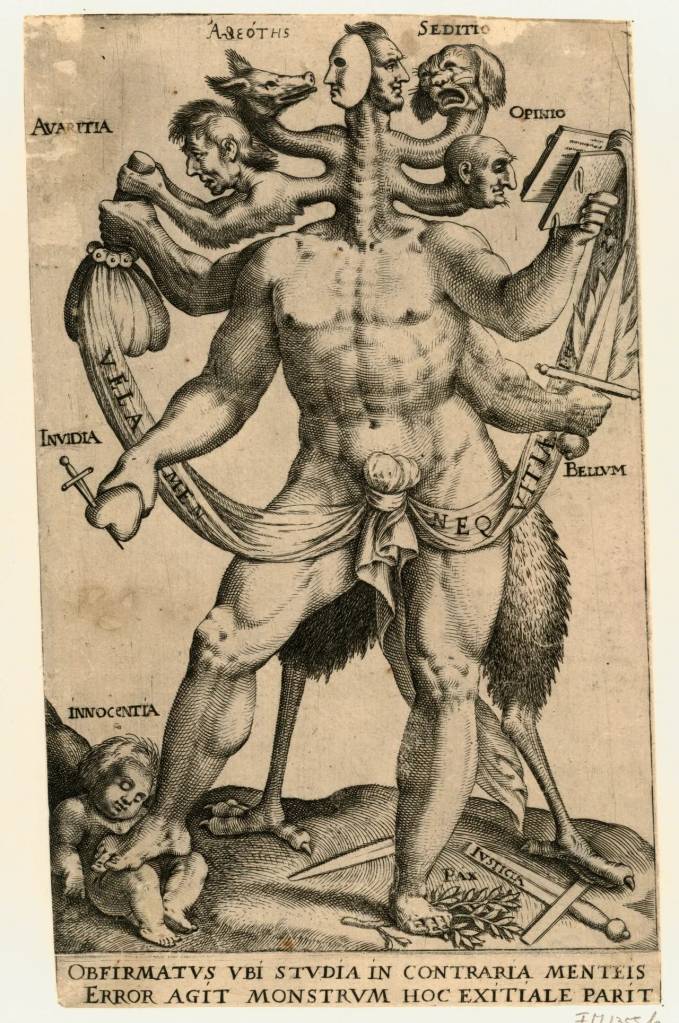
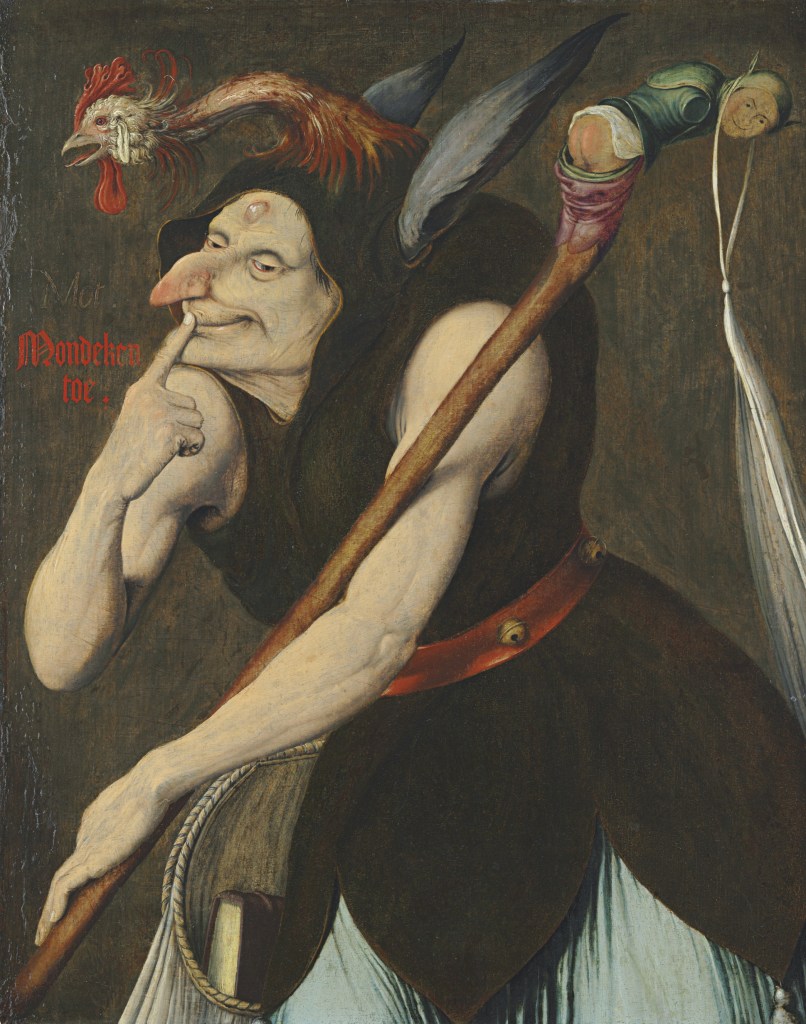
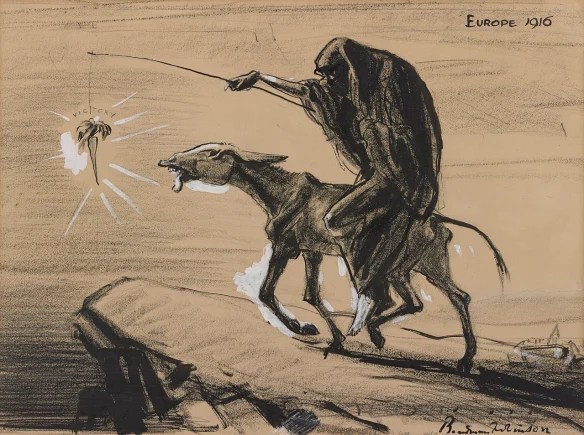
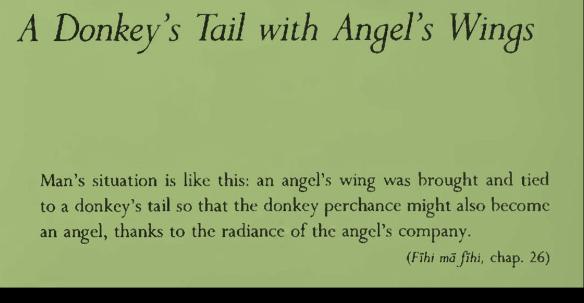
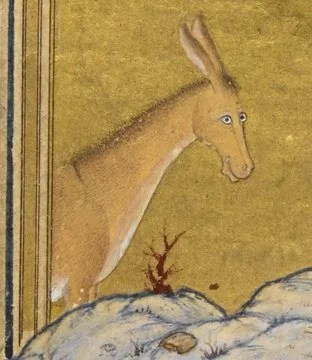
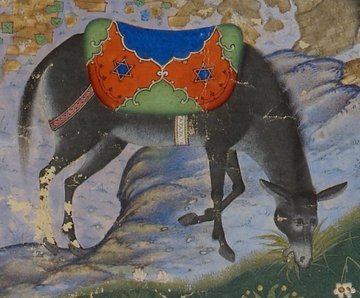
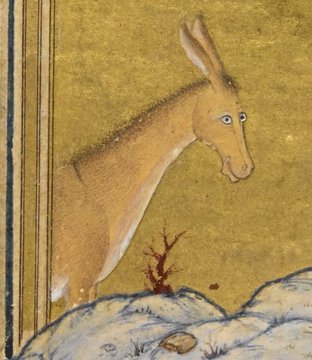
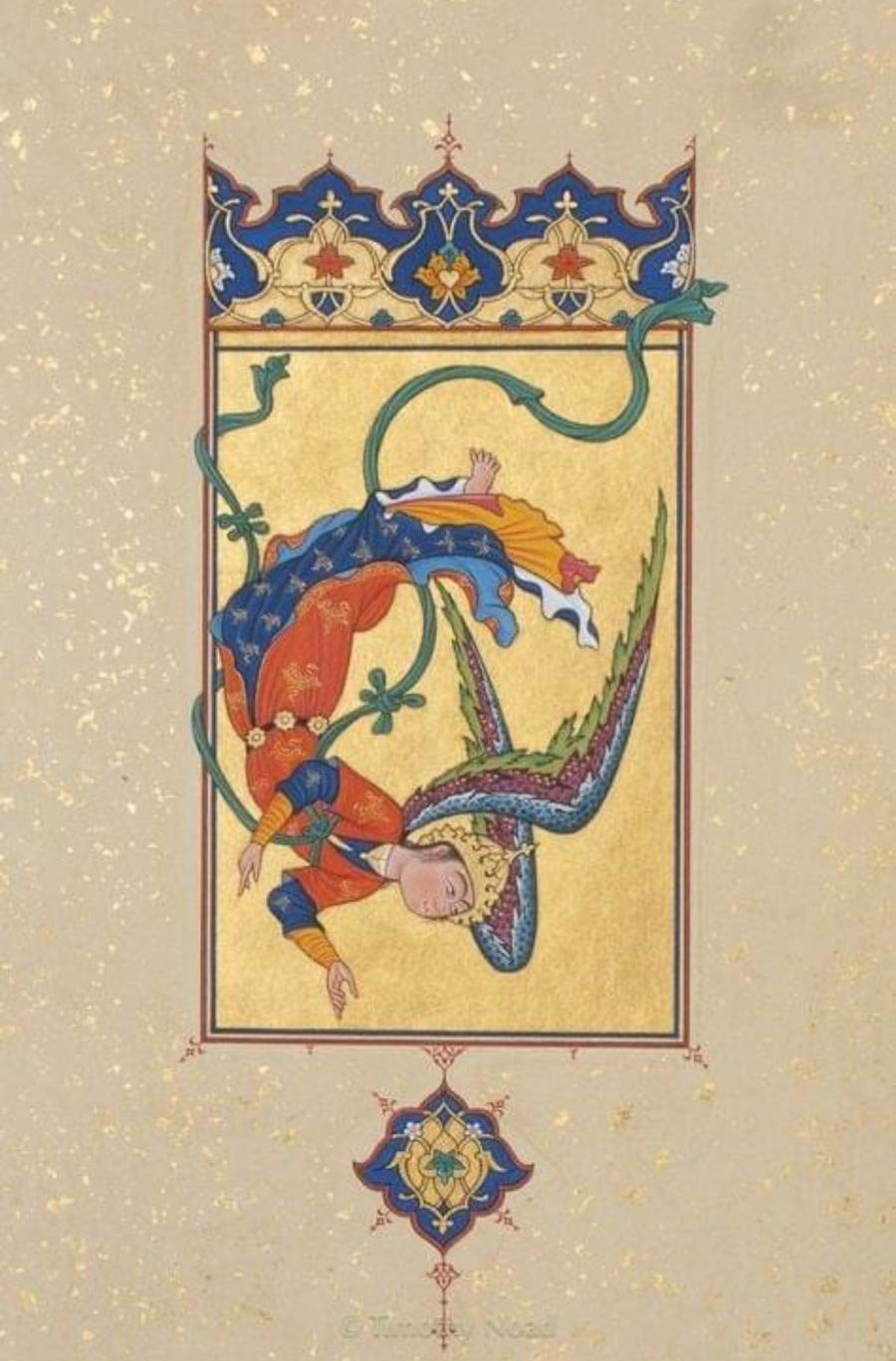
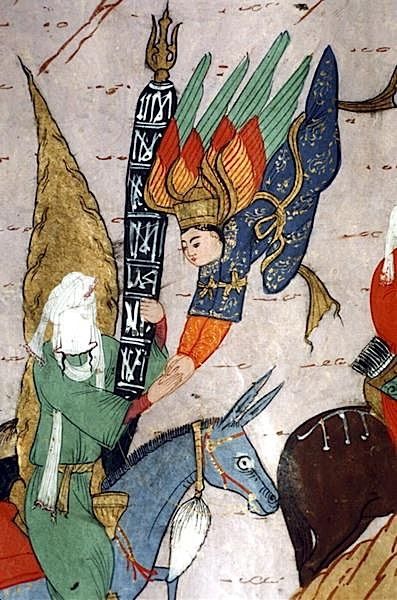

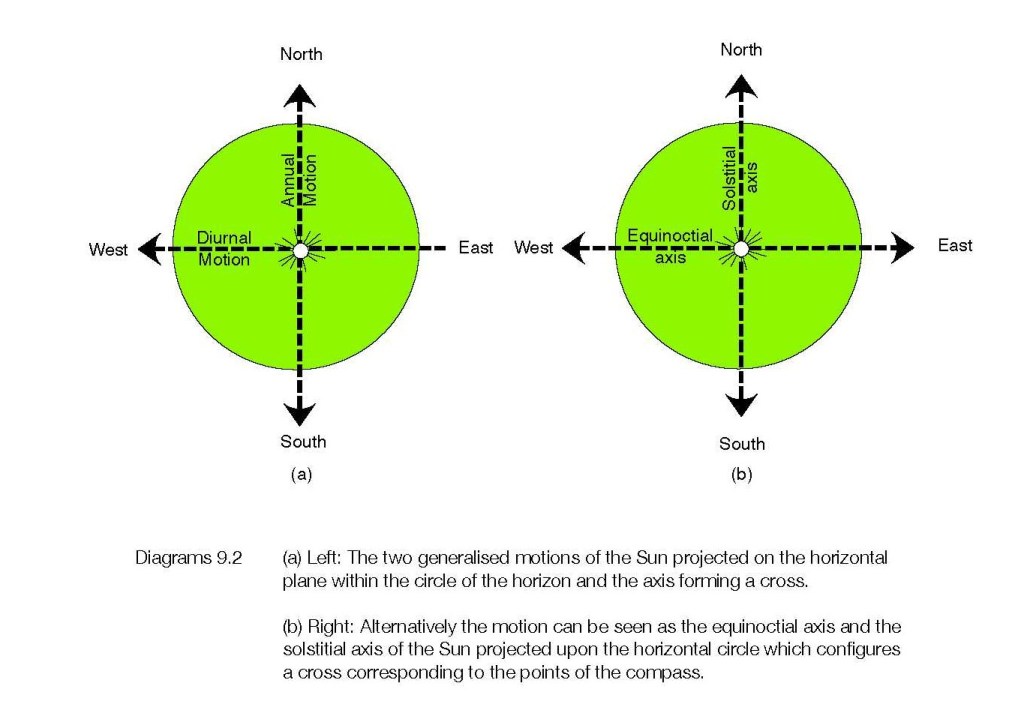


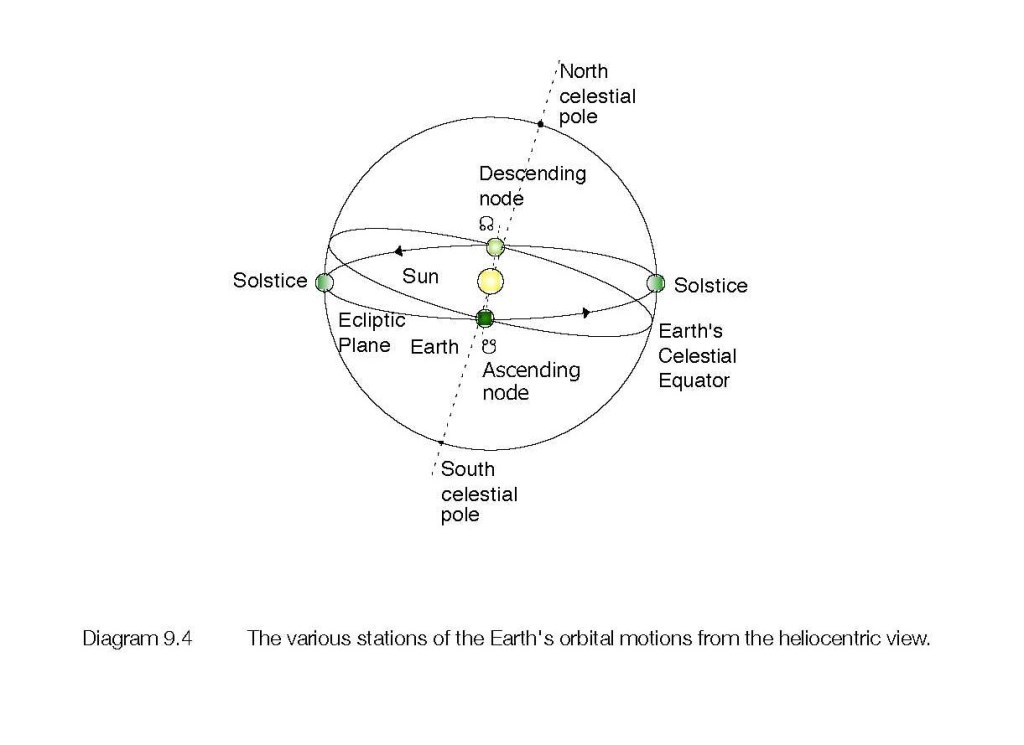

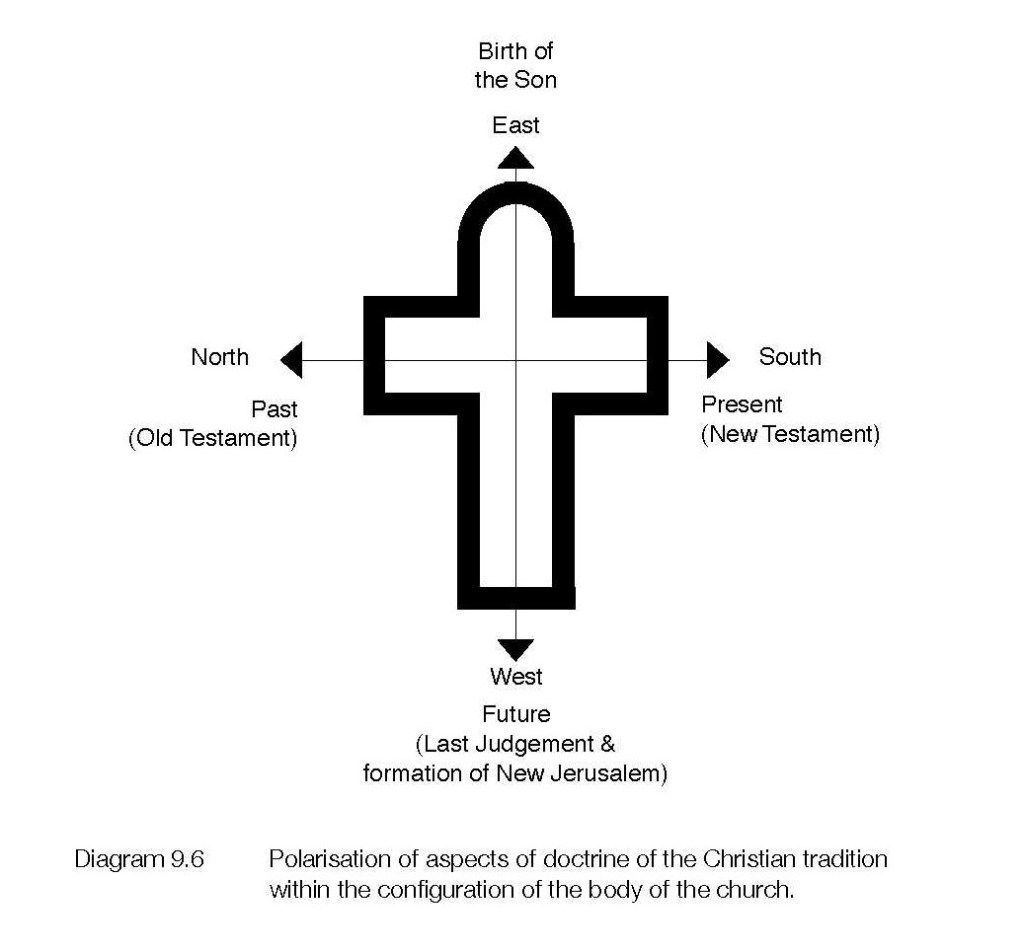


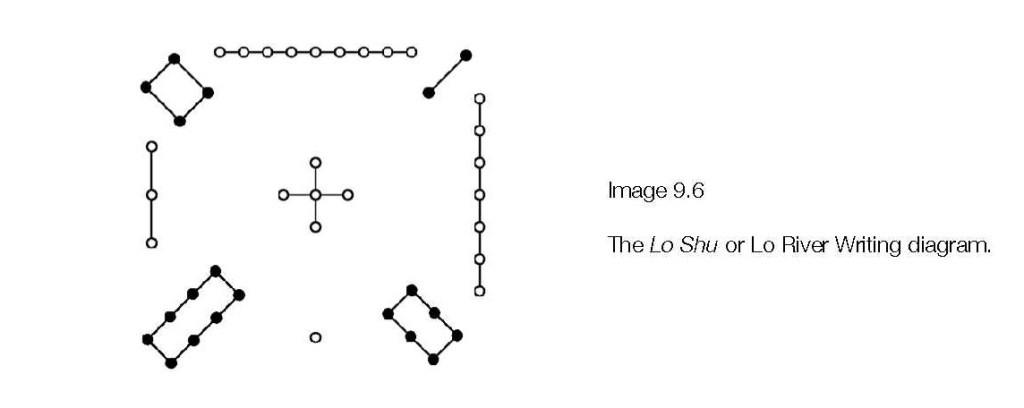

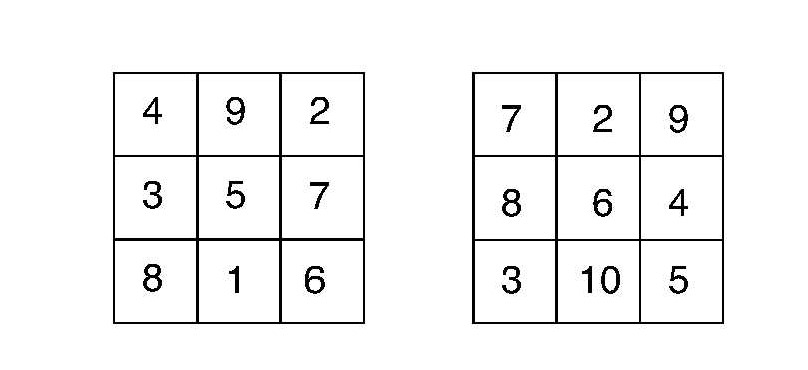


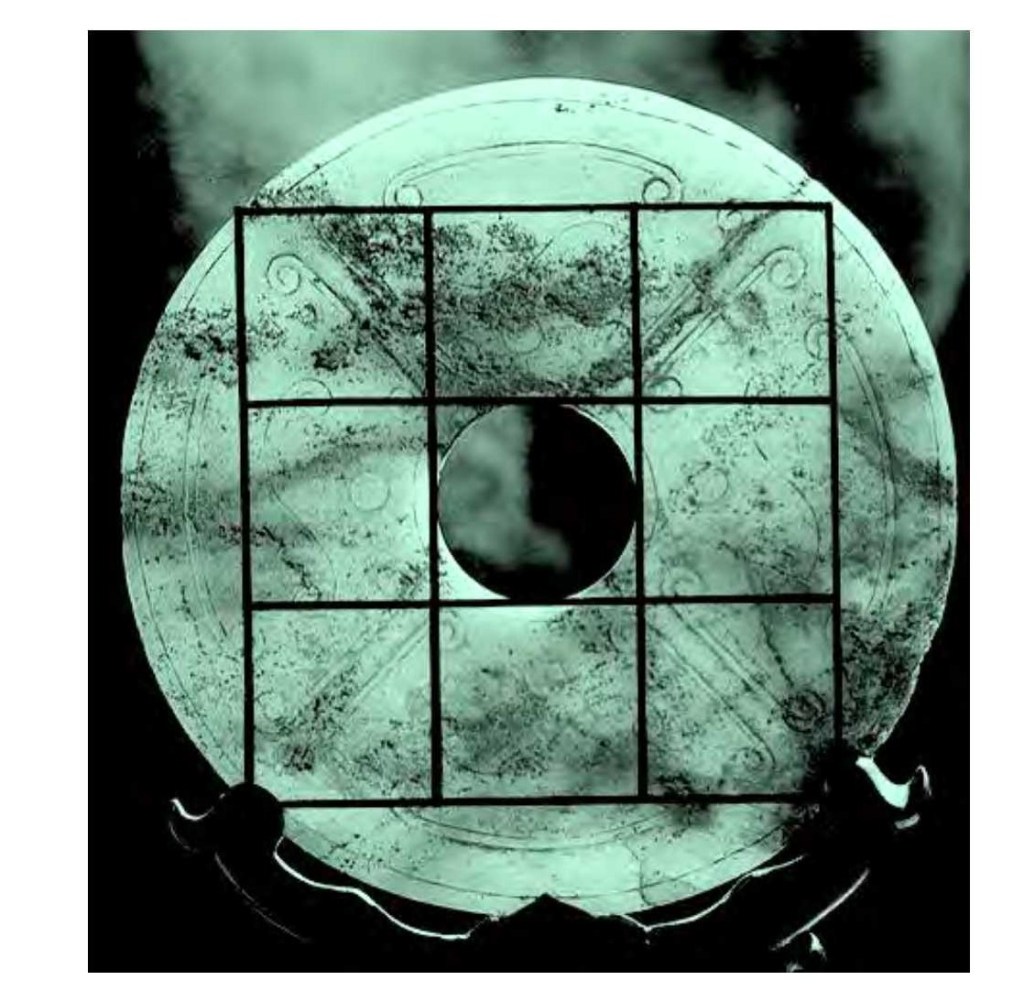

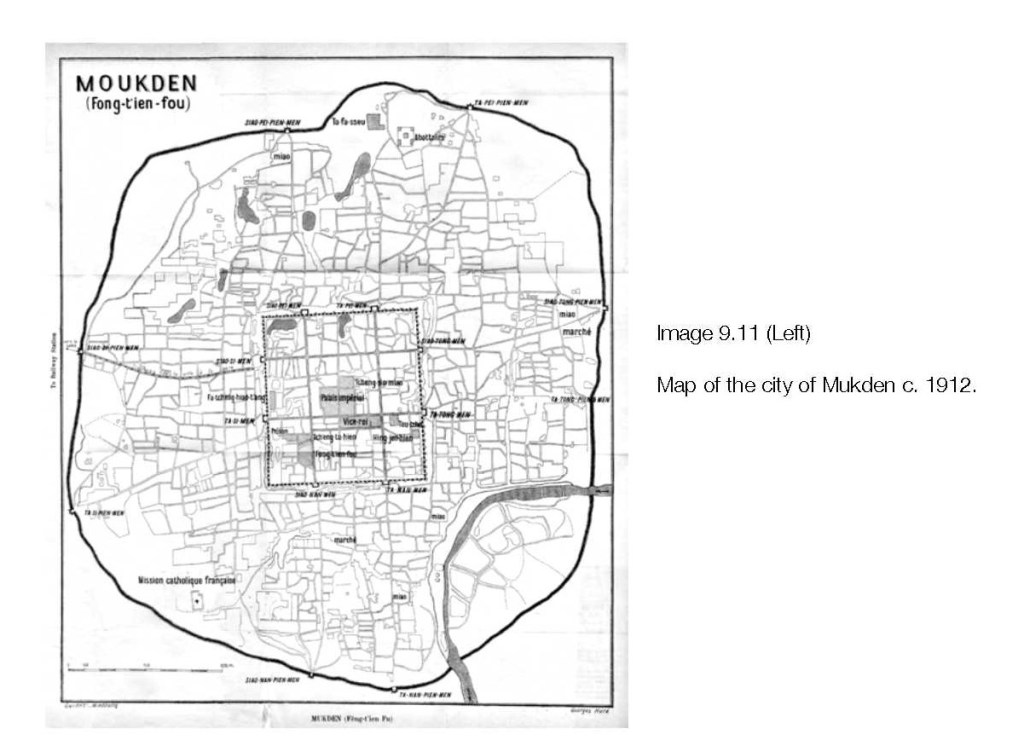

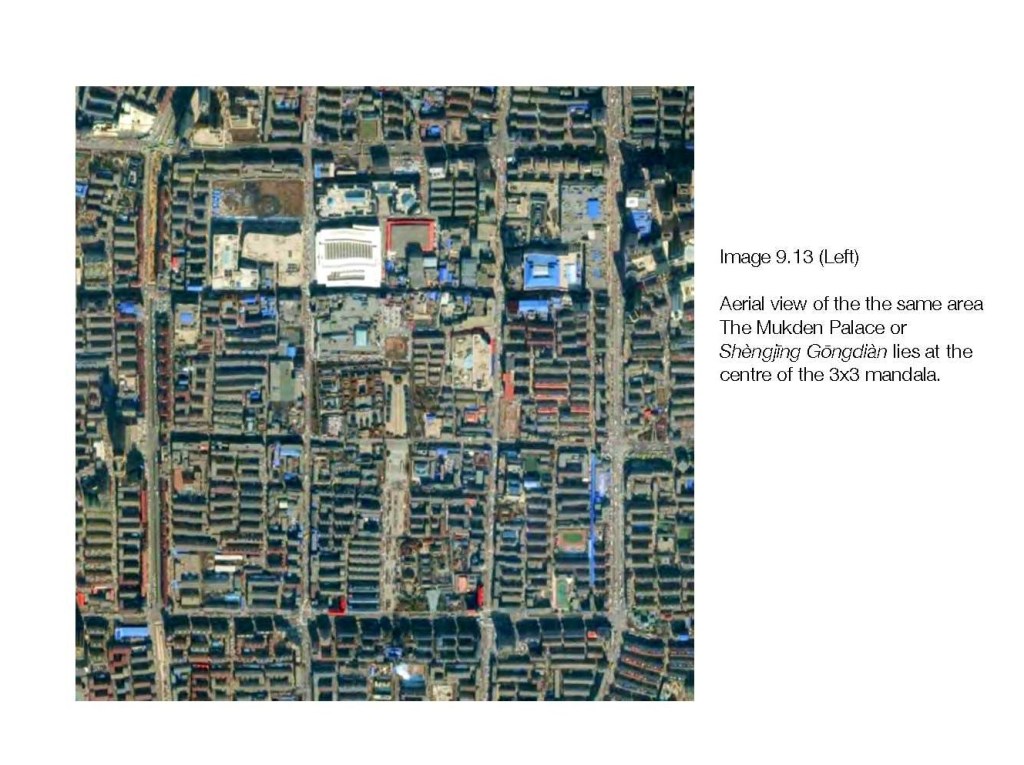



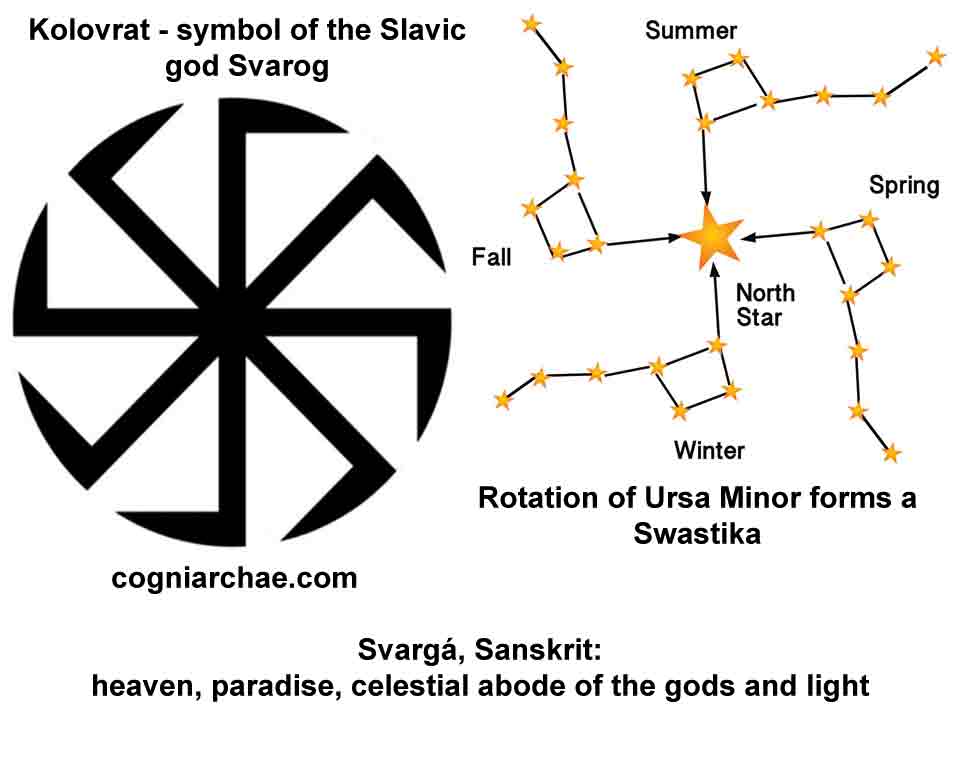
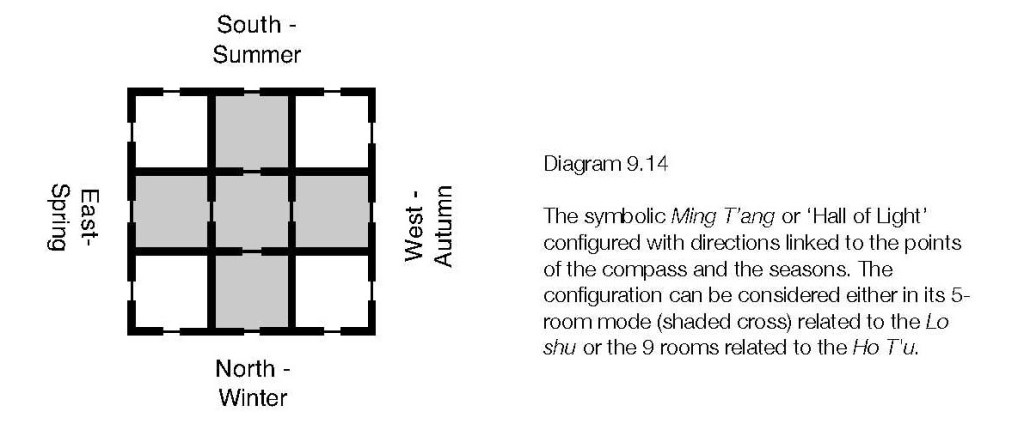

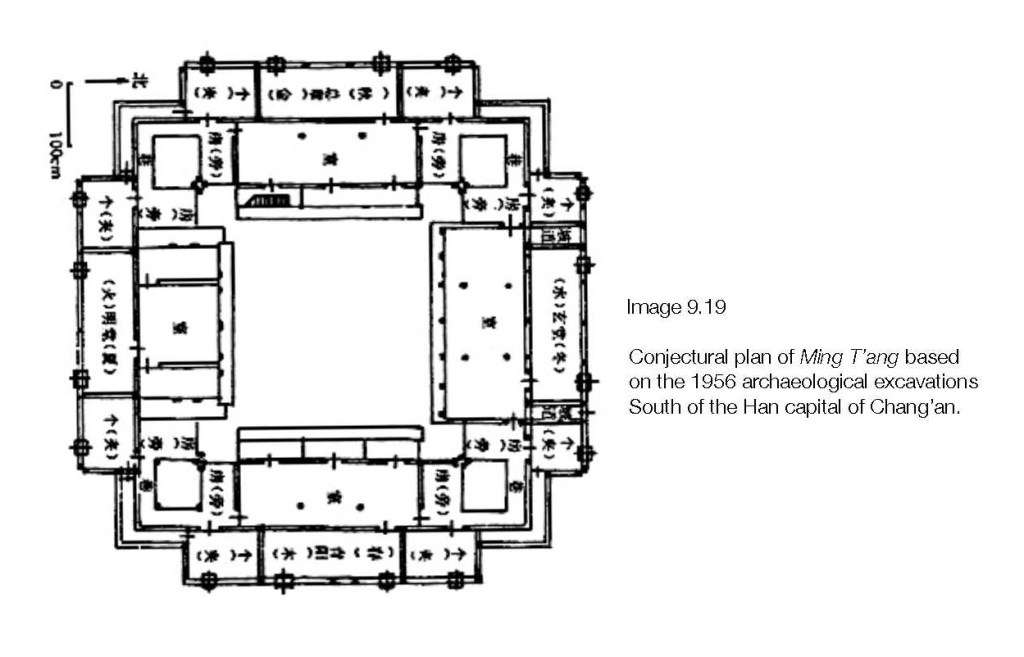
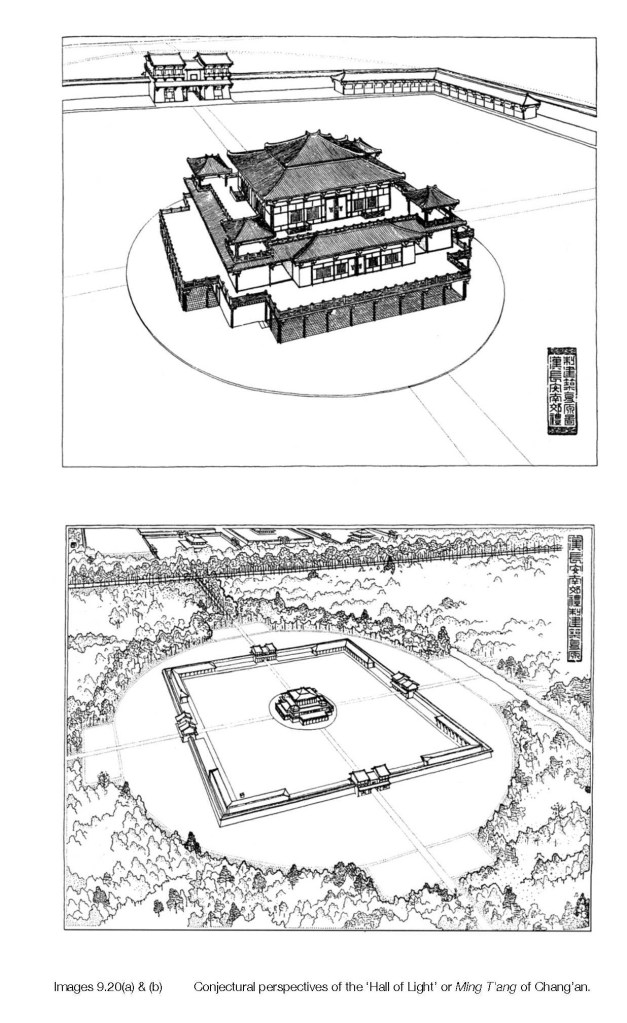
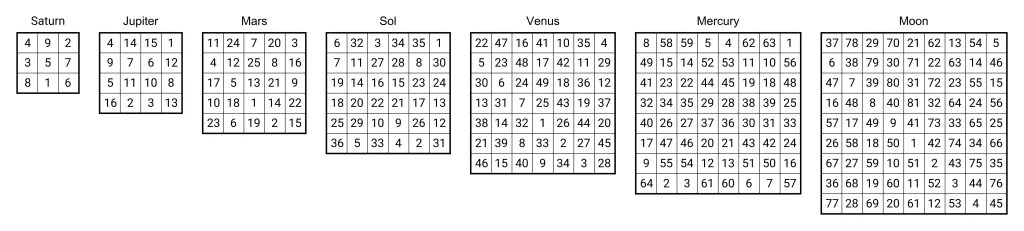
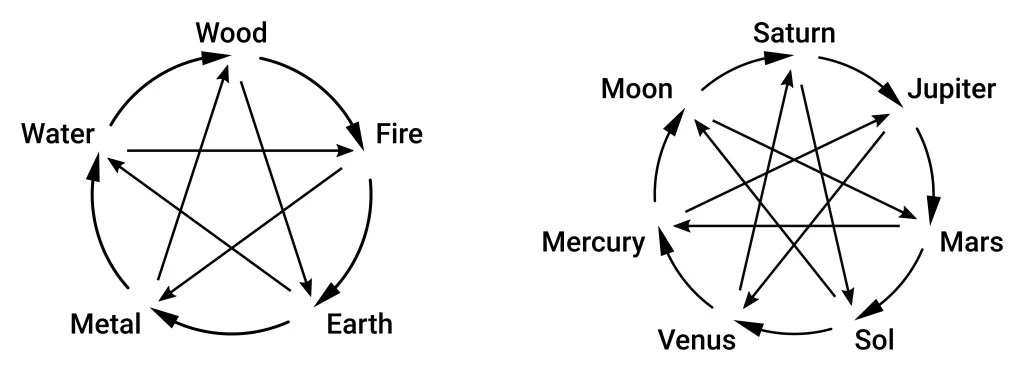

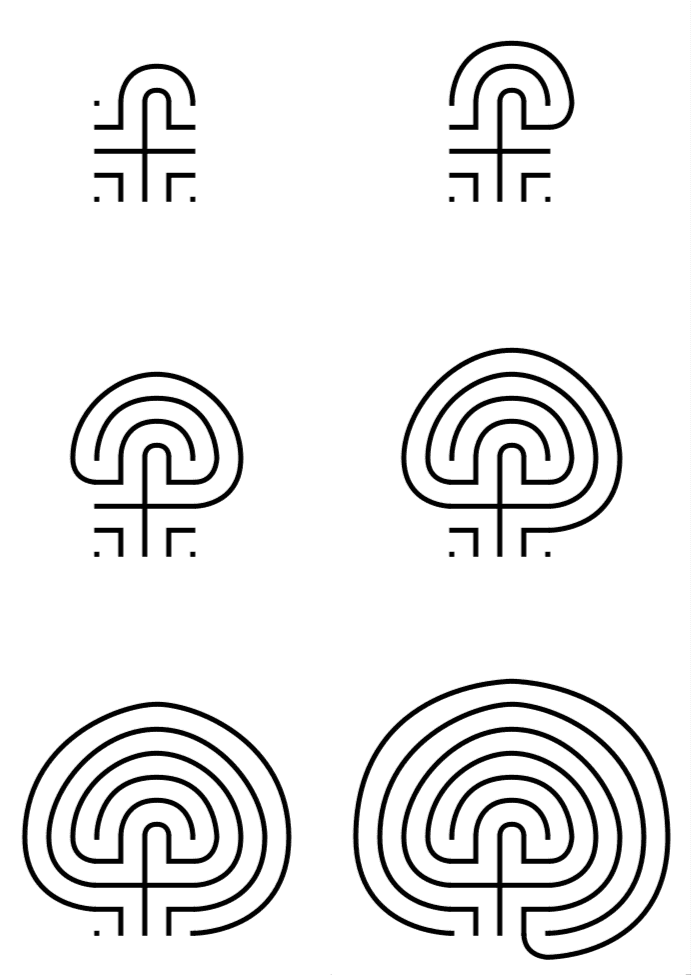


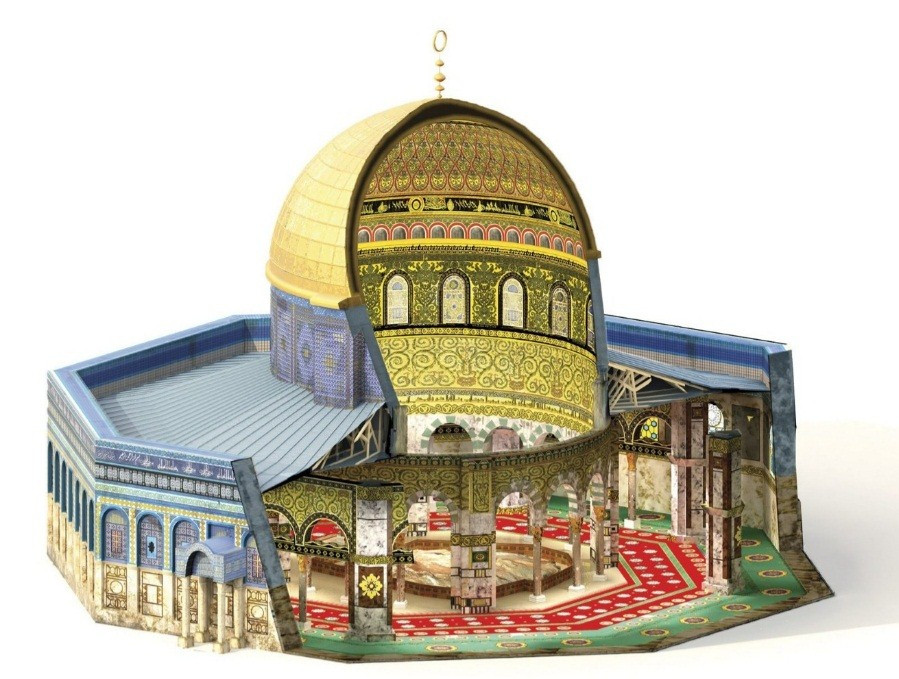
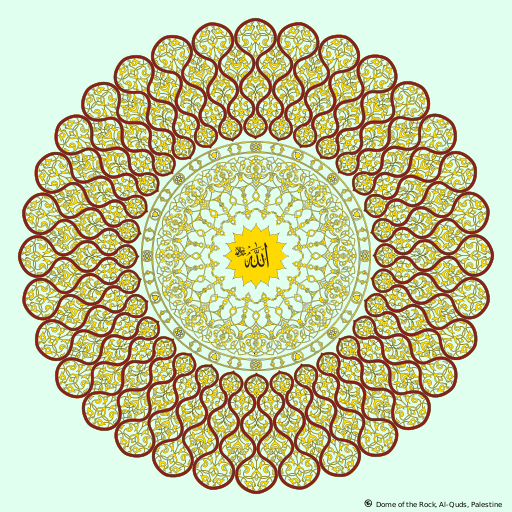


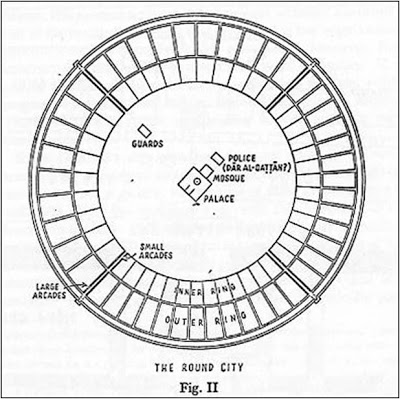
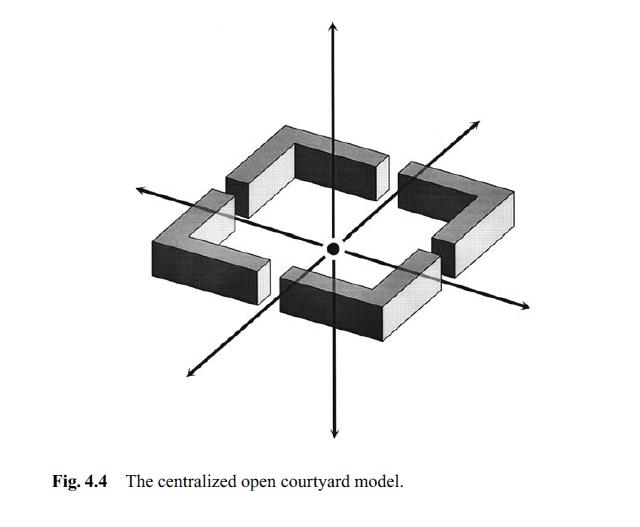

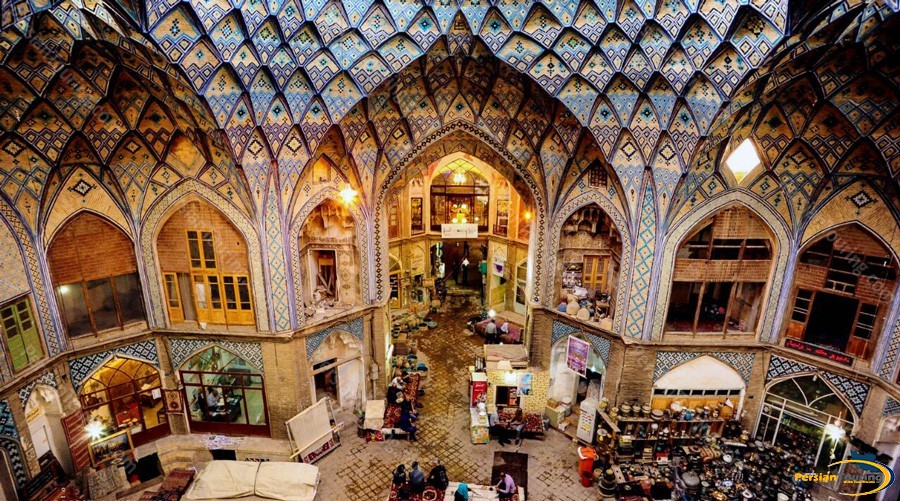

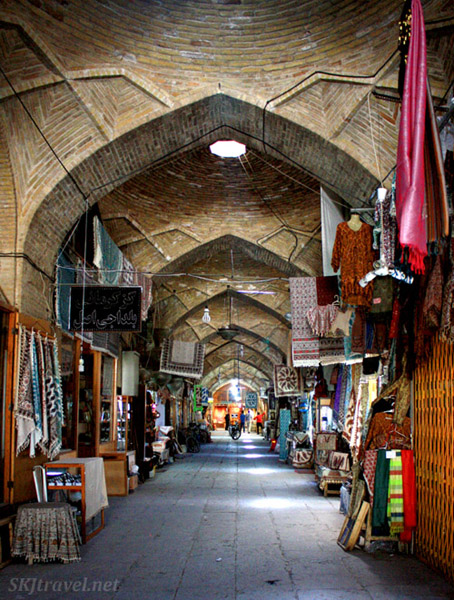
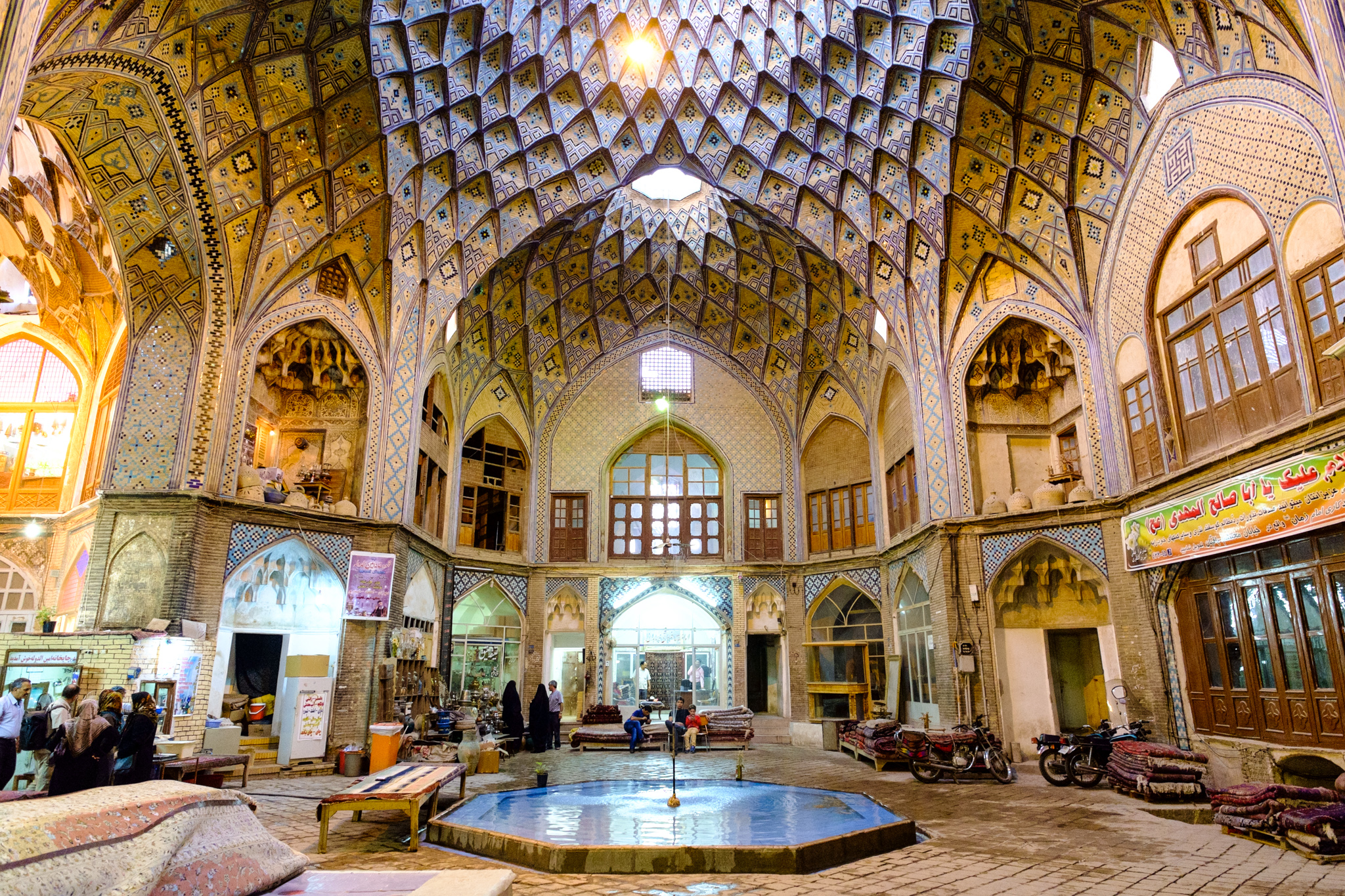
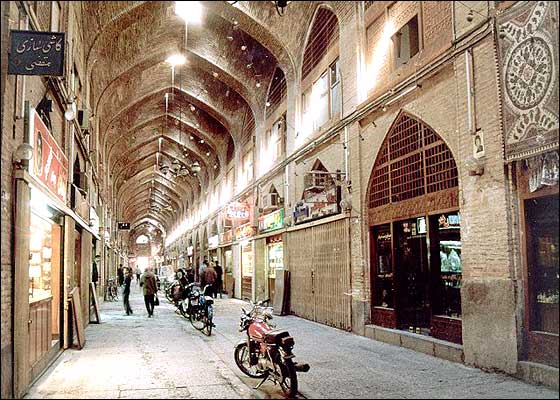

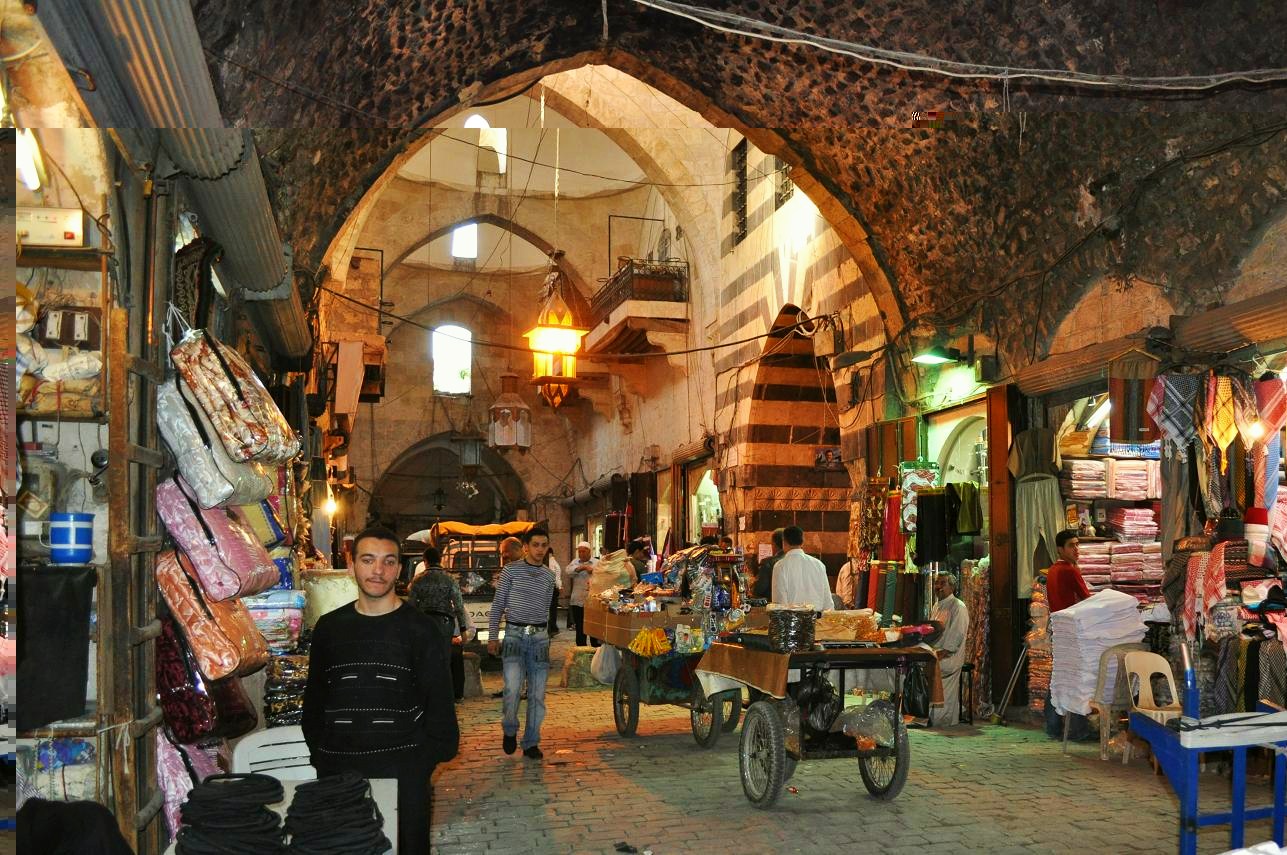
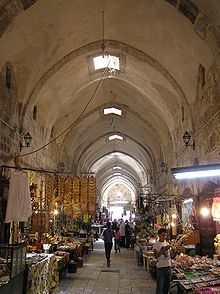
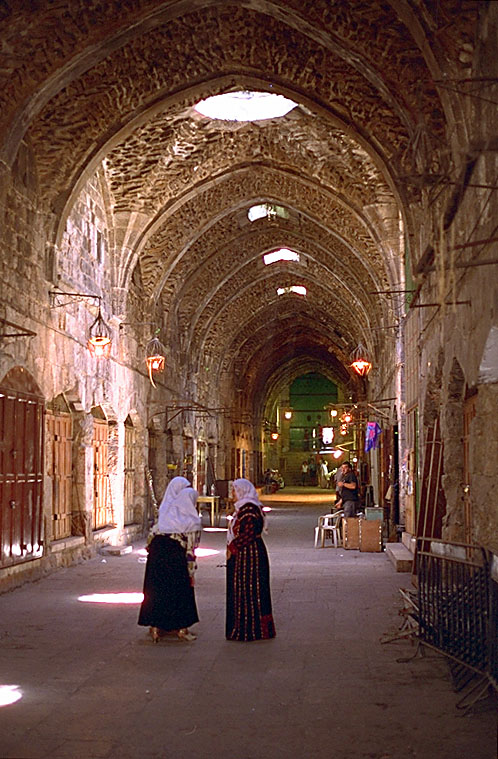
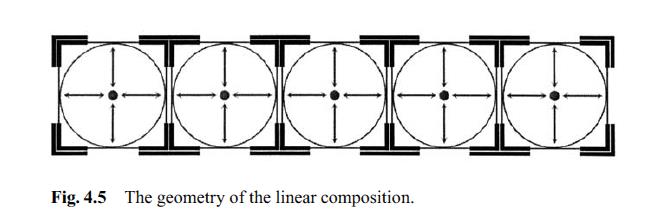
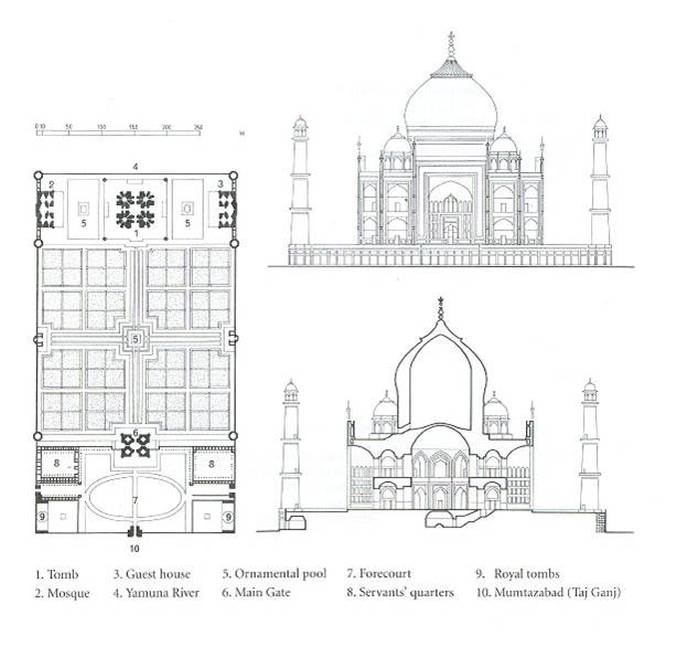

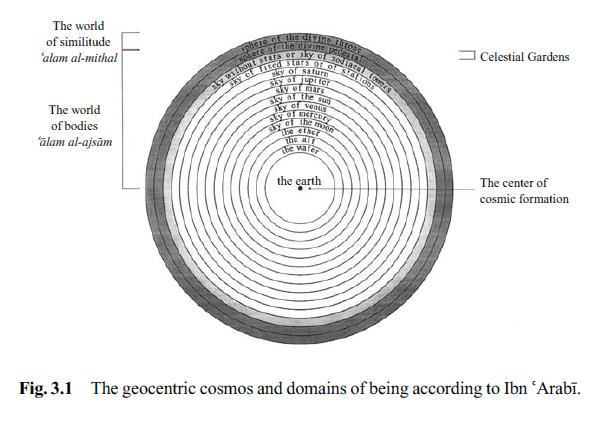


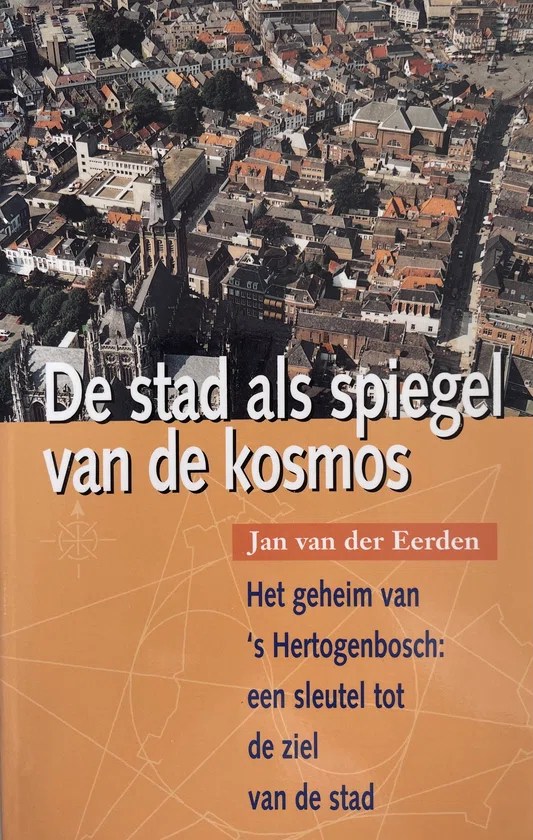

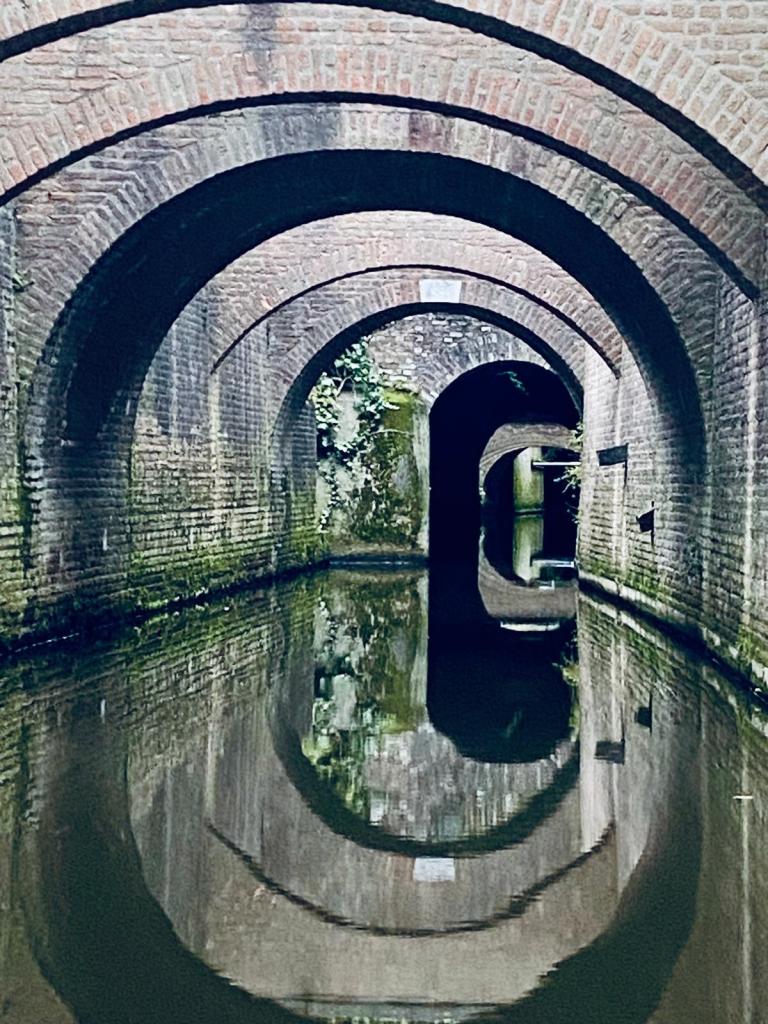


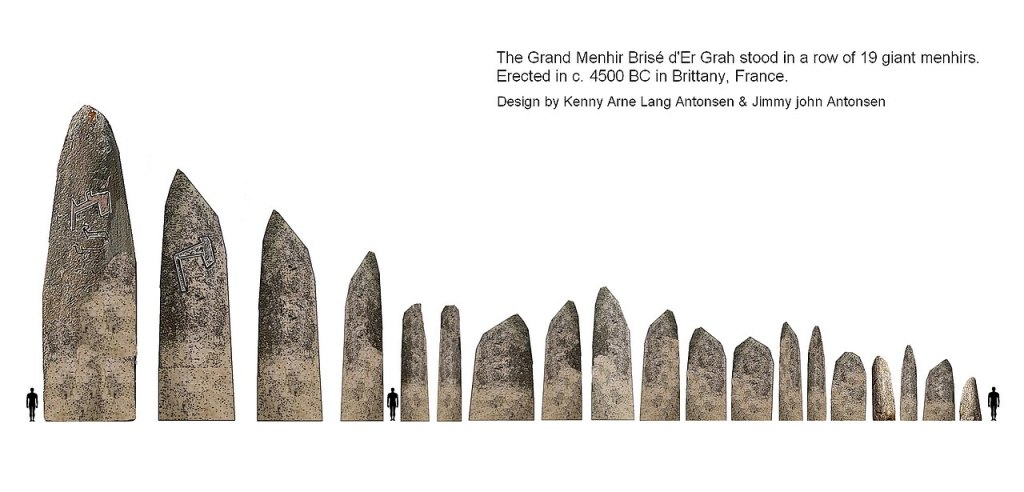


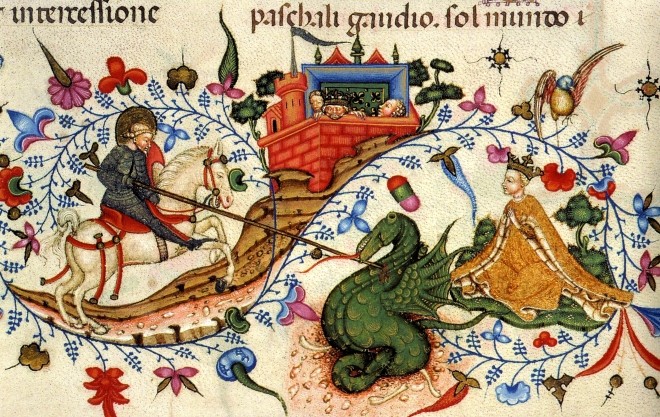


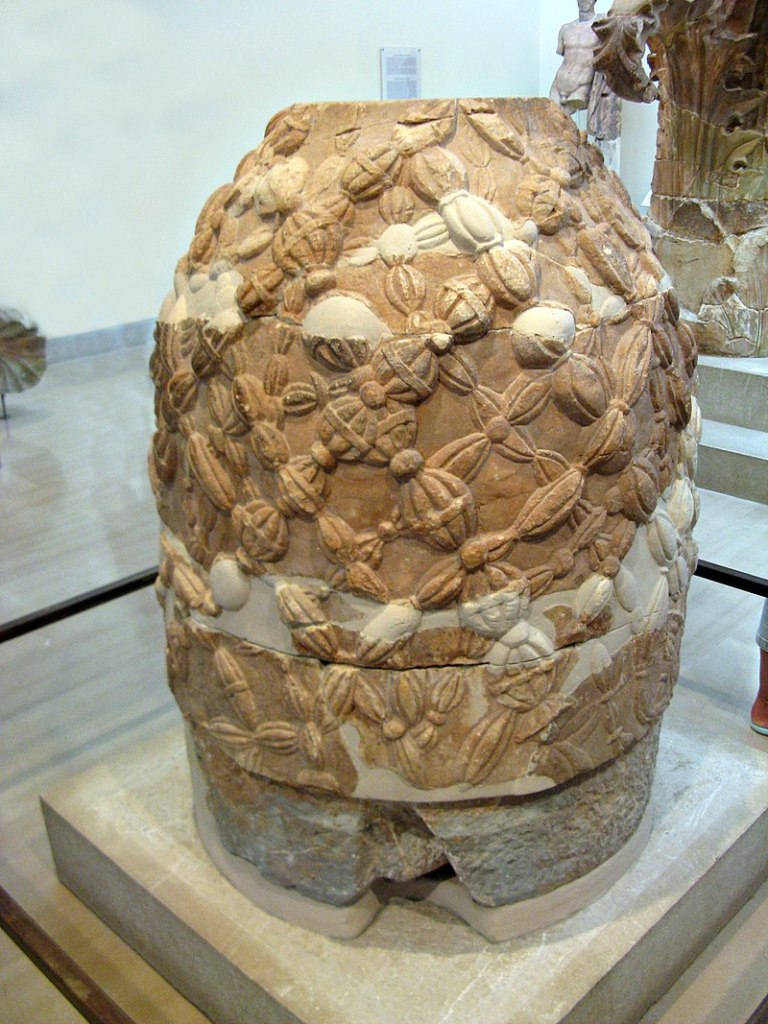

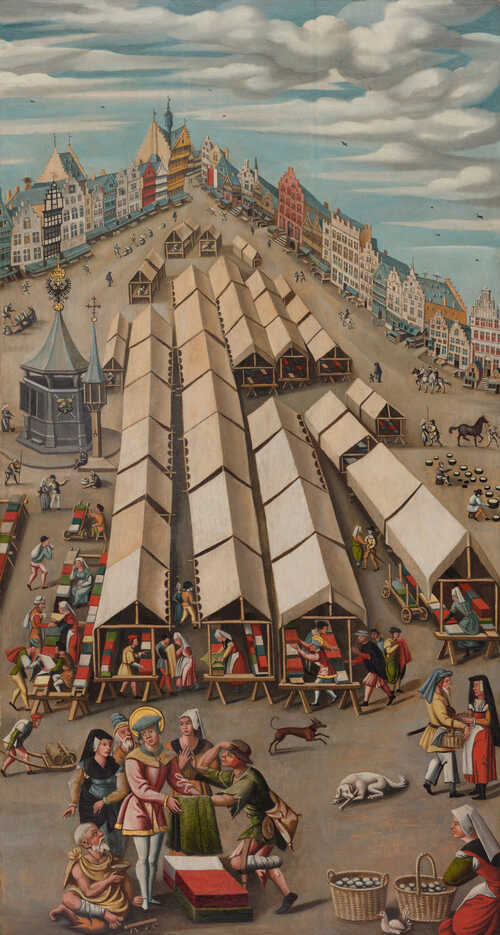

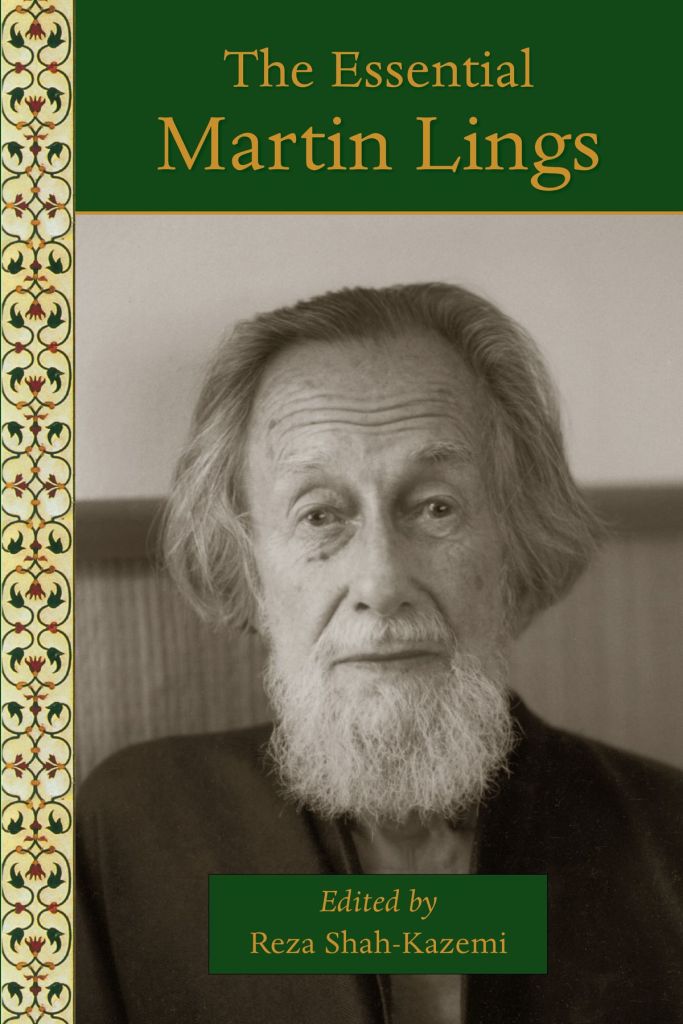








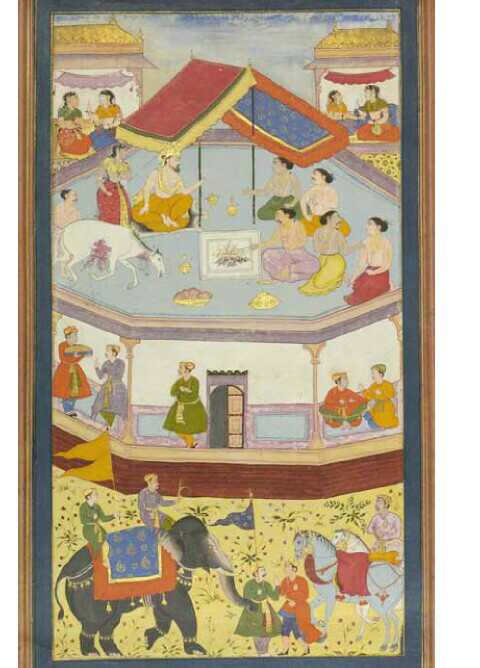
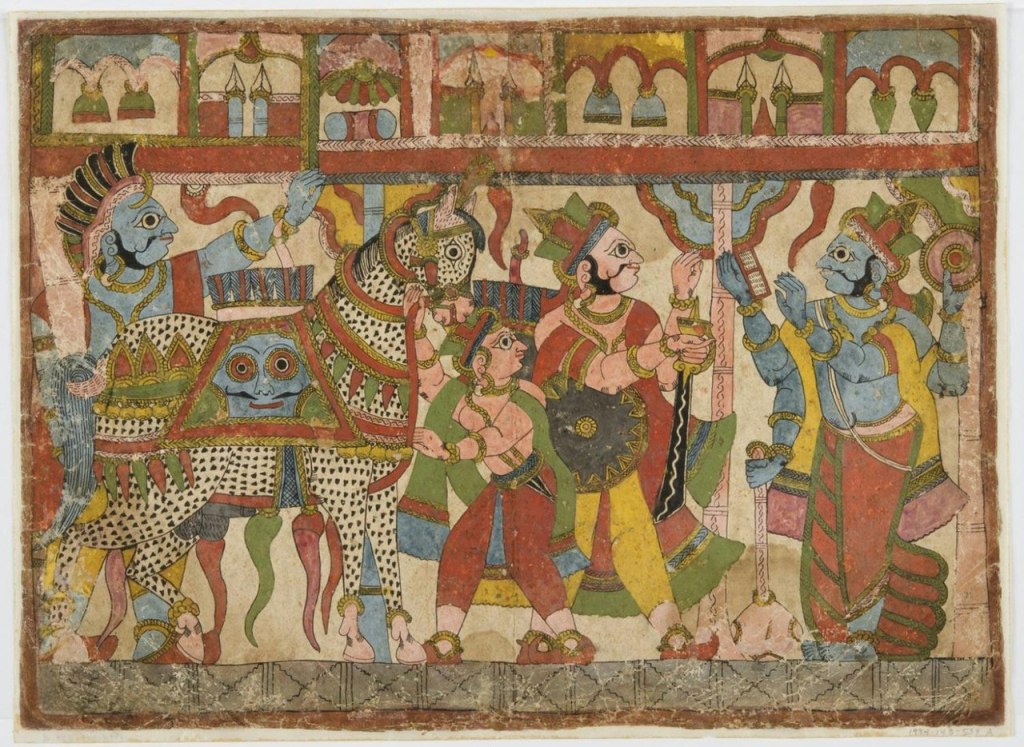
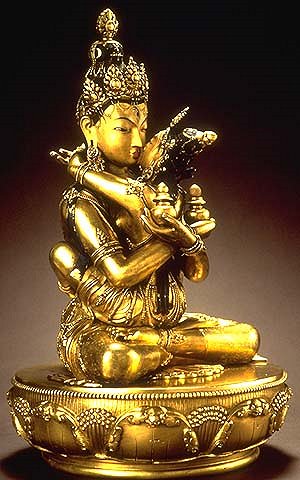
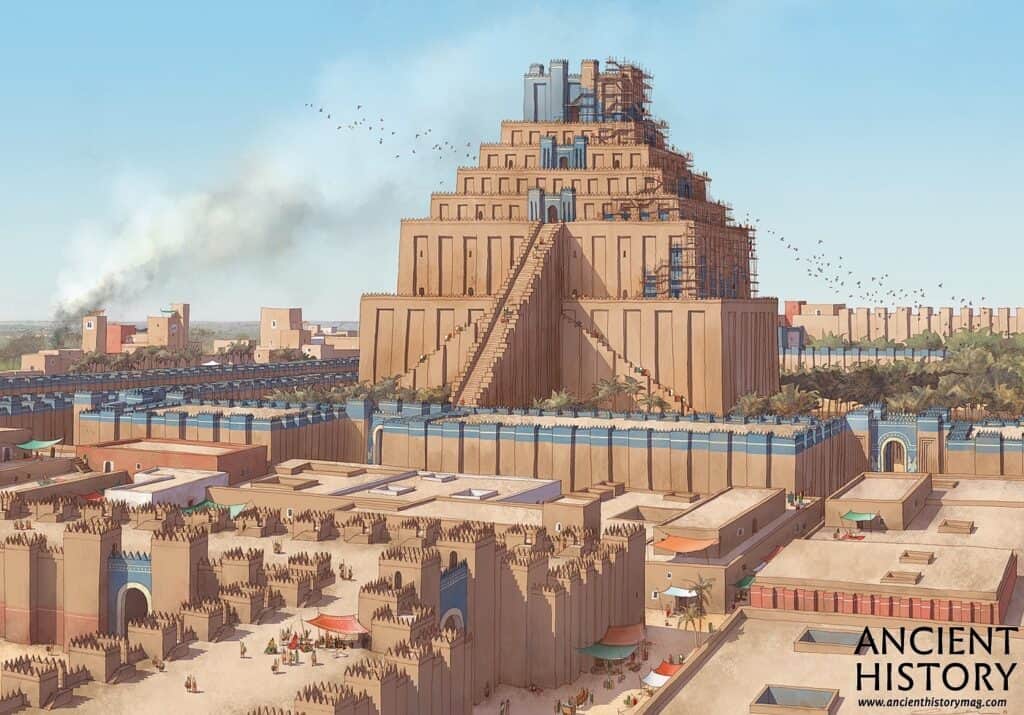
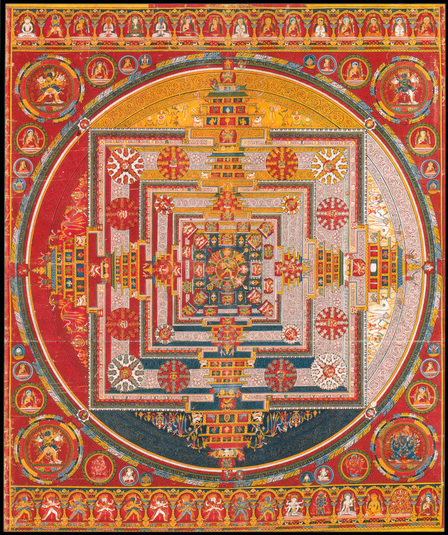
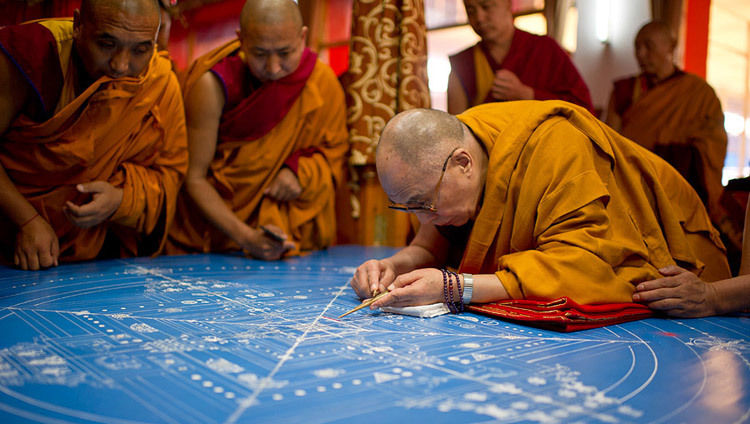
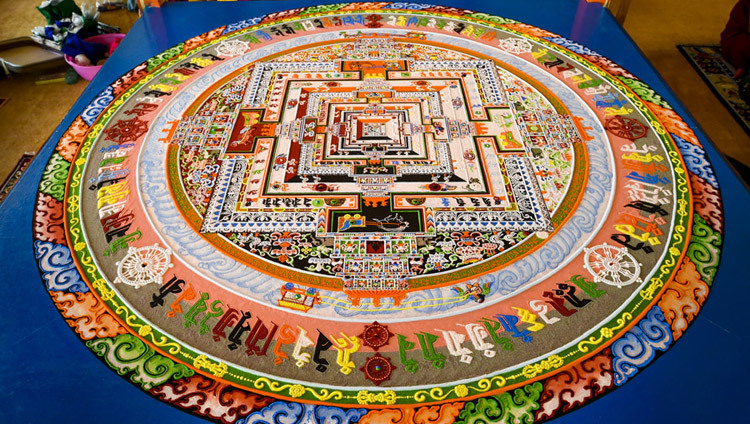
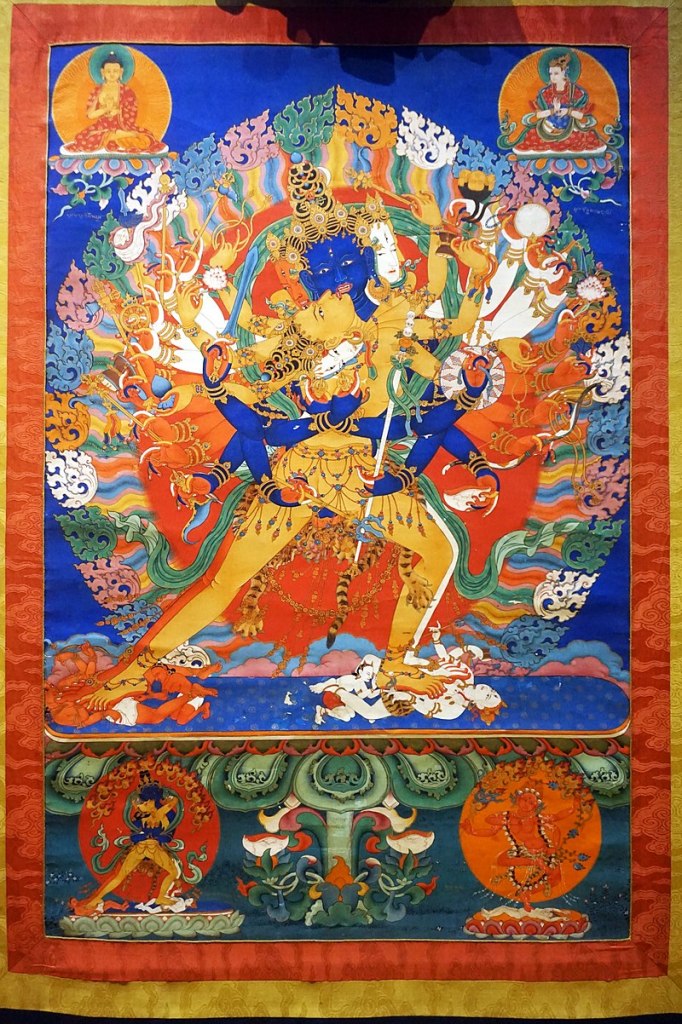
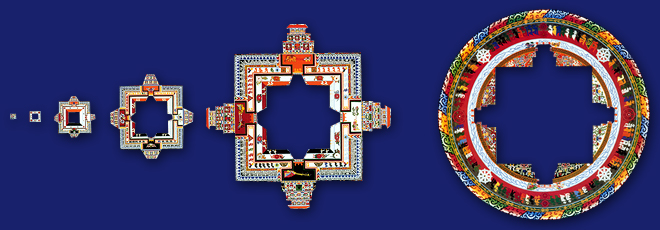
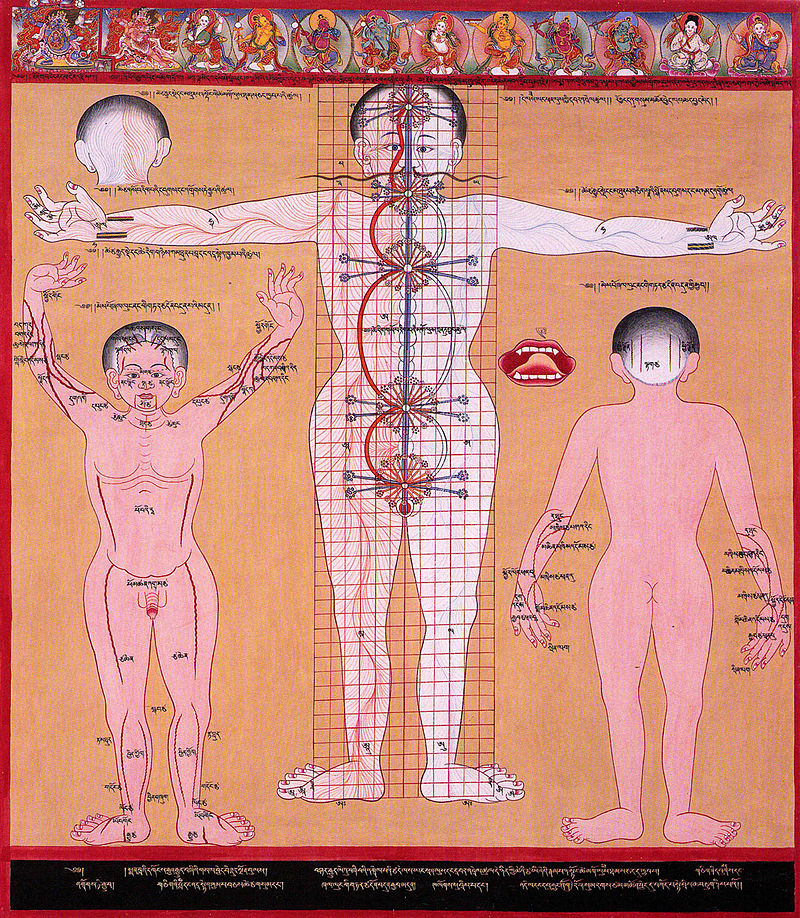
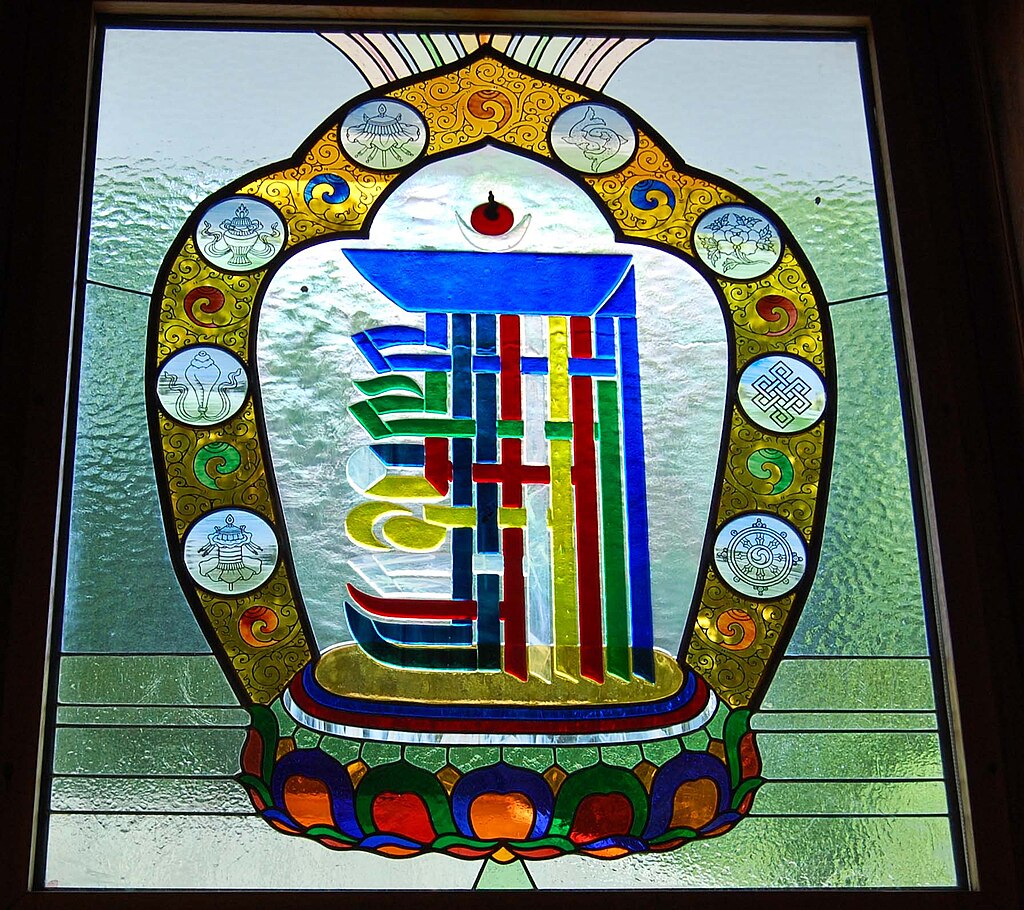
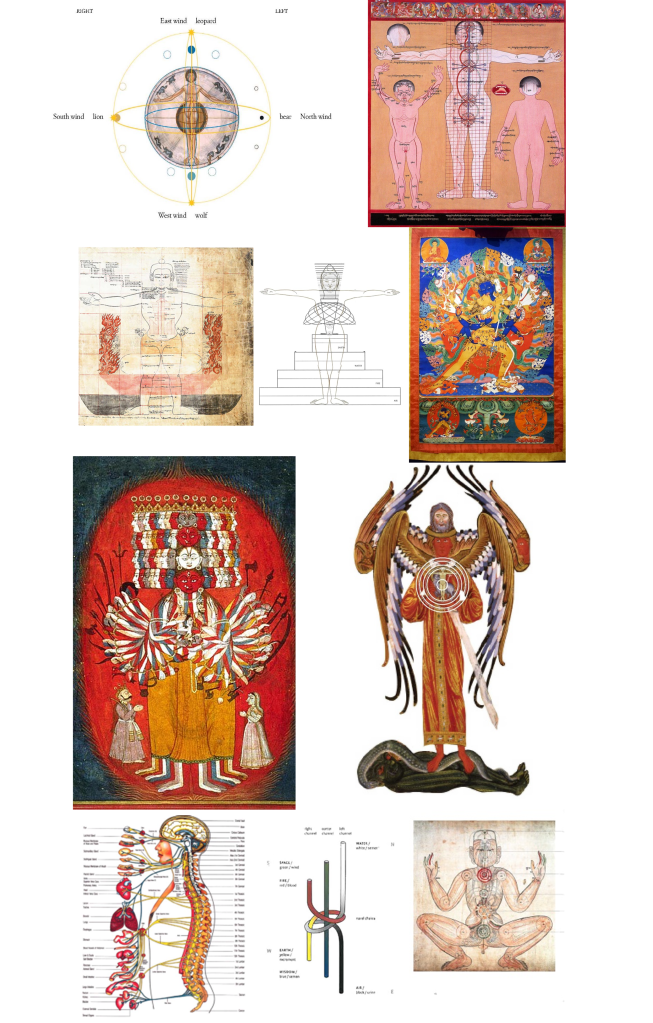
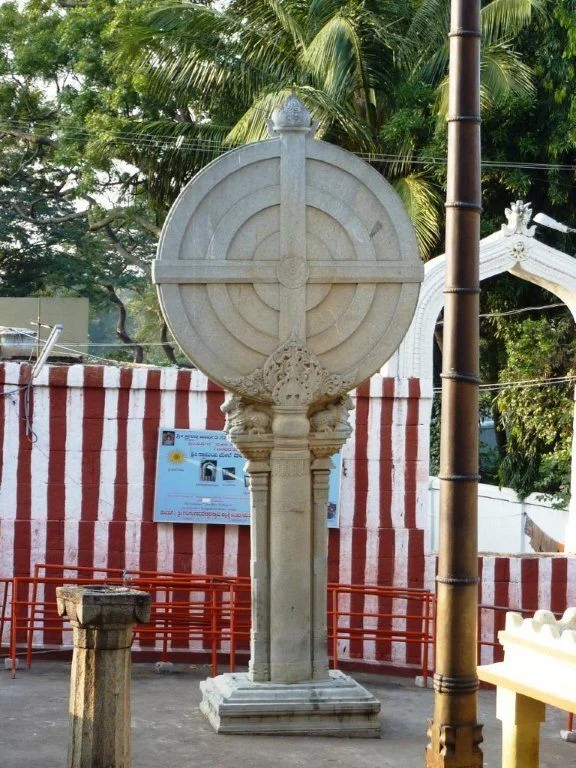
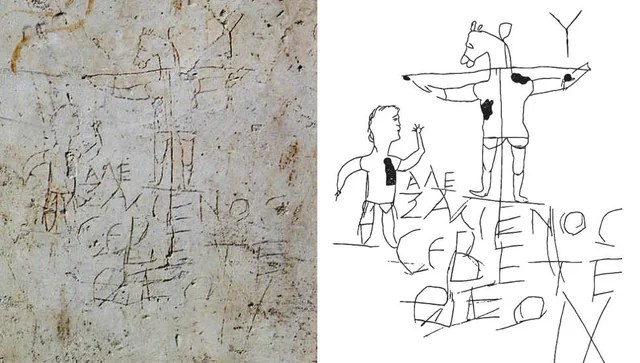
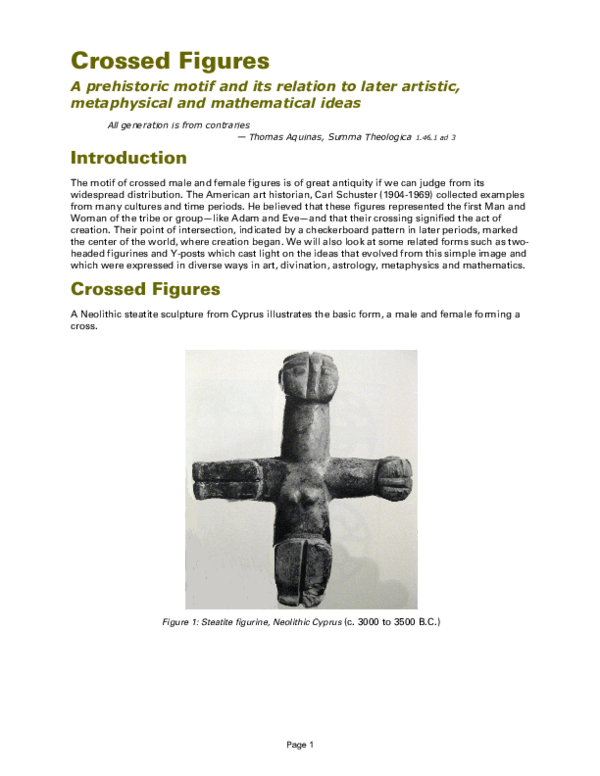
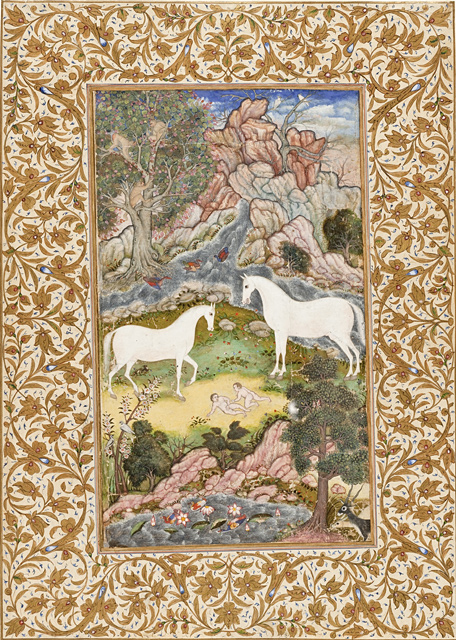
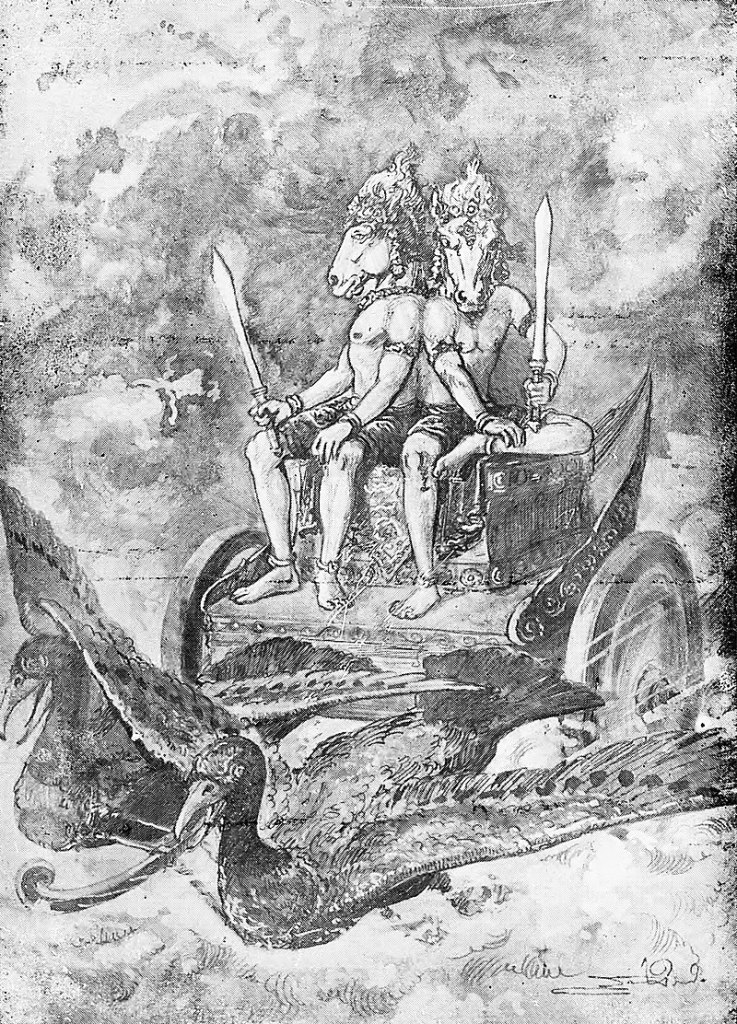
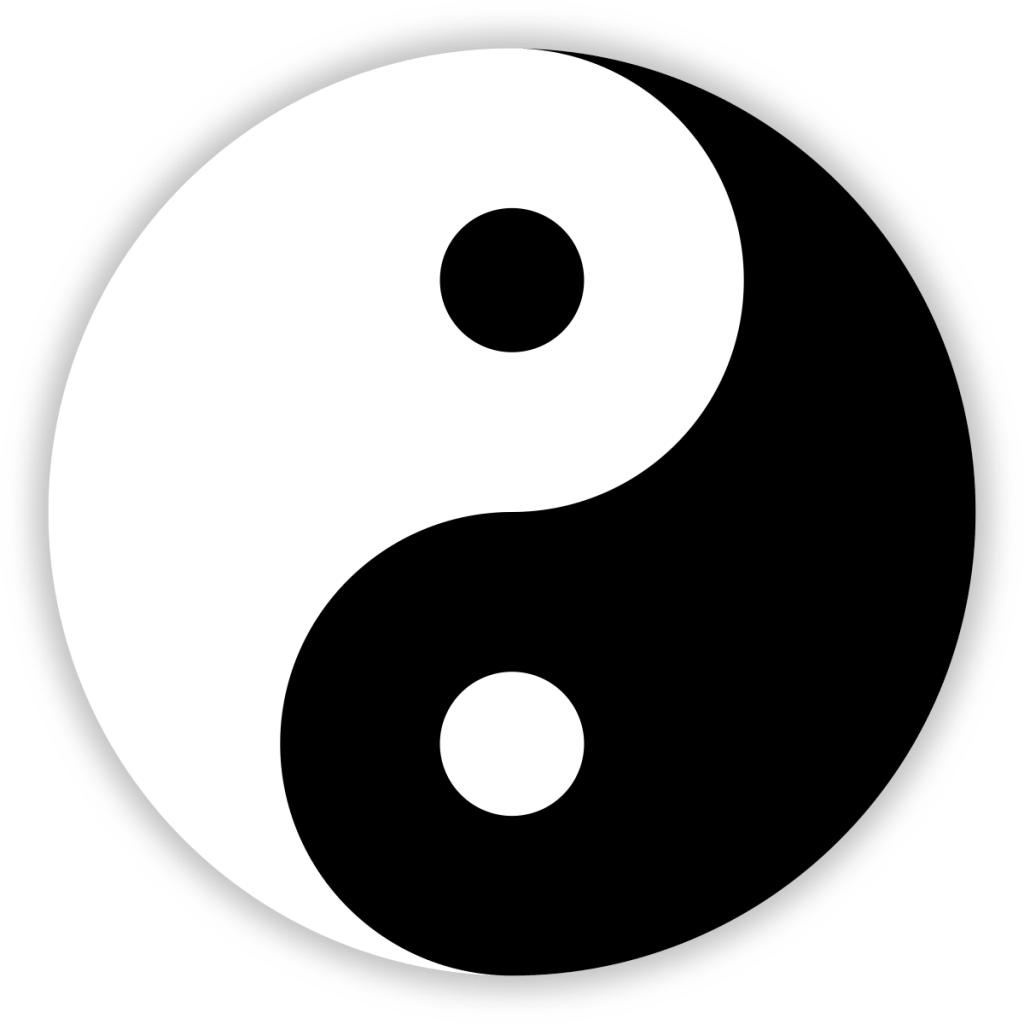
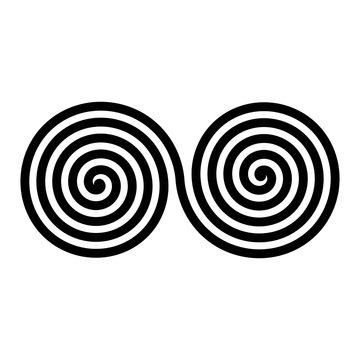
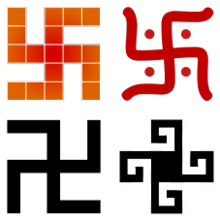
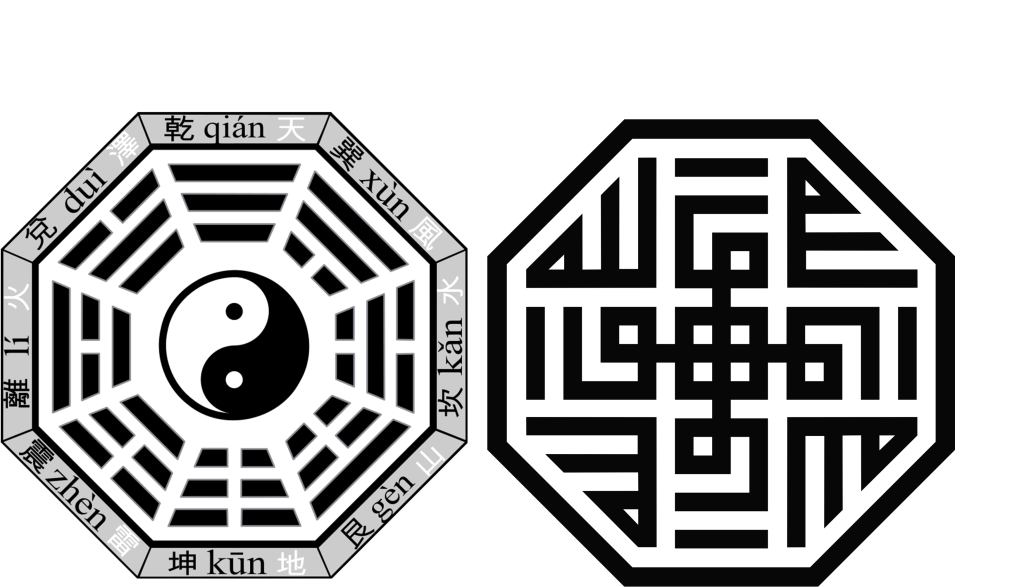
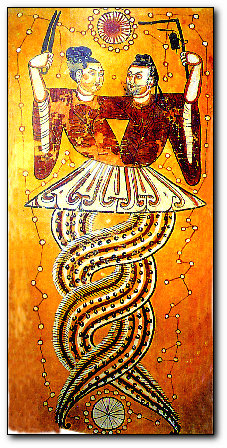
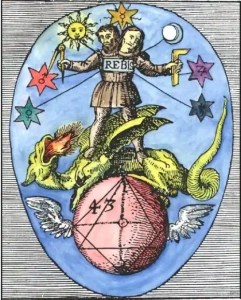
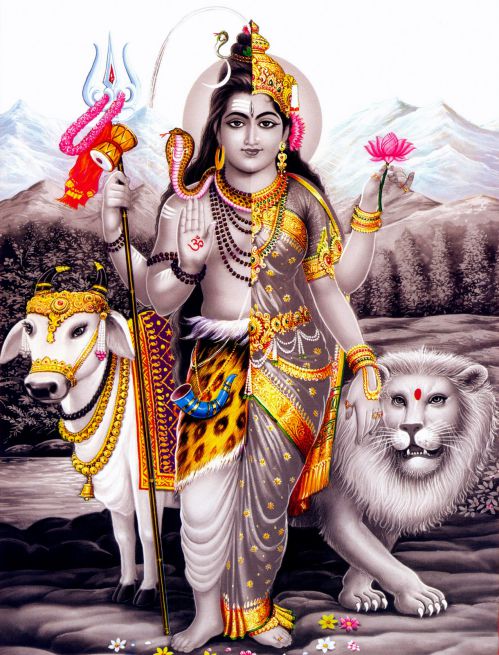
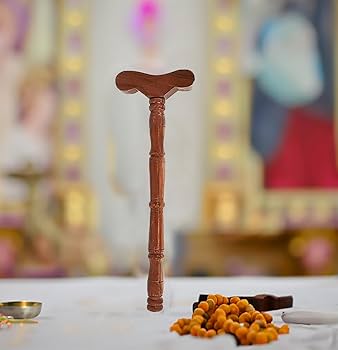
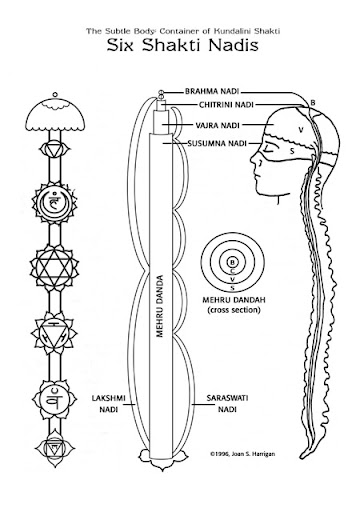

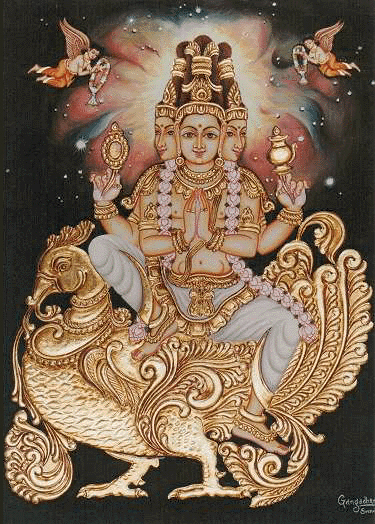
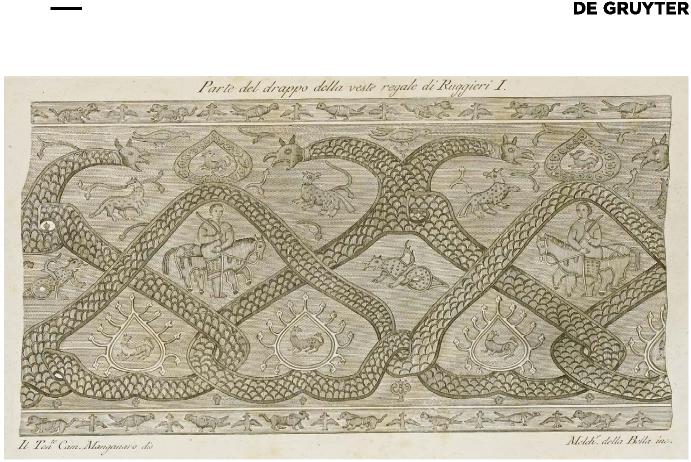
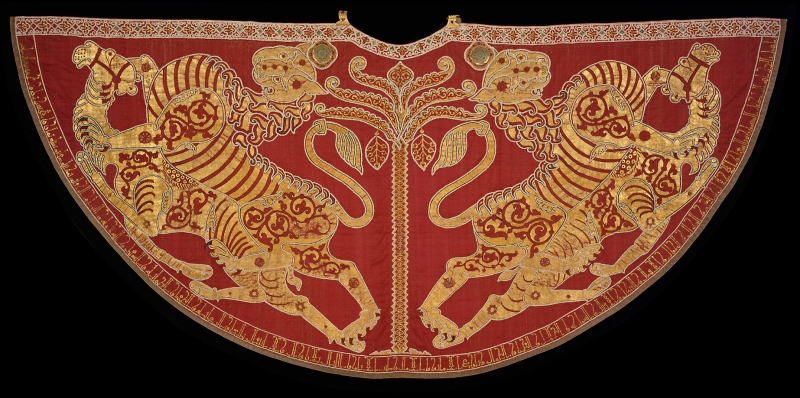
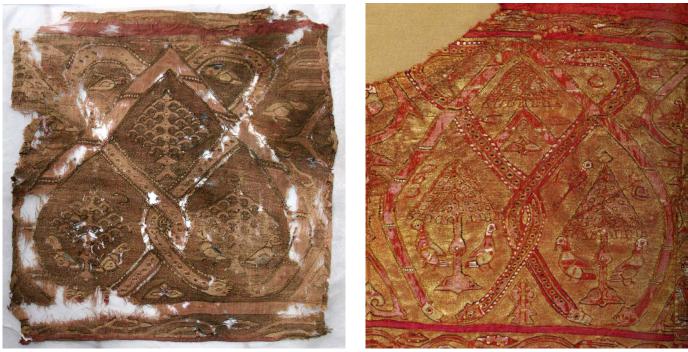
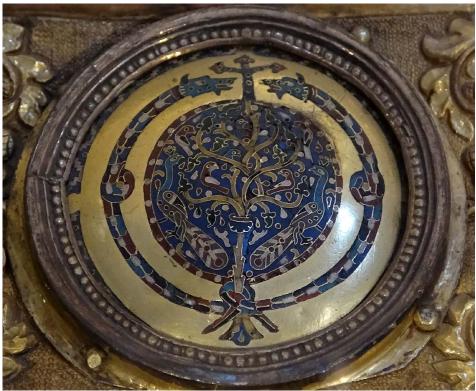
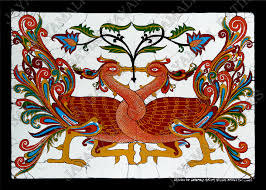
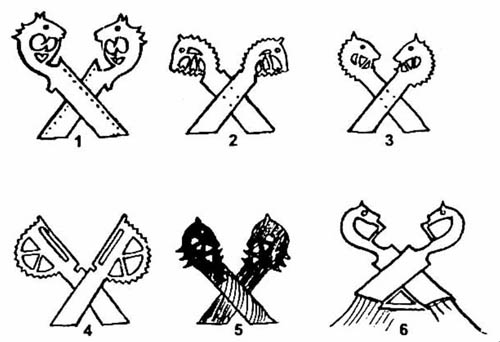
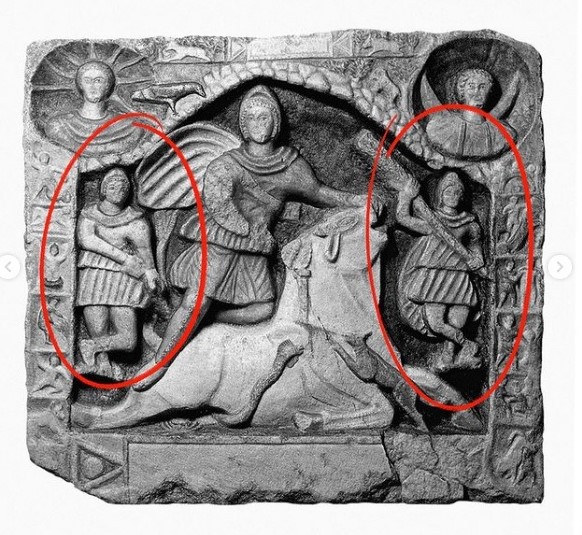
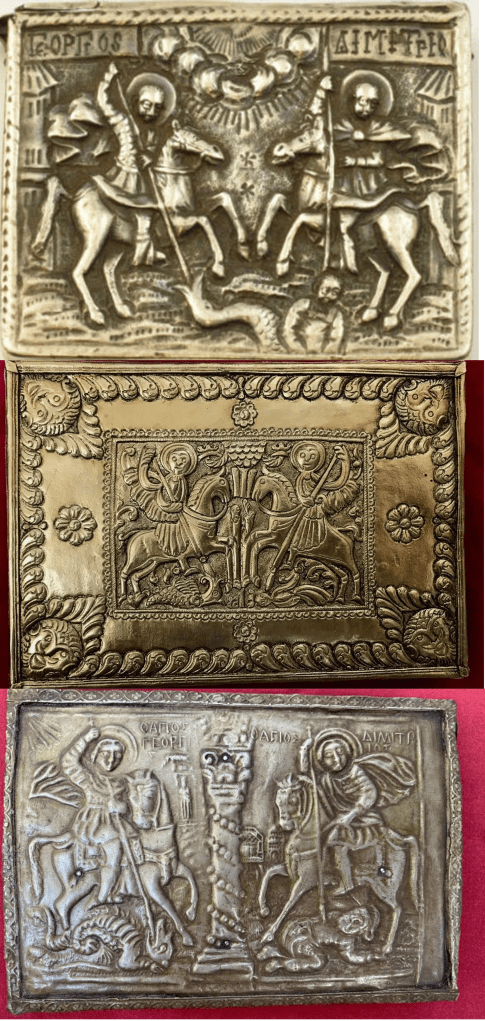
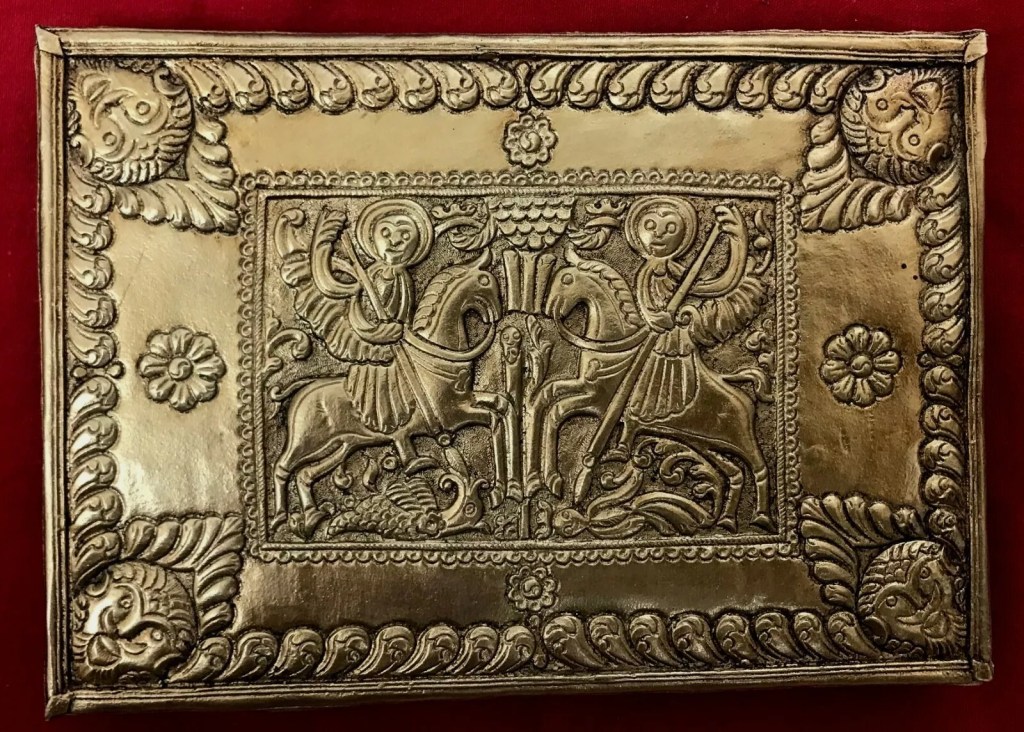

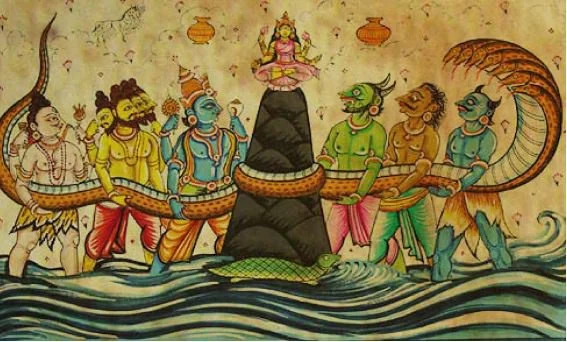
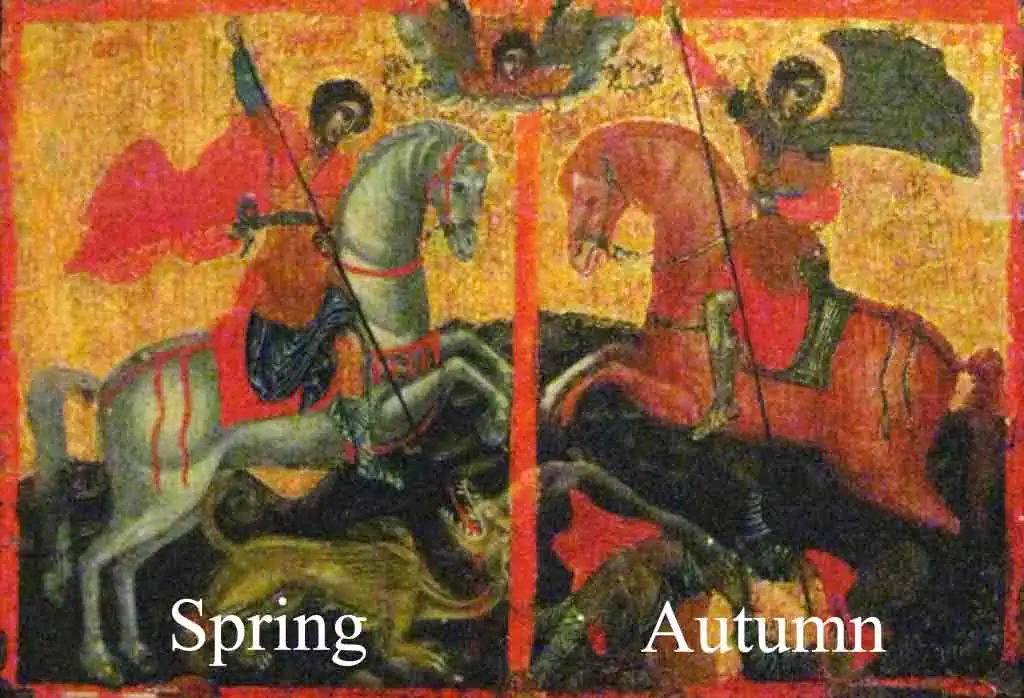
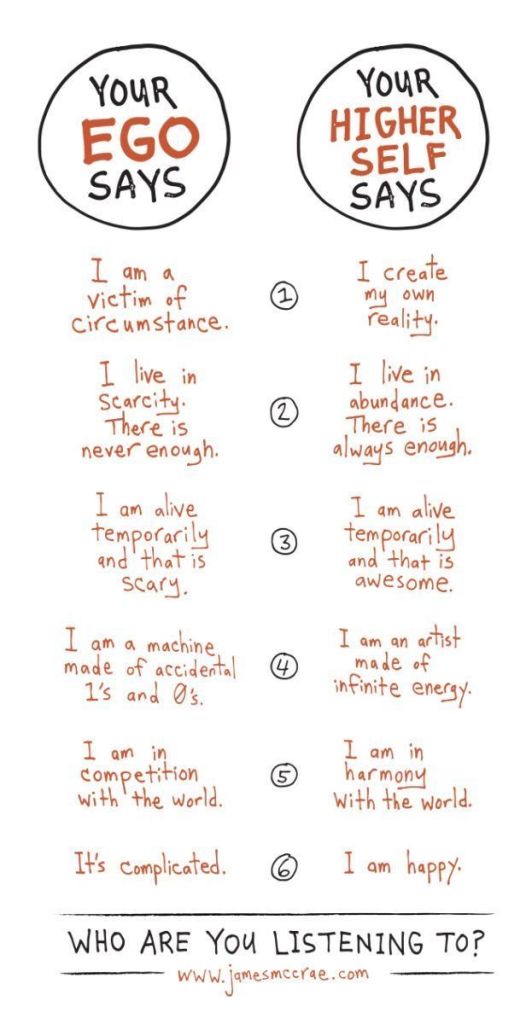
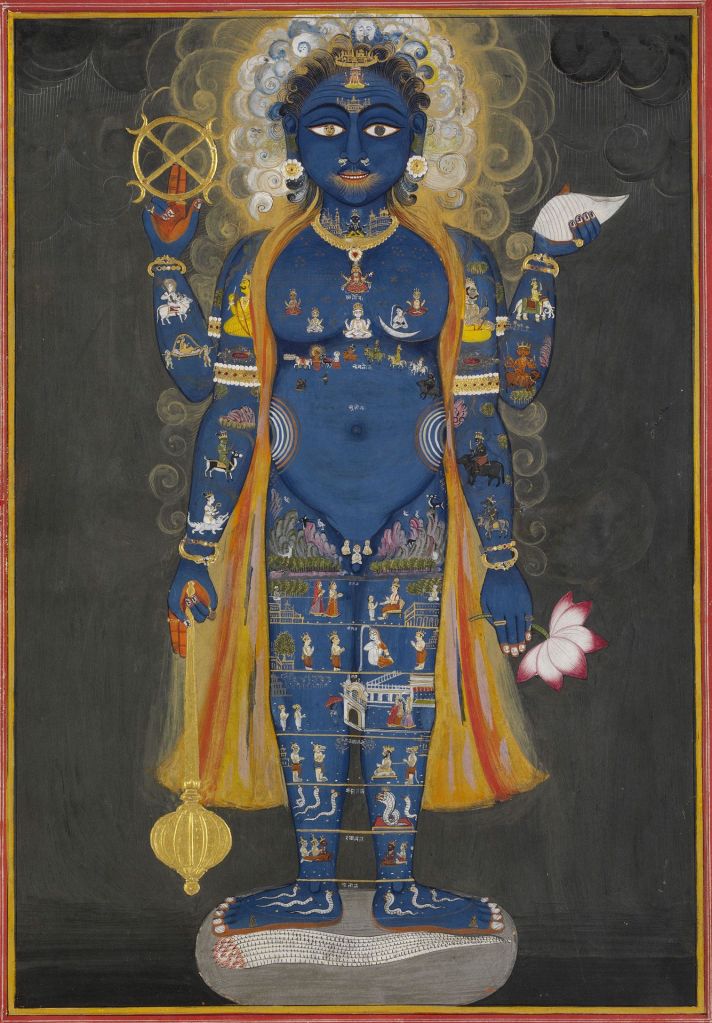
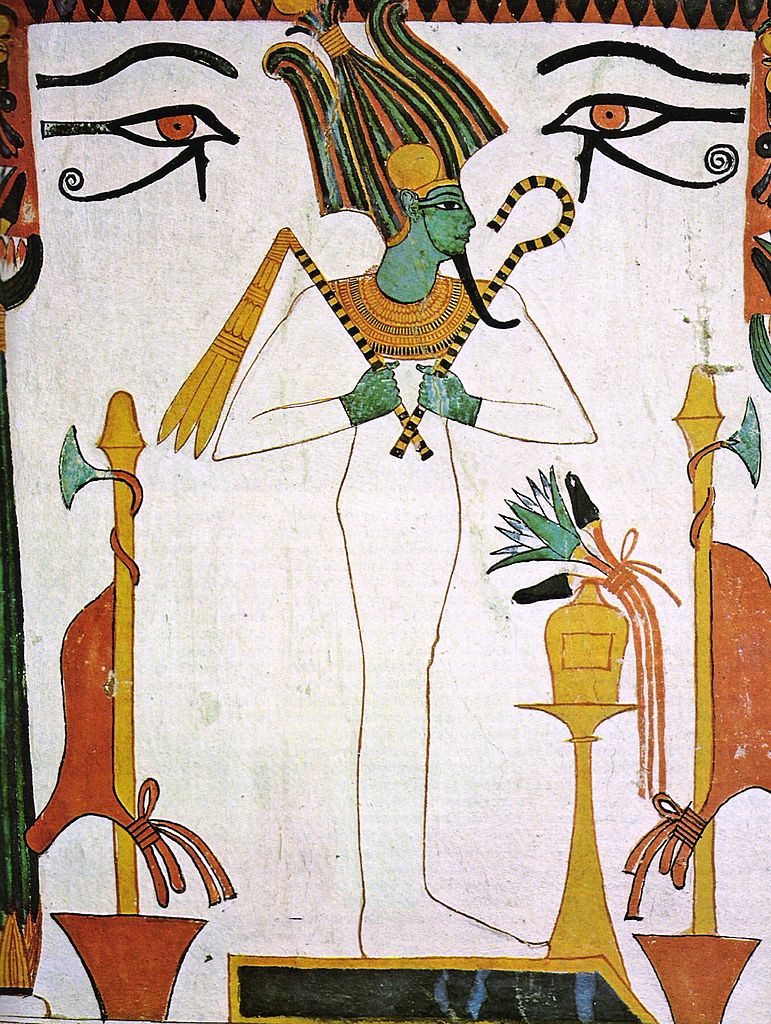
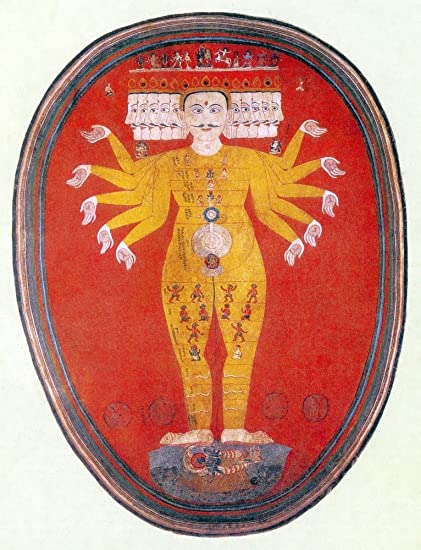
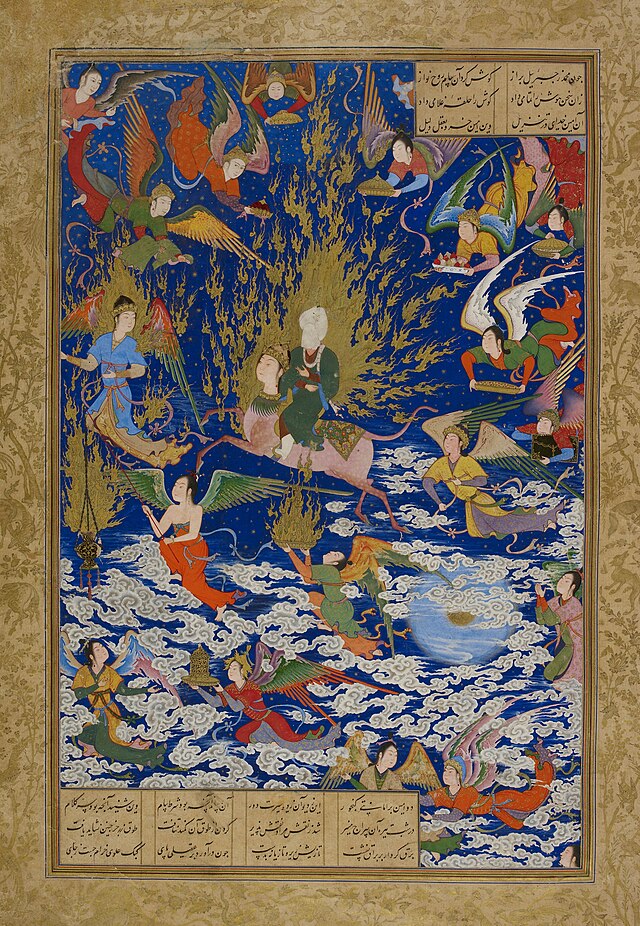
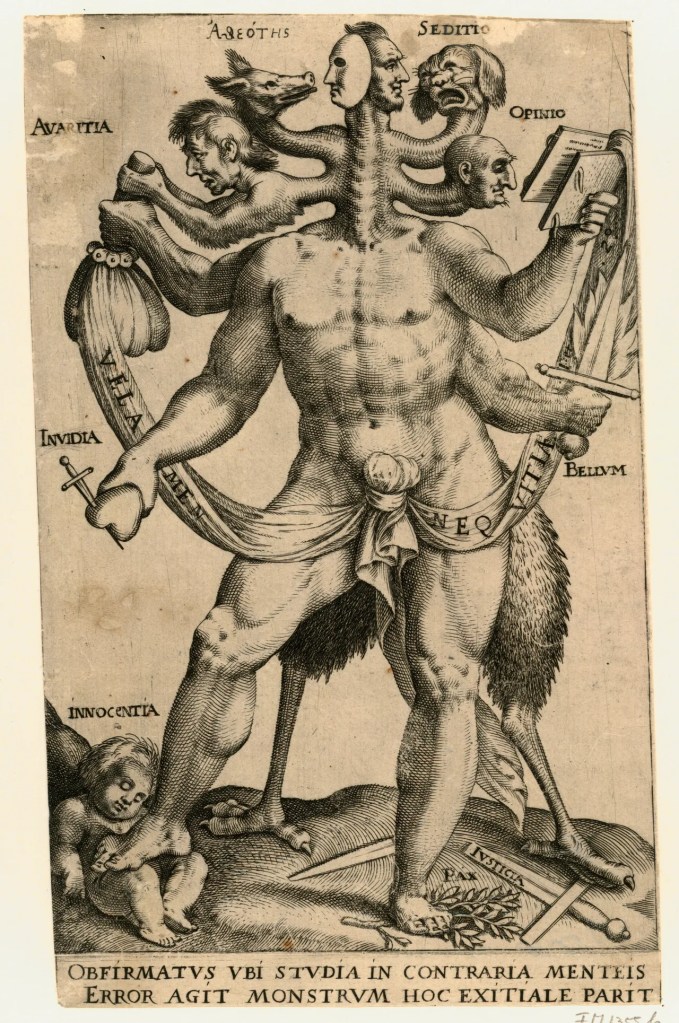
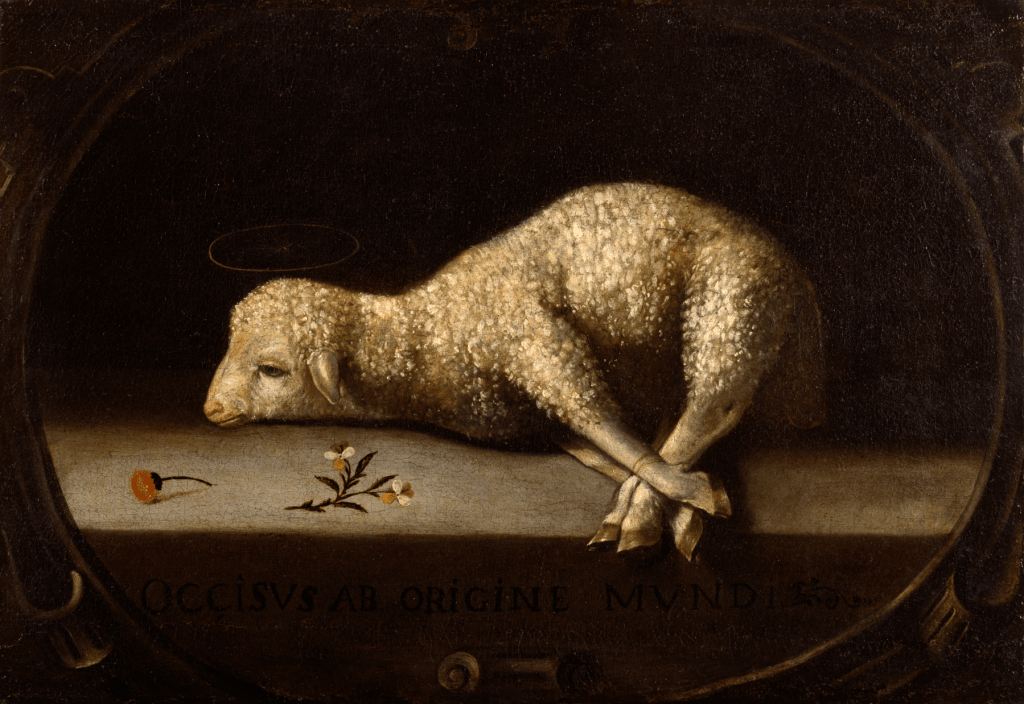


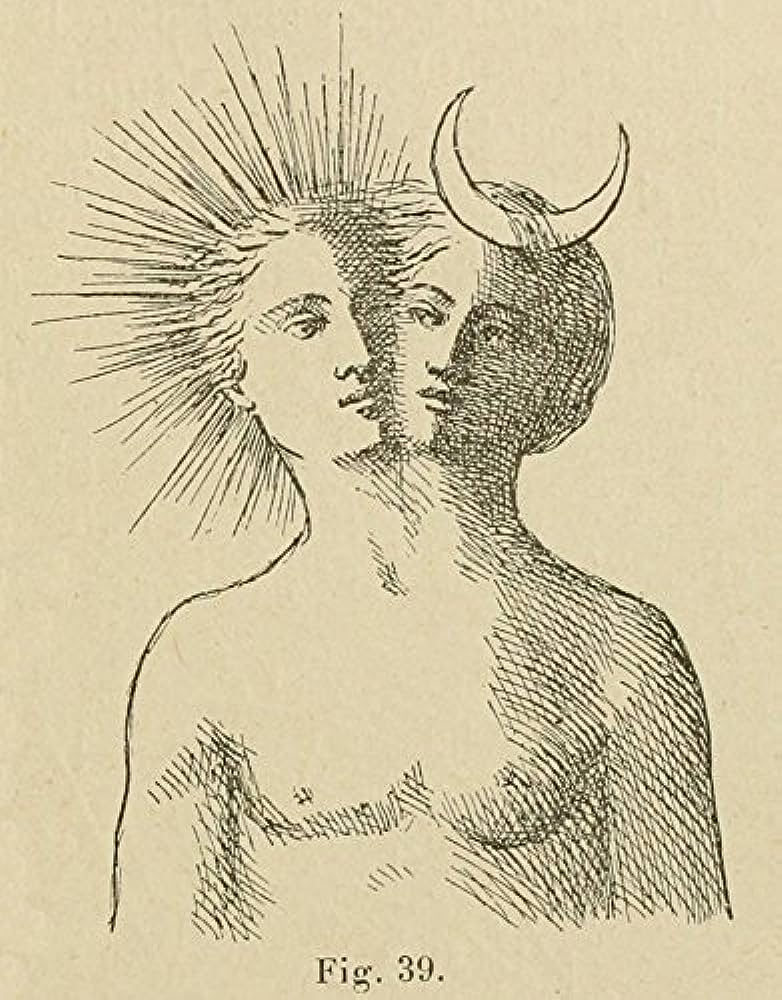
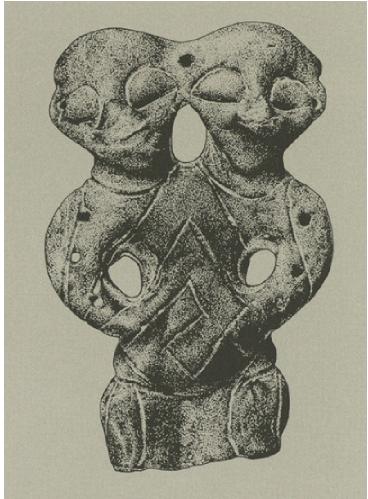
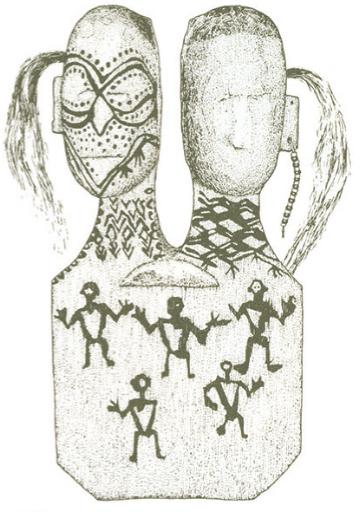
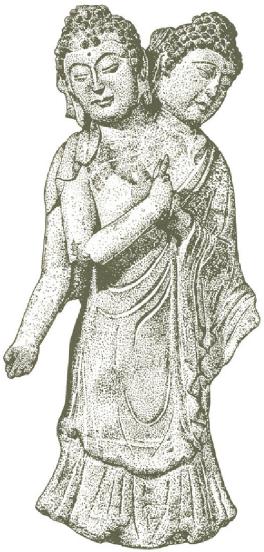
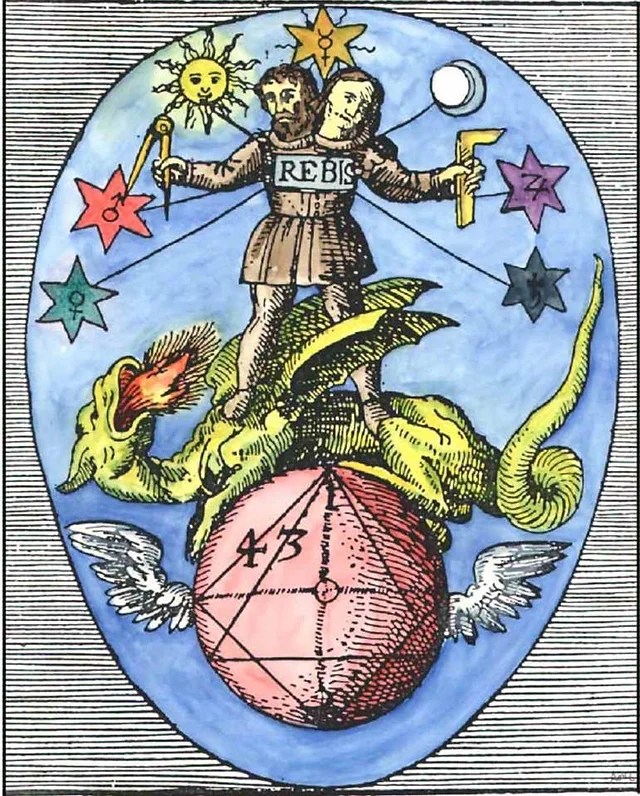
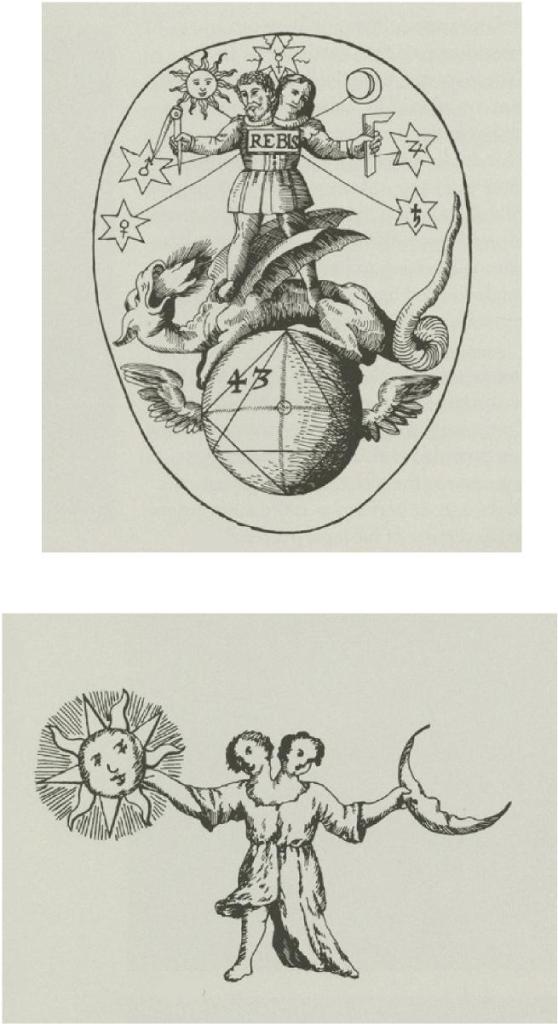
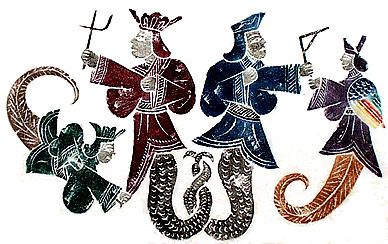
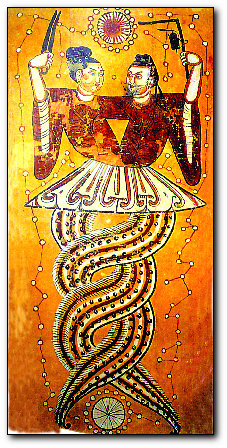
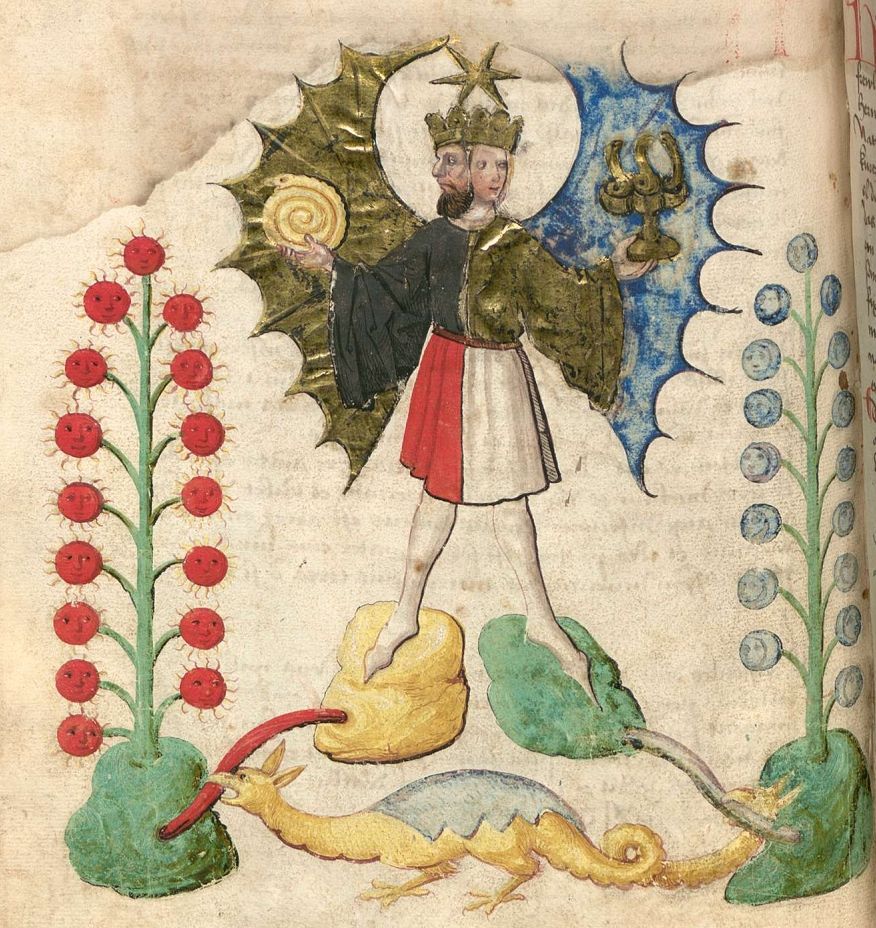
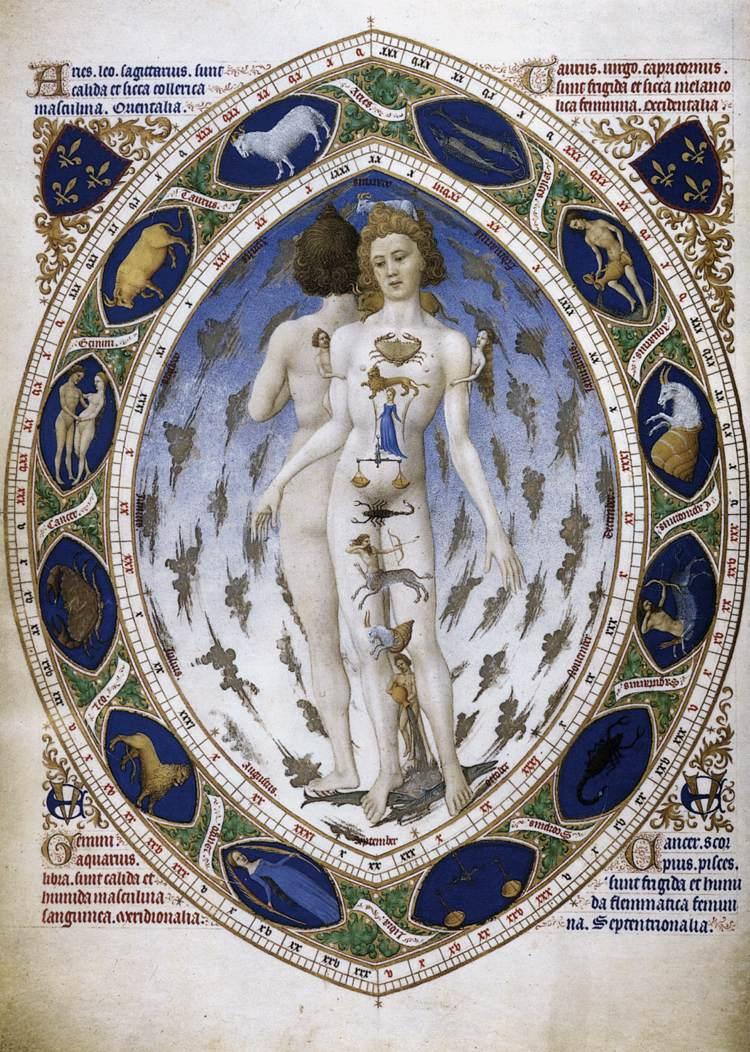
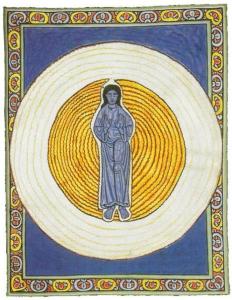
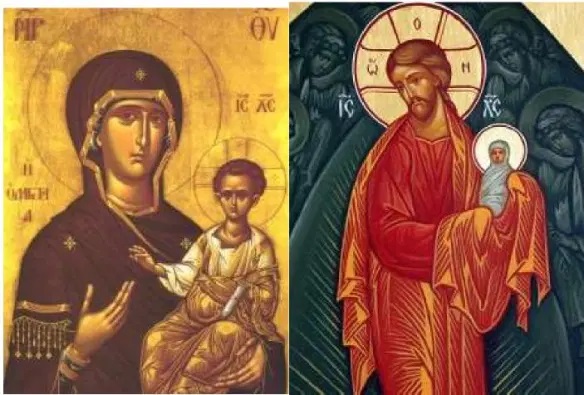
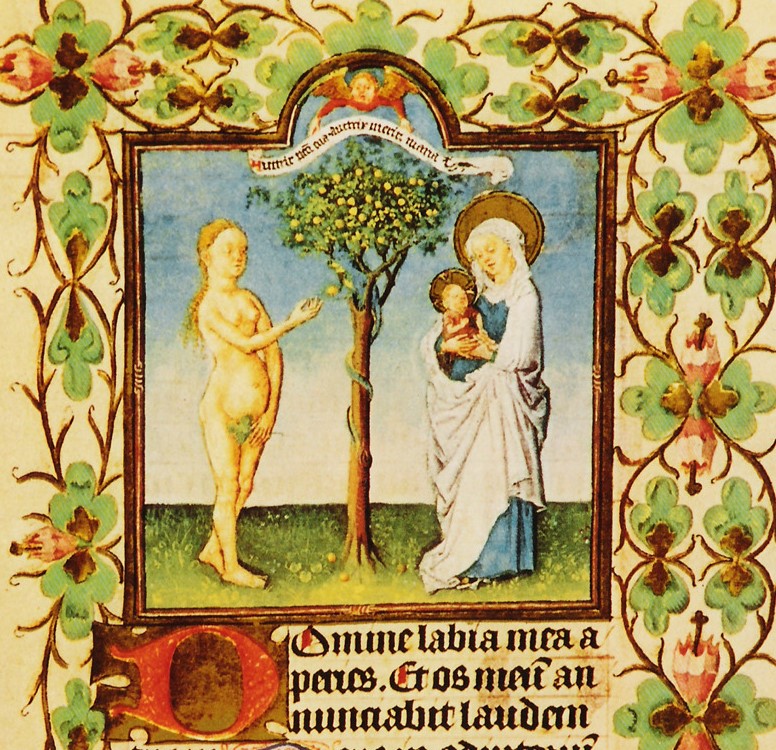
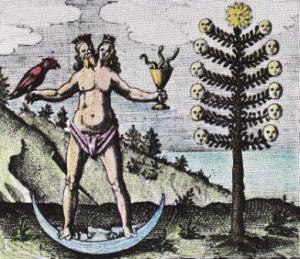
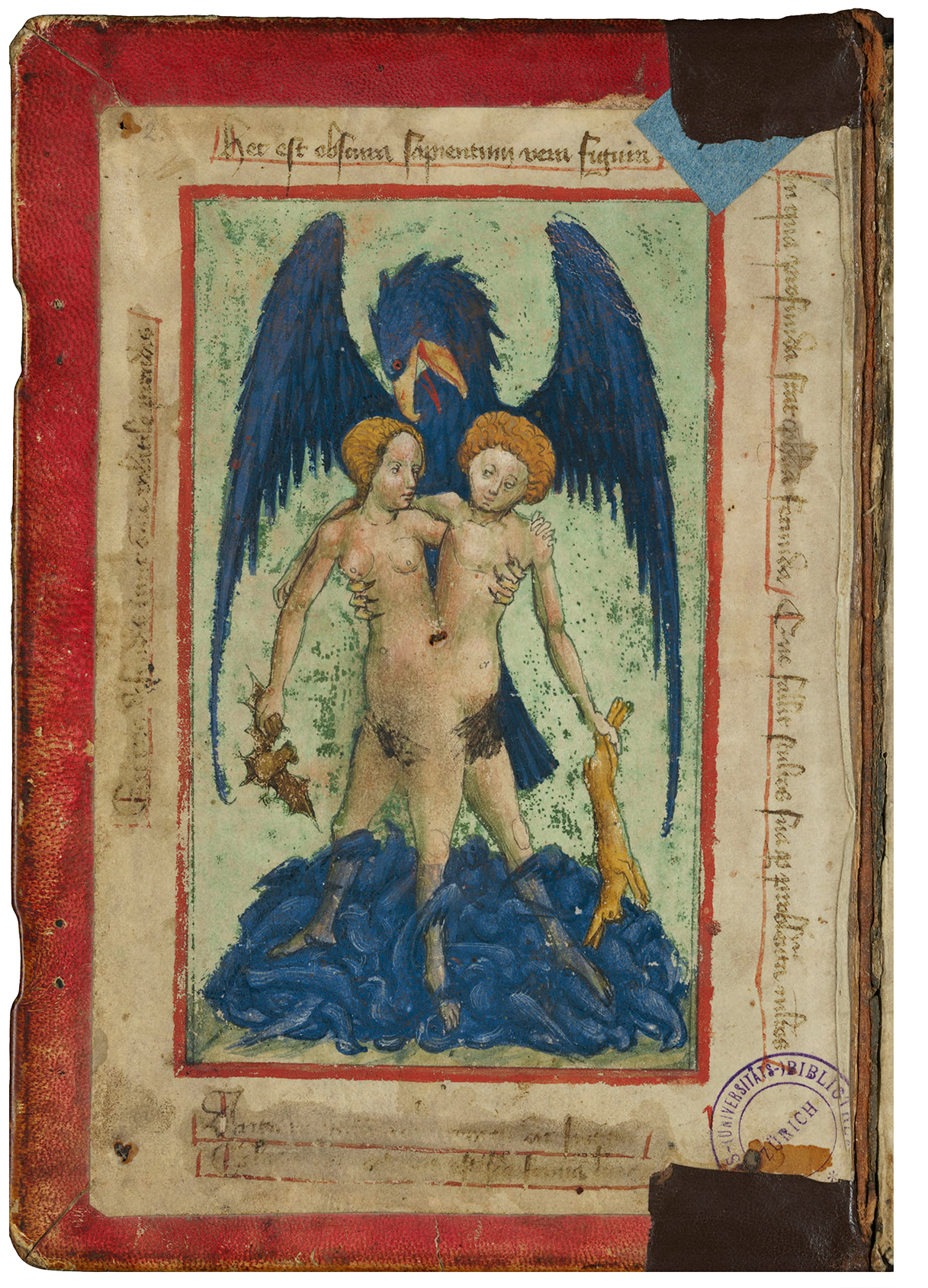
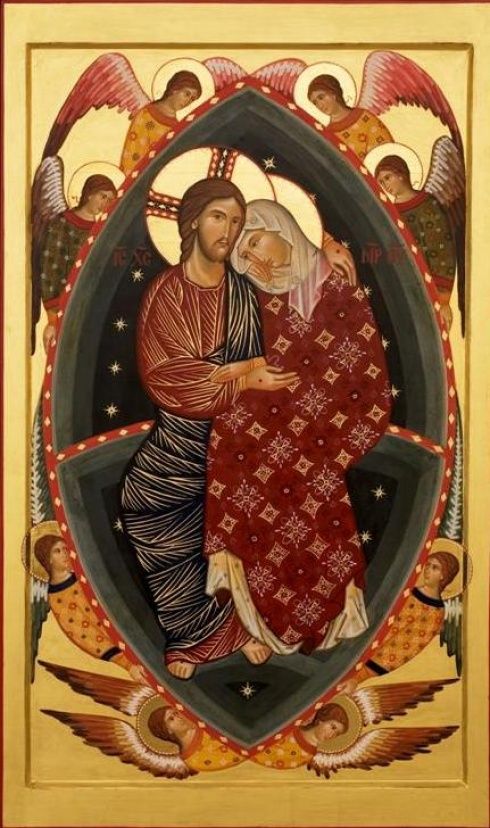
 Path to the Maypole of Wisdom

