The Natural Law of Compassionate Justice, An Islamic Perspective
The Natural Law of Compassionate Justice, An Islamic Perspective
1
The Natural Law of Compassionate Justice, An Islamic Perspective
By Carlijn kingma CARTOGRAPHY OF SOCIETY
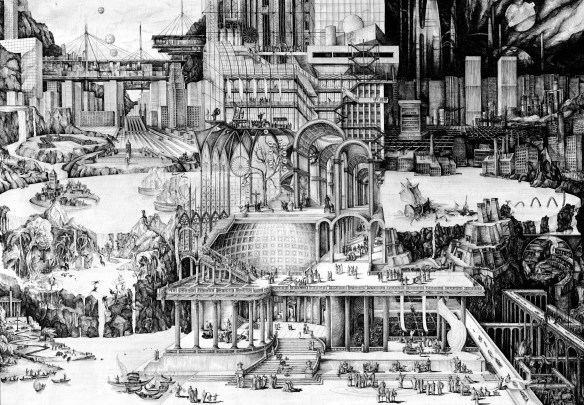
Chinese Ink and dip pen on paper Size original drawing: 1189mm x 841mm
April 2016 -For more information about the prints, please send an email to: carlijnkingma@gmail.com.
Below you can read the introduction of the story:
The urge to transcend and push life ‘as it is’ in order to move towards life ‘as it should be’, is a defining feature of humanity. Utopia is a way of articulating of this urge – a project or vision which provides us with a clear view on an alternative present or future world, through which, although sometimes just for one little moment, we can believe in something extraordinary. Utopia has long been the name for the unreal and the impossible. We have set utopia over against the world as the world of dreams, fantasies and ideas. Thus, sometimes, we seem to forget, that, like Lewis Mumford used to say, the choice we have is not between reasonable proposals and an unreasonable utopianism. Utopian thinking does not under- mine or discount real reforms. Indeed, it is almost the opposite: practical reforms depend on utopian dreaming. It encourages us in our efforts, and sets a beacon in the uncharted seas of the distant future, and in doing so drives to incremental improvements. The world needs utopia, as the cities and mansions that people dream of are those in which they finally live.
For as long as we exist, we have imagined the things that ought to be. The Greeks knew such wise men as philosophers, they allowed them great freedom and rejoiced in the mathematical precision with which their intellectual leaders mapped out those theoretical roads which were to lead mankind from chaos to an ordered state of society. The Old Tes tament used to call such people prophets, insisting with narrow persistence upon the King dom of Heaven as the only possible standard for a decent Christian Utopia. The sixteenth and seventeenth centuries fought many bitter wars to decide the exact nature of a white- washed Paradise, erected upon the crumbling ruins of the medieval church. The eighteenth century saw the Promised Land lying just across the terrible bulwark of stupidity and super stition, which a thousand years of clerical selfishness had erected for its own protection and safety. There followed a mighty battle to crush the infamy of ignorance and bring about an era of well-balanced reason. Unfortunately, a few enthusiasts carried the matter a trifle too far. Napoleon, realist-in-chief of all time, brought the world back to the common ground of solid facts. In response, the twentieth century grew a counter-culture of everything fixed and finite, and presented utopia with its twin brother, the anti-utopia, which by opposing utopia also made her stronger. But in recent decades something has changed. Many observe utopia and their sympathizers as foolhardy dreamers at best and murderous totalitarians at worst. If the utopian spirit has proved to be a tool to trigger progress and improvements, then the recent growing suspicion towards utopia and the growing anti-utopian library is worrisome. Over the last century Utopia has gained a historic record of “anti-utopian” novels and instead of worrying how we can get to the good place we now think about how we can prevent the ‘utopian project’ from being realized. How did this happen? And as the will-to- transcend will always remain, how can we make the utopian project, our beacon leading us to conscious progress and change, legitimate and valuable again?
Understanding where utopia stands today is to understand its past, where it comes from and what ideas it carried. The first part of this thesis is an attempt to set out, mainly in drawing, supported by text, the general pattern of utopian writing in the West. Setting out the history of utopian writing is not meant principally as an historiographical exercise, but is necessary for understanding and thinking about the fate of utopia in our own times, and its possibilities for the future. Through history we learn how utopia always emerges and exists under specific circumstances. At the same time, the content and articulation of utopia has always been bonded to a set of attributes such as the organization of knowledge; power; the interpretation of territory; and time, resulting in the question of finality. Understanding the changing utopian tradition as a result of the changing attributes of the material world in the past, can help us understand the recently emerged suspicion of the utopia today, and hand us the tools to resonate on the possibility of a post-modern utopia tomorrow.
An inevitable part of the utopian tradition is the art of storytelling, and therefor, this elab- oration on the changing tradition of the utopia of the west is done mainly through image and illustrated with words. Image 1. History of the Utopian tradition, shows an overview of the whole story. Our journey begins in ancient Greece, with the Republic of Plato, as we work ourselves up to the utopian visions of the 20th century. A sequence of fragments, taken from the main image, will guide us through the story, handing us the possibility to not only understand each utopia as a separate entity or a product of its time, but also to understand each story as a part of a changing utopian tradition.
[…] Ch. 1 – Ch. 7 are left out but are available in print.
by Anar Tanabayeva
In our time of globalization humanistic principles should be fundamental to the people around the world, otherwise we can not solve the global problems of mankind. At the present time, when the world globalization processes put before mankind new issues and identified the main problem, the study of the works of such thinker as Al-Farabi becomes extremely important. To study Al-Farabi’s philosophy is becoming more relevant in today’s context of increasing democratic reforms, creation of a legal, secular state and approval of harmony in society. In this respect, the study of political philosophy of Al-Farabi, especially his teachings on politics, freedom, happiness, and the need to mutual assistance between people, his appeal to science, intellectual and moral perfection of man and society, over-actualized. Particularly relevant today a thinker’s concept on political leadership, his ideas about the virtuous society, justice, equality, preserving peace, preventing war, condemnation of wars. In this regard, political philosophy and ideas of the thinker can be a valuable source for the education of the younger generation. Read more here
Utopian literature in its broadest meaning deals with the idealistic conceptions and themes that are not applicative in real human life. This type of literature and thinking,
though we regard it as imaginative and may be fanciful, yet it embodies great themes, and aiming at noble human goals and purposes.
Al-Farabi in his work the Virtuous City and More in his Utopia present to the humanity through these two magnificent works, under discussion in this research, an example of the virtuous and idealistic community they aspire, as philosophers, to be achieved in real human life, if virtue and goodness guide mankind to its perfection and happiness.
This research discusses these two works as Utopian literature, irrespective to the profound philosophical thoughts they comprise. Read more here
This essay will explore some of al-Farabı’s paradoxical remarks on the nature and status of the democratic city (al-madı¯nah al-jamaıyyah). In describing this type of non-virtuous city, Farabı departs significantly from Plato, according the democratic city a superior standing and casting it in a more positive light. Even though at one point Farabı¯ follows Plato in considering the timocratic city to be the best of the imperfect cities, at
another point he implies that the democratic city occupies this position.
Since Farabı’s discussion of imperfect cities is derived from Plato’s Republic and follows it in many important respects, I will argue that his departure from Plato in this context is significant and points to some revealing differences between the two philosophers. In order to demonstrate this, I will first set up a comparison between Plato’s conception of the democratic city and Farabı’s. Then I will propose three explanations for the greater appreciation that Farabı seems to have for democracy, as well as for the apparent contradiction in Farabı’s verdict concerning the second best city. Read more here
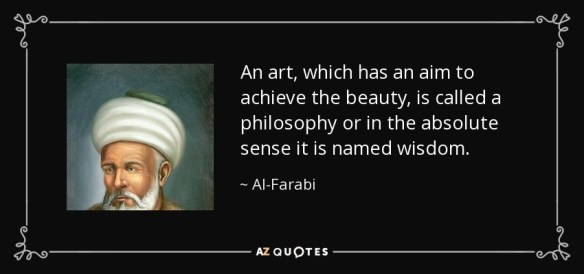
On the basis of reasonable activity of a man as his natural prop- erties Al-Farabi made a
number of conclusions about the humanistic equality of all people as a result of the overall reasonable nature of the autonomy of the human being, the creative activity of the person, freedom of the human will, independent of the value of human life. This issue Al-Farabi considered in his «Treatise on the views of the residents of the virtuous city».
Perfect society of Al-Farabi divides into three types: the great, medium and small. Great Society – a collection of companies of all people living in the land, the average – an association of people in some parts of the land, small-a small association of residents.
The greatest good and the highest perfection can be achieved, according to al-Farabi,
primarily the city, but not society, standing on the lower level of perfection. The latter AlFarabi considers the village, district, street and house. This system is a perfect society, drawn by Al-Farabi with strict logical sequence is the result of logical thinking scientist coming from the relationship between the concepts of general and private.
So, the most perfect form of society, by Al-Farabi, is the city. He uses the term city not only represents the city in the modern sense, as a unit of administrative-territorial division, but also to refer to the state and social groups.
An important place in the social and ethical teachings of Al- Farabi is the idea of a
virtuous city. Virtue, according to Al-Farabi, – this is the best moral qualities. Read More here
William C. Chittick
The name `Islam’ refers to the religion and civilization based upon the Qur’án, a Scripture revealed to the Prophet Muhammad in the years AD 610-32. About one billion human beings are at least nominally Muslim, or followers of the religion of Islam. The modern West, for a wide variety of historical and cultural reasons, has usually been far less interested in the religious dimension of Islamic civilization than in, for example, that of Buddhistn or Hinduism. Recent political events have brought Islam into contemporary consciousness, but more as a demon to be feared than a religion to be respected for its sophisticated understanding of the human predicament.
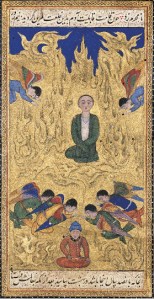 Those few Westerners who have looked beyond the political situation of the countries where Islam is dominant have usually devoted most of their attention to Islamic legai and social teachings. They quickly discover that Islam, like Judaism, is based upon a Revealed Law, called in Arabic the Shari’a or wide road. Observance of this Law — which covers such domains as ritual practices, marriage relationships, inheritance, diet and commerce —is incumbent upon every Muslirn. But western scholars have shown far less interest in two other, more inward and hidden dimensions of the Islamic religion, mainly because these have had few repercussions on the contem-porary scene. Even in past centuries, when Islam was a healthy and flourishing civilization, only a relatively smalt number of Muslims made these dimensions their tentral concern.
The more hidden dimensions of Islam can be called `intellectuality’ and `spirituality’. The first deals mainly with the conceptual understanding of the human situation and the second with the practical means whereby a full flowering of human potentialities can be achieved. They are important in the present context because they provide clear descriptions of human perfection and set down detailed guidelines for reaching it. If we want to discover how Islam has understood the concept of perfection without reading our own theories into the Queán or imposing alien categories on the beliefs and practices of traditional Muslims, we have to pose our question to the intellectual and spiritual traditions of Islam itself. Read more Here
with a Brief Comparison to the Thought of Sir Muhammad Iqbal by Rebekah Zwanzig,
This thesis analyzes four philosophical questions surrounding Ibn al-‘Arabi’s concept of the al-insan al-kamil, the Perfect Individual. The Introduction provides a definition of Sufism, and it situates Ibn al-‘Arabi’s thought within the broader context of the philosophy of perfection. Chapter One discusses the transformative knowledge of the Perfect Individual. It analyzes the relationship between reason, revelation, and intuition, and the different roles they play within Islam, Islamic philosophy, and Sufism. Chapter Two discusses the ontological and metaphysical importance of the Perfect Individual, exploring the importance of perfection within existence by looking at the relationship the Perfect Individual has with God and the world, the eternal and non-eternal. In Chapter Three the physical manifestations of the Perfect Individual and their relationship to the Prophet Muhammad are analyzed. It explores the Perfect Individual’s roles as Prophet, Saint, and Seal. The final chapter compares Ibn al-‘Arabi’s Perfect Individual to Sir Muhammad Iqbal’s in order to analyze the different ways perfect action can be conceptualized. It analyzes the relationship between freedom and action.
1) what type/s of knowledge are necessary to gain a complete understanding of the eternal and non-eternal, and how this transformative knowledge leads to perfection;
2) The Perfect Individual as a level of existence, and how the individual fits into the dichotomy of eternal and non-eternal;
3) The Perfect Individual as a reflection of the Divine in the cosmos, or what the transformation and embodiment of perfection entails;
4) the Perfect Individual as an active agent in the world, and how this individual, after reaching perfection, interacts with the world. Some of the problems that will arise in the proceeding chapters and the proposed solutions are outlined below. Read more here
Abu Nasr Muhammad Alfarabi, the medieval Muslim philosopher and the founder of Islamic Neoplatonism, is best known for his political treatise, Mabadi ara ahl al-madina al- fadhila (Principles of the Opinions of the Inhabitants of the Virtuous City), in which he proposes a theory of utopian virtuous city. Prominent scholars argue for the Platonic nature of Alfarabi’s political philosophy and relate the political treatise to Plato’s Republic. One of the most striking similarities between Alfarabi’s Mabadi ara ahl al-madina al- fadhila and Plato’s Republic is that in both works the theory of virtuous city is accompanied by a theory of soul. It is true that Alfarabi’s theory of soul differ considerably from that of Plato’s Republic. However, we propose that notwithstanding the differences, the two theories of soul do play an identically important role in the respective theory of virtuous city. The present article explores the relationship between the soul and the city in Plato’s Republic and Alfarabi’s Mabadi ara ahl al-madina al- fadhila, and intends to show that in both works the coexistence of the theory of soul and the city is neither coincidental nor a casual concurrence of two themes. Rather, the
concept of soul serves as a foundation on which Plato and Alfarabi erect their respective theory of perfect association. Thus, Alfarabi’s treatise resembles Plato’s Republic not only in the coexistence of the theory of soul and the city, but also in the important role of the concept of soul in the theory of virtuous city. Read more here
“The secularity of the society in which we live must share considerable blame in the erosion of spiritual powers of all traditions, since our society has become a parody of social interaction lacking even an aspect of civility. Believing in nothing, we have preempted the role of the higher spiritual forces by acknowledging no greater good than what we can feel and touch.” Vine Deloria Jr
The perspective of modernity where Western Man as the egolatrous being is placed at the top of existence for all others to look towards for recognition.

The pyramidal construction of Man from an Islamic perspective shifts our understanding of the seriousness of placing the egolatrous Man above God in constructing reality, while simultaneously allowing us to imagine what would be necessary in creating a transmodern critique in constructing the Human.

THE ISLAMIC CONCEPT OF HUMAN PERFECTION:
 Those dimensions of Islam dedicated to providing the guidelines for the development of the full possibilities of human nature came to be institutionalized in various forms. Many of these can be grouped under the name `Sufism’, while others can better be designated by names such as `philosophy’ or `Shiite gnosis’. In general, these schools of thought and practice share certain teachings about human perfection, though they also differ on many points. Here we can suggest a few of the ideas that can be found in most of these approaches.
 Look also: Polishing your heart, Virtues Ethic for a modern Devotion in our times
Current decadence, greed, evil, falsehood, corruption, violence, injustice, exploitation, thus have a Cosmic undertone. It is a “Cosmic Law” that civilizations which have become megalomaniacal will inevitably collapse. Because all levels of existence are corroded – including the religious realm – only a Dimension that is beyond can redeem us.
One of the many disastrous consequences of an ongoing repression of this trans-personal Ground of Being – and the mistaken assumption of the Absolute by a relative entity or self – is epitomized in our techno-industrial pursuit to convert the earth into one large global factory – reinforced by multinational monopoly. Herein, nature is viewed simply as exploitable “raw material” for a “manufacturing” process aimed at churning out “products” for the “consumer.” This apparent narrowing of human perspective is the logical result of paradigmatic trends linking back to the so-called Age of Enlightenment.

The first verses regarding Jihad were revealed in Makkah before the Hijra to Medina. These verses reference “Jihad al-Nafs” or the struggle against the self (ego/ base desires)
Meaning of nafs: It has two meanings.
First, it means the powers of anger and sexual appetite in a human being… and this is the usage mostly found among the people of tasawwuf [sufis], who take “nafs” as the comprehensive word for all the evil attributes of a person. That is why they say: one must certainly do battle with the ego and break it (la budda min mujahadat al-nafs wa kasriha), as is referred to in the hadith: A`da `aduwwuka nafsuka al-lati bayna janibayk [Your worst enemy is your nafs which lies between your flanks. Al-`Iraqi says it is in Bayhaqi on the authority of Ibn `Abbas and its chain of transmission contains Muhammad ibn Abd al-Rahman ibn Ghazwan, one of the forgers].
The second meaning of nafs is the soul, the human being in reality, his self and his person. However, it is described differently according to its different states. If it assumes calmness under command and has removed from itself the disturbance caused by the onslaught of passion, it is called “the satisfied soul” (al-nafs al-mutma’inna)… In its first meaning the nafs does not envisage its return to God because it has kept itself far from Him: such a nafs is from the party of shaytan. However, when it does not achieve calmness, yet sets itself against the love of passions and objects to it, it is called “the self-accusing soul” (al-nafs al-lawwama), because it rebukes its owner for his neglect in the worship of his master… If it gives up all protest and surrenders itself in total obedience to the call of passions and shaytan, it is named “the soul that enjoins evil” (al-nafs al-ammara bi al-su’)… which could be taken to refer to the ego in its first meaning.

From the beginning of our entrance into the school of Sufism, we have been taught about the seven levels of being. These seven levels are like grades in any educational system which one must pass through in order to graduate. In our system, however, evaluations are made by a Higher Authority than the teacher.

Passing and failing grades are made known through real dreams, through the interpretation of which the teacher gives new responsibilities and duties to the seeker. But what is most important is that the seeker himself should be able to realize his own states so that he can live up to the next level to which he aspires. Obviously, first it is necessary that he be conscious, aware of his character and actions, and be sincere in looking at himself. But it is also necessary to thoroughly know the characteristics of each level, especially the level in which he is presumed to be, and the next level, in which he hopes to be. Read more here
by Todd Marlin Richardson
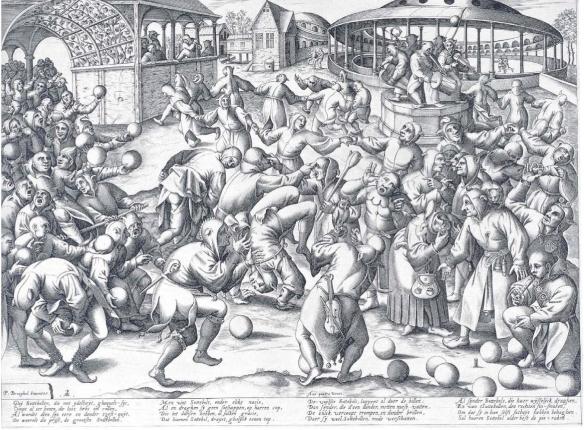
Bruegel’s Festival of Fools
The topics of blindness and self-awareness I discussed in relation to the
Peasant and Nest Robber bring me to the focus of my fourth and final chapter,
Bruegel’s Festival of Fools . In addition, the practices of making and viewing
works of art I have described for all of Bruegel’s later peasant paintings are also
helpful in thinking about this particular design. Nadine Orenstein argues for a late
dating of the print, after the now lost drawing by Bruegel, based on the words Aux
quatre Vents inscribed at the bottom center. This is the form of the publisher’s address
used by the widow of the print’s publisher, Hieronymus Cock, following his death in
1570. Orenstein speculates the drawing was completed in the last years of Bruegel’s
life, during the same time he painted the peasant panels, and the print produced after
his death.
Although fairly subtle, the composition of the Festival of Fools stages a
procession similar to a wagon play. (Wagon plays were processional dramas that took place during Ommegangen (devotional processions) in the 1550s and 1560s. Rhetoricians conceived of wagon plays as didactic episodes that could morally
edify and educate their audience. The plays utilized overt metaphors and personifications to create allegorical productions that focused on collective civic identity. Read more here
 The bivium of Pythagoras, this sign which leaves us free to choose the path of good or the path of evil.
“The letter” Y “represents the symbol of moral life. The question of good and evil arises before the free will of man: two roads open before him: the left, the thick branch of the “Y”, is wide and easy to access, but leads to the chasm from shame, that of the right, the thin branch, is a steep and painful path, but at the summit of which one finds repose in honor and glory. “
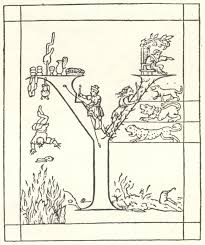
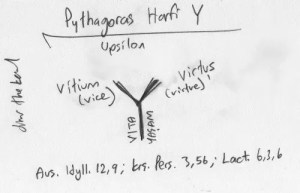
 The letter “Y”, in antiquity, has often represented a “bivium” (a fork in the road); a point in life where we have to make a vital decision. According to Pythagoras, it represents the paths of virtue and vice. The letter Y is also symbolic of looking within, Inner contemplation, Meditation and inner wisdom.
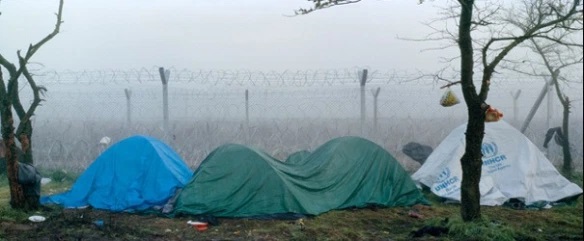
What the Emigration to Sincerity demands of us
Emigration: Historical Hijra
Starting from a narrow family-tribal environment Prophet Muhammad (pbuh) underwent 13 years of hardship and torment in Meccan society; with the immigration (Hijra) to Medina, a new stage began. This stage, if one takes into consideration the time that it took all religions to spread, is the starting point of one of the fastest religious developments in recorded history. In this sense, when one speaks of the Hijra one is not merely speaking of a journey from Mecca to Medina, or the starting point of a calendar; one is speaking of a new start for humanity.
The Hijra is symbolic of changing those conditions that cause problems and that clash with ideals and beliefs, as well as the search for new opportunities. ..
…The most important principle to learn from the Hijra is the constant observation of intention. In particular, Sufis consider the constant observation and control of intent to be a basic principle for attaining ikhlas (sincerity). From this aspect, Sufism can be considered to be a total investigation and interrogation of intention.
Goethe and his poem “Hegir” : Hijra
When one speaks of the Hijra one is not merely speaking of a journey from Mecca to Medina, or the starting point of a calendar; but one is also speaking of a new start for humanity. And Johann Wolfgang von Goethe make his Hijra, his emigration and take refuge in Islam. He became a “Refugee”.
The Hijra is symbolic of changing those conditions that cause problems and that clash with ideals and beliefs, as well as the search for new opportunities.
In this caravan poem, Goethe gives us a picture of the restless nomad existence which early Arabian poetry had enabled him to envision.
The whole “West-East Divan” is shot through with something of this nomadic restlessness. Already in the first great poem entitled “Hegir” the poet alludes to Arabian life and traditions. He is a True Pelgrim. He turns to the wisdom of the Sufis as Hafiz.
His own “Hedschra” is an inteliectual emigration to a simpler state of existence which seems to him to be purer and righter than his own immediate world. Thus he calls out to himself:
“Hegira”
North and South and West are quaking,
Thrones are cracking, empires shaking;
Let us free toward the East
Where as patriarchs we’ll feast:
There in loving, drinking, singing
Youth from Khidr’s well is springing.
His goal: to discover and reconcile in himself in a new, higher unity the multiplicity of monotheism’s divine expressions. Such unity was always Goethe’s goal, for he well understood the alchemical truth that unity only divides in order to find itself again in a higher sense. As he wrote:
 Anything that enters the world of phenomena must divide in order to appear at all. The separated parts seek one another again, and may find each other and be reunited: in the lower sense by each mixing with its opposite, that is, by simply coming together with it, in which case the phenomenon is nullified or at least becomes indifferent. But the union can also occur in the higher sense, whereby the separated parts are first developed and heightened, so that the combination of the two sides produces a third, higher being, of a new and unexpected kind. Read more here

By Carlijn kingma CARTOGRAPHY OF SOCIETY
How our religion of capitalism and central believe in mechanical progress has led again to confusion of speech, and how society, accordingly, ends up divided in multiple romantic reactions. Or, a map to find our way home within the modern dream of progress.
In collaboration with Piet Vollaard and Edwin Gardner
Rotterdam 2017
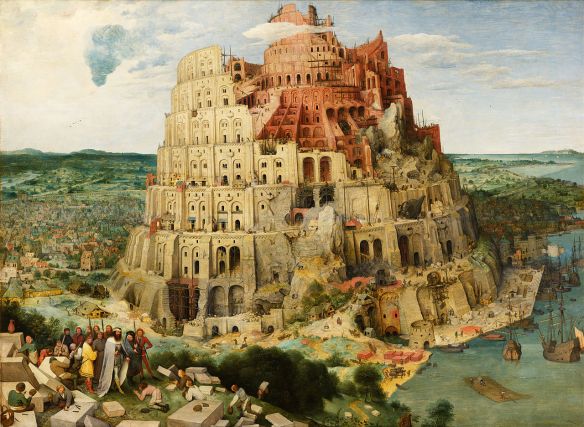
Then they said, “Come, let us build ourselves a city, with a tower that reaches to the heavens, so that we may make a name for ourselves; otherwise we will be scattered over the face of the whole earth.”
— Genesis 11:4
Why does a man build a tower? To fight off enemies? To transmit TV programs? To house more inhabitants and to economize high costly earth? No, no and no! That’s a lie, and the masking of the real and the only true function of a Tower – to shout as loud as possible “Here I am! Look how strong and mighty I am!
This time we are building a tower to reach for the heavens of progress. Organized around an oil engine, we deploy, we produce and continue to grow. But somehow along the way, dissonance emerged on the exact direction we are heading. And while trying to reach for these heavens of progress, we forgot why we actually wanted to go there in the first place. And once we finally reach the skies, our sight is clouded with smog.
Almost everyone inside the tower – or maybe even everyone – secretly dreams of being better. To be smarter, richer, more liked or more powerful. And in order to become this better person, and move up inside the hierarchy of our society, a man will face competition. Most of us get stuck somewhere in some layer of accomplishments/success, but for the lucky little few, who can make it to the top, the world beneath is a playground.
But first of all, down in the center of the drawing, to be able to enter the tower at all, a man has to have the right papers. Like the lottery you can win a ticket for access, if born in the right country at the right time. If not, we are very sorry to tell you, but I’m afraid today we are full. But if you happen to win and you have made it inside, you can walk the ramps, that circle up, and eventually aim for the skies. But again, like everything else in this world, not without resistance.
Inside the tower, at the bottom of it all, we find the working class. We call them the lower educated, and they perform practical tasks, such as taking the oil from the earth. To transcend and move up inside the tower of success, perhaps to the service based practices, you need first to pass through an educational gate, to prove you are worthy of the task. But to reach for the skies, it doesn’t stay there, there are multiple thresholds and gates. Although the gates of global borders now seem permanently open, you will soon walk upon some more, judging your ethnical background, your gender and family name. And finally, for the engineers and programmers who work inside the building for bigger trade, to become a god in our own little world, to become director of the the political muppet show and to rule, point and divide, there is a gate to pass only with money.

— view here ( in Dutch)
It all might seem unbelievable maybe, but don’t think for a moment we are non-believing men. For all I know there is much and more to say about our central believe in mechanical progress. We have gods of progress to turn to and to worship. Zeus, with his pointy arrow in arm, ripped right of the growth chart. Or Hermes, playing an arithmetic song about how we can reach for the innumerable/uncountable.
Imprisoned within the eternity of our daily routines, in fear of losing our spot in the line to another person or to a robot perhaps, we solemnly move from one task to the next. In blind procession, trying to keep the engine of capitalism running and do what is expected of us, we have all become creatures of habit and convention.
We work eight hours, we sleep eight hours, and in the eight hours left we work a little more. While night we secretly dream of descending, up to nobody knows where. Inside our man made dream of housing, we happily decorate the concrete cells like cabinets of homely attributes. But somehow, everywhere within the tower, from the exiled migrant to the footloose networker, people have lost their notion of home. Our bedrooms become a product on the market, while work has been move to the kitchen table. Home has been displaced by an idea that’s both elusive and contested. And we feel lost and displaced inside this rational concrete dream.
Note: The Tower of Babel by Breughel
Building the Tower of Babel was, for Dante, an example of pride., Canto 12.
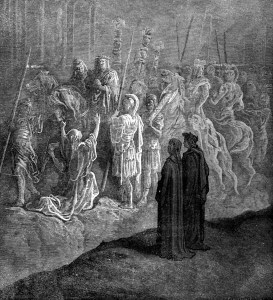
Purgatory in the poem of Dante Divine Comedy is depicted as a mountain in the Southern Hemisphere, consisting of a bottom section (Ante-Purgatory), seven levels of suffering and spiritual growth (associated with the seven deadly sins), and finally the Earthly Paradise at the top. Allegorically, the Purgatorio represents the penitent Christian life In describing the climb Dante discusses the nature of sin, examples of vice and virtue, as well as moral issues in politics and in the Church. The poem outlines a theory that all sins arise from love – either perverted love directed towards others’ harm, or deficient love, or the disordered or excessive love of good things.

The gate of Purgatory, Peter’s Gate, is guarded by an angel bearing a naked sword, his countenance too bright for Dante’s sight to sustain. In reply to the angel’s challenge, Virgil declares that a lady from heaven brought them there and directed them to the gate. On Virgil’s advice, Dante mounts the steps and pleads humbly for admission by the angel, who uses the point of his sword to draw the letter “P” (signifying peccatum, sin) seven times on Dante’s forehead, bidding him “take heed that thou wash / These wounds, when thou shalt be within.”
With the passage of each terrace and the corresponding purgation of his soul that the pilgrim receives, one of the “P”s will be erased by the angel granting passage to the next terrace. The angel at Peter’s Gate uses two keys, silver (remorse) and gold (reconciliation) to open the gate – both are necessary for redemption and salvation. As the poets are about to enter, they are warned not to look back. Read more here

In his essay “World on Fire” Charles Eisenstein describe the situation as follow:
“I can’t easily draw a causal connection here, but it seems significant that uncontainable wildfires are contemporaneous with inflammatory rhetoric, heated debates, flaring tempers, burning hatred, seething distrust, and smoldering resentment. Just as dried out, fuel-laden forests burned out of control with a mere spark, so also have our cities burned as the spark of police murders touched the ready fuel of generations of racism; decades of economic decay, and months of Covid confinement. Our social ecosystem is as damaged and depleted as the forests that are so prone to fire“.
While engineers, ecologists, and especially indigenous people can offer techniques to properly steward forests and restore them to resiliency, the transition to a healed world requires something much deeper than better techniques. More important is to learn to inhabit the source from which indigenous land stewardship practices arise. That source is a way of seeing, conceiving, and relating to nature. It is also a way of understanding ourselves: who we are and why we are here.
Fundamentally, the source of wise forest management is to see and know nature as a being, not a thing. That’s the best I can put it, but it isn’t good enough. The words themselves entrap me in error. Nature is not something separate from ourselves, and not even “things” are just things. Let me say then that traditional and indigenous cultures live in a world where being is everywhere and in everything, and humans are no more or less sacred than trees, mountains, water, or ants.
On the most obvious level, the view of nature-as-thing greatly facilitates the clearcutting, mining, stripping, and profiteering, just as dehumanization of other people allows their exploitation and enslavement. It’s the same basic mindset. But there is another problem too: the mindset of nature-as-thing prevents us from coming into the intimacy of relationship that is necessary to tend, heal, and cocreate with it to mutual benefit. It is like the difference between a doctor who treats you impersonally, as a “case,” and one who sees you as a full human being.
Last month, the state of California committed to a 20-year program of forest thinning which seeks to reduce fires through brush clearing, logging, and prescribed burns. This program is fraught with possible unintended consequences. When we understand a forest as an organism, a being, rather than an engineering object, we recognize engineering concepts like reducing fuel load as, at best, a first step. After all, a healthy forest requires rotting vegetable matter to nourish fungi, invertebrates, etc. that are crucial elements of forest ecology. How do we know how much brush to clear and how many logs to remove? We can only learn that through attentive observation and long relationship. Here, the experience of local first peoples can be invaluable, as they have built up that knowledge over countless generations. To learn from the inevitable mistakes that will occur in the forest thinning program will require humility, the kind that comes when one knows one is relating to a complex living being. Otherwise, we stumble from one error to the next, as when, in an effort to increase carbon sequestration, we plant ecologically and culturally unsuitable trees that end up dying a few decades later, leaving conditions even worse than before.
Another word for the attitude that I named as the source from which indigenous land stewardship practices arise is “reverence.” To revere something is the opposite of reducing it to a thing. Modern, educated people have long lived in an ideological matrix that says nature, at bottom, is merely a whirl of generic particles bumping around according to mathematical forces. What is there to revere? It says that purpose, intelligence, and consciousness subsist in human beings alone. The burning of the world calls us to awaken from this delusion.
From the attitude of reverence, we see things invisible to the engineer’s eye. We ask questions the utilitarian never asks. Paradoxically, in the end, the knowledge thus gained we be more useful – not just to the forest, but to ourselves – than anything we could accomplish from the exploitative mindset.
In truth, we are not separate from nature. What we do to the other, we ultimately do to ourselves. When the forests are sick, we are sick. When they burn, even if we escape the flames, something burns within us too. The social climate mirrors the geological climate. We may not recognize this truth as indigenous people do, but we are the land. Is it not obvious, looking at today’s political landscape, that a fire rages out of control?
I can’t easily draw a causal connection here, but it seems significant that uncontainable wildfires are contemporaneous with inflammatory rhetoric, heated debates, flaring tempers, burning hatred, seething distrust, and smoldering resentment. Just as dried out, fuel-laden forests burned out of control with a mere spark, so also have our cities burned as the spark of police murders touched the ready fuel of generations of racism; decades of economic decay, and months of Covid confinement. Our social ecosystem is as damaged and depleted as the forests that are so prone to fire.
The matrix of complex relationships that we call community has to a great degree collapsed into simplified relations with impersonal institutions, mediated by money and technology. Social networks may give the appearance of community, but they lack the interdependency that marks a real community (or ecosystem). We can see now how fragile – or how inflammable – such a society is.
I won’t be so bold as to say that addressing our social separation will quell the fires. Yet, one can see how the project of land healing through reverence and relationship is congruent to the project of social healing, which, too, depends on restoring reverence and relationship.
———————————–
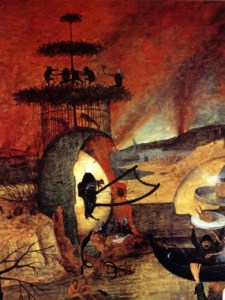
Note: Compare with 500 years ago:
Bruegehel : the Apocalypse within
The absurdity of Bruegel’s characters comes straight out of Erasmus’ Praise of Folly, a fantasy and satire on the self-deception on much of human endeavour, mocking human pretensions, monks and theologians, the scholastic intellectual substructure that supported late Medieval piety.
Erasmus cites Democritus who was supposedly constantly amused by the spectre of humanity. The book first appeared in 1511, and underwent numerous revisions and additions until the last corrections in 1532. It was an instant success. The book’s narrator is Folly who portrays life as an absurd spectacle lambasting the foibles and frailties of mankind, only to praise the ‘folly’ of simple Christian piety, the pious ideals in which Erasmus had been educated, and spirituality of The Imitation of Christ, four treatises from the 15th century attributed to Thomas â Kempis.
Erasmus and À Kempis were both Augustinian canons, more importantly both had their roots in the devotio moderna to which Erasmus remained faithful to the end of his life.
The text of Folly is a potent mix of wit, wisdom and wordplay, but it culminates in a serious indictment of churchmen, and sets out the virtues of a Christian way of life that St Paul says looks to the world like folly: “For Christ sent me not to baptize, but to preach the gospel: not in wisdom of speech, less the cross of Christ should be void. For the word of the cross, to them indeed that perish, is foolishness; but to them that are saved, that is, to us, it is the power of God”.
This is the crossroads of belief where Renaissance Christianity and Medieval religion collide, and evangelical humanists take the turning signposted scripture. The pilgrim’s way had forked and despite the lure of side roads such as ‘theological backlash’ and ‘millenarianism’, two major routes had opened up, and remained open, to choose from.
Bruegel stood at that crossroads and seemed never quite made up his mind which direction to go in. As he wavered in his decision, he was also sensibly never open about exactly what he believed. “He lived at a time and place in which free and open expression of certain ideas could mean death.” Read more here
————————————–
The Doorway Called Enchantment
I live in the northeast of the land people call the United States. Here, fire is not much of a threat, yet. A few weeks ago I was walking with my brother in the woods behind his Pennsylvania farm, where the sloping land gives way to mountainside. We crossed a creek, a bare trickle in some places, dry in others. John told me that he had been here with an old-timer who said that in his youth, this creek was so deep and strong, even in August, that there were only a few places one could cross it. What happened to this being, this creek? Some locals say it is because too many wells were dug, drawing down the water tables and drying out the springs that feed the creeks. Others say it is because of the repeated logging of the mountain, going back to colonial times. Or maybe, I thought, it is again a long-delayed result of the cascade of changes following the extermination of wolves, cougars, and beavers. All these activities are an insult to the land and to the water, oblivious to reverence.
Ultimately, to stop the fires and turn onto a world-healing path, we must turn from domination and subjugation to reverence and respect. Sometimes that means adopting the role of a protector for vulnerable, precious beings, like Marina Silva is doing in Brazil. (Here is an organization she works with, along with others I mentioned in my 2019 article on the Amazon fires.) Sometimes it means stepping into the role of nurturer or healer, like the people reintroducing beavers, practicing regenerative agriculture, and building water retention landscapes. For someone in the corporate or financial world, reverence might steer them to choose life over profit in a moment where it takes a little courage to do that. That courage is a dilute version of the courage of South American indigenous activists who risk torture and murder by landowners, logging companies, mining companies, and their paramilitaries, because it puts something else above maximizing personal self-interest. It is thus an important act of solidarity.
Reverence brings courage. Reverence brings knowledge. Reverence brings skill. Reverence brings healing. It is the fulcrum of the great turning of civilization toward reunion with nature. Today the word has religious connotations, but this is not the kind of reverence that worships an idol. It is the reverence of the lover who looks into the eyes of the beloved and sees infinity.
If reverence brings all these things, then what brings reverence? It will not do merely to exhort people to be more reverent. The gateway to reverence is enchantment. A few days ago I stood with my son Cary, age seven, at Rhode Island’s last undeveloped coastal pond watching turtles. We felt what it was like to be those turtles. We could hardly stop watching them. In that moment, the thought that we would harm them for anything less than a sacred purpose was horrifying and absurd. We knew them as precious in and of themselves, not for any use to us. Few people, dropping into that moment, could escape that enchantment. Yet, every day, we participate in systems that treat turtles and much else as resources to exploit, or make them collateral damage in other exploitation. We cannot avoid this participation, for we live in that system, and that system lives in us. More and more of us no longer feel at home in it though. It cannot easily accommodate our reverence, our enchantment, and our true purpose of service to life.
Mining company executives or members of ranchers’ death squads might be far away from the doorway of enchantment. The principle of enchantment-borne reverence does not substitute for legal action, nonviolent direct action, and so on. However, a healed planet will not result from a succession of desperate holding actions. We need to ground ourselves in directly experiencing earth as obviously precious as the turtles were to Cary; to know her as a being and as an organism, and we need to spread that knowledge. Then we will have the clarity, the courage, the skill, and most importantly, the allies in unlikely places, to defend her vulnerable parts, to preserve and strengthen her organs, and to transition away from systems built on the mythology of earth-as-thing.
Note: The Tower of Babel by Breughel
Building the Tower of Babel was, for Dante, an example of pride., Canto 12.
Purgatory in the poem of Dante Divine Comedy is depicted as a mountain in the Southern Hemisphere, consisting of a bottom section (Ante-Purgatory), seven levels of suffering and spiritual growth (associated with the seven deadly sins), and finally the Earthly Paradise at the top. Allegorically, the Purgatorio represents the penitent Christian life In describing the climb Dante discusses the nature of sin, examples of vice and virtue, as well as moral issues in politics and in the Church. The poem outlines a theory that all sins arise from love – either perverted love directed towards others’ harm, or deficient love, or the disordered or excessive love of good things.
The gate of Purgatory, Peter’s Gate, is guarded by an angel bearing a naked sword, his countenance too bright for Dante’s sight to sustain. In reply to the angel’s challenge, Virgil declares that a lady from heaven brought them there and directed them to the gate. On Virgil’s advice, Dante mounts the steps and pleads humbly for admission by the angel, who uses the point of his sword to draw the letter “P” (signifying peccatum, sin) seven times on Dante’s forehead, bidding him “take heed that thou wash / These wounds, when thou shalt be within.”
With the passage of each terrace and the corresponding purgation of his soul that the pilgrim receives, one of the “P”s will be erased by the angel granting passage to the next terrace. The angel at Peter’s Gate uses two keys, silver (remorse) and gold (reconciliation) to open the gate – both are necessary for redemption and salvation. As the poets are about to enter, they are warned not to look back. Read more here
Migration to the Spiritual Land of Peace
Part I: Introduction
For years, normality has been stretched nearly to its breaking point, a rope pulled tighter and tighter, waiting for a nip of the black swan’s beak to snap it in two. Now that the rope has snapped, do we tie its ends back together, or shall we undo its dangling braids still further, to see what we might weave from them?…
Covid-19 is like a rehab intervention that breaks the addictive hold of normality. To interrupt a habit is to make it visible; it is to turn it from a compulsion to a choice. The phenomenon follows the template of initiation: separation from normality, followed by a dilemma, breakdown, or ordeal, followed (if it is to be complete) by reintegration and celebration. Now the question arises: Initiation into what? What is the specific nature and purpose of this initiation? The popular name for the pandemic offers a clue: coronavirus. A corona is a crown. “Novel coronavirus pandemic” means “a new coronation for all.”
Already we can feel the power of who we might become. A true sovereign does not run in fear from life or from death. A true sovereign does not dominate and conquer (that is a shadow archetype, the Tyrant). The true sovereign serves the people, serves life, and respects the sovereignty of all people. The coronation marks the emergence of the unconscious into consciousness, the crystallization of chaos into order, the transcendence of compulsion into choice. We become the rulers of that which had ruled us. The New World Order that the conspiracy theorists fear is a shadow of the glorious possibility available to sovereign beings. No longer the vassals of fear, we can bring order to the kingdom and build an intentional society on the love already shining through the cracks of the world of separation. Read more: The Coronation with Charles Eisenstein
see also:“I can’t Breathe” is the expression of the Crisis of the modern world.
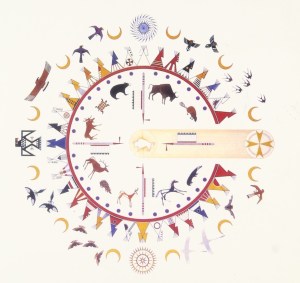 In all religious of the world we find the quest to Sincerty and Uprightness and is part of the Unanimous tradition. the search for the now apparently forgotten meaning of Tradition and the significance of the perennial philosophy needs to be pursued with an ever—increasing sense of urgency in the highly materialistic West. see The Unanimous Tradition: Essays on the essential unity of all religions a Tribute to Ananda Coomaraswamy
At Sacred Web Conference 2006 on Rediscovering the Sacred in our Lives and in our Times,. HRH The Prince of Wales said:


This wisdom was told not only in all the spiritual Traditions of the world, but surely by all the Prophets from the birth of Adam ( see the Tales of the Prophets) till the Last prophet Mohammed(a.s.)( see MUHAMMAD THE MESSENGER OF ISLAM His Life & Prophecy)
This wisdom is still told and used every day with the stories the Lifes of the saints in the Christian tradition-( see the Golden Legend) and the liturgical calendar that indicates the dates of celebrations of saints , or the Lives of the Saints in the Orthodox Church. For the lives of the Sufi Saints in the Islamic Tradion look also The Tadhkiratu ‘l-awliya – the” Memoirs of the saints” by Attar, Farid al-Din, d. ca. 1230 .Or look to The Naqshbandi Sufi Way: History and Guidebook of the Saints of the Golden Chain.
But to start our Migration to the Spiritual Land of Peace – Exercise, we look at an old text known as papyrus 3024 from the Berlin Museum, known as “Man arguing with his Soul” or the “Rebel in the Soul” we can perhaps study one of the earliest accounts of the confrontation with the ego.
This controversial text, that was meant for initiates at the threshold of the Ancient Egyptian Inner Temple, speaks to us with intriguing relevance to the problems of today. Taking the form of a dialogue between a man and his soul, this sacred text explores the inner discourse between doubt and mystical knowledge and deals with the rebellion and despair of the intellect at a crucial stage of spiritual development.
The first complete and consistent translation of the Berlin Papyrus 3024, which is thought to be nearly 4,000 years old:
“The man’s soul tells him that men of greater value than he have suffered from the world, and advises him to gain an insight from his attitude and search to overcome his despair.
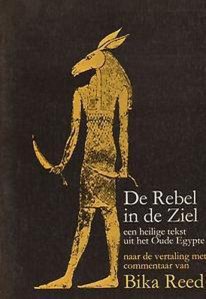 It is An Egyptian temple text, related with the God IAI, an aspect of the Solar God, the stubborn donkey. It shows the intellectual rebellion of our Ego.

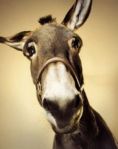
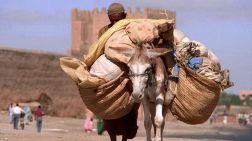
“The stubborn, passionate, long-suffering ass is the perfect natural symbol of our rational personality. It bears, like the ass, the weight of all our suffering, and carries us through life. It is stubborn, selfish and refuses to go where we think we best…
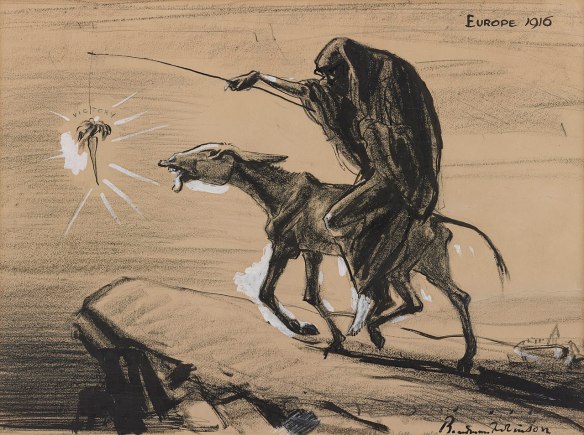
….Yet paradoxically, it is the same stubborn ass, and only the ass, that can carry the Rebel to salvation; mounted upon the ass, man is mounted upon his own rebellion. The ass is the father of all rebels, but also the carrier of redemption.”
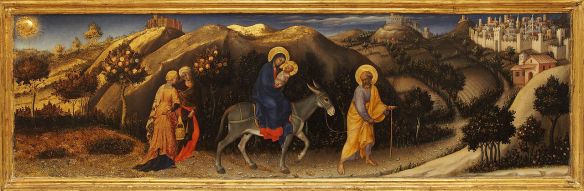
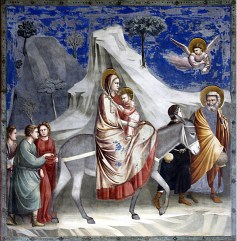
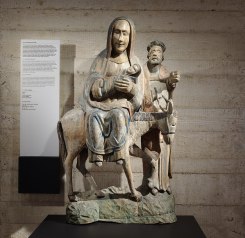
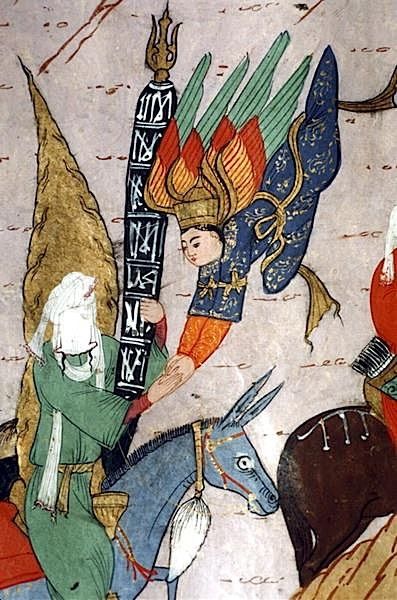
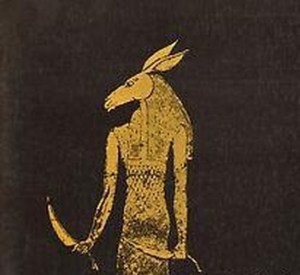 In Ancient Egypt, Iai, the Great Ass, is the aspect of the Sun God with Ass’s ears. This is Osiris in his listening state; listening equalled wisdom to the Ancient Egyptians. The Book of the Gates depicts the progression of the sun through the night. The Twelve Hours of Night are depicted as regions of the Underworld. Each region is an Hour, and each Hour has its gate through which to pass. To pass, we must know the name of the gatekeeper, or guardian.
This is the same as identifying the layers of egos we each have within – an ego is what others might call one of the deadly sins, Pride, Envy, Greed…all those different aspects of the personality that can prevent us from progressing through the gates or stages of spiritual development. When we look inwardly at the aspects of our personality that rule or affect our lives, we need to recognise what is affecting our spiritual progress; if we learn to use it wisely and become its master, instead of it being master over us, we then recognise the Guardian of that Gate – can name the Guardian, and can “pass through the Gate”. Consciousness moves from Gate to Gate.
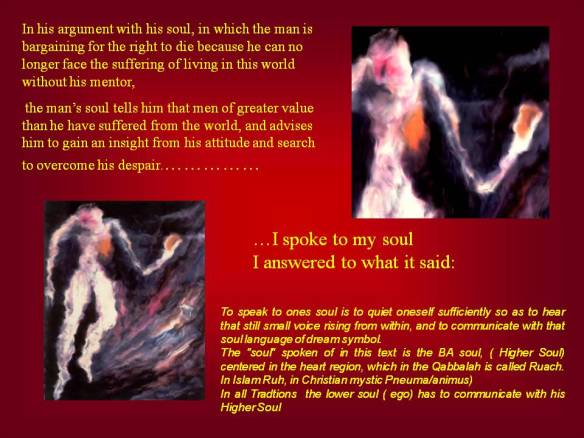
In the argument with his Soul, the man is bargaining for the right to die because he can no longer face the suffering of living in this world without his mentor. In Ancient Egypt, it was believed that a man and his Soul would be judged together in the afterlife; the Soul can make appeals on his behalf. So the man is arguing with his Soul to persuade it that killing himself is the correct thing to do, as he wants it to accept his reasons, and agree with him so that it will stay with him after death and make favourable appeals. However, his Soul has other ideas..
“I spoke to my soul that I might answer what it said:
To whom shall I speak today?
Brothers and sisters are evil and friends today are not worth loving.
Hearts are great with greed and everyone seizes his or her neighbor’s goods.
Kindness has passed away and violence is imposed on everyone.
To whom shall I speak today?
People willingly accept evil and goodness is cast to the ground everywhere.
Those who should enrage people by their wrongdoing
make them laugh at their evil deeds.
People plunder and everyone seizes _his or her neighbour’s goods.
To whom shall I speak today?
The one doing wrong is an intimate friend and the brother with whom one used to deal is an enemy.
No one remembers the past and none return the good deed that is done.
Brothers and sisters are evil
and people turn to strangers for righteousness or affection.
To whom shall I speak today?
Faces are empty and all turn their faces from their brothers and sisters.
Hearts are great with greed
and there is no heart of a man or woman upon which one might lean.
None are just or righteous and the land is left to the doers of evil.
To whom shall I speak today?
There are no intimate friends
and the people turn to strangers to tell their troubles.
None are content and those with whom one used to walk no longer exist.
I am burdened with grief and have no one to comfort me.
There is no end to the wrong which roams the earth.
When we consider the age of this text, from XII Dynasty Egypt (approx 1991-1783 BC), we can see that the nature of the woes and troubles of humankind have changed very little.
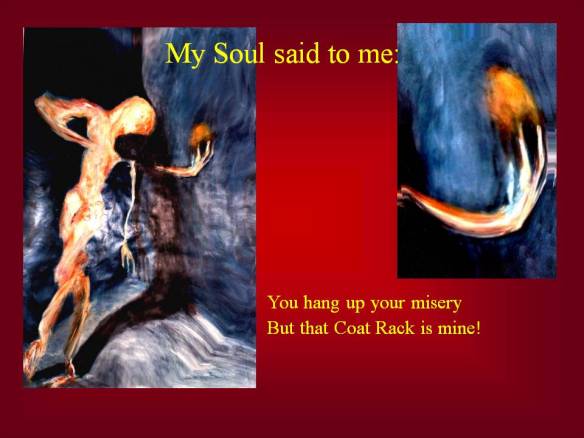
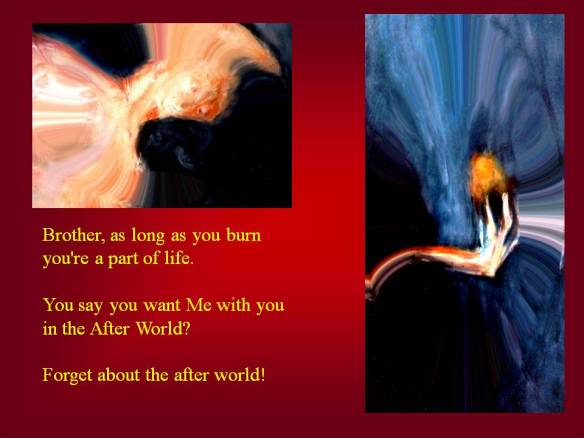
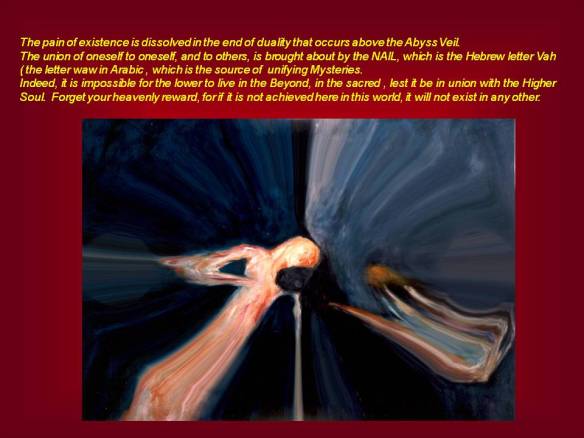
The man’s soul tells him that men of greater value than he have suffered from the world, and advises him to gain an insight from his attitude and search to overcome his despair. It tells him some allegorical stories – the first being the “mythical field of transformations”; both the field AND the plough are to be found within man. The field is the ground; the earth, where the soul of the man dwells, and is to be cultivated by the ploughman – the man must “cultivate” himself.
The harvest is what is then offered back to the soul. The “harvest”, what is left of the man after his life, is in dangerous hands if left uncultivated. It is exposed to a “storm from the North” said to indicate the Head (Reason); the storm is consciousness threatened by intellectual rebellion.
The man at this point in the story, when his Rebel/ego is arguing for survival, is not yet ready to let the wisdom of his heart rule his intellect, and this is symbolised by the crocodile. The man’s heirs, in the story he is told by his soul, are eaten by a crocodile whilst still in the egg, before they are fully formed, before they have lived, and will never realise their potential. Read more here
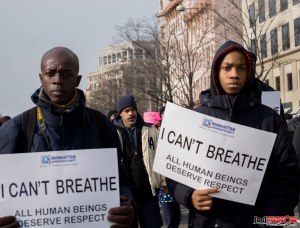
“I can’t breathe“ is sure the slogan associated with the Black Lives Matter movement in the United States. The phrase is derived from the words of Eric Garner and George Floyd, two African-American men who died of asphyxiation during their arrests in 2014 and 2020, respectively, as a result of excessive force by primarily white police officers. The phrase is used in protest against police brutality in the United States.
But this protest, this Cry show us the real problem of the Modern man:
Modern man is a human without Soul, without the “Living Breath”.
The protest is the expression of his deep spiritual Crisis in the times of deep ignorance..
Modern man suffocates and cries: “i can’t breathe” , because a human without “the living Breath” is always dying. It is his only certainty in life, man shall once die and all traditions in the world teach us to take care of our Soul, our “Living Breath”, always in our daily life, but sure at the moment when we are dying. Modern man is the only one of all the traditions of the world who dares to think that he is right to live without his soul and without his “Living Breath”. What an arrogance and Vanity! But remember Vanity is the quality of being vain, something that is vain, it is always empty, or valueless.
Contemporary conversations about death and dying are lost and unsatisfying on many levels. This phenomenon subsists not only in fields like bioethics, but also in religion and spirituality. Modern culture is preoccupied with seeking ways to live a longer, youthful life, ignoring the inevitable forthcoming of death. One period during which the topic of death and dying was reflected upon by the common Christian was between the fifteenth and the seventeenth centuries, during which a specific genre of literature was formed: ars moriendi. This genre attempted to provide intellectual, cultural and religious answers as to how death should be understood and ritualized. Two spiritual writers who contributed to the understanding of ars moriendi are Desiderius Erasmus and Teresa of Ávila. What unites these figures of the Catholic tradition is their attempt to show that preparation for death is a lifelong process of cultivating appropriate virtues. Read hereThe Art of Dying Well according to Erasmus of Rotterdam and Teresa of Avila
As the Corona virus is taking a toll on all of us and is attacking our lungs, giving us serious problems of breathing, especially those least able to retreat into their homes until the worst is over.
But, beyond the health and humanitarian measures urgently needed for those affected, it also offers a chance to right historical wrongs – the abuse of our earthly home and of marginalised societies, the very people who will suffer most from this pandemic. This viral outbreak is a sign that by going too far in exploiting the rest of nature, the dominant globalising culture has undone the planet’s capacity to sustain life and livelihoods. The unleashing of micro-organisms from their animal hosts means that they must latch on to other bodies for their own survival. Humans are a part of nature – and everything is connected to everything else.
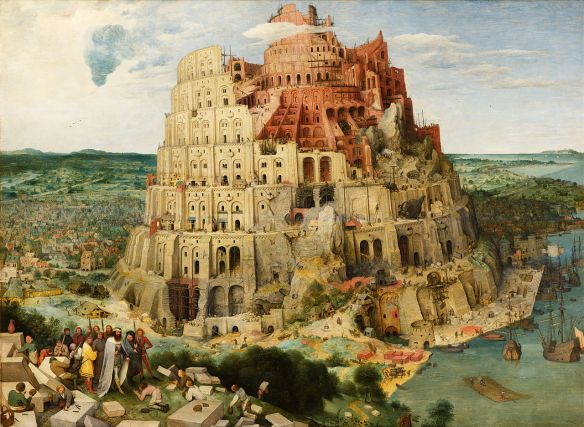
The story of the Tower of Babel (like that in The Suicide of Saul, Bruegel’s only other painting with an Old Testament subject) was interpreted as an example of pride punished, and that is no doubt what Bruegel intended his painting to illustrate. Moreover, the hectic activity of the engineers, masons and workmen points to a second moral: the futility of much human endeavour. Nimrod’s doomed building was used to illustrate this meaning in Sebastian Brant’s Ship of Fools. Pieter Bruegel’s Tower of Babel , originally displayed in the suburban villa of Antwerp entrepreneur Niclaes Jonghelinck as an image that fostered learned dinner conversation (convivium) about the well-being of the city. Looking at various sources, the author analyzes how the theme of the painting, a story of miscommunication and disorder, resonated with the challenges faced by the metropolis. Antwerp’s rapid growth resulted in the creation of a society characterized by extraordinary pluralism but with weakened social bonds. Convivium was one of the strategies developed to overcome differences among the citizens and avoid dystrophy of the community. Read more Here
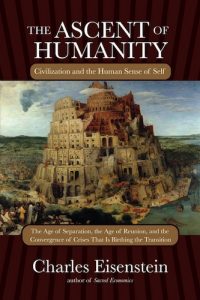 Charles Eisenstein explores the history and potential future of civilization, tracing the converging crises of our age to the illusion of the separate self. In this limited hardcover edition of Eisenstein’s landmark book, he argues that our disconnection from one another and the natural world has mislaid the foundations of science, religion, money, technology, economics, medicine, and education as we know them. It has fired our near-pathological pursuit of technological Utopias even as we push ourselves and our planet to the brink of collapse.
Fortunately, an Age of Reunion is emerging out of the birth pangs of an earth in crisis. Our journey of separation hasn’t been a terrible mistake but an evolutionary process and an adventure in self-discovery. Even in our darkest hour, Eisenstein sees the possibility of a more beautiful world–not through the extension of millennia-old methods of management and control but by fundamentally reimagining ourselves and our systems. We must shift away from our Babelian efforts to build ever-higher towers to heaven and instead turn out attention to creating a new kind of civilization–one designed for beauty rather than height. Breathtaking in its scope and intelligence, The Ascent of Humanity is a landmark book showing what it truly means to be human. Read here online
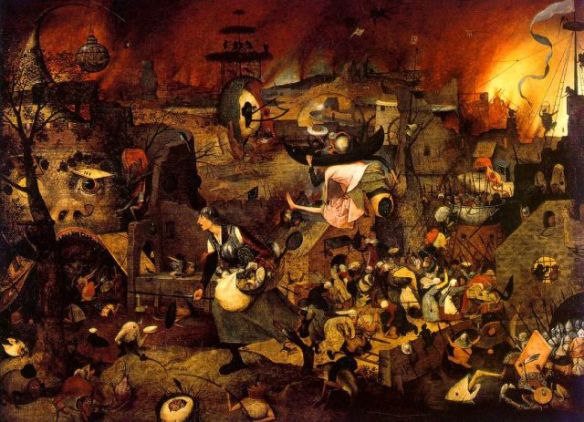
Our civilization is in decay. Because we have blown-up our ego. Cosmic Balance has been disturbed. The painting “Dulle Griet”of the great painter Bruegel express very clearly the Crisis of Modern man: Modern Man with all his “economical grow- energy” and scientifical research based on his rebellion against his Soul, is landed in an apocalyptic “theather” prophesying the complete destruction of the world.
Dulle Griet is the model of modern man’s Rebellion against his soul and Anger against it. How can Dulle Griet find a way to calm her anger?
 She can looks in the mirror and see herself,making more “selfies”, so seeing more anger as the portait of vanity of Hans Memling shows us. The lady see only more vanity The message of Memling is in his Triptych of Earthly Vanity and Divine Salvation focuses on the idea of “Memento mori,” a Latin phrase that translates to “Remember your mortality.” Memling’s triptych shockingly contrasts the beauty, luxury and vanity of the mortal earth with images of death and hell. In the time of Breughel and in our times the message is that Vanity is not the solution. see: Nothing Good without Pain: Hans Memling”s earthly Vanity and Divine Salation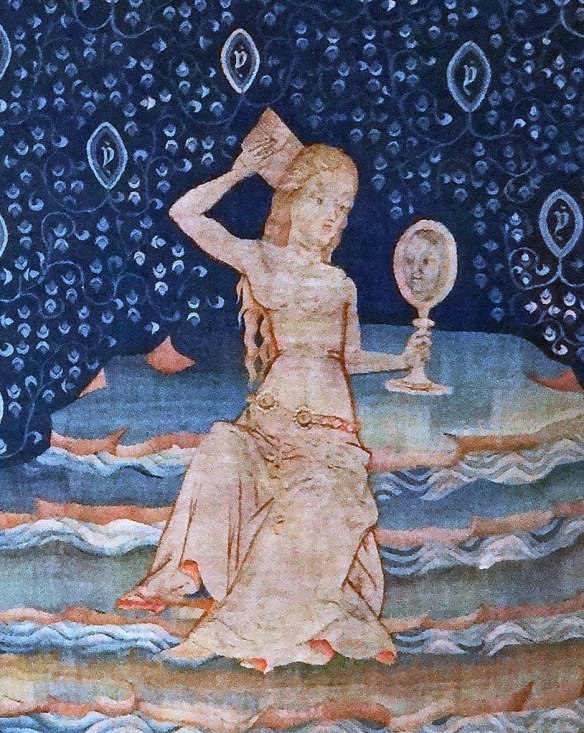
The Whore of Babylon in the The Apocalypse Tapestry of Angers
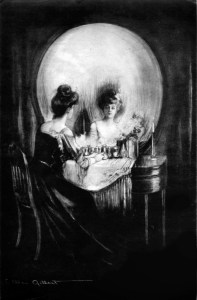
All Is Vanity by Charles Allan Gilbert (September 3, 1873 – April 20, 1929)
The phrase “All is vanity” comes from Ecclesiastes 1:2 (Vanity of vanities, saith the Preacher, vanity of vanities; all is vanity.
Don’t change the world in hopes of changing yourself,
change yourself so the world changes because of you.
For more info see: The Spiritual Land of Peace of the “Holy Refugees”
In his Qatsy trilogy film director Reggio, use the world qatsi from the Hopi language, in which the word qatsi translates to “life.” see Life out of Balance: the Qatsi trilogy
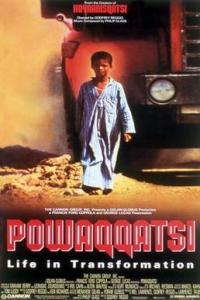 POWAQQATSI’s overall focus is on natives of the Third World — the emerging, land-based cultures of Asia, India, Africa, the Middle East and South America — and how they express themselves through work and traditions. What it has to say about these cultures is an eyeful and then some, sculpted to allow for varied interpretations.The title POWAQQATSI is a Hopi Indian conjunctive — the word Powaqa, I ( Ego),which refers to a negative sorcerer who lives at the expense of others, and Qatsi –i.e., life.
where KOYAANISQATSI dealt with the imbalance between nature and modern society, POWAQQATSI is a celebration of the human-scale endeavor the craftsmanship, spiritual worship, labor and creativity that defines a particular culture. It’s also a celebration of rareness — the delicate beauty in the eyes of an Indian child, the richness of a tapestry woven in Kathmandu — and yet an observation of how these societies move to a universal drumbeat.
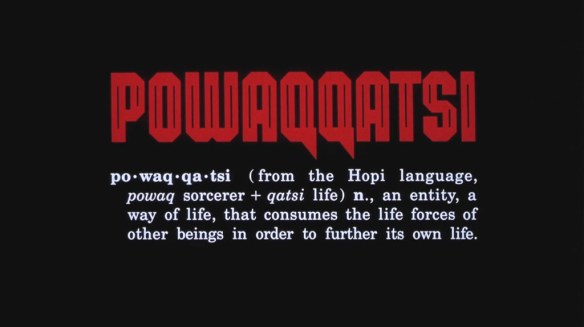
2.Powwaqatsi (1988) from Stephen Galleher on Vimeo.
Plato’s words are as relevant now as they were during his time. He is still one of the world’s greatest teachers.
Philosopher Plato discusses five types of regimes (Republic, Book VIII). They are Aristocracy, Timocracy, Oligarchy, Democracy, and Tyranny. Plato also assigns a man to each of these regimes to illustrate what they stand for. The tyrannical man would represent Tyranny, for example. These five regimes progressively degenerate starting with Aristocracy at the top and Tyranny at the bottom
Oligarchy then degenerates into a democracy where freedom is the supreme good but freedom is also slavery. In democracy, the lower class grows bigger and bigger. The poor become the winners. People are free to do what they want and live how they want. People can even break the law if they so choose. This appears to be very similar to anarchy.
Plato uses the “democratic man” to represent democracy. The democratic man is the son of the oligarchic man. Unlike his father, the democratic man is consumed with unnecessary desires. Plato describes necessary desires as desires that we have out of instinct or desires that we have to survive. Unnecessary desires are desires we can teach ourselves to resist such as the desire for riches. The democratic man takes great interest in all the things he can buy with his money. Plato believes that the democratic man is more concerned with his money over how he can help the people. He does whatever he wants when ever he wants to do it. His life has no order or priority. So can a happy few ( 1% of the world population) try to dictate the rest of the human and using them as robotic slaves and wanting them to live without a soul.
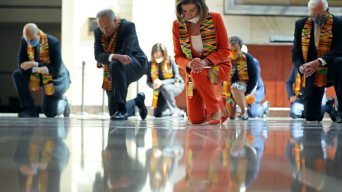

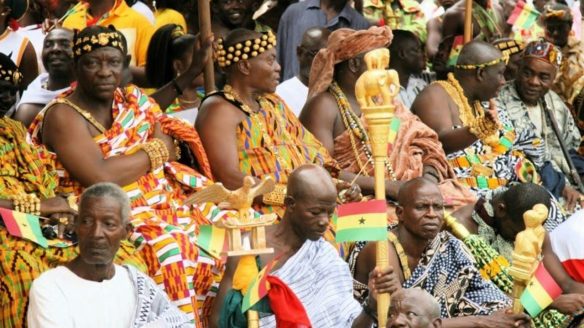 Ashanti kingdom
It is and always shall be a dead End…

The Reign of Quantity gives a concise but comprehensive view of the present state of affairs in the world, as it appears from the point of view of the ‘ancient wisdom’, formerly common both to the East and to the West, but now almost entirely lost sight of. The author indicates with his fabled clarity and directness the precise nature of the modern deviation, and devotes special attention to the development of modern philosophy and science, and to the part played by them, with their accompanying notions of progress and evolution, in the formation of the industrial and democratic society which we now regard as ‘normal’. Read more here
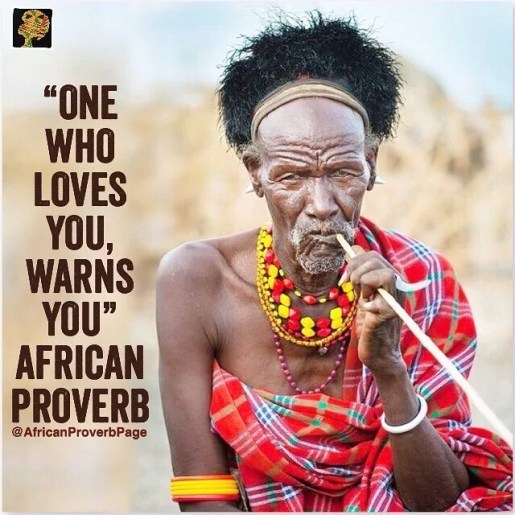
see Rediscovering the Sacred in our Lives and in our Times.
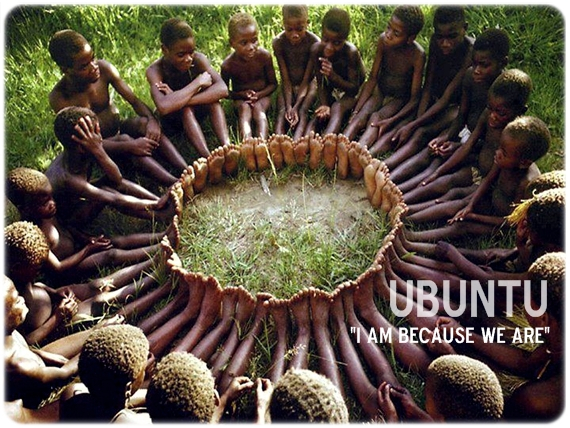
Spiritual Rescue is to be find in the African Tradition as Ubuntu: Ubuntu (Zulu pronunciation: [ùɓúntʼù])[1] is a Nguni Bantu term meaning “humanity.” It is often translated as “I am because we are,” or “humanity towards others,” or in Xhosa, “umntu ngumntu ngabantu” but is often used in a more philosophical sense to mean “the belief in a universal bond of sharing that connects all humanity.
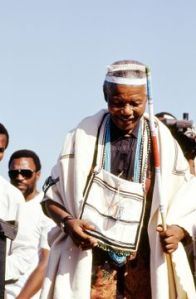 Traditional education system, still in use in our time by the Xhosa, where Nelson Rolihlahla Mandela was born to the Thembu royal family in Mvezo can help to revover our humanity as the Rites of passage used fort he youth
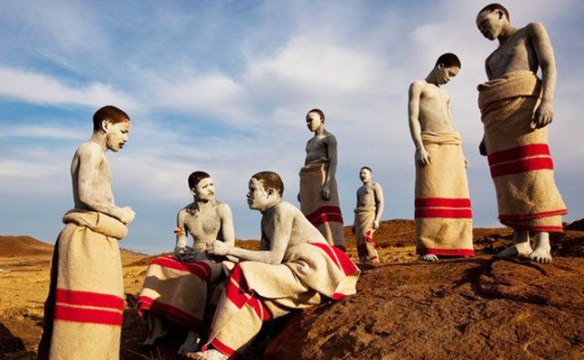
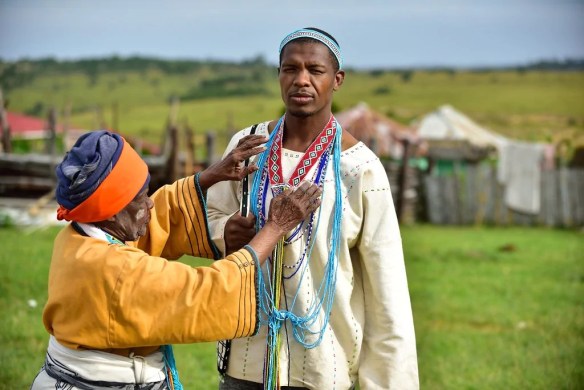
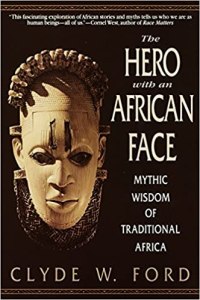 In his remarkable book, Clyde Ford restores to us the lost treasure of African mythology, bringing to life the ancient tales and showing why they matter so much to us today.
African myths convey the perennial wisdom of humanity: the creation of the world, the hero’s journey, our relationship with nature, death, and resurrection. From the Ashanti comes the moving account of the grief-stricken Kwasi Benefo’s journey to the underworld to seek his beloved wives. From Uganda we learn of the legendary Kintu, who won the love of a goddess and created a nation from a handful of isolated clans. The Congo’s epic hero Mwindo is the sacred warrior who shows us the path each person must travel to discover his true destiny.These and other important African myths show us the history of African Americans in a new light–as a hero’s journey, a courageous passage to a hard-won victory. The Hero with an African Face enriches us all by restoring this vital tradition to the world. Here free downoad.
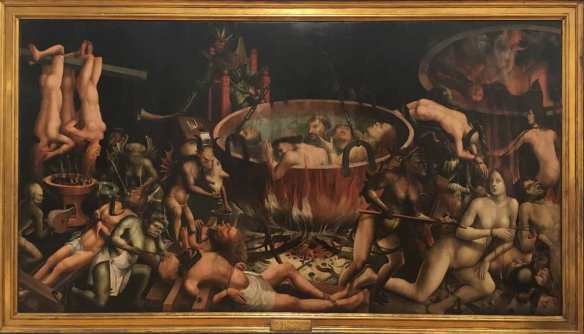
Artist unknown (Cristovão de Figueiredo?), Hell, Museu da Arte Antiga, Lisbon, ca. 1515. Oil on oak, 119 x 217.5 cm.
In his post Alexander Nagel explains:Our painting of hell is big, much bigger than you might expect from looking at a photo. It doesn’t fit clearly into any category of picture known at the time. It is an independent panel, not a scene in a fresco cycle that gains meaning from the larger program. It’s not an altarpiece, nor is it a typical private devotional image, which would have been smaller. Its oblong shape suggests it was not part of a larger structure, as in triptychs by Bosch and others, where hell occupies one compartment, one part of a larger statement about human life and the world. This is a big stand-alone painting of a subject that normally didn’t stand alone. The painting lowers you right down to the sub-basement of hell and lets you look. The looking begins as voyeuristic fascination and then sinks into self-reflection. Hell Is for White People
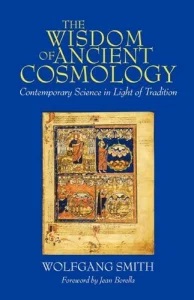 What emerges from the considerations of Physics and Vertical Causation is an incomparably enlarged worldview: a cosmos vast enough to encompass not only all of modern science — from the distant stars to subatomic particles — but also the quintessential patrimony of antiquity, with its higher spheres inhabited by allegedly “mythical” beings. The discovery of vertical causality has reopened the door to the wisdom of ancient cosmologies, which, far from being “prescientific superstitions,” refer to truths higher than those discoverable by way of physics. Wolfgang Smith has shown that a radical expansion of our Weltanschauung is not only scientifically admissible, but is in fact absolutely necessary for a proper understanding of physics. see The-Wisdom-of-Ancient-Cosmology-Contemporary-Science-in-Light-of-Tradition

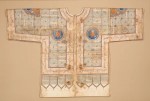 Just as many now don face masks and do breathing exercises to protect against COVID-19 – despite debate around the science behind such practices – so too did the Islamic world turn to protective devices and rituals in premodern times of trouble. From the 11th century until around the 19th century, Muslim cultures witnessed the use of magic bowls, healing necklaces and other objects in hopes of warding off drought, famine, floods and even epidemic diseases. Read more here
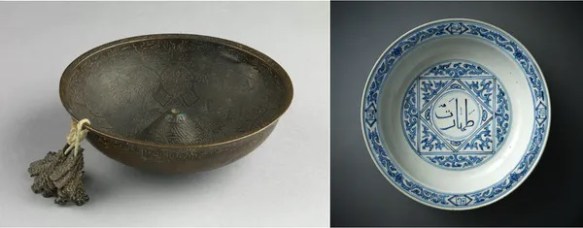 A metal magico-medicinal bowl, left, and a ceramic ablutions basic inscribed with the word ‘taharat,’ meaning purity.
Sacred Economics traces the history of money from ancient gift economies to modern capitalism, revealing how the money system has contributed to alienation, competition, and scarcity, destroyed community, and necessitated endless growth. Today, these trends have reached their extreme—but in the wake of their collapse, we may find great opportunity to transition to a more connected, ecological, and sustainable way of being.
This book is about how the money system will have to change—and is already changing—to embody this transition. A broadly integrated synthesis of theory, policy, and practice, Sacred Economics explores avant-garde concepts of the New Economics, including negative-interest currencies, local currencies, resource-based economics, gift economies, and the restoration of the commons. Author Charles Eisenstein also considers the personal dimensions of this transition, speaking to those concerned with “right livelihood” and how to live according to their ideals in a world seemingly ruled by money. Tapping into a rich lineage of conventional and unconventional economic thought, Sacred Economics presents a vision that is original yet commonsense, radical yet gentle, and increasingly relevant as the crises of our civilization deepen. Read online here
For years, normality has been stretched nearly to its breaking point, a rope pulled tighter and tighter, waiting for a nip of the black swan’s beak to snap it in two. Now that the rope has snapped, do we tie its ends back together, or shall we undo its dangling braids still further, to see what we might weave from them?
Covid-19 is showing us that when humanity is united in common cause, phenomenally rapid change is possible. None of the world’s problems are technically difficult to solve; they originate in human disagreement. In coherency, humanity’s creative powers are boundless. A few months ago, a proposal to halt commercial air travel would have seemed preposterous. Likewise for the radical changes we are making in our social behavior, economy, and the role of government in our lives. Covid demonstrates the power of our collective will when we agree on what is important. What else might we achieve, in coherency? What do we want to achieve, and what world shall we create? That is always the next question when anyone awakens to their power.
Covid-19 is like a rehab intervention that breaks the addictive hold of normality. To interrupt a habit is to make it visible; it is to turn it from a compulsion to a choice. Read also The Coronation with Charles Eisenstein
 Being alone in quarantine, devoid of friends, family, co-workers and community, a person is truly lonely. Talking on the phone, messaging and even video chatting is no substitute for being in the physical presence of others. There is no replacement for the hug, kiss or even the handshake. Just having others around gives a person a sense of security and comfort. Quarantine forces a painful loneliness.
Yet the loneliness of companionship can also create an opportunity. The loneliness of others creates the solitude of the person with God. All alone, a person is able to commune with God as never before. God is eternally listening to our voices, and God awaits our prayers.
The silence of prayer/meditation provides a person the opportunity to connect to God on the deepest of levels. Without the pressures of work, a schedule or family chores, a person can turn to God, pour their heart out and deepen their relationship with the Creator. The gaping hole of spirituality left by the absence of ritual can be filled with a more unique connection to God.
Quarantine is a challenge previously unthought of by our Sages. It is lonely and depressing. Those feelings are natural and valid. All of us in quarantine are feeling them. But taken in the right way, it can provide time and opportunity to connect with God, rethink values and recommit to the priorities that are important to us. It means to become a “Refugee”, to recover our soul and to take refuge in the “Living Breath” and take care of it.
Don’t change the world in hopes of changing yourself,
change yourself so the world changes because of you.
The Soul That Does not Live in God is not Alive
Spring makes red and white flowers appear on the trees,
But the spring that is the origin of colors is colorless.
Understand what I have said, and give up all talk;
Run to the Origin without color and unite yourself to it.
Annihilate yourself before the One Existence
So that thousands of worlds leap out of you
And your pure existence flames out of itself
And goes on and on birthing different forms.
Of course, none of these forms will last.
Happy is the one who knows this mystery!
Happy is he who gives his life to know this!
He leaves this house for another far more radiant.
You cannot understand this mystery through reason;
The Way to Knowledge winds through suffering and torment.
If you do not feel pain, you do not look for healing.
The soul that does not live in God is not alive.
She seems like a soul, but does not deserve the name:
She has not been made alive by the Beloved.
The soul is given life by the four-elements
Like a lamp that burns through the night:
The light is from oil and wick, it is not eternal.
While the oil exists, the lamp burns, but then goes out.
The one made alive by God will never die.
He lives through God and not through gold or bread.
God is the Light, the Eternal Source of Lights.
The Light is causeless, as is His fiery radiance.
Like gold, God’s value comes from His pure, perfect essence.
Depression, anxiety, and fatigue are an essential part of a process of metamorphosis that is unfolding on the planet today, and highly significant for the light they shed on the transition from an old world to a new.
When a growing fatigue or depression becomes serious, and we get a diagnosis of Epstein-Barr or Chronic Fatigue Syndrome or hypothyroid or low serotonin, we typically feel relief and alarm. Alarm: something is wrong with me. Relief: at least I know I’m not imagining things; now that I have a diagnosis, I can be cured, and life can go back to normal. But of course, a cure for these conditions is elusive.
The notion of a cure starts with the question, “What has gone wrong?” But there is another, radically different way of seeing fatigue and depression that starts by asking, “What is the body, in its perfect wisdom, responding to?” When would it be the wisest choice for someone to be unable to summon the energy to fully participate in life?
The answer is staring us in the face. When our soul-body is saying No to life, through fatigue or depression, the first thing to ask is, “Is life as I am living it the right life for me right now?” When the soul-body is saying No to participation in the world, the first thing to ask is, “Does the world as it is presented me merit my full participation?” Read More Here
What the Emigration to Sincerity demands of us? see To Become a “Refugee”: Emigration to Sincerity or “uprightness” of Love
see also Source materials for the “Refugee” of our Times
COVID-19 is taking a toll on all of us, especially those least able to retreat into their homes until the worst is over.
But, beyond the health and humanitarian measures urgently needed for those affected, it also offers a chance to right historical wrongs – the abuse of our earthly home and of marginalised societies, the very people who will suffer most from this pandemic. This viral outbreak is a sign that by going too far in exploiting the rest of nature, the dominant globalising culture has undone the planet’s capacity to sustain life and livelihoods. The unleashing of micro-organisms from their animal hosts means that they must latch on to other bodies for their own survival. Humans are a part of nature – and everything is connected to everything else.
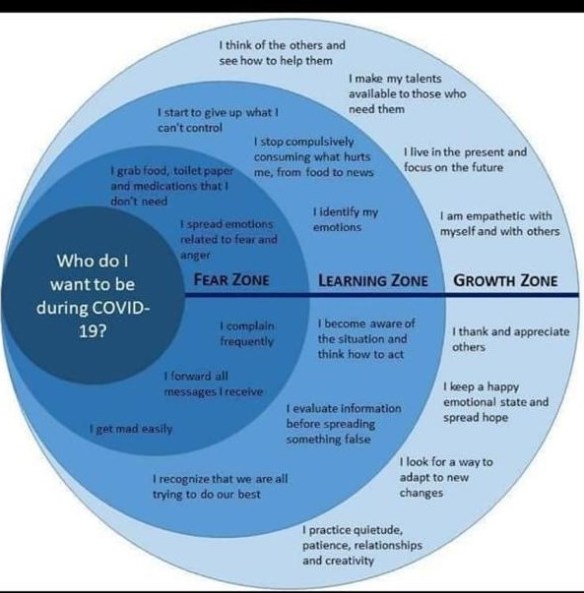
The Nature is Speaking:
More on Nature is speaking here
…”.I would like to tell you a few things about this virus and the lessons it should teach us, all the things we should be learning. I would like to add my voice to the crowd and be heard above it.
I would like to say: fish have returned to the Venetian canals now that humans have stopped polluting them.
I would like to say: the clouds of air pollution over Italy and China have dissipated since people were prevented from causing them with their cars, planes, factories.
I would like to say: up to 80,000 premature deaths which would have been caused this way have probably been prevented in China by the shutdown of the economy.
I would like to say: carbon monoxide levels in the air above New York have collapsed by 50 percent in a single week.
I would like to say: Nature recovers swiftly when we stop our plundering of Her bounty.
I would like to say: lift your gaze, humans.
I would like to say: we can learn from this, we can change.
I am squatting in the sun on this day of the spring equinox, it is a cold sun, I am down by the pond with my children, we are watching the tadpoles squirm free of their jelly under the leafing poplars. The world is turning.”
Paul Kingsnorth is a writer living in rural Ireland.
The current pandemic is just one aspect of the human-made planetary crisis known as the Anthropocene; runaway climate change and biodiversity loss are others – and all are connected. COVID-19 confronts us with a civilizational crisis so immediate and so severe, that the only real strategy will be one that can reach into and heal the web of life.
This crisis strips away all delusional confidence in modern world notions of history, progress, humanity, knowledge, time, secularism, and our tendency to take life itself for granted. It should also caution us against responses that strip away democratic and human rights, as is happening in the name of controlling the virus in many countries, for such responses only further reduce the ability of citizens to deal with such crises.
The corona crisis signifies a civilization that is dying, but also, it shows a pluriverse of ‘other worlds’ rising up. Every crisis is an opportunity. The key question is how to remake our economy and polity in a way that respects ecological limits and works for all humanity. The answer must go beyond superficial managerial and technological fixes to deep systemic transformations that can shake up structural injustices, unsustainability, and de-futuring. We need a dramatic shift towards genuine democracy;one that places confidence in the time-tested genius of local communities and collectives.
We challenge the old eurocentric mode of existence based on separation of humans from other natural entities – us versus them, mind versus body, secular versus spiritual. By denying the essential interdependence of everything on Earth, this dualist way of thinking and being simply served to entrench the domination of masculine power over life-affirming feminine care. It paved the way for the most objectifying and harmful economy humanity has ever seen, today enshrined in a heavily militarised global neoliberal capitalist (dis)order.
The pandemic is bringing home new lessons. Economic globalization has not brought universal prosperity but ecological devastation, social disruption and inequality.
Being alone in quarantine, devoid of friends, family, co-workers and community, a person is truly lonely. Talking on the phone, messaging and even video chatting is no substitute for being in the physical presence of others. There is no replacement for the hug, kiss or even the handshake. Just having others around gives a person a sense of security and comfort. Quarantine forces a painful loneliness.
Yet the loneliness of companionship can also create an opportunity. The loneliness of others creates the solitude of the person with God. All alone, a person is able to commune with God as never before. God is eternally listening to our voices, and God awaits our prayers.
The silence of prayer/meditation provides a person the opportunity to connect to God on the deepest of levels. Without the pressures of work, a schedule or family chores, a person can turn to God, pour their heart out and deepen their relationship with the Creator. The gaping hole of spirituality left by the absence of ritual can be filled with a more unique connection to God.
Quarantine is a challenge previously unthought of by our Sages. It is lonely and depressing. Those feelings are natural and valid. All of us in quarantine are feeling them. But taken in the right way, it can provide time and opportunity to connect with God, rethink values and recommit to the priorities that are important to us.
Looking the horizontal way and learning from the past, as Breughel and Bosch did but also Erasmus and Goethe as many others, learning from the “Black Death” and taking also a vertical distance to understand better the message from Eternity, wil the website Maypole of Wisdom deliver a message for our times at the intersection or cross point of the present.
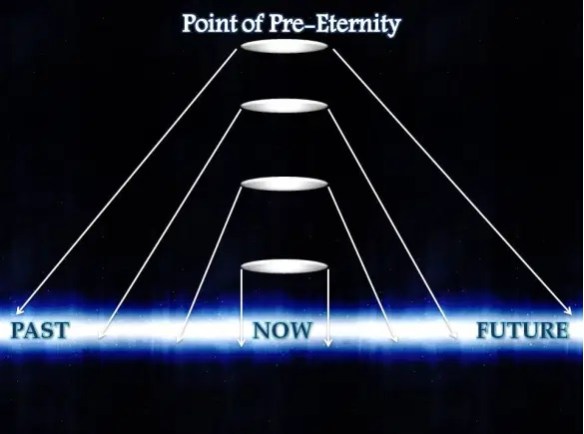
 Looking to the Spiritual vertical way, as the Maypole do, gives us an opportunity of discerning an understanding between Non-Virtues and Virtues, needed in our times.
We need to be sincere with our selves , to be “upright” strictly honourable and honest, as the symbol of the Maypole is. Together we can initiate and erect a maypole as various European folk festivals do, in respect of the safely coming of Spring. But as many Folklores in Europe did, to keep it more permantly, we can plant a Lime Tree in the center of the village of on squares in the city, to keep the remenbering of “uprightness”,of sincerity in our mind, in our heart and in our allday lives. In this way,as in many folklores of Europe, they recognize their dependance to Nature and their submission to something Higher than themselves. And happy they danced under the Lime Tree on important opportunities. Man has always be in need of a symbol, but certainly a symbol for communality and fraternity.
 As the Spring Rejuvenation ritual of the Carnaval of Binche in Belgium, the Gilles of Binche becomes for one day the hero and symbol of Fraternity.
The Lime Tree of Wisdom can become again a beautiful symbol of Fraternity, and also draw strength together to face the future and a place of remembering, sharing and of coming together. Than Maybe, this message from the Past can help us to be able to rediscover the meaning of the Eternal Spring. Or as Hildegard of Bingen call it The Greenness ( Viriditas) of our soul.
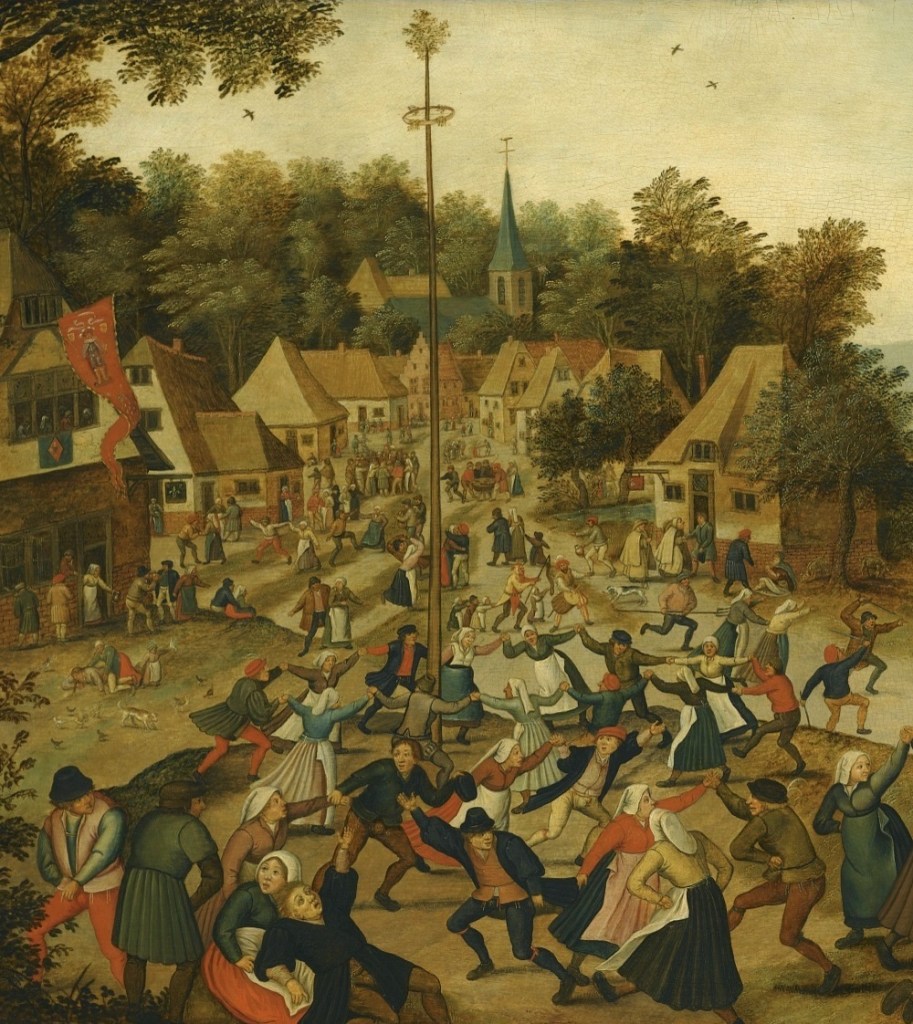
The Feast of St George in Holland


The website Maypole of Wisdom is a project of the website Sufi Path of Love, Sufi Platform Naqshbandi Haqqani Rabbani Holland


 Path to the Maypole of Wisdom