“Virtue is the correct use of free will.”
St augustine – “On Grace & Free Will”

A TREATISE ON GRACE AND FREE WILL
BY
AURELIUS AUGUSTIN, BISHOP OF HIPPO
In this treatise Augustin teaches us to beware of maintaining grace by denying free will, or free will by denying grace; for that it is evident from the testimony of Scripture that there is in man a free choice of will; and there are also in the same Scriptures inspired proofs given of that very grace of God without which we can do nothing good. Afterwards, in opposition to the Pelagians, he proves that grace is not bestowed according to our merits. He explains how eternal life, which is rendered to good works, is really of grace. He then goes on to show that the grace which is given to us through our Lord Jesus Christ is neither the knowledge of the law, nor nature, nor simply remission of sins; but that it is grace that makes us fulfil the law, and causes nature to be liberated from the dominion of sin. He demolishes that vain subterfuge of the Pelagians, to the effect that “grace, although it is not bestowed according to the merits of good works, is yet given according to the merits of the antecedent good-will of the man who believes and prays.” He incidentally touches the question, why God commands what he means himself to give, and whether he imposes on us any commands which we are unable to perform. He clearly shows that the love which is indispensable for fulfilling the commandments is only within us from God himself. He points out that God works in men’s hearts to incline their wills however he wills, either to good works according to his mercy, or to evil works in return for their deserving—his judgment, indeed, being sometimes manifest, sometimes hidden, but always righteous. Lastly, he teaches us that a clear example of the gratuitousness of grace, not given in return for our
deserts,(That which is deserved or merited; a just punishment or reward) is supplied to us in the case of those infants which are saved, while others perish though their case is identical with that of the rest. Read here
Read also: Augustine’s Understanding of Time and Eternity
St. Augustine on Human Temporality and Divine Eternity
The City of God and Confessions – St Augustine
—————-


What does love look like?
It has the hands to help others.
It has the feet to hasten to the poor and needy.
It has eyes to see misery and want.
It has the ears to hear the sighs and sorrows of men.
That is what love looks like.
Saint Augustine
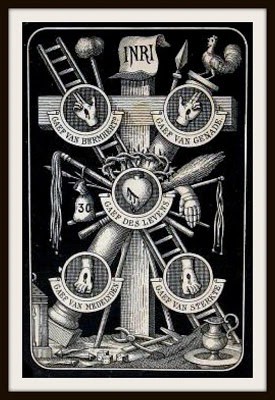
In the 5 circles is written: “Gave van Barmhartigheid“: Gift of Mercy , “Gave van Genade’: Gift of Grace, “Gave des Levens” ( in the heart): Gift of Life, ” Gave van Medelijden”: Gift of Compassion, “Gave van sterkte“: Gift of strength.
– The Body is Like Mary

The Body is Like Mary
The body is like Mary, and each of us has a Jesus inside.
Who is not in labour, holy labour? Every creature is.
See the value of true art, when the earth or a soul is in
the mood to create beauty;
for the witness might then for a moment know, beyond
any doubt, God is really there within,
so innocently drawing life from us with Her umbilical
universe – infinite existence …
though also needing to be born. Yes, God also needs
to be born!
Birth from a hand’s loving touch. Birth from a song,
from a dance, breathing life into this world.
The body is like Mary, and each of us, each of us has
a Christ within.
– Mevlana Jalaluddin Rumi
 Path to the Maypole of Wisdom