
The Crucified Monk | Icon of the Monastic Life

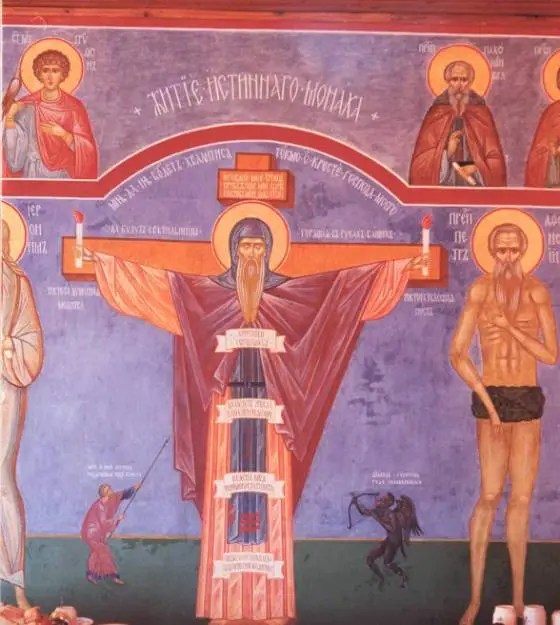
Around the entrance of refectories in Orthodox monasteries, there can sometimes be seen a shocking image of a monk being crucified. The unnamed monk silently reposes on the cross, whilst around him he is assailed by terrifying demons and skeletal figures. Just as shocking as the image itself is the inscription which accompanies it: The True Life of a Monk
Monasticism is an ancient Christian practice which developed in the 3rd and 4th centuries A.D., around the time when Christianity became legalized in the Roman Empire and persecutions practically ceased. This has sometimes been given as a reason for the rise of monasticism: the desire for zealous Christians to flee from the world where living the Christian life was suddenly comfortable, “easier”, and even fashionable. However, all the greatest monastic saints, in their writings, give one source for their motivation for entering a monastery: the Gospels.

A perfect example of this is from the life of St Anthony the Great. In his hometown church, Anthony heard the Gospel reading proclaimed, as if spoken to him directly: “If you would be perfect, go, sell all you have and give to the poor, and come and follow me.” And so Anthony was inspired to live a life which became the foundation for monasticism, putting forward the basic motivation for monks and nuns ever since.

With such a basic Scriptural motivation for monasticism, this way of life becomes a lot more interesting for every Christian.
The Icon: “True Life of a Monk”
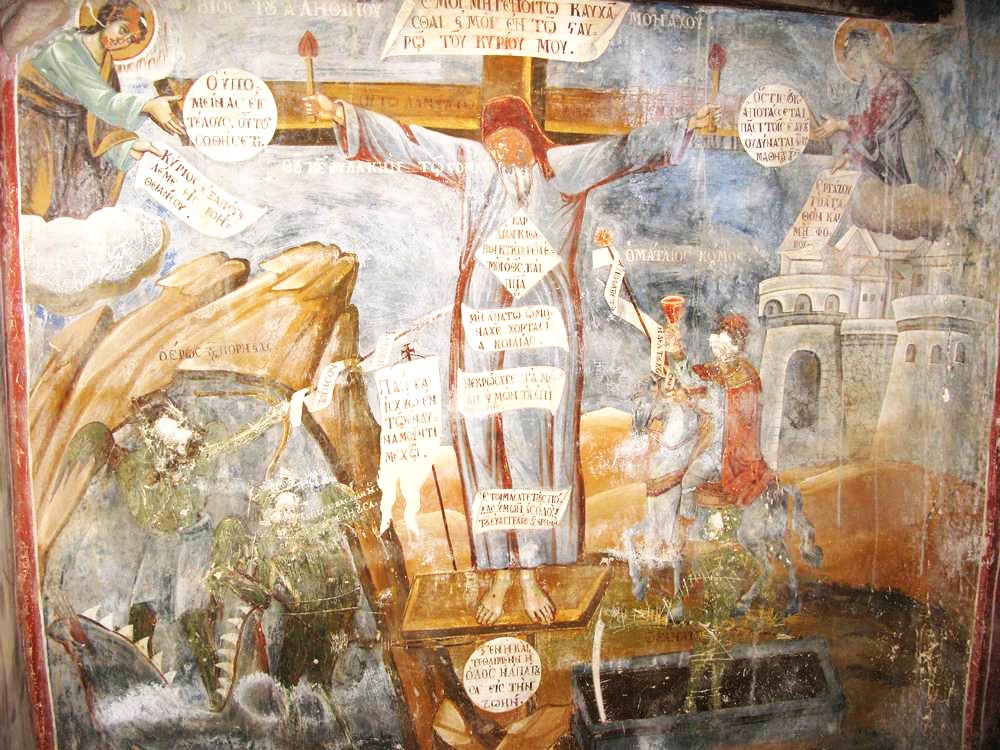
The image of the crucified monk is didactic: an icon for contemplation, not veneration. The subject of the icon is not a named Saint, but an unnamed, generic figure of a monk – or a nun if it is found in a female monastery. In its fullest form, the image looks as it does in the picture above from an Athonite fresco. Initially quite confusing, the image is replete with inscriptions which fully explain what is going on, and the only barrier to understanding is not being able to read the language of these inscriptions.
I can give no better explanation of the icon than to reproduce an extract from the The “Painter’s Manual” of Dionysius of Fourna, an 18th century Greek text for iconographers:
Draw a monk crucified on a cross, clothed in a tunic and a monk’s hat, barefoot and with his feet nailed to the footrest of the cross; his eyes are closed and his mouth shut. Just above his head is this inscription: “Set a watch, O Lord, before my mouth; keep the door of my lips”.
In his hands he holds lighted candles, and next to the candles is this inscription: “Let your light so shine before men, that they may see your good works, and glorify your Father, which [is in heaven]“.
On his chest he has a tablet like a hassock, which says: “Create in me a clean heart, O God, and renew a right spirit within me.”
On his stomach is another scroll, like a title, with these words: “Do not be led astray, O monk, by a full belly.”
Lower down on his body is another scroll which says: “Mortify your members which are upon the earth.”
Lower down again, below his knees, is another scroll which says: “Prepare your feet in the way of the Gospel of peace.”
Above, in the top arm of the cross, make a title nailed on with this inscription: “God forbid that I should glory, save in the cross of my Lord.” On the three arms of the cross make seals, and in the right one write this: “He that endures to the end shall be saved.” In the left-hand one: “He who does not renounce everything is not able to be a disciple of Christ.” On the seal above the footrest of the cross: “Strait and narrow is the way that leadeth unto life.”
To the right side of the cross paint a dark cavern with a big dragon in it coiled up, and write: “The all-devouring Hell.” Over the mouth of the dragon is a naked young man with his eyes bound by a cloth, he holds a bow and shoots at the monk. On his bow is a scroll which says: “Maker of lust.” Write this inscription above him: “The love of harlotry.” Above the cave put many snakes and write: “The cares.” Near to Hades put a devil dragging at the cross with a rope and saying: “The flesh is weak and cannot resist.” At the right-hand end of the footrest put a spear with a cross and a flag and write on it: “I can do all things through Christ Who strengthens me.”
To the left of the cross make a tower with a door, out of which comes a man sitting on a white horse, wearing a fur hat and robes woven with gold and trimmed with fur. In his right hand he holds a cup full of wine and in his left a lance on the end of which is a sponge; a scroll is wrapped around the lance which says: “Take delight in the pleasures of the world.” He shows them to the monk. Write this inscription above him: “The vainglorious world.” Below him put a grave out of which Death is coming holding a large scythe on his shoulder and an hour-glass in his hand, and looking at the monk. Above him is the inscription: “Death and the grave.”
Below the hands of the monk on either side put two angels holding scrolls; write on the scroll of that on the right: “The Lord has sent me to help you.” And on that on the left: “Do good and fear not.”
Above the cross represent heaven with Christ in it, holding the Gospels on his breast open at the words: “Whosoever will follow me, let him deny himself, and take up his cross, and follow me.” In his right hand he holds a king’s crown, and in his left a crown [of flowers]. Below him to either side are two angels, looking at the monk and showing him to Christ, and holding between them a long scroll with these words: “Fight that you may receive the crown of righteousness, and the Lord will give you a crown of precious stones.”
Then write this title: The life of the true monk.

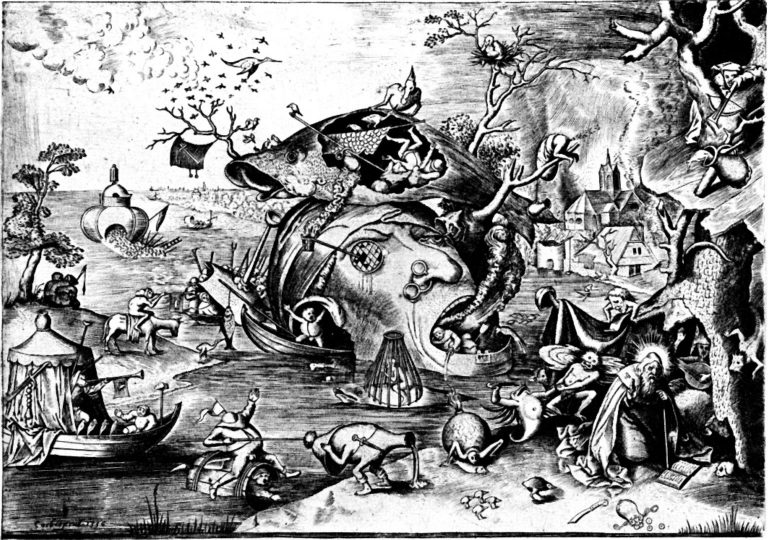
Some versions of this icon will be simplified, or will show demons surrounding the crucified monk firing arrows at him (see the first image of this post). The arrows and spears directed against the monk will be identified by inscriptions as various “passions” (vainglory, lust, gluttony etc). see The seven deadly sins
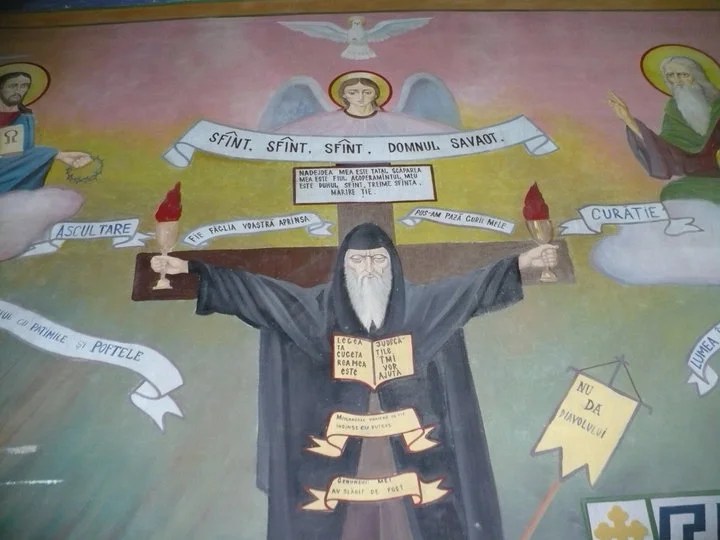
Romanian Fresco in Bucovina (modern-day Ukraine). The angel holds the inscription: “Holy, Holy, Holy Lord of Sabaoth”; the fresco also shows God the Father (right), the Son (left), and the Holy Spirit (dove at centre)
The image painted for monastics to contemplate and therefore properly belongs in a monastery. The “true life of a monk” is not necessarily the true, Christian, life for all of us. If we are not monks or nuns, we should not pretend to be so. Yet insofar as the monastic life is based in the Gospel and instructs all Christians on how to live a Christian life, the icon of the Crucified Monk can be useful. While ever “lay” Christians read monastic literature like “The Ladder of Divine Ascent”, retreat temporarily to monasteries, or in other ways draw on the monastic experience, they can also gain benefit from this icon.
Especially during Lent, when the life of all Christians becomes that little more ascetic, we can see the image of the “True Life of a Monk” as the image of the “True Life of a Christian”.

- The birth of Jesus in man
In Sufism, the four traditional forms (white, black, red and green) of this initiatory death represent the practices which aim to extinguish spiritual lusts as well as carnal concupiscences read here in French
The Green death: Death to the universe.
Death thus understood, death with regard to the universe, becomes, with the desire to enter the path, the first step of the itinerants towards God. In Sufi thought, it has four aspects: a white death, a black death, a red death and a green death.
The white death is hunger, which is akin to enlightenment. The black death is realized when the Sufi practices and succeeds in enduring the evils caused by men or even all evil in an absolute way, which is likely to sadden the self/ego which becomes darkened. The Red Death consists of subduing him, which ends up killing him.
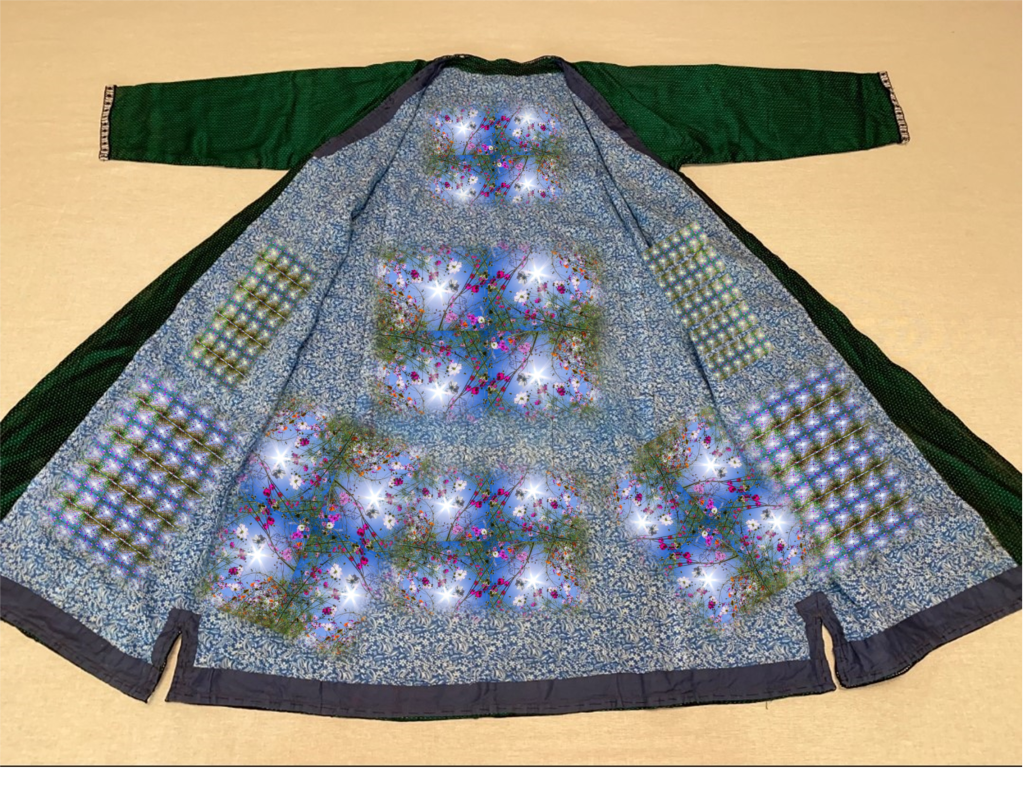
Finally, the green death consists of wearing the dress which becomes, by dint of being patched, variegated like the earth in spring.
Spiritual death here below is therefore the supreme privation. But, for Sufism, there exists, here below also, another death, this one eminently positive: death with regard to the universe, which is rebirth and which is access to the first home of the other. -of the. Such death results in life, it is itself life.
The words of Hallâj are eloquent in this regard:
“Kill me, my comrades, it is in my murder that my life lies! My death, it is to (over)live; and my life is to die!”
We change Reality by changing our Perception of it
There is much to be learn about Eternity by living in Time
There is much to be learn about Time by living in Eternity
Sheikh Nazim al Haqqani al Rabbani
Islam and the Transformative Power of Love
Before the modern-day obsession with social and political issues, the strand of learning often called Sufism played a major if not predominant role in all Muslim societies. What distinguishes Sufism from other approaches to the Islamic tradition is the fact that it considers the transformation of the soul the goal of human life, while looking at dogma, ritual, and law as means to this end, not ends in themselves. (Sufism is a problematic and controversial term, but probably more adequate than “mysticism” or “esotericism”, both of which carry too much baggage to apply in any more than superficial ways to the vastly diverse assortment of teachings and practices that are directed toward spiritual transformation in the Islamic tradition). In keeping with the worldview established by the Koran, Muslim scholars addressed three major issues: activity, understanding, and transformation.
Activity became the specialty of the jurists, the experts in the Shariah, who took it upon themselves to define right and wrong deeds. Understanding was the specialty of various schools of theology and philosophy, ranging from the dogmatic to the mystical and metaphysical. Transformation was the specialty of spiritual guides, many but not all of whom came to be called Sufis.
If we want to choose one word to designate the process and goal of transformation, we can not do better than “love.”
To explain why this is so, I will summarize the understanding of love as it was discussed from early times. Specifically, I want to look at two issues that run through all the discussions, namely the ontological and moral imperatives.
The ontological imperative means that all things love by nature.
The moral imperative means that human beings, by virtue of their own specific nature, must refine and perfect their love or suffer the consequences.
Any thinking that can be called Islamic grounds itself in tawhīd, the notion of unity. Briefly, tawhīd means that all reality is utterly contingent upon the one supreme reality, called God by theologians and the Necessary Being by philosophers. What imparts a specifically Islamic color to this universal notion is the idea that Muhammad was the last in a series of 124,000 prophets sent by God.
Strict attention to unity brings us face to face with the ontological imperative:
Everything is exactly what it must be, for all things are under the control of the One. Among the many Koranic proof texts cited in support of this imperative is the verse «His only command, when He desires a thing, is to say to it “Be!”, and it comes to be» (36: 82).
Theologians called this word “Be” the creative command (al-amr al-khalqī).It is eternal, which is to say that, from the human point of view, it is re-uttered at every moment. As a result, the universe and all things within it are constantly renewed. Read more here
Stupid that everyone in his case
Is praising his particular opinion!
If Islam means submission to God,
We all live and die in Islam.”
Goethe (West-East Divan)
Goethe, the “refugee” and his Message for our times
As Paul Kingsnorth in 50 Holy Wells say: “Who knows what the future holds? Not me. But as the chaos of the Void accelerates, a parallel spiritual longing deepens. We need truth. We need God. People still come to the wells to speak to Him. I can see, if only in my dreams, a future in which more and more people come looking here. A future in which the wells are still tended and the prayers grow in numbers, the well rounds revive and the sacred landscape of ancient Ireland begins to awaken from its slumber. A future in which we remember that all things are soaked in God. A future in which the lessons of the modern hermit St Joseph the Hesychast are remembered by us worldly Christians today:
God is everywhere. There is no place where He cannot be found. Within and without, above and below, wherever you turn all things cry out: “God.” We live and move in Him. We breathe God, we eat God, we clothe ourselves in God. All things praise and bless God. The whole creation cries out. All things, living or inanimate, speak with wonder and glorify the Creator.
Verily He is the One Who will revive the dead…
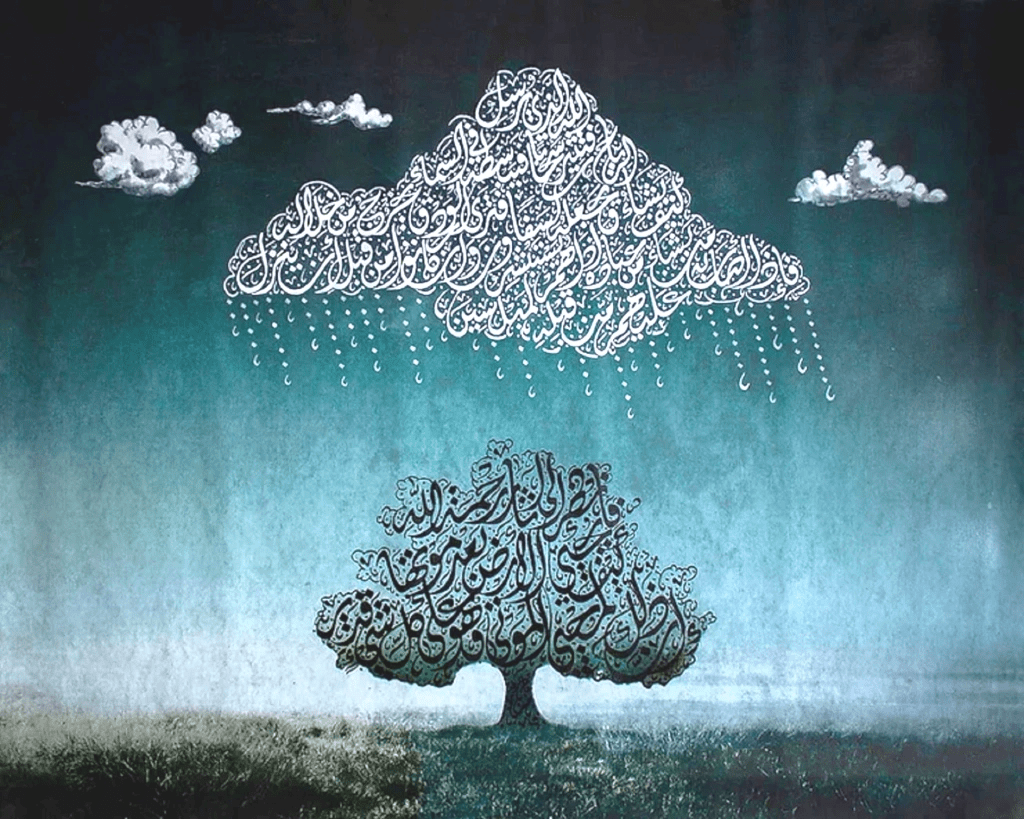
48- Allah is He Who sends the winds, so they raise clouds, and spread them along the sky as He wills, and then break them into fragments, until you see rain drops come forth from their midst! Then when He has made them fall on whom of His slaves as He will, lo! they rejoice!
49- And verily before that (rain), just before it was sent down upon them, they were in despair!
50- See, then, the tokens of Allah’s Mercy: how He revives the earth after it is dead. Verily He is the One Who will revive the dead. He has power over everything. see here
Rumi
Note:Sufism is different from monasticism. Sufism is based on Quran and Sunna. Allah says in Quran:
Then in the footsteps of these Messengers, We sent (other) Messengers and We sent ‘Isa, the son of Maryam (Jesus, the son of Mary) after them and gave him the Injil (the Gospel). And We created kindness and mercy in the hearts of those who were (the true) followers (of ‘Isa [Jesus]). And they themselves invented the innovation of monasticism. We did not prescribe it for them. But they (introduced this innovation of monasticism) merely to seek Allah’s pleasure. Then they could not practically keep and maintain that check which was its due (i.e., could not continue its spirit and discipline). So We paid those of them who believed (and continued the innovation of monasticism to seek the pleasure of Allah) their reward. And most of them (who left it and changed their ways) are disobedient. (57: 27)
In the aforementioned verse, word “Rahbaniya” (monasticism) is used which means fear. Rahbaniya means the religion of fear. It means that a person, due to fear (regardless of whether it is the fear of someone’s cruelty or the fear of his own weakness), flees from the worldly life and takes refuge in the forests and mountains.
Monasticism in Christianity
Monasticism is deeply rooted in Christianity. The Christian church did not adopt monasticism for about two centuries after Jesus. But it would not be wrong to say that the germs of monasticism were present in Christianity from the beginning. They considered asceticism and dervish life to be superior and preferable to married and business life. It was considered undesirable for those who performed religious services in the church to be married, have children and maintain a household. By the third century, monasticism had taken the form of a contagion and it started to spread around like a pandemic.
The main reason for the popularity of monasticism in the ancient polytheistic Christian society was moral depravity, lasciviousness and worldliness. In order to break this growing wickedness, the Christian Church preferred intensity and extremism instead of adopting the path of moderation and imposed a way of life in which worldly relationships, marriage, wife and children, business, even drinking and eating was reduced to bear minimum. Some of the things that Christian ascetics used to adopt included:
- Torture one’s body
- Staying dirty, avoiding cleanliness and water
- Prohibiting marriage
- Severing ties with relatives
- Going against human nature
- Sectarianism
Due to sectarianism, many sects and groups started to arise in the Christian community. All these sects had strong differences and hatred towards other sects. By the fourth century, around 90 sects had born in Christianity. A brief history of some of Christian priests is described here:
Incidents of Christian Ascetics
St. Macarius used to carry a weight of 80lbs at all times. For 6 months he slept in a swamp and poisonous flies kept biting his body. It is written about a group of 130 nuns that they never washed their feet. Taking shower was like death for them.
St. Vitus was the father of two children. When he became an ascetic, his wife wept, but he separated from her. According to St. Jerome, severing marital relations was the foremost duty of a Christian ascetic. The darkest reality of Christian monasticism was that it separated blood relations. According to the priests, it was a sin to have soft feelings for blood relations. St. Jerome says about it, “If your nephew puts his arms around your neck and clings to you, if your mother tries to stop you, if your father lies down in front of you to stop you, even then, leave everything behind, run towards the flag of the cross without shedding a single tear. On this path, ruthlessness is piety.
St. Simeon Stylites spent 27 years away from his parents. His father died from the shock of separation. When his mother found out about him, she went to see him but he refused to meet her. For three days and three nights she kept waiting there and finally she died lying there.
The religion that goes against human nature, nature takes its revenge. The Christian religion is a prime example of this.
What is Renunciation of World in Sufism?
Mostly people incorrectly portray the concept of ‘Tark-e-Dunia’ (renunciation of world) in Sufism and try to link it with monasticism. Thus, diverting people from Sufism. Sultan ul Ashiqeen Sultan Muhammad Najib ur Rehman says in his book Sufism – The Soul of Islam:
“The critics and deniers of Sufism heavily scandalised the term ‘renunciation’ and labelled it as monasticism and un-Islamic. In fact, the term renunciation has never been understood in its true sense. According to the philosophy of Sufism, renunciation means renouncing the lust of worldly pleasures inwardly.”
Daata Ganj Bakhsh Ali ibn Usman al-Hajveri says:
The more a man gets fed up with the world, the stronger becomes his relation with Allah. It does not mean that he must leave his home and family to start living in a jungle. Rather, it means that he should remove the love of the world from the inward. Live in the world but do not become worldly. It is the very excellence of Sufism, not to be drenched while remaining in the river. This is not courageous to avoid going near a river and keep boasting about not getting wet. To the Sufis, renunciation of the world is in fact spiritual rather than physical. The excellence is to live physically among the creation being spiritually away from it. (Kashf-ul-Mahjub)
Sultan ul Faqr VI Sultan Muhammad Asghar Ali says:
Live in the world like a boat floats on water. Consider the boat as your esoteric self and the water as the world. The boat is safe until the water enters it. When water enters the boat, it definitely sinks. You are like a boat and the water is like the world. Save yourself from the world and its love.
If you have wealth but you do not foster love for it and spend it generously for the sake of Allah, it is not worldliness. However, if you make worldly things your priority then all these things would become worldliness. Thus, evade yourself from the appetite of material things while living in this world, just as a wild duck lives in water but does not drown. Get your destiny from the world like a crane who while living on a riverside gets livelihood from it but does not drown.
Do your business of the world but for the sake of Allah; eat from your livelihood but for the sake of Allah and move in the world but again for Allah. I do not suggest alienate yourself from the world but you must continue to remember Allah while doing everything. Your inward should be attentive towards Him while your hands are busy in the worldly affairs. (Sultan-ul-Faqr VI Sultan Mohammad Asghar Ali-Life and Teachings)
Sufism Discourages Monastic Life
Monasticism means to leave the worldly life in a way that you go to jungle or in isolation, away from the people. Whereas, Islam is the religion which is complete and perfect way of life because it satisfies all the needs and aspects of life. It gives perfect guidance to every individual and social affair.
Islam teaches rights of Allah as well as the rights of human beings. That is the reason there is no concept of things like monasticism in Islam.
The life of our Prophet (pbuh) is perfect example and guide for us. He used to remain intensely engaged in spreading the message of Islam and at the same time he gave lessons on excellent and fruitful ways of spending our worldly life whether it’s individual or collective.
Cutting ties with worldly means is against the nature. The essence of renouncing the world is to fulfil the worldly responsibilities and duties whilst keeping one’s inward enlightened with the remembrance of Allah. This is what renunciation of world means according to Sufism. Allah says in Quran:
The life of this world is nothing but sport and pastime and the Home of the Hereafter is the only (true) life. Would that they knew (this secret)! (29: 64)
The Holy Prophet (pbuh) also declared the love of the world a danger for faith. He said “The love of this world is the root of all evil”. (Ibn Majah 4112)
The System of Khanqah in Sufism
(Khanqah is the Arabized form of the Persian compound noun “Khan-gah” made up of two parts of “khana” (house) and “gah” (place). The term “khanqah” means a house where Sufis, dervishes and shaykhs live and worship. Khanqah is also called “sawmi’a”, “ibadatgah”, “ribat”, “tikiya”, “zawiya”, “qalandar”, “dergahg”,”langar”, “duwayra” and “jama’at khana”. Also, the name of some villages in Iran is Khanqah.
Residing in Khanqah for training has some commonality between Islam and Christian monasticism. However, they are fundamentally different to each other. The key difference is that in Christian monasticism, people who reside in a Khanqah sever all kinds of family ties and worldly affairs. Whereas the Sufi Khanqah which flourishes under the supervision of a perfect spiritual guide does not teach the seekers to leave worldly life. Instead, they are inculcated to renounce the world inwardly whilst discharging their worldly duties and responsibilities. And this is accomplished under the supervision of a perfect spiritual guide. By the blessings of his spiritual sight and esoteric attention, the spiritual guide, cleanses the spiritual self of sincere seekers.
By gaining closeness to the perfect spiritual guide, his blessings and favour, his inspired knowledge (ilm-e-Ludduni), the seeker gains freedom from attachments, love of this world and its lusts. There is no room for heresy, monasticism or anything that goes against Sharia in a Sufi Khanqah. The importance of Khanqah is proven from Quran. The Holy Prophet (pbuh) laid the foundation of the system of Khanqah from the platform of al-Suffa. Allah says in Quran:
(O Beloved Prophet!) Stay tenaciously in the companionship of those who remember their Lord morning and evening, ardently seeking His pleasure. (18: 28)
Companions of al-Suffah
Shaikh Shihab al-Din Suhrawardi writes in his renowned work Auarif-Al-Ma’araf:
The Companions of al-Suffah have a special place in Islam who stayed and got trained at the platform of al-Suffah. For them, this was their first school, where faith (Iman) was entered into their inwards and Islam spread in the whole world.

The rank of Companions of al-Suffah is so exalted that Allah mentioned them in Quran. Prophet Mohammad (pbuh) gave them glad tidings. He said: “O Ashab al-Suffah, glad tidings to you that those of you who remain steadfast on these qualities that you have adopted here and would remain content on this state, would be raised and remain closest to me on the day of Judgement (Auarif-Al-Ma’araf).
Khanqah is the only place where people of same point of view and thoughts live and remember Allah. They don’t become oblivious to remembrance of Allah even for a moment. They live there day and night. Whilst residing there, they fulfill the tasks and duties assigned to them by their spiritual guide which in turn cleanses their inwards. By being in Khanqah it is not at all meant that the seeker will turn away from his duties towards his mother, father, sisters and brothers nor will he become negligent towards the family. Rather, Khanqah teaches beautiful way of life of Islam and the golden rules which when seeker applies to his life will succeed in both the worlds.
Khanqahs in Sufism are according to Mohammadan Sharia
Following the Sunna of Prophet Mohammad (pbuh), the perfect Fakirs in every era established Khanqah for enlightening the souls of the seekers of Allah.
Here, the seekers of Allah get their inwards cleansed and enlightened under the spiritual guidance of the spiritual guide. Their (inner) self progresses from an-nafs al-ʾammārah (inciting self) to an-nafs al-muṭmaʾinnah (self at peace). By remaining in blessed company of our Perfect Spiritual Guide, the seeker’s inner (self) and outward being is enlightened with Divine light.

Monasticism in Islam
There is no concept of monasticism in Islam as the Holy Prophet (pbuh) said in a hadith:
There is no monasticism in Islam.
In another hadith, the Holy Prophet (pbuh) emphasised that Islam prefers Jihad over monasticism.
Abu Saeed al-Khudri (r.a) narrates that a man came to me and asked for advice. I said: I had asked the Holy Prophet (pbuh) the same question and he said, “I advise you to fear Allah Almighty because this is the foundation of everything. Hold Jihad firmly since it is the monasticism of Islam. And remember Allah and recite Quran. Since it is the source of blessings in the sky and the remembrance for you on the earth. (Masnad Ahmad bin Hambal: 8982)
We can infer from the aforementioned hadith that monasticism in Islam means Jihad in the way of Allah and the best Jihad is ‘Jihad with one’s self’ i.e. training and purifying one’s inward. In order to achieve this goal, sitting in company of a perfect spiritual guide became permissible for the seekers in Khanqah because the main purpose of the Khanqah is to purge seekers’ inciting self.
In the end, we mention this beautiful saying of Ghawth al-Azam Shaikh Abdul Qadir Jilani:
“O servant of Allah! Adopt the company of Saints, because their glory is that when they look and pay attention to someone, they revive and enlighten their inward. Whether that person is a Jew, Christian or worshiper of fire.” (Al-Fath Al-Rabbani)
You are invited to adopt the company of the perfect spiritual guide of this age. So that you may purify your soul, attain the closeness and gnosis of Divine Essence and presence in Mohammadan Assembly which is real success in this world and hereafter.
What is the difference between Sufism and Monasticism?
The main difference between Sufism and monasticism is that in monasticism the monks sever their ties with blood relations. They stop all kinds of engagements with worldly life such as business, family etc. and subject their bodies to torturous endeavours.
Whereas in Sufism, the perfect spiritual guide trains the seekers to remove the world and its desires from their inward whilst still living a normal life. They discharge their duties as a son, father, husband etc. but inwardly they remain attached to Allah Almighty every moment. The source of guidance and example to follow is the life of Prophet Mohammad (pbuh) in Sufism.
– Questions to Mawlana Shaykh Nazim
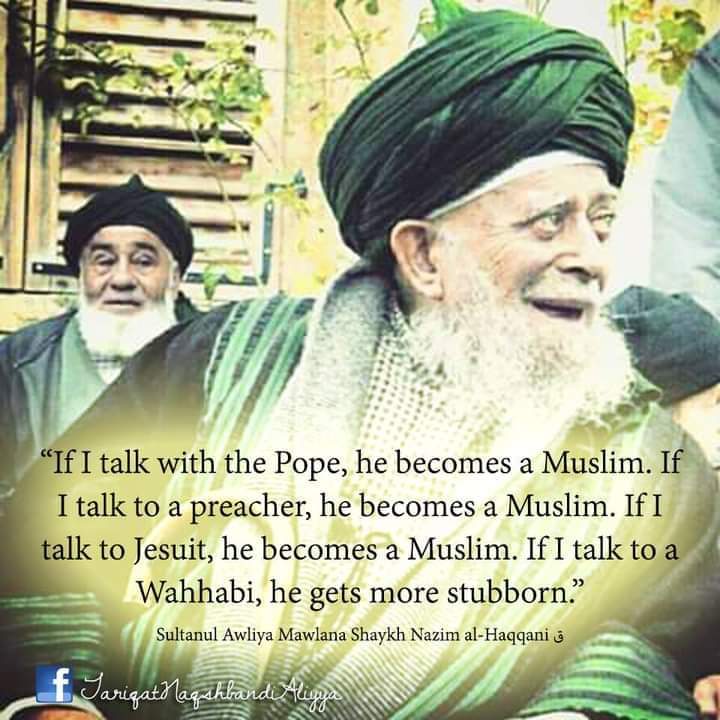
Sultanul Awliya as-Sayyid Mawlana Shaykh Muhammad Nazim ‘Adil Al-Haqqani An-Naqshbandi ق sohbat, 14 December 1994
GUEST: Mawlana I see that among our brothers, there are some foreign people. There is for sure a wisdom in opening your arms to these people. How come? How do you win a non-Muslim person? How are they honoured with Islam?
MAWLANA: Are they not Allah’s servants? I don’t collect them from the moon and stars. They are the people of the Earth. They are servants of Allah. Not people of the heavens. If you don’t appreciate Islam, Allah makes the Europeans to appreciate it. He takes out the sword and disciplines you. They will teach you Islam. The manifestation is on them now. There is a hadith: “The sun will rise from the West.” Its meaning is authentic. No need to translate it but if we translate it, it is a sign that Islam’s sun will rise from the West again. These are the new seeds of Islam blooming in Europe. They will come here in waves. They will insult people, who insult Islam here. Guidance is from Allah, not from us. We are a means.
GUEST: I asked because in other jamaats, among the brothers, the followers, I had never seen foreigners. Is it that you have an exceptional quality? How is it?
MAWLANA: It doesn’t belong to me, Allah gave me that quality. If I talk with the Pope, he becomes a Muslim. If I talk to a preacher, he becomes a Muslim. If I talk to Jesuit, he becomes a Muslim. If I talk to a Wahhabi, he gets more stubborn. I can’t communicate with arrogant Muslims. I can’t make them leave their arrogance. But these people (non-muslims) are inclined to Haqq (Truth). When you talk about Haqq their conscience immediately runs to accept it. It is not difficult. There is nothing easier than making them Muslim.
People who come to Europe for inviting (to Islam), either from here or other Muslim countries, they are arrogant. So these people don’t listen to them. If you approach these people humbly, respectfully, with love they give their lives for you. They too are Allah’s servants. He isn’t an ordinary man, he is a professor. This man is a German professor, doctor. A gentleman. He has high education. Jamaladdin also. Each one of them is a university graduate. They have professions. They aren’t ordinary people. We can’t deceive them and draw them to religion. No!
GUEST: Mawlana, there are various jamaats in Turkey. What do you advise the followers? What is your view on them?
MAWLANA: I’m tired of this variety. This variety is like partly cloudy. Each cloud is loaded with blessing. Divine order doesn’t let them rain. When they unite, blessing descends. I have no other advice. They should leave these names, unite under the name of the everlasting empire that their ancestors established. Our ancestors the Ottomans united all the Muslim nations under one identity. They succeeded in uniting them. Unfortunately now, there are Arabs, Saudis, Jordanians, Syrians, Iraqis, Yemenis, Egyptians, Sudanese, Tunisians, Algerians, Moroccans. All sorts. Even the Arabs can’t own their identities. They can’t say we are the Muslim Arabs. They are divided under fake names, titles. That’s why they have no value.
GUEST: By the way, Mawlana some people are busy preparing. Very busy preparing, as you may well know.
MAWLANA: Is it yellow fever?
GUEST: New year is coming. They celebrate the birth of ‘Isa ‘alaihi salam. They mark it as the first year and they celebrate the new year. What do you think about New Year?
MAWLANA: There is nothing to think. What can you expect from a community forced in this direction for 70 years? Expect them to approve the integrity of our Prophet’s ﷺ birthday? For 70 years, they say it is brain washing, not brain washing but brain spoiling. Each suggestion made makes people away from Islam, meaning, spoils their brains instead of washing their brains. Unfortunately their brains are spoiled with Christmas for over 70 years.
Let alone being religious, there is no religious tradition left. Now they adopted these Christian traditions. Tradition, new tradition. They intend to continue it. Headache. It is certainly unacceptable. “I celebrate it at home.” Don’t. “I eat chicken instead of turkey.” Don’t eat turkey either. Eat bread and olives that night. At least if we look at it from a religious perspective, when his mother gave birth to ‘Isa ‘alaihi salam she became hungry. With Allah’s order she shook the branch of the date tree and the dates fell down. At least if they put dates on their tables it would be consistent with the Holy Quran. They can calculate it and if it is ‘Isa’s ‘alaihi salam birthday, they can eat dates. I’m not saying that they should do this, but if they did it might be accepted.
We, Muslims don’t believe in the correctness of the day that Christians claim is the birthday of ‘Isa ‘alaihi salam. It is absolutely incorrect. That isn’t the day. But Christians have made this religion fake. It is a religion of showing off. They haven’t left anything related to reality so we can say, do this, do that. No need. Because the Saudis, whom you assume to be practicing sharia, reject the celebration of our Prophet’s ﷺ birthday. It is prohibited by the Saudis. So many ignorant ones, with titles of ‘Doctor’ are educated by Saudis.
They also reject the Mawlid. They prohibit the Mawlid-i Sharif reciting in the month of Mawlid. They say it is prohibited, bid’a (innovation), etc. They are the ones making bid’a. For this reason within this year this yellow fever won’t leave them. But this yellow fever makes them uncomfortable. These people busy with New Year preparations, should be ready for yellow fever within that year, that they call ‘New Year’.
Look also 99 Sohbets of Maulana Sheikh Nazim Adil al Haqqani ar Rabbani

“Love is beautiful for our Lord and His servants. Do everything with love, it must be accepted by your lord and he will do it with pleasure. Allah says; I don’t need your worship, I only seek the Love with which it is offered. Now we are trying to do all the practices but forgetting to ask for Divine Love, so we are becoming like robots, or like doing gymnastics.
If our worship makes the love for Allah grow in our hearts, then we should keep that practice and continue.”
~ Sultan-ul-Awliya Mawlana Shaykh Nazim
 Path to the Maypole of Wisdom