Saudi Arabia is well-known for its dry and hot deserts. World is shocked as holy cities turn green after immense rainfall.
Cities of Jeddah, Makkah and Madinah showed greenery in several dry regions according to reports issued by Terra Satellite image on January 7. Internet users admitted that they were frightened amidst heavy rainfall that greenery might appear.
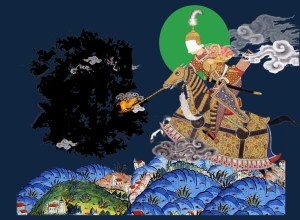
Its February and still the images and videos are circulating on internet comparing both arid and green regions in frame and discussing that Muhammad’s prophecy might actually be true. Many Muslims around the globe confessed that prophecy has been fulfilled and Judgement Day is nearer than we can imagine. Around 1400 years ago, Prophet Muhammad (SAW) narrated:
“The Final Hour will not come before wealth becomes abundant and overflowing so much so that a person takes Zakat out of his property and will not be able to find anyone to accept it from him and till the land of Arabia reverts into meadows and rivers.” (Sahih Muslim-157c)
Saudi desert turned green after thousands of years making prophecy true
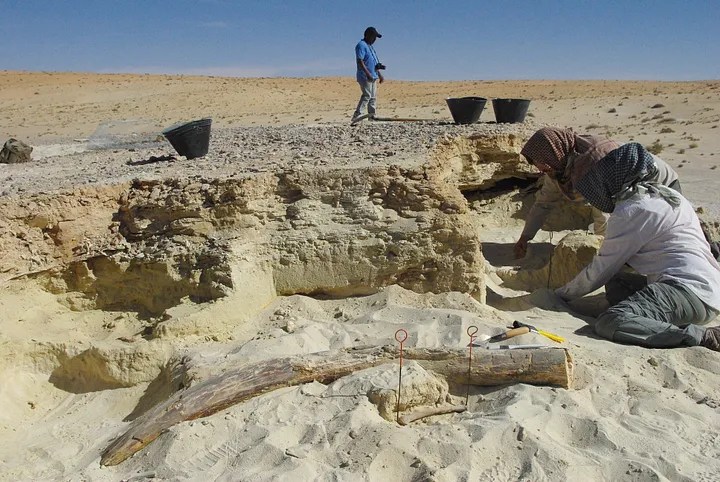
This Hadith is mentioned in the second most authentic collection of Prophet’s sayings. The word “revert” implies that these holy cities were once filled with greenery and vegetation. Archeologists discovered fossils like elephant’s tusks decade ago which confirmed that gigantic creatures existed in this land thousands of years ago and could not have survived if Saudi Arabia wasn’t a wetland.
325000-year-old Elephant tusk discovered in Nafud desert
Pilgrims in Makkah were shocked to see greenery in holy cities and were not pleased as they have faith that the Last hour is nearer.
Saudi Green Initiative is also in gear which will result in vegetation and plantation leading to Green Saudi Arabia by 2030. In order to restore natural greenery, 17 new initiatives are launched and 18 million trees have already been planted.
If you see, one part of hadith is yet to come true-Rivers. There are still no permanent rivers in Saudi Arabia however there are valleys. Immense rainfall just like recent one can also give rise to rivers once again as geologists confirmed the climate change might be one of the reasons.
A greener future and better quality of life:
Achieving a green future is a global imperative. Saudi Arabia aspires to enhance quality of life and safeguard future generations at home and beyond its borders. Working toward this goal, the Kingdom is bringing together government ministries, private sector entities and foreign leaders under dual green initiatives, to identify and deliver on opportunities to rapidly scale climate action. Saudi & Middle East Green Initiatives
Learn how Saudi Arabia is turning its deserts into green oasis using new technology and sustainable practices. From forests to farmlands, see how these projects are changing the landscape.
Neom promises a sustainable future, but at what cost? Discover the hidden truths of forced displacements, worker deaths, and human rights violations behind Saudi Arabia’s Vision 2030. Is this futuristic city worth the human and ethical price?
Saudi Arabia’s NEOM: Dream in the Sand:
Saudi Arabia wants to become a major player in the global tourism game. Massive amounts of money have been invested, among other controversial megaprojects, in Trojena, a ski resort smack dab in the desert where it practically never snows. These grandiose projects are raising eyebrows due to their human and environmental price tags. We attempted to get into Trojena, the site in the middle of nowhere designated by the country to host the Asian Winter Games in four years’ time Neom: What’s the green truth behind a planned eco-city in the Saudi desert?
Saudi Arabia To Host 2029 Asian Winter Games In NEOM’s Trojena
NEOM 2025 UPDATE: The Line or The Lie :
Neom – The Line – The Rise and Fall of Saudi Arabia’s Linear City.
Dr. William Stoddart has written over the years several books and many articles dealing with religion, spirituality, philosophy, and the modern world. No less important, he has also kept up a constant and voluminous correspondence about these same subjects with many people from many countries. The standpoint from which Stoddart writes is that of the perennial philosophy or sophia perennis, whose main exponents in the last century were René Guénon, Ananda Coomaraswamy, Titus Burckhardt and, towering above them all, Frithjof Schuon. An idea as to what the perennial philosophy is, the reader will acquire, precisely, by reading this book. Stoddart has devoted all his life to understanding this philosophy, and to living in accordance with it. It is certainly as a result of this that, in his writings-books, essays, and letters-we find three very important characteristics: precision, simplicity, and essentiality. Precision, one has to say, because Stoddart understands. He does not write about what he does not know, or knows only partially or superficially. He is not “discussing ideas”, but expounding truths, be they concepts or facts. He knows that imprecision is contrary to Truth. Simplicity, because he writes to help others to learn, and he knows-both in principle and from experience-that simplicity is the key to learning. He knows also that Truth is simple. Essentiality, because he realizes that, to really understand religion, spirituality, and the perennial philosophy -and, on this basis, to understand the errors of the modern world- it is necessary to go to the essence of things, and not let oneself be dispersed in their multiple manifestations. He knows that it is always in the essential that we can find the true. In this book, the reader will be sure to find the same characteristics. In a precise, simple, and essential way, it will help him to remember the most important truth -those which uncover the highest, and at the same time, the deepest meaning of man- and to apply them to the many aspects of human life. Read Here
While the crisis of modernity has progressively escalated into a global meltdown and the masses are besieged by—the tyranny of mindless distractions, obsessive consumption of unnecessary goods, the insatiable thirst for unrestrained quantity, exploitation by illogical mechanisms of fear, the assault by hostile economic policies devised by the corporate hegemony virtually bloodletting the populace, the endless perpetuation of the war machine, the ever quickening of time, and the collapsing ecosystems of planet earth to name only a few—these are none other than reflections of the inner disarray, if not an utter eclipse of the human microcosm itself.
One wonders where the regulatory agencies of today are to be found in this late hour and who would be the appropriate authority to be contacted regarding the imploding world that appears to be on an inescapable trajectory of self-destruction for it is not a simple question to answer and rightfully deserves considerable reflection. The struggle for physical survival palpably includes the psychological but there appears to be very little response to the ruptured spiritual compass from which all these compounding crises derive.
Regrettably and sadly in our times, if we look in the mirror, we can see an image of a totally disturbed, disrupted and disconnected human being who has forgot all his past and denied it consequently. He forgets his Soul and prepares unconsciously and inevitably the end of times or end of a World .
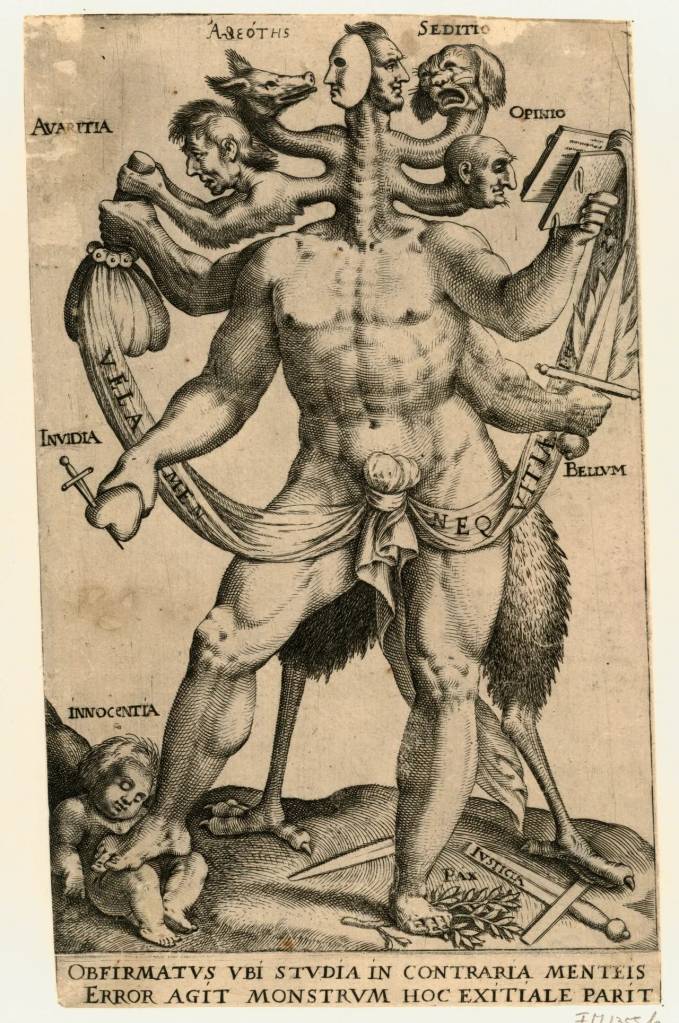
Mirror of moder man: The drawing shows the five-headed and four-legged monster. This monster has the heads of Avarice (Avaritia), Stupidity (Stupiditas), Deceit (Fraus), Sedition (Seditio) and Opinion (Opinio). In his hands, he bears attributes of Envy (Invidia) and War (Bellum). Under his feet, he tramples the Innocence and Peace (Pax) and Justice (Justitia). With inscriptions in Dutch and Latin. (1616)
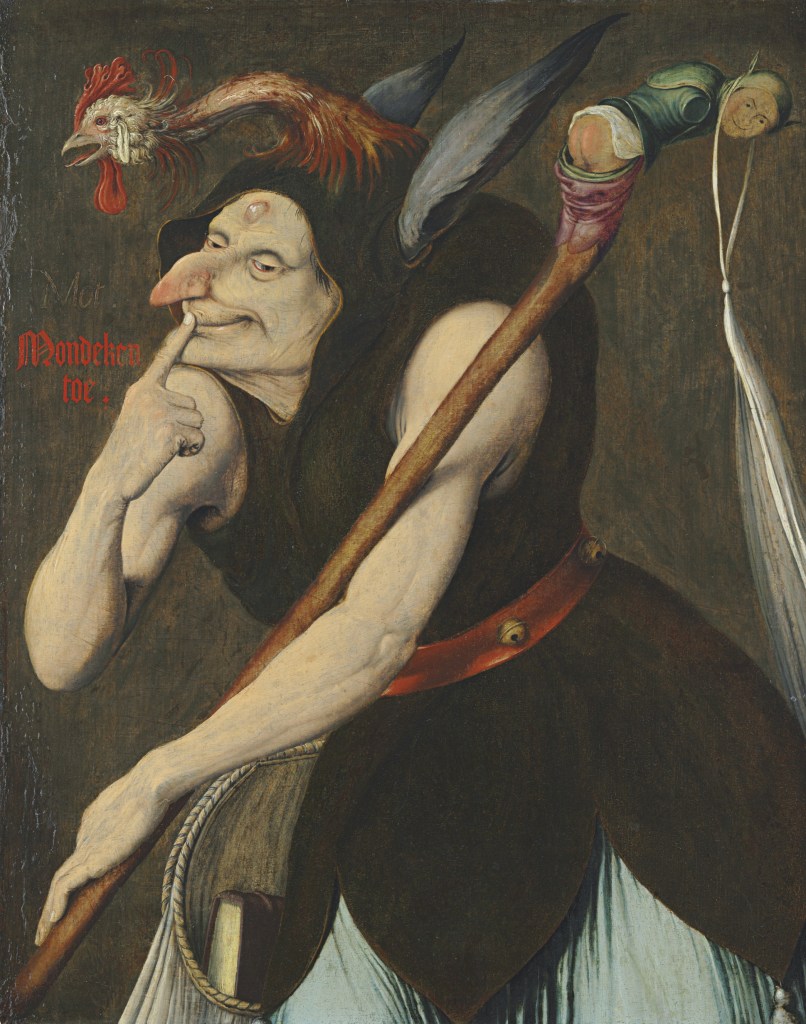
Erasmus: In Praise of Folly …. Keep your month Shut
“Despite everything, there are still present, even in the [postmodern] West, men who, by their ‘interior constitution’, are not ‘modern [or postmodern] men’ but who are instead able to understand what the tradition essentially is and who do not agree to consider lay error as a fait accompli; it is only to such men that we have always wanted to turn.” – René Guénon
While the crisis of modernity has progressively escalated into a global meltdown and the masses are besieged by—the tyranny of mindless distractions, obsessive consumption of unnecessary goods, the insatiable thirst for unrestrained quantity, exploitation by illogical mechanisms of fear, the assault by hostile economic policies devised by the corporate hegemony virtually bloodletting the populace, the endless perpetuation of the war machine, the ever quickening of time, and the collapsing ecosystems of planet earth to name only a few—these are none other than reflections of the inner disarray, if not an utter eclipse of the human microcosm itself. One wonders where the regulatory agencies of today are to be found in this late hour and who would be the appropriate authority to be contacted regarding the imploding world that appears to be on an inescapable trajectory of self-destruction for it is not a simple question to answer and rightfully deserves considerable reflection. The struggle for physical survival palpably includes the psychological but there appears to be very little response to the ruptured spiritual compass from which all these compounding crises derive.
For those who are familiar with the works of the Traditionalist or Perennialist authors, principally the French philosopher René Guénon (1886-1951), the answer to this question is tangible yet no less consoling, for the prognosis is that we are living at the end of a temporal cycle known as the Kali-Yuga or Dark Age. This diagnosis, while often contextualized within the—Hindu tradition also known as the sanātana dharma—primordial, eternal code of conduct disclosed at the conception of this temporal cycle culminates in its equivalent expression al-hikmat al-khalidah or din al-qayimah within the Islamic tradition, the last revealed sapiential tradition of this cycle. One could suggest that René Guénon, functioned as such a regulator however not in the conventional sense as he was indefatigably monitoring and illuminating single,handedly one might add, in an unparalleled fashion the most neglected conspiracy of all—the spiritual crisis of modern man.
Shaykh ‘Abd al-Wahid Pallavicini, born in 1926 in Milan, Italy, as a young seeker was moved by Guénon’s oeuvre, and although he perceived the importance of theory he also perceived its indispensable and corresponding practice of an authentic spiritual form. This work discloses the serendipitous events that led Shaykh Pallavicini to embrace Islam which incidentally took place on January 7th, 1951, when he was twenty-five years old and was given the name ‘Abd al-Wahid, “servant of the One”. Shortly after, Shaykh Pallavicini learned that Guénon had passed away in Cairo on the same day, this event served as an omen indicating that he needed to carry on this vital work.
For the next twenty years Shaykh Pallavicini lived and traveled in the East and was in proximity to some of the most illumined masters of Islamic spirituality known during this generation. While he was initiated into the Alawiyah Sufi brotherhood, through a European branch that was in touch with René Guénon, he also received authorization to conduct an independent branch of Sufism—Ahmadiyyah Idrisiyyah Shadhiliyyah—in Europe and in the mid-eighties he founded the Center for Metaphysical Studies, the Comunità Religiosa Islamica or the Italian Islamic Religious Community (CO.RE.IS.). He is extensively engaged in interfaith dialogue with numerous representatives of diverse religious traditions and has also participated in many noteworthy projects in order to spread truthful information on authentic Islam.
Sparing no time and mincing no words Shaykh Pallavicini underscores the distinct challenges of living one’s spiritual tradition in the contemporary era: “[W]e do not reject life or the world in itself, but instead denounce the parts of the modern [and by extension postmodern] world that are anti-traditional and thus inhibit our spiritual development.” While this book is presented within the context of his own spiritual tradition, that of Islam and its inner dimension known as Sufism (tasawwuf), he never deviates his attention from the integral metaphysics of the—Primordial Tradition—the source from which all authentic traditions originate in divinis. The inner dimension, what is often referred to as the Heart of Islam, has a unique eschatological implication for seekers in this era, when understood in light of the Primordial Tradition: “Sufism, the living initiatory expression of the last revealed tradition, Islam.” Shaykh Pallavicini explains that if men and women were closer to the Primordial Tradition, as was the case in earlier ages, most evident in the Krita-Yuga or Satya-Yuga known as the Golden Age in Western cosmology, there would be no need for the exoteric or the outer dimension of religion. Due to the extreme level of decadency in the contemporary psyche—the lost sense of transcendence—one needs the outer dimension of religion to realign with the sacred if the esoteric dimension is to be sought. Clearly, there is no Zen without Buddhism, and although the inner or esoteric dimension of every religion necessarily has affinities with those of other religions, there is also no Yoga without Hinduism, no Kabbalism without Judaism, or Sufism without Islam, nor is there true Hesychasm (the last surviving form of Christian esoterism) outside the Orthodox Church.
While Shaykh Pallavicini, like Guénon, acknowledges the universality of all authentic spiritual revelations, he astutely illuminates the essential unanimity of the three Abrahamic traditions: “‘monotheism’ should not have a different meaning than that of ‘universality,’” which etymologically refers ‘to the One,’ the one God of Abraham.” He continues to express the common ground between the Abrahamic traditions: “Nothing in the shari‘ah (compilation of Islamic Law) could abrogate the Ten Commandments nor could the Commandments constitute an obstacle to spiritual fulfillment.” A very contentious subject that greatly needs elucidating is that of “conversion” and what this signifies when understood according to the Primordial Tradition, which has implications beyond the three Abrahamic faiths:
The perspective of some born Muslims, any conversion to Islam should imply a repudiation of Christian beliefs. Their repudiation, in the best cases, denies Christianity’s validity in its esoteric and exoteric forms because of its pre-Islamic origin, despite the completely opposing statements of the Qur’an itself.
While monotheism intrinsically reveals universalism and universalism essentially discloses monotheism, both ipso facto are derivatives of orthodoxy and orthodoxy is none other than doctrinal purity which provides discernment and illuminates the path in order to prevent deviation. The importance of authentic or orthodox doctrine at the core of the Primordial Tradition for present-day seekers is its ability to cut through and recognize the radical errors of New Age pseudo-spirituality. This is what Guénon termed “counter-tradition” the ill-fated succession of “anti-tradition”, and it also applies to particular trends in interfaith dialogue that all too often endorse syncretism or a mixture of traditional forms which gravely distort the understanding of both the outer and inner dimensions of religion:
It is very important to understand that the right metaphysical Path, and the primordial Tradition that constitutes its formally revealed expression, are not to be looked for in a hypothetical essence, nor in an even more hypothetical “quintessence” located somewhere above the revealed religions. There is not a “transcendent unity” of religions that can be extracted, or abstracted, from forms. There does not exist an “eternal wisdom,” or a sophia perennis, independent of the messages of the Prophets that would be sufficient to study in these so-called “post-Prophetic” times in order to inherit knowledge.
The book—A Sufi Master’s Message—pays homage to one of the great luminaries of the XXth century René Guénon who played a providential role in resuscitating the integral metaphysics of the Primordial Tradition for contemporary seekers. While some might argue that Guénon’s mission to establish an “intellectual elite” to thwart the spiritual crisis in the modern and now postmodern world has failed, to the contrary this work is a living demonstration that the intellectual elite has taken root in the West and is diligently working to confront the militantly anti-spiritual forces that have been systematically unleashed into the current era.
Paradoxically, the good news is that the dissolution of the present world can be slowed down by the presence of integral spirituality which this work reaffirms and acts as a rich well for sincere seekers to drink from—the waters of the Primordial Tradition, the tributary from where all sapiential traditions derive. In closing, the significance of this much needed work of Shaykh Pallavicini dedicated to the remarkable figure of René Guénon could be summarized per the memorable saying of Prophet Muhammad: “God will not withdraw all knowledge with an act that will take it away from all men, but will withdraw it by reducing the number of the wise until no more are left.” And let it be known that René Guénon was regarded as such a one.
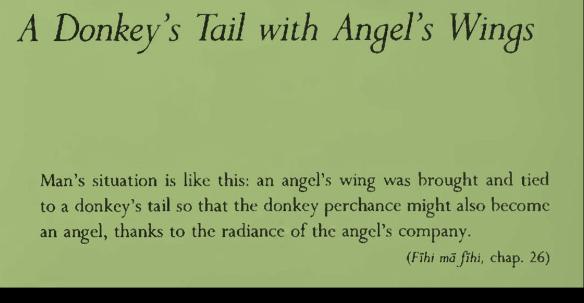
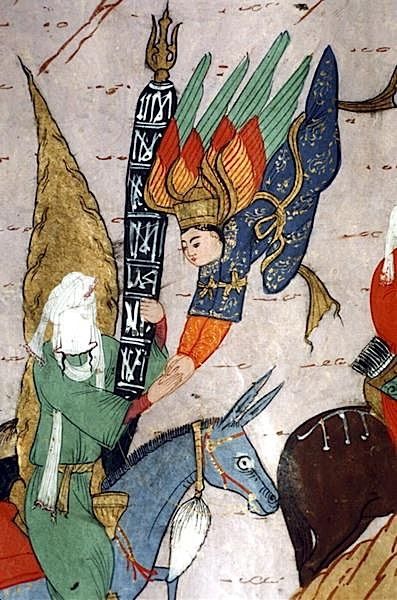
This is an impressive image by Rumi, for it portrays the human condition, the fact that the only creature with a certain amount of free will is situated between beast and angel, between the world of pure matter and that of pure spirit. If he follows his lower instincts, he will fall deeper than any animal, for the animals are constrained in their actions and have no choice. If, however, he purifies himself and develops his God-given spiritual qualities, he will reach a station higher than the angels, for angels, too, cannot act according to their own inclination; their role of constant worship and obedience is once and for all prescribed. Humans, however, have to wander along an extremely narrow path as they choose between good and evil, matter and spirit; they are, as Maulana says, like ducks, which belong to both water and earth; or else they are half honeybee, half snake, capable of producing both honey and venom. Did not the angels cry out in horror when the Lord told them at the beginning of time that He would place a vice-regent on earth, whereupon they foresaw that the new creature would he “bloodshedding and ignorant” (Sura 2/31)?
But God knew better what He was planning, and so the angels had to prostrate themselves before the newly created Adam, who thus became masjud al-mala’ika, “the one before whom the angels fell down.” He was singled out by the Divine Word in the Koran: karamna, “We have honored the children of Adam” (Sura 17/70). Maulana reminds his listeners time and again of this Divine Word, and he sees the greatest danger to humanity in the risk of their forgetting the high position allotted to them by God. God “taught Adam the names” (Sura 2/32). Read more here….
This feast mLord of Misruleay represent a Christian adaptation of the pagan feast, Cervulus, integrating it with the donkey in the nativity story.[2] In connection with the biblical stories, the celebration was first observed in the 11th century, inspired by the pseudo-AugustinianSermo contra Judaeos c. 6th century.
In the second half of the 15th century, the feast disappeared gradually, along with the Feast of Fools, which was stamped out around the same time. It was not considered as objectionable as the Feast of Fools. Read more Here
here the concert René Clemencic – La Fête de L’ Âne : Procession (IV)
Lord of Misrule
In England, the Lord of Misrule – known in Scotland as the Abbot of Unreason and in France as the Prince des Sots – was an officer appointed by lot during Christmastide to preside over thttps://www.youtube.com/watch?v=lOJ0OrqyiZohe Feast of Fools. The Lord of Misrule was generally a peasant or sub-deacon appointed to be in charge of Christmas revelries, which often included drunkenness and wild partying. In the spirit of misrule, identified by the grinning masks in the corners, medieval floor tiles from the Derby Black Friary show a triumphant hunting hare mounted on a dog.
The Church in England held a similar festival involving a boy bishop.[1] This custom was abolished by Henry VIII in 1541, restored by the Catholic Mary I and again abolished by Protestant Elizabeth I, though here and there it lingered on for some time longer.[2] On the Continent it was suppressed by the Council of Basel in 1431, but was revived in some places from time to time, even as late as the eighteenth century. In the Tudor period, the Lord of Misrule (sometimes called the Abbot of Misrule or the King of Misrule)[1] is mentioned a number of times by contemporary documents referring to revels both at court and among the ordinary people.[3][4][5]
In the spirit of misrule, identified by the grinning masks in the corners, medieval floor tiles from the Derby Black Friary show a triumphant hunting hare mounted on a dog.
Boy bishop is the title of a tradition in the Middle Ages, whereby a boy was chosen, for example among cathedral choristers, to parody the adult Bishop, commonly on the feast of Holy Innocents on 28 December. This tradition links with others, such as the Feast of Fools and the Feast of Asses.
The commemoration of the massacre of the Holy Innocents, traditionally regarded as the first Christian martyrs, if unknowingly so,[20][b] first appears as a feast of the Western church in the Leonine Sacramentary, dating from about 485. The earliest commemorations were connected with the Feast of the Epiphany, 6 January: Prudentius mentions the Innocents in his hymn on the Epiphany. Leo in his homilies on the Epiphany speaks of the Innocents. Fulgentius of Ruspe (6th century) gives a homily De Epiphania, deque Innocentum nece et muneribus magorum (“On Epiphany, and on the murder of the Innocents and the gifts of the Magi”).[c]
In the Middle Ages, especially north of the Alps, the day was a festival of inversion involving role reversal between children and adults such as teachers and priests, with boy bishops presiding over some church services.[25] Bonnie Blackburn and Leofranc Holford-Strevens suggest that this was a Christianized version of the Roman annual feast of the Saturnalia (when even slaves played “masters” for a day). In some regions, such as medieval England and France, it was said to be an unlucky day, when no new project should be started.[26]
There was a medieval custom of refraining where possible from work on the day of the week on which the feast of “Innocents Day” had fallen for the whole of the following year until the next Innocents Day. Philippe de Commynes, the minister of King Louis XI of France tells in his memoirs how the king observed this custom, and describes the trepidation he felt when he had to inform the king of an emergency on the day.[27]
In Spain, Hispanic America, and the Philippines,[28] December 28 is still a day for pranks, equivalent to April Fool’s Day in many countries. Pranks (bromas) are also known as inocentadas and their victims are called inocentes; alternatively, the pranksters are the “inocentes” and the victims should not be angry at them, since they could not have committed any sin. One of the more famous of these traditions is the annual “Els Enfarinats” festival of Ibi in Alacant, where the inocentadas dress up in full military dress and incite a flour fight.[29]
Tudor Lord of isrule: How Edward VI Resurrected a Raucous Christmas Tradition
Antiquary John Stowe wrote of the popular Medieval tradition of the Lord of Misrule, explaining that:
“In the feast of Christmas, there was in the King’s house, wheresoever he was lodged, a Lord of Misrule, or Master of merry disports, and the like had ye in the house of every noble man of honour, or good worship, were he spiritual or temporal.”
He went on to explain that the Mayor of London and his sheriff also had their Lords of Misrule and that these lords would begin their ‘rule’ and organise “the rarest pastimes to delight the beholders” on All Hallows Eve (Hallowe’en) and end their rule on the day after Candlemas Day, at the beginning of February. The revelry, Stowe explained, consisted of “fine and subtle disguisings, maskes and mummeries, with playing at cards for counters, nails and points in every house, more for pastimes than for gain.”
Oxford and Cambridge universities, and Lincoln’s Inn, would also appoint Lords of Misrule, as would the royal court, although their ‘rule’ tended to be limited to the 12 days of Christmas. Henry VII, the first Tudor monarch, continued the Medieval tradition, electing a Lord of Misrule for every Christmas of his reign. His son, Henry VIII, also embraced the tradition, going so far as to appoint a separate Lord of Misrule for the young Princess Mary’s household at Christmas, 1525. However, it was in the reign of Henry VIII’s son, the boy king Edward VI, that the tradition reached its zenith under the patronage of John Dudley, Duke of Northumberland, who was Lord President of the Privy Council from 1550 to 1553. The tradition had declined in the latter years of Henry VIII’s reign – an ambassador to Edward VI’s court remarked in January 1552 that a Lord of Misrule had not been appointed for “15 or 16 years” – but it was resurrected with great gusto at the royal court in the Christmas seasons of 1551-1552 and 1552-1553, the final Christmases of Edward’s reign.
Portrait miniature of Edward by an unknown artist, c. 1543–46
While the king’s uncle, Edward Seymour, Duke of Somerset and former Lord Protector, languished in the Tower of London awaiting execution as a traitor to the crown, the Duke of Northumberland sought to distract and divert both king and court with a programme of entertainment and revelry for the 12 days of Christmas. In December 1551, Northumberland appointed George Ferrers, a lawyer, courtier, MP, former servant of Somerset and a poet of some renown, as Lord of Misrule. Sir Thomas Cawarden, Master of the Revels, was informed of the appointment and asked to do all he could to aid Ferrers. Cawarden, who may well have felt slighted by the appointment of Ferrers instead of himself, had to be spurred into action by letters of complaint from both Northumberland and Ferrers regarding his inaction and the quality of items he had provided. In Cawarden’s defence, he was expected to provide a long list of apparel and items at very short notice indeed.
Although the Revels Accounts in the Loseley Manuscript are incomplete, they do show that the revels of these two Christmas seasons took the tradition of Lord of Misrule to new heights. Never before had the Lord of Misrule entered the City of London in a huge and elaborate procession that mimicked the procession of a monarch. Ferrers demanded a large retinue which, in January 1553, included no fewer than six councillors, a ‘dizard’ (talkative fool), jugglers, tumblers, a divine, a philosopher, an astronomer, a poet, a physician, an apothecary, a master of requests, a civilian, friars, two gentleman ushers and “suche other” as he needed. The fools included the “Lord Misrule’s ape”, his “heir apparent” and children. Both of Edward VI’s final Christmases were spent at Greenwich Palace, the 15th century abode situated on the bank of the River Thames. Ferrers made his entry to the royal court at the palace under a canopy, presumably like a royal canopy of estate, and in one piece of pageantry at court he appeared “out of the moon”.
On 2 January 1552, Ferrers presided over a drunken mask at court for which he was furnished with eight “visars” (perhaps vizards or masks), eight swords and daggers, headpieces decorated with serpents and clubs that were full of “pykes” (spikes). The Christmas festivities also included the “Tryumphe of Horsemen”, in which 18 answerers ran six courses each against the Earl of Warwick, Henry Sidney, Sir Henry Gates and Sir Henry Neville as challengers. “Rich hangings” from the “King’s timber houses” were cut up and used for 12 bards for the challengers’ great horses, and caparisons and trappings for their eight light horses. A mock Midsummer Night festival was held that night and the furnishing of “as many Counterfett harnesses & weapons as ye may spare and hobby horsses” suggests that the entertainment included a mock joust. According to the Revels Accounts, other entertainment over the Christmas period included a mask of “Greek worthyes”, a mask of apes, a mask of bagpipes, a mask of cats and “a mask of medyoxes, being half man, half deathe.”
Two masked revellers by Jacob de Gheyn, circa 1595. Courtesy of the Rijksmuseum
On the night of 3 January 1552, there was a mock midsummer that required six hobby horses to be supplied, and then on 4 January the Lord of Misrule made his entry into the City of London. WR Streitberger points out that this entry was not only a parody of traditional royal entries into the capital but also “partly a burlesque of the power vested in royalty to dispense justice”. Diarist and merchant Henry Machyn gives a detailed contemporary account of Ferrers’ entry, writing of how Ferrers landed at Tower Wharf with a great number of young knights and gentlemen on horseback, “every man having a baldric of yellow and green about their necks”. They went first to Tower Hill, accompanied by a procession consisting of a standard of yellow and green silk with St George, guns and squibs, trumpet players, bagpipe players, flautists and other musicians, morris dancers, and the Lord of Misrule’s councillors in “gownes of chanabulle lyned with blue taffata and capes of the same”. Then came the Lord of Misrule, apparelled in a fur-trimmed cloth of gold gown, 50 men of the guard dressed in red and white, and a cart carrying a pillory, gibbet and stocks. The procession then made its way to the Cross at Cheapside where a great scaffold had been erected. There, a proclamation was made of Ferrers’ “progeny”, his “great household” and his “dignity”, before a beheading took place. Thankfully, it was a symbolic beheading; the ‘head’ of a hogshead of wine was “smitten out” for everyone to drink. After that, the Lord of Misrule enjoyed a sumptuous feast with the Lord Mayor before visiting the Lord Treasurer at Austin Friars and then taking a barge back from Tower Wharf to Greenwich.
As well as the pillory, gibbet and stocks described by Machyn as being part of the Lord of Misrule’s entry into London, the Revels Accounts list joints for a pair of stocks with hasps and staples, locks for the pillory and stocks, keys, manacles with a hanging locks, a “hedding ax” and “hedding block”. As well as symbolising the power of the monarch – or the Lord of Misrule at Christmas – to dispense justice, these items and the scaffold at Cheapside my well have alluded to the forthcoming execution of the Duke of Somerset.
On Twelfth Night 1552, a tourney was held during the day, and that evening, following a play performed by the King’s Players, there was a contest or feat of arms between Youth and Riches, with them arguing over which of them was better. It is thought to have been devised by Sir Thomas Chaloner, the statesman and poet. Sir Anthony Browne, Lord Fitzwater, Ambrose Dudley, Sir William Cobham and two other men fought on Youth’s side against Lord Fitzwarren, Sir Robert Stafford and four others on the side of Riches. “All these fought two to two at barriers in the hall. Then came in two apparelled like Almains [Germans]. The Earl of Ormonde and Jacques Granado, and two came in like friars, but the Almains would not suffer them to pass till they had fought. The friars were Mr Drury and Thomas Cobham.” It is not clear whether this contest between Germans (Protestants) and Catholic friars was, in fact, devised to ridicule the Catholic Church. This mock combat was followed by a mask of men and a mask of women, and then a banquet of 120 dishes. “This was the end of Christmas”, is how the account ends.
Two masked musicians perform for a noblewoman, by Jacob de Gheyn, circa 1595. Courtesy of the Rijksmuseum
The allusion to the Duke of Somerset’s scheduled execution was not the only controversial element of the Lord of Misrule’s programme of entertainment that year. Jehan Scheyfve, the imperial ambassador, recorded what he obviously saw as an anti-papist display. According to Scheyfve, a procession of mock priests and bishops “paraded through the Court, and carried, under an infamous tabernacle, a representation of the holy sacrament in its monstrance, which they wetted and perfumed in most strange fashion, with great ridicule of the ecclesiastical estate”. He wasn’t the only one upset about this affront to the Catholic Church; he wrote that “Not a few Englishmen were highly scandalised by this behaviour; and the French and Venetian ambassadors, who were at Court at the time, showed clearly enough that the spectacle was repugnant to them”. One can only assume, however, that the king was happy with this procession and the programme of festivities, for, as historian Jennifer Loach points out, the Revels Accounts show that the king took an active involvement in directing the entertainment and that changes were often made as “declared and commaunded by his highenes or his pryvie counsell” in order “to serve the kinge and his counsells pleasure and determinacion”. The King’s Printer, Richard Grafton, in writing about how well Ferrers was received at court as the Lord of Misrule, commented that he was “very well liked… But best of al by the yong king himselfe, as appered by his princely liberalitie in rewarding that service.” Ferrers was rewarded for his service with a payment of £50 from Northumberland and in September 1552 was appointed as Lord of Misrule for the 1552-1553 Christmas season.
The Christmas season of 1552-1553 began on with Ferrers sending his “solemn ambassador” to court, accompanied by a herald, trumpeter, “an orator speaking in a straunge language” and an interpreter. The ambassador’s mission was to speak to the king and ask for an audience for the Lord of Misrule. This audience was granted and the next day, Ferrers travelled to court along the Thames in the king’s brigantine, which was decorated in blue and white, escorted by other vessels and boys dressed as Turks and playing drums. At Greenwich, he was met by Sir George Howard, the Lord of Misrule’s Master of the Horse, who had come with a horse for Ferrers and who was accompanied by four pages of honour carrying Ferrers’ headpiece, shield, sword and axe. Ferrers writes of how he had taken Hydra, the serpent with seven heads, as his coat of arms, a holly bush as his crest and ‘Semper ferians’ (always keeping the holiday) as his motto.
Entertainments over Christmas and New Year included a pageant in which Ferrers emerged from “vastum vacuum” (a vast airy space), which must have been some kind of pageant car; a feat of arms; a mock midsummer show and joust of hobby horses, presumably like the previous year; a day of hunting and hawking, and masks of “covetus men with longe noses”, “women of Diana hunting”, “babions faces of tinsel black and tawny”, “pollenders”, “matrons” as well as soldiers.
University of Leicester Special Collections. ‘Lord of Misrule’ from: William Sandys, Christmastide: its History, Festivities and Carols, (London, [1852], SCM 12913.Ferrers ordered five different suits of apparel via Cawarden for the festive season: one to wear on both his entry to court and his entry into London, two for the next “hallowed daies”, another for New Year and a final one for Twelfth Night. He also ordered a fool’s coat and hood for John Smith, who was playing the Lord of Misrule’s “heir apparent”, a hunting costume consisting of a coat of cloth of gold decorated with red and green checkerwork, a cloth of gold hat decorated with green leaves, and six sets of outfits complete with horns for his attendants. Other items included “Irish apparel” for both a man and woman, costumes for members of his retinue, maces for his sergeant-at-arms, and hobby horses, one of which he ordered to be made with three heads.
Henry Machyn records the Lord of Misrule’s entry into London on 4 January 1553, writing that he was met at Tower Wharf by the Sheriff’s Lord of Misrule, who took a sword and bore it before Ferrers, who was dressed in royal purple velvet furred with ermine, his “robe braided with spangulls of selver full”. Ferrers was accompanied by a large retinue dressed in a livery of blue and white. As well as musicians, fools and morris dancers, there were once again gaolers armed with a pillory, stocks, an axe, shackles and bolts, and prisoners, presumably actors, who were “fast by the leges and sum by the nekes”. They processed through Gracechurch Street and Cornhill, and once again made their way to a scaffold. After a proclamation had been made, Ferrers gave the Sheriff’s Lord of Misrule a gown of gold and silver before knighting him. The two Lords of Misrule toasted each other and as they proceeded onwards, Ferrers’ cofferer distributed silver and gold. The day ended with a feast at the Lord Mayor’s home, a visit to the Sheriff’s house and a banquet course at the Lord Treasurer’s house. Twelfth Night was celebrated with “The Triumph of Cupid, Venus and Mars”, which, according to Cawarden’s correspondence, was a play devised by Sir George Howard, who was also Master of the Henchmen. Enid Welsford believes that this play was an imitation of the Italian ‘trionfi’, a triumphal procession, and it appears that Venus did indeed enter in a triumphal chariot accompanied by a mask of ladies followed by the marshal and his band. Venus rescued Cupid from the marshal with some kind of mock combat, and at some point, Mars also made his triumphal entry. Thus ended the Twelve Days of Christmas. Once again, the King was pleased his Lord of Misrule and George Ferrers was granted an estate at Flamstead in Hertfordshire.
Although Sydney Anglo makes the point that few records survive detailing the Lord of Misrule’s entertainments in other years, we know from the accounts of Edward VI’s reign that £500 was spent on the revels of Christmas 1551-1552 and £400 on that of 1552-1553, compared to £150 in 1547-1548 and £11 in 1548-1549. The entertainment of George Ferrers’ time as Lord of Misrule was pageantry at its most lavish. Historian Ronald Hutton concludes that the spectacle of Ferrers’ entries into London, for example, “was one of the most elaborate in Tudor history”. It is a shame that the incomplete records only give us a tantalising glimpse into the revelry.
The ancient custom of sacrificing divine kings is played out in both Bulgarian and Sardinian festivals in the Dionysian mode by distributing virtual fragments of their mutilated bodies over village fields, thus ensuring the return of a fertile spring. The tradition, which associates the sacrifice of the king or his children with a great scarcity of crops, points to the belief that the king is responsible for the weather and harvests. The spilled blood evokes rainfall for the parched earth, essential for collective survival. According to Frazer, when gods are killed, they take on the role of scapegoat, sweeping away disease, death, and sin from the community, and are eaten symbolically in order to be assimilated.
In the carnival enacted in Samugheo, Sardinia, a related character called S’urtzu-Dioniso, symbolizes the god to be sacrificed. He appears as a goat, which according to legend, is how Dionysus often appeared. Under the goat skin is a bladder filled with blood and water. When he is hit and falls, the bladder breaks and red blood soaks the ground. After this sacrifice, new life emerges.
Kukerovden, which translates as ‘Day of the Kukers’, is a Bulgarian mystery play within the festival, in which each player bears a strong symbolic connection to an archetypal aspect of nature. The Neolithic ritual is designed to bind heaven and earth together by telling a human story that echoes the greater, universal drama.
Sacrifice of S’urtzu-Dioniso
The wine-fueled Kukerovden ritual includes a tsar or king and a human couple along with a team of attendant kukeri. In an act of bawdy pantomime, the groom impregnates his bride as the kukeri charge, dance and interact with the crowd, jabbing, thrusting, and chasing girls with their long, red poles. Two kukeri are then yoked to a wooden plow, goaded by the tsar as they ritually till three concentric rings. The tsar scatters grain seeds symbolizing the sowing of fields.
Kukerovden Plow with Male, Female and Tsar
The heated climax occurs when the tsar is struck down with the spindle of destiny. Raising his body announces the arrival of spring. By now the bride, a male disguised with kerchief and comically bulging dress is ready to give birth. When the child pops out, usually represented by an androgynous rag doll, the ceremony is complete.
Maimone Dragging Plow, Sardinia Solo Maimon Dragging Plow
The ritual seems to have originated as an initiation for young Kukeri, historically, boys and young bachelors. Through phallic thrusting and sowing movements. older men would convey the ways of the world and their community. Maimon is the name by which Dionysus is invoked in Sardinia. In Orotell, Maimones mime cultivation by dragging a plow behind them. The deep, indissoluble bond is indicated by ropes that bind the farmers to the yoke. It is no coincidence that Dionysus was especially adored by farmers who considered him the inventor of the plow and the one who had taught men how to lure oxen to ease their labour.
The Koukeri tradition recreates the connection between Nature and Man: earth – woman; ploughing the soil – taking the woman; sowing – inseminating; grain – semen; passing of winter – killing of the Tsar; coming of spring – the Tsar’s resurrection. The Koukeri’s moves bear the signs of sacral code: The stabbings with the red-painted swords represent the phallic copulation moves; the hopping and jumping are to make the wheat grow tall; the body swaying – to make the wheat sway with heavy grain; the rolling on the ground – for Man to take from Earth’s strength; the bells noise – to scare and chase away the evil spirits.
The Koukeri custom was part of the game cycle that prepared the young men for their future roles of husbands and land workers. It was an important rite-of-passage, which gave them the opportunity to learn about and experience life after marriage. A lad, who had not participated in the Koleda, Sourva and Koukeri games, would be considered a “second rate” marriage candidate, and would be put in the same group with the nwith the non-healthy and widowed men. He could only marry a “second rate’ woman – non-healthy, widowed, or one left by her husband.
The main actors of the Koukeri group are: a Tsar (king), a newly wedded couple or an elderly couple, koukeri. They have a chariot or a cart, in which they drive the Tsar around; a plough, with which they ritually till the soil; a wooden pot, full of grain, which the Tsar sows; wooden swords and a club, perceived as phallic symbols; a doll. Despite the regional variances, in the past, the ritual comprised the following sequence of actions: The Koukeri, only young single men, led by the Tsar, a man of respectable age and social standing – prosperous, with a family and children, gathered in the centre of the village, from where, with the musicians in front, they would go to all houses, offering blessings for health, fertility and prosperity. The Bride tries to sweep and clean up the front yard, but does it so clumsily that only causes disorder. The Hosts give the Koukeri food, wine and/ or money, and thank them cordially for the blessings. In turn, the Bride kisses the Host’s hand. After the house rounds have been completed, the Koukeri group, followed by villagers, return to the village square, where they perform their ancient ritual. First, they engage in a battle with the evil spirits by running around, waving arms and swords wildly, and making noise with their bells, thus chasing the evil forces away. The Groom / Old Man use the scuffle to “make love to and inseminate” the Bride / Old Woman. The Koukeri return from the battle and give their Tsar three pieces of bread. Then three circles of ritual ploughing take place. The Tsar walks behind the plough and sows grain, followed by the main group, who are jumping and waving their swords in the air. Upon completion of the tilling, the Tsar blesses the congregation for good health and prosperity, and is then killed by a Kouker. All Koukeri gather above him and resurrect him. The Bride/ Old Woman gives birth to a child, and the Koukeri celebrate with hopping and dancing. During the enactment of the custom, the Koukeri exchange jokes with the spectators. At the end, the Koukeri gather for a dinner with the food and wine, given to them by the villagers. It’s a joyous and elevating event.
In our days, the Koukeri Day is just a festive reminder of times gone by, a merry holiday, whose main importance is to gather people for a joyful celebration of life.
The Sardinian version of carnival is called Carrasecare,’meat carried in a cart to be dismembered’. But the term care does not mean meat for butchery, which is always called petta or petza. The term suggests human meat, revealing the arcane function of traditional Sardinia carnivals. Maskers continue to play out the roles, though with different intentions. They are sad events that require a victim or a stand-in effigy to be torn apart, incarnating the deity who had been eaten by Titans, then resurrected by his mother.
Demeter and Dionysus in Kukeri Festival Cart, Bulgaria
The cart also serves as the platform for enacting the consummation of the divine union between the Neolithic Great Mother and her consort-son in Bulgaria. They reappear in Minoan myth as either Demeter or Semele, depending upon the version, as the stand-in for the Great Mother and her consort- son, Dionysus in bull form, representing male virility. Ensured through these mini-dramas is the fertility of the fields, fruit trees and grape vines, the source of the wine that keeps the excitement of the festivals alive. The magic of these long-repeated rituals seem to be regarded as guarantee for a rich harvest, health and fertility for humans and their domesticated animals with chaos subdued and evil spirits chased away. Read more here
The corresponding Western season of preparation for Christmas, which also has been called the Nativity Fast[2] and St. Martin’s Lent, has taken the name of Advent. The Eastern fast runs for 40 days instead of four (in the Roman Rite) or six weeks (Ambrosian Rite) and thematically focuses on proclamation and glorification of the Incarnation of God, whereas the Western Advent focuses on three comings (or advents) of Jesus Christ: his birth, reception of his grace by the faithful, and his Second Coming or Parousia.
The Three Young Men in the Fiery Furnace, celebrated during the Nativity Fast as a reminder of the grace acquired through fasting (15th century icon of the Novgorod school).
January 14 is “Feast of the Ass” Day
On January 14, medieval Christians celebrated Feast of the Ass Day, although perhaps not the type of “ass” you may be thinking of! It actually celebrated the various accounts in the Bible where a donkey (or ass) is mentioned, especially the one that supposedly carried Mary and the baby Jesus to Egypt.
Digging Deeper
Not surprisingly, like many or even most Christian holidays, the Feast of the Ass had its origins in Paganism, being derived from the religious feast called Cervulus.
Flight into Egypt by Gentile da Fabriano
During this bestial-based holy day, a ceremony often took place in which a girl with a baby (or a pregnant girl) was led through a village on a donkey, followed by churchgoers answering the priest with “hee-haws” during the related church service or Mass. In some accounts, the priest himself would bray.
Amazingly, this nifty holiday fell out of favor around 1500 along with its sister feast, the Feast of Fools. Apparently some thought the titles and actions of these two celebrations were less than “Christian.”
Perhaps they should bring this particular feast back and give people a valid excuse, at least one day a year, to make an “ass” / donkey of themselves and ourselves in church or everywhere else in life outside.
Landscape as an Image of the Pilgrimage of Life :
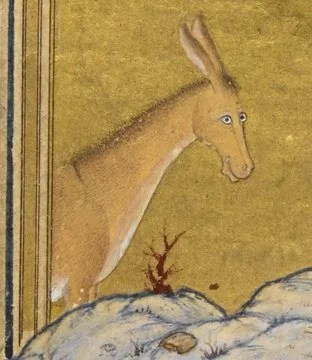
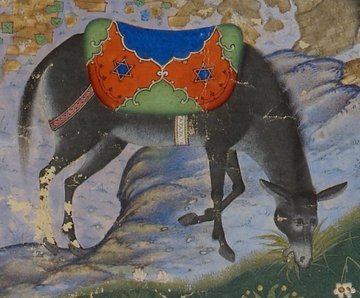
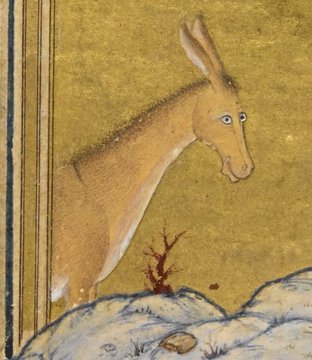
Look at the donkey in The Rest on the Flight into Egypt of the “Holy Refugees” by Joachim Patinir…
..he is smiling in his heart…
It depends of the sturburness of our Ego, the Donkey.
In the Spiritual Land of Peace, the donkey, our ego is quiet, he submits totally to the “Holy Refugee” and eats the “Greenness” of the spiritual field of the Land watered by the Eternal Water of Life….
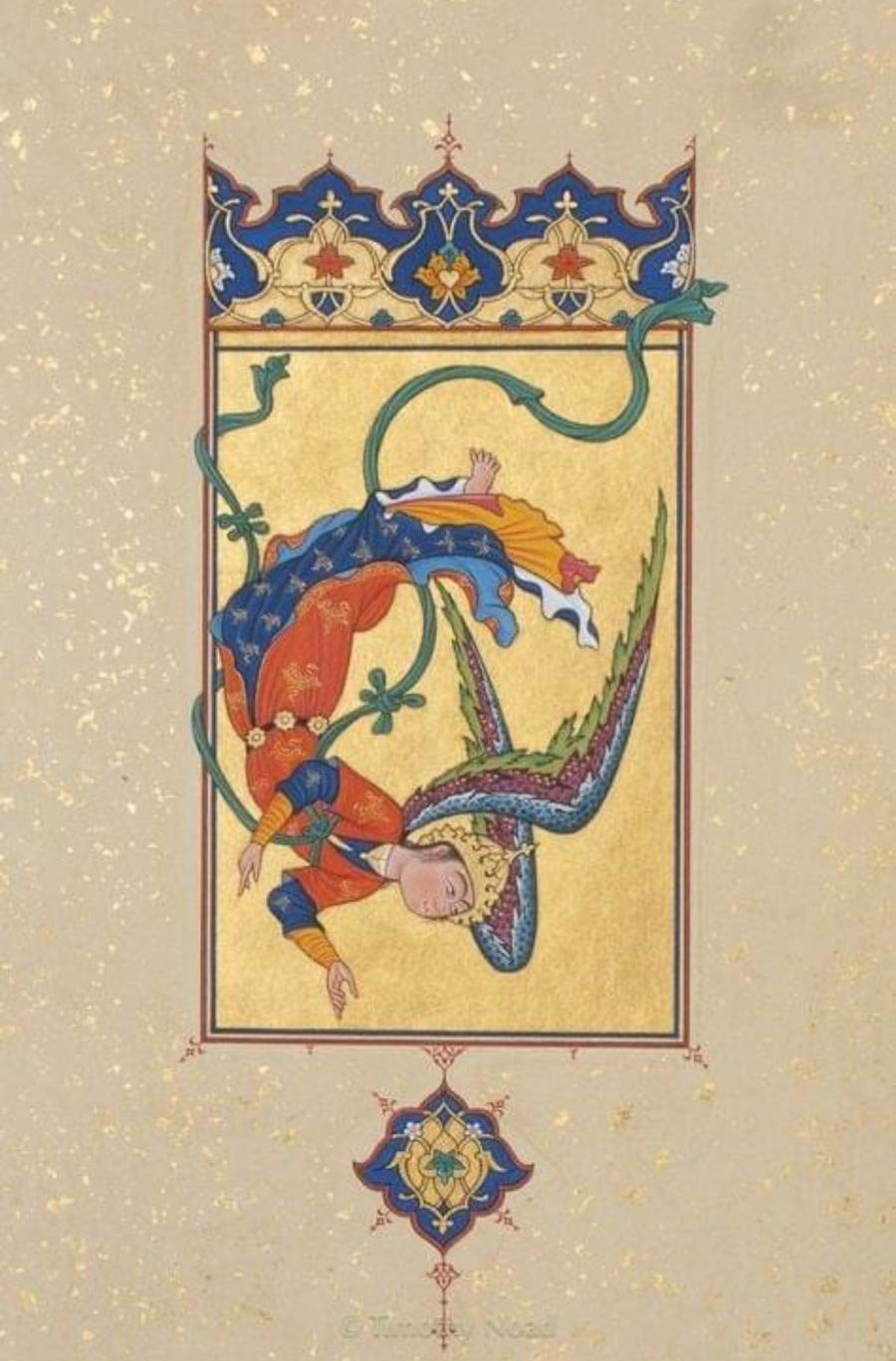
Corona or Covid- is like a rehab intervention that breaks the addictive hold of normality. To interrupt a habit is to make it visible; it is to turn it from a compulsion to a choice. The phenomenon follows the template of initiation: separation from normality, followed by a dilemma, breakdown, or ordeal, followed (if it is to be complete) by reintegration and celebration. Now the question arises: Initiation into what? What is the specific nature and purpose of this initiation? The popular name for the pandemic offers a clue: coronavirus. A corona is a crown. “Novel coronavirus pandemic” means “a new coronation for all.” A Choice or a possible migration to the Spiritual Land of Peacet
To become a Refugee, a Holy Refugee through an emigration to Sincerity or uprightnees of Love
We are not the first generation to know that we are destroying the world. But we could be the last that can do anything about it, not with the vanity of earthly knowledge and so called democratic solidarity and wisdom here on earth as the commercial of WWF wants to convince us, but with asking humbly the help of Divine Wisdom so realising in us the image of the man who painfully transcends his material ego: The birth of his soul. It is a test. It’s time to decide!
Treatise on Unification by Ibn al Arabi In the name of God, the Merciful, the Compassionate. Blessings upon our master, Muhammad, and upon his family and companions. This is a noble treatise in which I have consigned a tremendous discourse. From my incompleteness to my completeness, and from my inclination to my equilibrium From my grandeur to my beauty, and from my splendour to my majesty From my scattering to my gathering, and from my exclusion to my reunion From my baseness to my preciousness, and from my stones to my pearls From my rising to my setting, and from my days to my nights From my luminosity to my darkness, and from my guidance to my straying From my perigee to my apogee, and from the base of my lance to its tip
From my waxing to my waning, and from the void of my moon to its crescent From my pursuit to my flight, and from my steed to my gazelle From my breeze to my boughs, and from my boughs to my shade From my shade to my bliss, and from my bliss to my wrath From my wrath to my likeness, and from my likeness to my impossibility From my impossibility to my validity, and from my validity to my deficiency. I am no one in existence but myself, so – Whom do I treat as foe and whom do I treat as friend? Whom do I call to aid my heart, pierced by a penetrating arrow, When the archer is my eyelid, striking my heart without an arrow? Why defend my station? It matters little to me; what do I care? For I am in love with none other than myself, and my very separation is my union. Do not blame me for my passion. I am inconsolable over the one who has fled me.
In this book I never cease addressing myself about myself and returning in it to myself from myself. From my heaven to my earth, from my exemplary practice to my religious duty,
From my pact to my perjury,from my length to my breadth.
Ethiopian Orthodox Christians are expected to fast for 43 days, a period known as Tsome Nebiyat or the Fast of the Prophets. Fasting also includes abstaining from all animal products and psychoactive substances, including meat and alcohol. Starting on 25 November, the fast believed to be “cleansing the body of sin” as they await the birth of Jesus.
Nativity Fast
Ethiopian and Eritrean Orthodox Churches commence the season on November 24 and end the season on the day of Ethiopian Christmas, which falls on January 7. The corresponding Western season of preparation for Christmas, which also has been called the Nativity Fast[2] and St. Martin’s Lent, has taken the name of Advent. The Eastern fast runs for 40 days instead of four (in the Roman Rite) or six weeks (Ambrosian Rite) and thematically focuses on proclamation and glorification of the Incarnation of God, whereas the Western Advent focuses on three comings (or advents) of Jesus Christ: his birth, reception of his grace by the faithful, and his Second Coming or Parousia.
The Byzantine fast is observed from November 15 to December 24, inclusively. These dates apply to the Eastern Catholic Churches, and Eastern Orthodox churches which use the Revised Julian calendar, which currently matches the Gregorian calendar.
It is also known as the Feast of Theophany, a cornerstone in Orthodox Christianity. It’s a time when the air buzzes with anticipation, as believers prepare to commemorate a pivotal moment in Christian faith: the baptism of Jesus Christ.
The Significance of Theophany in Orthodox Christianity
This feast is far more than a mere commemoration; it’s a celebration of Jesus Christ’s baptism in the Jordan River. This event marks the manifestation of God as the Holy Trinity to the world — Father, Son, and Holy Spirit — providing a profound revelation of Divine truth that resonates with believers.
Theophany stands as a pivotal point where heaven meets earth. During the liturgical services, especially through the Great Blessing of the Waters. This ritual is not only about purification but also signifies the sanctification of the entire creation. Orthodox theology teaches that when the waters are blessed, they become a means of spiritual renewal, symbolizing the washing away of sins.
Indeed, every aspect of Theophany is imbued with deep symbolism which adherents internalize and reflect upon. The icons depicting the feast portray the voice of God the Father proclaiming Jesus as His beloved Son, the Holy Spirit descending as a dove, and the figures of angels in awe. These are not just static images but invitations for us to contemplate the mystery of God becoming manifest in the world.
Orthodox Christians believe that participating in Theophany services invokes a renewal of their own baptismal vows. The prayers and hymns are designed to draw us closer to the heart of our faith, a personal call to embrace the transformative teachings of the gospel. It’s during Theophany that we reaffirm our commitment to live a life in accordance with Christ’s example.
By observing Theophany, we are reminded of the unity between the cosmic and the personal elements of faith. The feast illustrates that salvation history is not confined to the past but is an ongoing narrative that continues within the life of every believer. Through this understanding, we grasp the scope of God’s redemptive work, which is both intimate and universal.
The Roots of Theophany in Christian Tradition
The history of Theophany stretches back to the earliest days of Christianity. In the Christian tradition, the feast commemorates not only Christ’s baptism but also His first public manifestation to the world. Theophany’s origins are tightly interwoven with the liturgical traditions that emerged in the early Church.
Liturgical records from as early as the 4th century detail the observance of the feast, illustrating its ancient roots and enduring importance. It was considered a major feast, sometimes even correlated with the celebration of Easter, accentuating its significance in the context of Christian redemptive events.
In the Eastern Orthodox Church, Theophany is often referred to as ‘Epiphany,’ a term that signifies a divine revelation. The feast is deeply rooted in the scriptural accounts of the Gospels, particularly in the works of Matthew, Mark, and Luke. These texts detail the event of Jesus’s baptism by John the Baptist at the Jordan River, marking it as an occasion where the Heavens opened and the Holy Spirit descended like a dove upon Jesus, while a voice from Heaven proclaimed Him as the beloved Son.
Celebrated on January 6th, this feast not only observes the baptism but also Christ’s first miracle at the wedding of Cana, which occurs shortly thereafter according to the Gospel of John. This dual focus on baptism and miracle underscores the multifaceted nature of divine manifestation and the profound mystery of God’s presence.
Orthodox Christians recognize this event as a cornerstone of their faith, as it reveals the Trinity — Father, Son, and Holy Spirit — to the world, and establishes the foundation for the sacrament of baptism. By looking at the roots of Theophany and its establishment in the early Christian Church, one gains a deeper appreciation for its central place in Orthodox ritual and doctrine. It continues to resonate through centuries as a powerful expression of faith, an acknowledgement of the divine mystery, and a call to a life transformed by the recognition of Jesus Christ’s divinity.
The Baptism of Jesus Christ: A Pivotal Moment
In the rich tapestry of Orthodox Christianity, the Feast of Theophany stands out, particularly for its commemoration of the baptism of Jesus Christ. This moment in the Jordan River signifies far more than a mere ritual. It marks the beginning of Christ’s public ministry and the divine approval of his mission on Earth. When I reflect upon this event, I’m moved by its profound significance, encapsulated in the voice from heaven declaring Jesus as the beloved Son.
Scripture recounts this pivotal moment with poignant clarity. As Saint John the Baptist lowers Jesus into the waters, the heavens open, and the Holy Spirit descends like a dove — a scene capturing the full revelation of God’s triune nature.
Beyond its doctrinal import, the baptism also symbolizes a model for personal transformation. In Orthodox tradition, followers re-commit to spiritual renewal, mirroring the purifying act that Jesus himself underwent. This moment beckons the faithful to embody Christ’s virtues and fosters a profound connection to his journey.
Moreover, the baptism induces a ripple effect throughout the liturgical year. It’s not merely an isolated event but a gateway to the subsequent narratives of Christ’s life and teachings. Each year, we are reminded of the seasons that follow — each echoing the resonant themes introduced by the baptism.
As the story of the baptism unfolds, the multifaceted themes interwoven in the Theophany celebration emerge starkly. Through liturgy and iconography, the Orthodox Church encapsulates the transformative power of water, the inauguration of Christ’s ministry, and a life led by example. These threads bind the observance, not only to the past but also to our contemporary journey in faith. The baptism of Jesus Christ remains an enduring call to renew and deepen our spiritual lives in alignment with the core precepts of Orthodoxy.
The Symbolism of Water in Theophany
Water plays a central role in Theophany, symbolizing purity, life, and transformation. It’s perceived not only as a physical substance but also as a spiritual one, carrying profound connotations within Orthodox Christianity. During Theophany, water is blessed and believed to take on holy properties, becoming a conduit for sanctification and an emblem of divine grace.
As I delve into the scriptures, it’s clear that water carries a duality of destruction and regeneration. In the Old Testament, it is seen in the great flood that cleanses the world of sin, and in the New Testament, it appears as the waters of the Jordan River where Jesus was baptized. This baptismal water signifies a new beginning, washing away the old self and refreshing the spirit akin to the rebirth of Creation after the deluge.
The practice of blessing bodies of water during Theophany also holds symbolic weight. Orthodox Christians often gather at rivers, lakes, or seas, where the blessing is performed. This ritual signifies the sanctification of nature and is a reminder of the participation of all creation in the redeeming act of Christ’s baptism.
Moreover, theophany water is used throughout the year for various sanctifying purposes, reinforcing its significance far beyond the feast day:
Blessing homes
Healing purposes
During other sacraments and rituals
In baptism, the symbolism of water reaches its zenith. It represents a tomb and a womb simultaneously — a tomb for dying to sin and a womb for giving birth to new life in Christ. Orthodox faithful view their own baptism as a personal participation in Jesus’ baptism. They’re reminded that through the waters, they’re initiated into the faith, emerging as changed individuals ready to embark on their spiritual journey.
In the liturgy, the use of water serves as a material and mystical link between the physical and the divine. The blessing of the waters during Theophany is a vivid enactment of divine incarnation and sanctification, encapsulating the essence of God’s closeness and the transformative power of His presence in the world.
The Sacred Rituals of Theophany
Theophany isn’t just a day for reflection; it’s marked by a rich tapestry of sacred rituals that engage the faithful in a profound spiritual journey. Among these, the Great Blessing of the Waters stands out as a pivotal moment. This ceremony is performed twice: once on the eve and then on the day of Theophany itself. During this ritual, the priest proceed to sprinkle holy water, a sign of divine presence, on the congregation, symbolizing the washing away of sins.
In many Orthodox communities, there’s a tradition of throwing a cross into a body of water. The bravest among the faithful dive in — regardless of the chilling temperatures — to retrieve it. This act of retrieving the cross signifies Christ’s baptism and serves as a public declaration of faith.
I’m also intrigued by house blessings, a practice where the sanctified waters from Theophany are used to bless and protect the homes of parishioners. A priest typically visits homes with a container of Theophany water, sprinkling each room while reciting prayers. This custom underlines the belief that God’s grace permeates every aspect of our lives.
These rituals aren’t simple ceremonies; they’re acts that bind the community together. They root Orthodox Christians in their faith, allowing them to participate physically in the mysteries of Theophany. Each droplet of water becomes a symbol of the Holy Spirit’s renewing power — connecting the earthly with the heavenly.
Clearly, Theophany’s rich liturgy and communal practices go beyond mere remembrance. They’re about engaging with faith at the deepest levels, where holy water isn’t just a symbol — it’s a living, breathing testament to belief, renewal, and the enduring promise of sanctification.
Conclusion
The Feast of Theophany holds a profound place in Orthodox Christianity, not just as a historical commemoration but as a living, communal experience. Through the Great Blessing of the Waters and other cherished rituals,we are reminded of the depth of our faith and the transformative power of God’s presence. As the holy water touches our lives, we’re renewed and united in the divine mystery. Theophany isn’t simply an event to remember — it’s an invitation to step into a renewed life, a moment where heaven touches earth and sanctifies our journey.
Note:Ablution – ritual of Purity in Islam
Wuduʾ (Arabic: الوضوء, romanized: al-wuḍūʼ, lit. ‘ablution’ [wuˈdˤuːʔ]ⓘ) is the Islamic procedure for cleansing parts of the body, a type of ritual purification, or ablution. The steps of wudu are washing the hands, rinsing the mouth and nose, washing the face, then the forearms, then wiping the head, the ears, then washing or wiping the feet, while doing them in order without any big breaks between them.
Wudu is typically performed before Salah or reading the Quran.
Wudu is often translated as “partial ablution”, as opposed to ghusl, which translates to “full ablution”, where the whole body is washed. An alternative to wudu is tayammum or “dry ablution“, which uses clean sand in place of water due to complete water scarcity or if one is suffering from moisture-induced skin inflammation or illness or other harmful effects on the person.
Qur’an 2:222 says “For God loves those who turn to Him constantly and He loves those who keep themselves pure and clean.”[2:222]
Qur’an 5:6 says “O believers! When you rise up for prayer, wash your faces and your hands up to the elbows, wipe your heads, and wash your feet up to the ankles. And if you are in a state of full impurity, then take a full bath. But if you are ill, on a journey, or have relieved yourselves, or have been intimate with your wives and cannot find water, then purify yourselves with clean earth by wiping your faces and hands. It is not Allah’s Will to burden you, but to purify you and complete His favor upon you, so perhaps you will be grateful.”
The Blessing Of The Waters – A Perennial New Beginning
Each year at Theophany we perform the service of the Great blessing of the waters. With this holy water or Agiasmos, as we call it, the priest blesses the people and their homes in a “pilgrimage” through their homes lasting sometimes more than a month. For the modern person that, has lost any sense of the sacred under the influence of the protestant theology and the secular society, all this seems a rather odd habit to say at least.
But even for the secular man the water has tremendous importance. According to the evolution theory life has started in the water. It is also an essential component of the life cycle, without it nothing can grow or live. Man himself is made 50-65% from water and although one can survive weeks without food, without this essential liquid man surely dies in a matter of days.
So how do we respond to the raised eyebrow of the secular man when we bring the Holy Water into discussion?
The first and obvious answer lays the very meaning of Theophany that incorporates the Baptism of our Lord Jesus Christ in the River Jordan. The entrance of the Lord Himself into the water and all the events that followed, the flowing back of the river and the revelation of the Holy Trinity should be for us a good enough explanation.
But there is more to add because this is not the first time when water plays a central role in the Holy Scripture. Since the beginning of times water was used by God in various occasions. At the very creation of the world we read that “the earth was without form, and void; and darkness was upon the face of the deep. And the Spirit of God moved upon the face of the waters.” (Gen 1:2). We remember the Great Flood that prevailed upon the earth drowning a mankind that was already sinking into un-repented sin. We see Moses parting the Red see with his staff so the people of Israel can be freed from the slavery of the Egyptian Pharaoh, while the pagan armies are destroyed by the same waters. We also acknowledge water as part of the purification rituals of the Mosaic Law.
The complete meaning of the importance of the water however is fully revealed in the water of Baptism. The key is the hymn we sing as we joyfully walk around the table with the Gospel at the end of the service: As many of you have been baptized in Christ you have put on Christ. As we are baptized in the water by a thrice immersion in the name of the Holy Trinity, we become Christ like. By dying as sinners in the water like in a tomb – three times, like three days – we are able thereafter to rise like Christ into incorruption, as members of the Church now and citizens in potentiality of the Kingdom of Heaven. Christ the New Adam, through the water of Baptism, is re-creating us in the Spirit, giving us again the choice that our forefathers failed so lamentably: a life in grace or a life in sin.
We recognize here the creation power of Genesis, the wrath of the Lord during the Flood and the liberating power of the Red Sea commanded by the wood of the Cross.
“Creation, Fall and Redemption, Life and Death, Resurrection and Life Eternal: all the essential dimensions, the entire content of the Christian faith, are thus united and hold together”
Through the descent of the Holy Spirit during Baptism and in the similar way during the Great Blessing of the Waters, the water regains its full potential and is transformed in a vehicle of renewal, a vehicle of change leading everything it touches toward the meeting with our Lord Jesus Christ.
This is possible because the Sacrament of Baptism is not to be understood as separated from Communion and Holy Liturgy, although the current liturgical practice does not really help in this respect, but the two should be considered as they really are: intimately linked. As Fr. Alexander Schmemann accurately states:
“Baptism is a personal Pascha and a personal Pentecost, as the integration into the laos, the people of God, as a passage from an old life into a new one and finally as an epiphany of the Kingdom of God.”
The Holy Communion is the earnest of the very goal of the Christian life: the Kingdom of Heaven. Each person that enters through baptism into the body of the Church starts living for the fulfillment of this promise, which is pre-tasted during the Holy Liturgy in the partaking of the Eucharist. The water of baptism makes all of this to happen by giving back to man his original potential.
Each year at Theophany we take part again and again in the reactivation of the spiritual properties of water by witnessing the river Jordan running backwards to its source, to its origins, symbolically reverting our lives to our true sacred roots. The Agiasmos consecrated at Theophany has the power to take us back were we belong, to renew into us the true Spirit of God and, paradoxically, instead of extinguishing, fueling the flame of our faith.
This Holy Water however does not work magically without our participation, but it demands involvement and requires a renewal of our dedication to Christ and His Church. It is for us a remembrance and a reaffirmation of our baptismal vows, it is a perennial new beginning that we embark in every time we use it. Without this understanding the sprinkling of Agiasmos is nothing else but an unwanted cold shower, devoid of any true significance.
Let us therefore receive the water of Baptism in our homes in the hope that the New Year will bring us closer to Christ and to one another. Let us all pray that the Holy Spirit that fills all things will also fill our lives with His peace and grace and that at the end of our lives we will be found worthy to join the rightful flock at the right hand of the Father.
Three Kings Day
Epiphany , Epiphany or Epiphany of the Lord ( Solemnitas Epiphaniae Domini in Latin ) is a Christian holiday celebrated annually on January 6 ( or on the first Sunday after January 1 – see below ) commemorating the Biblical event ( Matt. 2:1-18) of the wise men from the East who saw a rising star and went out to seek the King of the Jews. They arrived in Bethlehem and found Jesus , the newborn King of the Jews. This probably alludes to the vision of Balaam, the seer in Moab who saw a star rising out of Jacob ( Numbers 24:17).
The three wise men were given names. In Greek they were Apellius, Amerius and Damascus, in Hebrew Galgalat, Malgalat and Sarathin, but they became known by their Latinized Persian names Caspar , Melchior and Balthasar . They are said to have been 20, 40 and 60 years old respectively, numbers symbolizing the life periods of the adult.
In the Catholic liturgy in Belgium and the Netherlands, the feast of the Epiphany of the Lord is celebrated on the first Sunday after January 1. In many southern European countries, Epiphany is a holiday and Epiphany is celebrated on the day itself. The Epiphany of the Lord is the first of three feasts, together with the Baptism of the Lord and the Presentation of the Lord in the Temple ( February 2 ), that belong to the Christmas cycle , the time of Jesus’ childhood and youth.
Carrying a star on a stick, singing from house to house. Originally, choirboys would have done this to collect money and food for the poor. Epiphany was a charity festival. From the 17th century, the ‘common people’ took up the star themselves. With impudent songs, children and adults would scrape together a festive meal. In Amsterdam, ‘star singers’ disappeared at the beginning of the 19th century. Image by Bernard Picart from 1732, Museum Catharijneconvent
In some parts of the Netherlands, children walk in groups of three dressed up with a crown along the doors on the evening before Epiphany; one of them has a blackened face. They carry lanterns and sing. A well-known song goes:
Three cooonings, three cooonings,give me a new (h)ood.My old one is worn out,my mother may not eat it again.My father has the money,counted down on the counter.
Originally the last sentence read: “counted on the [russel] grid.” Counting on the grid here means: not having money or not being able to keep track of it. [ 6 ] This version is still sung in Flanders.
The last two lines also read: “My father has no money, isn’t that a bad situation?”
As a reward for singing, they receive food, sweets and money . The lanterns are a remnant of an old pagan custom, in which torches were carried to drive away evil spirits. The sweets that are handed out originate from pagan sacrificial meals. The Germans were not allowed to eat legumes (their staple food) during the twelve nights of the New Year’s festivities and the ‘holy bean’ marked the end of that fasting period.
Galette à la frangipane (crème d’amande et crème pâtissière).
The king’s bread or king’s cake that is baked is well-known; a brown bean or coin is hidden in it and the person who finds it is “king(in)” that day. A custom is that the person who is the king may be the boss in the house that day. The bean in the cake is also derived from pagan customs.
The king’s letter was also known , both in the home and at a large official party. One could grab from a barrel of papers and the one who drew the king’s letter was treated by everyone and was the boss. Letters were also drawn for the position of councillor, steward, secretary, singer, musician, cook, porter, cupbearer and fool and foolish woman. According to a legend, King Francis I of France heard about such a king’s letter for the first time in 1521, he declared war on the ‘king’ and went there, but was received with snowballs , apples and eggs . A drunken man even threw a piece of burning wood , but King Francis saw how foolish he had made a fool of himself and refused to prosecute the man.
In the past, it was common practice to leave the Christmas tree up until Epiphany. According to tradition, taking down the tree before Epiphany would bring bad luck. Nowadays, however, most Christmas trees are taken down before Epiphany. [ 7 ] In the past, it was also common practice not to put the Epiphany figures in the nativity scene right away, but only on January 6, at Epiphany. The figures were moved a step closer to the nativity scene every day, because they were still ‘on their way’ and would not reach the scene until January 6. [ 8 ] [ 9 ]
At churches or in the church porch a play was performed around Epiphany with Mary , Joseph , the baby Jesus , the donkey , the ox , Herod and the Three Wise Men. In Protestant areas this also happened inside the church.
Three Kings procession on camels through Eindhoven, January 5, 1955
In Maastricht (organised by the parish of Our Lady Star of the Sea ) and ‘s-Hertogenbosch (by the ‘s-Hertogenbosch Three Kings Foundation), live Three Kings processions pass through the city centre every year. Fully costumed, the kings ride through the city on camels and horses. The procession also includes shepherds with donkeys and sheep and of course Mary and Joseph with the baby Jesus. Children (whether or not in costume) are invited to walk along with lanterns. The service concludes in the basilica, during which the Kings offer their gifts to the baby Jesus and traditional Three Kings songs are sung. In ‘s-Hertogenbosch, a new tradition was added in 2015: the fourth gift. Children could bring toys that still looked new, to be collected in St. John’s Cathedral and donated to children who were less fortunate.
In Enkhuizen, among other places, the Three Kings Star was known. A fragile object made of paper and wood that was carried along the houses on Epiphany. With the star on the stick, the bearer sang a song and collected small amounts. The Zuiderzee Museum has recordings of songs, eyewitness accounts, photos of the owner in action and two stars, one of which has been restored to its former glory.
In the 21st century, the tradition of Epiphany is considered lost in the Netherlands. [ 10 ] However, the tradition still lives on in Maastricht, ‘s-Hertogenbosch, Tilburg and Lierop. In 2012, the Brabant Epiphany singing was added to the Intangible Cultural Heritage of the Netherlands . [ 11 ] In addition, the Heemkundekring Tilborch is committed to keeping the festival alive. According to Ineke Strouken, director of the Dutch Centre for Folk Culture, about Epiphany as intangible heritage: ‘It is dynamic heritage that must be given space to grow with the times and acquire new meanings.’
Op 5 januari is de Glöckötåg (Glöcklertag). ’s Avonds om ca. 17:00 uur vindt op het centrale plein een symbolisch gevecht plaats tussen de „Glöckler“ (die de lente voorstellen) met de Bärigln (Pelzperchten, die de winter voorstelt). Middernacht is de strijd voorbij en controleert de Percht of het huis wel schoon is, 5 januari 2015