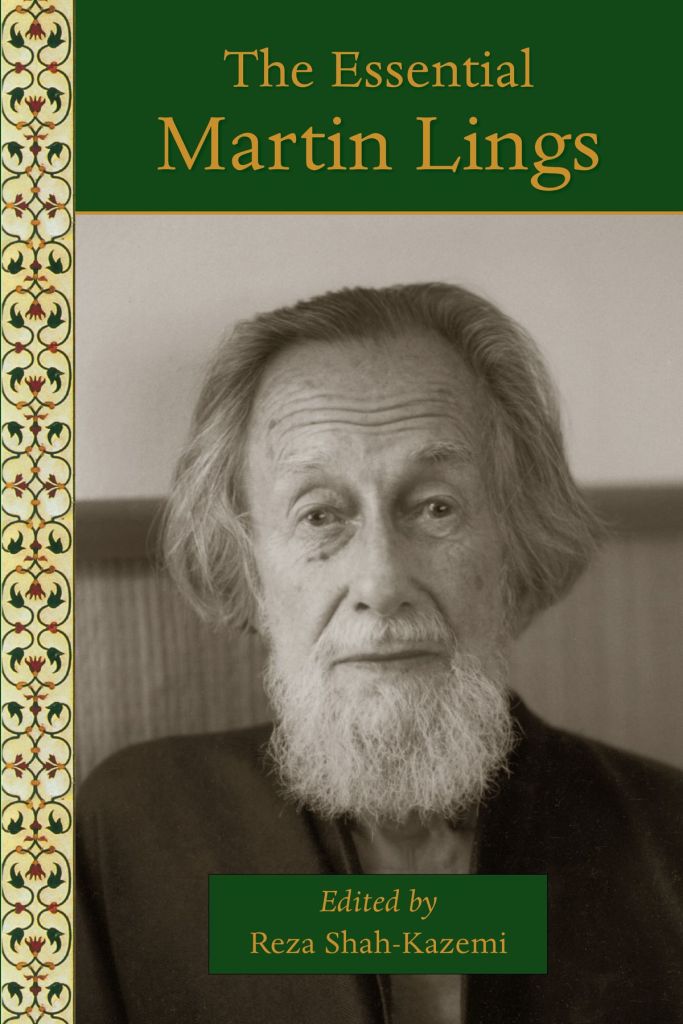
This collection brings together some of the most outstanding and representative writings of Martin Lings (1909–2005), drawn from his broad span of works. He was former Keeper of Oriental Manuscripts at the British Museum, as well as being a distinguished translator, scholar, and poet.
Lings was the author of several awardwinning books on subjects ranging from Sufism to Shakespeare, including A Sufi Saint of the Twentieth Century: Shaikh Ahmad al-ʿAlawi, His Spiritual Heritage and Legacy (1961), the best-selling Muhammad: His Life Based on the Earliest Sources (1983, translated into over a dozen languages), and Shakespeare in the Light of Sacred Art (1966). He also wrote works addressing the spiritual crisis of our times, such as The Eleventh Hour (1987), Ancient Beliefs and Modern Superstitions (2001), and A
Return to the Spirit (2005). This anthology conveys wisdom of a timeless nature— neither of the East nor of the West—which the world today desperately needs.
This volume is divided into six themes—Metaphysics; Hermeneutics; Tradition and Modernity; Traditional Psychology; Islam; and Art and Poetry, which contain some of Lings’ most compelling writings on these subjects. For example, there are essays on comparative spirituality, such as ‘Do the Religions Contradict One Another?’, which show how each spiritual tradition is akin to points on a circle that connect to the center through diverse radii, representing their mystical dimensions, and how they all come together in a unitary Divine Essence. It is this metaphysical perspective that could be said to be his point of departure for this anthology.
The essay ‘Oneness of Being’ is an unsurpassed distillation of waḥdat al-wujūd, a doctrine associated with Ibn ‘Arabī (1165–1240). While central to Sufism, it is found across all spiritual traditions, most evidently in their esoteric dimensions. Lings maintains that the waḥdat al-wujūd is ‘the Supreme Truth and therefore the ultimate goal of all mysticism’ (p. 8). He demonstrates parallels between the formulations of Sufism and those of other traditions, while demonstrating a truly universal perspective that deepens one’s orientation toward this ‘Supreme Truth’.
In the section ‘Hermeneutics’, we witness Lings’ impressive command of the science of symbolism. He supervised the English translation of the consummate work Fundamental Symbols: The Universal Language of Sacred Science (1995) by René Guénon (1886–1951) and, as his mentor, Frithjof Schuon (1907–1998), haddone, he too sought to interweave symbols into the depths of the human psyche, with a view to actualizing them spiritually. Through the keys provided by the science of symbolism, we may come to see that the Absolute clothes itself in salvific self-revelations.
‘Tradition and Modernity’ explores the rise of desacralization in modernity, particularly the psyche of ‘fallen’ humanity. We are shown how traditional cosmology informs epistemology which, in turn, defines our connection to the cosmos and all sentient beings. Although the errors of the Zeitgeist are thoroughly exposed, so too are the compensations; for example, we now have extraordinary access—more than ever before—to the world’s sapiential traditions (whether or not we take advantage of this boon).
The section ‘Traditional Psychology’ (not to be confused with its modern aberrations) pertains to the ‘science of the soul’ as informed by the spiritual traditions of the world; it presents a fundamentally different approach to conventional psychology in that it includes a fully integrated approach which unifies the tripartite structure of the human being, consisting of spirit, soul, and body. A key essay that illustrates this theme is ‘The Decisive Boundary’ (1991). The anthology includes sections from Lings’ writings on the Islamic tradition and its inner dimension of Sufism: notably, his magisterial account of the life of the Prophet Muhammad; his acclaimed biography of the Algerian Sufi master, Ahmad al-ʿAlawī (1869–1934); his pioneering work on the Qurʾānic art of calligraphy and illumination; and his celebrated translations (from the Arabic) of classics from the field of Sufi mystical poetry. Both biographical and theoretical information are provided here, with explanations of basic elements in Islamic spirituality.
The final section, ‘Art and Poetry’ provides rich insights into the genius of William Shakespeare (1564–1616). Lings worked as a university lecturer in Cairo for many years and had the opportunity to produce many of Shakespeare’s plays. In this way, he not only acquired a practical understanding of how to present such works on stage, but was also able to shed light on the spiritual dimension of these plays.
In his preface, Reza Shah-Kazemi elucidates the many important themes contained in Lings’ œuvre, yet observes: ‘To extract from these writings those which are “essential” is, therefore, a very difficult task’ (p. vii). Nevertheless, he has accomplished this undertaking admirably, making Lings’ work more accessible to new audiences, while offering a rich compendium to those already familiar with his writings.
In these deeply troubled times, the enduring insights of Martin Lings appear as ‘Light upon Light’ (nūr ‘alā nūr) which serve to dispel the paralyzing nihilism and profane outlook of the present day. By way of conclusion, we cite Shah-Kazemi’s observation that the character of Martin Lings ‘invited in the very core of his being the truth manifested by the splendor of beauty’ (p. vii). It is a fitting tribute to a saintly figure who, through his far-reaching vision, will continue to influence sincere seekers for generations to come.
 Path to the Maypole of Wisdom