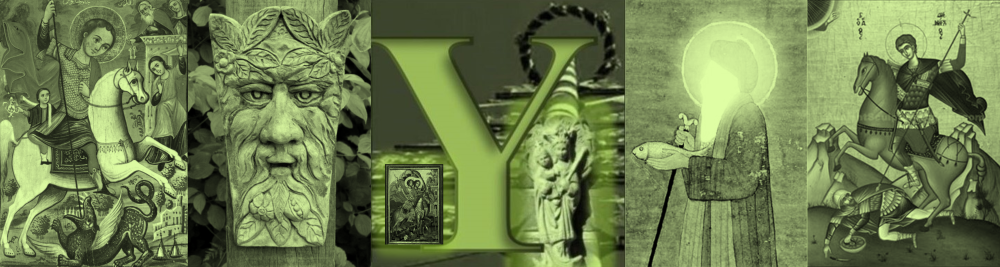
St George and Al khidr – 23 April

St George and Al khidr – 23 April

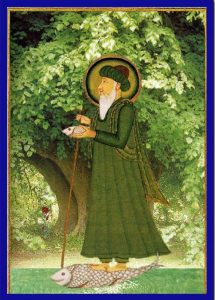
Hıdırellez or Hıdrellez (TurkishHıdırellez or HıdrellezAzerbaijaniXıdır İlyas or Xıdır Nəbi; Crimean Tatar: Hıdırlez; Romani language: Ederlezi) is a folk holiday celebrated as the day on which the prophets Al-Khidr (Hızır) and Elijah (İlyas) met on Earth.[1] Hıdırellez starts on the night of May 5 and ends on May 6 in the Gregorian calendar, and April 23 (St. George’s day for the Christians) in the Julian calendar. It is observed in Turkey, Crimea, Gagauzia, Syria, Iraq, the Caucasus, and the Balkans and celebrates the arrival of spring.

Khidr (Arabicٱلْخَضِر‎romanizedal-Khaḍir), also transcribed as al-Khadir, Khader, Khizr, al-Khidr, Khazer, Khadr, Khedher, Khizir, and Khizar, is a figure described but not mentioned by name in the Quran as a righteous servant of God possessing great wisdom or mystic knowledge. In various Islamic and non-Islamic traditions, Khidr is described as a messenger, prophet, wali, slave, or angel who guards the sea, teaches secret knowledge, and aids those in distress. As guardian angel, he prominently figures as patron of the Islamic saint Ibn Arabi. The figure of al-Khidr has been syncretized.

Hıdırellez is regarded as one of the most important seasonal bayrams (festivals) in both Turkey and parts of the Middle East. Called Day of Hızır (Ruz-ı Hızır) in Turkey, Hıdırellez is celebrated as the day on which the prophets Hızır (Al-Khdir) and İlyas (Elijah) met on Earth.[3] The words Hızır and İlyas fused to create the present term. Hıdırellez Day falls on May 6 in the Gregorian calendar and April 23 in the Julian calendar. In other countries the day has mostly been connected with pagan and Saint George cults.

The word Hıdırellez, born out as a compound form of Hızır and İlyas, they are regarded as two different persons. In respect to religious sources, there are several references on İlyas; However, there is no slight mention about Hızır. The perception of seeing Hızır and İlyas as identical arises from the fact that İlyas stands as an obscure figure within the context of Tasavvuf (Sufism) and popular piety when compared to Hızır and there are numerous legends on Hızır, whereas little is known about İlyas and furthermore, there are many great maqams of Hızır, yet there are only few maqams for İlyas. Ali the Fourth Caliph is associated with Hızır within Alevi-Bektaşi belief system.

St. George is the figure corresponding to Hızır in Christianity. Besides being associated with St. George, Hızır is also identified with İlyas Horasani, St. Theodore and St. Sergios. St. George believed by Muslims to be identical with Hızır, is also believed to be similar to some Muslim saints; St. George is identified with Torbalı Sultan and Cafer Baba in Thessaly, Karaca Ahmet Sultan in Skopje, which is a mounting evidence how St. George and Hızır have influenced St. George’s Day and Hıdrellez Day ceremonies.
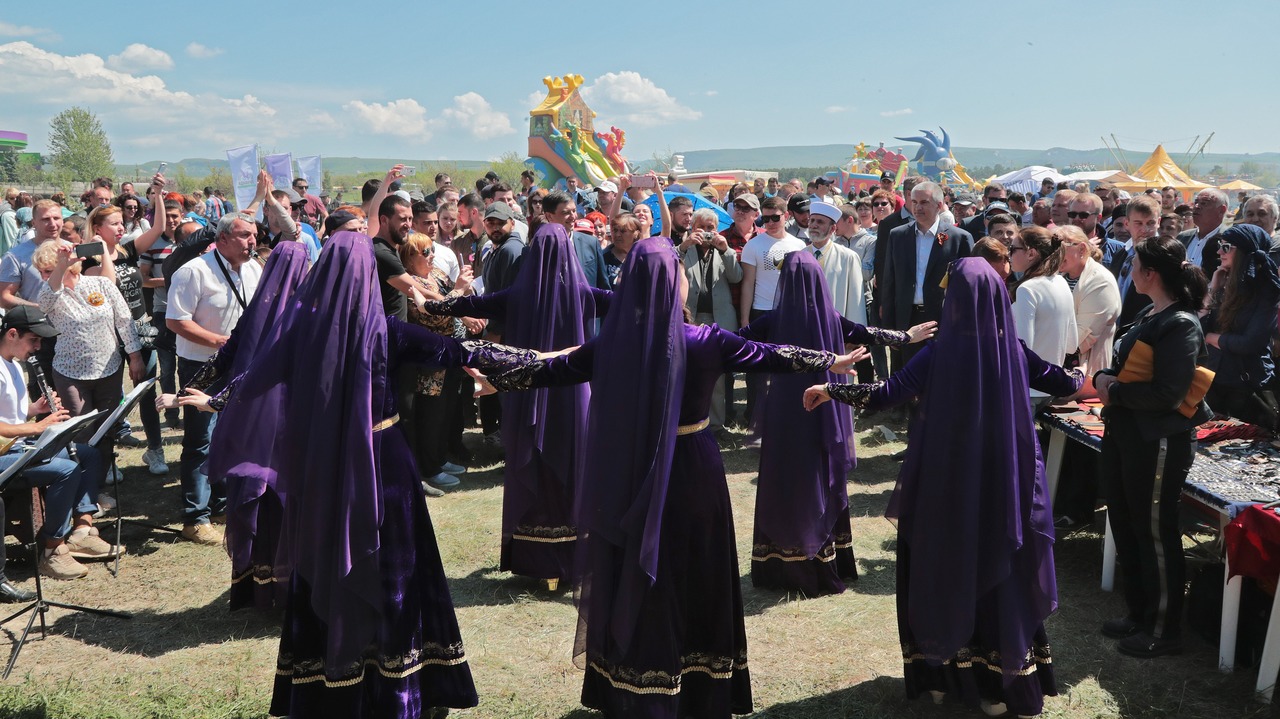
Hıdırellez_in_Crimea_03

Hıdırellez or St. George Day is also celebrated under the name Dita Verës (Summer Day) in Albania which was originated by the pagan cult in the city of Elbasan – the so-called Zana e Çermenikës- the goddess of forest and hunting. It is celebrated on March 14 and symbolizes the end of winter and the beginning of spring and summer. At the same time, in different regions of Albania, it is celebrated among some other communities known as Dita e Shëngjergjit, St. George Day on May 6.

Hıdırellez is widely spread celebration in most Syrian territories, but mainly practiced in the rural areas. We have information about spring rituals practiced since ancient times. Those rituals are the manifestations of the celebration for the arrival of spring and summer. Further of the symbol of spring and resurrection of life that is, so called ever-green, ever-return Al-Khidr prophet. Rituals take place annually on May 6. People, Muslims and Christians, regardless of their religious affiliation, celebrate the living Alkhidr prophet that is St. George or Mar Georgeos. The cult of celebration of St. George has become influential over the formation of Eid Alkhidr in Syria as well. The two names are identical. People go to picnic to the natural places, practicing the rituals of celebration, including performing folk music, singing and dancing. In the area of Zabadani for example, people used to gather around a tree aged about 800 years as a symbol of the ever-return Alkhidr.

One widespread belief suggests that Hızır has attained immortality by drinking the water of life. He often wanders on the earth, especially in the spring, and helps people in difficulty. People see him as a source of bounty and health, as the festival takes place in spring, the time of new life.[1] To date, the arrival of spring or summer, figuratively meaning the rebirth of nature or the end of winter, has been celebrated with ceremonies or various rituals at every place in which mankind lives. Within the seasonal cycle, winter symbolizes death; spring symbolizes revival or regeneration of life. Thus, time for the days full of hope, health, happiness and success comes. Therefore, Hıdırellez Day is highly significant since it is believed to be the day on which Hızır and İlyas met on the earth, which is accepted as the arrival of spring/ summer.

In Turkey, it is widely believed that Hızır is the prophet who while bringing fertility to man wanders on the earth and as for the prophet İlyas, he is accepted as the water deity. In order to fulfill some of their missions, these two prophets wander around the land and the sea throughout the year and meet on May 6. This meeting stands for the fusion of the land and water.

Today, the ceremonial activities for Hıdırellez are prevalently and elaborately prepared especially in villages or towns rather than metropolises. The preparations for the celebrations are associated with the issues as cleaning the house and the garments, dress, finery and food-drink and doing shopping for the feast. The indoor of the houses and the outdoor places as gardens are supposed to be clean, because Hızır is expected to visit the houses on that day. Almost everywhere, garments and other apparels and food-beverages are common components of Hıdırellez ceremonies. All the preparations related to the ceremonies are of particular concern to the young men or women, since Hıdırellez is regarded as the most proper occasion for the youth-willing to marry in the future-to find a suitable match.

Hıdrellez ceremonies are held in the countryside near the cities, towns or villages where generally streams, lakes or other water springs exist. By great majority, there are tombs or shrines open to visits in those locations which are placed on hills. Bearing the specific features, Hıdırlıks are particularly chosen for Hıdırellez ceremonies.

As Hızır is believed to be a healer, some ritual practices as regards to health issues can be seen on Hıdırellez Day. On that day, meals cooked by lamb meat are traditionally feasted. It is believed that on Hıdırellez Day all kinds or species of the living, plants and trees revive in a new cycle of life, therefore the meat of the lambs grazing on the land which Hızır walks through is assumed as the source of health and happiness. In addition to these, some special meals besides lamb meat are cooked on that day.

The other ritual practice for seeking health and cure is the ritual of jumping over the fire which is built by old belongings or bushes. While uttering prayers and riddles, people jump over the fire at least three times. That fire is called Hıdırellez fire; hence, it is believed that all illnesses or diseases are warded off all the year long. Another ritual practice for having good health on Hıdırellez Day is to be awash or bath by water brought from some holy places.

It is believed that all the wishes and prayers come true on the eve and the very day of Hıdırellez. If one wishes to have more properties, s/he makes a small rough model of it onto the ground in the garden and Hıdırlık. Occasionally, the wishes or prayers are written on a piece of paper and thrown under the rose trees, etc.[1]

Furthermore, within the scope of Hıdırellez ceremonies in Turkey and the countries mentioned, some practices related to seeking for good fortune and luck can be seen. One of those practices is the tradition called “mantufar, martifal etc.”, which is played to have good fortune. On 5th of May, the girls or women seeking for good fortune, luck or a suitable match to marry put their rings, earrings etc. into a pot. Then, the pot is closed after pouring some water into it. Afterwards, the pot is left under a rose tree for one night and the following day, women put the pot in the middle of the crowd and take their belongings out while reciting mâni (rhyming Turkish poems).

At first sight there seems to be little connection between Elijah, George and Khidr, apart from the fact that in the Middle East they are frequently associated with the same place by different religious traditions. Is it then a simple case of overlapping traditions, Jewish, Christian and Muslim, all of whom focus on the Holy Land as part of their own heritage and take Abraham as their forefather?

Certainly there is a view which suggests that Khidr is to Muslims what Elijah is to Jews, in respect of them both acting as initiator to the true believer, and which in itself is testimony to attempts to find common ground between the three traditions.

The sacred sites associated with Elijah, George and Khidr over centuries seem to have accumulated worship in various forms, so that one sits quite literally on top of or next to another. The sites often exhibit similar attributes: for instance, the presence of water and greenness, suggesting fertility in a barren land; or perhaps a cave, which represents a meeting-place of two worlds, the manifest and the hidden (and on occasion both elements are present, as at Banyas).

Then there is the ancient theme of the spiritual side of man being dominant over the material, as suggested in the stories by the holy rider on a chariot or horse (or in the case of Khidr, a fish).

This is a clear picture of the divinised human, who comes to deliver mankind:

Elijah is zealous for God and the destroyer of false prophets,

while St George is the conqueror of animality in the form of the dragon;

Khidr’s role is rather less vividly martial – he brings real self-knowledge, delivering the individual from the false and base nature of the soul.

In all three cases one can remark the polarity of the monotheist or true believer and the pagan or ignorant: Elijah and the prophets of Baal, St George and the emperor Diocletian, for example and perhaps most strikingly in this respect, Khidr who points out the interior meaning of this opposition and is thus the educator of Moses.

However, we should note significant differences in their status, which in part reflect the religious context in which they appear: Elijah is a prophet, in a long line of prophecy; St George is a saint, martyred for his faith in the tradition of Christianity; Khidr, however, is almost a nobody – he is neither saint nor prophet, but an ordinary person graced with immortality and initiatic significance. While the first two are usually portrayed as mounted, Khidr has his feet upon the ground (or just above it in some stories) or walks on water; as we shall see, he has a most particular role to play in mystical teaching. Read more here

  • Saint George (Khidr) Slays the Dragon and Becomes a Saint

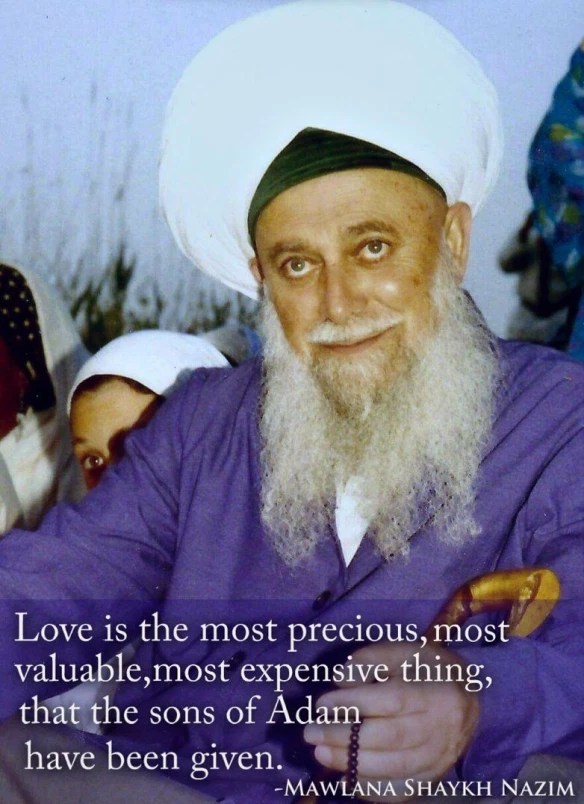
Sultan al Awliya  Mawlana Shaykh Nazim al-Haqqani 2 September 2009 Lefke, Cyprus

In the holiest month, Ramadan. Blessed month. And through this blessed month I am trying to reach something from spirituality. Through spirituality I am asking to reach the level of holy ones, that holy ones they are blessed ones. Blessed ones and O people! If you are not going to reach blessings from heavens through your whole life, what is the benefit of your existence here?

What does it mean? It means nothing nothing! Why? Why you are not asking “Am I in existence to be nothing? To be like a dust?” It is big blame, O people! if I am not asking that question, “For what I am in existence? What is the main aim of my being in existence? For what I have been granted eyes, ears, tongue, hands, feet and a perfect figure? Yes, man just created on a perfect figure. No any other created as a man. The creation of man it is perfect.

But if you are not thinking Who granted to you who is figure, designer, for you, for what granted that to you , you must think on it. Designer of man on same womb, designing some babies as a man. Designing some babies as a baby girl or baby boy. As He likes. You are not putting your will there to say “I must be figure of man.” Or “I must be figure of lady.” Or no one can say, “I must be red color or white color or ? color or green color.

“O Shaykh we are never hearing of green color man!”

“Yes, we  must be. You are not looking east and west. Say to top people that you must do and you must look and find green men also.

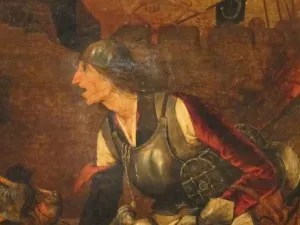
Yes there is green men, it is true. there is green man. Only one, but he is not also, his face green, but that is then Christians saying St. George, but we are saying Khidr (as) . Green man, chevalier St. George. Always in his hand he is killing a dragon. Very good. It is very very and a  important symbol that they are making a figure on a horse through his hand a spear and killing a dragon. So many people they are taking only looking to that figure, but really that figure asking to teach people.

O people! That one who is a famous personality through creation, through his hand with a spear killing a giant gigantic dragon.

O people! Look what does it mean? It means that St. George going to be a saint because he killed that dragon that it is  representing our egos. Killing and going to bury the same. O people! ! Enough to carry your feelings that belongs all of them to your dragon. Leave that feelings and kill that one then everyone going to be a St. George, a blessed one in the Divine Presence. And that Green Man is only one. And asking to teach people “O people! Til your most terrible enemy, the dragon is killed…but you are not taking any care of it.

As everyone knows that every prophet they were sitting on earth, not on thrones. There are some exceptions, doesn’t matter, but mostly whole prophets sitting on earth with poor people, weak people, native people, and aseer, (slaves) slave people. They were sitting with those people and that not taking honor from them but giving honor because they are trying to give something to our Lord’s creatures. They tried to make people best ones, not the worst ones. Who is working for their egoes and no other aim for them is except their dragons? Therefore don’t try to be “First Lady”or “Number One” in America, in Turkey, in England, in Russia.

Who is first one? Who is best one? Don’t think that every first one going to be best one. Everybody thinking first one. First one they claim but it is not important. Important is that one who is claiming to be best one. Are you best one? Give answer to me. To be “First One” if making you best one, bravo. If not then it is a very dangerous situation to be “First Lady”or “Number One” through nations. No. Only if you are asking our honor in Divinely Presence. Yes, you may claim, “I am first one on earth” but on heavens do you think your name written under tables of best ones? Old Testament, New Testament, Psalms and Holy Quran what there are saying? What are they teaching people? Teaching them to be best ones or worst ones? Say! Popes say! Archbishops say! Patriarchs say! Presidents say! Philosophers say! Hindus say! Buddhists you may say! The Lord of heavens asking from you to be first ones or best ones? That is the main source of troubles on earth.
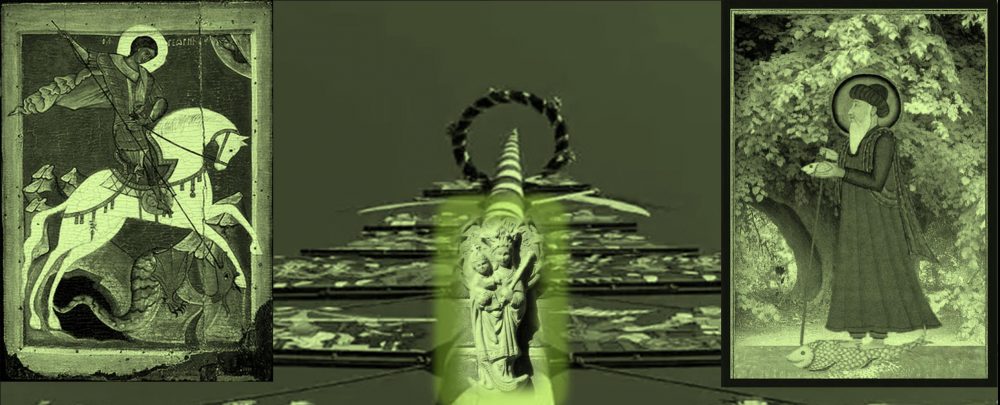
Look also to St george day- 23 April

Mawlana said that we have entered the time of Sayyidina Al-Mahdi (as) and the the command for Muslims now is to distinguish themselves from non-Muslims to be under Divine protection and “The Green – Yeşil” is the door.

THE GREEN

Shaykh Mohammad Nazim Al-Haqqani An-Naqshibendi, Sohbat of the 30th of September, 2012.

Bismillahi r-Rahmani r-Rahim.

To the people of this time: Which is the most beautiful color? It is green. Who wears a green cap, a green dress; who paints their houses green; who keeps a green flag on their cars- these ones are seen from above & are under protection. There is no protection for any other color, only for green.

Let everybody hang green flags on the endpiece of their cars. Green… If they like they can put on it the old flag of Egypt, it is green. Turks also have green. They also can put Turkish flag. They should put green flag. If the sky came down to earth, it wouldn’t touch them.

Who uses green dress, green cap, nothing comes on him. Who pays attention to wearing green dress, at least whatever dress he/she puts on should be green. Green is the heavenly protection. It is heavenly protection. They should pay attention to green. May Allah forgive us. Fatiha.

Green is the most beautiful of the colors. It is the color of life, it has descended from Heavens. Therefore they should pay attention to this. Fatiha.

No harm touches the one who loves green in dunya & in akhirah. This is the new instruction from Heavens: Green, it is the color of life. It is the color the angels love. Sundus, sundus al- akhdar (fine green silk). It is green, it is the most beautiful color of the paradises. Sundus, therefore they should wear it. The scarf on their head, green silk. They can put embroidery or needlework on it, whatever they want to do. Basically they should put green cap. They don’t suffer from headache. These ones don’t suffer from headache. There is a special angel that protects them. If all that the sky carries of punishment came down to earth, it won’t touch them.

Like this, vest also should be green. If they circulate this green color, the heaviness in the world will be lifted. Let them be careful about this. They should love the green color. It has the love of the habitants of paradise in it- sundus al-akhdar/green silk. Is it not? O Allah, You know. There are things to come on those who don’t love it. There is special angel to protect those who wear green. There is an angel who descends from Heavens. Let them pay attention to this. Women and men, all. At least they should put green rosette (pin) on their chest. It protects them.

Ladies should prefer dark colors. Dark colors should be preferred, should be the choice of the ladies. Therefore I don’t like light colors, I don’t like at all. May Allah forgive us. Fatiha.

If they are to paint the outside of their houses, they should prefer green. They should choose for dresses the green ones. They should prefer green color in the furniture they use. It brings them good luck. Green color brings good luck. Other colors are unlucky except the green color, it is the color of life. They should wear it, use it. These people become lucky. The people of this time should pay attention to this also. They don’t say “O my head, O my teeth.” Who covers his/her head with a green cover will not suffer from headache.

The latest fashion of Islam in the end of times is this, our fashion is this. Everything other than this and something will befall them. They should at least put something green around their necks. They should at least put green turban/ cotton cover on their heads. Let their cars be green. I will make green ghalib/victorious. Green prevents punishment. It turns away calamity. It turns away accidents and calamities. This is also a new instruction. Be careful about this. Fatiha.

Men should wear green rosette on their chests. Ladies should wear green colored stones, jewelry. If green prevails in the world all troubles will go away & finish. O Lord, may You forgive us. May You send us Your servants who will teach us. There is divine protection in the color green.

The cars also, they have something for flags. They should put a green colored flag on it- with 3 crescents, or with 3 stars, or with 1 crescent & 3 stars. It should be green. No accident or calamity comes on them. May Allah forgive us.

Green brings majesty, angels love it. The color of fire- the people of this time have a tendency for red. Their fashion is red. It is fire, it burns them. Green gives comfort, gives beauty, gives peace, gives barakah. Be careful about this. O the ladies of this time, adorn yourselves with green. Fatiha.

The greenery. Use the greenery that grows in nature, the greenery that grows in nature by the power of Allah Almighty. Eat them, grow them & have no fear. Meat makes you wild. Vegetables & greens make you friendly & soft. It makes you kind & ladylike, or it makes you a gentleman. Or else you become a wild animal. Allah… May Allah forgive us.

Fatiha.
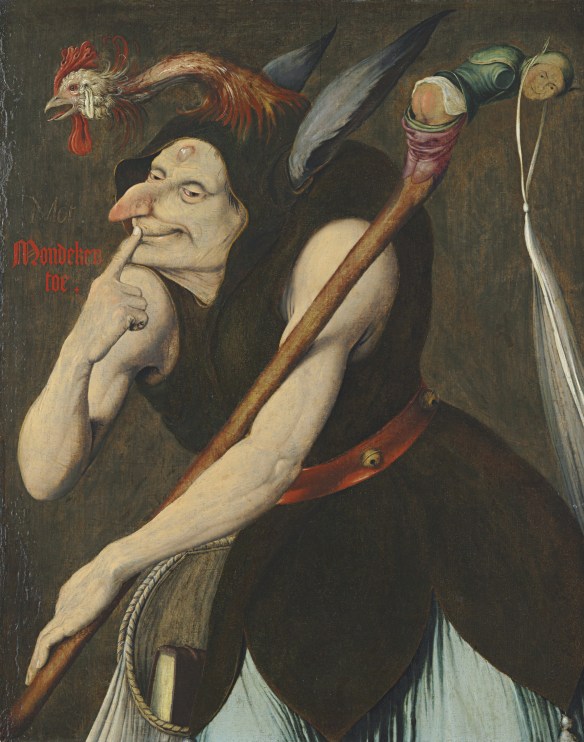
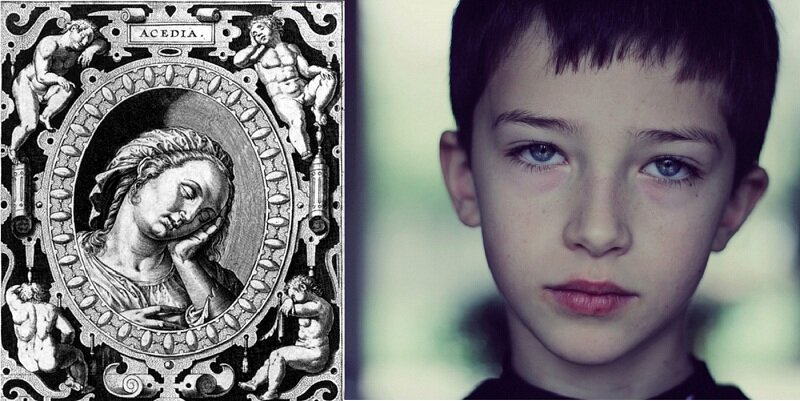
Acedia = Lack of Care

In Praise of Folly, Erasmus

“The supreme madness is to see life as it is and not as it should be,

things are only what we want to believe they are ...”

Jacques Brel

DP818263

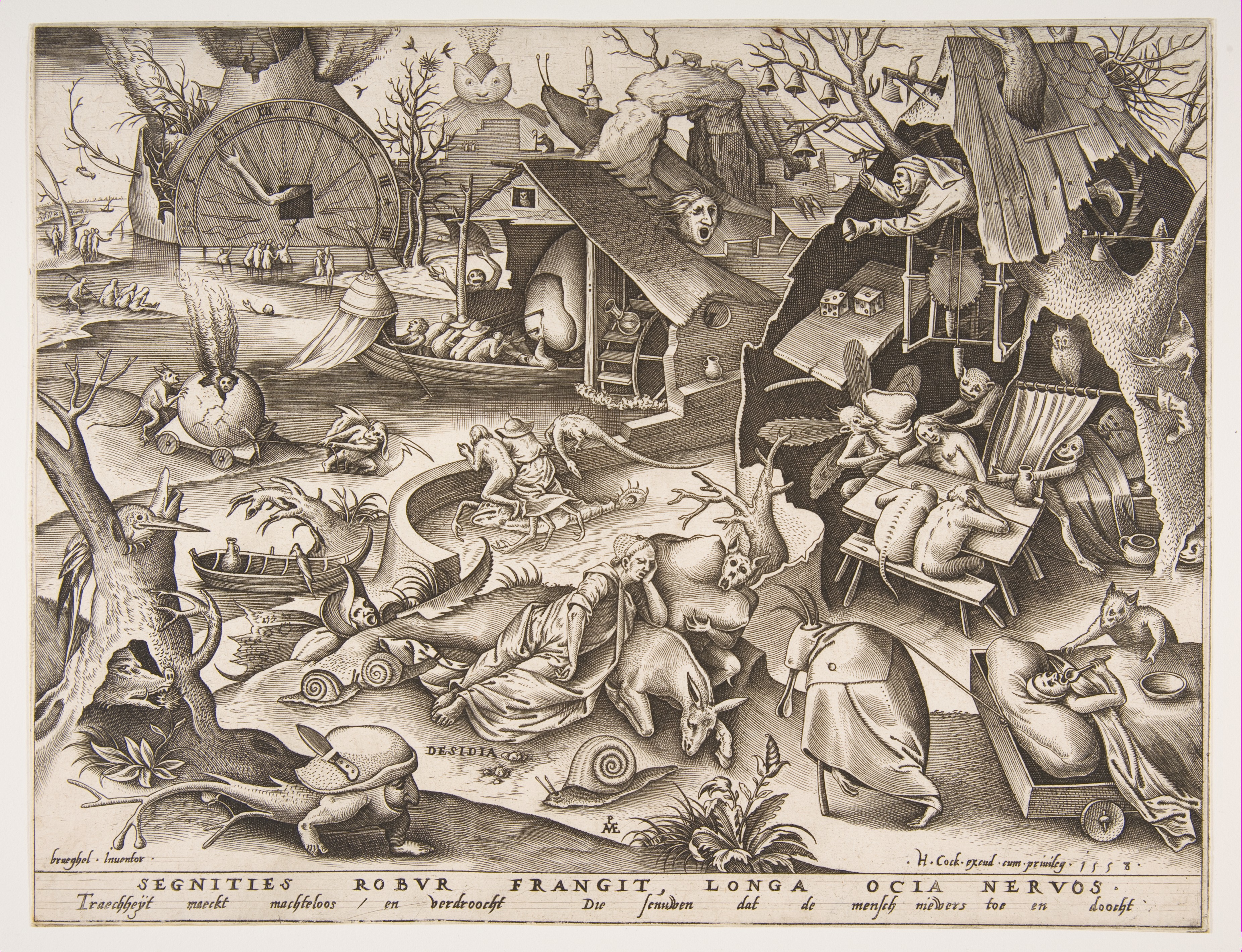
Sloth – Acedia makes man powerless and dries out the nerves until man is good for nothing.”

Acedia (/əˈsiːdiə/; also accidie or accedie /ˈæksɪdi/, from Latin acēdia, and this from Greek ἀκηδία, “negligence”, ἀ- “lack of” -κηδία “care”) has been variously defined as a state of listlessness or torpor, of not caring or not being concerned with one’s position or condition in the world. In ancient Greece akidía literally meant an inert state without pain or care.

SLOTH (Laziness, Indolente, Desidia, Accidia, Pigritia, La Paresse, Trágheit,

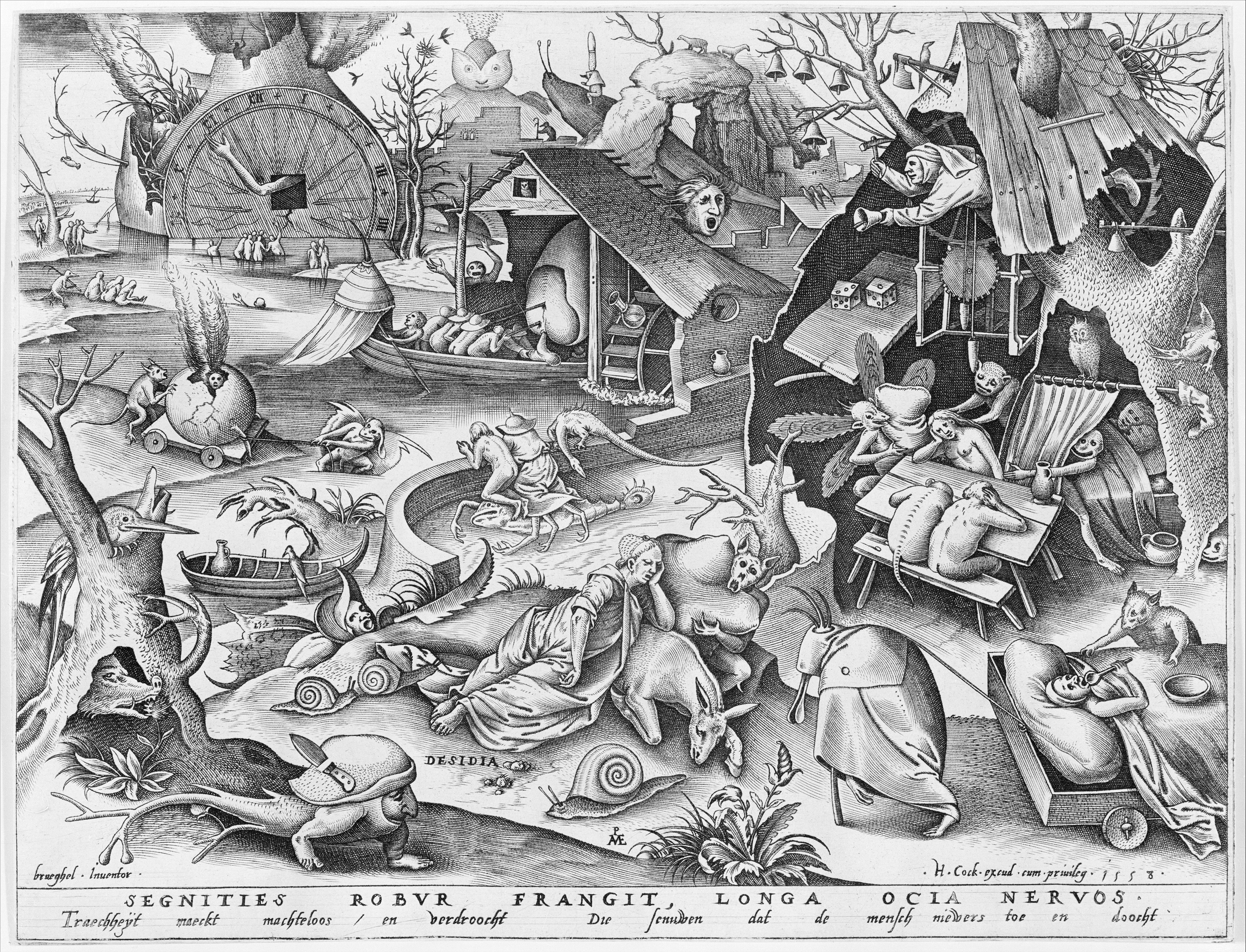
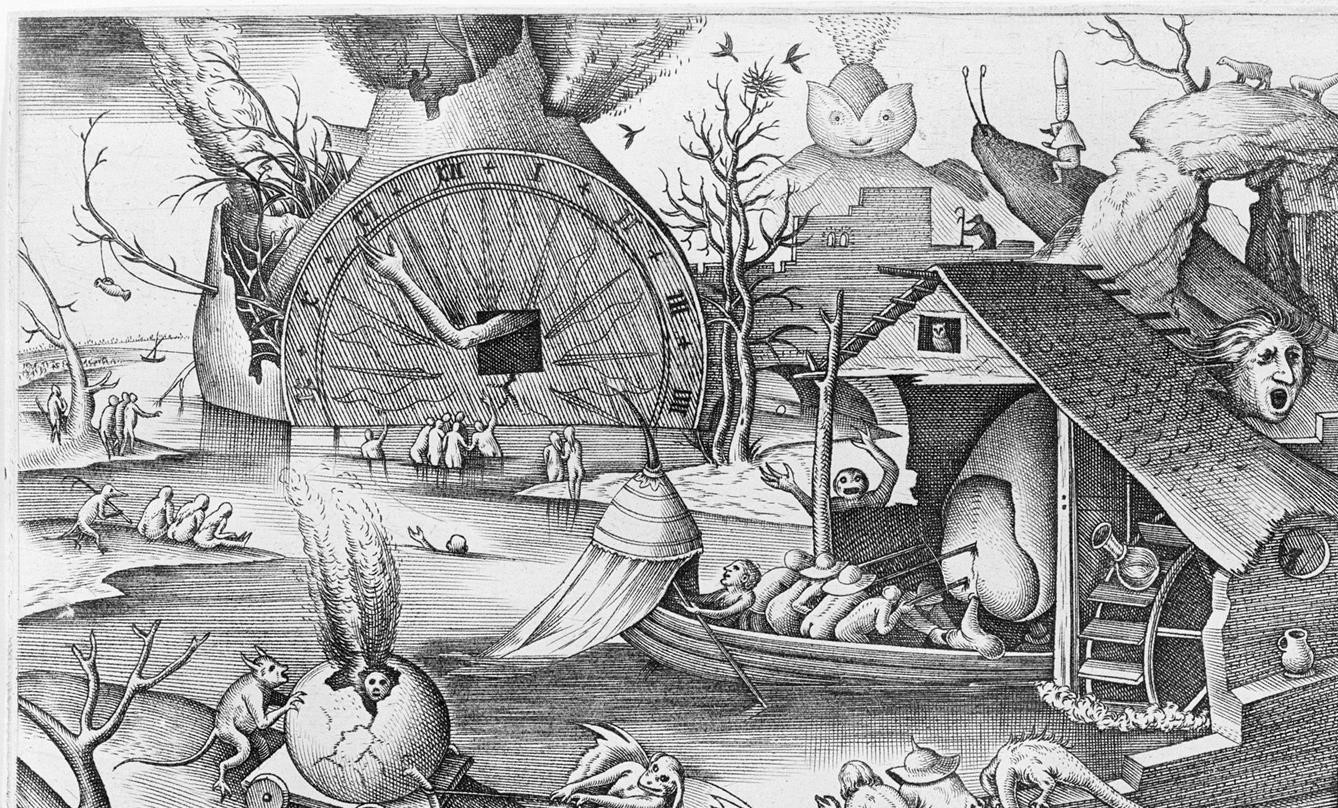
The original drawing, in the Albertina, Vienna, is dated 1557.

Many a modern must find this not only the most passive and negative but in many ways the most haunting and shattering of Bruegel’s seven Sins.

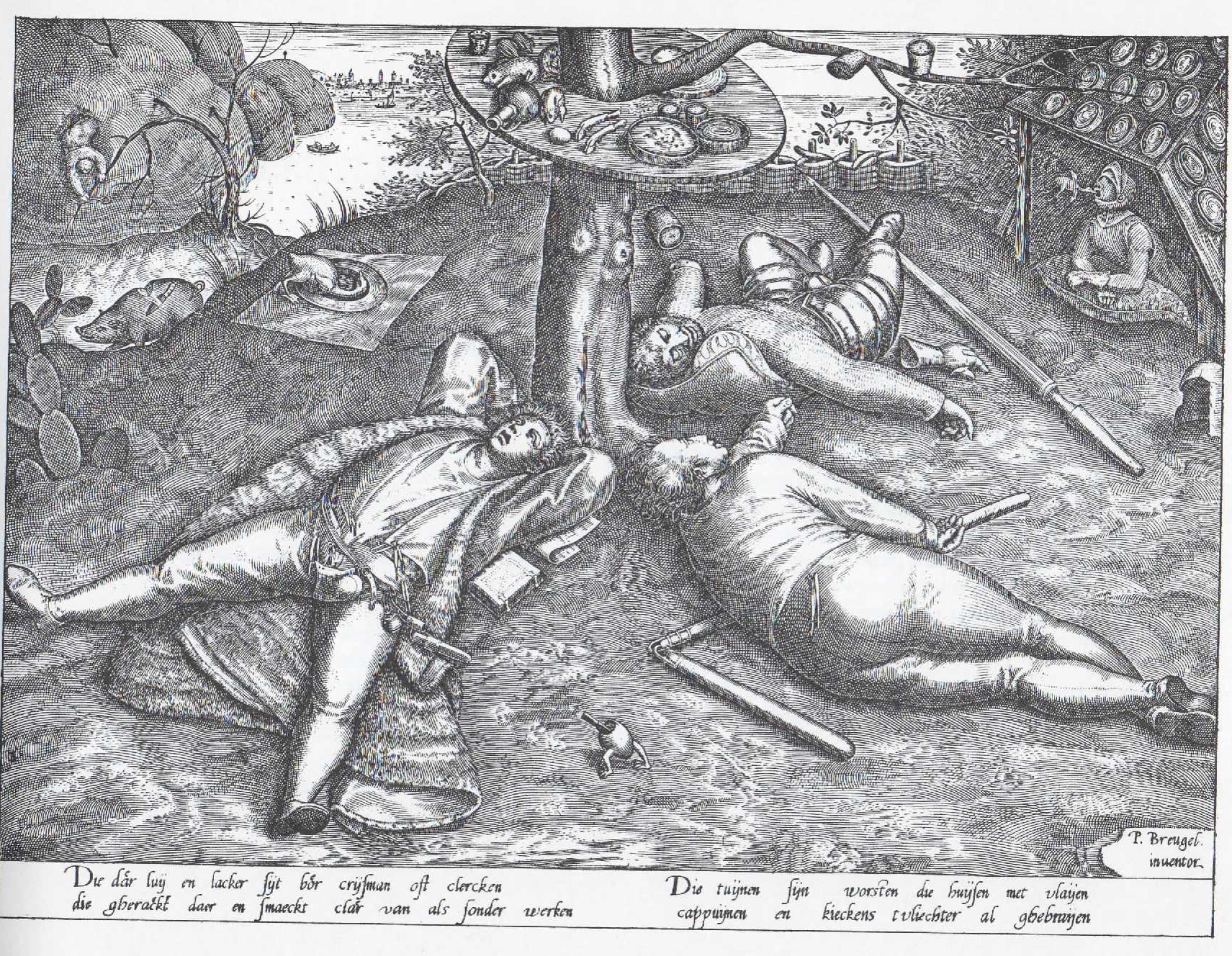
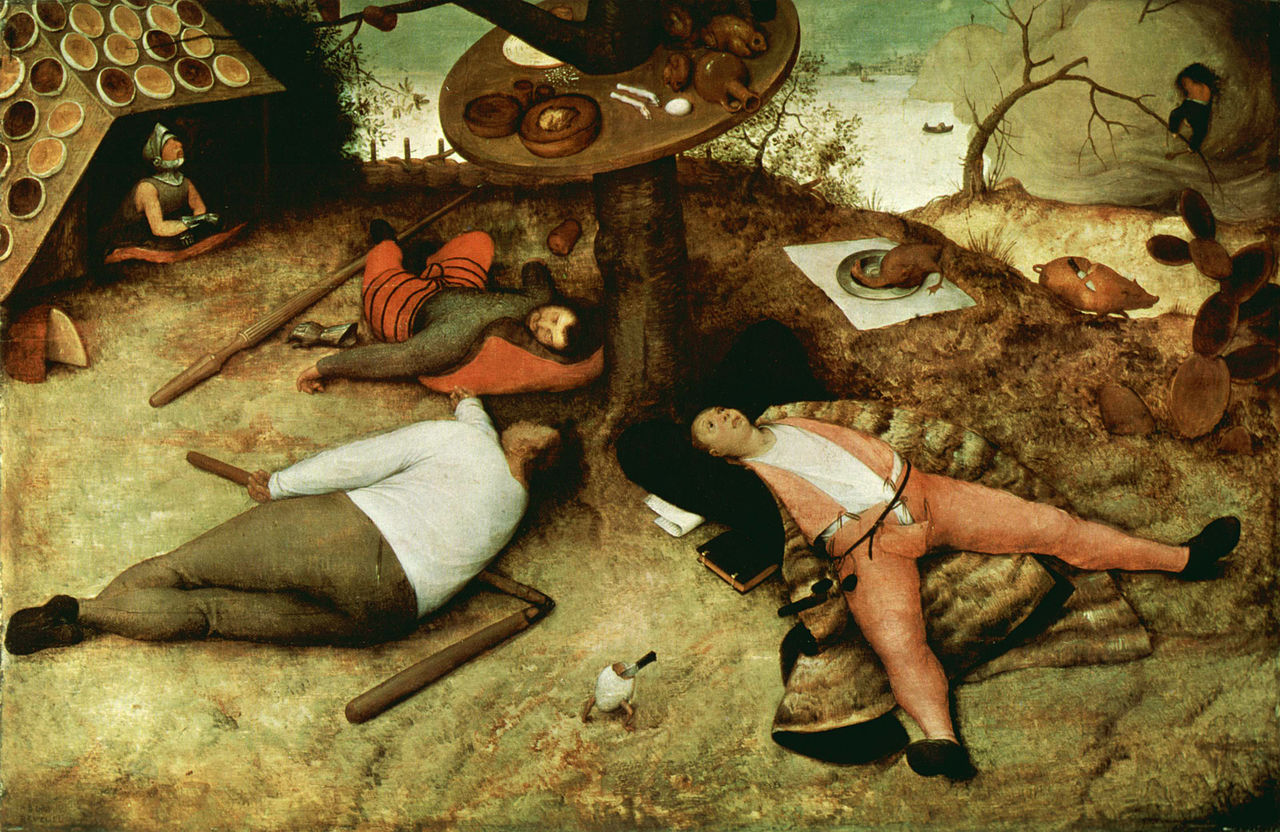
It symbolizes the evils of the vice which was treated with more irony and folksy fantasy in “The Land of Cockaigne,” reproduced as Plate 32. In that print, Plenty has destroyed ambition, energy, activity.

Evert0321280px-Pieter_Bruegel_d._Ä._037

The arrangement of the clerk, peasant, and soldier underneath the tree suggests the men as the spokes of a wheel, where the tree is the hub. The roasted fowl lies in the place where a fourth spoke could be.

Ross Frank has argued that the painting is a political satire directed at the participants in the first stages of the Dutch Revolt (1568–1648), where the roasted fowl represents the humiliation and failure of the nobleman (who would otherwise form the fourth spoke of the wheel) in his leadership of the Netherlands, and the overall scene depicts the complacency of the Netherlandish people, too content with their abundance to take the risks that would bring about significant religious and political change.[3]

The painting has also been cited as illustrating the Freudian oral stage of psychosexual development,[4] showing a paradise of oral pleasure. It is used to demonstrate how human beings achieve oral pleasure and stimulation from eating and simply having things in the mouth.

see here more info: The land of Cocagne

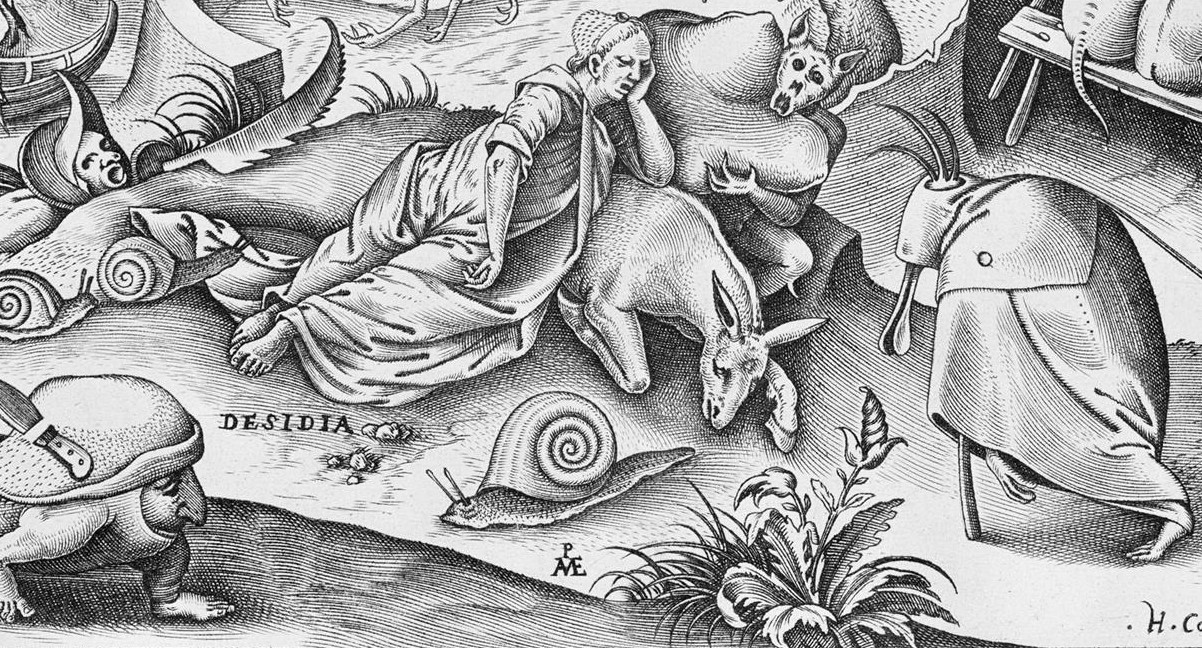
Here, Sloth herself, older and uglier than the other allegories, sleeps open-mouthed in a landscape of delay, decay, and ultimate impotence

sin acedia 1

She reposes on her beastly counterpart, a sleeping ass. A monster behind her adjusts her pillow. Around her crawl huge snails. Even the hill of Sloth is soft as shown by a winged demon sawing into it at left. One art historian sees the saw as a suggestion of Dame Sloth’s snoring as she sleeps. Another regards the sawman as a symbol for malicious gossip, his mouth ever open as he cuts away the ground from under others. ( To try to let the other come in problems).

sin acedia 2

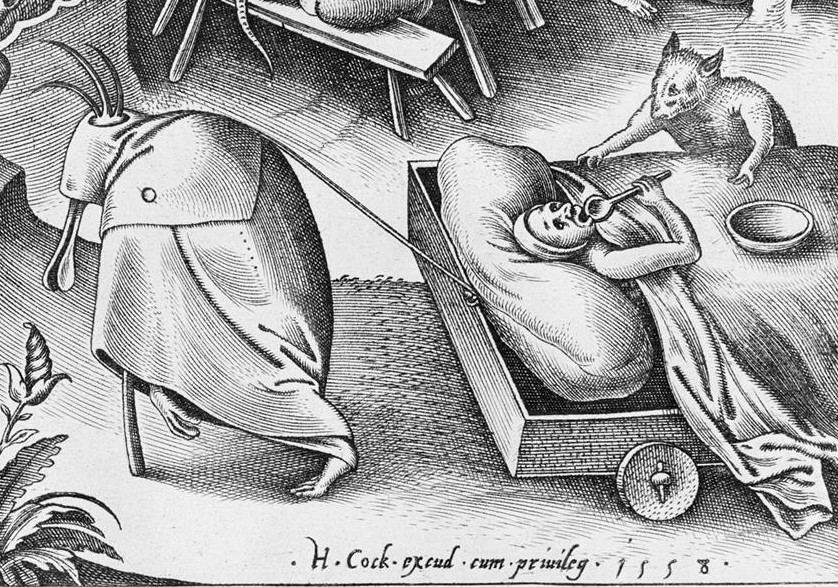
From the right, a stork-beaked monster in monk’s garb drags a sinner too indolent to leave his bed; he eats as he lies. The counterpart of this monk, Tolnay finds in Bosch’s ” Temptation of St. Anthony” painting (Lisbon). At the lower left, on a nearer hillock, trawls an all-head-and-feet monster, dragging a tail half fish, half branch. A hollow tree, farther left, contains a great pig’s head and provides a perch for a demon bird.

MM12067sin acedia 3

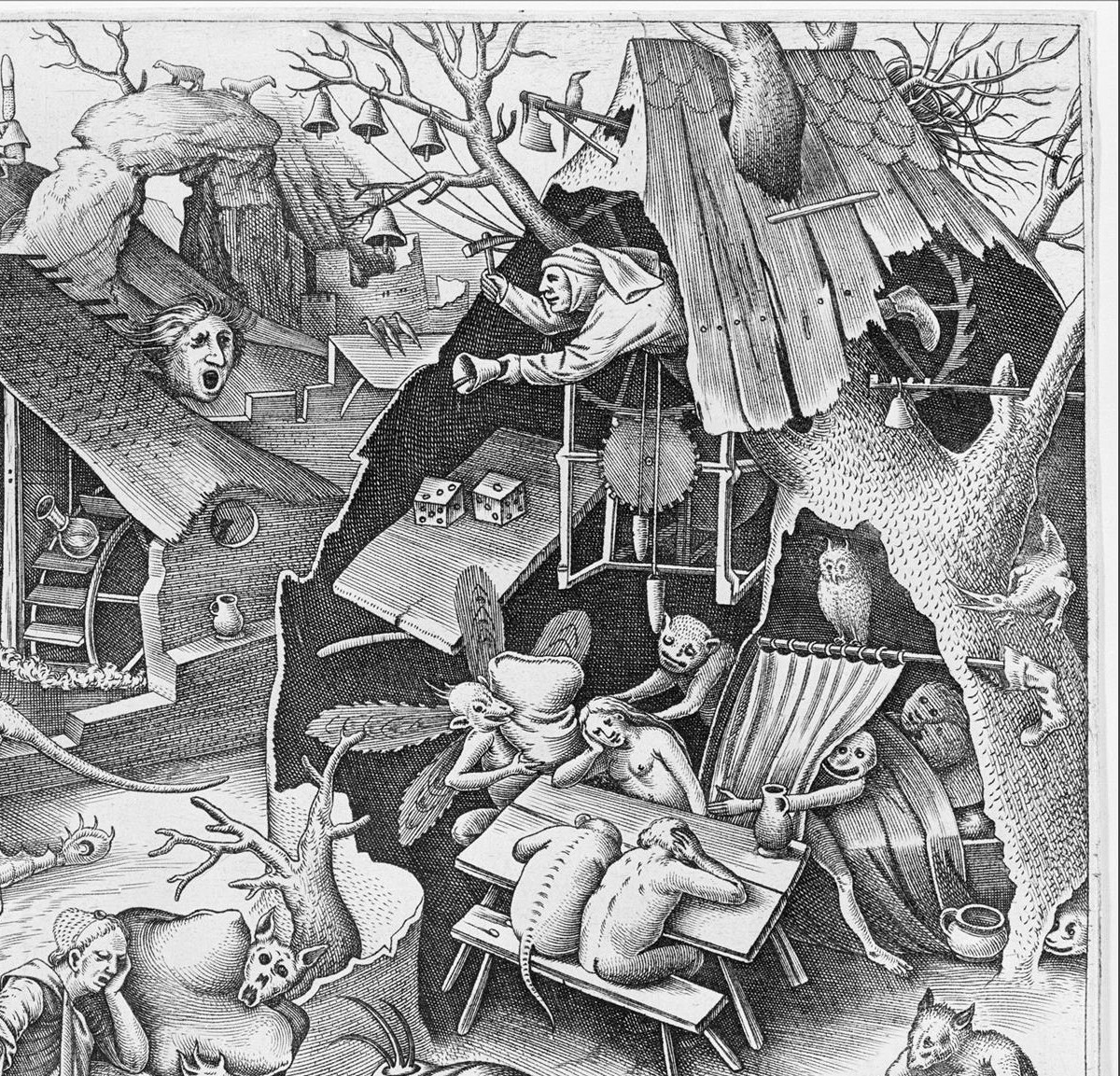
The hollow-tree symbol is extended enormously to the right of Dame Sloth. In this shell-like structure mingling building and tree, naked sinners and monsters sleep around a table. A couple lie together in bed behind a curtain. The demon leers around it as he seeks to draw the sleeping girl inside. Sloth or excess leisure encourages lechery. An owl, again, looks down cryptically.

Dice on the table to the left of the owl refer perhaps to gambling by lazy time-wasters. A man, caught in a great clockwork above, strikes a bell with a hammer. Tolnay reads this as a kind of pun, for in the Flemish lui ( Luid)signified both the verb “to ring” (as a bell), and the adjective “lazy.”

The idea of clock and time a-wasting appears again at the upper left. Like some effect in a Jean Cocteau motion picture, a human arm points to 11 o’clock. The lazy leave things till the eleventh hour.

sin acedia 4

And catastrophe lies behind—a blaze is burning up the broken structure, filled with dead branches.

A little to the right, just below the top margin, a mountain top with human face spouts smoke. A little farther to the right an enormous slug raises its feelers into the sky as it trawls through a stone arch. On its neck rides an almost unreadable strange distortion: a monster with a shaft (candle ?) instead of a head.

Below, just above center, a squatting giant, built into a mill, enacts a proverb common to many a culture: “He’s too lazy to shit.” The faceless midgets in the boat behind him are inducing a bowel movement with poles and pressure. Another owl looks through a small square window in the roof above this operation.

On the bank, somewhat to the left, two demons drag into the water of sin a woman almost bidden inside a seething hollow egg, which looks also like a beet or turnip.

References to many other Flemish proverbs have been shown or suspected. Basic to the complicated spectacle as a whole is the thought in the Flemish rhyme below the print. It is roughly rendered in English thus : Translation of Latin caption: Sloth breaks strength, long idleness ruin the sinews

 The various examples of lazy or slothful behavior, in evidence in the surrounding landscape, colorfully demonstrate the message of the inscription below: “Sloth makes man powerless and dries out the nerves until man is good for nothing.”

In short, sloth, far from resting, recuperating and rejuvenating,waste a man away, renders him impotent and good for nothing. He becomes like a slug, a slave of the stupefied tyrant machine, DAME Desidia   or Acedia , ἀκηδία, “negligence”, ἀ- “lack of” -κηδία “care”) has been variously defined as a state of listlessness or torpor, of not caring or not being concerned with one’s position or condition in the world.

Mentally, acedia has a number of distinctive components of which the most important is affectlessness, a lack of any feeling about self or other, a mind-state that gives rise to boredom, rancor, apathy, and a passive inert or sluggish mentation. Physically, acedia is fundamentally associated with a cessation of motion and an indifference to work; it finds expression in laziness, idleness, and indolence.

Emotionally and cognitively, the evil of acedia finds expression in a lack of any feeling for the world, for the people in it, or for the self. Acedia takes form as an alienation of the sentient self first from the world and then from itself. Although the most profound versions of this condition are found in a withdrawal from all forms of participation in or care for others or oneself.

Sloth not only subverts the livelihood of the body, taking no care for its day-to-day provisions, but also slows down the mind, halting its attention to matters of great importance. Sloth hinders the man in his righteous undertakings and thus becomes a terrible source of human’s undoing

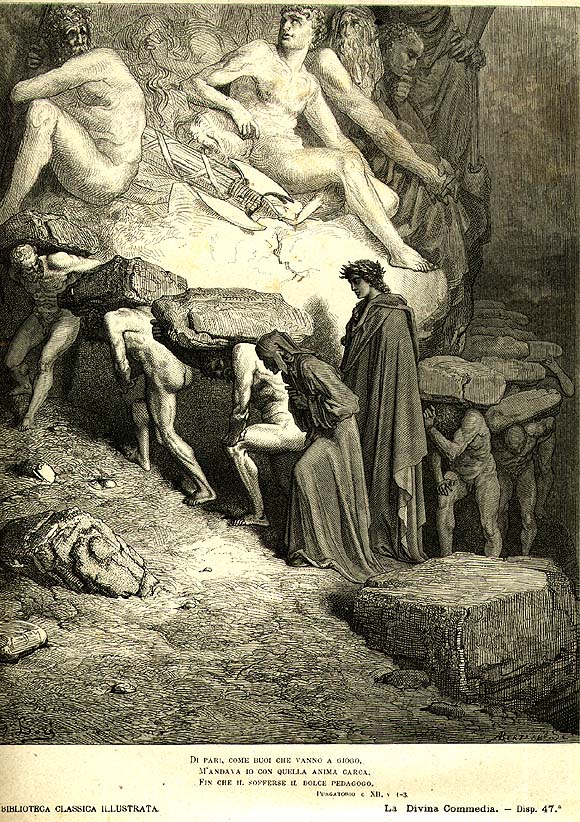
In his Purgatorio Dante portrayed the penance for acedia as running continuously at top speed. Dante describes acedia as the “failure to love God with all one’s heart, all one’s mind and all one’s soul”; to him it was the “middle sin”, the only one characterised by an absence or insufficiency of love, virtue and uprightness.

The antidote Industria  meaning Craftmanship , Diligence ,Persistence, effortfulness, ethics, Virtues and sincere uprightness.

  • The Tower of Babel by Breughel

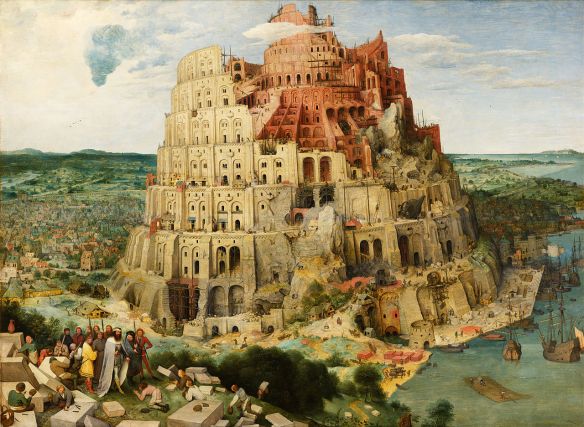
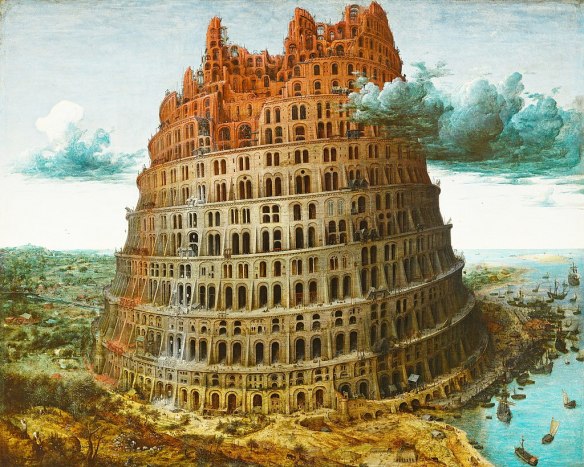
The Tower of Babel was the subject of three paintings by Pieter Bruegel the Elder. The first, a miniature painted on ivory, was painted while Bruegel was in Rome and is now lost.[1][2] The two surviving paintings, often distinguished by the prefix “Great” and “Little”, are in the Kunsthistorisches Museum, Vienna and the Museum Boijmans Van Beuningen in Rotterdam respectively. Both are oil paintings on wood panels.

The (Great) Tower of Babel

The (Little) Tower of Babel

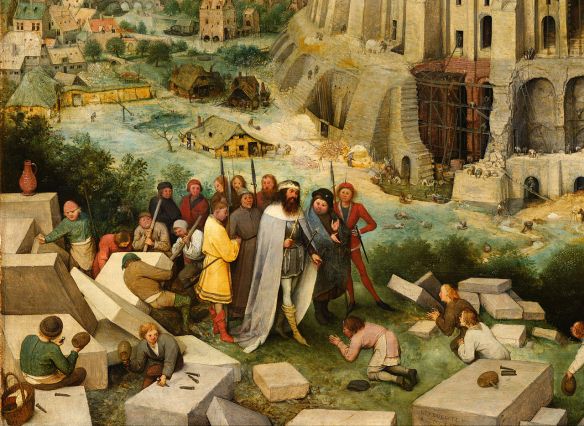
The Rotterdam painting is about half the size of the Vienna one. In broad terms they have exactly the same composition, but at a detailed level everything is different, whether in the architecture of the tower or in the sky and the landscape around the tower. The Vienna version has a group in the foreground, with the main figure presumably Nimrod, who was believed to have ordered the construction of the tower,[although the Bible does not actually say this. In Vienna the tower rises at the edge of a large city, but the Rotterdam tower is in open countryside.
The paintings depict the construction of the Tower of Babel, which, according to the Book of Genesis in the Bible, was built by a unified, monolingual humanity as a mark of their achievement and to prevent them from scattering: “Then they said, ‘Come, let us build ourselves a city, and a tower with its top in the heavens, and let us make a name for ourselves; otherwise we shall be scattered abroad upon the face of the whole earth.‘” (Genesis 11:4).

The Viennese “Big” Tower, is almost twice as large as the Rotterdam “Little” Tower and is characterized by a more traditional treatment of the subject. Based on Genesis 11: 1-9, in which the Lord confounds the people who began to build “a tower whose top may reach unto Heaven”, it includes – as the other version does not – the scene of King Nimrod and his retinue appearing before the genuflecting crowd of workmen. This event is not mentioned in the Bible but was suggested in Flavius Josephus’ Antiquities of the Jews. It was important to Bruegel as underlining the sin of the King’s pride and overbearing which the picture is supposed to highlight. See more here
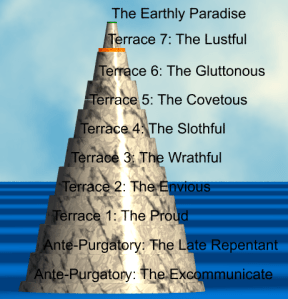
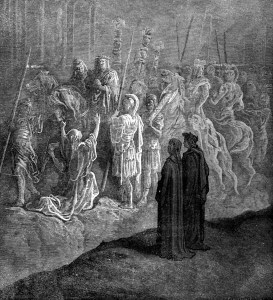
Dante purgatory:

Seven terraces of Purgatory
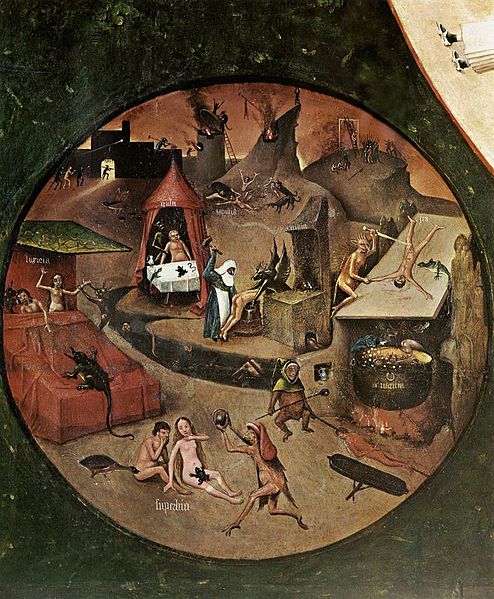
After passing through the gate of Purgatory proper, Virgil guides the pilgrim Dante through the mountain’s seven terraces. These correspond to the seven deadly sins or “seven roots of sinfulness”] Pride, Envy, Wrath, Sloth, Avarice (and Prodigality), Gluttony, and Lust. The classification of sin here is more psychological than that of the Inferno, being based on motives, rather than actions.[22] It is also drawn primarily from Christian theology, rather than from classical sources The core of the classification is based on love: the first three terraces of Purgatory relate to perverted love directed towards actual harm of others, the fourth terrace relates to deficient love (i.e. sloth or acedia), and the last three terraces relate to excessive or disordered love of good things.[21] Each terrace purges a particular sin in an appropriate manner. Those in Purgatory can leave their circle voluntarily, but may only do so when they have corrected the flaw within themselves that led to committing that sin.
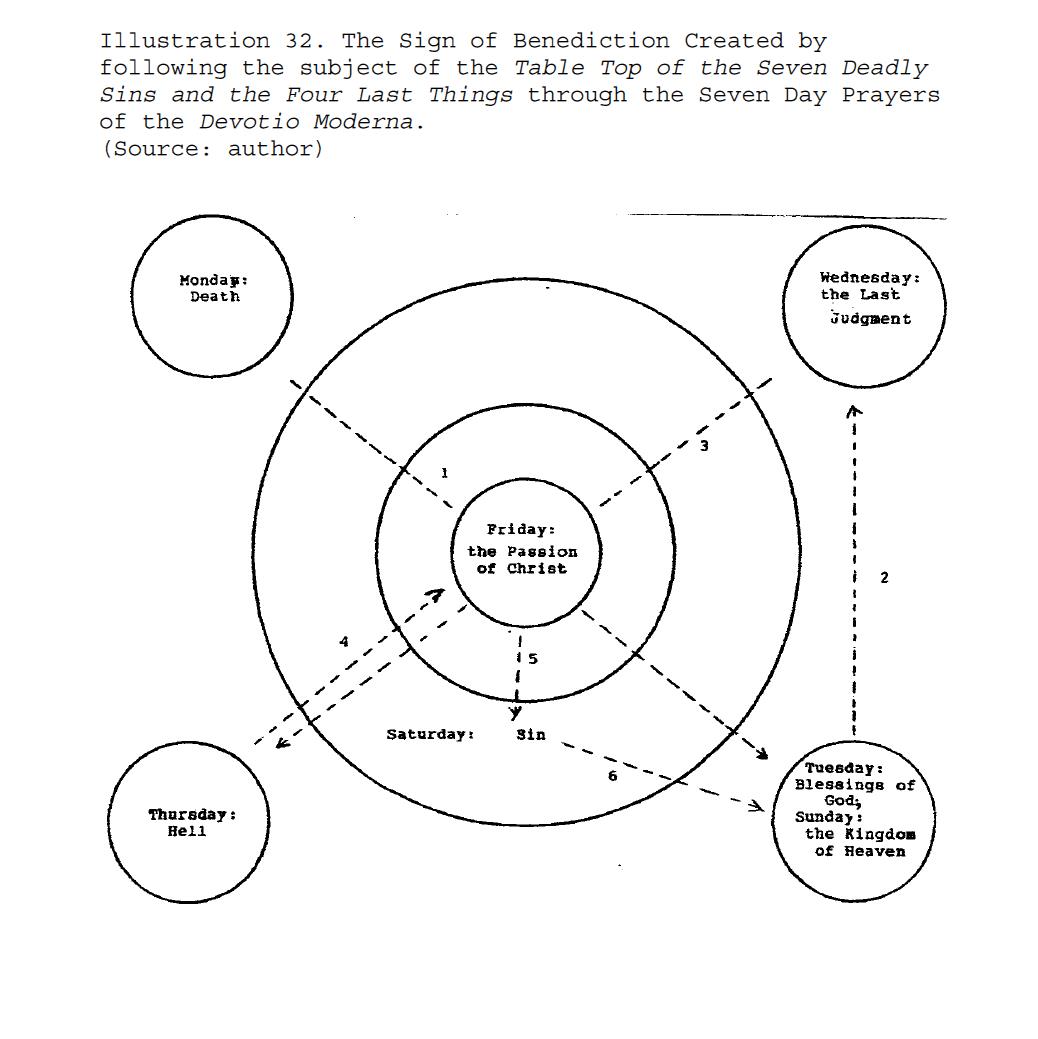
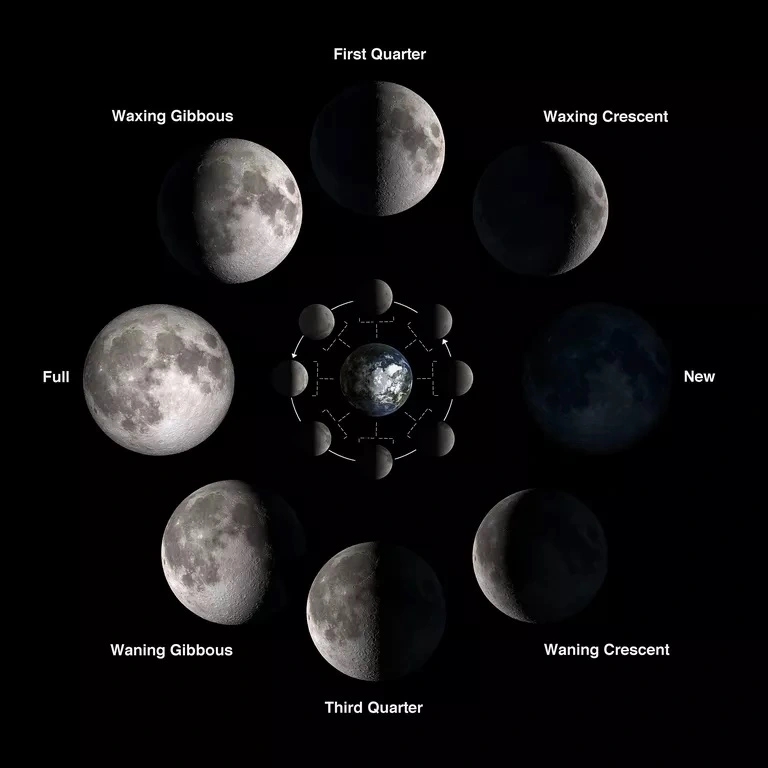
  • Essentially Dante devises in Purgatorio 10 a way of describing moving images in words: he is describing moving pictures/movies/film, though the medium does not yet exist. The same miraculous medium is used for the 13 examples of punished pride that are described in Purgatorio 12. While the carved examples of the virtue of humility are on the wall of the terrace, the examples of the vice of pride are on its pavement, like pavement tombs the pilgrim has seen on earth, but more lifelike due to the “artificio” (artifice [Purg. 12.23]) of their maker.

A spectacular acrostic displays the 13 examples of pride almost “visually”; see the attached chart for a list of all the examples. Note the interweaving of biblical and classical examples and how the exempla of pride reflect the three types of pride dramatized by the encounters with the three souls of Purgatorio 11. The examples are arranged in the following pattern: four sets of terzine begin with the word “Vedea”; four sets of terzine begin with the word “O”; four sets of terzine begin with the word ‘Mostrava”. Thus twelve examples of pride spell out VOM or UOM, “man” in Italian, signifying that pride is man’s besetting sin.

The thirteenth terzina offers the final example, which sums up all the others by referring to a city rather than to a person and by replicating in one terzina all three of the letters that spell the acrostic:

  Vedeva Troia in cenere e in caverne;
o Ilión, come te basso e vile
mostrava il segno che lì si discerne! (Purg. 12.61-63)
  I saw Troy turned to caverns and to ashes;
O Ilium, your effigy in stone—
it showed you there so squalid, so cast down!

The characters featured as examples of pride would repay lengthy discussion. Here we find Nembrot, he who built the tower of Babel and who spoke gibberish to Dante and Virgilio in Inferno 31:

  Vedea Nembròt a piè del gran lavoro
quasi smarrito, e riguardar le genti
che ’n Sennaàr con lui superbi fuoro. (Purg. 12.34-36)
  I saw bewildered Nimrod at the foot
of his great labor; watching him were those
of Shinar who had shared his arrogance.

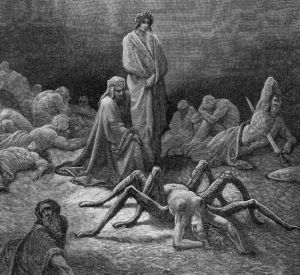
Most important to my reading of the terrace of pride is the mythological figure of Arachne, marked by the Ulyssean adjective “folle”:

  O folle Aragne, sì vedea io te
già mezza ragna, trista in su li stracci
de l’opera che mal per te si fé. (Purg. 12.43-45)
  O mad Arachne, I saw you already
half spider, wretched on the ragged remnants
of work that you had wrought to your own hurt!

Arachne was famous for her weavings that were so lifelike that they seemed alive. The passage describing her work in Ovid’s Metamorphoses, discussed in Chapter 6 of The Undivine Comedy, nourished Dante in his conceptualizing of representational arrogance as the cornerstone of his terrace of pride (see the Introduction to Purgatorio 11). Again, as in Purgatorio 10’s depiction of the “visibile parlare” of the sculpted virtues, in Purgatorio 12 the point is hammered home that this art is not just “life-like”, it is “life” itself:

  Morti li morti e i vivi parean vivi:
non vide mei di me chi vide il vero,
quant’io calcai, fin che chinato givi. (Purg. 12.67-69)
  The dead seemed dead and the alive, alive:
I saw, head bent, treading those effigies,
as well as those who’d seen those scenes directly.

At the end of the canto we encounter another of the ritual components of the purgatorial experience, repeated on each terrace: Dante meets the angel and a “P” is removed from his brow, signifying his successful participation in the purgation of one “peccatum” or vice/sin. He climbs toward the next terrace, and as he climbs he hears a shortened form of the first Beatitude: “Beati pauperes spiritu” (Matthew 5:3). The eight Beatitudes are from Christ’s Sermon on the Mount (Matthew 5:3-10) and will be featured on the purgatorial terraces. In full, this Beatitude, featured on the terrace of pride to celebrate the soul’s new acquisition of a pride-less “poverty of spirit”, is: “Blessed are the poor in spirit, for theirs is the kingdom of heaven.”

  • Educating Desire: Conversion and Ascent in Dante’s Purgatorio

by Paul A. Camacho

Paul A. Camacho in his paper asks our attention “Why the Purgatorio? As first-time readers discover with surprise in the closing cantos of Dante’s Inferno, Hell is defined primarily by stasis. Where there is motion in Hell, it is only the tormented self-circling of a will that cannot love anything beyond itself. Hell is the place that Dante scholar Peter Hawkins has memorably described as “repetition-compulsion, an endless replay of the sinner’s ‘song of myself.’” It is certainly true, as Dante saw, that conversion requires an underworld itinerary: we can no overcome the drive to get what we mistakenly think will bring us happiness through intellectual understanding or sheerwill-power alone. But to journey throug hHell as Dante would have us do,one must experience one’s sin and failure without getting trapped in it; and this means one must face all the darkness in oneself without becoming entombed by fear, despair, or gawking fascination. This is a heavy task for anyone, let alone for the average undergraduate. By contrast, Purgatory is, in Hawkins’ words, “dynamic, dedicated to change and transformation.It concerns the rebirth of a  self free a tlast to be interested in other souls and other things .” It is fruitful to dwell in Purgatorio with students because it is in Purgatory that we now reside. I mean this: in Hell there is no time, there is only infinite stasis; in Paradise there is no time, but rather the dynamic over-abundance of eternity; only in Purgatory is there time,because only here is there the possibility of change and growth. If we read the Commedia to learn how to love better here and now, in this world, it is the Purgatorio that will provide the blueprint.”
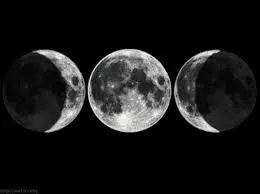

In Cantos 17 and 18 of the Purgatorio, Dante’s Virgil lays out a theory of sin, freedom, and moral motivation based on a philosophical anthropology of loving-desire. As the commentary tradition has long recognized, because Dante placed Virgil’s discourse on love at the heart of the Commedia, the poet invites his readers to use love as a hermeneutic key to the text as a whole. When we contextualize Virgil’s discourse within the broader intention of the poem—to move its readers from disordered love to an ordered love of ultimate things—then we find in these central cantos not just a key to the structure and movement of the poem ,but also a key to understanding Dante’s pedagogical aim. With his Commedia, Dante invites us to perform the interior transformation which the poem dramatizes in verse and symbol. He does so by awakening in his readers not only a desire for the beauty of his poetic creation, but also a desire for the beauty of the love described therein. In this way, the poem presents a pedagogy of love, in which the reader participates in the very experience of desire and delight enacted in the text. In this article, I offer an analysis of Virgil’s discourse on love in the Purgatorio, arguing for an explicit and necessary connection between loving-desire and true education. I demonstrate that what informs Dante’s pedagogy of love is the notion of love as ascent, a notion we find articulated especially in the Christian Platonism of Augustine. Finally, I conclude by offering a number of figures, passages, and themes from across the Commedia that provide fruitful material for teachers engaged in the task of educating desire. Read more here

A lifelong pilgrimage: The Mirror of Jheronimus bosch

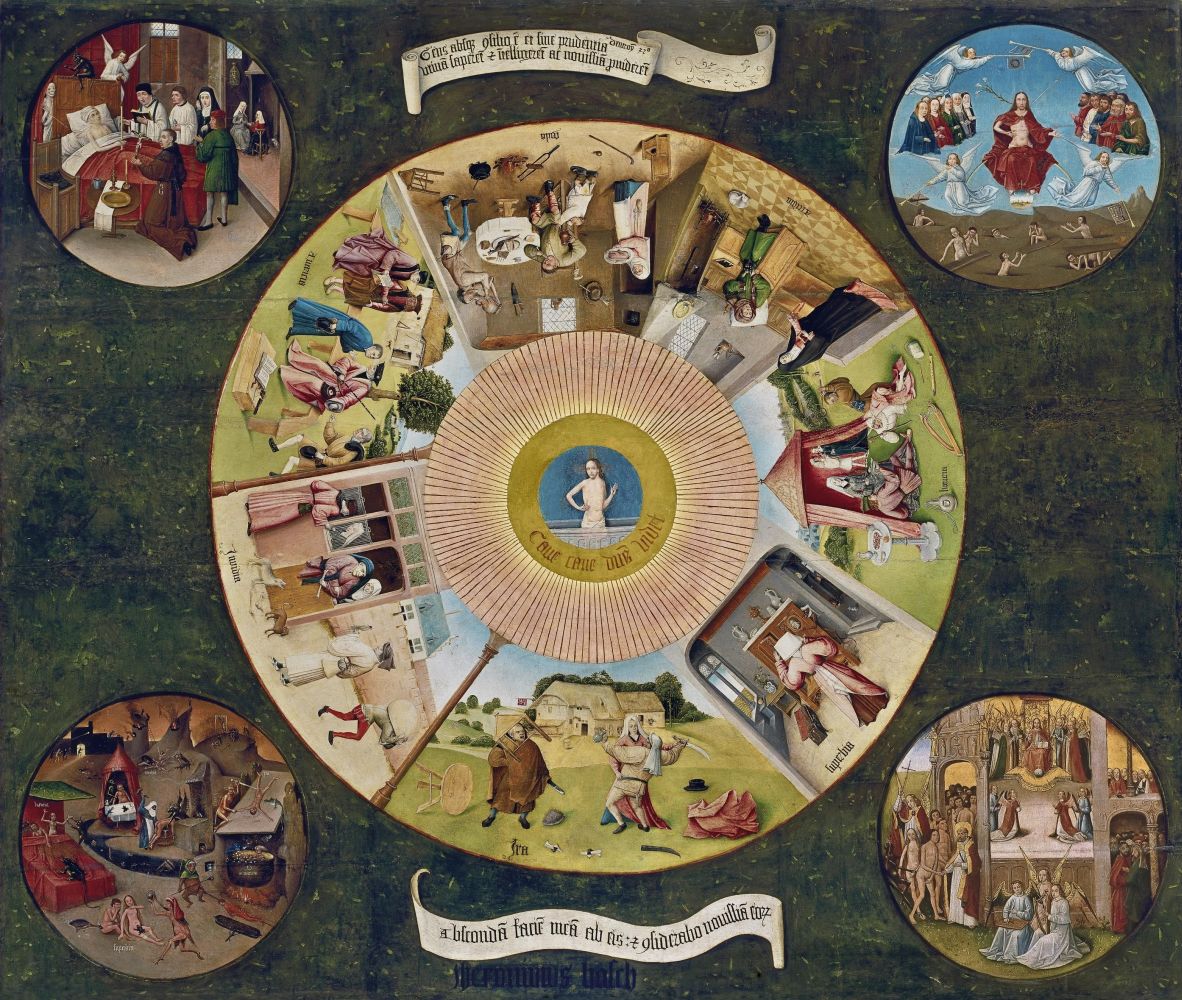
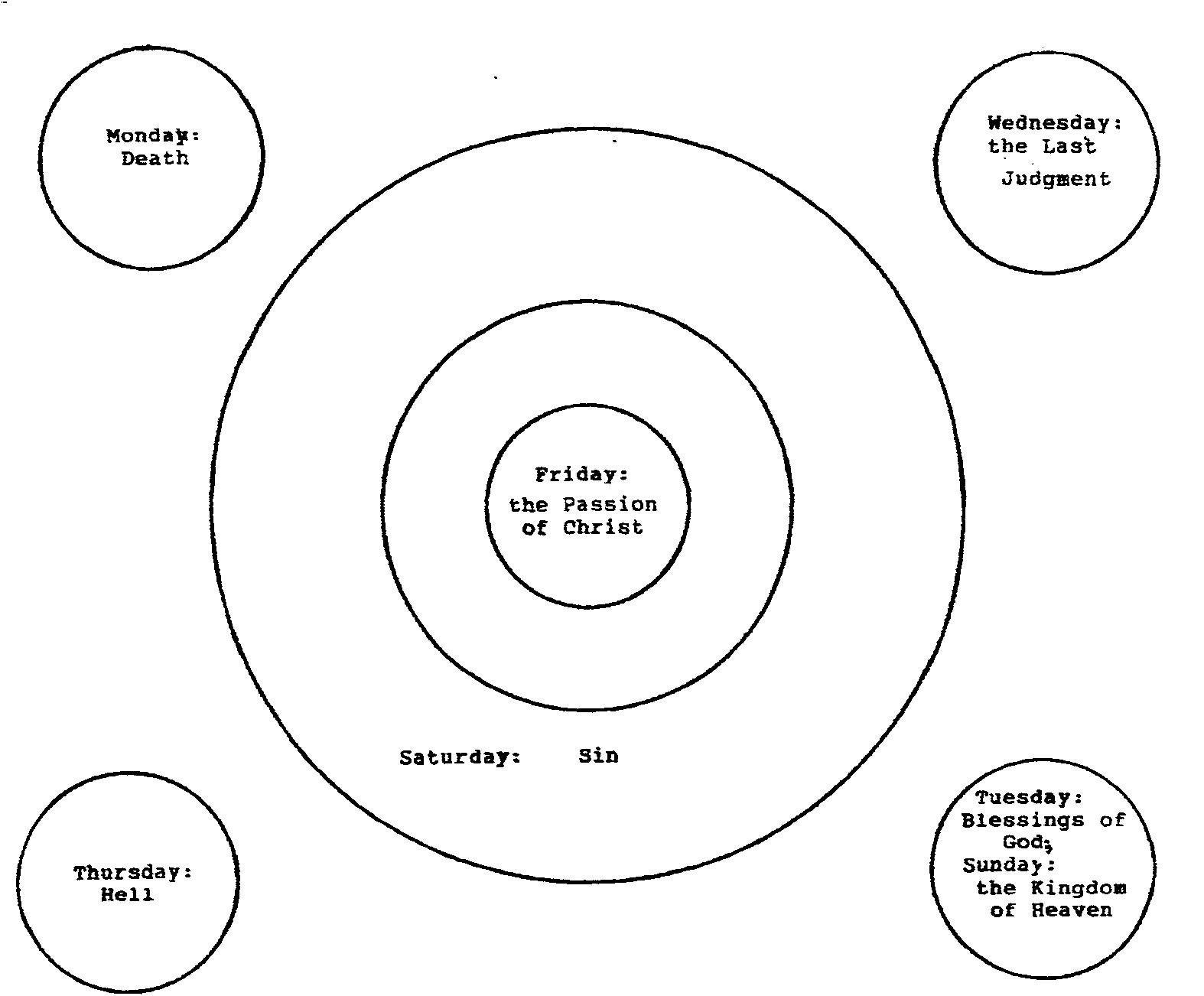
  • This panel symbolizing the “all seeing eye” or “eye of salvation” structurally, it is like a circle of “Seven deadly sins

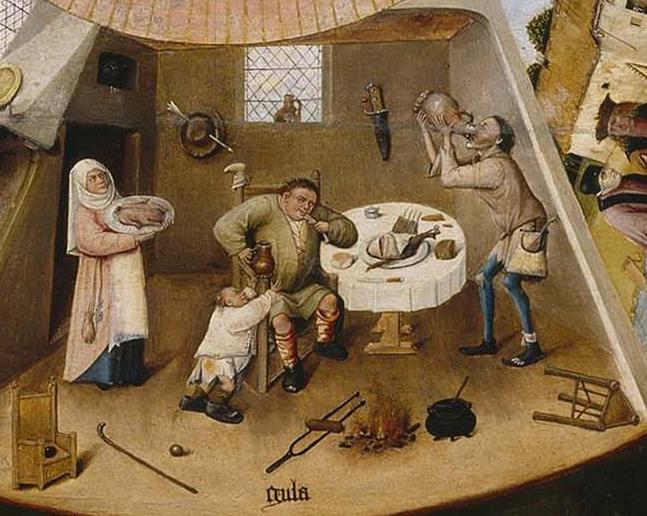
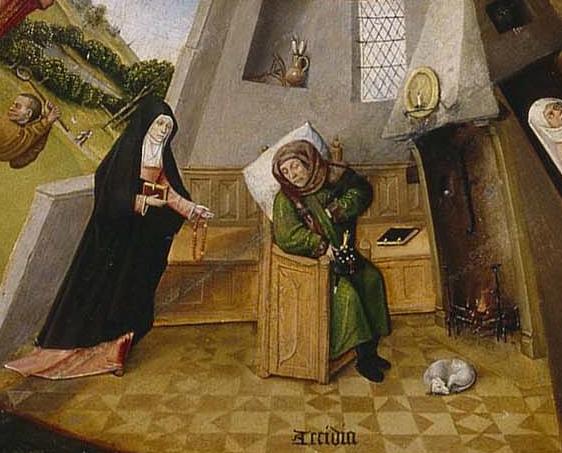
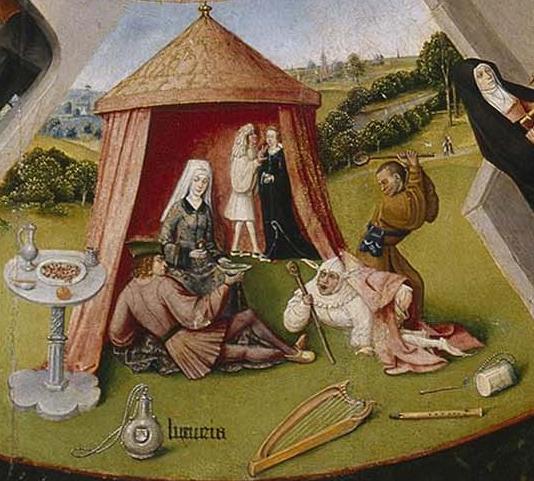
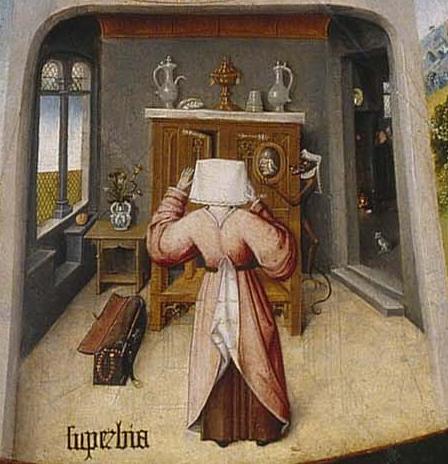
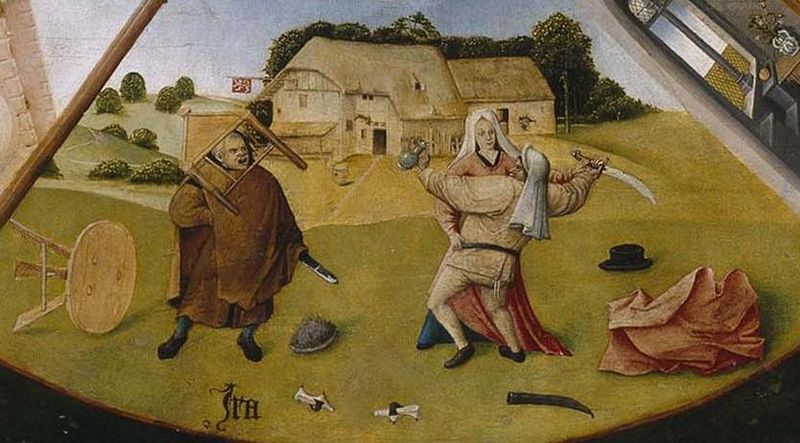
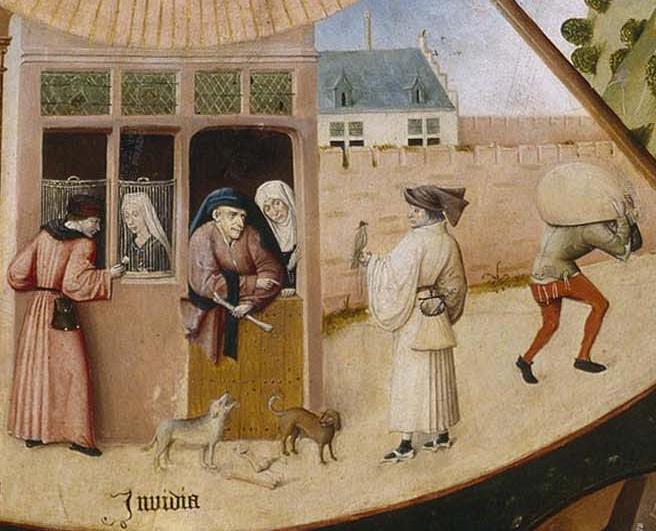
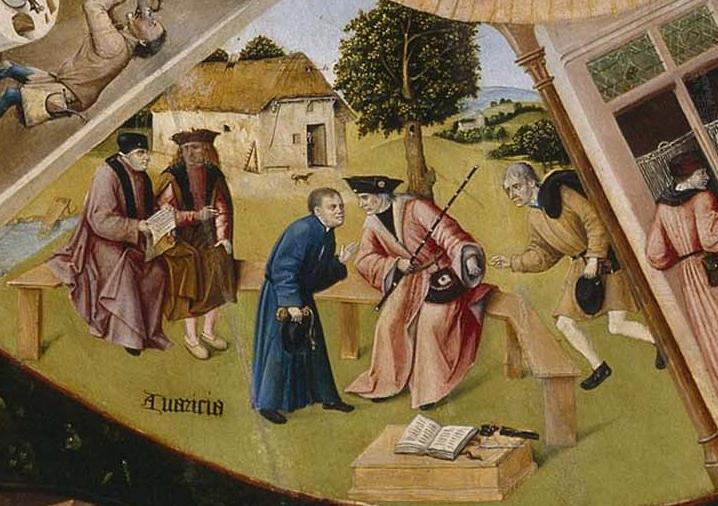
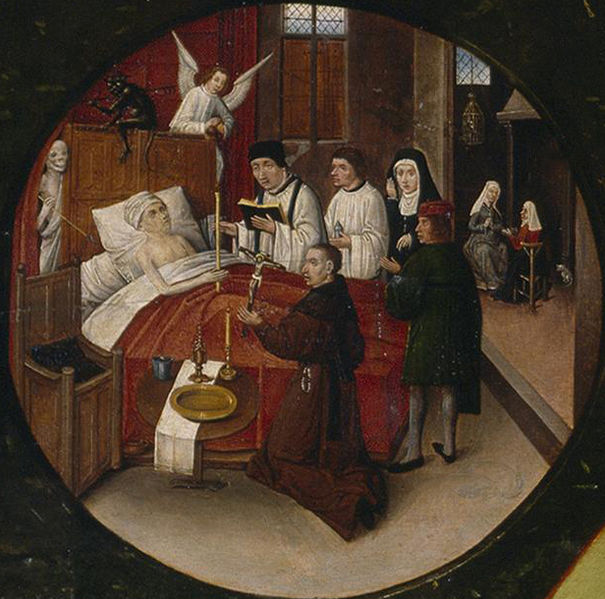
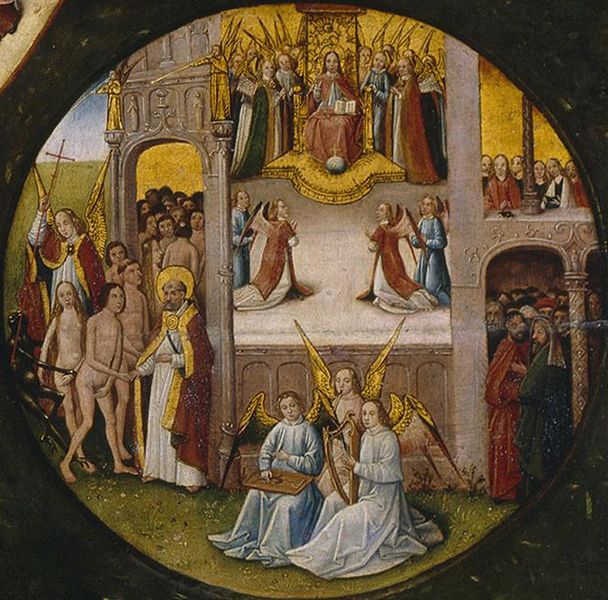
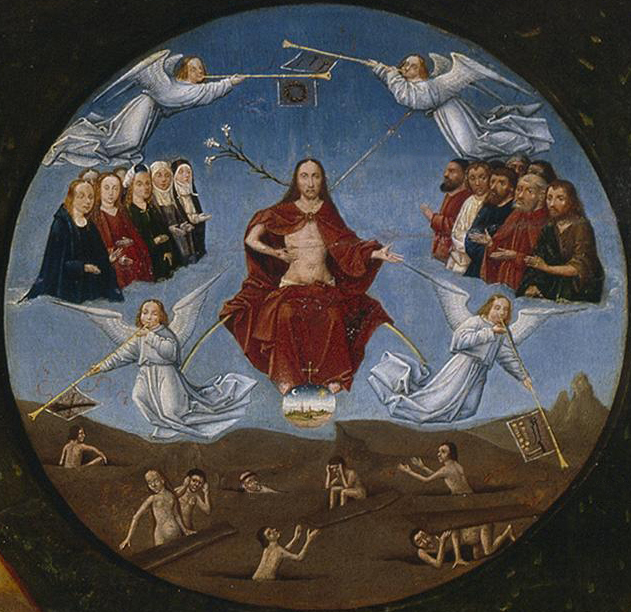
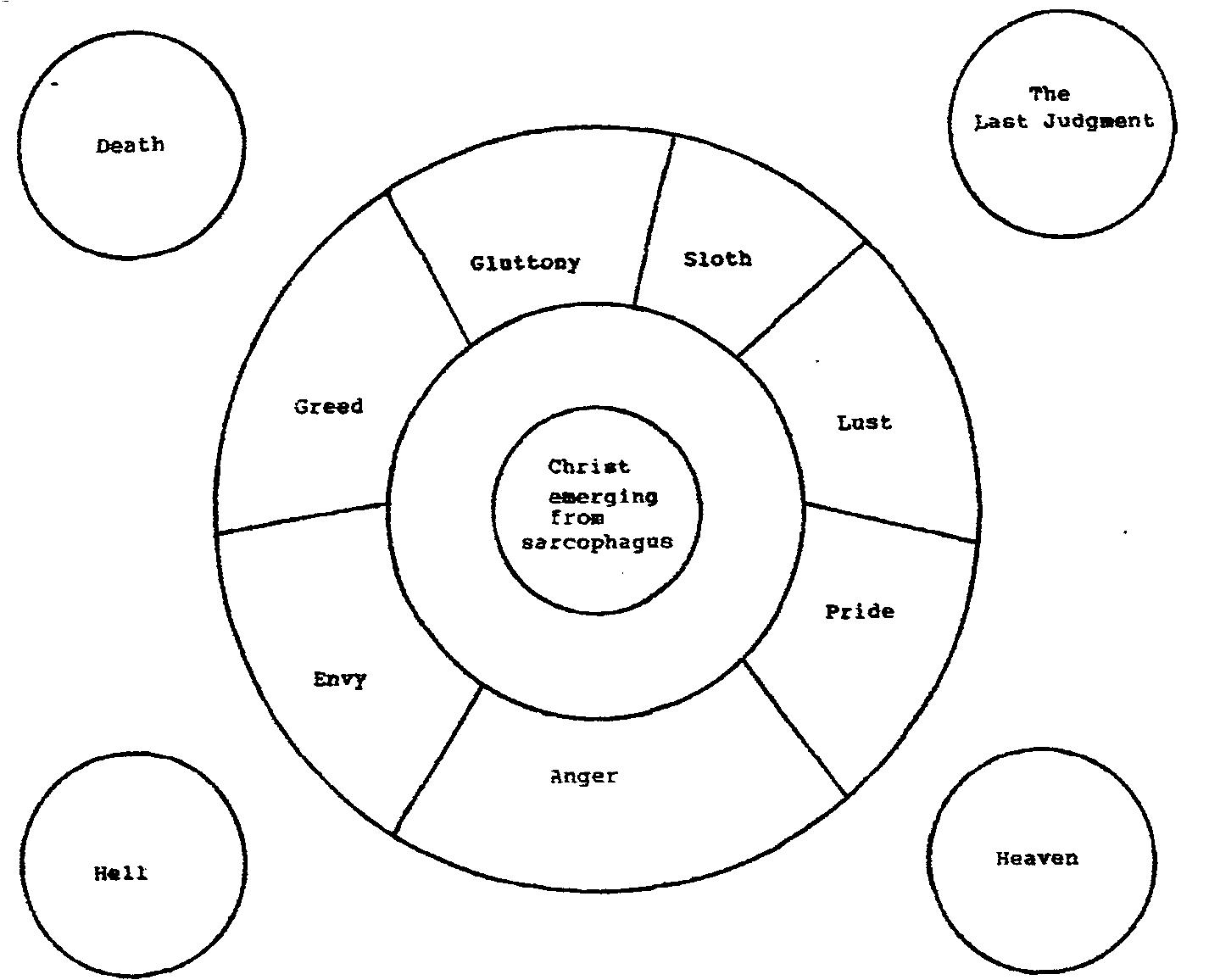
Four small circles, detailing the four last thingsDeath, Judgment, Heaven, and Hell — surround a larger circle in which the seven deadly sins are depicted: wrath at the bottom, then (proceeding clockwise) envy, greed, gluttony, sloth, extravagance (later replaced with lust), and pride, using scenes from life rather than allegorical representations of the sins.[4]

At the centre of the large circle, which is said to represent the eye of God, is a “pupil” in which Christ can be seen emerging from his tomb. Below this image is the Latin inscription Cave cave d[omi]n[u]s videt (“Beware, Beware, The Lord Sees”).

Above and below the central image are inscription in Latin of Deuteronomy 32:28–29, containing the lines “For they are a nation void of counsel, neither is there any understanding in them”, above, and “O that they were wise, that they understood this, that they would consider their latter end!” below.

Each panel in the outer circle depicts a different sin. Clockwise from top (Latin names in brackets):

  1. Gluttony (gula): A drunkard swigs from a bottle while a fat man eats greedily, not heeding the plea of his equally obese young son.
  2. Sloth (acedia): A lazy man dozes in front of the fireplace while Faith appears to him in a dream, in the guise of a nun, to remind him to say his prayers.
  3. Lust (luxuria): Two couples enjoy a picnic in a pink tent, with two clowns (right) to entertain them.
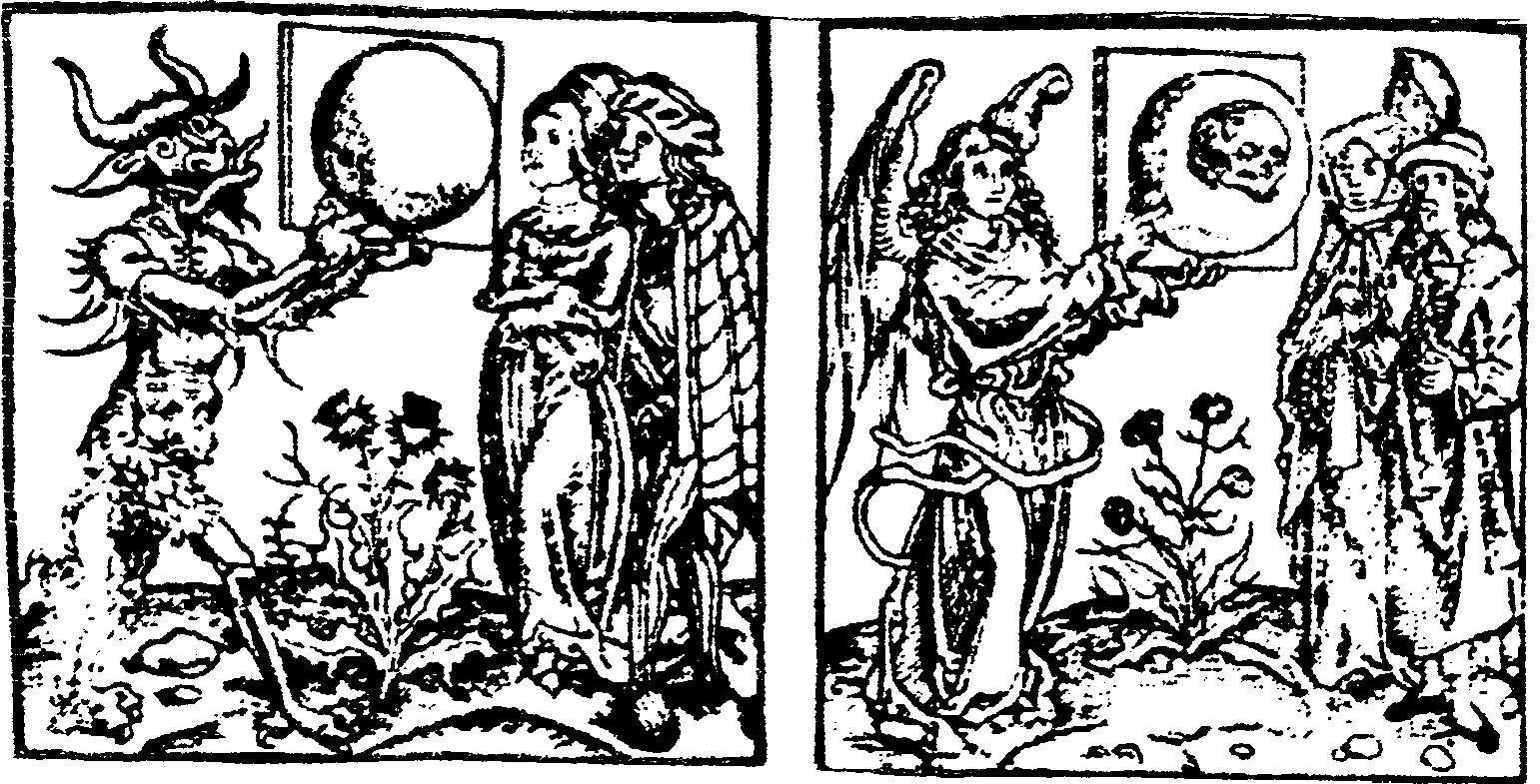
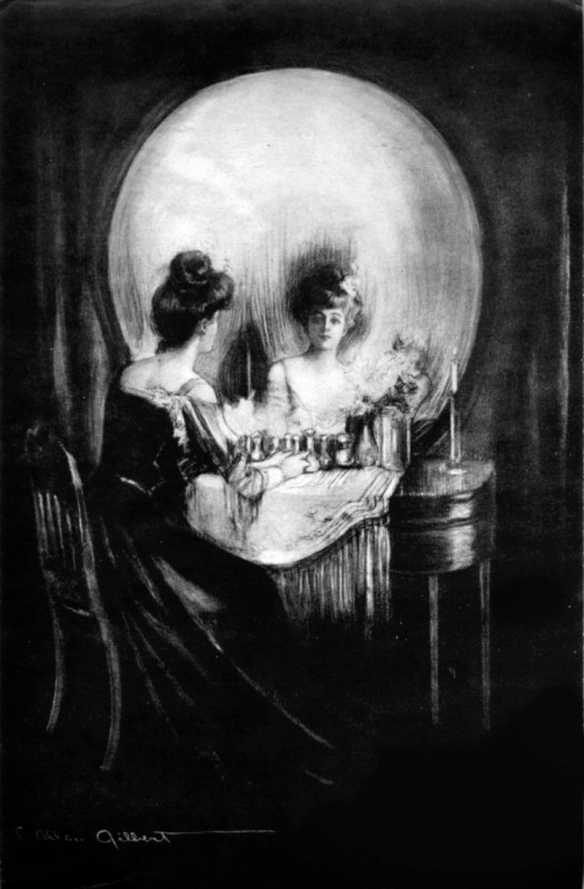
  4. Pride (superbia): With her back to the viewer, a woman looks at her reflection in a mirror held up by a demon.
  5. Wrath (ira): A woman attempts to break up a fight between two drunken peasants.
  6. Envy (invidia): A couple standing in their doorway cast envious looks at a rich man with a hawk on his wrist and a servant to carry his heavy load for him, while their daughter flirts with a man standing outside her window, with her eye on the well-filled purse at his waist. The dogs illustrate the Flemish saying, “Two dogs and only one bone, no agreement”.
  7. Greed (avaricia): A crooked judge pretends to listen sympathetically to the case presented by one party to a lawsuit, while slyly accepting a bribe from the other party.

The four small circles also have details. In Death of the Sinner, death is shown at the doorstep along with an angel and a demon while the priest says the sinner’s last rites, In Glory, the saved are entering Heaven, with Jesus and the saints, at the gate of Heaven an Angel prevents a demon from ensnaring a woman. Saint Peter is shown as the gatekeeper. In Judgment, Christ is shown in glory while angels awake the dead, while in the Hell demons torment sinners according to their sins.

140px-Jheronimus_Bosch_Table_of_the_Mortal_Sins_(Gula)

Seven Deadly Sins

Jheronimus_Bosch_Table_of_the_Mortal_Sins_(Accidia)

Jheronimus_Bosch_Table_of_the_Mortal_Sins_(Luxuria)

Jheronimus_Bosch_Table_of_the_Mortal_Sins_(Superbia)

800px-Jheronimus_Bosch_Table_of_the_Mortal_Sins_(Ira)

Jheronimus_Bosch_Table_of_the_Mortal_Sins_(Invidia)

Jheronimus_Bosch_Table_of_the_Mortal_Sins_(Avaricia)

Four Last Things

605px-Jheronimus_Bosch_4_last_things_(death)

  • “Death of a sinner”, angel and devil weigh a man’s soul

494px-Hieronymus_Bosch_-_The_Seven_Deadly_Sins_(detail)_-_WGA2501

  • Hell” and the punishment of the seven deadly sins.  

608px-Jheronimus_Bosch_4_last_things_(Paradise)

Jheronimus_Bosch_4_last_things_(Last_Judgment)

  • THE SEVEN DEADLY SINS AND THE FOUR LAST THINGS THROUGH THE SEVEN DAY PRAYERS OF THE DEVOTIO MODERNA

Christ’s gaze in Bosch’s painting draws the viewer’s attention. When a member of the Devotio Moderna looked at the painting during his daily prayers, he underwent serious
self-examination which was possible because “visual images” served as a still more effective vehicle for compassionate meditation.

Devils and the Angel’s Mirrors.

Without the gaze of Christ, the painting would not have as great an impact on its viewer in a time of meditation. When the viewer meditates upon the seven day prayers of the Devotio Moderna, he/she sees the image of Christ as the Man of Sorrows looking at him or her. Through this interaction with Christ, the viewer examines his own morals and keeps his faith in God. The viewer’s world is not the physical environment where he lives but the one that is reflected in the Eye of God. As the viewer prays upon the seven day prayers, he will be guided to the Kingdom of Heaven where he will be greeted by the angels and face Christ without any shame or guilt upon the death of the redeemer. The righteous person will keep his faith in God as he sees the image of Christ in the Eye of God.
The eye creates an eternal exchange of the interaction between the viewer and Christ As the image reflects the ‘inner perception’ of the viewer, Bosch’s painting reflects the viewer’s own consciousness in choosing between right and wrong as he undergoes the daily meditations of the seven day prayers of the Devotio Moderna.

Read more here

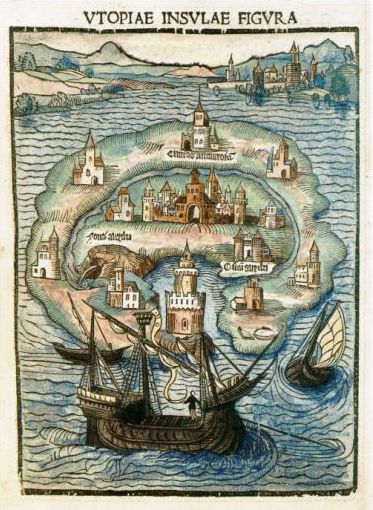
Utopia and the Devotio Moderna:

The Brabantine mysticism of Jan van Ruusbroec and the Priory of Groenendaal,
the Modern Devotion of Geert Grote and the spiritual and religious thought of
Erasmus and More through Utopia and other key works of Christian humanism.

Maarten Vermeir -University College London

utopia-kleur

Two Renaissance work serve me well as interpretation keys for Thomas More’s
book of Utopia.

My first interpretation key will always remain Desiderius Erasmus’ Praise of Folly
or Moriae Encomium.
As you all know, Erasmus wrote his Praise of Folly in the house of More and the
narrator of his Praise, Lady Stultitia or Moria, is ironically linked to the name of
Thomas More. Lady Moria orates a great amount of nonsense, but through
Erasmus’ fine irony at the same time a great deal of wise and rightful criticism
on aspects and figures of his contemporary society. At the end of her Praise,
Stultitia speaks also about a deeper mystical, Christian folly and considering
similar statements by Erasmus in other works like his Enchiridion Militis
Christiani, these statements of Lady Stultitia were seriously meant by Erasmus.
Also in Thomas More’s Utopia we can recognize a mixture of serious ideas
through the eyes of More and Erasmus (about the institution of the state and
church, international relations, the division between church and state,
spirituality, religion and tolerance, social care, culture/education? And
matrimonial policies) with also nonsensical ideas to their opinion (the economic
system, the travel restrictions inside the Utopian state). A search for their ideas
on these points through other works and their personal orientations makes the
recognition of such mixture unavoidable. In Utopia we can probably find more
serious concepts than nonsensical, and although this partition was reversed in
the earlier Praise of Folly, the family similarity on this point remains paramount
and crucial to a correct understanding.
The narrator of More’s Utopia, Raphael Hythlodaeus(in one of the two meanings
translated as ‘Merchant of Nonsense’, in the other as ‘Destroyer of Nonsense’)
is linked reciprocally to Erasmus through the figure of Saint Erasmus, as I learned
recently, the patron of all sailors. Also reciprocally, Thomas More started
probably writing the book of Utopia in one of the major residences of Erasmus
in the Low Countries: the Antwerp house of his friend Pieter Gillis.
My second preferred interpretation key for More’s Utopia consists in the 900
theses of Pico della Mirandola.
Thomas More translated ‘The Life of Pico della Mirandola’ and was undoubtedly
aware of della Mirandola’s philosophical program: in his famous 900 theses Pico
della Mirandola intended to combine into a higher synthesis the best elements
of classical traditions, especially from the philosophy of Plato and Aristotle, with
aspects of the Jewish-Christian traditions, especially mystical elements like he
found in the Jewish Kabbala. His great endeavor was to formulate a consistent
marriage between Jewish-Christian mysticism and the rich humanistic learning
by which he was surrounded in Renaissance Florence. His early death prevented
him regretfully from executing this great master plan. But the Christian
Humanists around Erasmus and Thomas More would become Pico’s true
inheritors and take Pico della Mirandola’s scheme as a blueprint for their
complete literary oeuvre and philosophical program. One of Utopia’s layers of
meaning is certainly a broad defense of the Christian humanistic ideals. The
serious parts of Utopia can be read as an honorary tribute to Pico della
Mirandola’s audacious plans, as a literary realization of Pico’s inspiring dreams.
These traces of della Mirandola’s program in Utopia will be subject of my later
research.

index u

Both works, Erasmus’ Praise of Folly and della Mirandola’s 900 theses have thus also a deeper Mystical meaning and importance.Also Thomas More’s Utopia has.
As a religious community Utopia knows only a few strict and unbreakable rules for the religious life of its citizens. Next to these respected rules, there is complete liberty for personal spirituality and thus room for many different colorings, orientations and institutions of the Utopians’ personal spiritual life. In this way each Utopian is also destined and commissioned to set out on a personal spiritual journey, encouraged by the daily contact between the elder and the
children or youngsters, sitting daily side by side with every meal.
This is also the foundation of Utopia’s religious tolerance and freedom: the
undeniable points of belief (the eternal soul, divine presence and activity in the
world, the punishment of vices and the rewarding of virtues – and thus the
rewarded or punished free will of men) have to be respected by all Utopians, and
all personal, by definition different additions in respect of these rules, are
tolerated in the Utopian state. These undeniable points were instituted by
Utopus himself and public challenges outside the closed company of priests and
officials, are punished severely to safeguard the common interest and public
order of the state. So the gap between the institution of Utopian tolerance and
later political actions of Thomas More, is therefore less deep and less broad as
often depicted. In his discussion with Luther on the Free Will, Erasmus stated
also that Luther shouldn’t discuss his ideas with or spread amongst the ordinary
people but discuss with qualified persons.Read more here

” I don’t care” : Warning of a Sufi Master

I heard many people saying; “I don’t care!” _

How can anyone who claims to be of humankind say such thing as, “I don’t care?”  It is a sure sign that he is an irresponsible person.

In the days of Ottoman Empire, the greatest of the learned men of the time was asked by some of the people: “Oh our master, can you tell us what the first sign of the arrival of the Last Day will be?

He replied:   “I don’t care.” _The people were aghast, and said: “If you don’t care, then who does?”

But he just repeated the same answer until, exasperated by their incomprehension, he said;_“Don’t you understand what I am saying? You asked me what the first sign of the Resurrection Day (Yaum ul- Qiyamah) will be, and I replied: “‘I don’t care”

”Everyone on that day will come with thoughts only for himself and not caring in the least for others – imprisoned within himself, alone”.

MAULANA SHEIKH NAZIM QS

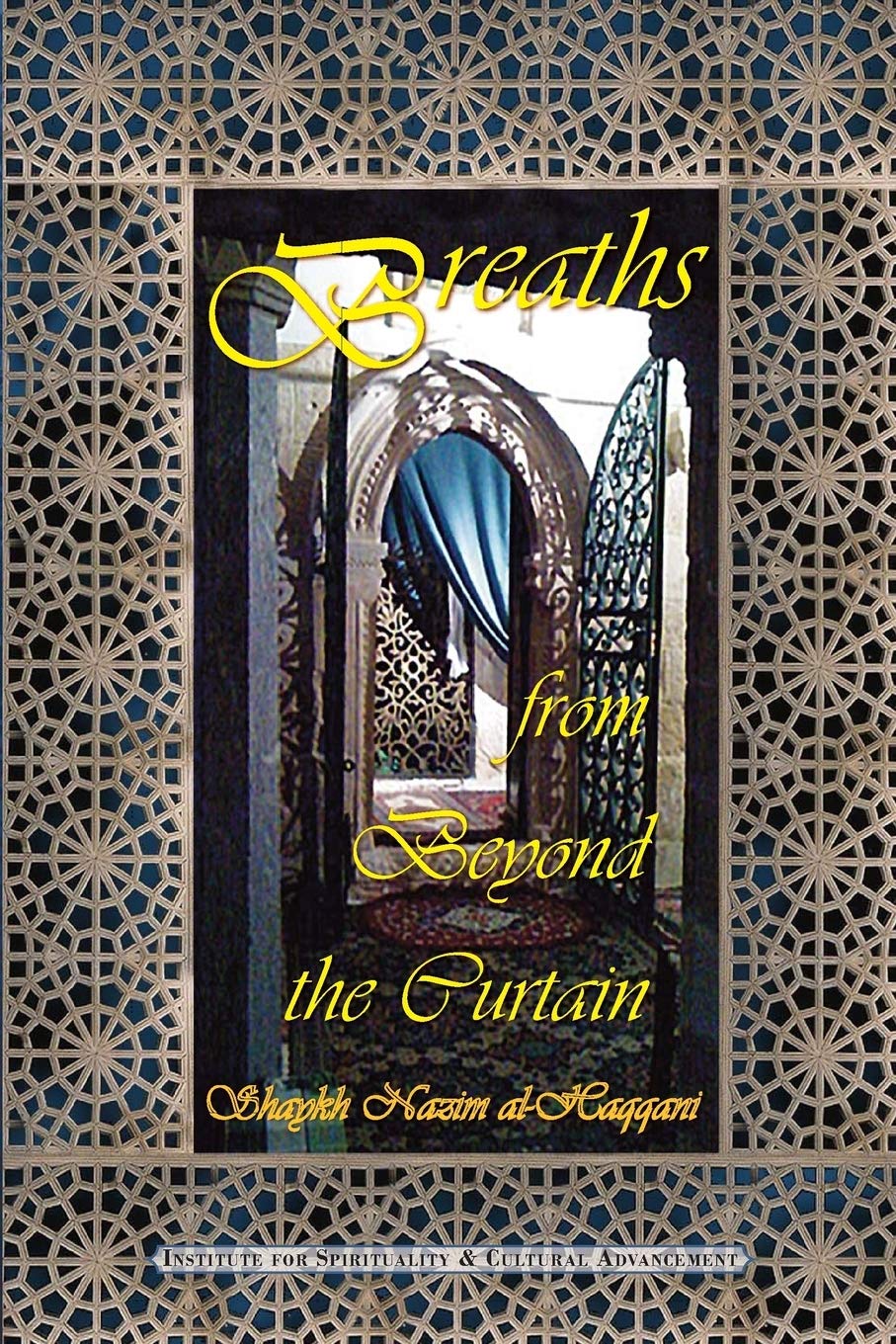
Breaths from Beyond the Curtain

The Lord Almighty, in His kindness, compassion and mercy, may give everyone billions, but He knows well that human beings are never going to be in pleasure when they are given without limits. Therefore, God gives, according to His wisdoms, a little little bit. But man is running to reach more and more, saying, “It is not enough!” Humankind living on this planet are asking for pleasure in their lives, and mostly now people are looking and seeing that pleasure is through riches. They think that if they get richer, there is going to be more pleasure for them, and that is wrong. Their egos are like a thirsty person, thirsty for physical and material desires. They are running to the ocean to take away their thirst but no matter how much salty water they drink, they become even more thirsty.

But when a thirsty person drinks once cup of pure, plain water, that cup is enough to take his thirst away. Our physical being is only for a short time, a very short time, and its perfection is only for keeping our souls in, but it is not a perpetual being.

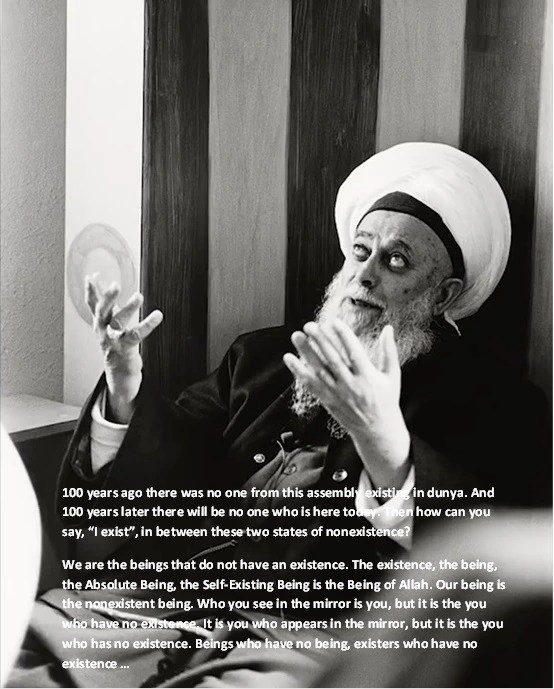
Yesterday we were nothing. Tomorrow we are going to be nothing. Between two nothings, how are we going to claim “I am here”? Our physical being is going to be dust. But the perfection of our spiritual being, that is something else.

If you reach that perfection, you are most fortunate. Those who took care of their spiritual perfection, should be happy with a new beginning, with a new structure, with a new being. They should reach unknown places that they only heard about before, and their perfection should continue in the afterlife also.

Therefore, the Lord sent, from His Divine Presence, from Heavens, chosen servants adorned with that secret power to arrange the lives of people on earth for reaching their ultimate perfection. Therefore those who are asking for pleasure in their hearts, they understand that they will find it only in the Divine Presence, and the way to the Divine Presence passes through Divine messengers, those who are on the way of God. If you listen to someone whose speech gives your heart, satisfaction, taking darkness away from your heart and your mind, and cleaning your intellect, you can understand that his level is high. If you find such a one hold onto his hand until he takes you to your final destination in the Divine Presence. Read here Free Download

SELECTED PUBLICATIONS
OF TALKS GIVEN BY MOULANA

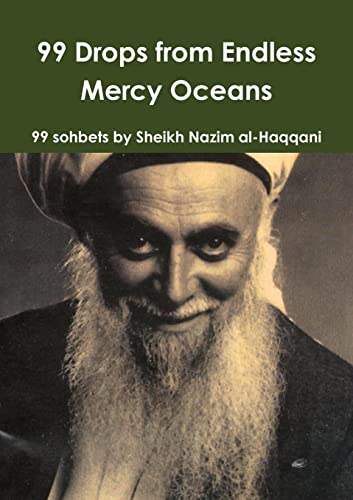
99 Drops from Endless Mercy Oceans

This book is a collection of 99 sohbets or speeches delivered by the Sheikh of the Sufi Order Naqshbandi, Mawlana Sheikh Nazim al-Haqqani ar Rabbani . Several themes are discussed, such as Islam, love, truth, spirituality, etc. Only by the light of the Spiritual Path and the mystic way can the Truth be discovered. In order for one to truly witness the Perfection of the Absolute, one must see with one’s inner being, which perceives the whole of Reality. This witnessing happens when one becomes perfect, losing one’s (partial) existence in the Whole. If the Whole is likened to the Ocean, and the part to a drop, the sufi says that witnessing the Ocean with the eye of a drop is impossible. However, when the drop becomes one with the Ocean, it sees the Ocean with the eye of the Ocean . Read Here Free download

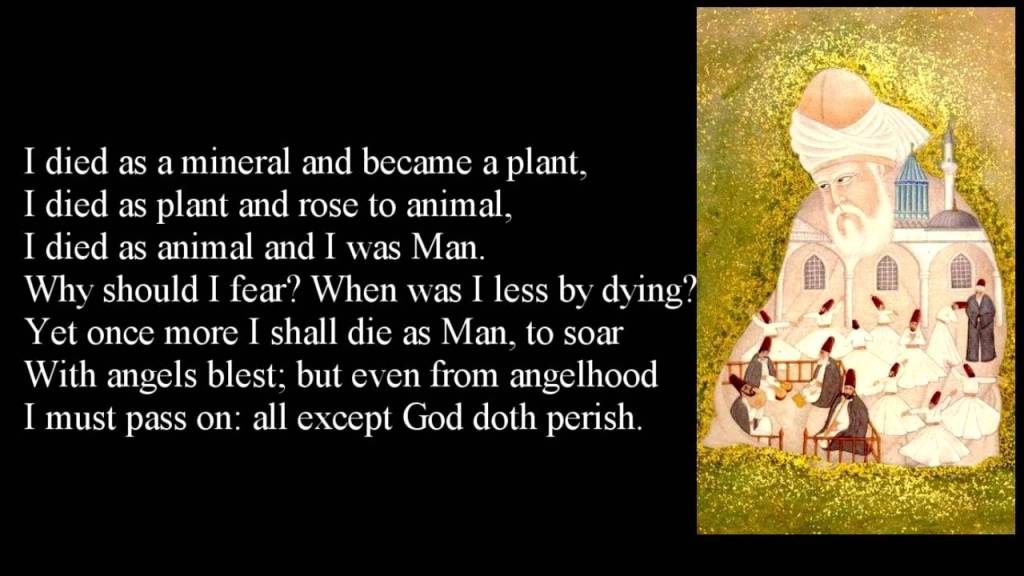
Rumi

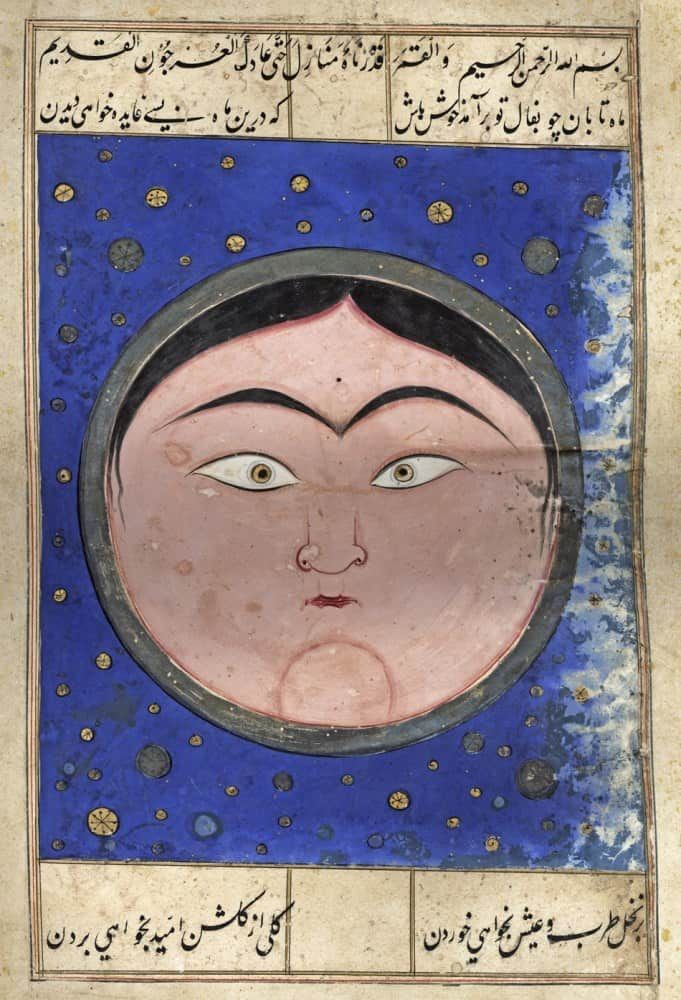
The Celestial ‘Polished Mirror’, the Mystical Dimension of the Moon

from The Celestial ‘Polished Mirror’ – The Mystical Dimension of the Moon according to
Muhyiddin Ibn ʿArabī – Esmé L.K. Partridge

When the Qurʾan speaks of Allah showing His Signs (āyāt) ‘in the horizons … until it becomes clear that [they are] the truth’ (Q.41:53), its meaning may be construed figuratively. Especially when perceived through the epistemological lens of the ẓāhir and bāṭin – the respective inner and outer dimensions of scripture that are disclosed through esoteric exegesis (taʾwīl) – the imagery of the ‘horizons’ may be interpreted purely as a motif concealing the more abstract, universal truth that is God’s omnipresence. In such an interpretation, the verse’s inner meaning (bāṭin) is perhaps tantamount to others that allude to the boundless presence of God, such as ‘and to Allah belongs the east and the west. So wherever you [might] turn, there is the Face of Allah’ (Q.2:115).

However, for Ibn ʿArabī – the master of distilling the bāṭin from the ẓāhir – the imagery of Allah revealing His Signs ‘in the horizons’ could refer to a more literal, as well as metaphorical, phenomenon: the celestial bodies as Signs of His nature and attributes. Such an interpretation would cohere with his cosmic vision in which the universe, like the Qurʾan Itself, is composed of ‘letters, words, chapters and verses’ that are each Divine self-manifestations (tajallī); the objects that adorn our immediate horizons are no exception. In particular, the Moon – an entity that is perennially invoked in spiritual art and poetry – shines with numinous qualities, presented by Ibn ʿArabī in several of his works such as the Tarjumān al-ashwāq and the Futūḥāt al-Makkiyya:

We say: As for the shining of the full moon that God set up as an image in the cosmos for His self-disclosure through His ruling property within it, that is the divine vicegerent, who becomes manifest within the cosmos through the names and properties of God … in the same way, the sun becomes manifest in the essence of the moon and gives light to the whole of it. Then it is called a full moon. Hence the sun sees itself in the mirror of the full moon’s essence, for it drapes it in a light through which it is called a full moon.( bn ʿArabī, The Meccan Revelations, Vol. II, ed. M. Chodkiewicz, trans. C. Chodkiewicz and D. Gril (New York: Pir Press, 2004)


This striking passage pertains to an elaborate schema of the Moon as a mystical metaphor qua Divine Sign which, although does not appear to have been systematically addressed by Ibn ʿArabī in his extant corpus, can be inferred from various passages of his cosmological, astrological and revelatory treatises. In this schema, the Moon is a representation of Man (and the Sun a representation of God), with the astronomical phenomena of gradual illumination paralleling the process of taṣawwuf.
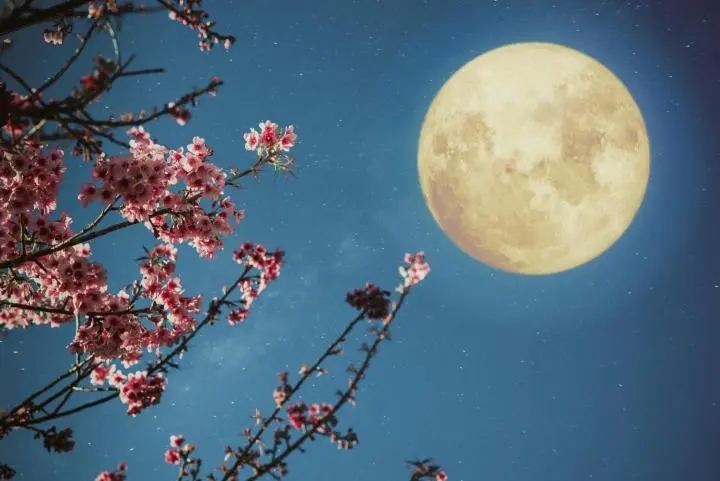
Just as the Moon traverses from its station in the penumbra of the Earth to an elevated position where it can fully reflect the Sun, the mystic overcomes the shadows of the
world (dunyā) and transforms into an individual gleaming with the splendour of God’s attributes (embodied by the paradigm of the Insān al-Kāmil). The mystic, like the Moon, becomes a ‘polished mirror’, in which the light of God is reflected. Moreover, the Moon and its processes function as analogical Middle Ways that mediate Divine Reality with creaturely nature, inviting a plethora of comparisons with other tenets of Ibn ʿArabī’s mysticism, including his version of the twenty-eight lunar mansions; the twenty-eight spiritual ‘way stations’ (maqāmāt); and the twenty-eight letters of the Arabic alphabet.


The following extrapolates this vivid constellation of metaphors, drawing on Ibn ʿArabī’s theories of cosmology, astrology and prophecy. Before proceeding, however, it may be necessary to note the subjectivity of the approach employed in doing so, on behalf of both the author and the Shaykh himself. Returning to the epistemology of the ẓāhir and bāṭin, it is characteristic for esoteric interpretations of exoteric forms – in this case, the Moon – to be relative to the individual imagination. When speaking of the noetic value of āyāt (signs) in the Futūḥāt, Ibn ʿArabī himself states not only that ‘the function on the [spiritual] journey is to “increase knowledge and open the eye of understanding”, but also that these revelations are “different [for different individuals]”.’
Though the following interpretation is ultimately a personal one and thus subject to the difference of individuality which Ibn ʿArabī speaks of, it nonetheless strives to ‘open the eye of understanding’ for all. In the hope of doing so, the deeply mystical significance of the Moon will now be illuminated, inspiring a reflection on the cosmos and the Signs with which it is embellished.

As a preliminary to the exploration of Ibn ʿArabī’s celestial metaphors, it is vital to familiarise oneself with the dynamics of light as presented within his cosmological writings. Of upmost importance to the mystical dimension of the Moon is the general notion of emanation; that is, the dispersion of Divine Light in a cosmic hierarchy of successive degrees. In this process of emanation, the True Light (or ‘the Light of Lights’, to borrow the jargon of Shihāb al-Dīn Suhrawardī) emanates His light throughout the cosmos, with this light becoming gradually dimmed in accordance with the constitution of the bodies that receive it. The highest and lowest intensities of that light form the duality of brightness (nūr) and darkness (ẓulma) – one of the many binaries spoken of by Ibn ʿArabī in the Futūḥāt – with the latter signifying the furthest departure of the light from its source.

Between the two states of Absolute Light and darkness, however, lies an intermediary, namely, Created Light. Created Light is the projection of God’s light that is cast upon His creations – it neither retains the intensity of the primordial brightness nor extinguishes
the light completely, but is rather an intermediary between the two.
In Ibn ʿArabī’s thought, this notion can be understood in regard to the broader concept of al-barzakh; the ‘isthmuses’ between light and darkness, which exist in varying degrees corresponding to the ontological hierarchy of the marātib al-wujūd; the levels of existence which each participate in differing intensities of the True Light.
Everything in creation participates in an intermediary barzakh, including Angels and human beings who host degrees of Created Light through the aforementioned process. William Chittick has summarised this phenomenon in the context of Ibn ʿArabī’s angelology, in which the Angels host the strongest and brightest degree of radiance from the True Light:

The angels (malāʾika) are – according to the Prophet – created from light, which is to say that their very substance is woven from light. This is not the Light which is God, for God in Himself is infinitely incomparable, even with the greatest of the angels, all of whom are His creatures. So the light out of which the angels have been shaped and formed is the immediate radiance of Light or Being.

It is emphasised here that Created Light is distinct from Divine Light itself; the ‘immediate radiance’ it emits is transferred to subservient bodies through emanation, in the process of which transmuting into its own unique type of light. This can also be understood as a form of projection, whereby the body that is subject to the emanation of the primary source appears to emulate it to some degree; yet, it is not numerically the same light but rather an appearance of it, filtered by the quality of its own constitution.

Even before the celestial bodies themselves are formally introduced, this mechanism can be comfortably applied to the astronomical phenomena acting upon the Moon. Just as the light present in Angels and human beings is not literally the light of God Himself, the light of the Moon is not numerically the same light as that of the Sun. Rather, its luminosity can be attributed to what is known in astronomical jargon as an ‘albedo’; the fraction of light that falls on satellites and other bodies that are non-luminous themselves.
Moreover, the quality of a celestial body’s albedo of Imagination is also dictated by its own constitution; a principle that is of great significance to the comparison of the Moon with the human being, whose reflection of God is subject to his own nature.
The potential to compare the Moon and the human being is consolidated by the Qurʾanic notion that Allah created both of them from the same substance: clay.


Not only is this striking in being somewhat foretelling of the later discovery that the Moon was formed from the Earth’s debris – thus being of a similar material composition – but also because it offers a firm basis for the conceptual comparison of the two. Being of the same substance, they host Created Light through the same dynamic of projection or reflection. Furthermore, another key commonality is that both entities’ manifestation of the True Light is not static, but subject to variation depending on certain conditions. The Moon undergoes different degrees of illumination from the Sun over its courses of waxing and waning; similarly, the human condition is subject to deviation away from its Divine reflection, with the existence of worldly temptations that can lead one astray from the path towards God. Just as the new moon retreats into the shadows, the mind is susceptible to submersion in the darkness (ẓulma) of the world. In the context of an exegesis of Qurʾan 17:20, Ibn ʿArabī describes this process and how human beings (the ‘loci’) are responsible for the amount of
light that they receive – God’s light is absolutely constant, while the human constitution can fluctuate:


God is saying that He gives constantly, while the loci receive in the
measure of the realities of their preparedness. In the same way, you say
that the sun spreads its rays over the existent things. It is not miserly
with its light toward anything. The loci receive the light in the measure
of their preparedness
.


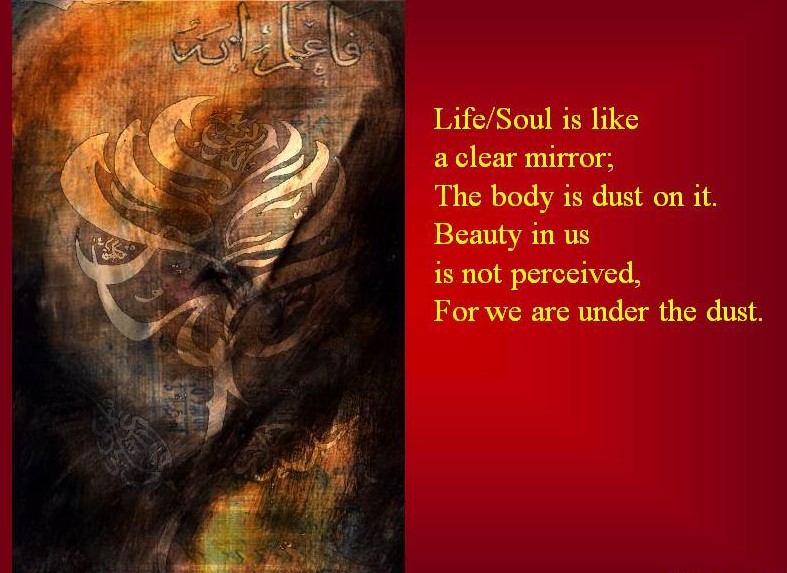
The path of the Sufi is to maximise their ‘preparedness’ through the process of tazkiya (spiritual purification), also known ubiquitously in Islamic mystical literature as ‘polishing the mirror’.
Before proceeding into the nuances of this metaphor in relation to the Moon, the foundations of Ibn ʿArabī’s science of light can be summarised as follows:

  • The Moon and the human being are conceptually similar as bodies of ‘Created Light’, which do not exhibit the light of God or the Sun from their own physical nature but through the projection or reflection of its radiance.
  • Both are composed of the same ‘clay’, causing them to share similar reflective properties.
  • Both are consequently prone to both light and darkness. As barzakhs, they both exhibit varying degrees of Divine radiance. This manifests in the Moon’s perennial waxing and waning, and in the human being’s varying susceptibility to darkness shown in how some hearts can be ‘perfect’ or ‘unique’ (to borrow adjectives used by Ibn ʿArabī himself) and some can be eclipsed by the shadows of materiality. Additionally, particularly during the phase where it is exactly half illuminated, the Moon can also be thought to embody Ibn ʿArabī’s concept of the munāzalāt; the precise mid-point between God and Man where the
    descent of God converges with the ascent of the human.

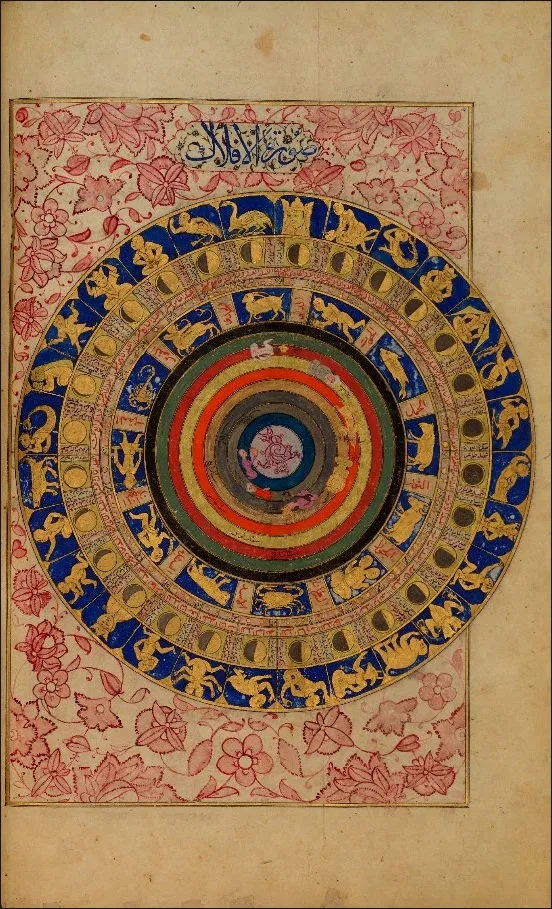
Overall, the Moon can be considered as a medial in several regards; as a host of Created Light, it participates in both light and darkness. Its physical situation as an intermediary in the structure of the cosmos is further elaborated by Ibn ʿArabī in his treatise on astrology – an art which in itself serves as a medium that bridges the celestial with the terrestrial, analogically reconciling the World of the Unseen (ʿālam al-ghayb) with the rubrics of language and geometrically comprehensible structures. Within these structures are the hierarchy of celestial spheres, mentioned previously in the context of Ibn ʿArabī’s marātib al-wujūd, the different degrees of existence. Their representation as concentric circles – depicted in Titus Burckhardt’s translation of Ibn ʿArabī’s astrological manual – reveals their order, from the highest point of the cosmos that is the Divine Throne, to the lowest: the ‘floor’ (farsh) of the Earth. In this diagram, the sphere of the Moon is situated directly above that of
the worldly elements. This indicates the Moon’s status not only as a barzakh in regard to light, but also in regard to space: it is an intermediary between the Earth and the higher degrees of the cosmos, akin to how the human being is suspended between the light of God and the dimmed constitution of its corporeal physicality.

The 9th-century polymath al-Kindī, invoking Aristotelian physics, was the earliest to offer an Islamic perspective on these hierarchical celestial dynamics. He regarded the stars and planets as ‘proximate agents’ for God’s actions, likening this phenomenon to the function that the bow has in an archer’s firing of an arrow.
According to this view, the Moon is a casual mediator in addition to a mediator or light. Notably, the Arabian astrologer Abu Maʿshar – who lived during the same Golden Age as al-Kindī and potentially influenced Ibn ʿArabī’s own astrological framework – commented that the Moon has a heightened impact on the Earth. According to him, it is ‘the swiftest object in the heavens’, meaning it ‘exerts the greatest effect on human affairs’; this is another valuable consideration in the interpretation of the Moon as a midpoint between God and Man in the Islamic cosmic vision. These insights should thus be considered for the present study, offering a more detailed picture of the celestial spheres and their relations to each other.

Furthermore, an essential quality assigned to the Moon in Ibn ʿArabī’s astrology is that of the imagination (al-khayāl), and more conceptually the imaginal realm (ʿālam al-ghayb) – another conceptual point of mediation. In Islamic mystical psychology, the imaginal realm functions as a point of crossover between the sensory world and the Divine, whereby imaginative powers make it possible to conceive a physical, limited object existing in a state
of unlimited permanence or abundance. For instance, an object encountered by the senses a posteriori is subject to the eventual decay of its material form. But, if the same object is imagined, one can conceive its perfect, everlasting form, which is not bound to spatio-temporal limitations. In this sense, the imagination is able to coalesce the realities of the worldly with the possibilities of the Unseen, conceptually hosting both shadow and light. It is
because of this that the imagination can be thought of as an ontological barzakh – another intermediary between the two planes of existence where, as Ibn ʿArabī tells us in his Meccan Revelations, ‘meanings manifest in sensory frames’.

The Moon – exhibiting both a luminous albedo and the darkness of its corporeal ‘clay’ – is
conceptually identical to the imagination in this sense. Not only is the Moon physically in-between the Earth and the higher spheres, but it is also an ‘in-between’ in terms of its ontological status, residing in the imaginal realm between the sensory and Divine realities.
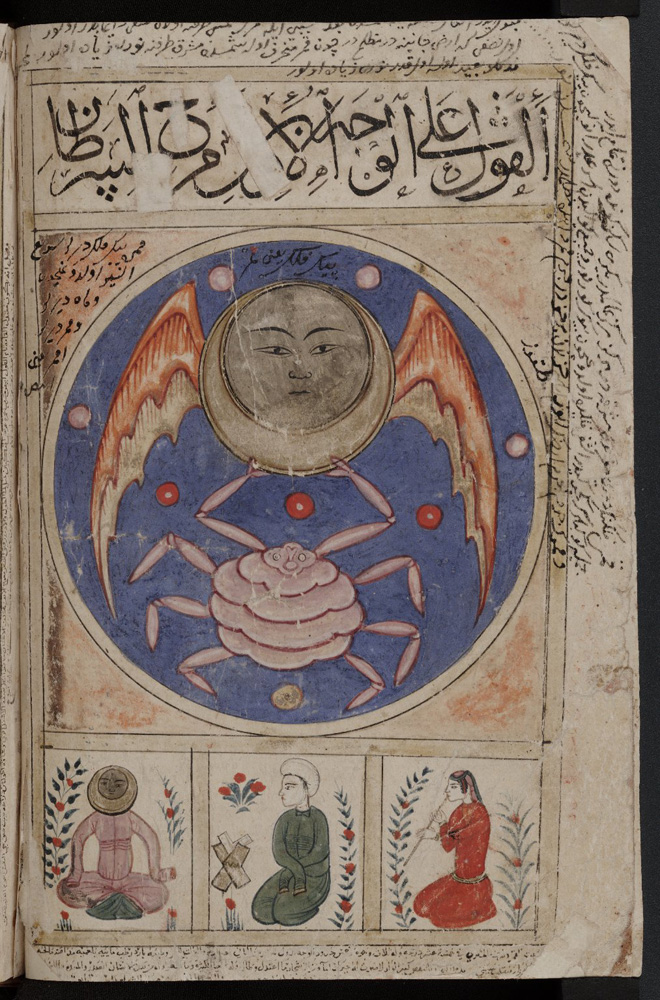
The relationship between the Moon and the imagination is deepened further by their mutual association with Cancer (known in Islamic astrology as al-saraṭān), the fourth zodiac sign which is typically associated with imagination and memory.

Its connection with the Moon can be found illustrated in the 14th-century Persian mystic Mahmud Shabestari, in his poem The Mystic Rose Garden:

the Moon sees in Cancer a creature akin to herself,
When head becomes tail she assumes the form of a knot
the Moon passes through eight and twenty mansions,
And then she returns opposite to the Sun.

According to Ibn ʿArabī, the zodiac signs themselves are ontologically aligned with the lunar and imaginal realms, existing in a ‘threshold realm’ that is ‘accessible to the human imaginative faculty’. Thus, in this context the Moon, the imagination, and their expression in the sign of Cancer, can be thought to represent the same overarching notion: imaginal intermediaries between the darkness (ẓulma) and mundanity of the dunyā and the brightness (nūr) and transcendence of the True Light.

Of further significance here is that the imagination itself is an analogical intermediary. This is worth noting in the mystical context of considering that the purpose of a figurative device, whether in the territory of literature or, in this case, the cosmos, is to harmonise the unknown (God) with the known (the physical world). This is the ability of the imagination, which as we have established is itself symbolically tied to the Moon. Its constitution enables the perception of Divinity through the corporeal instruments of the senses, translating the ineffable brightness of Him and His attributes into a conceivable reality.
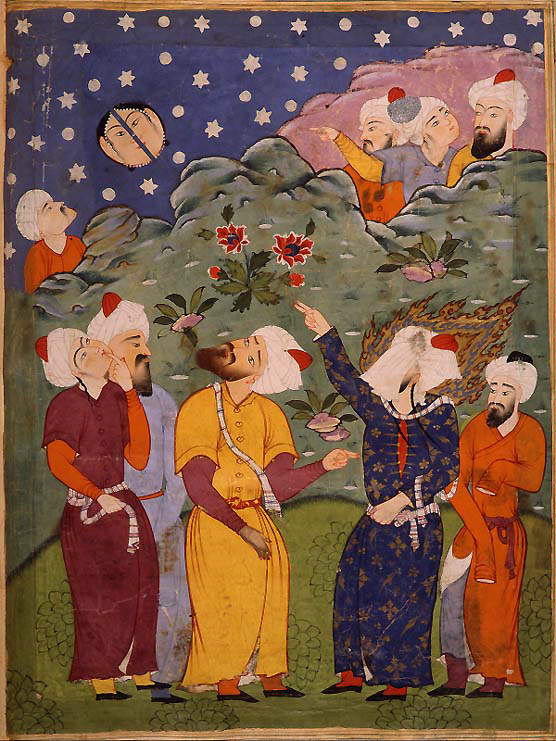
Just as God cannot be grasped without analogy, the Sun cannot be perceived without its light being somehow filtered (at least, not without risking severe retinal damage).

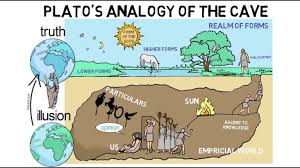
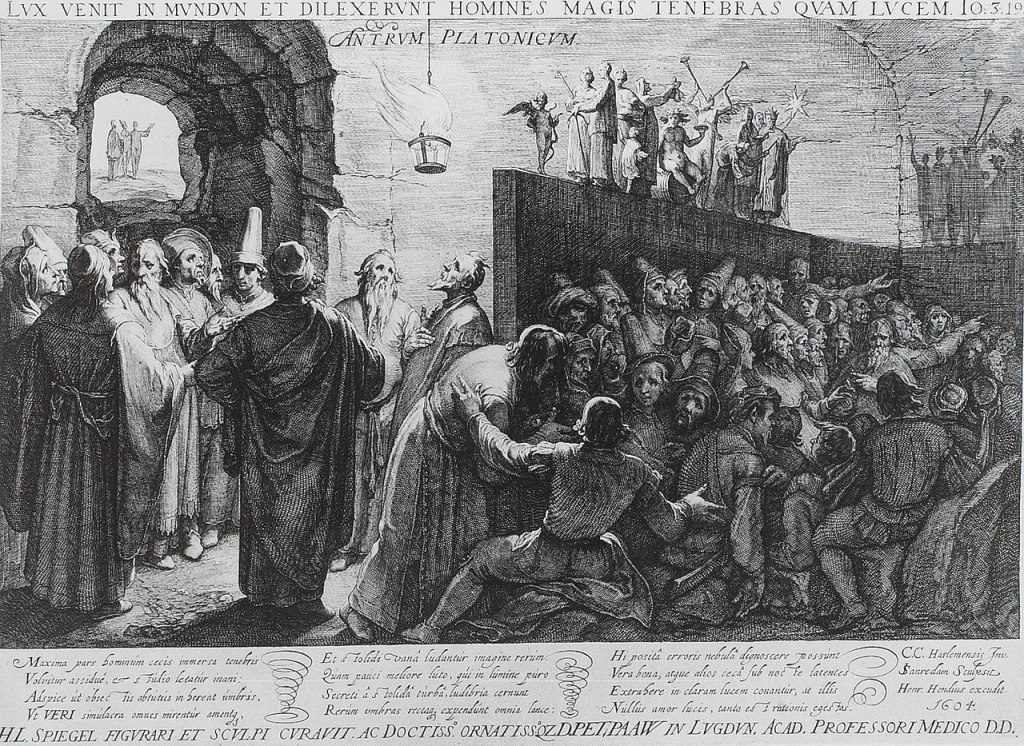
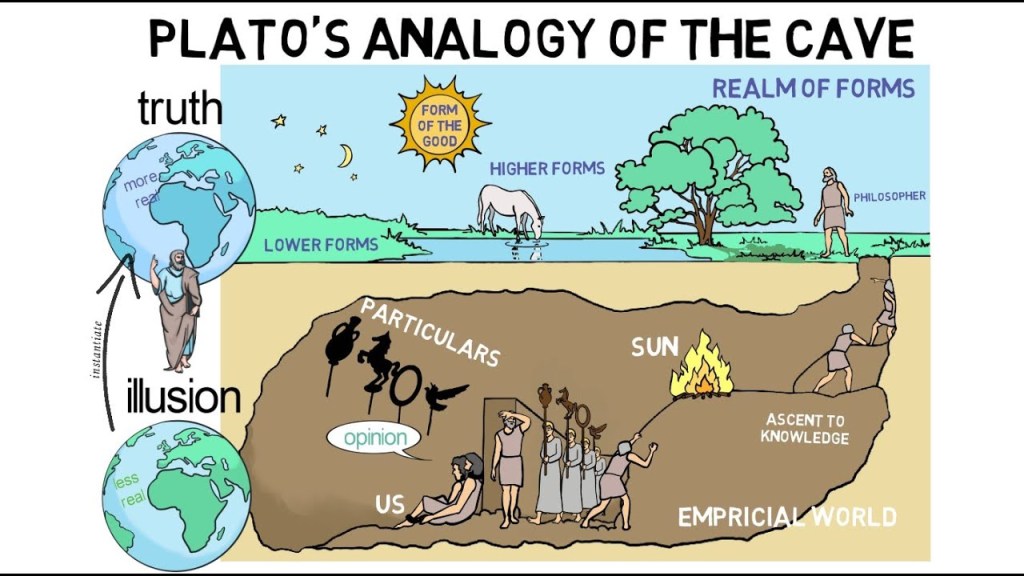
Plato, in his Allegory of The Cave, speaks of how the overwhelming brightness of the Sun will stun the mind of the cave dweller beyond comprehension. He does, however, explain that we can gradually accustom ourselves to ‘the sight of the upper world’ through exposure to its lower intensities. The Moon, in this case, makes this possible through mediation. While
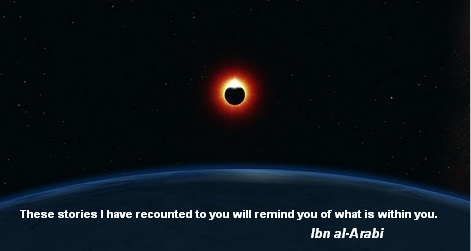
we cannot gaze at the Sun, we can gaze at the Moon – a body which imitates it upon the perceptible canvas of corporeal clay. Here, the Moon once again proves itself to be not only an astrological but also a theological barzakh, embodying, along with the imaginative faculty, functioning as the mystical Middle Way. Thus, the Moon can be thought of as a Middle Way in its epistemological function.
Moreover, the stations that the Moon undergoes in the process of becoming full are, as will now be explored, representative of another kind of Middle Way, namely, the path which human beings must surpass to move from worldly life to a state of unity with God.
A defining quality of the Moon is that its situation is not static; it exhibits different degrees of the Sun’s light over the course of twenty-eight days. What is the significance of this gradual progress towards the perfect reflection? Ibn ʿArabī’s Alchemy of Human Happiness, recently translated by Stephen Hirtenstein, offers a full extrapolation of his spagyric metaphors, providing further insights into the process of spiritual purification, which parallels the
process of illumination undergone by celestial bodies. The transmutation into gold as an analogy of the human being’s attainment of eudaimonia – that is, becoming one with God – is perhaps the most significant of all.
Gold, in the imagination of the ancient world, is a substance conceptually tied to the immortal light of the Sun. Alchemical transmutation represents the purification of a lesser metal (most commonly, copper) into gold, which through a series of chemical reactions comes to resemble its radiance – a process which can be, literally and figuratively, likened to the Moon and its attainment of the Sun’s luminosity upon becoming full. This comparison
becomes even more lucid when we study the two key elixirs in alchemy: the white and the red. The former is explicitly equated to the Moon itself, aiding the transformation of copper into silver, while the latter is compared to the Sun, which then turns silver into gold.

Again, the Moon – or rather, its elixir form – here functions as the point of transition or causal Middle Way between the lowest of materials, such as copper (or clay, our worldly form) and
supreme gold (the True Light). Alchemical purification vis-à-vis eudaimonia – which could also be compared to the Sufi gnosis, that is, fanāʾ (self-annihilation preceding Divine union) – is achieved through a procession of stages, or alchemical reactions as it were. In the Futūḥāt, Ibn ʿArabī refers to these as maqām (plural: maqāmāt) and in other sources ‘the degrees of perfection’ (kamāl) or ‘way stations’ – recurring terms in soteriological Sufi discourse. For instance, Ibn ʿArabī himself cites al-Harawī’s volume on the 100 ‘way stations’ of moral and spiritual development, which are also extrapolated by the Persian saint Khwajā Abdullāh Anṣarī, who describes in more depth the successive stages bridging the transition from self-awareness to self-loss.
Ibn ʿArabī’s framework of spiritual stages, however, designates not 100 degrees, but twenty-eight – a figure with inherent lunar connotations. These twenty-eight degrees can also be associated with the twenty-eight mansions of the Moon (manāzil al-qamar), featured previously in Shabestari’s poem and discussed by Ibn ʿArabī in his treatise on astrology. These ‘mansions’ are a sequence of astrological houses through which the Moon passes during its orbit. Each house is tied to a zodiac sign and can be figuratively compared to the notion of the way stations or maqāmāt through which the Sufi must traverse to reach his final station of spiritual ‘fullness’.
What is particularly paramount in Ibn ʿArabī’s system of astrology is the connection between the twenty-eight lunar mansions (the celestial ‘way stations’) and the twenty-eight characters of the Arabic alphabet. Chapter 2 of the Futūḥāt offers a deeper analysis of the subliminal qualities of the letters, such as Alif, y andm, which Ibn ʿArabī describes being orthographically linked to form the root of a verb denoting ‘eternity’. Insights such as
these demonstrate the rich esoteric dimensions of the Arabic writing system, which manifests in other tenets of Islamic belief such as the inherent holiness of the Arabic Qurʾan. Moreover, the Sufi practice of remembrance (dhikr) entails the recital of Allah’s ninety-nine Names in Arabic, which too inspires the mystical experience. Speaking in the Arabic language, a bridge between the human tongue and the Word of God (the Logos), can thus be seen as an inherently mystical act and, furthermore, one that serves as another form of Middle Way. Considering this, it becomes clear why Ibn ʿArabī compares its alphabet with the Sufi’s twenty-eight way stations towards Divine Union; it facilitates the presence of
God, just as the Moon does in its stages of ascension to fullness, both through twenty-eight modes.
Considering all of the above, it is apparent that the principle of ‘polishing the mirror’ can be applied to the phenomena of the Moon and its gradual process of illumination. The concept of spiritual purification that it pertains to ties in not only with Ibn ʿArabī’s metaphors of alchemical transmutation, whereby lower materials transmute into gold, but also with the concept of the Moon becoming the fullest reflection of the Sun. The polished mirror represents the human being who has, by progressing through the moral and spiritual ‘degrees’ or way stations and other noetic intermediaries, come to reflect Divinity; likewise, the Full Moon is the result of its traversion through the astrological lunar mansions, which
too are an intermediary bridge from the shadows of darkness to the reflection of the True Light. Both bodies have undergone a process of becoming ‘polished’, eventually coming to exhibit the highest degree of Created Light. The final phase of this metaphor will now be explored in the context of spiritual revelation and prophecy.
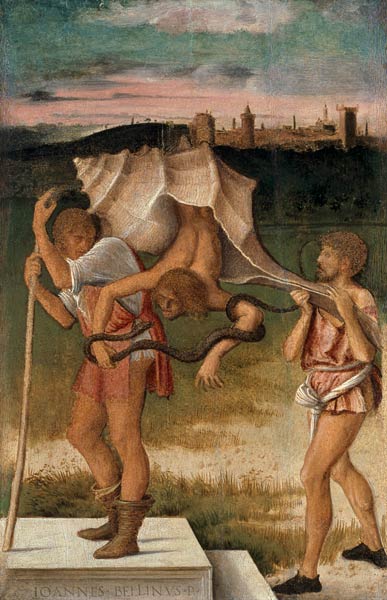
In one Hadith, we find an encounter where al-Barāʾ b. ʿAzib is asked, ‘Was the face of the Prophet (as bright) as a sword?’ He responds, ‘No, but (as bright) as the moon.’ Such is emulated in an account of Jābir Ibn Samura, a Companion of Muhammad, who recalls his face resembling the Full Moon in the night sky. What may appear merely as figures of speech here in fact coincide perfectly with Ibn ʿArabī’s celestial metaphors. The Prophet Muhammad is the embodiment of Allah’s attributes within the human form, and thus represents the perfectly polished mirror that is radiant with the True Light. Nonetheless, Muhammad is not Allah himself; he remains a mortal human of worldly clay, subject to the impermanence of the physical world just as the Moon is subject to perpetually waxing and waning. Ibn ʿArabī alludes to this phenomenon in the Futūḥāt when he speaks of the individual experiencing gnosis as ‘[God] manifest[ing] Himself through your essence in your outer form’; the mystic receives God’s light, but nonetheless retains his worldly nature in regard to his or her physical exterior.
It is not only Muhammad who is symbolically associated with the Moon; in Ibn ʿArabī’s parable of the two travellers in his The Alchemy of Human Happiness, the paradigmal nature of Adam – the primordial Insān al-Kāmil – is also associated with it. The correspondence of Adam and the Moon is realised by the character of the ‘follower’ – the individual who is attuned to the inner meanings of the sights encountered on the spiritual journey – while
the ‘rational thinker’ perceives only the physical form of the celestial body. While the rational mind sees only the Moon, the intuitive mind sees Adam – itself a powerful metaphor of the importance of perceiving the inner dimension (bāṭin) of worldly Signs. The follower’s insights are corroborated by other passages of Ibn ʿArabī’s, in which he explicitly describes Adam as ‘the mirror of Divinity’.

See also : the Splitting of the Moon

As with Muhammad, Adam is a ‘polished mirror’ who reflects the True Light, as the Full Moon reflects the Sun. Furthermore, the phenomena of Prophecy can be associated with the imaginative abilities, which, as was explored earlier, are qualitatively lunar. Returning to al-Kindī’s 9th-century Qurʾanic science, he speaks of the muṣawwira (imaginative faculty) as the host of Divine knowledge. This is exhibited by everybody to some extent during dreaming (where, according to al-Kindī, sensory recollections from memory coalesce with deeper meaning sent by God), but it is especially potent in those who are receptive to spiritual revelation. This is seen most profoundly in the portrayal of Joseph in Sūrat al-Yūsuf, where his prophetic abilities are revealed through his impeccable dream-interpretation skills. Al-Kindī attributes prophecy to the most well-attuned, ‘polished’ imagination, which can be compared to the fullest illumination of the Moon (which, as discussed previously, is ontologically related to the ʿālam al-mithāl). At this climactic point, the Prophet’s imagination becomes a vessel for attributes of God and, returning to Plato’s allegory of the Cave, marks the moment when the individual: [becomes] able to catch sight of the sun, not just reflected in water, or as it appears in any alien location, but the sun itself, by itself, in its own place, and observe it as it is.
This short excursion has sought to extrapolate on the mystical dimension of the Moon as presented in Ibn ʿArabī’s writings, which can be summarised as follows. In his cosmological system, the Earth’s satellite has the status of a barzakh – an intermediary between Divine Light and mundane physicality. This, as a principle, can be related to the nature of the human condition, which finds itself suspended between the nature of Allah (being created in His image) and that of the physical dunyā. Moreover, it is specifically the imaginative faculty, which, just like the Moon, mediates the two states. The imagination exists in the same ontological ‘sphere’ as the Moon and the zodiac, being suspended between the known
and the unknown.
Moreover, this medial status is significant in the pursuit of mysticism; analogies and symbols fulfil the concept of the analogical Middle Way. The Moon itself is an analogy of Divine Light that has been appropriately dimmed for the inadequacy of human eyes, and on an even deeper level is also itself an analogy for the process of ‘polishing the mirror’ in order to reflect God’s attributes and reach theophanic union. As it was explored, the Moon undergoes twentyeight lunar mansions, which can be compared to the twenty-eight degrees of perfection which can, in turn, be related to Ibn ʿArabī’s metaphors of alchemical transmutation. The Moon also relates to the twenty-eight letters of the Arabic alphabet, which too constitute a mystical Middle Way between worldliness and God, considering
the sanctity of the Arabic language in the Islamic context.
The result of the human being who has undergone these twentyeight stages is a union with God; the Moon’s total reconciliation with the Sun’s light. This can manifest in religious revelation, with prophets (and their imaginative faculties) coming to resemble the
Full Moon. Furthermore, what is symbolically striking in the astronomical phenomena of the Full Moon is the fact that it has, quite literally, risen above the Earth; it is only when the mystic has overcome the dunyā that it can face and reflect the Sun (Allah) in His
totality. This contrasts with the new moon upon which no sunlight can be reflected, symbolising the obstruction of worldly attachment to both material objects and the illusion of the self (nafs).
Meanwhile, the Full Moon – the celestial ‘polished mirror’ – is that which has overcome the obstacle that is the world. It has risen from the shadows of its worldly clay, completed its course of spiritual ascension and, finally, has become illuminated by Allah, the source of the True Light

Everything that We recount to you of the stories of the messengers
is so that thereby We may strengthen your heart. For through
this there has come to you the Truth and an exhortation,
and a reminder for the believers.”
 (11:120)
“The prophets are all brothers with the same father.
Their mothers are different, but their religion is one.”
— The Prophet of God
(Bukhari, 4.55.652)
Every Messenger is a prophet, and every prophet is a saint.
— Muhyiddin Ibn al-‘Arabi (the “Greatest Sheikh”)

Acedia vs Pre-Eternity : Trauma of our times

  • The Acedia virus is spreading rapidly among people

Many people have a feeling of stress and overload, of lethargy and a lack of motivation, of fear and uncertainty about the future. The word Acedia is used for that complex feeling. Acedia is not new. The Greek poet Homer already used the word to mean ‘neglect, lack of care’. Later on, acedia also came to mean ‘listlessness’, ‘sluggishness’ and ‘inertia’.

If you look at our life, you notice that you mainly end up in the 1D and 2D living level due to this Acedia virus. Your life becomes straightforward and superficial. Your self-made boundaries are coming at you more and more. Your inner freedom is getting smaller and smaller. This is because we are fighting against our own nature. Because we want to save people at all costs, we end up in an unnatural downward spiral. This is not the natural intent. The Corona virus is a message to people. It will not disappear and dissolve until we follow our own nature. By clinging to the unnatural thinking, doing and making system of humanity, we will have to deal with much more natural resistance. If we really listen to this resistance, we will find out that nature has what is best for us.

So many people are now stuck in their 1D and 2D lives, causing an extreme unnatural deformity and skewed growth. Only humans are capable of this on this planet, because we have the consciousness to deviate from the natural path. We have abused this gift enormously. Humanity has started to think, act and make in deviations. We do not use the deviations to create a new natural path, but to fight the natural path. Because we do not make use of a natural creation process in all our thinking, doing and making, we are becoming increasingly distant from ourselves and nature. We see and experience all the nasty consequences of this, but we also try to combat it by fighting even harder against nature and ourselves. All faith in natural existence has been broken by ourselves. You can fix this again by starting the natural creation process. It all has to do with our imagination. Our imagination determines the path we follow. It is necessary to direct this imagination with our consciousness. This does not require a 3D living level, but a natural 4D living level. At a 4D living level you live from the center of consciousness. Through everything who you are comes together. By disconnecting your consciousness from your imagination, a tension arises between the two. The first step towards natural shaping of yourself and your environment is to feel this field of tension. Only when you feel this can you ensure a natural balance.

The Acedia virus is the most contagious virus. The leaders of the unnatural deformed system make decisions that create even more deformities and chaos. They don’t know any better. The Acedia virus is a persistent virus, because it is invisible and unnoticeable to many. So it does not exist in the eyes of the masses who are in charge. It is only a matter of time before humanity realizes that things have to change completely. This is a natural need such as needing to breathe, eat and drink. If humanity is to win, it must defeat itself. Man has become his own worst enemy because of the Acedia virus. If we do not realize this, then the emptiness, nature will continue to force itself more and more violently until we give up this unnatural struggle and start shaping everything again and naturally.

  • The Acedia virus as Afternoon Devil

Not only St Antony, many desert fathers were busy fighting off demon attacks: bearded devils, venomous snakes with a human head, seductive women who turned into crocodiles or masturbating apostles. Presumably all those images were projections, and/or due to chemical reactions in the brain, caused by sleep deprivation and extreme fasting periods.

The most dangerous demon was the so-called midday devil, who tried to seduce the hermits into spiritual dullness and eventually abandon their way of life. Especially when they lived alone, the ascetics often became miserably stressed and fell into dejection, restlessness, and a psychotic aversion to their filthy dens and lonely caves. Their state of mind, which arose mainly around noon, in the heat of the day, was accurately described in the writing Praktikos , or The Monk, composed in the fourth century by the desert father Evagrius . For the malaise he uses the Greek word akèdeia , which means something like ‘indifference’ or ‘listlessness’ (in Latin: acedia ; in English the word accidie derived from it still exists , in Italian accidia ).

  • Melancholy

In later times the acedia breaks away from the midday devil and manifests itself under other names: melancholy, taedium vitae (aversion to life), nostalgia, apathy, Weltschmerz, ennui , frustration,” nausée” ( Sartre’s Nausea), boredom and finally depression, that modern container concept. In the Renaissance, the body replaces God. Melancholy means black bile, which is one of the four bodily fluids necessary for good, balanced health. Those who have too much black bile become sad and depressed. In the modern phase, the acedia becomes medicalized, giving rise to “a strange amalgam of depression and doubt of the benevolence of reality”). The same goes for drug use.

Boredom is the fundamental mood of contemporary society. The psychiatrists and psychotherapists are busy with the resulting depressions. The entire modern entertainment industry lives by man’s need for stimuli that (temporarily) relieve him from everyday boredom. A very special form of the phenomenon is the dromomania or morbid wanderlust. Dromomania literally means: mania for locomotion. It mainly affects wealthy elderly people who can afford to take a quick look at all the wonders of the planet just before saying goodbye. One cruise is not yet over or the suitcases for the other are already ready. Finally, the boredom of the nursing home also awaits them.

  • The salvation of yourself

The instability has to do with the fact that you are always looking for distraction. Even if that is in the form of a different education or hobby, you suffer from Acedia . Being too busy with your health is also less positive than we think. It can also mean that you are only disciplining your body and totally neglecting your mind. Poor compliance with rules means as much as not fulfilling your obligations. Not only cutting corners, but working too hard can be a sign of a general feeling of discouragement or desolation. Acedia eventually even makes you doubt your state of life or your calling. You feel like you’re never going to achieve what you need to achieve and that, in short, it’s all pointless. You have no inner strength left and so you flee into laziness, working too hard, or doing nothing. It takes some getting used to this. We’ve all learned to pathologize our gloomy feelings. We use phrases like “I’m depressed” or “I’m so autistic about that”. Would a broader definition of apathy give a more truthful picture of humanity? Not being able to push yourself to anything can be a signal that there’s more to it than you think. Apathy is actually the opposite of persistence.

Persistence when you’re despondent may sound tough, but it’s pretty simple. By staying true to your life as it is, the duties you now have to do, you can overcome your sense of malaise. By sticking to your daily tasks like a stairway to heaven and by climbing in faith, you can overcome even the most severe despondency and grow as a person.

So the next time you’re despondently putting things off, and you realize that your time on social media isn’t bringing you any live contacts, maybe read this quote from the desert monk Arsenius (4th century). “Go to your room, eat something, sleep and do no work for a while, but don’t leave your room under any circumstances!”

The Noonday Devil: Acedia, The Unnamed Evil of Our Times a book by Jean-Charles Nault, OSB

The noonday devil is the demon of acedia, the vice also known as sloth. The word “sloth”, however, can be misleading, for acedia is not laziness; in fact it can manifest as busyness or activism. Rather, acedia is a gloomy combination of weariness, sadness, and a lack of purposefulness. It robs a person of his capacity for joy and leaves him feeling empty, or void of meaning

Abbot Nault says that acedia is the most oppressive of demons. Although its name harkens back to antiquity and the Middle Ages, and seems to have been largely forgotten, acedia is experienced by countless modern people who describe their condition as depression, melancholy, burn-out, or even mid-life crisis.

He begins his study of acedia by tracing the wisdom of the Church on the subject from the Desert Fathers to Saint Thomas Aquinas. He shows how acedia afflicts persons in all states of life— priests, religious, and married or single laymen. He details not only the symptoms and effects of acedia, but also remedies for it. Here a summary:

3 Definitions of Acedia

#1: “Spiritual lack of care.” – Evagrius of Pontus

  • Evagrius of Pontus (345-399), who was the first to present a coherent doctrine on acedia, adapted the original Greek understanding of acedia as a physical “lack of care” (specifically with regard to not arranging a funeral for your deceased family members) into a spiritual “lack of care” (with regard to your own spiritual life). Evagrius personified acedia, calling it “the noonday devil” (cf. Ps 90:6) and the “most oppressive of all the demons” because acedia is able to conceal itself from the one who experiences it.
  • “Acedia is the temptation to withdraw from the narrowness of the present so as to take refuge in what is imaginary; it is the temptation to quit the battle so as to become a simple spectator of the controversy that is unfolding in the world”

#2: “Sadness about spiritual good.” – St. Thomas Aquinas

  • Aquinas says that acedia is a negative reaction (sadness) about participating in God’s life (spiritual good) because we are unwilling to renounce a particular carnal, temporal, limited, apparent good that stands in the way of our true good.

With acedia, we are discouraged, spiritually depressed, and fall into despair. We choose to live in mediocrity, usually manifest through little everyday infidelities. “We are unable to believe in the greatness of the vocation to which God is calling us: to become sharers in the divine nature”

#3: “Disgust with activity.” – St. Thomas Aquinas

  • Since “our acts are like steps that either bring us closer to the vision of God or else distance us from it, depending on whether they are good or bad” 4), an interior, spiritual disgust (weariness, sloth, boredom) with activity is, therefore, an obstacle to beatitude.
  • This definition of acedia is rooted in John Cassian’s (360-433) presentation of acedia as a lack of impetus to work.
  • We feel a constant need to change, to move, an inability to accomplish any task, rooted in a self-sufficiency that presents itself as a false humility in not striving for greatness.
  • “I have discovered that all human misfortune comes from one thing, which is not knowing how to remain quietly in one room” (Blaise Pascal).

The Importance of Acedia

Acedia is both the most forgotten topic of modern morality nd perhaps the root cause of the greatest crisis in the Church today. Acedia is not only “the monastic sin par excellence” but also “the major obstacle to enthusiastic Christian witness”

Remedies for Acedia

#1: Joyful perseverance

  • “The strategy to be deployed against the devil of acedia can be summarized in the phrase: joyful perseverance” (
  • We must resist, stand fast, remain faithful to our routine and rule of life, and persevere in God’s sight.
  • “Restore to me the joy of your salvation, and uphold me with a willing spirit” (Ps 51:12). This is the prayer that must dwell in our hearts on days of acedia. It sums up perfectly our spiritual attitude when confronted by temptation. We are radically saved, restored to life with Christ: our sadness has definitively been changed into joy (Jn 16:20). This gaudium resulting from the Resurrection of Christ is something that we must show; we must witness to it. We are called to a marvellous work: to help others – to the merger extent that we can, in other words, by our excellent actions – to walk toward our perfect fulfillment in Christ. Now this requires magnanimity, greatness of soul” ).

#2: Be faithful in the little things

  • We must live the present moment in all its spiritual intensity, knowing that it is an opportunity to encounter the Lord.
  • We must be faithful in the very little things (Lk 16:10; 19:17; Mt 25:21), especially in ora et labora, that is, prayer and work.

#3: Use the Word of God

  • Use a verse from Scripture to confound the devil. We must “raise our eyes toward heaven, toward Him who waits to see us fight” (136): “O God, come to my assistance; O Lord, make haste to help me” (Ps 69).
  • St. Benedict (480-547) situated acedia within the context of lectio divina, prescribing praying with the Word of God as the true antidote against acedia: “When evil thoughts come into one’s heart, to dash them against Christ immediately” (St. Benedict).

#4: Meditate on death

  • This gives meaning to passing time and helps you fight against self-love:  “keep death daily before one’s eyes” (St. Benedict).
  • “Make me know the shortness of my life, that I may gain wisdom of heart” (Ps 90).
  • “Someone asked an old man: “What do you do to avoid falling into acedia?” He replied: “Every day I wait for death.”
  • ————————————————————-
  • Note: Mutiny of the Soul
  • Depression, anxiety, and fatigue are an essential part of a process of metamorphosis that is unfolding on the planet today, and highly significant for the light they shed on the transition from an old world to a new.
  • When a growing fatigue or depression becomes serious, and we get a diagnosis of Epstein-Barr or Chronic Fatigue Syndrome or hypothyroid or low serotonin, we typically feel relief and alarm. Alarm: something is wrong with me. Relief: at least I know I’m not imagining things; now that I have a diagnosis, I can be cured, and life can go back to normal. But of course, a cure for these conditions is elusive.
  • The notion of a cure starts with the question, “What has gone wrong?” But there is another, radically different way of seeing fatigue and depression that starts by asking, “What is the body, in its perfect wisdom, responding to?” When would it be the wisest choice for someone to be unable to summon the energy to fully participate in life?
  • The answer is staring us in the face. When our soul-body is saying No to life, through fatigue or depression, the first thing to ask is, “Is life as I am living it the right life for me right now?” When the soul-body is saying No to participation in the world, the first thing to ask is, “Does the world as it is presented me merit my full participation?” Read More Here

The “Dulle Griet” as “whore of Babylon” ,  in the land of Ignorance by Brueghel

Dulle griet is the representation of the  Whore of Babylon living in a land of Ignorance.

The Whore of Babylon in the The Apocalypse Tapestry of Angers

The Whore of Babylon or Babylon the Great is a symbolic female figure and also place of evil mentioned in the Book of Revelation in the Bible. Her full title is stated in Revelation 17 (verse 5) as Mystery, Babylon the Great, the Mother of Prostitutes and Abominations of the Earth.

The word “Whore” can also be translated metaphorically as “Idolatress“.[1] The Whore’s apocalyptic downfall is prophesied to take place in the hands of the image of the beast with seven heads and ten horns. There is much speculation within Christian eschatology on what the Whore and beast symbolize as well as the possible implications for contemporary interpretation.

Look also: Bruegel: the Apocalypse Within

Dulle Griet is the model of modern man’s  Rebellion  against his soul and  Anger against it. How can Dulle Griet find  a way to calm her anger?

She can looks in  the mirror and see herself,making more “selfies”, so  seeing more anger as the portait of vanity of Hans Memling shows us:. The lady see only more vanity .

The message of Memling is in his Triptych of Earthly Vanity and Divine Salvation  focuses on the idea of “Memento mori,” a Latin phrase that translates to “Remember your mortality.” Memling’s triptych shockingly contrasts the beauty, luxury and vanity of the mortal earth with images of death and hell. In the time of Breughel and in our times  the message is  that  Vanity is not the solution. see: Nothing Good without Pain: Hans Memling”s earthly Vanity and  Divine Salation

All Is Vanity by Charles Allan Gilbert (September 3, 1873 – April 20, 1929)

The phrase “All is vanity” comes from Ecclesiastes 1:2 (Vanity of vanities, saith the Preacher, vanity of vanities; all is vanity.

Don’t change the world in hopes of changing yourself,

change yourself so the world changes because of you.

——————————————————

  • Praise of folly

“The supreme madness is to see life as it is and not as it should be, things are only what we want to believe they are ...”

Jacques Brel

Read more here

  • Allegory of the cave

The Allegory of the Cave, or Plato’s Cave, is an allegory presented by the Greek philosopher Plato in his work Republic (514a–520a) to compare “the effect of education (παιδεία) and the lack of it on our nature“. It is written as a dialogue between Plato’s brother Glaucon and his mentor Socrates, narrated by the latter. The allegory is presented after the analogy of the sun (508b–509c) and the analogy of the divided line (509d–511e).

In the allegory “The Cave,” Plato describes a group of people who have lived chained to the wall of a cave all their lives, facing a blank wall. The people watch shadows projected on the wall from objects passing in front of a fire behind them and give names to these shadows. The shadows are the prisoners’ reality, but are not accurate representations of the real world. The shadows represent the fragment of reality that we can normally perceive through our senses, while the objects under the sun represent the true forms of objects that we can only perceive through reason. Three higher levels exist: the natural sciences; mathematics, geometry, and deductive logic; and the theory of forms.

Socrates explains how the philosopher is like a prisoner who is freed from the cave and comes to understand that the shadows on the wall are actually not the direct source of the images seen. A philosopher aims to understand and perceive the higher levels of reality. However, the other inmates of the cave do not even desire to leave their prison, for they know no better life.[1]

Socrates remarks that this allegory can be paired with previous writings, namely the analogy of the sun and the analogy of the divided line.

– The principle of verticality

The principle of verticality, which is a fundamental principle of traditional wisdom, is based on the affirmation of transcendence as an aspect of a comprehensive and integrated reality that is Absolute.

According to this understanding, reality has both a transcendent Origin and an immanent Center, which are one, rather than being reduced to the merely horizontal dimension of its existential or quantitative elements.

Verticality implies both Heaven and Earth, a worldview in which meaning and purpose are defined principally by both height and depth,and secondarily by breadth – that is, principally by man’s relationship to God, who is simultaneously ‘above’ and ‘within’ creation, and who there-fore governs all creaturely relationships – rather than by breadth alone –that is, solely in terms of the relationship between the subject and the world.

It also implies that the horizontal is subordinate to the vertical,that is to say, the relationship between man and the world is premised on the primary relationship between God and man: to restate this in Christian terms, the love of one’s neighbor is premised on one’s love for God. According to the traditional worldview, existence is transcended by a supreme reality, which, whether expressed in theistic or non-theisticterms, is Absolute, and which, without derogating from its unity, is si-multaneously (at the level of the primary hypostasis) expressed by the horizontal ternary, Truth or the Solely Subsistent Reality, Goodness or the Perfection and Font of all Qualities, and Beauty or Abiding Serenity and the Source of its Radiant Effulgence: in Platonic terms, the True, the Good and the Beautiful.

All creation is prefigured in this supreme reality,which projects existence out of its own Substance into a world of form (hence etymologically, ex-stare, to stand out of, or to subsist from, as the formal world of existence stands out of, and subsists from, the Divine Substance) through a vertical ternary comprising, first, the Essential or Principial Absolute (which is Beyond-Being), second, the Relative-Absolute Source of Archetypes (which is the primary hypostasis of Being), and third, the realm of Manifestation (which is Existence).

The world itself,and its creatures, including man, as such, are therefore of derivative significance and are accidental in relation to the supreme reality, which alone is substantial. The world is transient, ephemeral and illusory.

The Divine Substance alone is permanent and real. This view of the transcendent, supreme and substantial reality of the Absolute (which, according to the principle of verticality, is described in terms of its elevation orperfection in relation to creation) finds its expression in all religious traditions.

The Sufi Master Sheikh Nazim al Haqqani al Rabbani says: We change Reality by changing our Perception of it.There is much to be learn about Eternity by living in Time and There is much to be learn about Time by living in Eternity

So it is time to look at eternity:

What is time and pre-eternity?

We change Reality By changing our perception of it

There is much to be learn about Eternity by living in Time

There is much to be learn about time by living in Eternerty

What is our Destiny:

Tthe sacred Tradition as Sufism an Islam  explains the most important cause for misunderstanding the issue of qadar (destiny) is confusion about the concepts of “time” and “pre-eternity” and misinterpreting them.

People live in time and place and so they evaluate every event according to time and they make a mistake by assuming “pre-eternity” as the beginning of “time”.  Misunderstanding qadar is the result of this wrong comparison.

Time is an abstract concept. It starts with the creation of the universe and many events happen in it. Time is divided into three parts: Past, present and future. This division is for creatures. Namely, the concepts such as century, year, month, day, yesterday, today, tomorrow are in question for creatures.

Pre-eternity does not mean before the beginning of the time. In pre-eternity, there is no past, present and future. Pre-eternity is a station where all times are seen and known at the same moment. Now, we will try to understand God’s attribute of pre-eternity through some examples from Sufism and Islam:

Suppose that this picture is our timeline. The middle is the present, that is, now; the left side is the past and the right side is the future. Now, we are holding a mirror on the time scheme. The mirror is close to the floor; so, only the present time is reflected on the mirror. The past and the future are not included. Now, we will lift the mirror a bit and in this position, the present time and a part of the past and the future are reflected on the mirror. When we lift the mirror a little more, the remaining part of the past and the future that are not seen in the previous position are also reflected on the mirror. That is, as we lift the mirror, the time period which appears on the mirror expands. Now, we will lift the mirror to the highest point.

At this point, the mirror encompasses the present, past and future as a whole. This point is called the point of pre-eternity, which sees all of the three times as a whole at the same moment. When we say, “Allah is pre-eternal”, we mean that Allah sees and knows all times and places at the same moment and that He is timeless.

The Metaphysics of Trauma

Trauma, which has become a hallmark of everyday life in the modern world, forms part of the broader mental health crisis that afflicts society today. It also, arguably, reflects a lost sense of the sacred. Throughout humanity’s diverse cultures, suffering is understood to be intrinsic to the larger fabric of life in this world; trauma, therefore, is a direct consequence of not being able to properly integrate suffering into one’s life. However, this is not to simply equate suffering with trauma, or trauma with illness. The prevalence of acute traumatic suffering has always been a major cause of disbelief in religion. Yet the increased weakening of faith in the modern world has provoked a particularly severe spiritual crisis, which could be dubbed the “trauma of secularism.” Through recourse to traditional metaphysics, we can begin to understand the transpersonal dimension of this phenomenon and thus accurately assess, diagnose and provide adequate treatment. It will be argued that healing and wholeness cannot take place outside the purview of a “sacred science,” the spiritual dimension of which transcends the limitations of mainstream psychology and its profusion of profane therapies. Read here

  • The Symbolism of the Cross

The Symbolism of the Cross is a major doctrinal study of the central symbol of Christianity from the standpoint of the universal metaphysical tradition, the ‘perennial philosophy’ as it is called in the West. As Guénon points out, the cross is one of the most universal of all symbols and is far from belonging to Christianity alone. Indeed, Christians have sometimes tended to lose sight of its symbolical significance and to regard it as no more than the sign of a historical event. By restoring to the cross its full spiritual value as a symbol, but without in any way detracting from its historical importance for Christianity, Guénon has performed a task of inestimable importance which perhaps only he, with his unrivalled knowledge of the symbolic languages of both East and West, was qualified to perform. Although The Symbolism of the Cross is one of Guénon’s core texts on traditional metaphysics, written in precise, nearly ‘geometrical’ language, vivid symbols are necessarily pressed into service as reference points-how else could the mind ascend the ladder of analogy to pure intellection? Guénon applies these doctrines more concretely elsewhere in critiquing modernity in such works as The Crisis of the Modern World and The Reign of Quantity and the Signs of the Times, and invokes them also to help explain the nature of initiation and of initiatic organizations in such works as Perspectives on Initiation and Initiation and Spiritual Realization. Read here

The Multiple States of the Being

The Multiple States of the Being is the companion to, and the completion of, The Symbolism of the Cross, which, together with Man and His Becoming according to the Vedanta, constitute René Guénon’s great trilogy of pure metaphysics. In this work, Guénon offers a masterful explication of the metaphysical order and its multiple manifestations-of the divine hierarchies and what has been called the Great Chain of Being-and in so doing demonstrates how jñana, intellective or intrinsic knowledge of what is, and of That which is Beyond what is, is a Way of Liberation. Guénon the metaphysical social critic, master of arcane symbolism, comparative religionist, researcher of ancient mysteries and secret histories, summoner to spiritual renewal, herald of the end days, disappears here. Reality remains. look here

The secularity of the society in which we live must share considerable blame in the erosion of spiritual powers of all traditions, since our society has become a parody of social interaction lacking even an aspect of civility. Believing in nothing, we have preempted the role of the higher spiritual forces by acknowledging no greater good than what we can feel and touch.” Vine Deloria Jr

The perspective of modernity where Western Man as the egolatrous being is placed at the top of existence for all others to look towards for recognition.

The pyramidal construction of Man from an Islamic perspective shifts our understanding of the seriousness of placing the egolatrous Man above God in constructing reality, while simultaneously allowing us to imagine what would be necessary in creating a transmodern critique in constructing the Human.

Read here:

THE ISLAMIC CONCEPT OF HUMAN PERFECTION

Rumi: A Disclosure of Wisdom  for our Time

Sufism is the way of purifying the heart from bad manners and characteristics under the guidance of a Sheikh.