Sun Dance of the Native Spirits of Plains Indians and Warli People of India

  • Sun Dance of the Native Spirits

The Sun Dance is the most sacred ritual of Plains Indians, a ceremony of renewal and cleansing for the tribe and the earth. Primarily male dancers—but on rare occasions women too—perform this ritual of regeneration, healing and self-sacrifice for the good of one’s family and tribe. But, in some tribes, such as the Blackfeet, the ceremony is led by a medicine woman. It has been practiced primarily by tribes in the Upper Plains and Rocky Mountain, especially the Arapaho, Arikara, Assiniboine, Cheyenne, Crow, Gros Ventre, Hidatsa, Sioux, Plains Cree, Plains Ojibway, Omaha, Ponca, Ute, Shoshone, Kiowa, and Blackfoot tribes.
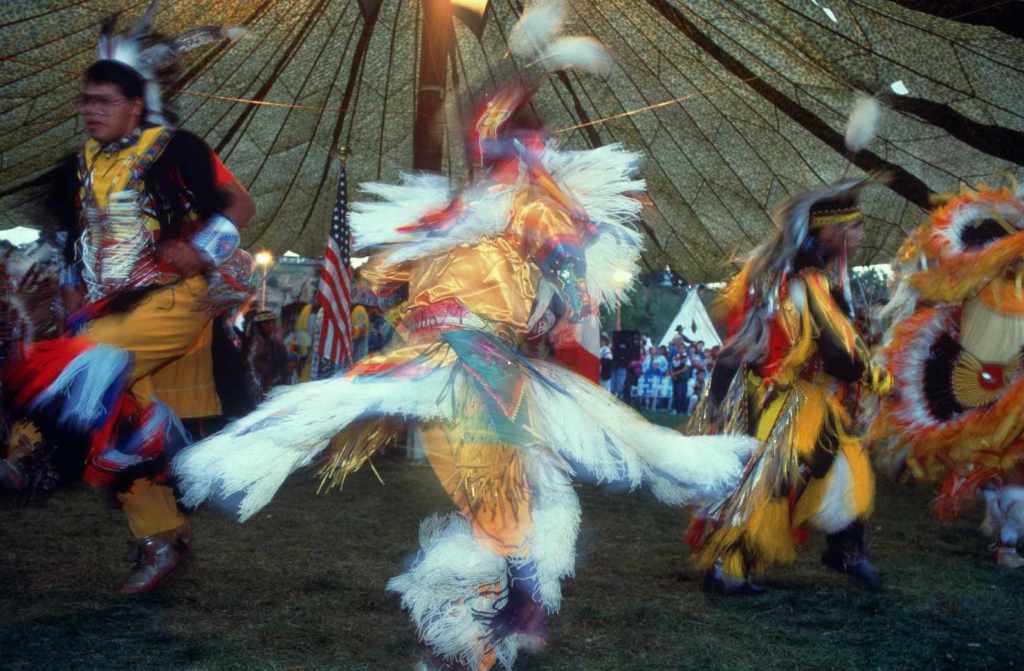
The Sun Dance is a ceremony practiced by some Native Americans and Indigenous peoples in Canada, primarily those of the Plains cultures. It usually involves the community gathering together to pray for healing. Individuals make personal sacrifices on behalf of the community See more here.

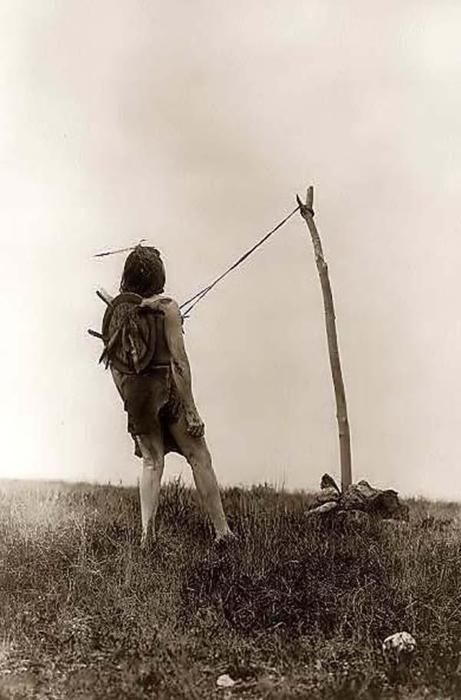
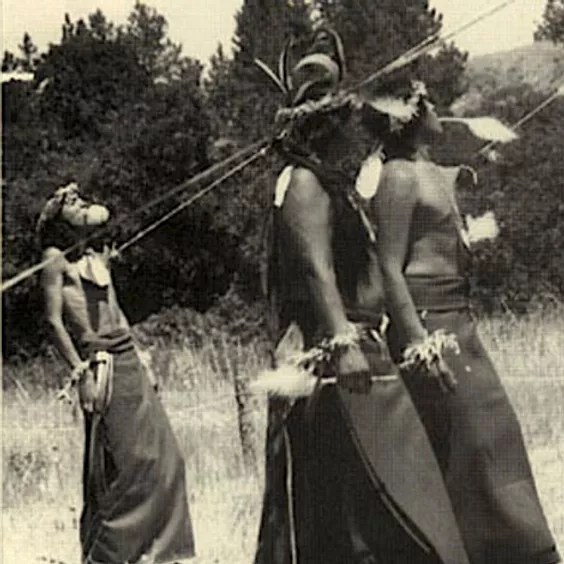
Usually the ceremony was practiced at the summer solstice, the time of longest daylight and lasts for four to eight days. Typically, the Sun Dance is a grueling ordeal, that includes a spiritual and physical test of pain and sacrifice. This ritual usually—but not always—involves piercing rawhide thongs through the skin and flesh of a dancer’s chest with wooden or bone skewers. The thongs are tied to the skewers then connected to the central pole of the lodge. The Sun Dancers dance around the pole leaning back to allow the thongs to pull their pierced flesh. The dancers do this for hours until the skewered flesh finally rips. The Sun Dance is also a rite of passage to manhood.

Sundance – preparation:

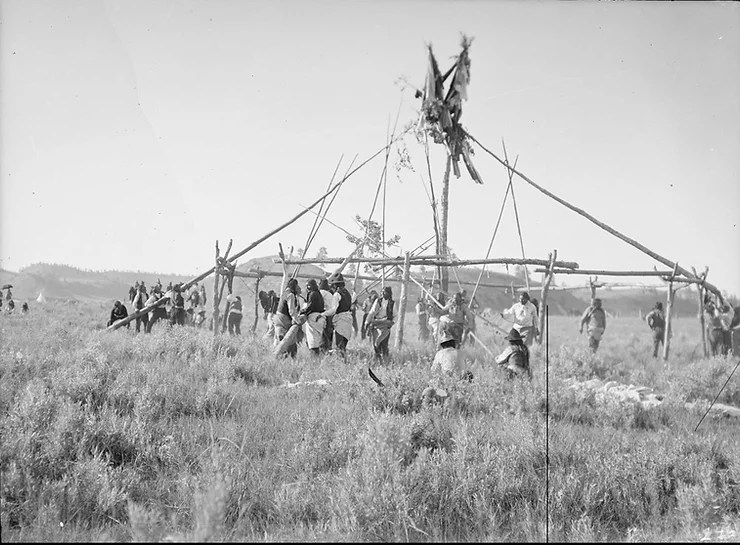
The dance is practiced differently by each tribe, but basic similarities are shared by most rituals. In some instances, the Sun Dance was a private experience involving just one or a few individuals. But many tribes adopted larger rituals that involved the whole tribes or sometimes many tribes gathered to celebrate the Sun Dance together. Lodges or open frames built of trees, rawhide or brush are prepared with a central pole at the center.
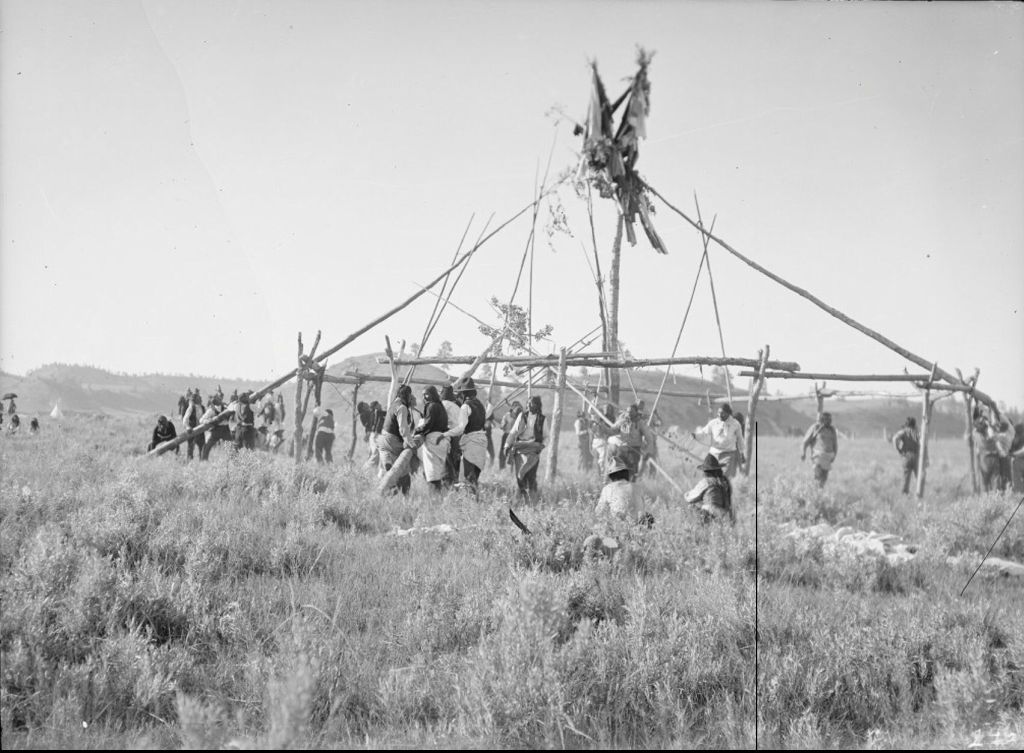
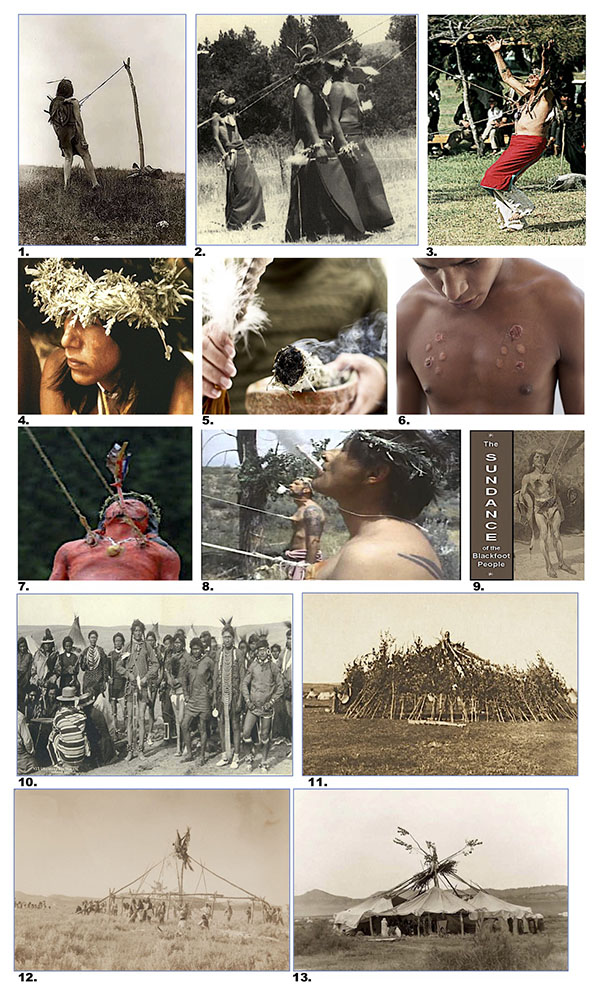
The Ultimate Ritual of Pain, Renewal & Sacrifice

Though the dance is practiced differently by different tribes, the Eagle serves as a central symbol in the dance, helping bring body and spirit together in harmony, as does the buffalo, for its essential role in Plains Indian food, clothing, and shelter. Sometimes an eagle’s nest or eagle would be mounted at the top of the center pole. Holy men might also place a dried buffalo penis at the top of the pole to give the dancers virility. And buffalo skulls were placed at the perimeter of the lodge to honor their power and courage. (Some dancers choose to have their flesh pierced through their backs and the rawhide ropes from the skewers are attached to the heavy buffalo skulls. Then the dancers dance on rocks and brush as they drag the heavy skulls. This usually takes longer to rip their flesh.

Buffalo–Tatanka
Tatanka are held in high regard by Native Americans. The tatanka gave up its own flesh and life to provide everything for the people. For Native Americans, the tatanka is a true relative, making life possible for them. Because of their importance, a buffalo symbol or skull is present in all sacred Lakóta rituals. The tatanka represent generosity and self-sacrifice. According to the Lakóta, to give what you have to others is one of the most highly respected way of behaving.
Dancers also blow a whistle made from the wing bone of an eagle that makes the sound of an eagle cry. The whistle is painted with colored dots and lines to represent the keen and precise perception of the eagle. There is also a beautiful eagle feather attached to the end of the whistle that blows back and forth to represent the breath of life.

In Native culture, the wanblí is considered the strongest and bravest of all birds. For this reason, its feathers symbolize what is highest, bravest, strongest, and holiest. When a feather falls to the earth, it is believed to carry all of the bird’s energy, and it is perceived as a gift from the sky, the sea, and the trees. Feathers may arrive unexpectedly but not without a purpose.


Each type of feather represents something different. The wanblí’s feather, however, is one of the most esteemed. An wanblí’s feathers are given to another in honor, and the feathers are displayed with dignity and pride.

Many tribes smoke sage and burn smudge pots of sage, which is believed to conjure spirits and help the dancers. Some tribes also wear wreaths of sage on their heads and wrists. Ancient dances and songs passed down through many generations are offered accompanied by traditional drums, smudge pots of sage are burned over a sacred fire.
The entire tribe prepares for a year before the ceremony and the dancers fast for many days in the open before the dance. The Sun Dance ceremony involves all the tribe. Family members and friends (only Native people are allowed to attend) gather in the surrounding camp to chant, sing and pray in support of the dancers.

If sun dancers have not released themselves from their bloody tethers by sundown, holy men remove the skewers and reverse the piercings to help rip the flesh. In the 1918 definitive book, “The Sundance of the Blackfoot People,” by leading American anthropologist Clark Wissler, he states: “When all thongs are torn out, the lacerated flesh is cut off as an offering to the sun… The author has seen some men extremely scarred from repeated Sun Dance ceremonies…The offering of flesh is called the Blood Sun Dance.” Exhausted dancers would be cared for afterward in a medicine lodge, where holy men and women sung and prayed above them.
The ceremony was extremely arduous and not without its risks. Clark Wissler also wrote: “It is said that all who take this ceremony die in a few years, because it is equivalent to giving one’s self to the sun. Hence, the sun takes them for its own.”

In 1883, the U.S. Secretary of the Interior and the Bureau of Indian Affairs criminalized the Sun Dance and other sacred religious ceremonies in an effort to discourage indigenous practices and enculturate Native Americans into white society. The prohibition was renewed in 1904 and remained illegal until 1934 when Franklin Delano Roosevelt’s new administration reversed the decision. During the fifty years the Sun Dance was prohibited, many native tribes defied the law and continued to perform their most sacred dance, usually as part of Fourth of July celebrations!
Read hereTHE SPIRITUAL LEGACY OF THE AMERICAN INDIAN
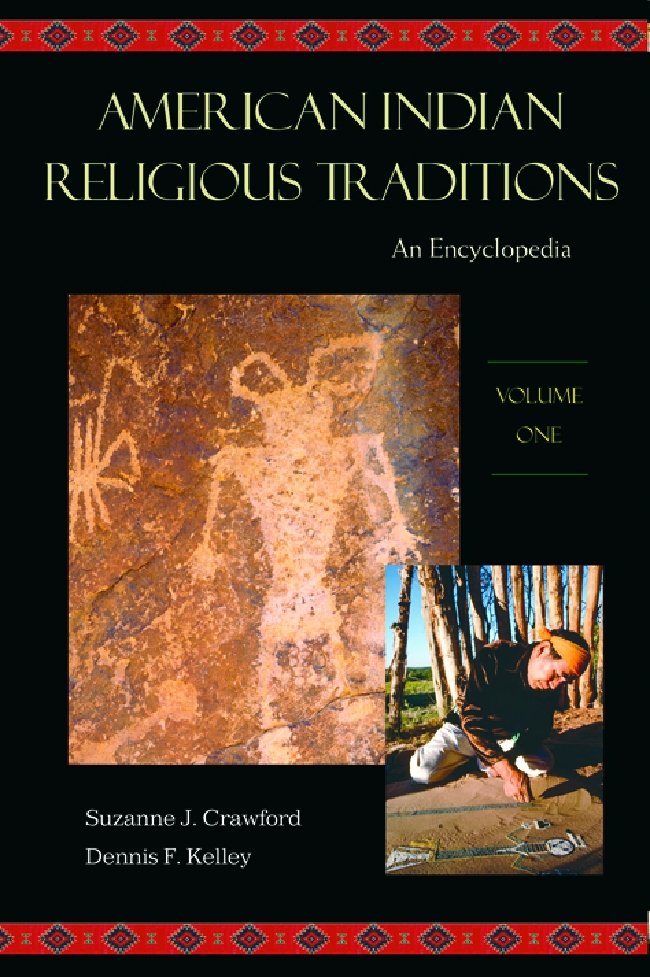
Read here : American Indian Religious Traditions
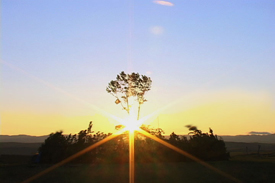
Native Spirit and The Sun Dance Way Home Page
Eagle (heraldry)
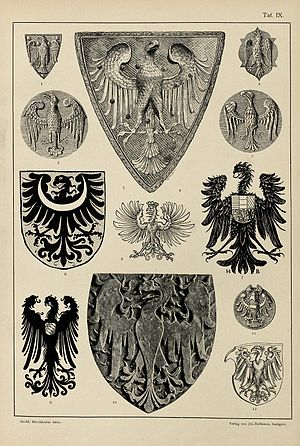
The eagle is used in heraldry as a charge, as a supporter, and as a crest. Heraldic eagles can be found throughout world history like in the Achaemenid Empire or in the present Republic of Indonesia. The European post-classical symbolism of the heraldic eagle is connected with the Roman Empire on one hand (especially in the case of the double-headed eagle), and with Saint John the Evangelist on the other.

A golden eagle was often used on the banner of the Achaemenid Empire of Persia. Eagle (or the related royal bird vareghna) symbolized khvarenah (the God-given glory), and the Achaemenid family was associated with eagle (according to legend, Achaemenes was raised by an eagle). The local rulers of Persis in the Seleucid and Parthian eras (3rd-2nd centuries BC) sometimes used an eagle as the finial of their banner. Parthians and Armenians used eagle banners, too.[1]

In Europe the iconography of the heraldic eagle, as with other heraldic beasts, is inherited from early medieval tradition. It rests on a dual symbolism: On one hand it was seen as a symbol of the Roman Empire (the Roman Eagle had been introduced as the standardised emblem of the Roman legions under consul Gaius Marius in 102 BC); on the other hand, the eagle in early medieval iconography represented Saint John the Evangelist, ultimately based on the tradition of the four living creatures in Ezekiel. Read more here

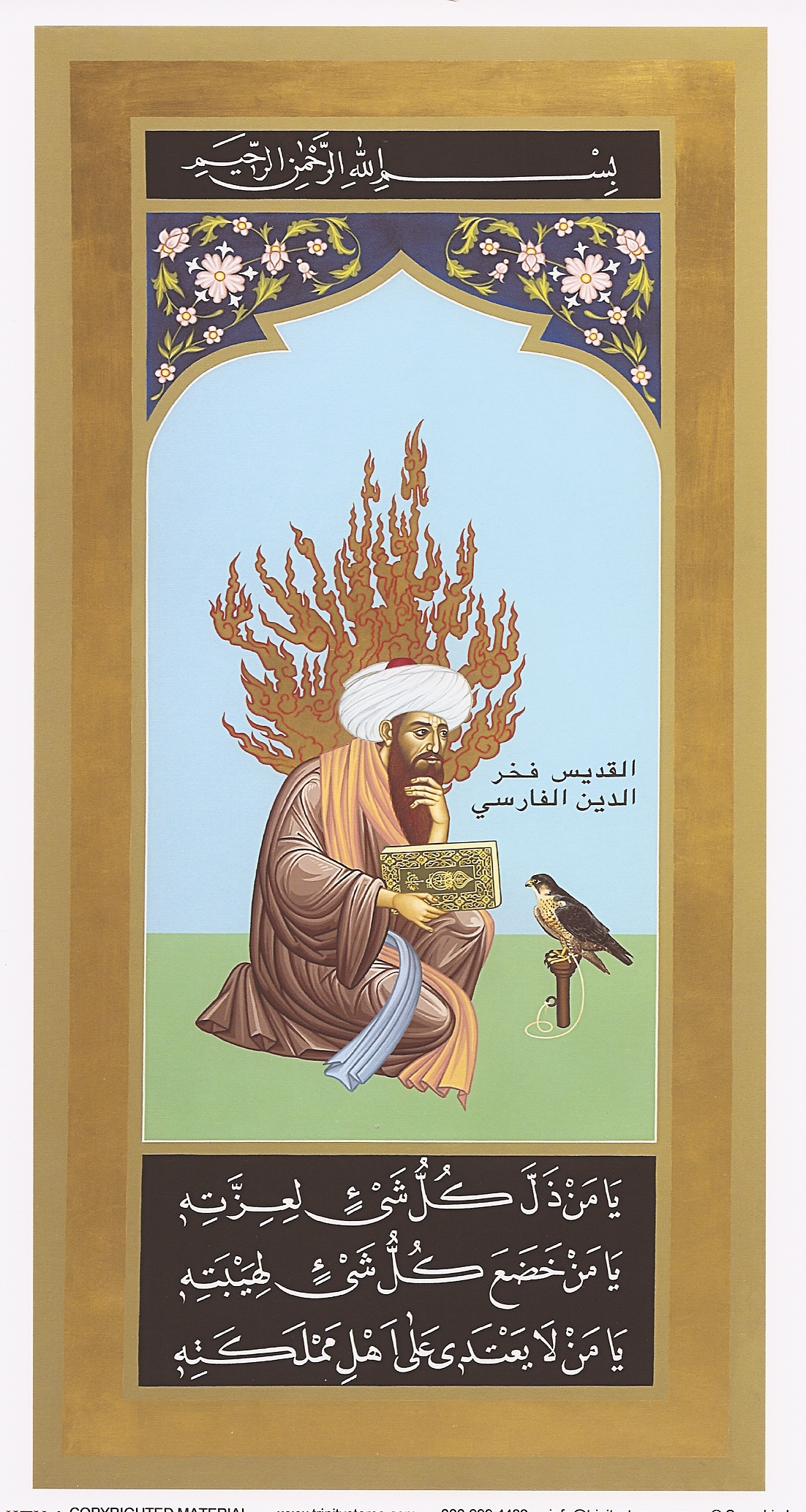
  • Falconry as a Transmutative  Art: Dante, Frederick II, and Islam

The imperial eagle – notably, in the form handed down by the Romans to later generations of European rulers – is the hypostasis of an absolute power conceived as “naturally” divine in origin. In contrast, the tamed falcon, at rest on the emperor’s fist or being offered to him by his falconers, became for Frederick II the emblem of an acquired form of wisdom – of a nobility, that is, which must be educated so that its inborn aggressiveness may be restrained and redeployed under the superior command of reason. The falconer thereby becomes the image of the ideal sovereign, he who succeeds in controlling the instinctual aggressiveness of humankind by way of his “taming power.” He is at one and the same time the self-aware and responsible repository of natural law and the guar- antor of positive law, that is, of justice. The study and practice of falconry were therefore for Frederick II the best and noblest ways for the sovereign to deepen his understanding of the laws of the natural and of the human realm; to him they were indispensable tools in his honorably dispatching his mission as universal sovereign….

….If the objective of the Commedia is to save humankind from itself and principally from its self-imposed rapaciousness, then we can usefully ask ourselves which figurative means Dante could call upon to evoke a process of taming and conversion that by its very nature aims at transmuting the individual’s instinctive ego-grasping into an artfully acquired – but nevertheless also gracefully received – form of absolute surrender and self-sacrifice to the highest manifestation of selflessness and boundless love.

How are we to visualize the very nature of a learning process that must be experiential if it is to become effective? Such is, after all, the goal of the Commedia as a whole – in direct opposition, that is, to the treacherous attempts at rational grappling with reality, which leave human pride misleadingly in charge of transcendent affairs. While in our postmodern world of con- cept-based existence there seems to be little or nothing to call upon in order to suggest such a salvific becoming, I hope to have shown persuasively that Dante saw in falconry the art most apt to express that process of surrender and taming of an individual’s own nature, in the form of a return to that very “hand” on whose universal fist the whole world is unknowingly perched. For Dante, no art better than falconry could convey the sense of that sacrificial inner transmutation necessary for human consciousness to awaken to the vision of itself as a pure reflection of the transcendental source of all-encompassing love.

No other art could as powerfully express the potential for universal salvation inscribed within a process meant to make human consciousness cognizant of its own divine origin – of its own participation in, and belonging to the very substance offered by the falconer to the falcon as its only rightful meal, as that “bread of angels” already evoked in the Convivio: purely celestial food, on which life itself unsuspectingly keeps feeding. …. Read the complete paper Falconry as a Transmutative  Art: Dante, Frederick II, and Islam

see also: Raptor and human – falconry and bird symbolism throughout the millennia on a global scale

———————————————————-

HISTORY OF THE WARLIS
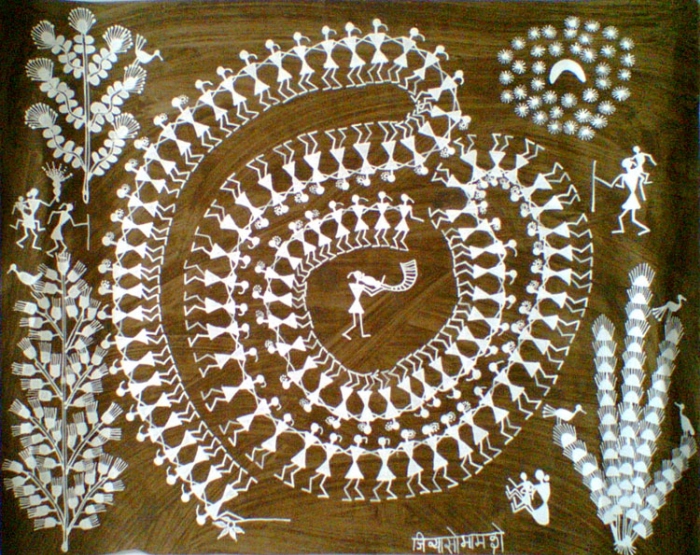

The Warlis are an aboriginal tribe living at the foothills of the Sahyadris in western India.
Warlis were hunters and gatherers living in the forest. With time, they were forced to settle down at the base of the hills, and so, they adopted an agro-pastoral lifestyle.
Waral is brushwood which the original settlers had to clear in order to settle down.
Warul also refers to the brushwood used to burn on the fields as Rab.
This could be the origin of the name of their tribe- Warli

n the book The Painted World of the Warlis Yashodhara Dalmia claimed that the Warli carry on a tradition stretching back to 2500 or 3000 BCE. Their mural paintings are similar to those done between 500 and 10,000 BCE in the Rock Shelters of Bhimbetka, in Madhya Pradesh.

Their extremely rudimentary wall paintings use a very basic graphic vocabulary: a circle, a triangle and a square. Their paintings were monosyllabic. The circle and triangle come from their observation of nature, the circle representing the sun and the moon, the triangle derived from mountains and pointed trees. Only the square seems to obey a different logic and seems to be a human invention, indicating a sacred enclosure or a piece of land. So the central motive in each ritual painting is the square, known as the “chauk” or “chaukat”, mostly of two types: Devchauk and Lagnachauk. Inside a Devchauk, we find Palaghata, the mother goddess, symbolizing fertility.[3] Significantly, male gods are unusual among the Warli and are frequently related to spirits which have taken human shape. The central motive in these ritual paintings is surrounded by scenes portraying hunting, fishing and farming, festivals and dances, trees and animals. Human and animal bodies are represented by two triangles joined at the tip; the upper triangle depicts the trunk and the lower triangle the pelvis. Their precarious equilibrium symbolizes the balance of the universe, and of the couple, and has the practical and amusing advantage of animating the bodies.

The pared down pictorial language is matched by a rudimentary technique. The ritual paintings are usually done inside the huts. The walls are made of a mixture of branches, earth and cow dung, making a Red Ochre background for the wall paintings. The Warli use only white for their paintings. Their white pigment is a mixture of rice paste and water with gum as a binding. They use a bamboo stick chewed at the end to make it as supple as a paintbrush. The wall paintings are done only for special occasions such as weddings or harvests. The lack of regular artistic activity explains the very crude style of their paintings, which were the preserve of the womenfolk until the late 1970s. But in the 1970s this ritual art took a radical turn, when Jivya Soma Mashe and his son Balu Mashe started to paint, not for any special ritual, but because of his artistic pursuits. Warli painting also featured in Coca-Cola’s ‘Come home on Diwali’ ad campaign in 2010 was a tribute to the spirit of India’s youth and a recognition of the distinct lifestyle of the Warli tribe of Western India.[4]

Tribal Cultural Intellectual Property

Warli Painting is the cultural intellectual property of the tribal community. Today, there is an urgent need for preserving this traditional knowledge in tribal communities across the globe. Understanding the need for intellectual property rights, the tribal non-profit Organisation “Adivasi Yuva Seva Sangh” initiated efforts to start a registration process in 2011. Now, Warli Painting is registered with a Geographical Indication under the intellectual property rights act. With the use of technology and the concept of social entrepreneurship, Tribals established the Warli Art Foundation, a non-profit company dedicated to Warli art and related activities.

Culture
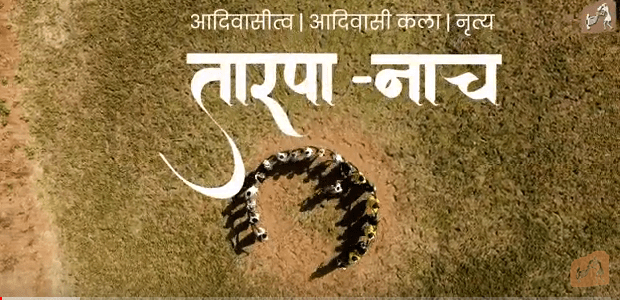
Warli legends say that the Gods went to the potter fly or Gungheri Raja to ask for balls of mud to make the earth which was flooded with water. Read here the Mystical World of Warli
Tradition

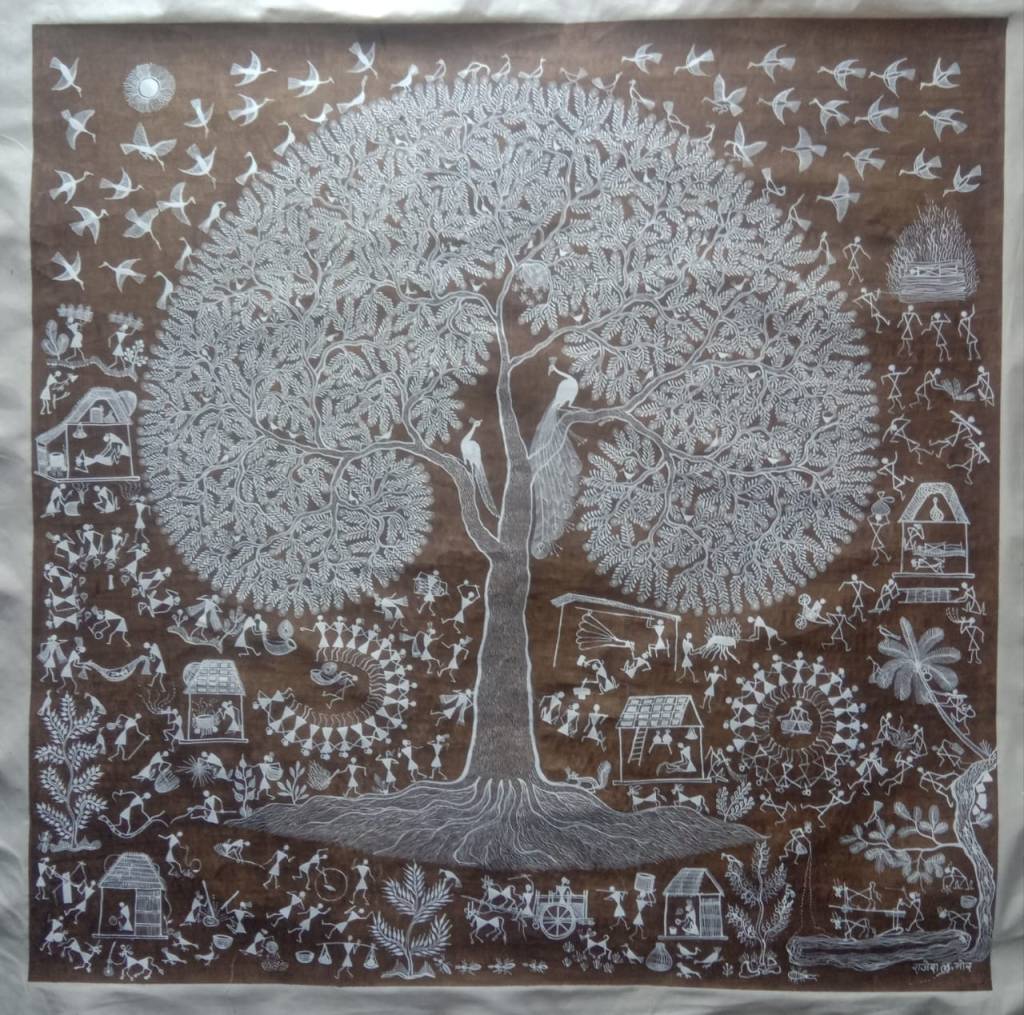
The Warli Painting tradition in Maharashtra are among the finest examples of the folk style of paintings. The Warli tribe is one of the largest in India, located outside of Mumbai. Despite being close to one of the largest cities in India, the Warli reject much of contemporary culture. Warli paintings of Maharashtra revolve around the marriage of God Palghat.The style of Warli painting was not recognised until the 1970s, even though the tribal style of art is thought to date back as early as 10th century A.D.[1] The Warli culture is centered on the concept of Mother Nature and elements of nature are often focal points depicted in Warli painting. Farming is their main way of life and a large source of food for the tribe. They greatly respect nature and wildlife for the resources that they provide for life.[2] Warli artists use their clay huts as the backdrop for their paintings, similar to how ancient people used cave walls as their canvases.

Jivya Soma Mashe, the artist in Thane district has played a great role in making the Warli paintings more popular. He has been honoured with a number of national and central level awards for his paintings. In the year 2011, he was awarded Padmashree.

A tarpa player c.1885

These rudimentary wall paintings use a set of basic geometric shapes: a circle, a triangle, and a square. These shapes are symbolic of different elements of nature. The circle and the triangle come from their observation of nature. The circle represents the sun and the moon, while the triangle depicts mountains and conical trees. In contrast, the square renders to be a human invention, indicating a sacred enclosure or a piece of land. The central motif in each ritual painting is the square, known as the “chauk” or “chaukat”, mostly of two types known as Devchauk and Lagnachauk. Inside a Devchauk is usually a depiction of palaghat, the mother goddess, symbolizing fraternity.[3]

Male gods are unusual among the Warli and are frequently related to spirits which have taken human shape. The central motif in the ritual painting is surrounded by scenes portraying hunting, fishing, and farming, and trees and animals. Festivals and dances are common scenes depicted in the ritual paintings. People and animals are represented by two inverse triangles joined at their tips: the upper triangle depicts the torso and the lower triangle the pelvis. Their precarious equilibrium symbolizes the balance of the universe. The representation also has the practical and amusing advantage of animating the bodies. Another main theme of Warli art is the denotation of a triangle that is larger at the top, representing a man; and a triangle which is wider at the bottom, representing a woman.[4][better source needed] Apart from ritualistic paintings, other Warli paintings covered day-to-day activities of the village people.

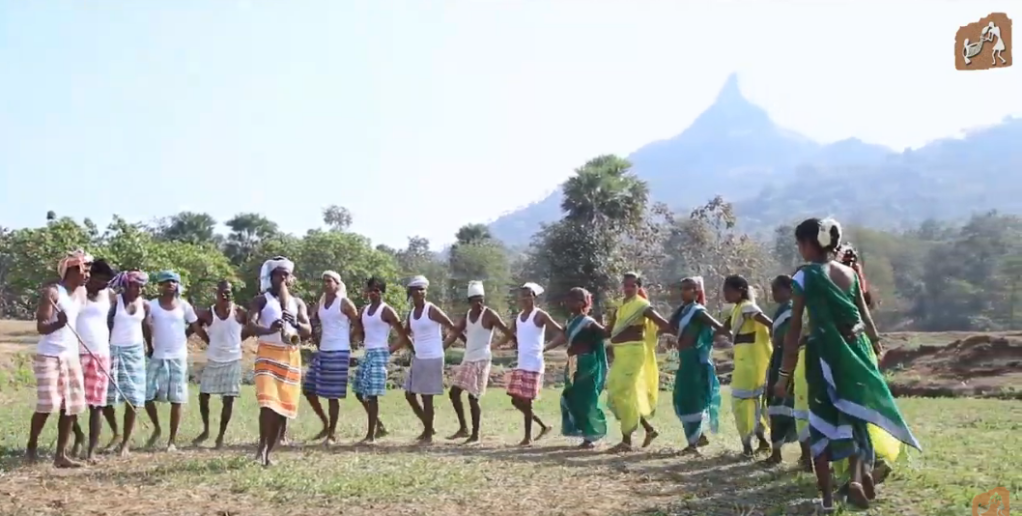
One of the central aspects depicted in many Warli paintings is the tarpa dance. The tarpa, a trumpet-like instrument, is played in turns by different village men. Men and women entwine their hands and move in a circle around the tarpa player. The dancers then follow him, turning and moving as he turns, never turning their backs to the tarpa. The musician plays two different notes, which direct the head dancer to either move clockwise or counterclockwise. The tarpa player assumes a role similar to that of a snake charmer, and the dancers become the figurative snake. The dancers take a long turn in the audience and try to encircle them for entertainment. The circle formation of the dancers is also said to resemble the circle of life.

Warli painting from Thane district

Materials used

The simple pictorial language of Warli painting is matched by a rudimentary technique. The ritual paintings are usually created on the inside walls of village huts. The walls are made of a mixture of branches, earth and red brick that make a red ochre background for the paintings. The Warli only paint with a white pigment made from a mixture of rice flour and water, with gum as a binder. A bamboo stick is chewed at the end to give it the texture of a paintbrush. Walls are painted only to mark special occasions such as weddings, festivals or harvests. They make it with a sense that it can be seen by future generations.

In contemporary culture

The lack of regular artistic activity explains the traditional tribal sense of style for their paintings. In the 1970s, this ritual art took a radical turn when Jivya Soma Mashe and his son Balu Mashe started to paint. They painted not for ritual purposes, but because of their artistic pursuits. Jivya is known as the modern father of Warli painting. Since the 1970s, Warli painting has moved onto paper and canvas.[5]

Coca-Cola India launched a campaign featuring Warli painting in order to highlight the ancient culture and represent a sense of togetherness. The campaign was called “Come Home on Deepawali” and specifically targeted the modern youth.[6] The campaign included advertising on traditional mass media, combined with radio, the Internet, and out-of-home media.

Traditional knowledge and intellectual property

Warli Painting is traditional knowledge and cultural intellectual property preserved across generations. Understanding the urgent need for intellectual property rights, the tribal non-governmental organization Adivasi Yuva Seva Sangh[7][8] helped to register Warli painting with a geographical indication under the intellectual property rights act.[9] Various efforts are in progress for strengthening sustainable economy of the Warli with social entrepreneurship.[10]

=========================
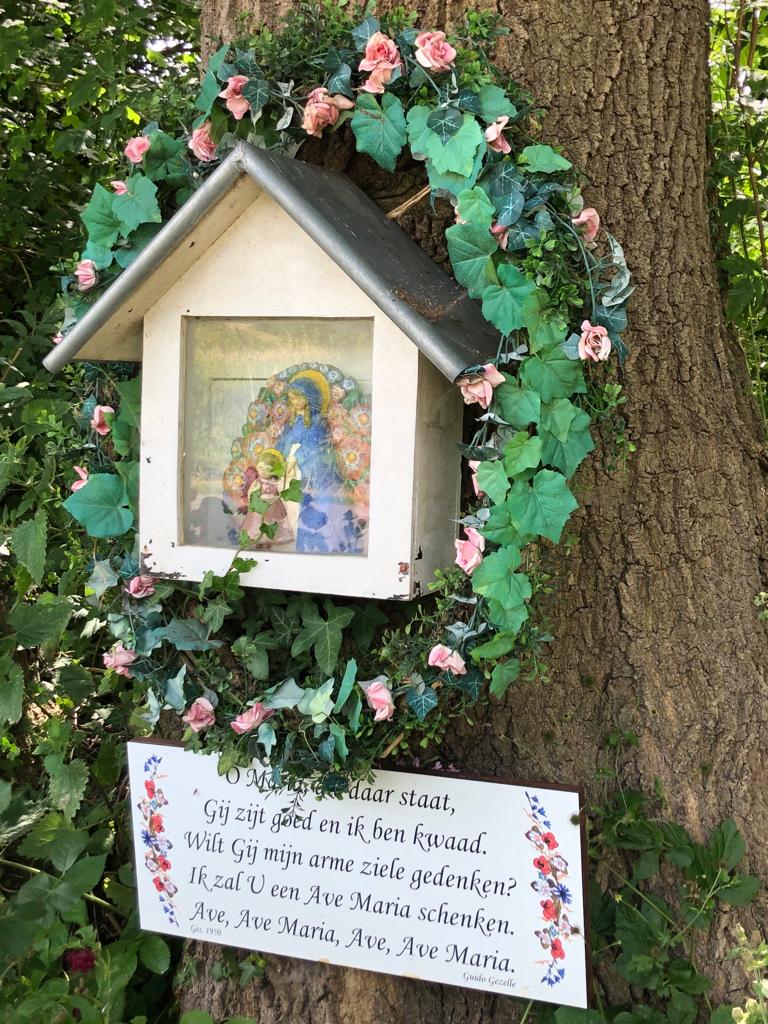
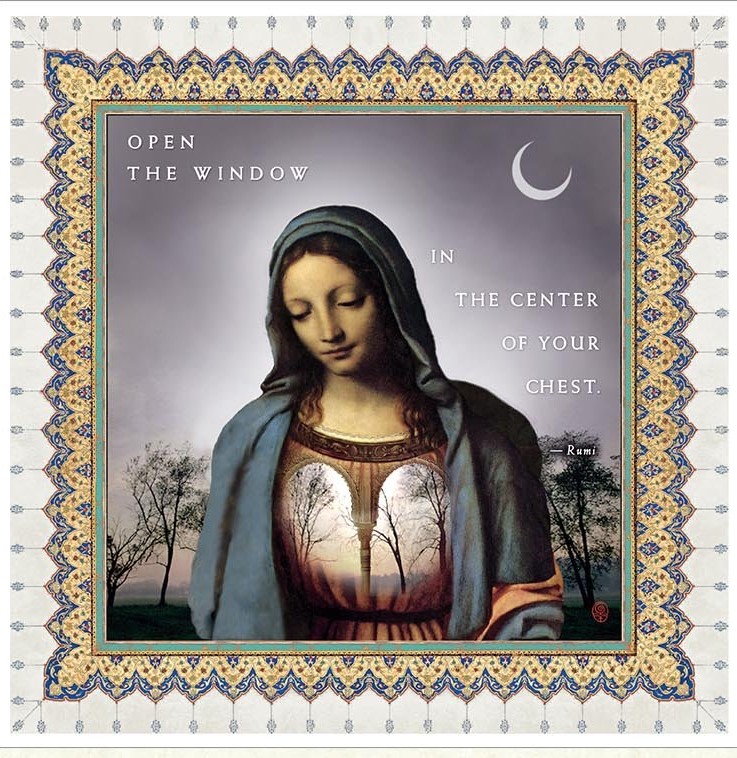
Oh Mary standing there
You are good and i am evil
will You remember my poor soul
I will bestow You an Ave Maria
Ave, Ave Maria, Ave Ave maria
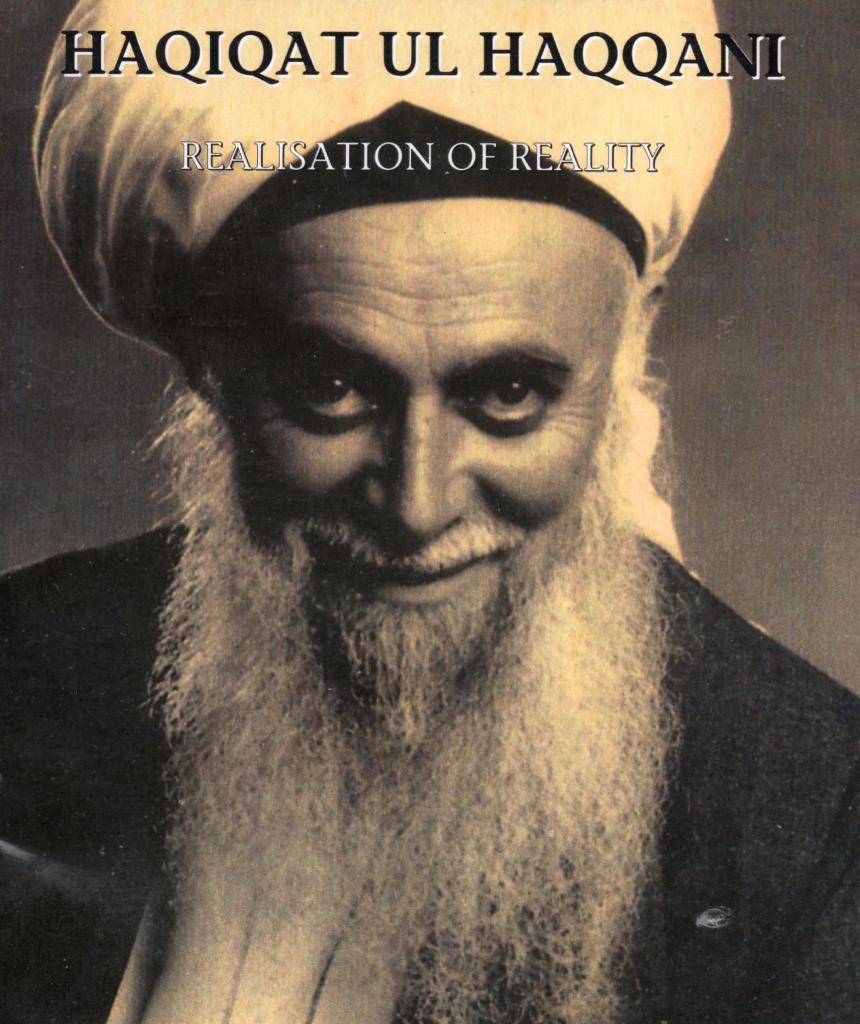
Kill your Dragon

“Our only purpose is to give our love, respect and service to God but if given the opportunity every person would be a pharaoh. His ego would declare itself the highest lord. We must kill the dragon that is our ego and then we will find Allah with us and around us and within us” Sheikh Nazim al Haqqani
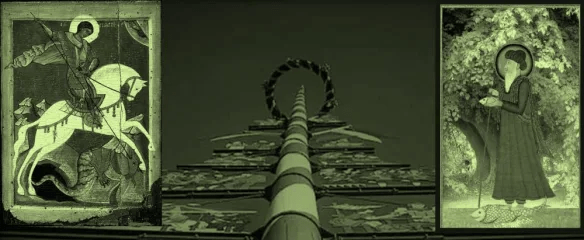
look also here

Looking to the Spiritual vertical way, as the Maypole do, gives us an opportunity of discerning an understanding between Non-Virtues and Virtues,  developing Spiritual values needed in our times :. Read here: Maypole the Principle of verticality
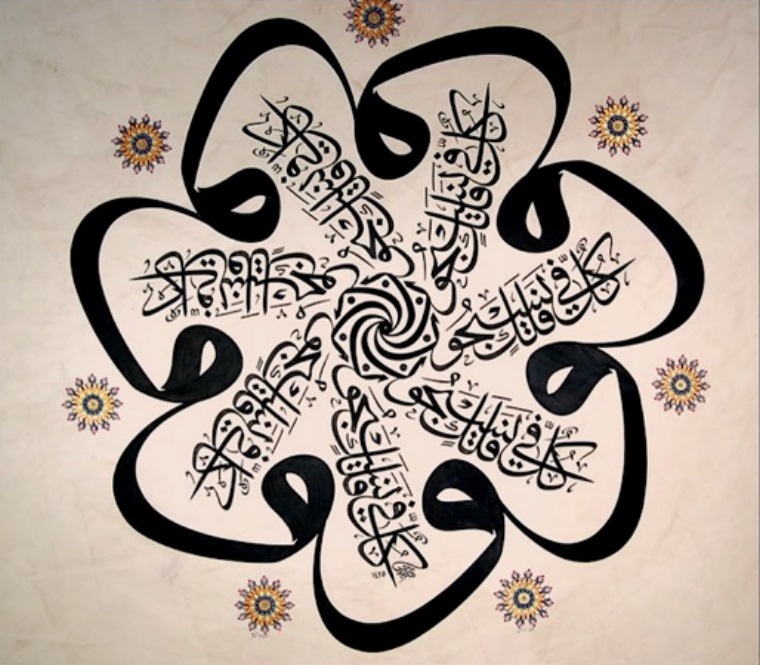
Ash-Shams (Arabic: الشمس, “The Sun”) is the 91st surah of the Qur’an, with 15 ayat or verses.

BY the Sun, and its rising brightness۝[18]

by the moon when she followeth him۝

by the day, when it showeth its splendor۝

by the night, when it covereth him with darkness۝

by the heaven, and him who built it۝

by the earth, and him who spread it forth۝

by the soul, and him who completely formed it۝

and inspired into the same its faculty of distinguishing, and power of choosing, wickedness and piety: now is he who hath purified the same, happy۝

but he who hath corrupted the same, is miserable.

— Q91:1-10[19]

1-10 Good and evil

BY the Sun, and its rising brightness۝[18] by the moon when she followeth him۝by the day, when it showeth its splendor۝by the night, when it covereth him with darkness۝by the heaven, and him who built it۝by the earth, and him who spread it forth۝by the soul, and him who completely formed it۝and inspired into the same its faculty of distinguishing, and power of choosing, wickedness and piety: now is he who hath purified the same, happy۝but he who hath corrupted the same, is miserable.

— Q91:1-10[19]

The first part deals with three things:-:

1-That just as the sun and the moon, the day and the night, the earth and the sky, are different from each other and contradictory in their effects and results, so are the good and the evil different front each other and contradictory in their effects and results; they are neither alike in their outward appearance nor can they be alike in their results.

2-That God after giving the human self powers of the body, sense and mind has not left it uninformed in the world, but has instilled into his unconscious by means of a natural inspiration the distinction between good and evil, right and wrong, and the sense of the good to be good and of the evil to be evil.

3-That the future of man depends on how by using the powers of discrimination, will and judgement that Allah has endowed him with, he develops the good and suppresses the evil tendencies of the self. If he develops the good inclination and frees his self of the evil inclinations, he will attain to eternal success, and if, on the contrary, he suppresses the good and promotes the evil, he will meet with disappointment and failure. Sahl al-Tustari (d. 896), a Sufi and scholar of the Qur’an, mentions, “By the day when it reveals her [the sun],He said:This means: the light of faith removes the darkness of ignorance and extinguishes the flames of the Fire.[20][21]
Dit delen:

A journey into manhood: Rites of passage of the Xhosa

Among the Xhosa speaking people children undergo different rituals through the process of
enculturation during the rites of passage from infancy to adulthood as these rituals define
them as a people.

The rituals include: i) efukwini (behind the door – birth rites); ii) tonjane (female puberty rites); and iii) ulwaluko(traditional male circumcision).

Each rite follows one another in a sequence in three phases. This sequence is characterised by “leave and cleave” phenomenon, meaning that a person leaves the old life behind and is “re-incorporated,” into society – which signifies embracing new life, and new ways of doing things

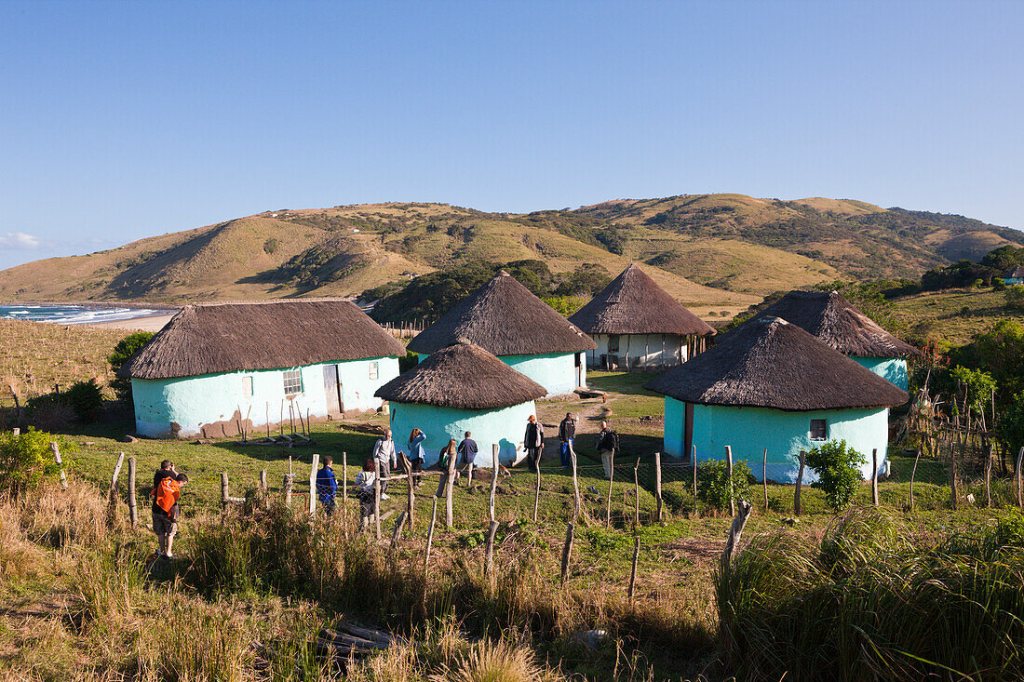
Xhosa Siedlung an der Wild Coast, Mbotyi, Ostkap, Suedafrika

Efukwini (behind the door – birth rites) ritual
Separation phase:
Efukwini is a sacred space for giving birth among the Xhosa peoples. It is characterised by the separation phase, where the expectant woman enters a secluded place (hut) to give birth. She remains in separation with the infant while umdlezane (a nursing mother) for the first 10 days to protect the child from evil forces. Umdlezane is attended by older family women who serve as assistants. The hut becomes a sacred space and no man is allowed to enter that space.

Transition phase:
Within the period of the 10 days the baby undergoes ukuwisa (the falling of the baby’s umbilical stump) and is given a name. The falling of the stump becomes an important event as it must be buried by umdlezane alone within the sacred space of birth for anchoring the child to its roots. This ritual signifies transitioning the foetus from birth to babyhood. When the mother returns with the baby after 10 days, women welcome them back, arrange food and people are now permitted to see the baby, while ensuring that there is fire always burning at the fireplace to maintain warmth for the nursing mother and infant.

Incorporation phase:
When the nursing mother returns with the child to the people after 10 days, a white goat is slaughtered, and the ceremony is called imbeleko (carry on your back). The ceremony characterises the incorporation phase. The purpose of this ritual is to introduce the child to the ancestors . Because the health of the child is dependent upon protection by ancestors from evil spirits, this ritual brings stability on the health of the child and failure to observe this ritual is believed to bring misfortune.

Intonjane (female rites) ritual
Separation phase:
Intonjane Is the Xhosa term for a girl’s rites of passage to womanhood performed between a girl’s first menstruation and her wedding. The ritual involves separation for a period of a week to three weeks, depending on the family wishes and culminates an event associated with girl’s developmental stages. The girl is placed in ejakeni (a special hut), which is built for this special purpose and has a curtain made with grass mats to create a partition for privacy. New utensils to be used by the initiate are purchased by the parents beforehand. An announcement is made to the village about the entering of their daughter into this ritual.
The family looks out for virgin girls that can voluntarily serve as assistants to the initiate during the period spent in separation. These assistants may or may not be related to the family of the initiate.
Transition phase:
The initiate’s lifestyle changes, as she transitions into a new space, and is now placed behind the curtain, attended to by the assistants. The slaughtering of a goat takes place on the on first or second day of entering intonjane with the initiate given isiphika (the right shoulder of the slaughtered animal) as umshwamo (meat roasted on fire) to eat using a stick as she is not allowed to use her hands. She is taught about mannerisms and to conduct herself in a respectful manner. The initiate also learns about how to preserve virginity to avoid pregnancy and other sexually transmitted diseases, as well as her role in looking after her family later
in life.

Incorporation phase:
The final phase of the ritual includes incorporation of the initiate into the same community from which she was removed temporarily, during the transitional phase. She is now ready to apply the teachings learned during the separation and transition phases which includes her role in family matters. She comes back as neither a child nor an adolescent, but as an adult, a new person. The incorporation phase is characterised by the initiate being more receptive on teachings than in previous phases.

Ulwaluko (traditional male circumcision rites) ritual
Separation phase:
Ulwaluko Is the traditional male circumcision rites to manhood, in which boys learn about acquiring their identity. Among the Xhosa speaking people, there is a saying that a boy is not a person and that he emerges from this state to become a man, after he had been through ulwaluko. This initiation ritual involves great excitement among AmaXhosa and consists of umngeno(the entering, which includes separation of the initiate to the bush). He is still a boy
until circumcision takes place at the bush. Umngeno is characterised by the separation phase, which is the first part of the ritual – the boy is temporarily removed to the bush where he remains for about a month or 6 weeks, depending on the family. Before the separation, a goat is slaughtered for the boy to eat isiphika (the right shoulder) excised from the goat and roasted on fire. Festivities as part of his send-off ceremony are observed, and the parents identify an Ingcibi (Traditional circumcision surgeon) to perform circumcision.

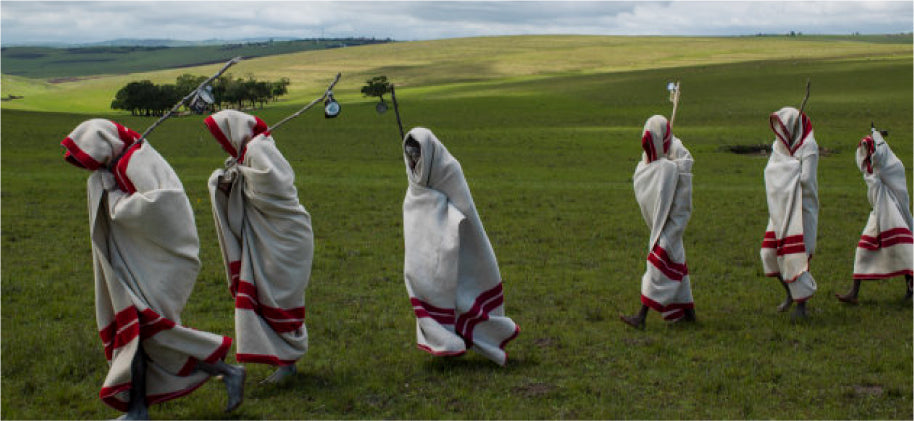
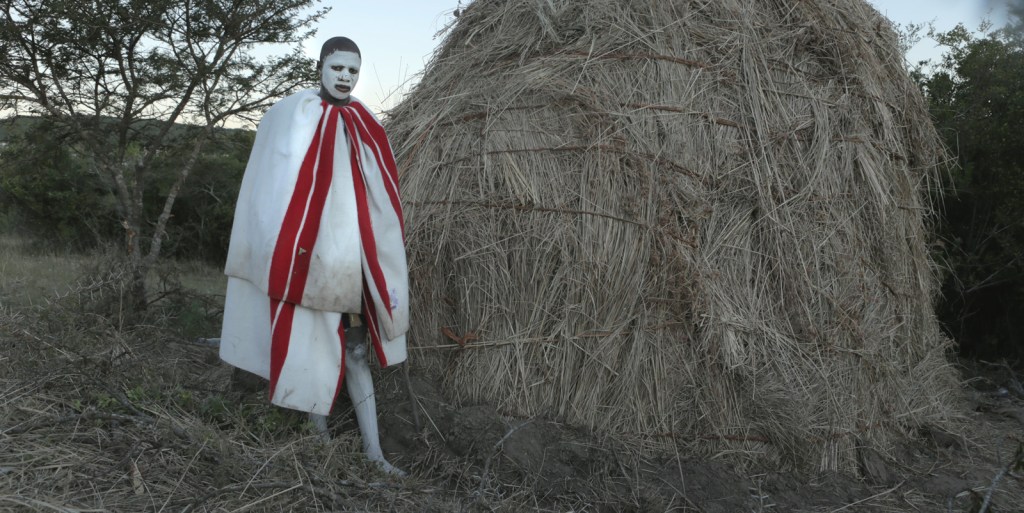
One of the most iconic images of the Xhosa people is the initiation, Abakhwetha blanket, a white felted blanket with stark red bands which run along the length edges of the cloth. The use of red in this blanket is symbolic of the blood associated with the initiation ritual through which the boys pass into manhood.

Transition phase:
The transitional phase is comprised of ubukhwetha (being an initiate) which occurs at the bush. The boy has undergone transition from boyhood into an initiate. The initiates are provided with Amakhankatha (assistants), who care for their healing and ensure that they are nourished. In this phase the initiate learns about being an adult as the process of becoming a man is not yet fully accomplished. The person is in-between, for he is neither a child nor an adult and learning to be an appropriate adult is continuous at this stage. The aim is to make the person forget about the previous behaviour and to embrace the acceptable life that lies ahead.
Incorporation phase:
The incorporation phase is characterised by “leave and cleave” phenomenon, i.e., the initiate leaves the old life behind and is “re-incorporated,” into society – which signifies embracing new life, and new ways of doing things. The incorporation phase ischaracterised by different ceremonies that occur in stages but for only one purpose, i.e., “incorporation “of the new man called ikrwala, (graduate) back into the community. The ceremony for the occasion is calledumphumo (the coming out). The new man is now expected to conduct himself as a responsible adult, attending to social issues that were not part of his life before circumcision.
It is at this phase that older men show amakrwala (graduates) or new men, how to be ‘real men’ and it is commonly shared that men who have been through initiation are distinguishable by their social behaviour.

A MONTH WITH THREE INITIATES DURING THE XHOSA CIRCUMCISION RITUAL
by Richard Bullock

The male initiation ceremony of the Xhosa people of South Africa, Ulwaluko, is an age-old tradition. It’s a mystical, secretive ritual that occurs far away from the eyes of the public. The only information non-participants and non-family members ever have about it is the disturbing death toll from what the newspapers call botched circumcisions. As a result, there is pressure from some quarters to ban the custom altogether. And, as winter approaches and a new crop of abakwetha are preparing to ‘go to the mountain’ to earn the right to call themselves men, the controversy is bound to resurface. But, having spent the 2014 winter season filming a documentary with three abakwetha, I can testify that the ceremony is a test of courage and is much more than a circumcision ritual.

building-bomaThe adults of the community build the hut in which the initiates will live for the month of the ceremony. ©Richard Bullock124A9905


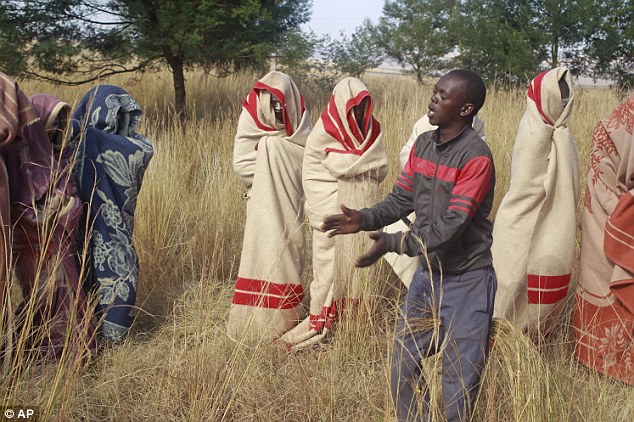
Banning it is a ridiculous notion. Ulwaluko is fundamental to Xhosa lifeI think banning it is a ridiculous notion. Ulwaluko is fundamental to Xhosa life, but it’s not a rigid, inflexible ritual. It changes with the times. For example, the abakwetha no longer actually go to the mountains, but somewhere close by yet cut off from the village. And the seclusion period is much shorter. When 63-year-old Bangile Pakamile went through initiation he was away for six months, and his younger brothers, who are in their forties, spent three months in seclusion. Now their sons Sandile and Anathi, and their close friend Lulama, will spend one month in the bush. There are two seasons for the Ulwaluko – winter and summer. Despite village elders murmuring, ‘we had it harder’, the month in the bush is not easy, particularly in winter. Every boy knows the inherent dangers – the number of deaths mounts up on the front pages like a recurring nightmare. Indeed, by the time Sandile, Nathi and Lulama had safely stepped out as new men, 39 initiates had died in the Eastern Cape, and more than 300 had been hospitalised.

article-2352015-1A960F4D000005DC-483_634x422

The number of deaths mount up on the front pages like a recurring nightmare The initiates, known collectively as abakwetha or individually as umkwetha, surrender their names. Their clothes are shredded in the days leading up to their exclusion, and they carry a short stick with a white cloth tied to one end. Women cut dry grass for thatching while men chop down flexible saplings. Dressed in traditional clothing, the adults construct a domed dwelling called iboma that will serve as the home for the abakwetha. Each of the customs is intricate and detailed, but there is no instruction booklet, so the men constantly remind each other of the many important details as the preparation continues.
The structure is surrounded by a symbolic barrier of thorn branches with a single entry and exit point. One member of the construction crew accidentally stepped across the thorn branches and was scolded by one of the elders. His indiscretion was probably due to ceremonial brandy rather than a failure to adhere to traditional guidelines. Alcohol has woven its way into every stage of the ceremony. Where traditional beer known as umqombothi might have once served a role, brandy and Castle Lager have been added. I find myself included in this custom, and a bottle of brandy is requested from me. All those present contribute in one way or another. The greatest contribution comes from the parents of the initiate. By my calculations, it costs somewhere in the region of ZAR10,000 (US$900) to put a boy through the initiation. There are cows and at least two goats to slaughter, traditional blankets, a month’s worth of food, traditional surgeon fees, overseer fees and food and drinks for parties. And the brand new smart clothes worn at the end of the month can cost in excess of ZAR2,000 alone. It’s a significant burden on already financially stretched families.

Buttons with no holes

John Pakamile, a 20-year veteran overseer of the initiates, tells me that the early white settlers brought two things to the Xhosa people. Alcohol and buttons with no holes. I sat dumbfounded, pondering ‘buttons with no holes’. John laughed at me and said: ‘We had everything we needed. Fresh water from the rivers, wild animals to hunt, livestock and gardens – what use did we have for money?’
For rural people far away from industrial and commercial centres, making ‘buttons with no holes’ is a constant struggle. But despite the economic hardships, many live full and dynamic lives filled with humour, warmth, love and generosity. It is a close community, and participation in the Ulwaluko involves every member of the wider family group and friends. While elders ensure practices are correctly adhered to, five or six younger boys will be in constant attendance at the abakwetha. Delighting in their role as inqalathi, the young boys chop wood from the nearby forest and begin making a pile of firewood outside the entrance to the iboma.

To comply with regulations governing traditional circumcision initiates must be at least 18 years of age and must present written parental or guardian consent to the central office of records for initiates. The initiates, the traditional surgeon, and the overseer must all be registered and have the necessary permits. There are actually traditional police who visit during the season demanding the official papers, which are kept in a plastic sleeve and tucked up into the thatching of the iboma. Failure to comply may result in fines and/or prison.
At the office of records, we met with the traditional surgeon. Although the circumcision is still done with an assegai (spear), I am assured by John that hygiene standards are rigorous. For two initiates, the spear has two sharp blades, one on each end. For three initiates, the surgeon brings two spears. The surgeon is an outsider who only appears for the removal of foreskins. He attends to all the initiates in the area and, thankfully, is not a participant in alcohol-related rituals at any time.

Kraal-cooking-xhosaWhile the initiates prepare to face the surgeon, the community prepares a feast to strengthen them for the trials to come. ©Richard Bullock

Going to the mountain

When the big day arrives for Sandile, Anathi and Lulama there is a huge gathering at the family homestead. The abakwetha are stripped naked and ushered inside the family kraal (traditionally a collection of huts within an enclosure). They sit on the bare ground draped in grey blankets while a cow and goat are slaughtered. There is a great deal of alcohol consumed by those in attendance, especially the old men who sit looking on from a semi-circle of chairs. Axes and knives flash in the winter sun as the animals are butchered, cooked in big pots, and then rapidly consumed by all.
All the while, in the swirl of dust, blood and noise, the abakwetha sit quietly with heads bowed in submission while attending men explain what is to come and what is expected of them. Their heads and pubic hair are shaved. They are offered choice cuts of goat and cow and encouraged to fill up.

Top: In normal times, the boys are avid ocean surfers near their village in Chintsa. Bottom: During the long cold nights and days, little helpers look after the initiates by collecting wood and stoking the fire in their hut. ©Richard Bullock

They find the surgeon waiting for them in the bush with spear in hand At dusk, all the men rise and encircle the abakwetha, singing an immensely powerful song. They slowly shuffle and dance along the road while the entire village ululates and shouts. The energy in the group feels edgy and somewhat dangerous. The men carry an assortment of sticks, and small scuffles break out as they near the edge of the village. Suddenly the three abakwetha drop their blankets and run for their lives as the men tear after them, shouting and wielding their sticks. It must have their teenage hearts beating out of their chests.
Having escaped one terror, they find the surgeon waiting for them in the bush with a spear in

hand. They sit down with legs apart, and a rapid single cut from the assegai removes the foreskin. The boys make no sound; they don’t flinch, stoic bravery being an important part of this and the hurdles to come. Their wounds are dressed with a medicinal plant called izichwe and tied with a leather thong around their waists. There is only a small group in attendance, and in the fading light, I can just see one of the boys’ shoulders rise as the thong is pulled taut, but he makes no sound.
The white cloth tied to the stick that they carried is thrown high into the air, a signal that it is done. A collective cry from the village follows – it is the last time the women will see or hear anything of the abakwetha for a month.

John oversees the correct application of river clay. ©Richard Bullock

Seven days of pain and hunger

The abakwetha are understandably in great pain and discomfort for the first few days. They eat only half-boiled maize and no water for seven days. They have a blanket and a little straw between them and the cold earth. The little inqalathi are their lifesavers keeping the fire burning through the night. It’s freezing cold, and the abakwetha lie with their knees raised, progressively weakening as the days go by.
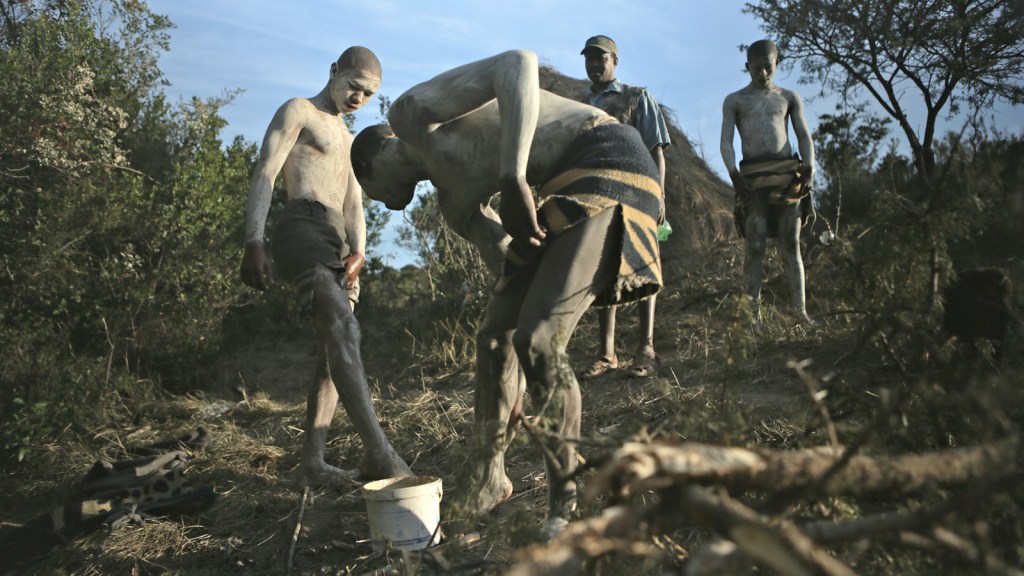
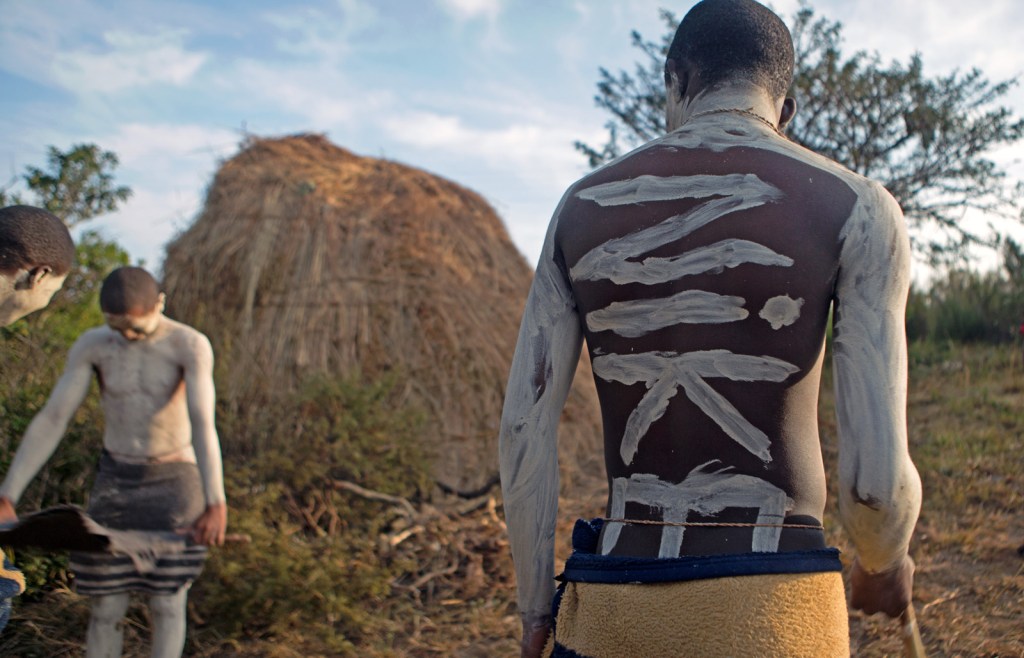
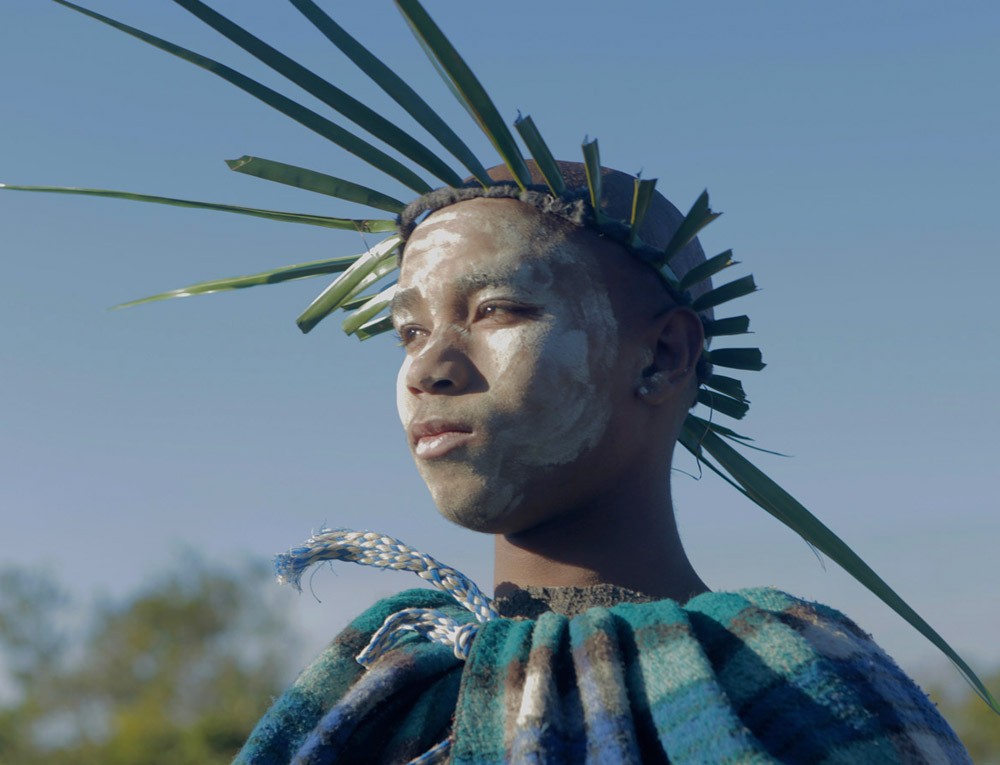
Their overseer John Pakamile shows them how to dress the wounds with ischwe leaves, visiting them up to four times a day during this critical time. After five days, John covers their faces, arms and legs in the white clay of the initiate. It is supposed to keep them warm and protect their skin from the sun, but no deeper meaning is forthcoming. The initiates must keep up this application of white clay or be punished. They are also given beautiful white blankets with red stripes and sit silently in the sun as John delivers the next set of instructions.

The initiates are in pain for days after their circumcision. A meagre diet of maize and no water for seven days also adds to their fatigue to the extent that they find it difficult to stand. ©Richard Bullock
It will be two days before they are allowed water. They appear thin and weak. They tell each other stories to avoid boredom and talk about food often. Their jaws hurt from grinding half-cooked maize.
They must show vigilance in their actions. After dressing the wounds, John makes them hold the water bottle for him to wash his hands. Even though they are dying of thirst, they never complain.
They are so weak on the morning of the seventh day they can barely stand. What were once three vigorous teenagers now appear like old men, hunched over their sticks. They hardly talk as they slowly apply white clay to their bodies before leaving the iboma. A goat is slaughtered outside, and the men in attendance drink ceremonial brandy in the warm winter sun. The abakwetha are given great spoonfuls of maize meal and sour milk followed by hunks of broiled goat. Their personalities and vigour return; they begin to laugh, tell jokes and even dance.
In the following days, they go for walks to collect leaves for dressing their wounds. The big stiff leaves are rolled between two bottles to soften them for comfort. I tried to help by collecting leaves and, on offering some to Sandile, he looked at them and said, ‘Not big enough, Rich.’ I don’t think he meant to joke; he just needed bigger leaves than I would.

After their initial seven days of meagre food and no water, the initiates are given better food and colourful blankets, which help keep them warm. Below, an initiate puts fresh leaves on his wound while a visiting friend texts on his cell phone. ©Richard Bullock
The seclusion, suffering and pain represent the trials of life

There are two other iboma built across the hills where six more abakwetha are undergoing the Ulwaluko. We went for a long walk to see how they were doing. Their iboma is very impressive. I later find out one of the boy’s fathers works for a thatching company and that he used old thatch and poles. These initiates are attended by a gaggle of their inqalathi. These micro-lumberjacks scale the thorn trees and work their machetes to keep firewood coming.
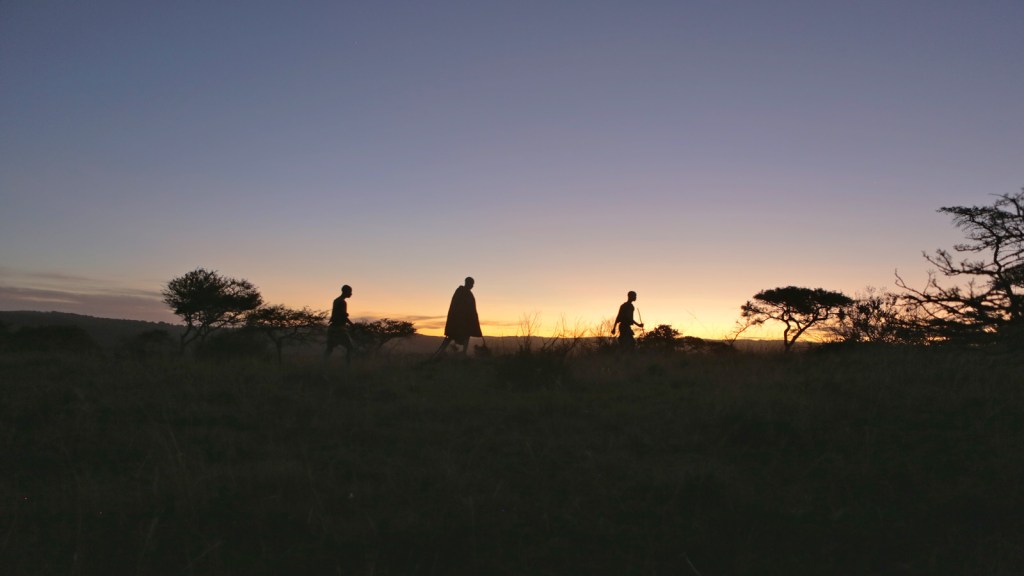
As the days pass slowly, the abakwetha walk in the hills chopping wood, teasing the inqalati and following their strict regimen. By day 20, their spirits are high. They dance, stick fight and hunt for rabbits in the bush. Their little helpers continue to devastate the thorn tree population.
The inqalathi are learning all the time. They watch all the ceremonies and learn the ‘language’ of the abakwetha, taking in with some trepidation what their rite of passage will require when it is upon them.
The verbal transfer of knowledge seems secondary to the symbolism. The seclusion, suffering and pain represent the trials of life; it is the process that matters, not what is said. It is a test of personal character and fortitude. Of course, no boy should needlessly die, but I wonder if the Xhosa people would place such a high value on the ceremony if there were zero chance of fatalities.

Initiates visit another group one hour’s walk away through the bush. ©Richard Bullock

I won’t go to Makiwane

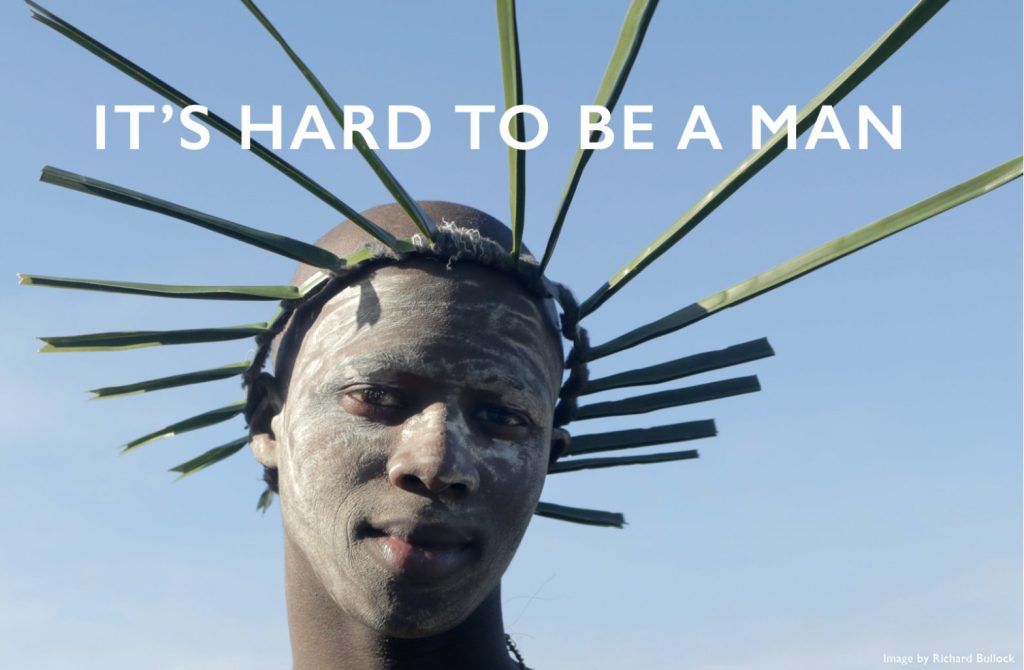
The abakwetha sing a beautiful song about their ordeal. Patrick, one of the inqalathi, translates it for me. While the backing singers repeat the phrase ‘It’s hard to be a man’, Lulama, who has a higher voice, sings the guidelines of the abakwetha. In particular, one verse is repeated: ‘I won’t go to Makiwane, no, no, no, it is not the time for Makiwane. Be quiet little boy; it’s hard to be a man.’
Cecilia Makiwane Hospital is a public hospital on the outskirts of East London. I asked them what it would take for one of them to go to the hospital. Sandile points his finger at the ground of the iboma and says, ‘We will never go. We would rather die here than go to the hospital.’

‘We will rather die here than go to hospital’

Meanwhile, the death toll for initiates stands at 35 in the Eastern Cape for this winter season, and there is still a week to go. This reluctance to seek outside help is one of the key reasons so many initiates die, but some overseers act responsibly. Last year pneumonia spread amongst initiates nearby. The supervisor blamed bad spirits in the iboma, and got all the boys proper medical attention. When they were well again, they returned to another iboma, away from the previous site. A smart application of spiritual beliefs saved the boys’ lives – and upheld tradition.

XhosaStick-fightingLittle boys sneak a surf magazine in for the initiates. Below, with their strength and testosterone returning, the initiates play at stick fighting. ©Richard Bullock
I have often filmed the abakwetha carrying out the morning ritual of applying white river clay. Today, perhaps through boredom, they adorn Anathi’s back with a giant NIKE logo – another strange clash of the traditional and the new. Lulama gets Zebra stripes on his back, and Sandile gets his girlfriend’s name. It seems rebellious. I dread to think how many whacks of the cane John might give them if he sees the NIKE logo. Maybe he won’t mind. Understanding the taboos is a minefield, and perhaps that’s the idea – to keep the abakwetha on their toes.
Their mood is high at this stage, and they count the days towards the 12th of July. I have taken to showing them videos of my children in Sydney. We all laugh; they see Charlie’s fourth birthday cake and are stunned as if they have never seen anything so amazing.

XhosaNew world cool mingles with old tradition. ©Richard Bullock

Boys to men

John and his youngest son cut palm leaves that they bend into three crowns for the initiates as a symbol that their homecoming is near. Their heads are freshly shaved, and John instructs them to shave the head of one of the inqalathi, ten-year-old Athiti. It is an honour for him, as he will serve as a mascot over the coming two days. He will lead the procession back to the village and participate as if he were an umkwetha himself.
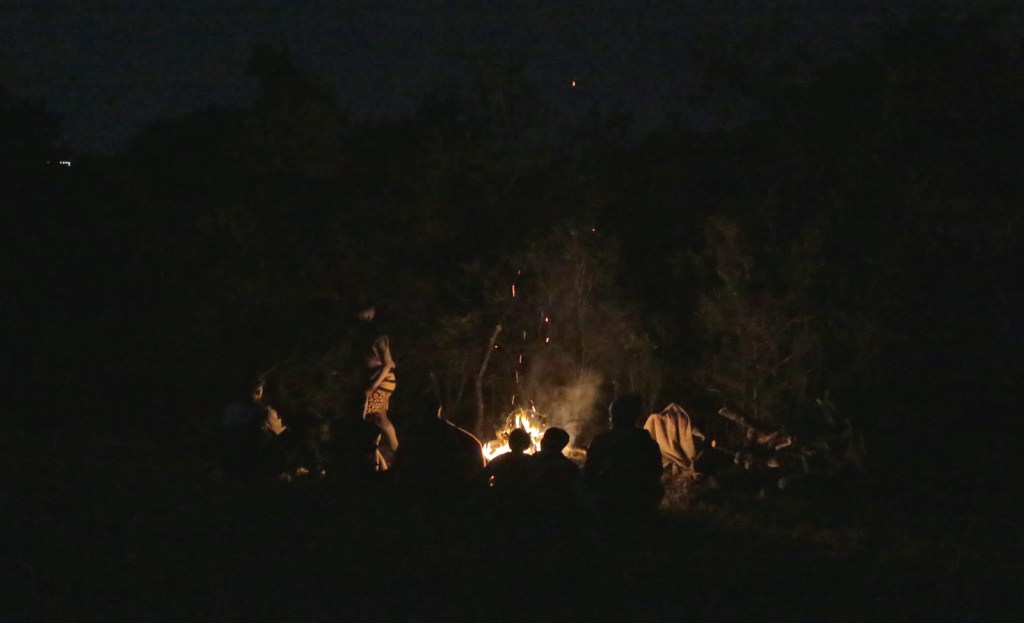
On their final day in the bush, the abakwetha and inqalathi work hard, chopping a huge stockpile of wood. Men build a bonfire outside the iboma and play a traditional initiation game called ceya through the night. It’s played with short and long twigs concealed in each hand, accompanied by what seem to be impersonations of animals, and spirits with strange clicks and squeals. In the firelight, the wild gesticulations, explosive laughter and warmth between the men of all ages is magical. How long have men played ceya by the fire under the spectacular African night sky?

XhosaXhosaXhosaTop: Older men stay up all night playing “Ceya” before the initiates homecoming. Middle: Lulama with his crown of palm fronds, given to initiates on their homecoming. Below, the initiates wash the clay from their bodies before returning home. ©Richard Bullock

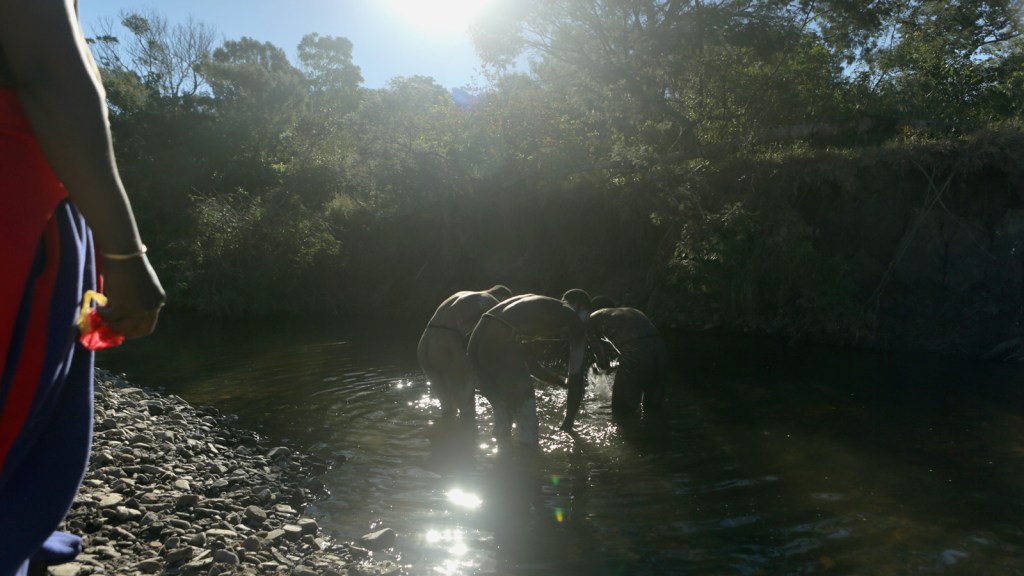
At dawn, John leads the abakwetha to the river. Before entering the water, they pay homage to the ancestors by daubing river clay on their foreheads, then they stand knee-deep and carefully wash all remnants of white clay from their bodies. In the cold morning light, they head back to camp naked. Bangile, the eldest of the Pakamile family, covers their bodies in butter. He then covers them in coloured blankets, leaving them just a tiny peephole through which they hold their black sticks.
Forming a single line behind young Athiti, they shuffle away from the iboma, where the men break into song and set the hut alight. Within minutes it is a fireball; all the trappings of the last month incinerated. The abakwetha do not look back as they walk on, followed by dozens of men, young and old. As they move through the village, women ululate, and small children join the group. When they reach the Pakamile homestead, the women beat sticks onto a corrugated iron sheet.

The boys sit outside the kraal, the little mascot Athiti at one end and an older man at the other, representing the generations. Seated around the boys are more than a dozen old men. Each of them stands to impart words of wisdom to the abakwetha. After each speech, a symbolic offering of one or two Rand coins represents the first step on a much larger journey. All I can think about is buttons with no holes.
After the speeches, the initiates are moved inside, surrounded by friends and siblings. Two girls enter and transform the boys by painting their faces with red ochre and wrapping their heads with black and white cloth. From being amakhwetha the initiates have become amakrwala. Finally, they begin to relax their stoic demeanour.
The following day, after a hearty breakfast of soup, vegetables and meat, the three amakrwala are escorted to Lulama’s rural home, a beautiful spot overlooking a pristine valley.

Back in their community after a month, the initiates’ faces are painted in dark red ochre. ©Richard Bullock

As a thank you to the overseer and the people of Chintsa village, the family slaughter a pig for their guests and mark the occasion with more brandy and beer. While family members sit in the morning sun, men butcher the pig and cook it on the open fire. The amakrwala sit in the grass, and Lulama sees his siblings for the first time in a month. At a certain point, John ushers him into a hut. Lulama washes and bathes his whole body while standing in a large enamel dish. He finally reappears in brand-new Western clothes. Lulama’s face is then smeared with a brownish paste to mark the final stage of the transition.
The entire group then travels back to Chintsa village. Sandile and Nathi wash and dress in smart flat caps, jackets, pressed trousers and leather-soled shoes. Bangile, the oldest man, embraces them and warmly slaps them on the back. There are brief speeches and ceremonial brandy shots, and it is finally over. They walk out of the hut and take their first steps on the long journey of life as men.

It is over. These are new men in their new clothes. ©Richard Bullock
It’s hard to be a man

Not once did I witness fighting, drinking or disobedience from the abakwetha. Likewise, the adults in direct supervisory roles performed their duties skillfully and responsibly. Because the tradition isn’t written down or uniform across the Xhosa nation, I am sure the ceremony has many variations. I suspect the deaths and mutilations may result from badly run initiation schools. Perhaps because I have witnessed a school run well, I am biased, but people from my culture circumcise babies and voluntarily risk their lives with breast augmentation and nose jobs. We are quick to judge traditional cultures and even quicker to forget our similarities.
I loved the warmth and comfort shown by the community of men. I have never sat in communion around so many fires and seen children and adults work together so effortlessly for a common cause. All had their role, and all had respect for each other. I was shown incredible kindness and understanding and was never questioned about my presence or purpose. They trusted me. The long ceremony gave me the time to ponder my own role as a man, something Westerners like me blunder into via alcohol-fuelled 21st birthday parties.
When I asked the abakwetha why they had to go through all this, they replied: It’s hard to be a man. You can’t buy or be given it; you must be it. You have to endure pain, hunger and hardship. When times get tough in your life, you know you got through your initiation, so you can get through whatever challenge you face.

Me-and-the-lads-during-Amakrwala-stageRichard Bullock with the Xhosa initiates he filmed and wrote about.
Rolihlahla: This was Mr Mandela’s birth name: it is an isiXhosa name that means “pulling the branch of a tree”, but colloquially it means “troublemaker”. His father gave him this name.

Mr Mandela wrote in his autobiography that he went through the circumcision ceremony aged 16.

‘I felt as if fire was shooting through my veins. The pain was so intense that I buried my chin in my chest’

Dalibhunga:This is the name Mr Mandela was given at the age of 16 once he had undergone initiation, the traditional Xhosa rite of passage into manhood. It means “creator or founder of the council” or “convenor of the dialogue”. 

He said: ‘Without a word, he took my foreskin, pulled it forward, and then, in a single motion, brought down his assegai [spear]. I felt as if fire was shooting through my veins.

‘The pain was so intense that I buried my chin in my chest. Many seconds seemed to pass before I remembered the cry, and then I recovered and called out, ‘Ndiyindoda!’ [I am a man!]’

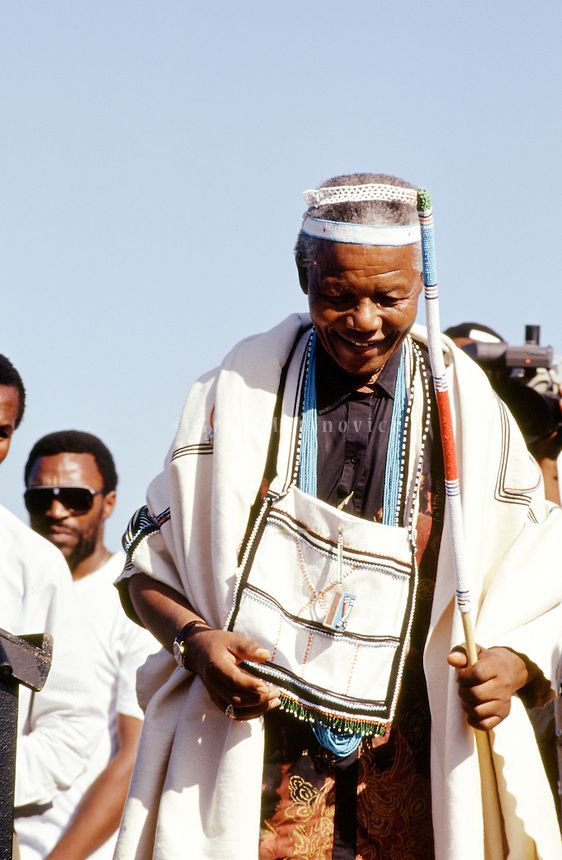
Nelson Mandela wears a traditional Xhosa outfit to the first day of his trial for leaving the country without permission and inciting workers to strike

When Mandela is buried in Qunu on Sunday, many of the Xhosa rituals may seem foreign to you. We asked Nelisa Ngqulana to explain some of the culture’s burial traditions to help you understand what is happening.

Mandela is being buried in his birthplace Xunu, because Xhosa people believe you must be returned to the earth in the place you were born. The elders of his tribe would have gathered at his home in Johannesburg, where he died, and spoken to his spirit: telling him that they’ve come to take him home. This is done to ensure the person’s spirit doesn’t wander around.

When Mandela’s body arrives in Qunu, it will be greeted by the elders who will shout “Aaah, Dalibhunga!” (the name given to him by the elders when he reached adulthood) three times. This will be repeated during the funeral ceremony as people bid him farewell and pay their respects.

Mandela’s family has royal connections: his great-grandfather was a Thembu king and his father was a respected counselor to the Thembu royal family. Mandela spent 10 years as the ‘adopted’ son of the Thembu royal family when his father died in 1927. At his funeral, the royal Thembu family will be dressed in traditional animal skins (leopards for chiefs and a lion skin for the king).

The South African flag that has been draped over Mandela’s coffin will be replaced by a leopard skin or blanket, symbolising that he has returned home. The skin marks Mandela’s connection to the royal family. A special stick, known as “umquma” will be placed on top of the coffin among the flowers. It will have travelled from this tiny village to Mandela’s home in Johannesburg to collect his spirit. The Thembu people [AbaThembu] believe that the dead cannot rest unless their spirit is reunited in this way with their final resting place.

Xhosa people believe the departed continue to live in the beyond. Early on the day of the funeral, an ox (or a smaller animal, depending on the importance of the person) is slaughtered in preparation for the umkhapho ritual (“ukukhapha” means “to accompany”). The men cook the meat with no spices, outside in boiling water. The meat must then be eaten outside the house. The ritual is intended to help the spirit to the beyond so the deceased can return as an ancestoral spirit later.

During the days leading up to the funeral, elders will have been in constant communication with ancestoral spirits, preparing the way for the deceased to be accepted into the beyond when his spirit arrives there.

Mandela is guaranteed to live on as an ancestral spirit, because is the head of a family. This means he will become an important protector. The ancestors are treated with great respect, and believed to have a special relationship with the living.

While death is a highly sacred occurrence in Xhosa culture, it is also considered impure because the elders have been summoning spirits throughout the mourning. Any bad spirits will be cleansed during a ceremony the day after the funeral. The elders will instruct the family on the appropriate period of mourning to honour and what they will be expected to do during that period.

About a week after the funeral, the family will perform ukuhlanjwa kwemihlakulo (washing of spades). His family will have to prepare umqombothi (a traditional beer made of maize) as part of the ritual. At this ceremony, Mandela’s clothes may be distributed among his family.


Elck (Everyone) and Nemo (No one ): A mirror for Modern Man

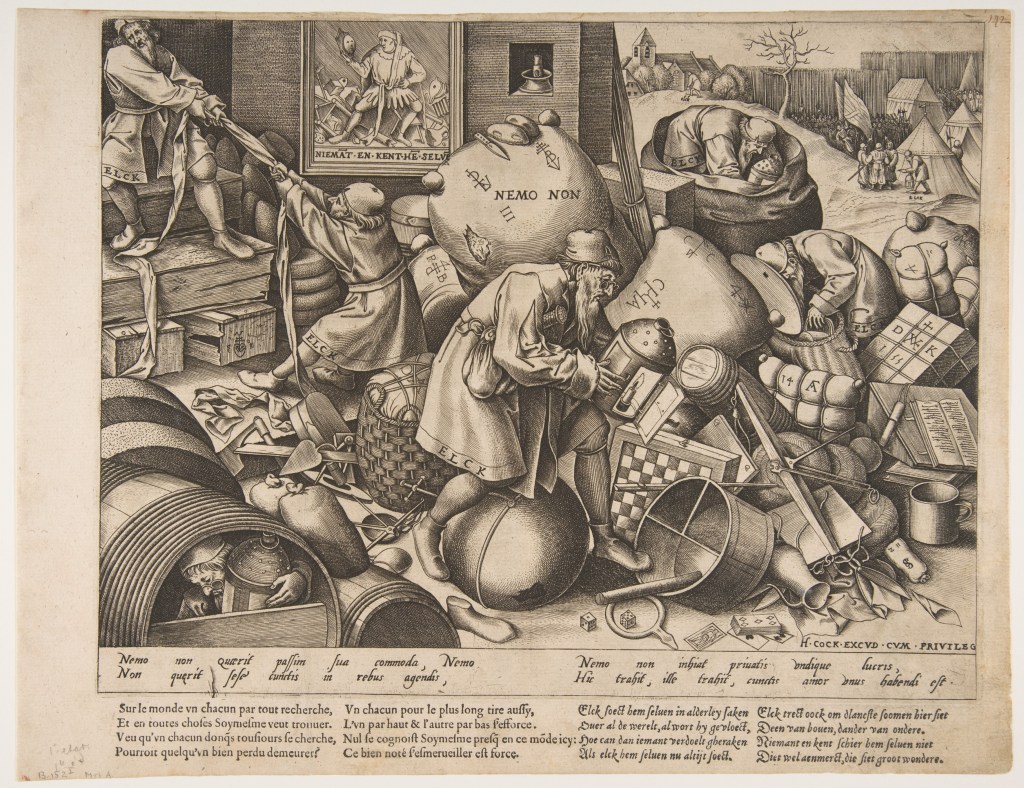
‘Elck’ or ‘Everyman’, study for a print; five figures labelled ‘Elck’ are rummaging through a pile of bales and objects, a bearded old man at centre wearing spectacles and examining a lamp, another figure searching in a sack in left background, another in a barrel in right foreground, and another at left in a basket, behind at right two ‘Elcks’ are having a tug-of-war, an army and tents in the distance.

Elck in Dutch means ‘each’ or ‘everyone’ and the scenes in this drawing illustrate proverbs or sayings. The central proverb concerns Elck who vainly seeks himself in the objects of this world as he stands over a broken globe. With a lantern he searches through a pile of barrels and bales, a game board, cards and objects which signify the distractions of life. To the right, two more Elck figuren play tug af war with a roper illustrating the saying, ‘each tugs for the Iongest end’. In the background on a mail hangs a picture which continues the moral theme_ It shows a fool sitting among a pile of broken household objects gazing at himself in a mirror.

He is Nemo or Nobody, as the inscription below him inforrns us: ‘Nobody knows hirnself”.

This is one of many moral drawings (and paintings) by Pieter Bruegel. Here, he condemns the selfish pursuit of worldly goods but he allso shows, through the picture of the fool, a way af conquering this vice. Only through self-knowledge can Elck free himself from the world’s vanities.

Discerning an understanding between Non-Virtues and Virtues is  needed in our times. And the works of Pieter Bruegel the Elder can help us to find an answer.

Five hundred years ago, there were a number of artists in The Netherlands who saw the beauty in daily life. And more than that: these artists were so talented that their depictions of the commonplace succeeded in making others receptive to it. There and then, in the 53 years between the death of Hieronymus Bosch (1516) and that of Pieter Bruegel the Elder (1569) lies the origins of our unquenchable interest for ourselves, the devious and the other. Read more here

In praise of Folly: Erasmus’ alleged main point or thesis is that foolishness brings people happiness and keeps people productive, whereas too much wisdom and prudence bring pain, depression, doubt, and lower levels of productivity.

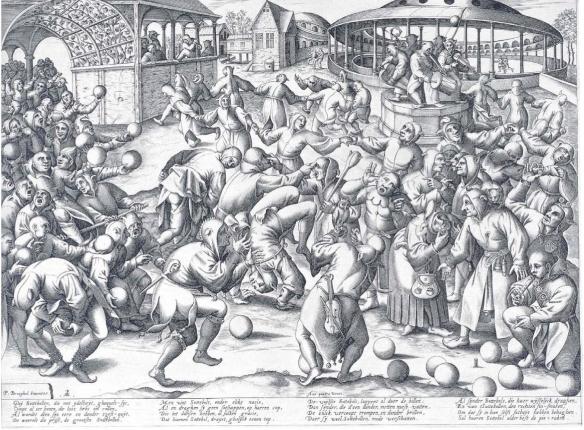
To See Yourself within It: Bruegel’s Festival of Fools

The topics of blindness and self-awareness for our time. Read more here

  • Bruegel : Discerning Wisdom from Folly

Discerning an understanding between Non-Virtues and Virtues is  needed in our times. And the works of Pieter Bruegel the Elder can help us to find an answer.

Five hundred years ago, there were a number of artists in The Netherlands who saw the beauty in daily life. And more than that: these artists were so talented that their depictions of the commonplace succeeded in making others receptive to it. There and then, in the 53 years between the death of Hieronymus Bosch (1516) and that of Pieter Bruegel the Elder (1569) lies the origins of our unquenchable interest for ourselves, the devious and the other.

Read more here: Bruegel : Discerning Wisdom from Folly

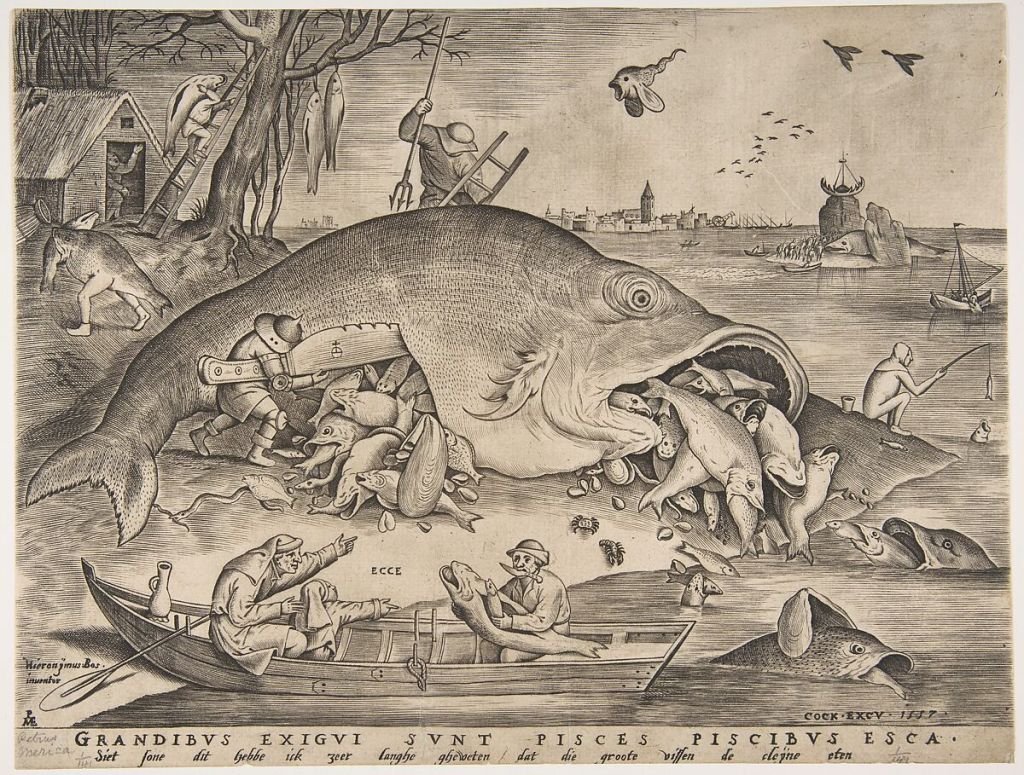
One of the most haunting of Bruegel’s images, Big Fish Eat Little Fish is among the first of the artist’s many treatments of proverbs in paintings or prints. The image reveals many small and large fish tumbling out of the mouth of an enormous beached fish. A small, helmeted figure with an oversized knife slices open the big fish’s belly, revealing even more marine creatures. Land, air, and water seem to be overrun by an odd assortment of real and fantastic fish, while in the foreground a man, accompanied by his son, gestures toward the scene. The meaning of his gesture is conveyed in the Flemish inscription below, which translates: “Look son, I have long known that the big fish eat the small.” This vernacular form of the ancient Latin proverb, which appears in majuscule lettering just above, relates to the theme of a senseless world in which the powerful instinctively and consistently prey on the weak. That the son understands the lesson is apparent from his gesture toward the other man in the boat, who has extracted a small fish from a larger one. Bruegel’s brilliant visualization of the proverb was first conceived as a drawing (Vienna, Graphische Sammlung Albertina) that is signed by the artist and dated 1556. This engraving by Pieter van der Heyden, however, is signed in the lower left corner with the name Hieronymus Bosch, who had died in 1516. The print’s publisher, Hieronymus Cock, was probably responsible for replacing Bruegel’s name with that of the more famous and salable Bosch, who had, not coincidentally, a major influence on Bruegel.

The unprecedented, and somewhat enigmatic, iconography of this image derives from the fertile imagination of Pieter Bruegel the Elder, who executed the original drawing after which this was engraved. Strongboxes, piggy banks, money bags, barrels of coins, and treasure chests—most of them heavily armed with swords, knives, and lances—attack each other in a ferocious display of chaotic, all-out warfare. The Dutch verses inscribed in the lower margin inform us that “It’s all for money and goods, this fighting and quarreling.” According to the Latin portion of the inscription, the banner with the “savage grappling hook” in the right background exemplifies greed, the vice at the root of all this trouble. The image seems to suggest that humanity’s lust for money is responsible for armed conflict. The concerns for the dangers of acquisitiveness and avarice expressed here had deep resonance in Antwerp, the bustling mercantile capital of Northern Europe where Bruegel was active for most of his career. Though inscribed “P. Bruegel” in the lower right corner, the engraving was probably not published until several years after the artist’s death in 1569. The accompanying inscription “Aux quatre Vents,” referring to the house At the Four Winds, through which many of Bruegel’s images were published, is found only on prints issued after 1570.

500 years later we see the same greed and folly or even worse:

Russian oligarch Roman Abramovich has made payments for over 1.3 billion dollars via his bank accounts at ING Amsterdam. Deutsche Bank’s anti-money laundering department reported these payments as suspicious. In 2016, Abramovich sent almost a fifth of his then estimated assets from Cyprus to the British Virgin Islands via ING using round-trip payments…see : Abramovich made 1.3 billion in suspicious transactions through ING-Amsterdam

The Spiritual Message of Bruegel for our Times:

  • The Way of Self-Knowledge

A basic tenet of the Perennial Philosophy is that the world – the cosmos – has its counterpart in man. Man is the miniature of the universe; man is the microcosm: ‘As above, so below’,( Hermes Trismegistus, The Emerald Tablets)  ‘in earth as it is in heaven’. (Matt. vi, 10)

But Man, according to traditional ideas, is excluded from his proper place in the cosmic scheme because of what allegory calls ‘Adam’s sin’ which condemns him to lead a false life, a life away from his rightful inheritance.

This is the central difficulty of the human condition, a riddle that calls man to awaken to the reality of his situation and become a seeker of truth.

If he hears this call he will learn that he must undergo an inner transition or transformation and that this has to take place before he can once again participate in real life. Read more here

News media frame all news items by emphasizing specific values, facts, and other considerations, and endowing them with greater apparent applicability for making related judgments. News media promotes particular definitions, interpretations, evaluations and recommendations. As to present Bruegel only as a Family business, and not to speak about his engagement on social and spiritual matters still of actual importance for our times:

For many years, those who wanted to admire the world-famous works of the Brueghel family of painters had no choice but to travel to the world’s greatest museums in Paris, Berlin, Milan, and Boston. Now, for the first time in history, the Het Noordbrabants Museum is bringing together the best of five generations of Brueghel in a unique, ambitious, and game-changing collection of eighty paintings and prints – all under one roof. It’s a family reunion in ‘s-Hertogenbosch!

Brueghel’s secret to success

Enterprising, innovative, and world-famous, the Brueghels are the apex family in Western art history. The Brueghels produced paintings that are admired for their humorous compositions, universal messages, and exceptional skill. The subjects range from wedding celebrations, famous proverbs, and Biblical stories to awe-inspiring landscapes and studies of animals, insects, and flowers.

From generation to generation, the family business remained an international success. In the exhibition you get a look behind the scenes at three creative family businesses. The questions we cannot ask the Brueghels anymore, we ask them. Because what is it like to live and work together as a family?“…. It shall not help to disguise the truth….

  • Crisis of Modern man
  • Our civilization is in decay. And we know it…. Because we have blown-up our ego. Cosmic Balance has been disturbed. The painting “Dulle Griet”of the great painter Bruegel express very clearly the Crisis of Modern man: Modern Man with all his “economical grow- energy” and scientifical research based on his rebellion against his Soul, is landed in an apocalyptic “theather” prophesying the complete destruction of the world.

Dulle Griet is the model of modern man’s Rebellion against his soul and Anger against it. How can Dulle Griet find a way to calm her anger?

She can looks in  the mirror and see herself,making more “selfies”, so  seeing more anger as the portait of vanity of Hans Memling shows us. The lady see only more vanity  The message of Memling is in his Triptych of Earthly Vanity and Divine Salvation  focuses on the idea of “Memento mori,” a Latin phrase that translates to “Remember your mortality.” Memling’s triptych shockingly contrasts the beauty, luxury and vanity of the mortal earth with images of death and hell. In the time of Breughel and in our times  the message is  that  Vanity is not the solution. see: Nothing Good without Pain: Hans Memling”s earthly Vanity and  Divine Salation

Don’t change the world in hopes of changing yourself,

change yourself so the world changes because of you.

For more info see:  The Spiritual Land of Peace of the “Holy Refugees” and

Forum for Ethics, Virtues and Uprightness.