St. Hildegard’s ‘Five Beasts’ in a Nutshell
In 1150 St. Hildegard completed her first major work, Scivias (“Know the Ways of God”), a description of 26 highly symbolized visions that manifest the history of salvation. Soon after her death, inexplicably, Scivias and Hildegard fell into obscurity. It wasn’t until the late 20th-century that the work was rediscovered by Latin scholars looking for material for their students. The first complete English translation appeared in the 1990s.
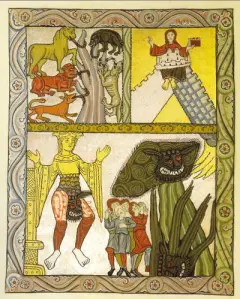
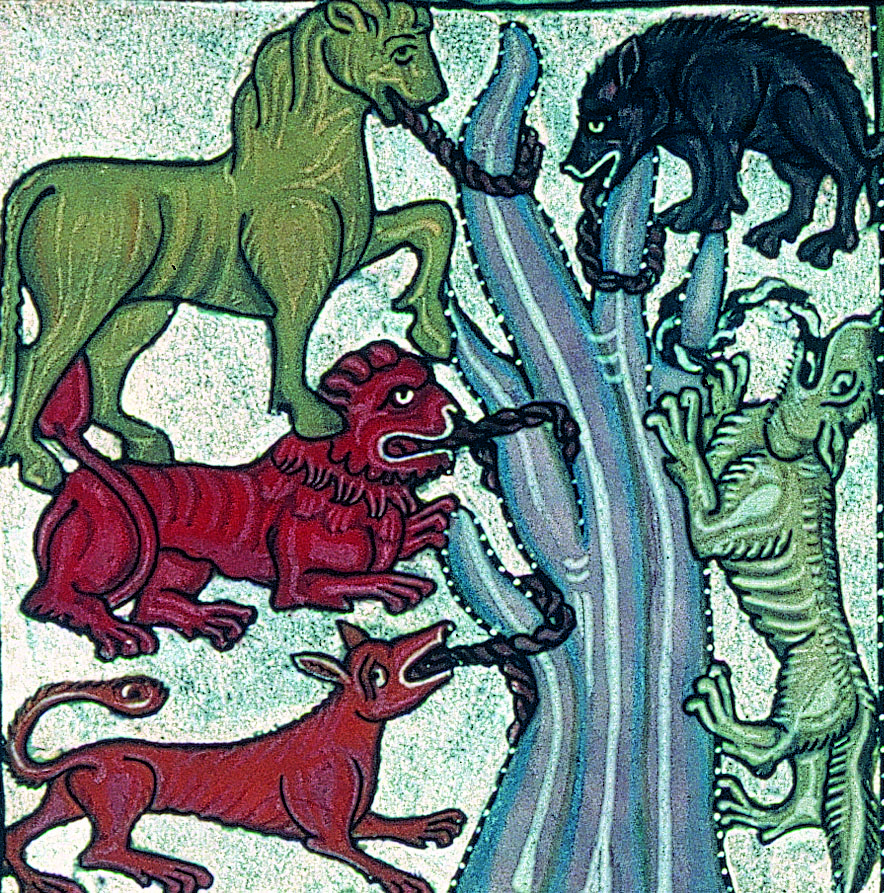
In Book Three, Vision 11, Hildegard describes five symbolic animals as the forerunners of the Antichrist: a Fiery-Red Dog, Yellow Lion, Pale Horse, Black Pig, and Grey Wolf.
it is known as : Pentachronon sive speculum futurorum temporum (The Book of Five Times or Mirror of Future Times), an anthology of her prophecies compiled c.1220.
She explains that each one represents individual and brief historical periods that follow each other in succession. She also reveals how each animal symbolizes a particular evil that afflicts society during the corresponding period.
In thebook The Five Beasts of St. Hildegard: Prophetic Symbols of Modern Society,it starts with an examination the 20th-century with the intention of seeing how historians divided it up and then how they characterized the individual eras that the divisions would unveil. It turned out that there is general agreement among them; certain years marked major social and geopolitical changes in Western society: 1914, 1945, and 1991.
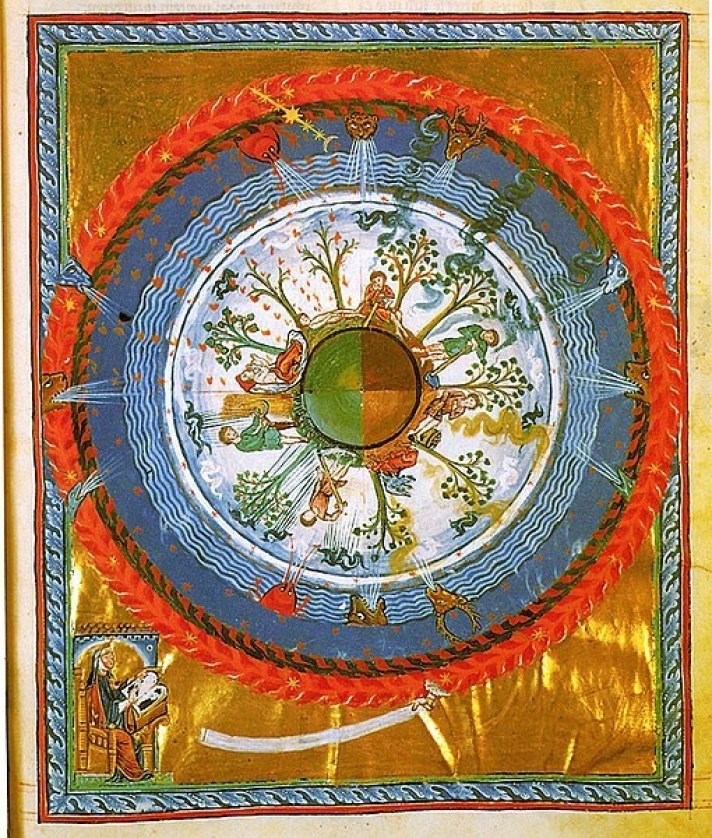
See also: Hildegard of Bingen: Viriditas – the greening power of the Divine –
Five distinct future epochs of Hildegard of Bingen:

Hildegard is more explicit in the final vision of the Book of Divine Works than in Scivias about distinct historical phases. She begins by recapitulating the final hymn of the Ordo Virtutum, which in itself presents a vision of history:
In the beginning all creatures were strong; in the midst of it flowers blossomed, then viridity slipped away. That fighting man [Christ] saw this and said: “I know this, but the golden number is not yet full. Look at my father’s mirror. I bear weakness in my body, my small ones tire. Now remember that the fullness which was there at the beginning ought not dry up. You resolved in yourself that your eye would never fail until you see my body full of jewels. For it tires me that all my limbs are object of derision. See Father, I show you my wounds. Therefore, people, bend your knees to your father so that he may stretch out his hand to you. As if identifying herself with a wounded Christ, Hildegard urges humankind to return to that fullness of health or viridity with which creation was once endowed. Hildegard unravels what this means by explaining that she sees history not as a march of unstinted progress since the incarnation, but as one of a new burst of vitality immediately after the incarnation, followed by a period of long decay, “in which viridity fell away from its strength and turned into womanly weakness.” The renewal of the papal schism in 1159 probably reinforced her pessimism about the future of the Church. She may be alluding here to either Paschal III (1164–8), the cardinal placed on the see of Rome by Rainald of Dassel, archbishop of Cologne (1159–67), imperial chancellor and vicar for all Italy, or his successor as Antipope, Calixtus III (1168–78). Hildegard then examines various historical periods, first describing the major apostles: the mild-mannered Matthew, the sceptical Thomas, the zealous Paul, the gentle James, brother of the Lord, the wise and strong Peter, and the virtuous and chaste John. There had been a gradual growth in iustitia and honesty of behaviour since the time of the Flood until the incarnation and the time of the apostles.After the time of the apostles, however, the sun became darkened and iustitia has weakened. She blames in particular “a judge of royal name” as bad as Nero and other tyrants. From a quite separate text, we know that she is referring here to the Emperor Henry IV. Hildegard assumes the voice of Christ in crying out about the loss of viridity in Christ’s body as if it were her own. She does not include any image of ecclesia as the Bride of Christ, as in Scivias. Perhaps out of disillusion with the formal structure of the Church, she now transferred her attention to the suffering of Christ himself. In the Liber Divinorum Operum, she concentrates on the theme that iustitia had fallen away from what it was in the past. The age of the dog began with the judge she mentions (Henry IV) and continued until God struck down another ruler “of a spiritual name, with the wisdom and cunning of a serpent,” perhaps Rainald of Dassel (d. 1167). She excoriates the ravaging wolves, dressed in ecclesiastical robes who carry arms, rob the poor, and plunder what does not belong to them. Then follows the age of the lion, a time of war, when armies will kill each other and many cities will be destroyed, although this will be followed by a time of justice and peace before final judgment, presumably the time of the millennium. Her metaphors are those of natural health, the earth abounding with the “viridity of fruitfulness.”
The age of the horse, however, symbolizes the onset of changeability. The armies of the heathen will attack Christendom. She anticipates a radical fragmentation of the Roman imperium that can never be repaired. People will follow other teachers and other archbishops.Picking up the claims of Scripture, she anticipates that both sons and daughters shall prophesy (Joel 2:28; Acts 2:17), while there will also be many heresies before the emergence of the Antichrist in the time of the pig.
By identifying these wild animals with specific periods in history, Hildegard encourages her readers to think much more clearly than in Scivias that these present times are part of an order that must pass away before ultimate judgment. She was no longer afraid of speaking out about the wrong directions that had been taken in the history of the Church. She is also more specific than in Scivias about what the Antichrist is teaching: his arguments against the precepts of chastity, which she says will deceive mankind.

Only through the sending of Enoch and Elijah will the trickery of the evil one be overcome and people will be won back to God. All of these prophecies serve to warn humanity that it must return to the moral righteousness, the iustitia revealed by Christ. Hildegard sees the wounds in Christ’s body as manifestations of the injustice which still endures in society. In Scivias, she had preserved a more traditional image of the Church as a Virgin Bride that had been soiled by vice and corruption. Her emphasis on the suffering of Christ in the Book of Divine Works reflects her broader interest in that work with the need to restore the health of the human body. She is convinced that injustice will eventually be exposed and the son of perdition defeated. Hildegard concludes the Book of Divine Works by referring back to the frailty of her own body, which she sees as weak and frail, animated only by the Holy Spirit to give instruction to the Church.Her hope for human history is that it moves towards a restoration of that vitality in her own body for which she longed. The Book of Divine Works is one of the great texts of the twelfth century, a vision of the working of the world and the human person. It may be misleading to describe it as a vision of history. Hildegard saw her mission as one of promoting moral reform rather than of arguing for social revolution. Nonetheless she did become much more articulate than she had been in Scivias about the extent of corruption within the Church after she had established herself at Rupertsberg. By the time she finished the Book of Divine Works in 1174, when she was seventy-six years old, she had lost none of her imaginative powers, but she was more pessimistic about the future than when she had started on her prophetic career.

Five distinct future epochs between her own time in the twelfth century and the Eschaton, or End Times: all labelled, in veiled metaphors, under animal signs:
(1) The Age of the Fiery Hound (2) The Age of the Yellow Lion (3) The Age of the Pale Horse (4) The Age of the Black Pig and (5) The Age of the Grey Wolf.
first, she avoided identifying “the day or the hour,” which is good because only false prophets do that. It might Seem like her timeline can be exactly fixed on the historical timeline and thus come up with a date…but we actually can’t do that without speculating.
Second: speaking of speculating, specifically about how to fix her timeline to the historical one, I’m about to try to do that very thing. But keep in mind that this is just fun speculation.
Third: the Church never says that private revelations are definitely true. So don’t take St. Hildegard’s vision as gospel truth, nor speculative attempts (like mine below) to fix it to certain points on a timeline. This is all theory…not necessarily true.
Now for my attempt to Speculatively affix this Not-infallible vision to a timeline:
The Fiery Hound age might be the 1100s. The Albigensians were forerunners of the antichrist and could be the perverse mercenaries of whom St. Hildegard speaks. The corrupt secular leaders could include Emperor Henry V, who persecuted the Church over the investiture controversy, King Henry II, who wanted to make the Church an arm of the State and martyred St. Thomas Becket in the process, and Emperor Frederick I, who persecuted Pope Alexander III. The corrupt spiritual leaders and pope could include the many English clergy who cooperated with King Henry II, the many other European clergy who cooperated with Emperors Henry V and Frederick I, Pope Paschal II, who compromised with Henry V over the issue of lay investiture, and Pope Celestine II, who compromised with France when the king there tried to illegally appoint a bishop.
The Yellow Lion age might be the 1500-1600s. The “time of chastisement and disendowment of Church” could be the Protestant Revolt. In England, Northern Germany, and the Netherlands, the Church was disendowed and its buildings were transferred to protestants. Catholics were persecuted in these territories and forced underground. “Tempus utile” and “tempus virile” seem to mean “time of usefulness” and “time of manliness,” and there were many great saints during these ages who made great use of the time to convert the protestants back to the Faith, institute the Catholic counter-reformation, and oversee the Council of Trent. This could be the “renewal of spiritual strength” St. Hildegard mentions. The “conversion of pagans” could be from the missionaries to South America who converted the continent to Christ, to North America where Mexico and Florida were converted, and Asia where Catholic missionaries such as St. Francis Xavier had great success in Japan and India.
The Pale Horse age might be the 1700-1800s. “Church polluted” could be a reference to the time right before the French Revolution, when France had many atheist bishops and almost the whole clergy subscribed to the anti-papal demands of the French. The 1800s also saw the heresies of Americanism and its child Modernism threaten the Church in America and some of its poison has continued to this day. “Persecution of Christians by heathens” could be a reference to the Revolution in France, the No Nothing party in America, the Kulturkampf in Germany, the Unification of Italy, and the Boxer Rebellion in China. “Christians saved by miracle and conversion of heathens” could be a reference to Lourdes and the restoration of Catholicism in France with Napoleon (who was a persecutor overall, but did re-legalize Catholicism…his successors in France were a bit better and restored Catholicism more fully). “Papacy and Empire dispersed” could refer to the dissolution of Holy Roman Empire, the kidnapping of the pope by Napoleon, and the annexation of the Papal States by Italy. “Church returns to pristine discipline” could refer to the reigns of Blessed Pius IX and Leo XIII, who also brought back the pope’s “spiritual strength” in part through their widely-read and influential encyclicals. The Church in Europe began to reattain dominance under them.
The Black Pig age could be the 1900-2000s. “Reign of heretics and forerunners of Antichrist” could refer to rampant atheism, modernism, and protestantism. “many Christians desert orthodoxy” could refer to the gains evangelicalism has made and cafeteria Catholicism within the Church. “moral decay and spiritual decline” could refer to sexual revolution with its fruits, rampant abortion, contraception, sexual deviance, and triumphalist hedonism. We are still in the 2000s, so we might be waiting for the “signs of the End.”
look also Time and Space in the Symbolism of Abel and Cain
- The Five Beasts of St. Hildegard: Prophetic Symbols of Modern Society
An another cycle is described by Reid TurnerThe Five Beasts of St. Hildegard: Prophetic Symbols of Modern Society. The cycle is as a mirror of the great one but on a shorter time ( see Timeline of Cycles by René Guénon and Gaston Georgel)In 1929 René Guénon made the breakthrough in decoding the correct duration of the Manvantara and the duration of the 4 Yugas. That work can be found in his book “Traditional Forms and Cosmic Cycles”. René Guénon explained in the aforementioned book how he arrived at the decoding of the real duration of the Yugas and of the Manvantara. He did not claim some secret source or divine inspiration, but rather he exposes his logical deduction based on elements of several different Traditions, and with that process demonstrates the complementary nature of the teachings of those Traditions. The end result of the breakthrough decoding, whose argumentation is too long to be duplicated here, is that:…Read More

In 1150 St. Hildegard completed her first major work, Scivias (“Know the Ways of God”), a description of 26 highly symbolized visions that manifest the history of salvation. Soon after her death, inexplicably, Scivias and Hildegard fell into obscurity. It wasn’t until the late 20th-century that the work was rediscovered by Latin scholars looking for material for their students. The first complete English translation appeared in the 1990s.In Book Three, Vision 11, Hildegard describes five symbolic animals as the forerunners of the Antichrist: a Fiery-Red Dog, Yellow Lion, Pale Horse, Black Pig, and Grey Wolf. She explains that each one represents individual and brief historical periods that follow each other in succession. She also reveals how each animal symbolizes a particular evil that afflicts society during the corresponding period.

In the book The Five Beasts of St. Hildegard: Prophetic Symbols of Modern Society, it starts with an examination the 20th-century with the intention of seeing how historians divided it up and then how they characterized the individual eras that the divisions would unveil. It turned out that there is general agreement among them; certain years marked major social and geopolitical changes in Western society: 1914, 1945, and 1991.
Thus the century can be divided into four eras: 1870-1914; 1914-1945; 1945-1991 ; 1991-present. (1870 was the Franco-Prussian War which changed the map of Europe and inaugurated the secularization of western Europe). Consulting a wide range of historians, some of whom were friendly to religion and others not, the characterizations of those historical periods that emerged actually matched Hildegard’s description of the specific social evils that were represented by the first four of her five beasts.
The following is a very condensed presentation of those correlations. The first one was difficult to figure out; Hildegard’s description of the era was brief and somewhat vague. The others, as you will discover, are quite obvious.
The Fiery Red Dog (1870-1914)

Historians like to call this the “Age of Imperialism”; the empires of Europe were at their zenith. From a sociological perspective, however, the theme of the era was the exploitation of the working poor, a problem Karl Marx was determined to fix. His ideology was spreading like wildfire of which the popes of the era would issue many warnings and condemnations. Pope Leo XIII, in his famous encyclical, Rerum Novarum, declared of the problem of social injustice “…there is no question which has taken a deeper hold on the public mind.” If you read the encyclical, you’ll notice that it is primarily a condemnation of communism.Here’s how Hildegard described the era:
“One is like a dog, fiery but not burning; for that era will produce people with a biting temperament, who seem fiery in their own estimation, but do not burn with the justice of God.”*
The key to understanding this is to focus on the word “justice”. “Fiery” is to be understood as passionate, similar to a common English usage of the word. We are told that during this era characters will emerge who are passionate for justice, but not really “on fire” because it is not the justice of God, but their own form of justice. It is not difficult to make a case that she was referring to injustice toward the working poor by the upper classes and the consequent rise of communism. The history and literature of the era testify to the centrality of social injustice for understanding what was happening during the period. (Zola, Hardy, etc.)
The Yellow Lion (1914-1945)

Most historians connect the two wars and call it something like “The Age of Catastrophe”, or “The Age of Total War”, an era dominated by wars, genocides, military dictatorships, political prisons, religious persecutions, etc. Historians struggle to understand how the Christian nations of Europe permitted it to happen.Hildegard describes the era as follows:
“Another is like a yellow lion; for this era will endure martial people, who instigate many wars but do not think of the righteousness of God in them; for those kingdoms will begin to weaken and tire, as the yellow color shows.”
“Martial” or “war mongering” does not overstate what kind of people dominated much of this era; nationalism and communism were two sides of the same coin. As the era came to a close, the fall of the Nazis and their allies proved to be a spectacular exhibition of self-delusion and cowardice.
The Pale Horse (1945-1991)

To historians these years are known as the “Cold War” era. Most focus their attention on the many conflicts, proxy wars, intrigue, etc. between the two superpowers. Others with more sociological interests will examine the student riots and unrest, assassinations, and the changing perspectives on human sexuality. In regard to the latter, one can think of two influential documents produced during the era that reveal the dramatic changes that took place with regard to sex, The Kinsey Reports (1948), and Humanae Vitae (1968).Hildegard describes the era as follows:
“Another is like a pale horse; for those times will produce people who drown themselves in sin, and in their licentious and swift moving pleasures neglect all virtuous activities. And then these kingdoms will lose their ruddy strength and grow pale with the fear of ruin, and their hearts will be broken.”
The key word is “licentious”, meaning sexual debauchery. Thanks to artificial birth-control the purpose of sex changed from procreation to pleasure. Like a healthy horse turning sickly pale, the damaging consequences of the sexual revolution on western society began to reveal themselves in the 1980s. Statistics on abortion, divorce, single-parent families, suicide, STDs (including AIDS), etc., all exploded as the era came to an end.
The Black Pig (1991-present)

It is an open question as to how future historians will view the West since 1991 and what sort of titles will be used to characterize the period. From the experience of the last quarter century one might be tempted to call it “The Age of Globalization”. The dominant themes have been free trade, elimination of borders and for much of Europe, a common market, passport, and currency. This title also suits the continuing migrations of millions to Europe from the Middle East and Africa.
Note that Hildegard states clearly that she is referring only to the era’s “leaders” in her description. The generation of leaders since the 1990s have not been, in general, the same type of people as their predecessors. Today’s leaders tend to be pro-abortion and pro-homosexual marriage, imposing many laws, like Obergefell vs. Hodges, that are contrary to Christian teaching.
Hildegard writes:
“…[T]his epoch will have leaders who blacken themselves in misery and wallow in the mud of impurity. They will infringe the divine law by fornication and other like evils and will plot to diverge from the holiness of God’s commands”
As the agenda of political correctness, gender theory, homosexuality, race, etc., gradually became more radicalized in the higher educational system through the 70s and 80s, naturally so have our leaders who were educated in those times. Think of Clinton, Blair, Obama, Trudeau, Cameron, Holland, Merkel, etc.; think also of the thousands of their political appointees, including judges, that further the cause of political correctness, the goals of which “infringe the divine law”. Historian Paul Johnson has described it in terms of social engineering and referred to it as “the salient evil of our time”.
The Grey Wolf
The arrival of the era of the Grey Wolf will ultimately prove whether it was coincidental that the preceding four historical eras matched Hildegard’s descriptions of them. But it is important to acknowledge, however, that Hildegard’s descriptions are not interchangeable with these eras. Historians may vary on the importance of the sexual revolution, but they would not place it in the other eras, it belongs to the Cold War years. Likewise, outside of the era of the Yellow Lion, the other three eras were relatively peaceful. Social engineering was being practiced by the Soviet Union and the Fascists, but it does not define the period of 1914-1945, malice and militarism do. Moreover, since the four follow in the proper order; it strikes me as unlikely that these correlations were accidental.
It is interesting that Hildegard goes into far more detail regarding the Grey Wolf then the other eras. Essentially, three main things will define the era:
- Civil unrest and revolutions with their cause being economic inequality.
- Physical persecution of the Church by a specific group of people.
- A powerful spiritual revival in the Church.
She also adds that it is when the Church will be “…replete with the full number of her children.” The Church’s mission to evangelize will have been completed.
The Beasts and the Symbolism of the Ropes
Each beast represents a brief historical period (see here for the background). You will notice that there is something coming out of each of the beast’s mouth. Hildegard describes these as ropes that are attached to the top of a mountain. The mountain, she tells us is meant to symbolize a specific social evil that is characteristic of the individual historical era.
She explains that the ropes represent the attachment of the people of that era to its particular social evil, and that this attachment would be evident from the beginning of the era to its end. This is very important in helping us to discern whether the era in question matches the symbolism of the beast. Lots of things happen during a given historical period, but not things that continue from the beginning to the end.
All the ropes are black except the one that comes from the mouth of the wolf, which is partly black and partly white. For the length of the ropes indicates how far people are willing to go in their stubborn pleasures; but though the one that symbolizes greed is partly black and puts forth many evils, yet some will come from that direction who are white with justice. And these latter will hasten to resist the son of perdition by ardent wanders, as My servant Job indicates about the righteous doer of justice, when he says:
Words of Job:
“The innocent shall be raised up against the hypocrite, and the just shall hold to his path; and to clean hands he shall add strength” [Job 17:8-9]. Which is to say:
One who is innocent of bloody deeds, murder and fornication and the like, will be aroused like a burning coal against one who deceives in his works. How? This latter speaks of honey but deals in poison, and calls a man friend but stifles him like an enemy; he speaks sweet words but has malice within him, and talks blandly to his friend and then slays him from ambush. But one who has a rod with which to drive away vile brutes from himself walks in the light of the shining sun on the righteous path of his heart; he is raised up in the sight of God as a bright spark and a clear light and a flaming torch. And so, bearing in himself the strongest and purest works, he puts them on like a strong breastplate and a sharp sword, and drives away vice and wins virtue.

“For, from the time of the persecution the faithful will suffer from the son of the Devil until the testimony of the two witnesses, Enoch and Elijah ( Khidr in Islam), who spurned the earthly and worked toward heavenly desires, faith in the doctrines of the Church will be in doubt. People will say to each other with great sadness, “What is this they say about Jesus? Is it true or not?”
“The king shall rejoice in God; all they that swear by Him shall be praised; for the mouth of them that speak wicked things is stopped” [Psalm 62.:12.]. Which is to say: The profound knowledge of the beautiful human language that gives voice to the will and disposition of God is a great measure of human stature; and it makes music at the altar of God, for it knows Him. And when the hissing and gaping of the Devil, which taints human minds with shame, is forsaken in the time of desperation, the blessed will be praised in minds that sing, and they will make a flowing path of words to the pure fountain of the mighty Ruler.
The Five Beasts of St. Hildegard and Revelation 17: The Beast with Seven Heads
St Hildegard’s vision of the last days is a description of five symbolic beasts that represent five unique historical periods that immediately precede the time of the Antichrist. The book, The Five Beasts of St. Hildegard: Prophetic Symbols of Modern Society, argues that four of the five periods have already occurred in our recent history. If the book’s theories are convincing, then we can look for references to that same future period of time in the prophetic literature of the Bible and compare.

One such reference is the well-known apocalyptic passage in the Book of Revelation which includes a description of the infamous “Whore of Babylon”. Unfortunately, the book of Revelation is very difficult to interpret, and Revelation 17:1-14, which references the Whore of Babylon and the beast with seven heads, is especially difficult to understand. But it can be interpreted, and often is among Catholic theologians, as referencing the time leading up to the Antichrist. To do so requires the premise that the book of Revelation relates to the future and has specific information about the end times.
BIBLICAL TYPOLOGY
A common method of interpreting Revelation among Catholic theologians is typological. Biblical typology is the study of words, events, symbols, etc. that have a broader meaning then their immediate biblical context. Numbers connected to events are the most common “types” found in the Bible; there were forty days of rain, forty years in the Sinai wilderness, forty days fasting in the desert etc. It tells us that these events are connected or somehow foreshadow each other. When a passage in Revelation can be connected to an event or series of events which happened in the first century, they’re also intended to be viewed as foreshadowing events into the future. Catholic biblical scholar Peter Williamson, STD., in his popular commentary on Revelation prefers the typological approach to interpreting the book’s message:
“…[U]nderstanding the book’s first-century historical context is essential for interpreting it correctly. However, it is also clear that Revelation claims to depict the Church’s trials leading up to the return of Christ. …In John’s view, the spiritual dynamics of the final trial are already present in the temptations and persecutions that confront the Church in his day. From our vantage point centuries later, we can see that the prophet John saw the end of history through the lens of the trial facing the first-century churches of Asia in the Roman Empire. Like other eschatological [end-time] biblical prophecies, those in Revelation seem not to distinguish the author’s day from that of history’s end.”
Utilizing this approach in interpreting Revelation 17, we have a clear biblical reference to the time leading up to the Antichrist that parallels Hildegard’s vision:
Revelation 17:1-6
Then one of the seven angels who were holding the seven bowls came and said to me, “Come here. I will show you the judgment on the great harlot who lives near the many waters. The kings of the earth have had intercourse with her, and the inhabitants of the earth became drunk on the wine of her harlotry.” Then he carried me away in spirit to a deserted place where I saw a woman seated on a scarlet beast that was covered with blasphemous names, with seven heads and ten horns. The woman was wearing purple and scarlet and adorned with gold, precious stones, and pearls. She held in her hand a gold cup that was filled with the abominable and sordid deeds of her harlotry. On her forehead was written a name, which is a mystery, “Babylon the great, the mother of harlots and of the abominations of the earth I saw that the woman was drunk on the blood of the holy ones and on the blood of the witnesses to Jesus.
Revelation 17:7-14
When I saw her I was greatly amazed. The angel said to me, “Why are you amazed? I will explain to you the mystery of the woman and of the beast that carries her, the beast with the seven heads and the ten horns. The beast that you saw existed once but now exists no longer. It will come up from the abyss and is headed for destruction. The inhabitants of the earth whose names have not been written in the book of life from the foundation of the world shall be amazed when they see the beast, because it existed once but exists no longer, and yet it will come again. Here is a clue for one who has wisdom. The seven heads represent seven hills upon which the woman sits. They also represent seven kings: five have already fallen, one still lives, and the last has not yet come, and when he comes he must remain only a short while. The beast that existed once but exists no longer is an eighth king, but really belongs to the seven and is headed for destruction. The ten horns that you saw represent ten kings who have not yet been crowned; they will receive royal authority along with the beast for one hour. They are of one mind and will give their power and authority to the beast. They will fight with the Lamb, but the Lamb will conquer them, for he is Lord of lords and king of kings, and those with him are called, chosen, and faithful.”
In the first passage the angel introduces John to specific apocalyptic images and characters. In the second, the angel explains who and what they represent. The explanation, however is complex and contains what seem like riddles. While there is no clear consensus among Catholic interpreters of these passages, it seems evident that the beast with the seven heads refers to the Antichrist, or at least the “eighth king” does. He is referred to “The beast that existed once but exists no longer is an eighth king, but really belongs to the seven and is headed for destruction“. This is the same beast that was introduced in Rev. 13:1-18 and will be destroyed by Christ (“the Lamb“).
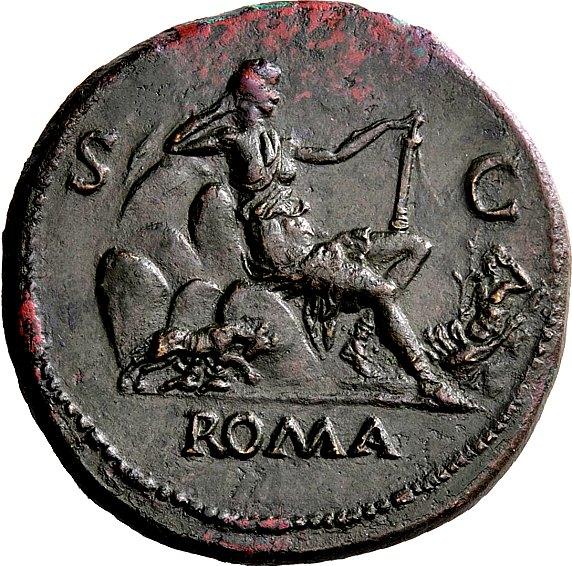
The reference to the seven kings representing the “seven hills” would clearly have been understood by St. John as Rome, since it was commonly known as the city on seven hills, the angel explained that each hill represents a king, connecting it to the seven-headed beast. A coin minted by Emperor Vespasian depicts the goddess Roma resting on seven hills just as the image of the harlot did. So we have the rise of the Antichrist, who will deceive the nations in the last days and be destroyed by Christ, being presented in connection with the Roman Empire during St. John’s day. From a biblical typological viewpoint, the angel is describing the last days using the analogous history of early imperial Rome.
THE SEVEN KINGS

The seven kings represent the first seven Roman Emperors, beginning with Augustus (27 BC-14 AD) (Julius Caesar was not considered emperor). Five of which, the angel tells John, have “fallen”. Following Augustus, they would have included Emperors Tiberius (14-37), Gaius (“Caligula”) (37-41), Claudius (31-54), and Nero (54-68). The next one, the “one who still is”, would have been Emperor Vespasian (69-79), who seized the throne during “the year of four emperors”. The seventh, Titus (79-81), whose reign lasted only two years, is the one who, “when he comes he must remain only a short while“.
The angel further helps John understand the beast’s connection to the Roman empire by referring repeatedly to an eighth king but who is really one of the seven who apparently dies and then comes back to life: “it existed once but exists no longer, and yet it will come again“. John would have understood this to be a reference to a much-believed popular myth in the first century that the much-hated Emperor Nero, after being declared and enemy of the people by the senate and committing suicide by stabbing himself, nevertheless survived and went into hiding in Parthia with the intention of returning and re-establishing himself on the throne. Historians of this period are familiar with this and refer to it as the “Nero Redivivus” legend.
EMPEROR NERO
“Count the numerical values of the letters in Nero’s name, and in ‘murdered his own mother’: you will find their sum is the same.”

This is a typical piece of Roman graffiti during Nero’s reign as reported by Roman historian Suetonius in his book, The Twelve Caesars. It refers to Greek numerology. In Hebrew numerology (gematria), however, his name adds up to a different number — 666. He did indeed murder his mother, as well as kick his pregnant wife to death when she complained about him coming home late.`He also may have invented homosexual marriage, as on two occasions he publicly married his male lover (Nero dressed as the bride). What would be most significant is that he was the first Roman emperor to systematically persecute Christians, including the murder of John’s brother disciples, Saints Peter and Paul. This makes Nero a “type” of the Antichrist.
In The Annals of Imperial Rome, the Roman historian Tacitus reports that Nero, who was widely suspected of instigating the burning of Rome and performing songs on his private stage while fire engulfed the city, looked around for scapegoats; this is when the persecutions began. The emperor chose to blame the “notoriously depraved Christians” (Tacitus notes that this is what Christians were popularly referred to as). Tacitus did not like Christians, who he said were followers of a “deadly superstition”, and who engaged in “degraded and shameful practices”, claiming also that “…the human race detested them.” His personal lack of sympathy is striking:
Their deaths were made farcical. Dressed in wild animals’ skins, they were torn to pieces by dogs, or crucified, or made into torches to be ignited after dark as substitutes for daylight. …Despite their guilt as Christians, and the ruthless punishment it deserved, the victims were pitied. For it was felt that they were being sacrificed to one man’s brutality rather than to the national interest.”
The persecutions ended after Nero’s death but resumed in the latter part of the reign of Domitian.
EMPEROR DOMITIAN, THE EIGHTH KING

After the brief reign of Titus, identified by the angel as the seventh king, his brother, Domitian took his place. Most of the information about his persecution of Christians comes from early Christian sources. Note the reference to Nero in this quote from Eusebius of Cesarea’s History of the Church:
“Many were the victims of Domitian’s appalling cruelty. At Rome great numbers of men distinguished by birth and attainments were for no reason at all banished from the country and their prosperity confiscated. Finally, he showed himself the successor of Nero in enmity and hostility to God. He was, in fact, the second to organize persecution against us.” (Book 3; Sec.17)
Suetonius explains that in the later part of Domitian’s reign his treasury had run short of money. This was when the extreme persecution began; he even passed a death sentence on anybody descended from the Davidic line. Tertullian, in his most famous work, Apolologeticus, also compares Domitian to Nero:
“Nero was the first emperor who wreaked his fury on the blood of Christians, when our religion was just springing up in Rome. But we even glory in being first dedicated to destruction by such a monster. …Domitian too had tried the same experiment as Nero, with a large share of Nero’s cruelty.” (Chap. 5)
Identifying Domitian with Nero was not uncommon at the time, but it does not exactly fit with the words of the angel who identified the eighth king as the same person as one of the seven (Nero). But this is typical of the biblical typologies in Revelation. Professor Williamson, who we quoted earlier, stated that apocalyptic literature in the bible is “…the future addressed through parallels with the present”. But notes that those parallels will not and can not be perfect. We know that the Antichrist will try and mock the death and resurrection of Christ through a deception, after which, the Church will endure its final persecution. This is reflected in the Nero-like, but more expanded, persecutions of Domitian, the last and most brutal of the kings represented by the seven headed beast. Yet it is reported by Eusebius that he relented and stopped the persecutions; again, he was a “type”, a foreshadowing of the Antichrist.
THE FIVE BEASTS OF ST. HILDEGARD
It was revealed to St. John that the last days would resemble the first days of the Roman Empire, its first eight emperors, all of whom are part of the same apocalyptic beast that represents the person of the Antichrist. St. Hildegard’s vision of five beasts appears to correspond to the first five heads of the seven-headed beast, the …”five who have fallen”, in three ways:
- They both represent five successive and unique (as well as brief) historical periods that precede the Antichrist and in some way prepare his way. Chroniclers of Rome report how the five emperors ruled in distinct ways.
- Both periods of rule (the five beasts and the seven kings) were heavily influenced by evil and under the influence of the spirit of the Antichrist.
- In the fifth period of each series (the reign of Nero and the era of the Grey Wolf) a period of physical persecution of Christians occurs that would end, but then later resume in a more determined way.
There is dissimilarity, and it is in the numbers: In Revelation there’s one beast with seven heads, one of which is the person of the Antichrist, versus Hildegard’s five separate beasts that precede the person of the Antichrist. However, because biblical typology is not always meant as an exact blueprint, but to only foreshadow future events, the difference may not be relevant. Just as past history can be organized and divided in different ways by different historians, those with the prophetic gift might report the same series of events in the future in different ways as well. Also, and this is an important distinction, Hildegard’s visions are not typological. She does not see historical events that foreshadow future events, but, using symbolic imagery which she carefully explains the meaning of, she sees aspects the future exactly as they will happen.
In addition, in later chapters of Scivias, (book 3, vision 11), Hildegard provides quite a lot of detail about the rise to power of the Antichrist, how he works his deceptions on “…those whose names were not written from the foundation of the world in the book of life” (Rev. 13:8), and apparently convinces the ten kings of the world to cede him their authority. It is evident that this will take an unspecified amount of time and will occur after the end of the era of the Grey Wolf. It is worth noting here that as Roman Emperor, Vespasian formally changed the laws regarding succession, thus allowing his son Domitian to become emperor. The Antichrist will likely have those that also pave the way for him to rise to power. There will undoubtedly be a period of time that elapses between the Grey Wolf and the rise of the Antichrist.
CONCLUSION
This represents the results of a typological interpretation of the passage in Revelation 17; yet there are other possible interpretations. I would highly recommend Peter Williamson’s Commentary, Revelation (Grand Rapids: Baker Academic, 2015) in which he discusses them. While there is not a perfect correspondence between the period leading up to the Antichrist in both Revelation and St. Hildegard, there are no material inconsistencies. The first of the two periods of persecutions revealed by St. John as envisioned by St. Hildegard begin sometime during the era of the Grey Wolf. In my analysis of her vision, this era is not very far off. Nero’s finally coming back.
- Patinir, Pieter Aertsen, Brueghel were living in the same period and try to find a way to show us what was wrong in their society: Vanity of earthly knowledge see landscape of the soul
In Revelation Vanity is represented by the Whore of Babylon. On earth this woman here represents all the pride of the world, all the temptations that we are constantly confronted with in our daily lives and to which we often succumb or the woman with the venom of the earthly senses (the serpent), but nature’s love (the earth) comes to her assistance.
In Chapter 13 the beast from the sea is depraved evil come to kill all virtues in the human heart. It derives its strength from the dragon, the poison of earthly wisdom, while the beast with two horns like a lamb and speaking like a dragon is hypocritical earthly holiness in the flesh which prevents the simple soul from’praying to God (the mark on the right hand or the forehead). The number of the beast is the whole of humanity.
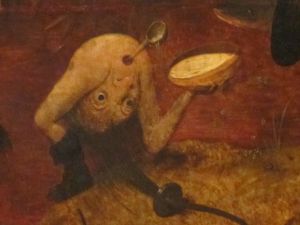
Babylón is interpreted as the confusion of earthly senses; the Whore is false earthly wisdom, her golden jewels hypocritical holiness and the cup fuIl of abominations the carnal appetites.
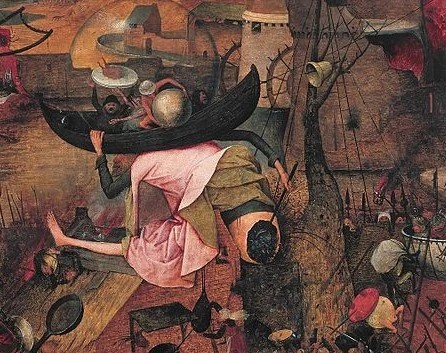
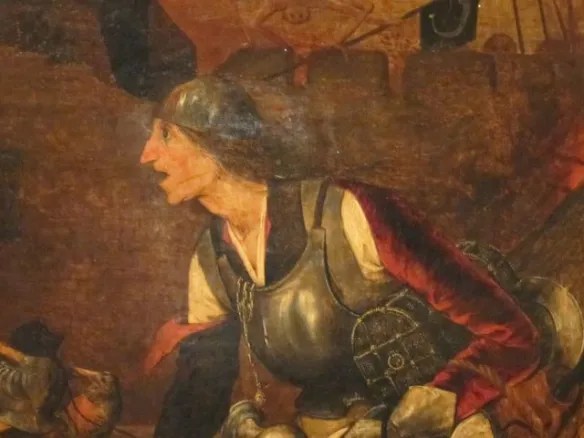
The beast with seven heads is the evil caused by earthly knowledge and wisdom and its rule on earth; its seven heads are the doctrines of earthly wisdom and the seven kings are personal vindictiveness under the guise of holiness.
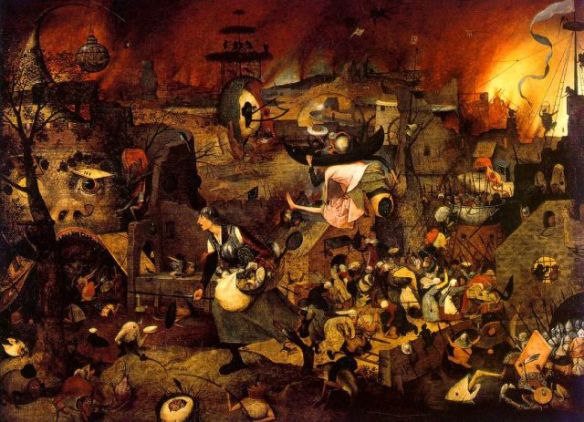
- Dulle Griet is the model of the Rebellion of modern man against his soul, a model of his Anger. How can she find a way to calm her anger?

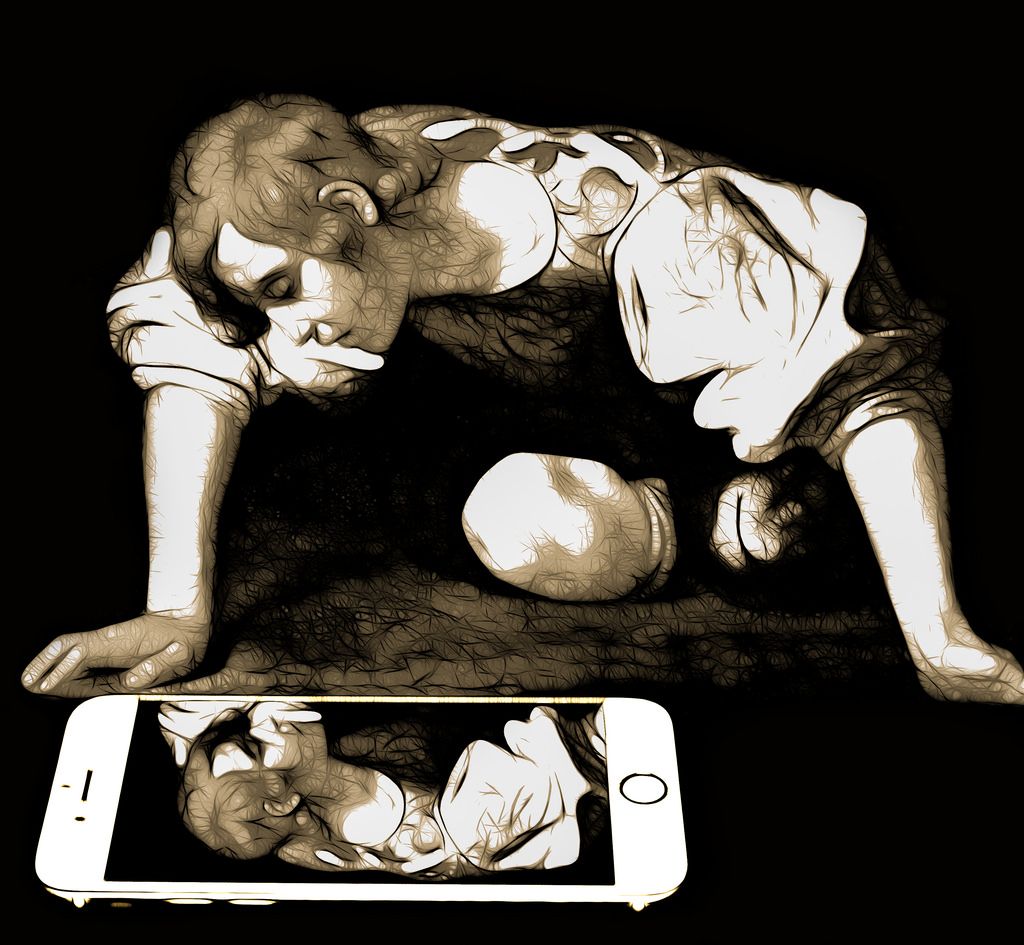
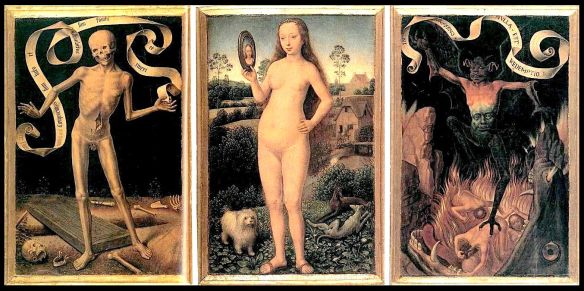
She can looks in the mirror and see herself, making more “selfies”, so seeing more anger as the portait of vanity of Hans Memling shows us. The lady see only more vanity. The message of Memling is in his Triptych of Earthly Vanity and Divine Salvation focuses on the idea of “Memento mori,” a Latin phrase that translates to “Remember your mortality.” Memling’s triptych shockingly contrasts the beauty, luxury and vanity of the mortal earth with images of death and hell.

In the time of BreugheI it was the message that Vanity was not the solution. see: Nothing Good without Pain: Hans Memling”s earthly Vanity and Divine Salvation
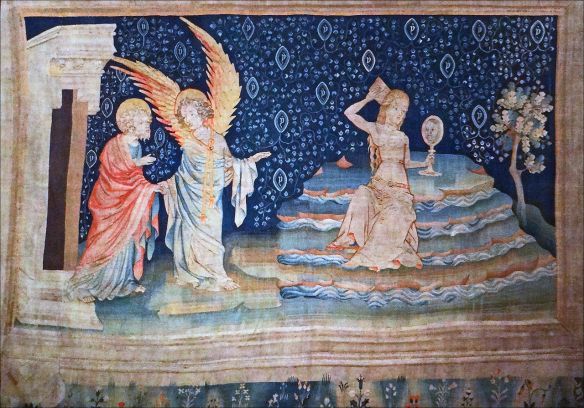

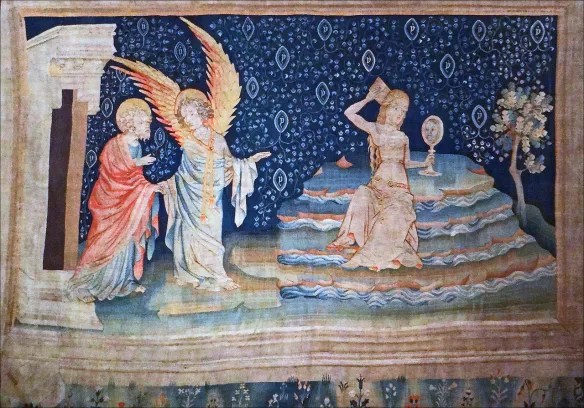
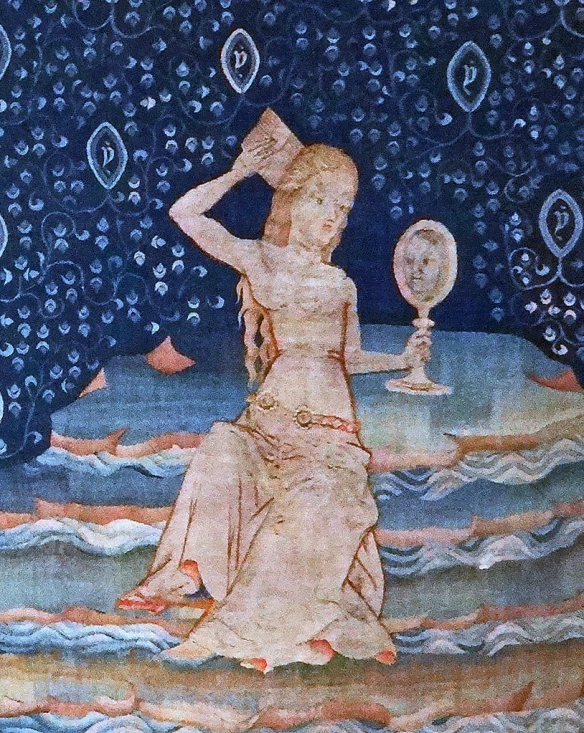
The scene of “Babylon, the Great Prostitute”: symbol of all abominations, From the tapisseries of the Apocalypse of Angers;She is seen styling her long hair,which in the Middle Ages is a sign of prostitution . This prostitute has a pretty face and she is looking in a mirror … but the mirror reflects another face, a great ugliness! This is the reality of the soul of this prostitute because the mirror is a symbol of truth and it is also the sign of the heart.She is represented sitting on a hill watered by four rivers: “These waters are peoples, crowds, nations, languages”. She looks at herself in a mirror but the reflection that it sends back to her is that of a very ugly face (image of her soul).“On her forehead was written a name, a mystery: Babylon the great, the mother of immorality and abominations of the earth. And I saw this woman drunk with the blood of the saints and the blood of the witnesses of Jesus … “”And the woman you saw is the great city that has kingship over the kings of the earth. »Having seen these details, we are now informed: She is the great prostitute of Babylon. Babylon means “the door of the Gods”. It is said in the Bible that Babylon was previously a golden cup in the hands of Yahweh but it fell and became the sign of pride. This woman here represents all the pride of the world, all the temptations that we are constantly confronted with in our daily lives and to which we often succumb. In the days of John, the seven hills watered by four rivers obviously refer to the city of Rome and the pride of this imperial Rome which imposes its yoke everywhere in the world.There is a sign of hope anyway in the tapestry with this angel with orange wings, the color of light and pointed towards the sky. He leads Jean by taking him by the hand … indicating that we are never alone. In the background, Hennequin of Bruges has also, once again, placed the bivium of Pythagoras, this sign which leaves us free to choose the path of good or the path of evil.
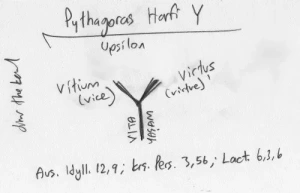
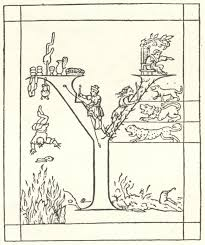
“The letter” y “represents the symbol of moral life. The question of good and evil arises before the free will of man: two roads open before him: the left, the thick branch of the “y”, is wide and easy to access, but leads to the chasm from shame, that of the right, the thin branch, is a steep and painful path, but at the summit of which one finds repose in honor and glory. “
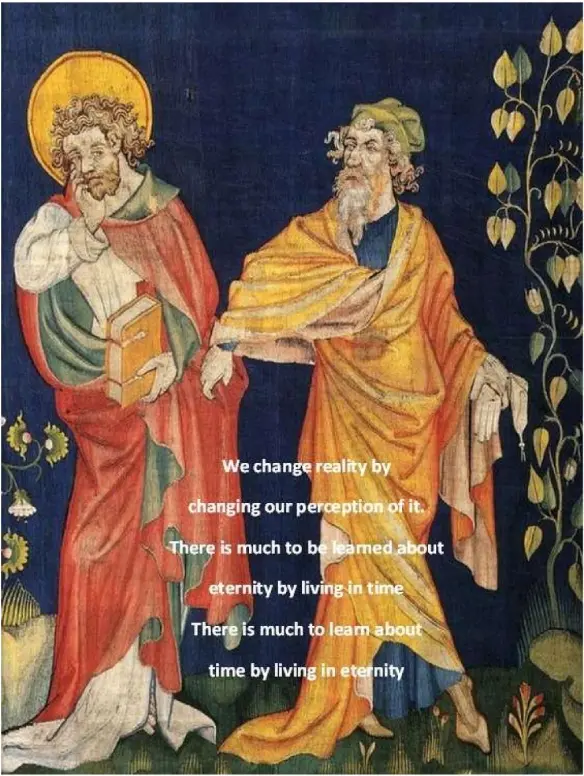
— Man in Sapphire Blue or The Trinity: A Study in Compassion.
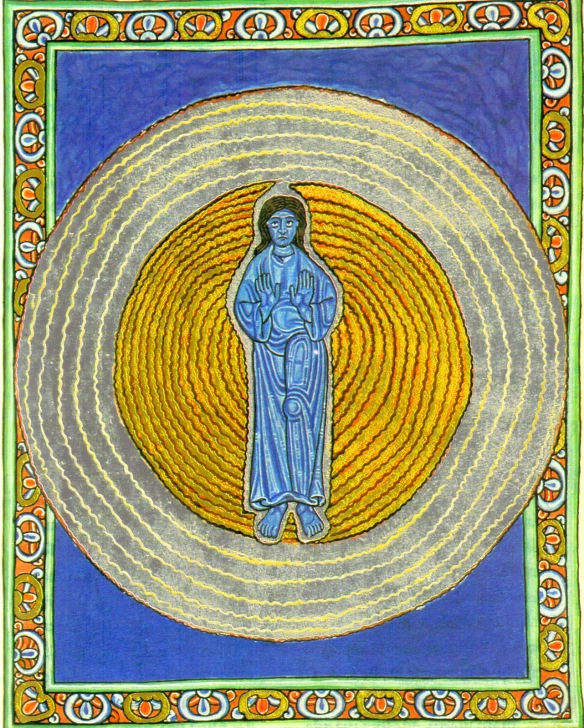
The Man in Sapphire Blue is from the book Scivias (1151)
Hildegard was 42 years old in 1142, when this, her first book of illuminations, was started.
Hildegard describes: “A most quiet light and in it burning with flashing fire the form of a man in sapphire blue.” The blue colors and the manner in which the man holds out his hands, extended toward the world, denote compassion and healing. Hildegard describes the Trinity as “One light, three persons, One God. The Father is brightness and the brightness has a flashing forth and in the flashing forth is fire and these three are one.” The Father is a living light, the Son, a flash of light and the Spirit is fire.. The fire of the Holy spirit binds all things together, illustrated as an energy field surrounding the man. Symbolized as the golden cord of the universe, the Holy Spirit streams through eternity creating a web of interconnectivity of all being and of divinity with creation and humanity (reminiscent of an East Indian cosmology using cord and thread imagery).
Hildegard’s theology of Trinity is about divine compassion entering the world. Jesus the Christ is the revelation of the compassion of God, the incarnation of divine compassion. The Hebrew word for Womb is compassion. But we do not merely look at a mandala (ancient circular image of the universe) – we are transformed by it. This mandala draws us into the energy of divine compassion, it connects us with the Christ, the Blue Man, such that we realize our own identity in Him who is the compassion for the universe. If we don’t hold our healing capacity in unity, the entire rope (universe) unravels.
May the words and visions of Hildegard speak to your sense of divine receptivity. And may you wonder with reverence at the precious gift of this amazing, sacred cosmos and our Oneness with all of Life.
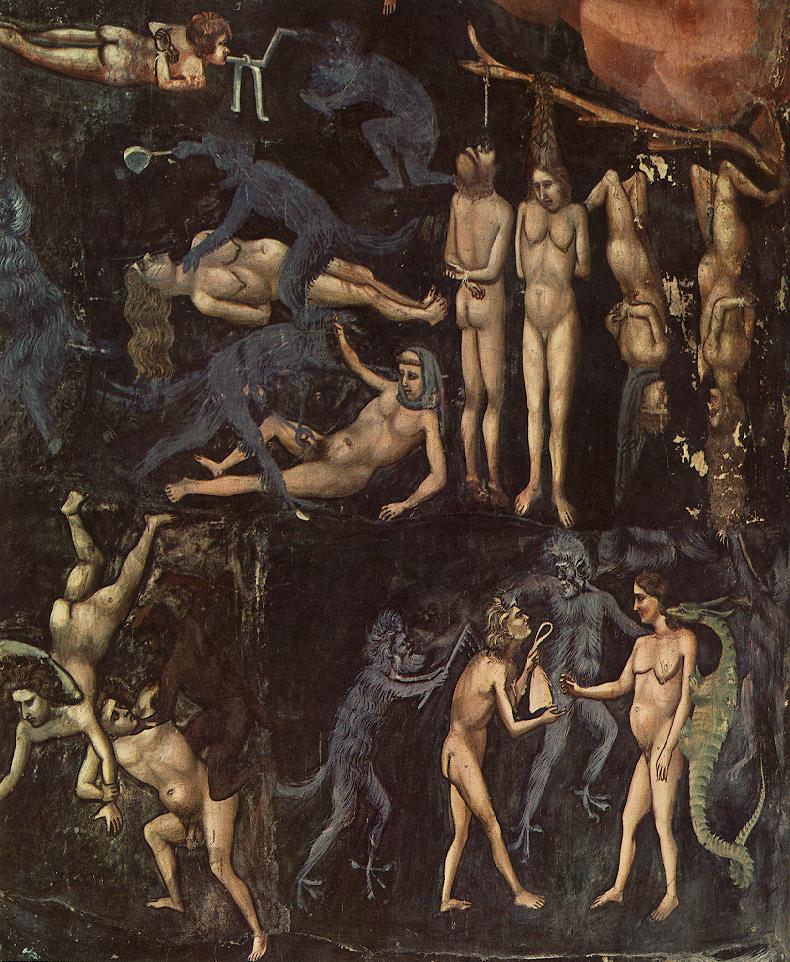
Giotto – last judgment Padua Arena
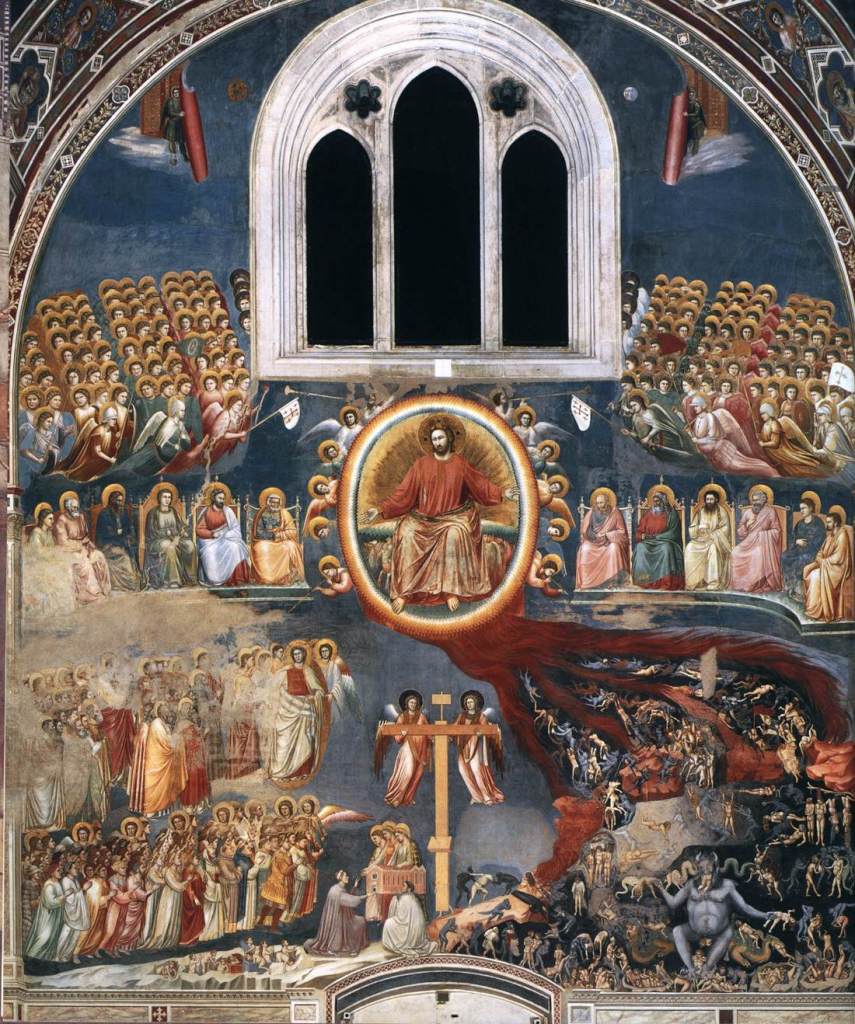
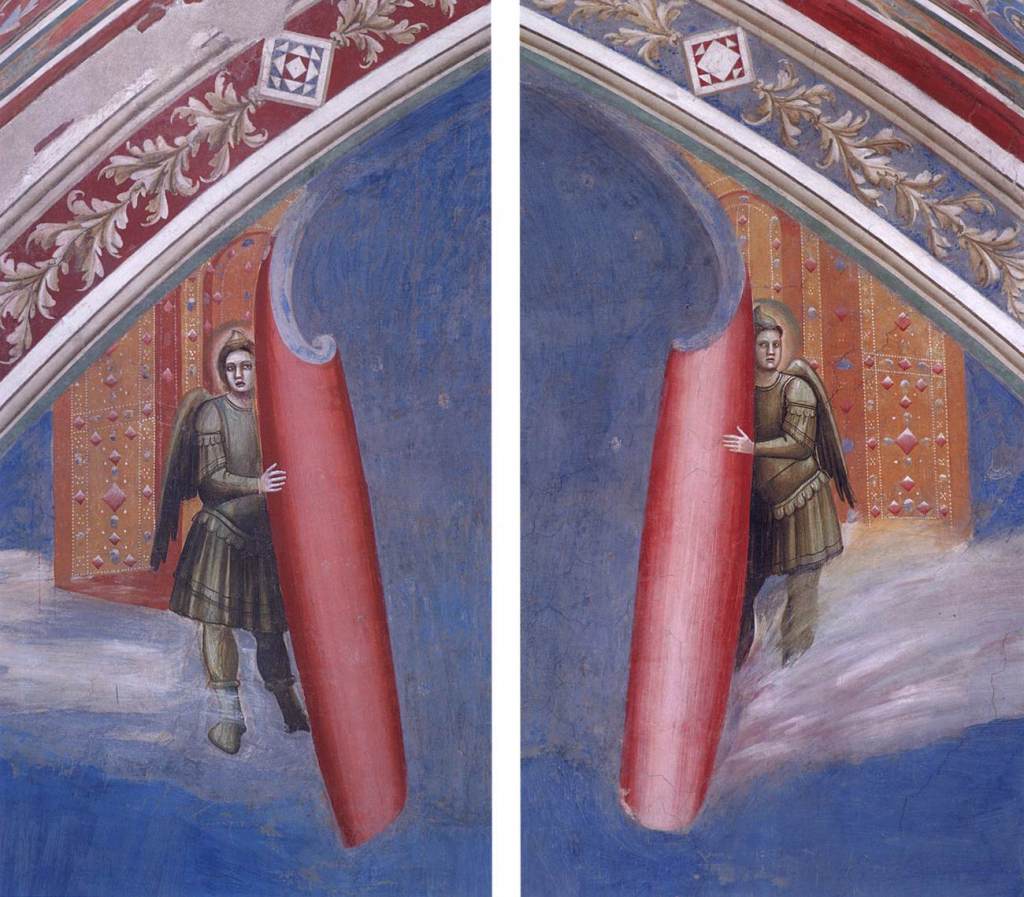
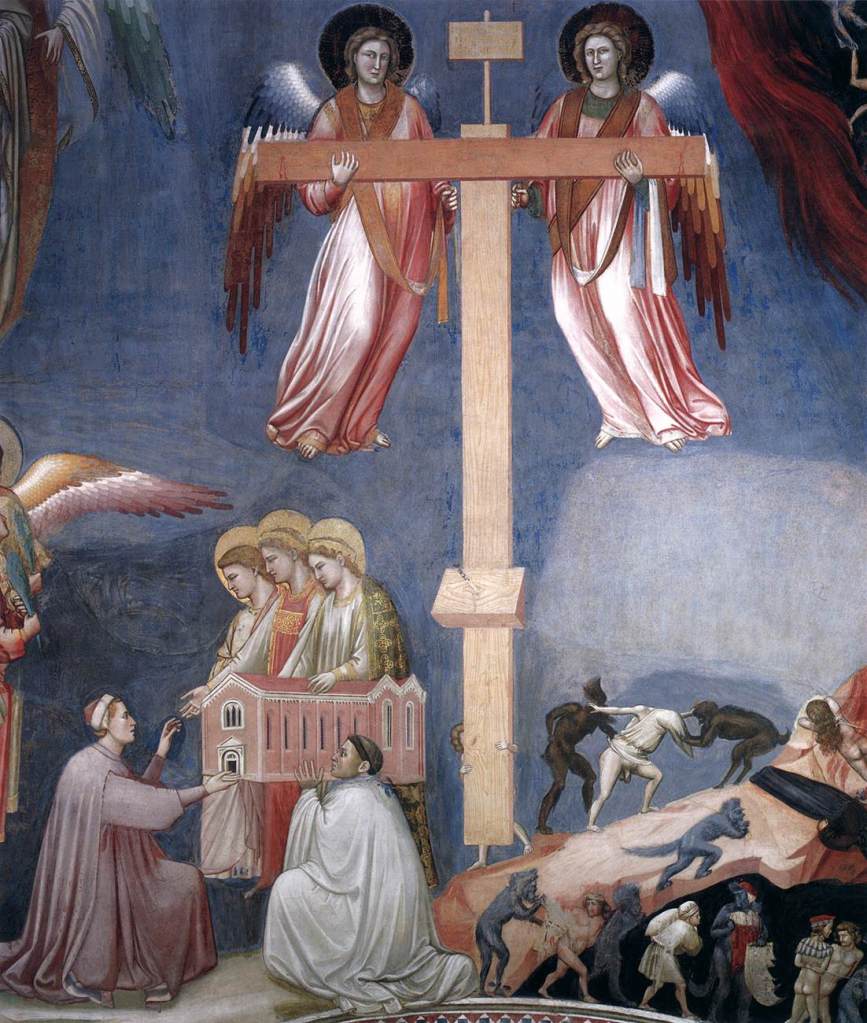
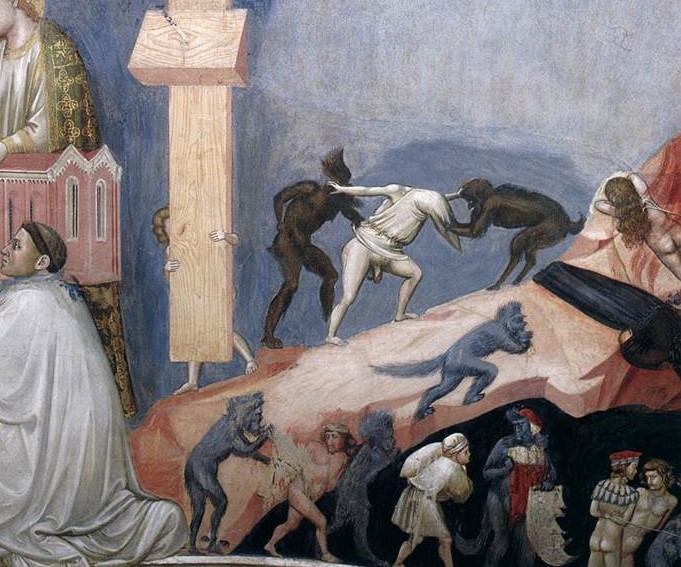
Panic
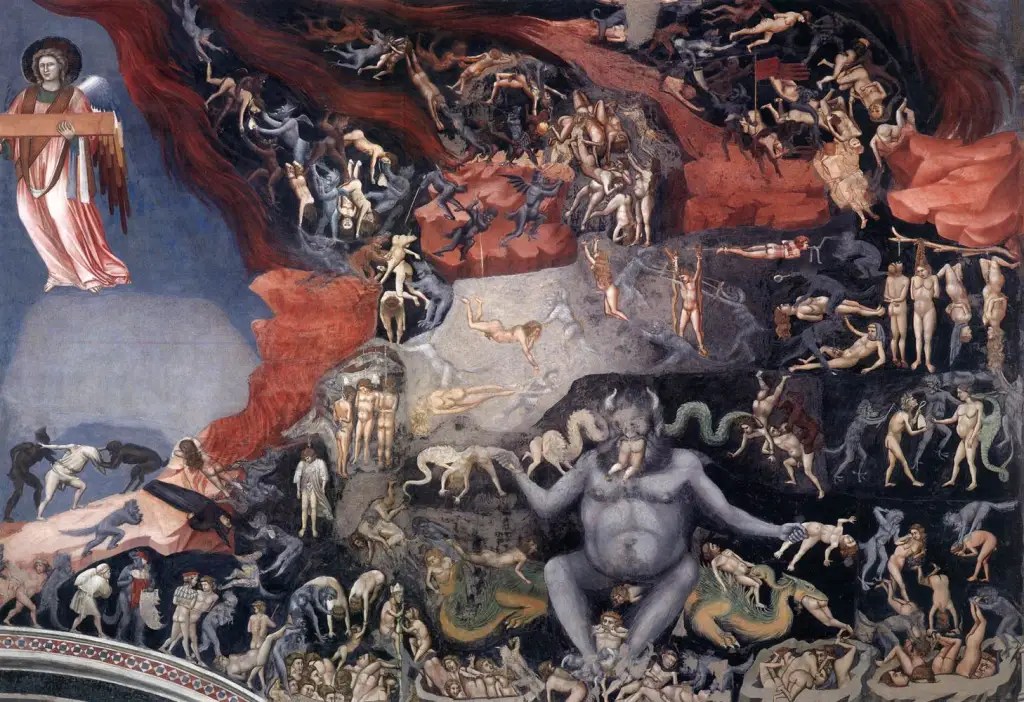
By Eden Prime
I have chosen to look at the word ‘Panic’ through the subject of The Last Judgement, during which the Second Coming of Christ occurs, where God judges humanity for the final time. The subject is found in all Canonical gospels, particularly the apocalyptic sections of the Bible. Traditionally, The Last Judgement will occur after the dead are resurrected and a person’s soul is reunited with its own body. Christ will then come, along with all the angels, and each person’s relationship with God will be judged. Read here
Legends of the End;prophecies of the End Times, Antichrist, Apocalypse, & Messiah From Eight Religious Traditions
Ever since the advent of nuclear weapons, biological warfare and irreversible degradation of the environment, we have all been facing the End of Days. Whether the world ends tomorrow or lasts for centuries, this is the ‘climate’ of our times. We are all more or less familiar with the Christian apocalypse—but what do the other world religions have to say about the Last Days? This book persents eight Legends of the End: Hindu, Buddhist, Zoroastrian, Jewish, Christian, Muslim, Hopi and Lakota. When these stories are placed side-by-side, great differences and amazing similarities appear—similarities both in broad outlines and in minute details. Every spiritual tradition must include both a story of the first Beginning and a myth of the final End—the end of the earth, of the universe, of time itself. In relation to this End, the secular worldview limits us to the perspective of Fear: the fear of the end of life, the dissolution of matter. But in the Spiritual worldview, the fear of material disaster is swallowed up in the unveiling of eternal Truth. Apocalypse means ‘revelation’. Read here









 Path to the Maypole of Wisdom
