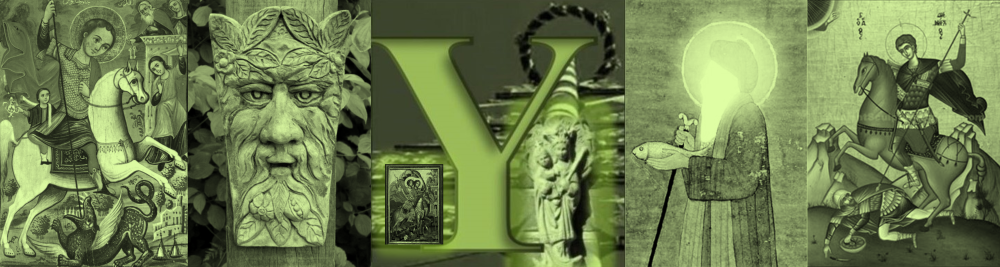
Ye Shall Know the Truth: Christianity and the Perennial Philosophy

To expound in a new key the spiritual, philosophical, and artistic patrimony of the Christian tradition in its intellectually challenging dimension as well as to consider its future possibilities this, in a nutshell, is what Ye Shall Know the Truth: Christianity and the Perennial Philosophy intends.
Behind it lies the belief that one of the main factors responsible for the contemporary decadence, lack of vigor, and indeed tragic crisis, in traditional religion is the indifference, and even suspicion, that is shown towards its sapiential or “knowledge” dimension.
Religion in general aims at addressing all men without distinction, with a view to providing them with the means of salvation, but not necessarily with a view to providing explanations regarding pure Truth and the fundamental nature of things and this despite the fact that these explanations are also provided, at least symbolically, for those with “eyes to see” and “ears to hear.”
In the case of Christianity, especially in its Western form, this loss has been particularly apparent since the time of the so-called “Renaissance” of the 15th and 16th centuries, a veritable revolution which signified not a “rebirth,” but the death of many crucial things, notably Medieval art, as represented, for example, by Romanesque abbeys, Gothic cathedrals, Byzantine icons, and also by such a masterpiece as the Divine Comedy and, above all, by the intangible spiritual kernel of these manifestations.
This spiritual, or rather, intellectual, dimension is not to be identified with mere quantitative information, cerebral ability, or bookish study, since it is much more profound, and comprises, on the contrary, qualitative dimensions that involve the whole being of man, and not merely his mental capacity.
Wisdom makes man think clearly, and live well, in accordance with the nature of things. Since the time when the influence and insights of sages such as Meister Eckhart (1260-1327) and Dante Alighieri (1265-1321) in the West, and Gregory Palamas (1296-1359) in the Christian East, began to wane, a more and more emotional and conventional kind of faith has predominated, leading to a sentimental view of things which is situated at a level well below the capacity and the needs of the human mind.
Despite its importance in the total scheme of things, this “sentimental faith”or “fideism” unaccompanied by an intellectual component, constitutes only a part of the integral religious message of Christianity. Too often, intelligence has been envisaged as a manifestation of spiritualor intellectualpride, without its being realized that this is a contradiction in terms, pride being at the antithesis of spirituality or intellectuality.
True intelligence is characterized by the capacity to see things as they really are, and therefore by an implacable objectivity, which excludes pride, precisely. Nowadays, most of the usual arguments advanced in favor of religion have, as Frithjof Schuon (1907-1998) has shrewdly pointed out, become “psychologically outworn”; considerations of a superior order have been relegated to a sort of limbo. In this connection, Ananda K. Coomaraswamy (1887-1947) has observed: “Today religion is presented in such a sentimental manner that it is not surprising that the best of the new generations rebel. The solution is once again to present religion in its intellectually challenging form.“-Mateus Soares de Azevedo . Read here Free download


 Path to the Maypole of Wisdom