Acedia vs Pre-Eternity : Trauma of our times

  • The Acedia virus is spreading rapidly among people

Many people have a feeling of stress and overload, of lethargy and a lack of motivation, of fear and uncertainty about the future. The word Acedia is used for that complex feeling. Acedia is not new. The Greek poet Homer already used the word to mean ‘neglect, lack of care’. Later on, acedia also came to mean ‘listlessness’, ‘sluggishness’ and ‘inertia’.
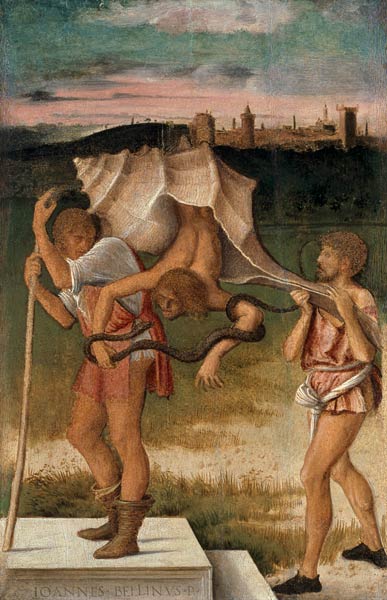
If you look at our life, you notice that you mainly end up in the 1D and 2D living level due to this Acedia virus. Your life becomes straightforward and superficial. Your self-made boundaries are coming at you more and more. Your inner freedom is getting smaller and smaller. This is because we are fighting against our own nature. Because we want to save people at all costs, we end up in an unnatural downward spiral. This is not the natural intent. The Corona virus is a message to people. It will not disappear and dissolve until we follow our own nature. By clinging to the unnatural thinking, doing and making system of humanity, we will have to deal with much more natural resistance. If we really listen to this resistance, we will find out that nature has what is best for us.
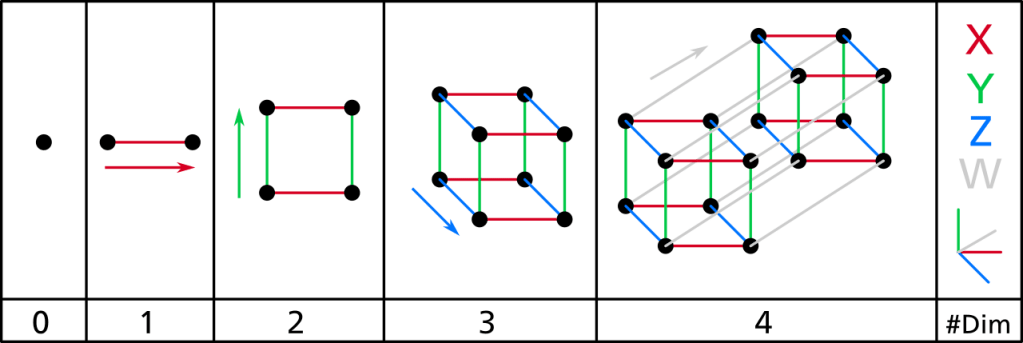
So many people are now stuck in their 1D and 2D lives, causing an extreme unnatural deformity and skewed growth. Only humans are capable of this on this planet, because we have the consciousness to deviate from the natural path. We have abused this gift enormously. Humanity has started to think, act and make in deviations. We do not use the deviations to create a new natural path, but to fight the natural path. Because we do not make use of a natural creation process in all our thinking, doing and making, we are becoming increasingly distant from ourselves and nature. We see and experience all the nasty consequences of this, but we also try to combat it by fighting even harder against nature and ourselves. All faith in natural existence has been broken by ourselves. You can fix this again by starting the natural creation process. It all has to do with our imagination. Our imagination determines the path we follow. It is necessary to direct this imagination with our consciousness. This does not require a 3D living level, but a natural 4D living level. At a 4D living level you live from the center of consciousness. Through everything who you are comes together. By disconnecting your consciousness from your imagination, a tension arises between the two. The first step towards natural shaping of yourself and your environment is to feel this field of tension. Only when you feel this can you ensure a natural balance.

The Acedia virus is the most contagious virus. The leaders of the unnatural deformed system make decisions that create even more deformities and chaos. They don’t know any better. The Acedia virus is a persistent virus, because it is invisible and unnoticeable to many. So it does not exist in the eyes of the masses who are in charge. It is only a matter of time before humanity realizes that things have to change completely. This is a natural need such as needing to breathe, eat and drink. If humanity is to win, it must defeat itself. Man has become his own worst enemy because of the Acedia virus. If we do not realize this, then the emptiness, nature will continue to force itself more and more violently until we give up this unnatural struggle and start shaping everything again and naturally.

  • The Acedia virus as Afternoon Devil

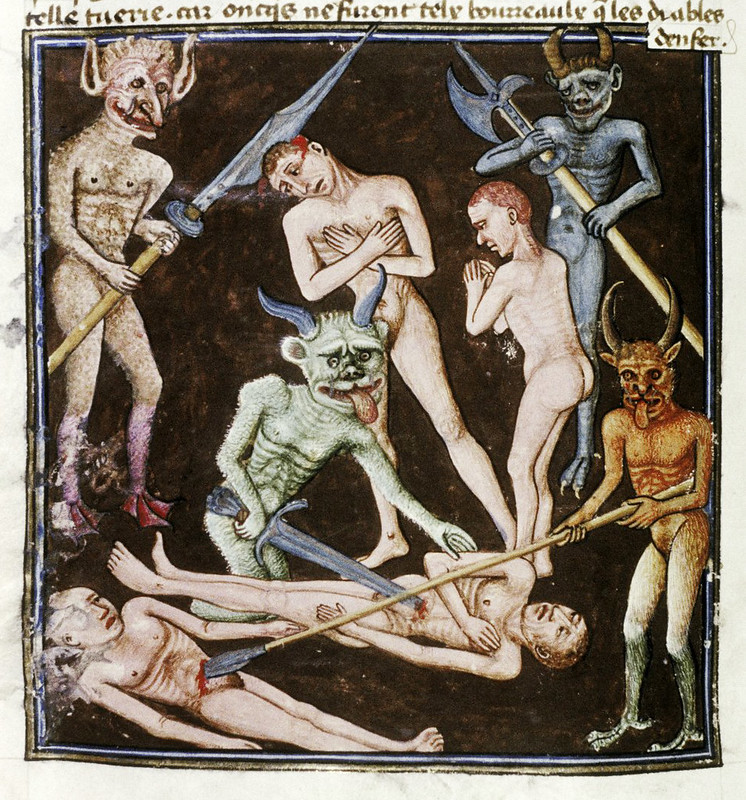
Not only St Antony, many desert fathers were busy fighting off demon attacks: bearded devils, venomous snakes with a human head, seductive women who turned into crocodiles or masturbating apostles. Presumably all those images were projections, and/or due to chemical reactions in the brain, caused by sleep deprivation and extreme fasting periods.
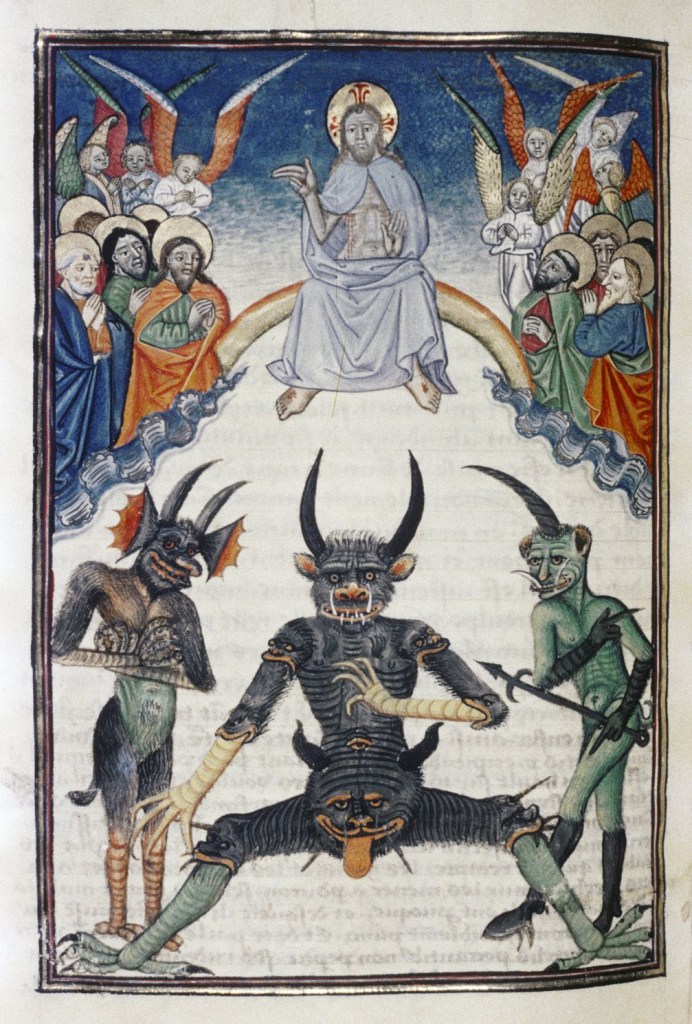
The most dangerous demon was the so-called midday devil, who tried to seduce the hermits into spiritual dullness and eventually abandon their way of life. Especially when they lived alone, the ascetics often became miserably stressed and fell into dejection, restlessness, and a psychotic aversion to their filthy dens and lonely caves. Their state of mind, which arose mainly around noon, in the heat of the day, was accurately described in the writing Praktikos , or The Monk, composed in the fourth century by the desert father Evagrius . For the malaise he uses the Greek word akèdeia , which means something like ‘indifference’ or ‘listlessness’ (in Latin: acedia ; in English the word accidie derived from it still exists , in Italian accidia ).

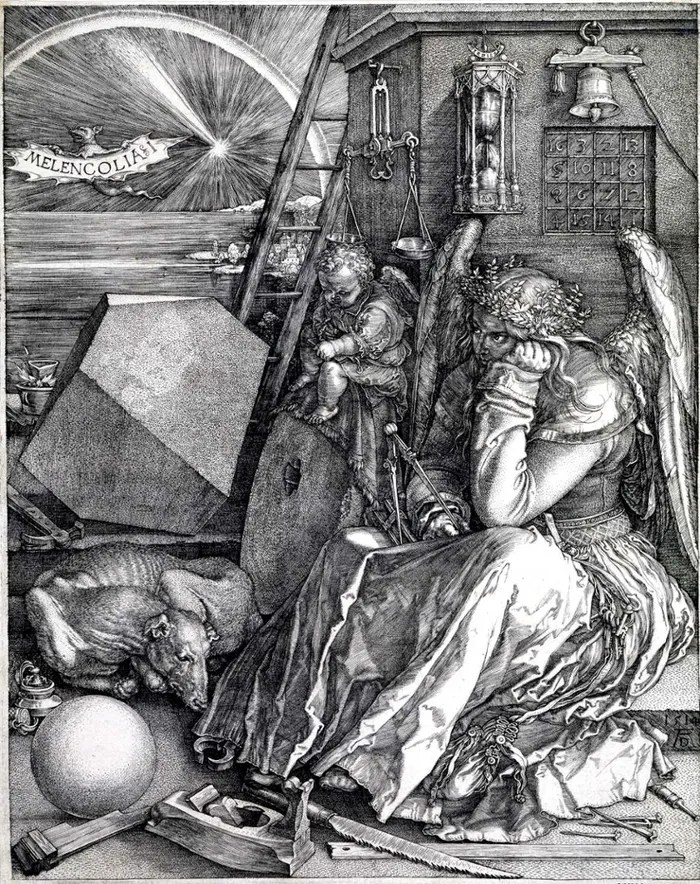
  • Melancholy

In later times the acedia breaks away from the midday devil and manifests itself under other names: melancholy, taedium vitae (aversion to life), nostalgia, apathy, Weltschmerz, ennui , frustration,” nausée” ( Sartre’s Nausea), boredom and finally depression, that modern container concept. In the Renaissance, the body replaces God. Melancholy means black bile, which is one of the four bodily fluids necessary for good, balanced health. Those who have too much black bile become sad and depressed. In the modern phase, the acedia becomes medicalized, giving rise to “a strange amalgam of depression and doubt of the benevolence of reality”). The same goes for drug use.
Boredom is the fundamental mood of contemporary society. The psychiatrists and psychotherapists are busy with the resulting depressions. The entire modern entertainment industry lives by man’s need for stimuli that (temporarily) relieve him from everyday boredom. A very special form of the phenomenon is the dromomania or morbid wanderlust. Dromomania literally means: mania for locomotion. It mainly affects wealthy elderly people who can afford to take a quick look at all the wonders of the planet just before saying goodbye. One cruise is not yet over or the suitcases for the other are already ready. Finally, the boredom of the nursing home also awaits them.

  • The salvation of yourself

The instability has to do with the fact that you are always looking for distraction. Even if that is in the form of a different education or hobby, you suffer from Acedia . Being too busy with your health is also less positive than we think. It can also mean that you are only disciplining your body and totally neglecting your mind. Poor compliance with rules means as much as not fulfilling your obligations. Not only cutting corners, but working too hard can be a sign of a general feeling of discouragement or desolation. Acedia eventually even makes you doubt your state of life or your calling. You feel like you’re never going to achieve what you need to achieve and that, in short, it’s all pointless. You have no inner strength left and so you flee into laziness, working too hard, or doing nothing. It takes some getting used to this. We’ve all learned to pathologize our gloomy feelings. We use phrases like “I’m depressed” or “I’m so autistic about that”. Would a broader definition of apathy give a more truthful picture of humanity? Not being able to push yourself to anything can be a signal that there’s more to it than you think. Apathy is actually the opposite of persistence.

Persistence when you’re despondent may sound tough, but it’s pretty simple. By staying true to your life as it is, the duties you now have to do, you can overcome your sense of malaise. By sticking to your daily tasks like a stairway to heaven and by climbing in faith, you can overcome even the most severe despondency and grow as a person.

So the next time you’re despondently putting things off, and you realize that your time on social media isn’t bringing you any live contacts, maybe read this quote from the desert monk Arsenius (4th century). “Go to your room, eat something, sleep and do no work for a while, but don’t leave your room under any circumstances!”
The Noonday Devil: Acedia, The Unnamed Evil of Our Times a book by Jean-Charles Nault, OSB

The noonday devil is the demon of acedia, the vice also known as sloth. The word “sloth”, however, can be misleading, for acedia is not laziness; in fact it can manifest as busyness or activism. Rather, acedia is a gloomy combination of weariness, sadness, and a lack of purposefulness. It robs a person of his capacity for joy and leaves him feeling empty, or void of meaning

Abbot Nault says that acedia is the most oppressive of demons. Although its name harkens back to antiquity and the Middle Ages, and seems to have been largely forgotten, acedia is experienced by countless modern people who describe their condition as depression, melancholy, burn-out, or even mid-life crisis.

He begins his study of acedia by tracing the wisdom of the Church on the subject from the Desert Fathers to Saint Thomas Aquinas. He shows how acedia afflicts persons in all states of life— priests, religious, and married or single laymen. He details not only the symptoms and effects of acedia, but also remedies for it. Here a summary:
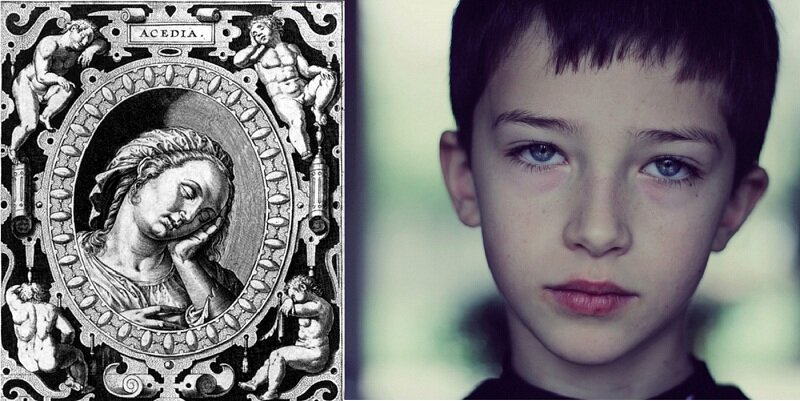
3 Definitions of Acedia

#1: “Spiritual lack of care.” – Evagrius of Pontus

  • Evagrius of Pontus (345-399), who was the first to present a coherent doctrine on acedia, adapted the original Greek understanding of acedia as a physical “lack of care” (specifically with regard to not arranging a funeral for your deceased family members) into a spiritual “lack of care” (with regard to your own spiritual life). Evagrius personified acedia, calling it “the noonday devil” (cf. Ps 90:6) and the “most oppressive of all the demons” because acedia is able to conceal itself from the one who experiences it.
  • “Acedia is the temptation to withdraw from the narrowness of the present so as to take refuge in what is imaginary; it is the temptation to quit the battle so as to become a simple spectator of the controversy that is unfolding in the world”

#2: “Sadness about spiritual good.” – St. Thomas Aquinas

  • Aquinas says that acedia is a negative reaction (sadness) about participating in God’s life (spiritual good) because we are unwilling to renounce a particular carnal, temporal, limited, apparent good that stands in the way of our true good.

With acedia, we are discouraged, spiritually depressed, and fall into despair. We choose to live in mediocrity, usually manifest through little everyday infidelities. “We are unable to believe in the greatness of the vocation to which God is calling us: to become sharers in the divine nature”

#3: “Disgust with activity.” – St. Thomas Aquinas

  • Since “our acts are like steps that either bring us closer to the vision of God or else distance us from it, depending on whether they are good or bad” 4), an interior, spiritual disgust (weariness, sloth, boredom) with activity is, therefore, an obstacle to beatitude.
  • This definition of acedia is rooted in John Cassian’s (360-433) presentation of acedia as a lack of impetus to work.
  • We feel a constant need to change, to move, an inability to accomplish any task, rooted in a self-sufficiency that presents itself as a false humility in not striving for greatness.
  • “I have discovered that all human misfortune comes from one thing, which is not knowing how to remain quietly in one room” (Blaise Pascal).
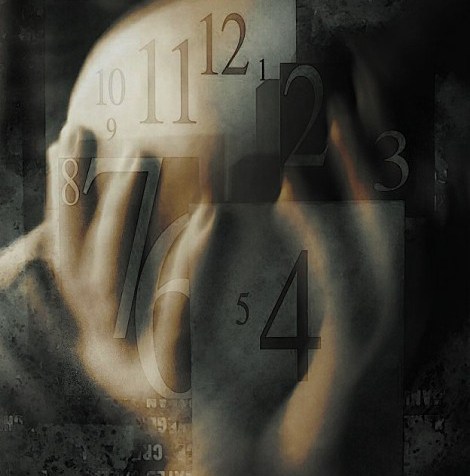
The Importance of Acedia

Acedia is both the most forgotten topic of modern morality nd perhaps the root cause of the greatest crisis in the Church today. Acedia is not only “the monastic sin par excellence” but also “the major obstacle to enthusiastic Christian witness”

Remedies for Acedia

#1: Joyful perseverance

  • “The strategy to be deployed against the devil of acedia can be summarized in the phrase: joyful perseverance” (
  • We must resist, stand fast, remain faithful to our routine and rule of life, and persevere in God’s sight.
  • “Restore to me the joy of your salvation, and uphold me with a willing spirit” (Ps 51:12). This is the prayer that must dwell in our hearts on days of acedia. It sums up perfectly our spiritual attitude when confronted by temptation. We are radically saved, restored to life with Christ: our sadness has definitively been changed into joy (Jn 16:20). This gaudium resulting from the Resurrection of Christ is something that we must show; we must witness to it. We are called to a marvellous work: to help others – to the merger extent that we can, in other words, by our excellent actions – to walk toward our perfect fulfillment in Christ. Now this requires magnanimity, greatness of soul” ).

#2: Be faithful in the little things

  • We must live the present moment in all its spiritual intensity, knowing that it is an opportunity to encounter the Lord.
  • We must be faithful in the very little things (Lk 16:10; 19:17; Mt 25:21), especially in ora et labora, that is, prayer and work.

#3: Use the Word of God

  • Use a verse from Scripture to confound the devil. We must “raise our eyes toward heaven, toward Him who waits to see us fight” (136): “O God, come to my assistance; O Lord, make haste to help me” (Ps 69).
  • St. Benedict (480-547) situated acedia within the context of lectio divina, prescribing praying with the Word of God as the true antidote against acedia: “When evil thoughts come into one’s heart, to dash them against Christ immediately” (St. Benedict).
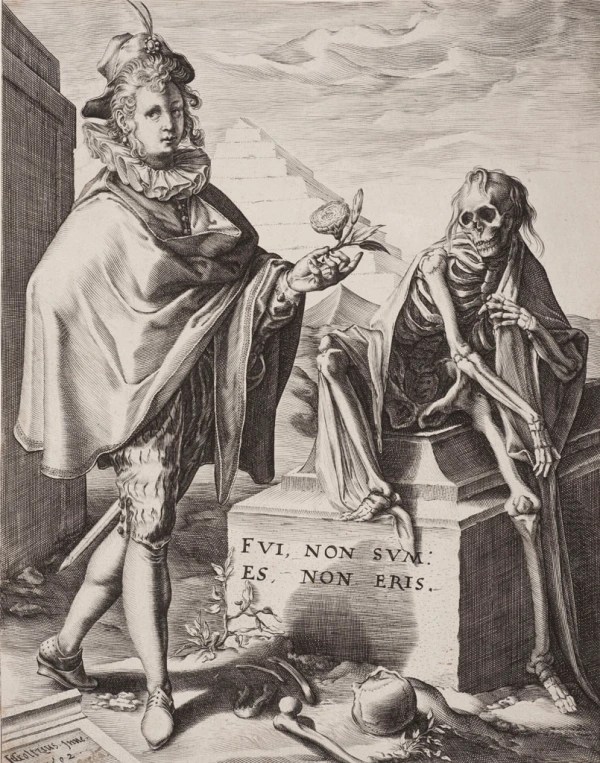
#4: Meditate on death

  • This gives meaning to passing time and helps you fight against self-love:  “keep death daily before one’s eyes” (St. Benedict).
  • “Make me know the shortness of my life, that I may gain wisdom of heart” (Ps 90).
  • “Someone asked an old man: “What do you do to avoid falling into acedia?” He replied: “Every day I wait for death.”
  • ————————————————————-
  • Note: Mutiny of the Soul
  • Depression, anxiety, and fatigue are an essential part of a process of metamorphosis that is unfolding on the planet today, and highly significant for the light they shed on the transition from an old world to a new.
  • When a growing fatigue or depression becomes serious, and we get a diagnosis of Epstein-Barr or Chronic Fatigue Syndrome or hypothyroid or low serotonin, we typically feel relief and alarm. Alarm: something is wrong with me. Relief: at least I know I’m not imagining things; now that I have a diagnosis, I can be cured, and life can go back to normal. But of course, a cure for these conditions is elusive.
  • The notion of a cure starts with the question, “What has gone wrong?” But there is another, radically different way of seeing fatigue and depression that starts by asking, “What is the body, in its perfect wisdom, responding to?” When would it be the wisest choice for someone to be unable to summon the energy to fully participate in life?
  • The answer is staring us in the face. When our soul-body is saying No to life, through fatigue or depression, the first thing to ask is, “Is life as I am living it the right life for me right now?” When the soul-body is saying No to participation in the world, the first thing to ask is, “Does the world as it is presented me merit my full participation?” Read More Here

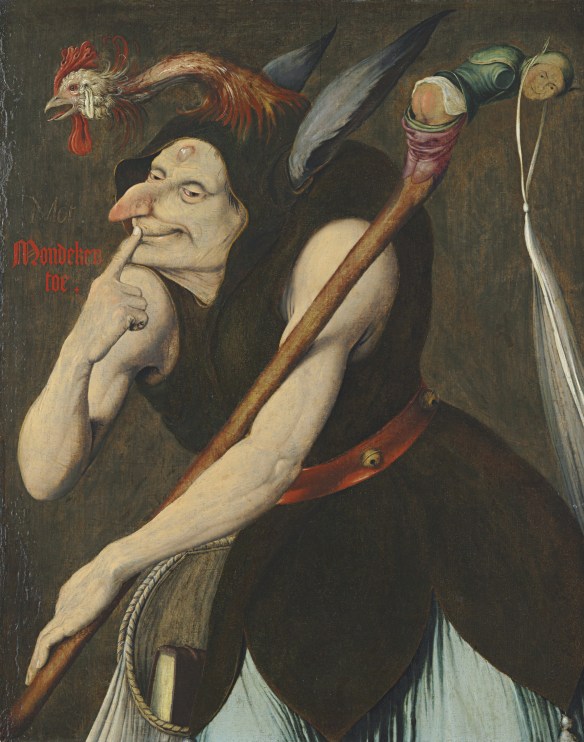
The “Dulle Griet” as “whore of Babylon” ,  in the land of Ignorance by Brueghel
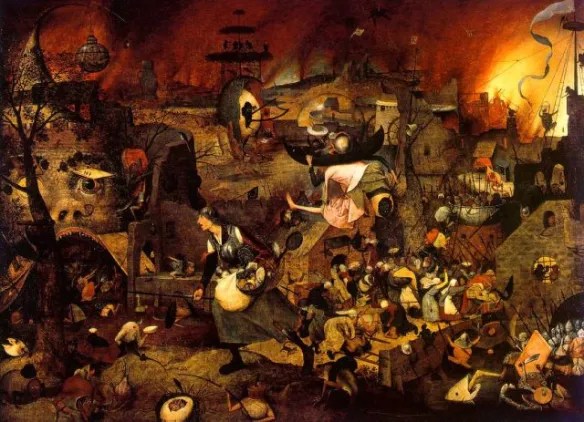
Dulle griet is the representation of the  Whore of Babylon living in a land of Ignorance.
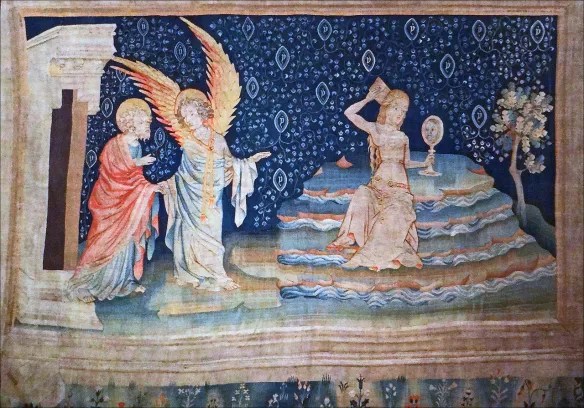
The Whore of Babylon in the The Apocalypse Tapestry of Angers

The Whore of Babylon or Babylon the Great is a symbolic female figure and also place of evil mentioned in the Book of Revelation in the Bible. Her full title is stated in Revelation 17 (verse 5) as Mystery, Babylon the Great, the Mother of Prostitutes and Abominations of the Earth.

The word “Whore” can also be translated metaphorically as “Idolatress“.[1] The Whore’s apocalyptic downfall is prophesied to take place in the hands of the image of the beast with seven heads and ten horns. There is much speculation within Christian eschatology on what the Whore and beast symbolize as well as the possible implications for contemporary interpretation.
Look also: Bruegel: the Apocalypse Within


Dulle Griet is the model of modern man’s  Rebellion  against his soul and  Anger against it. How can Dulle Griet find  a way to calm her anger?
She can looks in  the mirror and see herself,making more “selfies”, so  seeing more anger as the portait of vanity of Hans Memling shows us:. The lady see only more vanity .
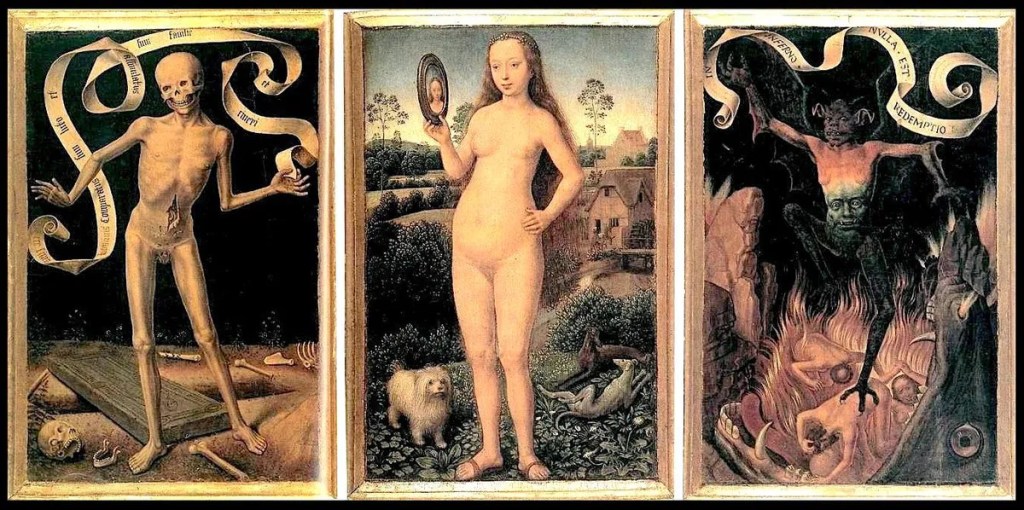
The message of Memling is in his Triptych of Earthly Vanity and Divine Salvation  focuses on the idea of “Memento mori,” a Latin phrase that translates to “Remember your mortality.” Memling’s triptych shockingly contrasts the beauty, luxury and vanity of the mortal earth with images of death and hell. In the time of Breughel and in our times  the message is  that  Vanity is not the solution. see: Nothing Good without Pain: Hans Memling”s earthly Vanity and  Divine Salation
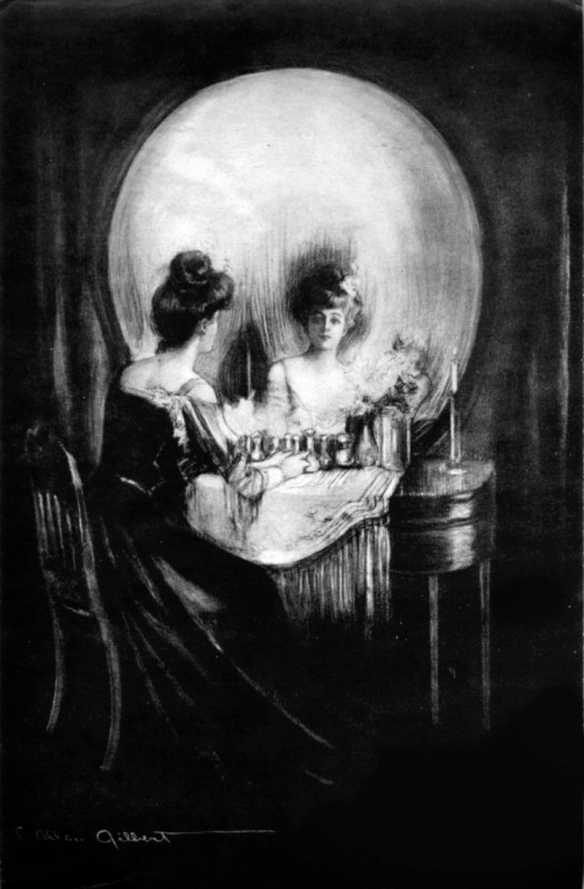
All Is Vanity by Charles Allan Gilbert (September 3, 1873 – April 20, 1929)

The phrase “All is vanity” comes from Ecclesiastes 1:2 (Vanity of vanities, saith the Preacher, vanity of vanities; all is vanity.

Don’t change the world in hopes of changing yourself,

change yourself so the world changes because of you.

——————————————————

  • Praise of folly

“The supreme madness is to see life as it is and not as it should be, things are only what we want to believe they are ...”

Jacques Brel

Read more here

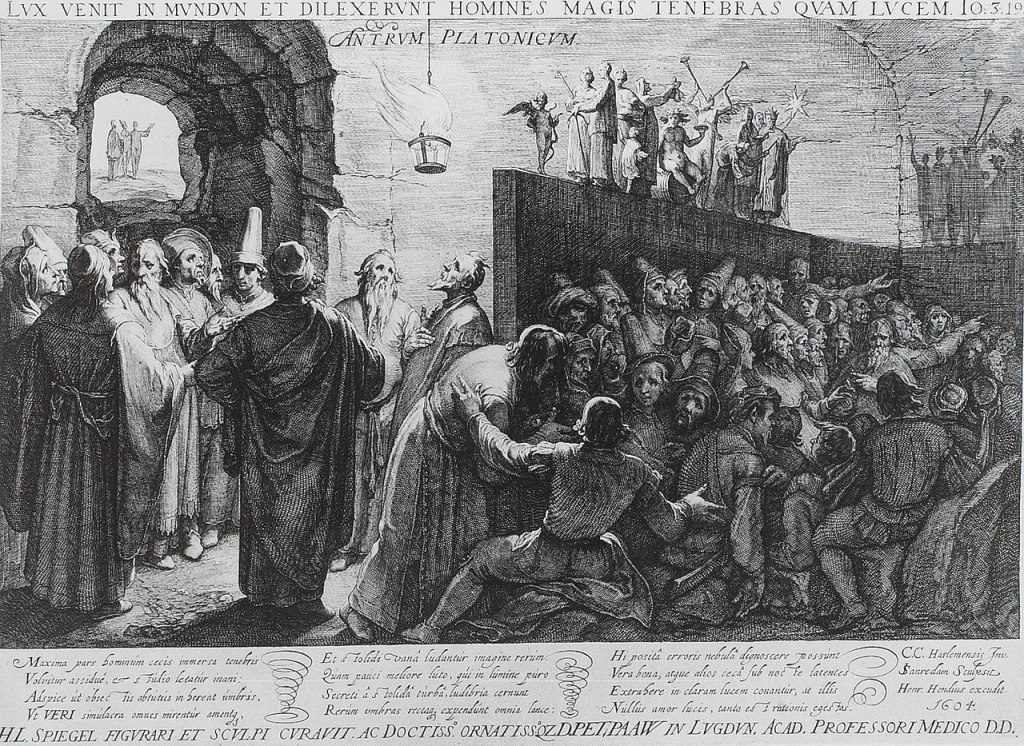
  • Allegory of the cave

The Allegory of the Cave, or Plato’s Cave, is an allegory presented by the Greek philosopher Plato in his work Republic (514a–520a) to compare “the effect of education (παιδεία) and the lack of it on our nature“. It is written as a dialogue between Plato’s brother Glaucon and his mentor Socrates, narrated by the latter. The allegory is presented after the analogy of the sun (508b–509c) and the analogy of the divided line (509d–511e).
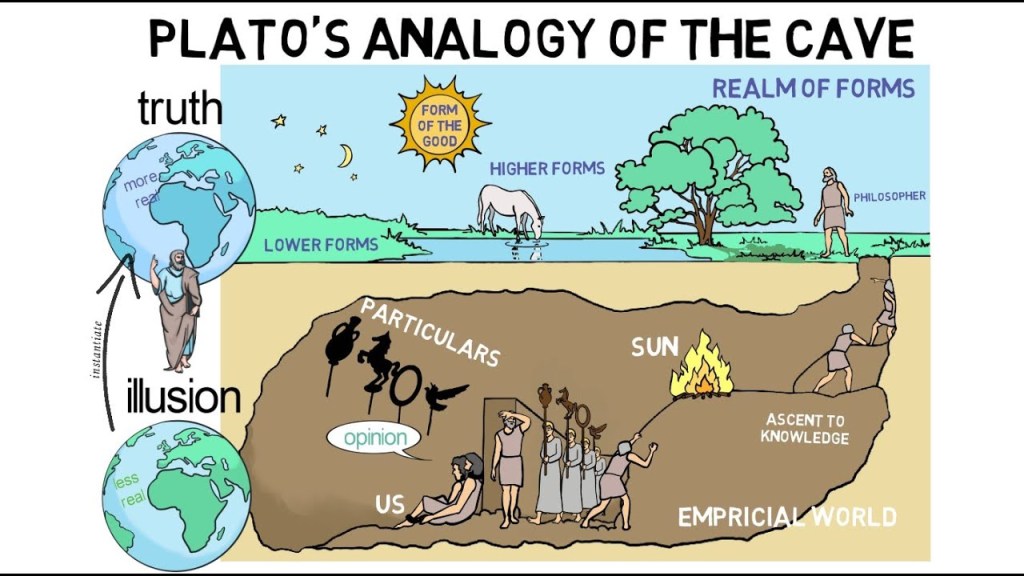
In the allegory “The Cave,” Plato describes a group of people who have lived chained to the wall of a cave all their lives, facing a blank wall. The people watch shadows projected on the wall from objects passing in front of a fire behind them and give names to these shadows. The shadows are the prisoners’ reality, but are not accurate representations of the real world. The shadows represent the fragment of reality that we can normally perceive through our senses, while the objects under the sun represent the true forms of objects that we can only perceive through reason. Three higher levels exist: the natural sciences; mathematics, geometry, and deductive logic; and the theory of forms.

Socrates explains how the philosopher is like a prisoner who is freed from the cave and comes to understand that the shadows on the wall are actually not the direct source of the images seen. A philosopher aims to understand and perceive the higher levels of reality. However, the other inmates of the cave do not even desire to leave their prison, for they know no better life.[1]

Socrates remarks that this allegory can be paired with previous writings, namely the analogy of the sun and the analogy of the divided line.

– The principle of verticality

The principle of verticality, which is a fundamental principle of traditional wisdom, is based on the affirmation of transcendence as an aspect of a comprehensive and integrated reality that is Absolute.
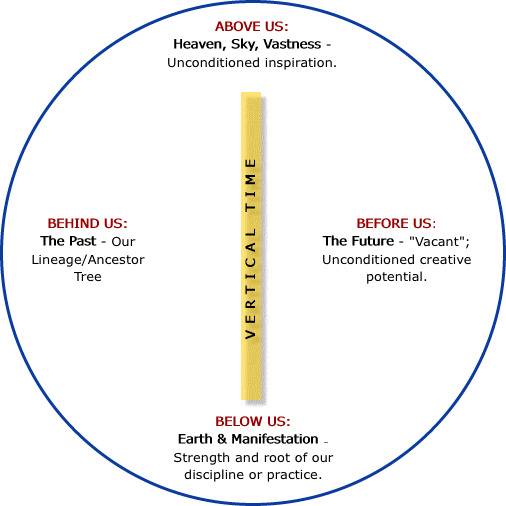
According to this understanding, reality has both a transcendent Origin and an immanent Center, which are one, rather than being reduced to the merely horizontal dimension of its existential or quantitative elements.

Verticality implies both Heaven and Earth, a worldview in which meaning and purpose are defined principally by both height and depth,and secondarily by breadth – that is, principally by man’s relationship to God, who is simultaneously ‘above’ and ‘within’ creation, and who there-fore governs all creaturely relationships – rather than by breadth alone –that is, solely in terms of the relationship between the subject and the world.

It also implies that the horizontal is subordinate to the vertical,that is to say, the relationship between man and the world is premised on the primary relationship between God and man: to restate this in Christian terms, the love of one’s neighbor is premised on one’s love for God. According to the traditional worldview, existence is transcended by a supreme reality, which, whether expressed in theistic or non-theisticterms, is Absolute, and which, without derogating from its unity, is si-multaneously (at the level of the primary hypostasis) expressed by the horizontal ternary, Truth or the Solely Subsistent Reality, Goodness or the Perfection and Font of all Qualities, and Beauty or Abiding Serenity and the Source of its Radiant Effulgence: in Platonic terms, the True, the Good and the Beautiful.

All creation is prefigured in this supreme reality,which projects existence out of its own Substance into a world of form (hence etymologically, ex-stare, to stand out of, or to subsist from, as the formal world of existence stands out of, and subsists from, the Divine Substance) through a vertical ternary comprising, first, the Essential or Principial Absolute (which is Beyond-Being), second, the Relative-Absolute Source of Archetypes (which is the primary hypostasis of Being), and third, the realm of Manifestation (which is Existence).

The world itself,and its creatures, including man, as such, are therefore of derivative significance and are accidental in relation to the supreme reality, which alone is substantial. The world is transient, ephemeral and illusory.

The Divine Substance alone is permanent and real. This view of the transcendent, supreme and substantial reality of the Absolute (which, according to the principle of verticality, is described in terms of its elevation orperfection in relation to creation) finds its expression in all religious traditions.
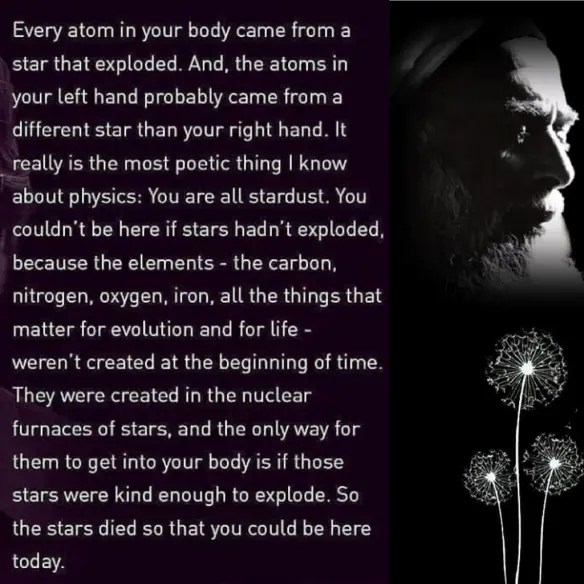
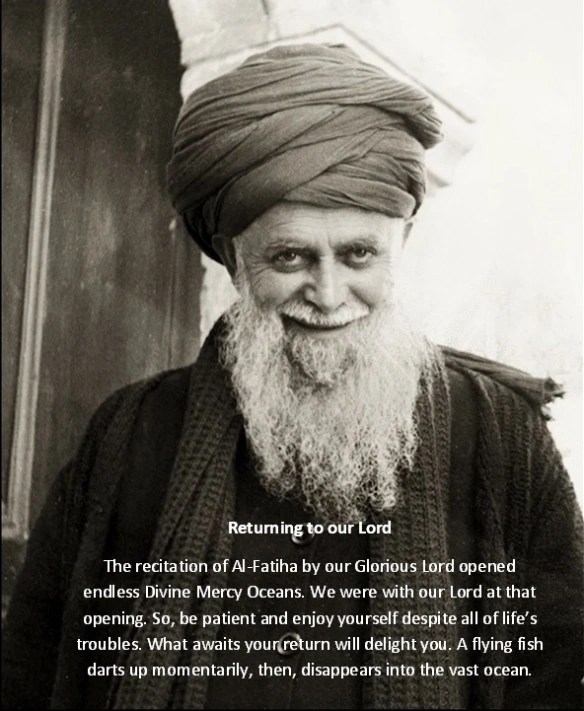
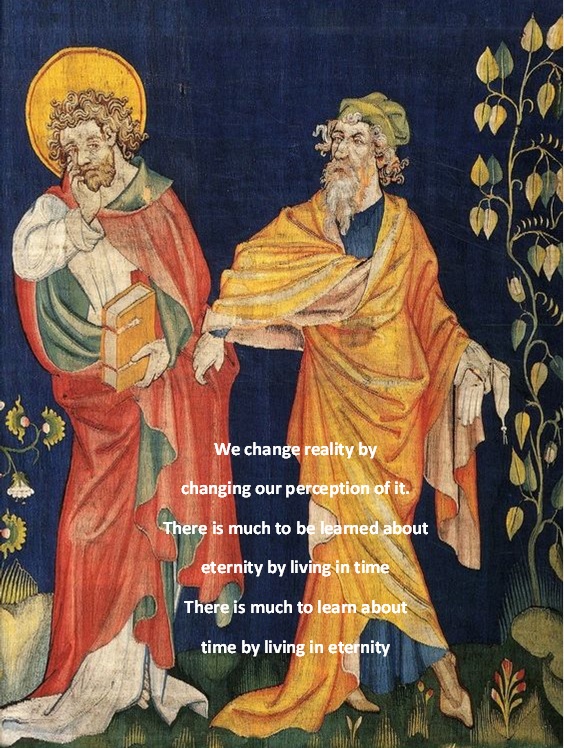
The Sufi Master Sheikh Nazim al Haqqani al Rabbani says: We change Reality by changing our Perception of it.There is much to be learn about Eternity by living in Time and There is much to be learn about Time by living in Eternity
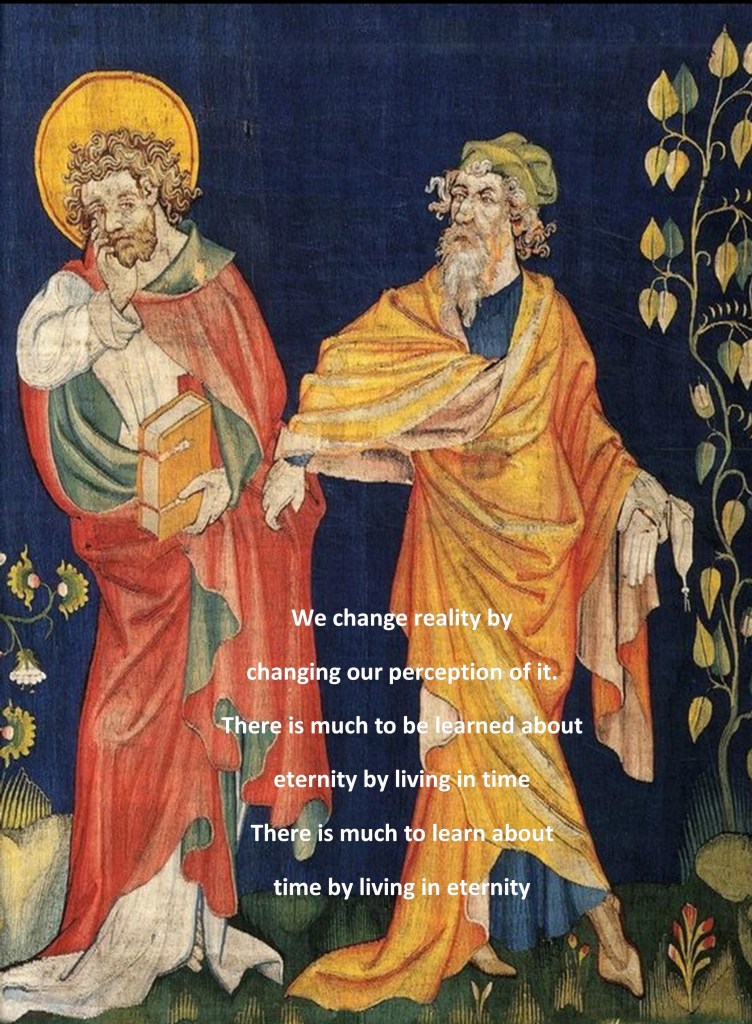
So it is time to look at eternity:

What is time and pre-eternity?

We change Reality By changing our perception of it

There is much to be learn about Eternity by living in Time

There is much to be learn about time by living in Eternerty

What is our Destiny:

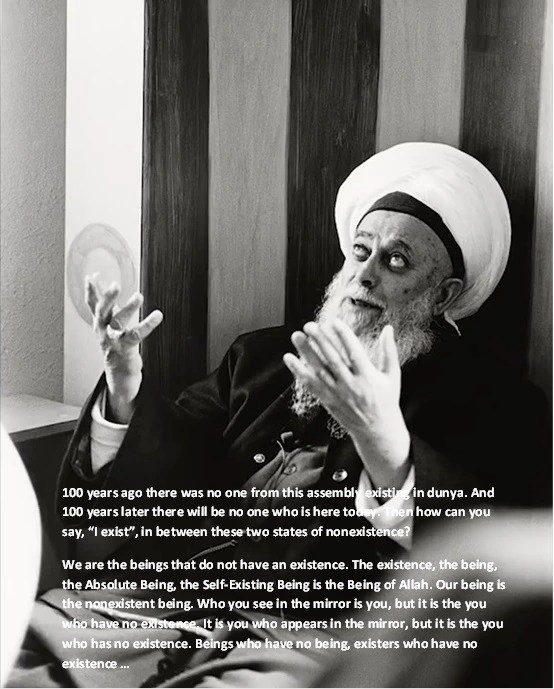
Tthe sacred Tradition as Sufism an Islam  explains the most important cause for misunderstanding the issue of qadar (destiny) is confusion about the concepts of “time” and “pre-eternity” and misinterpreting them.

People live in time and place and so they evaluate every event according to time and they make a mistake by assuming “pre-eternity” as the beginning of “time”.  Misunderstanding qadar is the result of this wrong comparison.

Time is an abstract concept. It starts with the creation of the universe and many events happen in it. Time is divided into three parts: Past, present and future. This division is for creatures. Namely, the concepts such as century, year, month, day, yesterday, today, tomorrow are in question for creatures.

Pre-eternity does not mean before the beginning of the time. In pre-eternity, there is no past, present and future. Pre-eternity is a station where all times are seen and known at the same moment. Now, we will try to understand God’s attribute of pre-eternity through some examples from Sufism and Islam:

Suppose that this picture is our timeline. The middle is the present, that is, now; the left side is the past and the right side is the future. Now, we are holding a mirror on the time scheme. The mirror is close to the floor; so, only the present time is reflected on the mirror. The past and the future are not included. Now, we will lift the mirror a bit and in this position, the present time and a part of the past and the future are reflected on the mirror. When we lift the mirror a little more, the remaining part of the past and the future that are not seen in the previous position are also reflected on the mirror. That is, as we lift the mirror, the time period which appears on the mirror expands. Now, we will lift the mirror to the highest point.
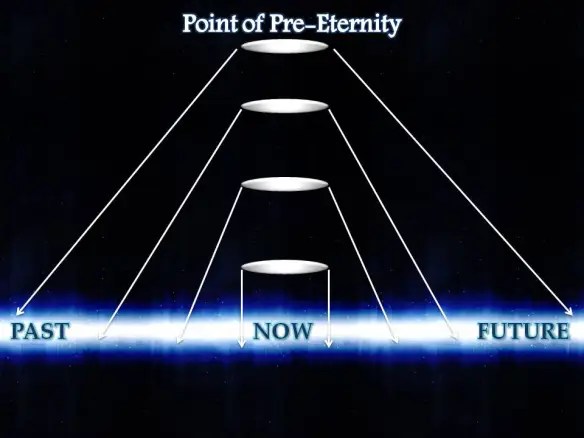
At this point, the mirror encompasses the present, past and future as a whole. This point is called the point of pre-eternity, which sees all of the three times as a whole at the same moment. When we say, “Allah is pre-eternal”, we mean that Allah sees and knows all times and places at the same moment and that He is timeless.
The Metaphysics of Trauma

Trauma, which has become a hallmark of everyday life in the modern world, forms part of the broader mental health crisis that afflicts society today. It also, arguably, reflects a lost sense of the sacred. Throughout humanity’s diverse cultures, suffering is understood to be intrinsic to the larger fabric of life in this world; trauma, therefore, is a direct consequence of not being able to properly integrate suffering into one’s life. However, this is not to simply equate suffering with trauma, or trauma with illness. The prevalence of acute traumatic suffering has always been a major cause of disbelief in religion. Yet the increased weakening of faith in the modern world has provoked a particularly severe spiritual crisis, which could be dubbed the “trauma of secularism.” Through recourse to traditional metaphysics, we can begin to understand the transpersonal dimension of this phenomenon and thus accurately assess, diagnose and provide adequate treatment. It will be argued that healing and wholeness cannot take place outside the purview of a “sacred science,” the spiritual dimension of which transcends the limitations of mainstream psychology and its profusion of profane therapies. Read here
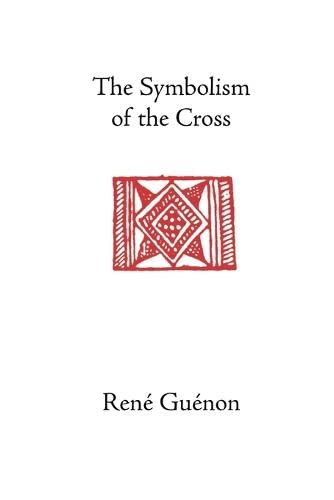
  • The Symbolism of the Cross

The Symbolism of the Cross is a major doctrinal study of the central symbol of Christianity from the standpoint of the universal metaphysical tradition, the ‘perennial philosophy’ as it is called in the West. As Guénon points out, the cross is one of the most universal of all symbols and is far from belonging to Christianity alone. Indeed, Christians have sometimes tended to lose sight of its symbolical significance and to regard it as no more than the sign of a historical event. By restoring to the cross its full spiritual value as a symbol, but without in any way detracting from its historical importance for Christianity, Guénon has performed a task of inestimable importance which perhaps only he, with his unrivalled knowledge of the symbolic languages of both East and West, was qualified to perform. Although The Symbolism of the Cross is one of Guénon’s core texts on traditional metaphysics, written in precise, nearly ‘geometrical’ language, vivid symbols are necessarily pressed into service as reference points-how else could the mind ascend the ladder of analogy to pure intellection? Guénon applies these doctrines more concretely elsewhere in critiquing modernity in such works as The Crisis of the Modern World and The Reign of Quantity and the Signs of the Times, and invokes them also to help explain the nature of initiation and of initiatic organizations in such works as Perspectives on Initiation and Initiation and Spiritual Realization. Read here

The Multiple States of the Being

The Multiple States of the Being is the companion to, and the completion of, The Symbolism of the Cross, which, together with Man and His Becoming according to the Vedanta, constitute René Guénon’s great trilogy of pure metaphysics. In this work, Guénon offers a masterful explication of the metaphysical order and its multiple manifestations-of the divine hierarchies and what has been called the Great Chain of Being-and in so doing demonstrates how jñana, intellective or intrinsic knowledge of what is, and of That which is Beyond what is, is a Way of Liberation. Guénon the metaphysical social critic, master of arcane symbolism, comparative religionist, researcher of ancient mysteries and secret histories, summoner to spiritual renewal, herald of the end days, disappears here. Reality remains. look here
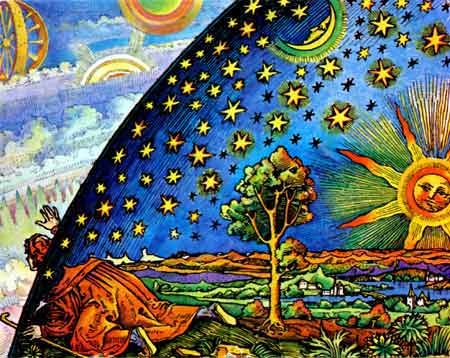
The secularity of the society in which we live must share considerable blame in the erosion of spiritual powers of all traditions, since our society has become a parody of social interaction lacking even an aspect of civility. Believing in nothing, we have preempted the role of the higher spiritual forces by acknowledging no greater good than what we can feel and touch.” Vine Deloria Jr

The perspective of modernity where Western Man as the egolatrous being is placed at the top of existence for all others to look towards for recognition.
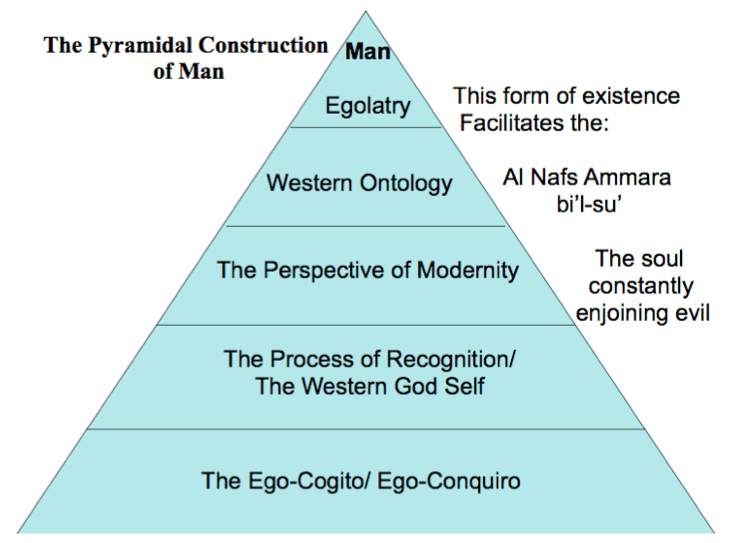
The pyramidal construction of Man from an Islamic perspective shifts our understanding of the seriousness of placing the egolatrous Man above God in constructing reality, while simultaneously allowing us to imagine what would be necessary in creating a transmodern critique in constructing the Human.
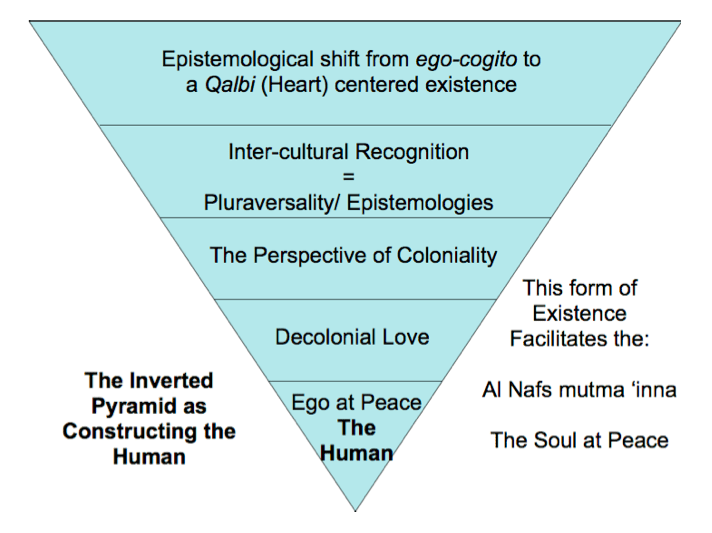
Read here:

THE ISLAMIC CONCEPT OF HUMAN PERFECTION

Rumi: A Disclosure of Wisdom  for our Time
Sufism is the way of purifying the heart from bad manners and characteristics under the guidance of a Sheikh.

The Improvement of Human Reason: “Alive son of Awake”

Ḥayy ibn Yaqẓān (ي بن يقظان, lit. ‘Alive son of Awake’) is an Arabic philosophical novel and an allegorical tale written by Ibn Tufail (c. 1105 – 1185) in the early 12th century in Al-Andalus.] Names by which the book is also known include the Latin: Philosophus Autodidactus (‘The Self-Taught Philosopher’); and English: The Improvement of Human Reason: Exhibited in the Life of Hai Ebn Yokdhan. Ḥayy ibn Yaqẓān was named after an earlier Arabic philosophical romance of the same name, written by Avicenna during his imprisonment in the early 11th century, even though both tales had different stories. The novel greatly inspired Islamic philosophy as well as major Enlightenment thinkers. It’s the most translated text from Arabic, after the Quran and the One Thousand and One Nights.

It was “discovered” in the West after Edward Pococke of Oxford, while visiting a market in Damascus, found a manuscript of Hayy ibn Yaqdhan made in Alexandria in 1303 containing commentary in Hebrew. His son, Edward Pococke Jr. published a Latin translation in 1671, subtitled “The Self-Taught Philosopher.”George Keith the Quaker translated it into English in 1674, Baruch Spinoza called for a Dutch translation, Gottfried Wilhelm Leibniz championed the book in German circles, and a copy of the book went to the Sorbonne Daniel Defoe (c. 1660 – 1731), author of Robinson Crusoe, was heavily influenced by the work as well as by the memoir of the Scottish castaway Alexander Selkirk. In the Muslim world, the book is an honored Sufi text.

The story revolves around Ḥayy ibn Yaqẓān, a little boy who grew up on an island in the Indies under the equator, isolated from the people, in the bosom of an antelope that raised him, feeding him with her milk. Ḥayy has just learned to walk and imitates the sounds of antelopes, birds, and other animals in his surroundings. He learns their languages, and he learns to follow the actions of animals by imitating their instinct.

He makes his own shoes and clothes from the skins of animals, and studies the stars. He reaches a higher level of knowledge, of the finest of astrologists. His continuous explorations and observation of creatures and the environment lead him to gain great knowledge in natural science, philosophy, and religion. He concludes that, at the basis of the creation of the universe, a great creator must exist. Ḥayy ibn Yaqẓān lived a humble modest life as Sufi and forbade himself from eating meat.

Once 30 years old, he meets his first human, who has landed on his isolated Island. By the age of 49, he is ready to teach other people about the knowledge he gained throughout his life.

Hayy ibn Yaqdhan is an allegorical novel in which Ibn Tufail expresses philosophical and mystical teachings in a symbolic language in order to provide better understanding of such concepts. This novel is thus the most important work of Ibn Tufail, containing the main ideas that form his system.

Ibn Tufail was familiar with the differences in the ideas of Al-Ghazali and those of the “Neoplatonizing AristotelianistsAl-Farabi and Ibn Sina. In Hayy ibn Yaqdhan, Ibn Tufail sought to present “a conciliating synthesis of the Islamic speculative tradition with al-Ghazālī’s Sufi-influenced recasting of Islamic mysticism and pietism.” Ibn Tufail borrows from Ibn Sina, using the title of one of his allegories and drawing inspiration from his Floating Man thought experiment, but transforming the subject’s sensory deprivation to social isolation.

With this novel, Tufail focuses on finding solutions to the three main problems discussed during his period:

  1. Humans, on their own, are able to reach the level of al-Insān al-Kāmil by merely observing and thinking of the nature, without any education.
  2. The information that is obtained through observation, experiment, and reasoning, does not contradict with revelation. In other words, religion and philosophy (or science) are compatible, rather than contradictory.
  3. Reaching the absolute information is individual and simply any human being is able to achieve that.

Read here: Hayy ibn Yaqdhan

    On Tradition, Metaphysics,and Modernity

    Seyyed Hossein Nasr is University Professor of Islamic Studies at The George Washington University and an Islamic philosopher. He holds degrees in mathematics and physics,
    geology and geophysics, and history of science from MIT and Harvard. Professor Nasr is the author of over fifty books and five hundred articles which have been translated into
    many major Islamic, European and Asian languages. These works deal with a wide array of subjects including perennial philosophy, Sufism, metaphysics, Islamic philosophy
    and science, traditional art, and the environmental crisis. The only Muslim thinker to have a volume dedicated to him in the prestigious Library of Living Philosophers series, Professor Nasr is one of the foremost authorities on Islamic, religious, and comparative studies in the world today.

    In this interview, Professor Nasr talks to us about some fundamental questions regarding tradition, the Perennial School of thought, the relation of science and religion, and the environmental crisis.
    Seyyed Hossein Nasr: On Tradition, Metaphysics, and Modernity
    Interview by Taimur Aziz, with research by Saim Raza, Derek Lee, and Lynnea Shuck
    Taimur Aziz (TA): The mention of “Tradition” is extensive throughout your works with ref-
    erence to a variety of ields including philosophy, religion and art. Moreover, you identify
    as belonging to the “Traditionalist school.” What is “Tradition,” and what role does it
    play in perennial philosophy?

    Seyyed Hossein Nasr (SHN): The meaning of “tradition” as used by traditionalists such
    as myself does not mean custom or transmitted habit, but principles of a divine order and
    their applications to various domains. I can quote for you from one of my own writings:
    Tradition . . . means truths or principles of a divine origin revealed or unveiled to mankind and, in fact, a whole cosmic sector through various figures envisaged as messengers, prophets, avatars, the Logos or other transmitting agencies, along with all the ramifications and applications of these principles to different realms including law and social structure, art, symbolism, the sciences, and embracing of course Supreme Knowledge with the means for its attainment. (Knowledge and the Sacred [SUNY Press, 1989], 67–68)


    TA: Perennial Philosophy is distinct from religious syncretism in that it insists on maintain-
    ing the boundaries of individual religions on the external level. Can you elaborate upon
    this distinction between the two schools of thought?

    SHN: There is a radical difference. Perennial philosophy as understood traditionally believes that each religion has an inward or essential and an outward or formal aspect or dimension. On the formal level religions are different and since these forms in orthodox and traditional religions are sacred and sacrosanct, they must be respected on their own level and not mixed together or neglected. Traditional perennial philosophy is therefore opposed strongly to syncreticism and pseudo-esoterism. Of course on the intellectual level a religion can borrow certain elements from another tradition to express its own truths as we see for example in St. Augustine and Christian Platonism in general but that is very different from using rites of the Greek religion as part of the Christian mass. As for religious syncreticism, as ordinarily understood, it is a mixing of different traditional elements into an amalgam, something that is completely opposed by traditionalist followers of the perennial philosophy.

    TA: You argue that the differences in religions lie only on the formal level. However, in
    many cases major traditional religions disagree over fundamental tenets such as the unity
    of the divine being and life after death. Polytheistic and monotheistic religions do not claim
    to have room for each other’s ideas. How does perennial philosophy, then, reconcile such
    basic differences between religions that seem to penetrate deeper than the formal level?

    SHN: No major traditional religion rejects the unity of the Divine Principle whether it be
    the Abrahamic religions, Hinduism, Taoism or Confucianism. As for Buddhism, although it
    does not speak to the objective Pole of Reality but the subjective one, it certainly does not
    speak of multiple ultimate nirvanas or paranirvanas. As for mythological and primal religions, behind the multiple “masks of the gods” there is always the presence of the one supreme Spirit, for example wakan-tanka in the Native American traditions. Let me also mention that in the case of Iranian religions such as Zoroastrianism the dualism between light and darkness involves the cosmic and moral battle between good and evil resulting in the final victory of the good. If you ask any Zoroastrian, you will find that he or she insists on being certainly a monotheist and not a dualist metaphysically and theologically speaking.
    Concerning life after death, since time immemorial human beings have disposed of the body of the dead ritually and believed in life after death as the French traditionalist anthropologist Jean Servier has demonstrated amply in his L’Homme et l’invisible. Some religions like Confucianism have said little in their formal teachings about eschatology while others such as Buddhism, Christianity and Islam have spoken extensively about this matter. If, as some claim, in early Judaism there were no beliefs in immortality but later on Judaism adopted this idea from Zoroastrianism and Christianity, then why would early Jews follow the Divine Law so assiduously and even be willing to give up their earthly lives for it?
    Polytheistic and monotheistic religions may not have room for each other’s ideas on
    the exoteric level, but they certainly do on the esoteric level. As for Islam, I only need to quote a verse from one of the most famous Sufi poets of the Persian language, Shaykh Mahmūd Shabistarī: If a Muslim were only to know what an idol is, He would know that [true] religion (dīn) is in idol-worship.
    Perennial philosophy reconciles formal and external differences by first of all going from the form to the essence and secondly by viewing forms not just as external forms, but as gateways to inner meanings. As Rūmī has said:
    The differences between people arises from the name [form- nām];
    When on goes to the inner meaning (ma‘nā), there is accord and peace
    .
    Only the Absolute is absolute in the metaphysical sense but within a particular order of
    reality its manifestation is in a sense still “absolute” although it is not the Absolute as such.
    It is to this former reality that F. Schuon refers as “the relatively absolute.” In various reli-
    gious universes many and sometimes most ordinary believers see the “relatively absolute”
    as the Absolute as such and therefore limit salvation to members of their own religion. A
    prime example is Christianity, which absolutizes the manifestation of the Divine in Christ
    resulting in the famous dictum extra ecclesiam nulla saluswith which many Christian
    theologians are grappling today. Islam has a less dificult problem with this issue because
    of the explicit universalism of many passages of the Quran. Particularism is, however,
    present in all religious climes including Islam in one way or another and is a theological
    issue with which they all have to deal especially now that the traditional boundaries of the
    various religious worlds have been removed to a large extent if not completely throughout
    much of the world.

    TA: Observing and connecting the common strands in the history of philosophy and religion seem to be a key project of perennial philosophy. However, you have previously written that perennial philosophy is a product of the process of intellection. Can you explain the nature of this process and how it contrasts with the formation of an inductive philosophy?
    SHN: Yes, observing and connecting the common strands in traditional philosophies and
    religions is a key project of perennial philosophy but not the basic project. The basis of
    perennial philosophy is a knowledge that does not come from simply examining such his-
    tories and connecting them. Rather, it comes from intellection in the traditional sense, from
    an inner illumination or what Guénon calls intellectual intuition. Metaphysically speaking,
    knowledge of principles can never be the result of mere induction. The principles must
    irst be “intellected” and their applications deduced from principial knowledge not induced
    from particulars. In inductive philosophy general truths are supposed to be based on the
    generalization of a number of known particulars. For example, if we observe hundreds of
    Arabs who are pious and then induce the general idea that Arabs are pious people, that
    is induction which, logically speaking, could be or not be true. Induction does not pos-
    sess the same certitude as deduction that moves from general principles and universals to particulars.

    The understanding and acceptance of perennial philosophy is based on intellection (in the traditional sense) and not just ratiocination although the perennial philosophy is not irrational and the faculty of reason can be used and has been used by authentic expositors of the perennial philosophy on the level of elaboration of some of its metaphysical truths and their applications to various domains. But by using only reason and not having recourse to intellectual intuition or intellection, as traditionally understood, it is not possible to gain an authentic comprehension of the metaphysical principles of the perennial philosophy as Suhrawardī already asserted eight centuries ago.


    TA: Central to many of your works is the idea of a universe that is hierarchical. For example, in The Need for a Sacred Science you write, “The Principle gives rise to a universe which is hierarchical, possessing many levels of existence and states of consciousness from the Supreme Principle to earthly man and his terrestrial ambience.” ( The Need for a Sacred Science, 56). What is the nature of this hierarchical structure and what does it constitute?
    SHN: As you know the word hierarchy is composed of the two Greek terms hiero and
    arché which mean sacred and origin, respectively. In the traditional worldview the Sacred
    Origin manifests Itself of necessity in levels and degrees that move ever farther from It yet
    are not severed completely from their Source. One can give the example of light which is
    most intense at the source but weakens as it is distanced from the source while remaining
    light; there are levels of strength and weakness of light ranging from the level that is close
    to the source of the light to one that is far removed. Traditional cosmologies were based
    on the basic hierarchy of creation itself, what Arthur Lovejoy called “the great chain of
    being.” Each being stands as a particular ring in the chain, those closer to the Source be-
    ing more perfect and having a greater degree of “intensity of being” like rays of light that
    are brightest when they are closest to the source of light. Ibn Sīnā has a treatise called Fi
    marātib al-wujūd (“On the Grades of Being”) that summarizes this doctrine of the levels of
    existence from the Islamic point of view, very clearly and succinctly.
    The idea of hierarchy involves not only existence, but also virtue, human perfection, knowledge, goodness, beauty and the like, and in a sense also their opposites. For example, there are degrees and a hierarchy in ugliness, evil, ignorance, etc. The traditional universe was dominated by the sense of hierarchy which also affected the social order, although not in the same way everywhere, as we see in the difference concerning social classes and castes in Hinduism and Islam, respectively.
    The idea of hierarchy, ontologically, cosmologically, epistemologically, ethically, spiritually, aesthetically and otherwise was so central in traditional religions that in Islam it is said that a person who does not believe in hierarchy is a zindīq or inidel. The destruction of cosmic hierarchy in the worldview of modernism and the banishing of the orders of angels from the modern Weltanschauung played a major role in the secularization of cosmic reality in the West. The vision of the traditional universe in which God reigned supreme and below Him was the hierarchy of angels from archangels down to lower angelic levels, then the psychic world and inally the natural world with its own levels of the three kingdoms and the hierarchic order of various species within them, was destroyed by modern science and philosophy leading to the cosmic dislocation and alienation that modern man faces today.

    TA: You write that “Basing itself on the knowledge provided by philosophia perennis, the
    traditional school judges between grades of divine manifestation, various degrees and
    levels of prophecy, major and minor dispensations from Heaven, and lesser and greater
    paths, even within a single religion” (The Essential Seyyed Hossein Nasr, 26). How does
    a scholar of this school make these judgements between different traditions without falling
    into subjectivism?

    SHN: The universal teachings of the perennial philosophy from metaphysics and cosmology to anthropology and art have been already expressed magisterially by such traditional masters as R. Guénon, A. K. Coomaraswamy, F. Schuon, and T. Burckhardt along with others. Once one understands these truths and realizes that they are objective truths embedded in the nature of reality, then one can judge various traditions and different schools within them accordingly. It is like having a yardstick which allows you to measure any distance objectively except that this yardstick is conined to the physical world whereas intellectual and spiritual “yardsticks” concern the intellectual and spiritual realm but they are as objective as the physical yardstick. The modern world possesses the physical yardstick but has lost the intellectual one, which must not be confused with reason as usually understood.


    TA: A great portion of your writings is concerned with the major environmental crisis that
    looms over the modern world today. Moreover, you frequently write about the “dominating
    philosophy” of the West with respect to the environment. Can you please explain what you
    mean by this?

    SHN: What I mean by the “dominating philosophy” of the West is the secularist, natural-
    ist, rationalist and humanistic worldview that became the dominating philosophy of the
    West from the Renaissance onward. It is based on Cartesian bifurcation that still underlies
    the whole epistemology of modern science and most other Western academic disciplines
    as well. There has been during the past few decades an important attempt by a number
    of thinkers in the West to emphasize “holistic science” based on unity rather than on the
    prevalent dualism based on the famous Cartesian bifurcation of reality into the completely
    distinct realms of mind and matter (the res cogitans and res extensa of Descartes). But
    despite this attempt, what I called the “dominating philosophy of the West” continues to be
    dominant not only in the West itself but now in other parts of the world to the extent that
    they are affected by modernism that had its origin and early growth in the West.
    Traditional Islamic society, like any other traditional society, did not cause the present full-blown environmental crisis nor was it aware of it until quite recently. This threatening crisis originated in the modern West and then spread elsewhere. Of course now, the Islamic world along with China, Japan, India, and other non-Western parts of the globe are all cooperating in the destruction of the natural environment. Today, in some countries in the Islamic world such as Iran, Turkey, Syria, Malaysia, and Indonesia, traditional segments of Islamic society are awakening to the reality of the environmental crisis and relearning traditional Islamic teachings about our relation to nature and our responsibilities towards God’s creatures. But this awakening is quite recent. To speak from my own experience, although my book Man and Nature, written originally in English, was one of the first to predict the environmental crisis, it was one of my last books to be translated into Persian, my own mother tongue. In any case without doubt interest in the preservation of the natural environment is on the rise in the Islamic world. Even in Saudi Arabia controlled by Wahhābism, many of whose followers nearly equate seeing the sacred in God’s creation with nature worship and idolatry, there is a grass-roots environmental movement led to a large extent by women.

    TA: You often emphasize that the only solution to the environmental crisis is the recovery
    of the traditional understanding of nature as sacred. Please elaborate on this traditional
    understanding of nature and how it compares with the understanding of nature in the mod-
    ern world.

    SHN: For most, if not all, of modernized humanity, nature is a vast machine, dead and at the service of man to be mastered and exploited for his own ends, to be conquered and dominated as Francis Bacon had said at the dawn of the modern era. Nature is abused by modern man rather than being treated as a mother, which is how traditional societies saw her; hence, the environmental crisis. I do not believe that the environmental crisis can be solved simply and only by better engineering or economics. What is needed is the rediscovery of nature as sacred. But what is the sacred? It is a quality that is ultimately and in its root divine. Modern man has lost the sense of the sacred whereas traditional man has an innate sense of it and has not needed to ask what it is. When people today say that life is sacred, they are using the notion only metaphorically, for the sacred is philosophically meaningless in the dominating scientiic worldview within which the modern world lives. But the deep “feeling” for the sacred has not disappeared completely for people of faith even in our secularized world. When a devout Catholic goes to mass, he or she experiences the Eucharist as something sacred even if that person accepts the secularized worldview devoid of the sacred once he or she leaves the church and in most cases he or she cannot even deine the sacred just experienced. God is the Sacred as such, one of the Names of God in Islam being al-Quddūs, the Sacred. We must first rediscover the Sacred that resides at the center of our being and through that rediscovery then be able to see the sacred in God’s creation, in nature as the locus of manifestation of the Sacred, as theophany.

    TA: What kind of role does scientiic inquiry play in the traditional Islamic society? And
    more importantly, how does that differ from the role science plays in today’s modern secu-
    lar world?

    SHN: First of all, let us make clear what we mean by “scientiic inquiry.” From the point of view of the philosophy of science there has been much debate concerning this term and also the term “scientiic method.” How did Einstein discover the theory of relativity or Kepler the laws of planetary motion? Certainly not through what is usually called “the scientiic method” today, nor even as a direct result of what is commonly known as ordinary scientiic inquiry based on experimentation, observation, etc. As a great philosopher of sci ence once said, “science is what scientists do.” In any case coming to Islamic society, I can say that logical and rational enquiry or what would correspond to scientiic enquiry today certainly did exist among Muslims as we see for example in Ibn Sīnā’s study of meteors, Ibn al-Haytham’s study of light and al-Bīrūnī’s of the specific weight of substances or his description of minerals. What was different in the traditional Islamic world from what one finds in the modern West is that in Islamic sciences many ways of knowing were accepted as legitimate on their own level, from empirical knowledge to intellectual intuition and vision. Moreover, traditional Islamic civilization was governed by a hierarchy of knowledge with which I have dealt in several of my works, whereas in the modern secular world this hierarchy has collapsed into a single accepted form of knowledge reached through the socalled scientiic method. Moreover, this way of looking at science has affected much of the contemporary Islamic world itself.

    TA: What loss do you think modern science has suffered as a result of its abandonment
    of ways of knowing other than the scientiic method and the collapse of the hierarchy of
    knowledge?

    SHN: Modern science and its effects on society suffer from not what modern science is, but what it is not and yet claims to be. It is this totalitarianism of modern science, claiming to be the only legitimate form of knowledge, that is so dangerous and even lethal for the continuation of human life on Earth. It is from this totalitarian claim that both modern science itself and its blind acceptance by society in general suffer. Many modern scientists, however, not only do not suffer from the exclusionist and totalitarian claims associated with modern science, but they espouse them completely. They also believe avidly in the reductionism built into the modern scientiic worldview, denying the legitimacy of any form of knowledge other than the scientiic as authentic knowledge. In contrast, there are some scientists who realize the limitations caused by accepting the so-called scientiic method as being the only path to knowledge and the suffering that both modern science and society undergo as a result of the domineering scientistic philosophy. Newton in his own way was already aware of this reality.
    Descartes and Galileo established modern science on the basis of pure quantity and relegated all quality to the subjective realm. They thereby created a science that discovered a great deal in the realm of the material world but at the expense of the loss of higher forms of knowledge which lost their status as authentic knowledge in the modern Weltanschauung.
    Theoretically, it would have been possible to develop modern science as a science within the hierarchy of knowledge of a metaphysical and cosmological order. But historically such a course was not followed in the West, leading to the spiritual, intellectual and psychological crisis that the modern world now faces globally with the spread of the modernistic worldwide, while the applications of this quantitative science in the form of technology have led to the environmental crisis that is now threatening human life itself on Earth.

    TA: You write in Religion and the Environmental Crisis that for four hundred years, phi-
    losophers inluenced by scientism have been trying to develop secular ethics but the norm
    by which their ideas of right and wrong are assessed continue to be the fundamental ethics
    laid down by religion. Do you think the secular world can establish an independent system
    of ethics – with regard to the environment and otherwise? If not, why?

    SHN: For several centuries, as I said, numerous philosophers in the West have sought
    to devise ethical systems independent of religion and inluenced solely by the scientistic
    worldview, but they have not been very successful in spreading their teachings because
    even in the West most people still follow the teachings of religious ethics. Moreover, the
    basis of most secular ethical philosophies when it comes to the question of the virtues
    mimics what is emphasized by religion such as the cardinal virtues of humility, charity and
    truthfulness. Even as virulent an anti-religious philosopher as Marx based his ethics in a
    deeper sense on the cardinal Christian virtue of charity which he, however, secularized. If
    not for the sake of charity, why bother with the condition of deprived workers? In Russia,
    as soon as the Soviet Union collapsed, Christian ethics came back in full force. In Com-
    munist China, where during the rule of Mao Confucianism was so severely attacked, the
    teaching and following of Confucian ethics are very much on the rise.
    Ethics based on scientism has had little inluence on society at large, especially outside of Western Europe, whether it be in Eastern Europe, Asia, Africa or the Americas—in all of which not only have religion and religious ethics survived, but their inluence is on the rise. Just look at the condition of religion in areas as different as Russia, India and the Islamic world as well as parts of what was called Christendom such as Poland along with much of the American continent. Secularized ethics has simply not had the power or innate authority to attract souls of men and women in large numbers in most parts of the world and has attracted only a minority in parts of the West where such a scientistic ethics irst arose.

    TA: In today’s world of globalization where religion has become a major subject for politi-
    cal, social and ideological interpretation and debate, how do you think the place of mysti-
    cal traditions in religions has been affected? Do you think Sufism continues to have effect
    in the lives of Muslims?

    SHN: In what you call “today’s world of globalization,” two opposing and at the same time in a sense complementary movements are taking place. On the one hand, globalization results in the destruction of local traditions, secularization of the life of both the individual and society, and even greater spread of modern Western ideas, norms, means of production, and everyday life as a whole in non-Western parts of the world. On the other hand, globalization has resulted in local reactions to preserve local cultures and beliefs. This latter reaction is associated in the realm of religion for the most part, if not totally, with what has now become known as fundamentalism. Both of these movements connected with globalizationare usually opposed to mysticism understood in its traditional sense.
    It is, however, important to point out that in many parts of the world, the majority of people still follow their religion in a traditional manner and are neither modernist nor fundamentalist but traditional. Among them various forms of mysticism continue to flourish as we see in such countries as Senegal, Egypt, Turkey, Iran, Pakistan, and Indonesia, as well as others in the Islamic world where, despite the presence of both modernism and fundamentalism, Sufism is still alive and in many places flourishing. Mysticism is also very much alive in Hindu India,despite the rise of Hindu fundamentalism and modernism, and in Buddhist Japan, despite its extensive modernization. Interestingly enough, interest in mysticism has also been increasing in the West itself, which is the cradle of modernism, and this rise is especially noticeable since the aftermath of the Second World War. We can see this rise not only in the spread of Hindu, Buddhist, Taoist, and Islamic mystical teachings in the West, but also in the attempt of some Westerners to rediscover and revive the mystical teachings of Christianity itself.
    As for Sufism continuing to have an effect on the lives of Muslims, there is no doubt that such an effect continues and in recent decades even some of the modern educated people have been turning to it. There are many more doctors and engineers in Sufi orders in Cairo today than there were when Gamal Abd al-Nasser overthrew the Egyptian monarchy. Sufism also continues to affect the lives of non-Sufi Muslims through many channels, especially the arts of poetry and music. It is enough to attend a session of qawwālī, which has a Sufi origin, in Lahore to realize this fact.

    TA: To what extent do you think the secularist movement of the West has resulted from the
    gradual loss of mystical traditions in Western religions?

    SHN: Historically speaking, the mystical dimension of Western Christianity became marginalized, but not completely destroyed, at the end of the Middle Ages before secularism
    set in in the Occident. It was the loss of the metaphysical dimension of religion in the West that in fact prepared the ground for the rise of secularism. When some of the most acute European minds could not find what they were seeking within the everyday teaching of the Church, they began to search elsewhere outside of the Church and turned to secularism. It is not true that somehow through some evolutionary process Western European intellectuals became more intelligent and realized the falsehood of the religious worldview. Montaigne and Bayle were not more intelligent that St. Thomas and Meister Eckhart. Rather, there is a causal nexus between the loss of the sapiential and mystical tradition in Western Christianity and the rise of secularism in the West.

    Tears, Laughter, Compassion and Wisdom in the Kali-Yuga

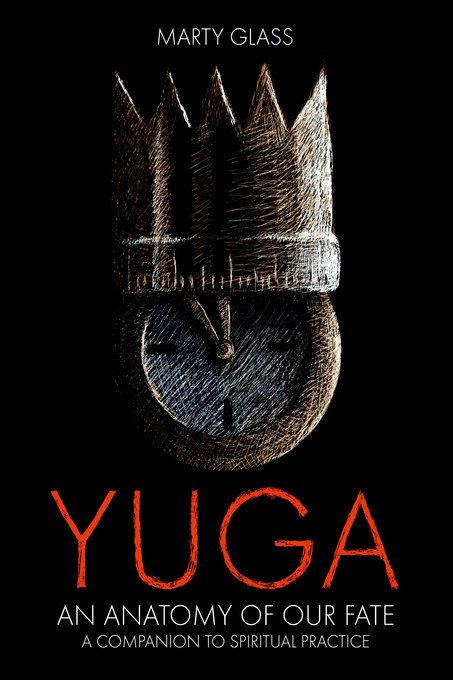
    YUGA describes five falls—the Fall into Time, the Reign of Quantity, the Mutation into Machinery, the End of Nature, and the Prison of Unreality. Taken together, these comprise the fate of historical humanity and are, the author is convinced, one-way trips. And the urban-industrial-vehicular-commercial-technological-pharmaceutical-electronic-information-spectator secular society they have produced has ripped the human world to shreds. The book is hard-hitting, but readers who find it disturbing overlook the invincible beatitude that undergirds its every line. When we awaken from our modern nightmare—as sooner or later we all shall—this book will help us remember what that nightmare was. In YUGA, the perennial wisdom has found a new and clarion voice.Equally at home with the Diamond Sutra and the Grundrisse of Karl Marx, while being a careful student of magazine displays at the checkout counters of supermarkets, the author cheerfully presents his book as a provocation rather than as argument. But the master achievement of YUGA, which lies neither in its ‘argument’ nor its style, is its voice. That voice speaks so palpably from the author’s heart that we find it resonating in our hearts as well. The final pages of YUGA are celebrations of joy and love, and the discerning reader will detect those qualities lurking between the lines of the book’s every page. For remember, Marty Glass is a spokesman for the truth that underlies all the world’s wisdom traditions. Behind the world of appearances—samsara, maya, and the shadows on Plato’s cave—stands the uncreated Light, Reality, which is eternal Bliss This reality speaks to individuals in the darkest of times, and its grace never falters. No one need be completely captive to history’s downward trajectory. Its dream unfolds, and we can actually love that dream if we are awake to the fact that it is we ourselves that are, collectively, the immortal Dreamer. The message of YUGA is the message of Tradition, the Sophia Perennis.

    Table of Contents

    Invitation—Surveillance—History and Way—Progress and Tradition—Self-Inflicted yet Autonomous, Unreal yet Fatal—Humanity, Posterity, Eternity—Clockwatch—Time and Temples—The Information Coronation—Import in Depth—Up to Speed—Invisible Absences—Awakening—The Name of the Age—The Degradation of Discourse—Not Impartial: Dispassionate—Taking Care of Business—Remember What the Dormouse Said! Feed your Head! Feed your Head!—One Way—Zen and the Art of Cosmic Cycle Discountenance—What a Long Strange Trip It’s Been

    Christ and the Kali-Yuga:

    Prefatory Remarks—The Fall into Time—The Jews and History—The Jews, Jesus, and the West —Historicity of Jesus—Incarnation and Faith, Surrender as Salvation—Legacy of Atonement —Kalki Avatar, Maitreya Buddha—Christians in the Kali-Yuga—The Deepest We Can Go: Homage to Frithjof Schuon—The Gnostic Testimony—Formation of the Church—Consequences and More Consequences: Absence of Maya, Presence of Sin —Incarnation and History, Eternity and Time—A Catholic View: Christopher Dawson—The Desert Fathers and The End of the World—Benediction—Last Chapter, End of the Book—Appendix Read more here

    Excerpts from an Interview with Marty Glass: Tears, Laughter, Compassion and Wisdom in the Kali-Yuga

    By Samuel Bendeck Sotillos

    Samuel Bendeck Sotillos: You have had the privilege of studying under the direction of the doyen of the World’s Religions, Professor Houston Smith. Is this how you came to learn about the “Perennialist” or “Traditionalist” school of comparative religion? And could you please underscore how this perspective has uniquely fashioned your writings, becoming its essence?

    Marty Glass: I think I remember how I came to know Professor Smith. I think that it had to do with The Sandstone Papers (1986). That book was not published initially by Sophia Perennis. It was published by Threshold Books, Kabir Helminski. Either Kabir got in touch with Huston or I got in touch with him. Somehow Huston got the manuscript and he wrote an endorsement on the back cover of the book. So I guess we got to know each other that way. I would also see him annually at the Memorial Day Program of the Ramakrishna Order, events that were held in Olema [CA]. He always came there and we used to meet once a year there. I got to know him better, we went out and had pizza from time to time and I would visit him at his house. We became friends.

    I think we became friends after both he and I discovered “traditionalism,” he probably before me. He discovered Schuon at some point, perhaps after reading Jacob Needleman’s anthology, The Sword of Gnosis (1974), or maybe just because he knew everyone, and I seem to remember that he said in an interview somewhere that this changed his whole life.

    The exact same thing happened to me and probably happened to many people. I remember I walked into Shambhala Bookstore, which does not exist anymore, on Telegraph Avenue [Berkeley, CA] and casually picked up a book called Understanding Islam (1963) by somebody named Frithjof Schuon. I had never heard of him, but somehow this book got in my hand. I took it out. I read two paragraphs and I knew immediately that I was in the presence of something I had never seen before in my life. It was like a revelation, like lightning or something: this man was clearly speaking ex cathedra. I’d never seen anything like it. Then I found out about the traditionalists. I read him, Coomaraswamy, Guénon, all of them.

    I realized that if I was a seeker of the Truth I could find it right there in the world of traditionalism: that is,in religion, in the spiritual traditions, as they were expounded by Guénon, Schuon, Coomaraswamy and the others. It wasn’t Marx, wasn’t Fidel and Che or Lenin or Chairman Mao, but this traditionalist school that was the real thing I had been seek-ing, and that school became the center of my spiritual understanding altogether. I still knew that the tradition that spoke to me directly was the religion of India. But the traditionalists enabled me to understand the “transcendent unity.” Enabled me to find the Truth in any house of worship in the world.

    SBS: The concept of the yugas, although broadly accepted in the perennial cosmologies or cosmologia perennis of the world’s spiritual traditions, has not been embraced by the modern and post-modern mindset. You have written a celebrated work on the social-historical criticism from a spiritual underpinning: Yuga: An Anatomy of Our Fate. Would you mind further articulating on the concept of the yuga for readers who might not be familiar with this perspective?

    MG: In the Hindu tradition, history is not linear but cyclical. And believe it or not, according to cyclical interpretations things are not getting better. The spiritual traditions are unanimous on this. It’s the opposite of the doctrine of the Enlightenment, the doctrine of Progress. Let me start again on this. The Hindu doctrine proposes four yugas, or Ages, in which we witness a steady deterioration of humanity’s spiritual capacities. That’s why in the final yuga, this one, we are given, by the grace of God, an easy practice, the Invocation of the Holy Name, any Name of God. But it seemed to me, in my writing, important to understand or interpret the cyclic doctrines in terms of our concrete lives, our living experience. Progress is a very powerful argument, very powerful, and in certain respects very true, incontrovertible. In YUGA I listed, after a very great deal of reading, what I called the Five Hallmarks of the Kali-Yuga: the Prison of Unreality, the Fall into Time, the Reign of Quantity, the End of Nature and the Mutation into Machinery or the Mutation into Technology. I am just saying this in one quick sentence, but there’s a very large bibliography behind it, an archive of deadly serious sociological analysis. To be able to think this way about what was happening in our lives I was especially helped by certain books. Bill McKibben’s The End of Nature (1989), a profoundly significant book; The Reign of Quantity (1954), of course, René Guénon magisterial work; the Fall into Time comes from Mircea Eliade’s body of work; the Mutation into Machinery has behind it an extensive archive of critical analysis addressing the meaning of technology in our lives; and the Prison of Unreality emerges from Jean Baudrillard’s work and the work of many other thinkers expounding the ramifications of the insight that we live in what we now all accept as a “virtual” world where we think everything that we see and do on screens, Baudrillard’s “hyper-reality of simulations,” Disneyland, is reality, unaware that we have lost contact with an unmediated reality, with our own lives. This is definitely the trickiest, most elusive statement about our lives, our profoundest and most invisible entrapment, the most insidious and diabolical mutation of humanity. What we perceive and regard as real is fundamental to our lives. You have to read the book. Talking about this demanded a style of prose I can’t duplicate in the spoken word.
    One of the things that distinguishes me from some of the other traditionalist writers is that my bibliography was not just taken from the world of spiritual writing by any means. There were many, many authorities, many masters I read who were writing about the times that we lived in. They are all in my bibliography. I mention so many of them in the book, like Lewis Mumford, for example, you know: so many of them who write about our times and are not specifically religious writers but are saying very very important things to help us understand what the Kali-Yuga means even though they are totally unfamiliar with that term. I called them “unconscious prophets of the Kali-Yuga.” Karl Marx, for example! He, talking about the universe of exchange value, and Guenon, talking about The Reign of Quantity,who would have loathed each other, were both talking about the same thing from different perspectives. So what informed YUGA was not only my background in religious writing, spiritual writing, but a very much larger bibliography, a much larger range of insights contributing to our understanding of the contemporary world. And they were more down-to-earth than the metaphysicians, more compelling, more demonstrable. Neil Postman writing about amusing ourselves to death, talking about television. Theodore Roszak. There are a hell of a lot of books like that; there are tons of them as a matter of fact. There are movies about what’s going down now. You can just go to the movies and see the dystopias. Read science fiction. It isn’t as if it is a secret that something is amiss. It’s presented in so many ways in our culture; there are so many people who know in different ways, different languages, different terminologies, that something is wrong. The Coen Brothers, and many other film-makers, certainly know. That body of knowledge became a very important part of YUGA. Cosmology, the four stages or the four yugas, is a form with no content. I was able to document the cyclical argument or prophecy simply by examining our daily lives.

    I am saying that it’s common knowledge that there is something pro-foundly wrong. I am happy about YUGA because it talks to people about their own lives, their lived experience. They can recognize themselves. It’s standard procedure now to contrast modern society with traditional societies, to help us understand the alternative ways of being human. Did Native Americans need more information? They did not have computers! What a terrible fate! No information! (laughter). But they had something more important than information. The traditional societies knew that there was a God, knew that there was a divinity behind this world. They had something that we have sadly lost. I talk about that of course in YUGA, but it’s almost a truism, it’s a cliché; people know that that there was something pure and wonderful about the way those people lived. They were not perfect, we are always human. There’s a great formulation by Seyyed Hossein Nasr: “The traditional worlds were essentially good with accidental evil, and the modern world is essentially evil with accidental good.”2 (laughter) I always thought that that was a brilliant summary. And yet, and yet, it’s still an oversimplification!

    2 S.H. Nasr, “What Is Tradition?” in Knowledge and the Sacred (Albany, NY: SUNY Press, 1989),

    SBS: A core point that you make is that: “Kali-Yuga: The Age of Wrong Diagnosis”.3 Could you say more?

    MG: (Laughter) Yes, that’s certainly true, because while people know that something is wrong here, the diagnosis is always wrong; they can’t figure out what it is. The true diagnosis begins with the assumption that humanity is a spiritual entity, that we have strayed from our primordial spiritual identity, that the criteria which determine our collective behavior do not originate in that identity. We say this is the problem or that’s the problem and that’s what we have to do, scientist can handle this problem, technology will take care of these problems. But there is something much deeper that’s wrong, the whole of humanity has gone astray. And yet even this analysis is at fault because it assumes that something can be done, that a collective reorientation is possible. I think we have to simply say that what’s happening, the Kali-Yuga, is inevitable, illusory and providential. Those three descriptive adjec-tives all at once: they compose, I believe, an insight into the truth of the thing. Which means that only individual spiritual realization is the medicine. That’s why the subtitle to YUGA is “A Companion to Spiritual Practice.” It can be summed up this way: “In these times a spiritual path is an ark. The great task is to make the flood visible.” Which is exactly what I tried to do in YUGA.

    I just read yesterday or a few days ago something that was dispiriting to me. In the Pacific Ocean there’s a huge patch of garbage as big as the state of Texas, or two states of Texas, that will never go away. Plastic, plastic stuff. You hear about irreversible things like that, the extinction of creatures, desertification, irreversible ecological disasters, and you realize how incredibly significant it is.

    I have always been a storyteller for children, all my life, for my own children and my grandchildren. A few months ago I told my grandchil-dren a story about a place where all the animals who were extinct are all still alive, a quest story. First I showed them pictures from my bird book of certain birds that were now extinct and told them that there was a place where they were all still alive. In the story they go on a quest and find the place, and the story ends in great joy. 3 Marty Glass, “Last Chapter, End of the Book” in Yuga:An Anatomy of Our Fate (Hillsdale,NY: Sophia Perennis, 2004), p. 323.

    The extinction of species is genocide, a terrible thing documented exhaustively in the National Geographic magazine. It isn’t as if humanity is deliberately malevolent. People are concerned about the extinction of species, deplore and lament it. They sense that it’s an enormously significant thing. But the powers, the forces that are making it happen, the vast impersonal elemental economic forces that are controlling global affairs and making these things happen are autonomous. Nobody wants it to happen, but it happens anyway.

    SBS: The spiritual doctrines and methods of the world’s reli-gions originate in what is non-human and beyond the contingen-cies of the physical world, known as Nirguna Brahman (beyond qualities) or Paramatma (Supreme Self) in the Hindu tradition. There are nonetheless certain spiritual practices which are said to be more effective in the different phases of the yuga. Could you speak more about the current age known as the Kali-Yuga in Eastern cosmology or the Iron Age in Western cosmology and what has been ascribed as the most beneficial spiritual practice for our times?

    MG: I discuss that in the Introduction to Eastern Light in Western Eyes (2003), in rather exhaustive detail. We are told that in the Kali-Yuga the practice is the Invocation of the Holy Name. Mantra repetition, a mantra, the Holy Name. This is understood in the Buddhist tradition, Islamic tradition and in the Christian tradition…

    The teaching that God is present in his name is true. “Hallowed be thy Name” we find in the Lord’s Prayer, in Latin sanctificetur nomen tuum. Of course, it isn’t as if anybody can say the Name and the Pres-ence will be affirmed in direct experience. There has to be preparation for this, and devotion. After that evening I read about mantra practice of the Holy Name in many places. The very last chapter in Whitall N. Perry’s book Treasury of Traditional Wisdom (1971) is Invocation of the Holy Name. He gave it that dignity, that prestige, by preserving it for the final chapter. You must feel and know it to be true that All I have is thy Name. You must feel and know it to be true that I have nothing in this world except the name of God and that’s everything. Feel it and know it and rejoice in it. There is a Hindu story about the chintamani stone illustrating precisely that truth.

    SBS: In your book Eastern Light in Western Eyes you discuss the challenges of the path in a time where there is much confu-sion, if not subversion of the dharma, leading seekers astray. You present the topic of spiritual guidance for those that have no human guide underscoring the important role that books currently play. Could you elaborate on this important matter that many seekers must tackle whether they are looking for a guide or not?

    MG: That’s a very important question, and I am aware that my par-ticular story is in no way representative. The fact that I could, without a teacher, without being part of a sangha or a group, learn what I have learned and become what I have become is very much a minority thing. I am atypical.

    Most people in these times want a teacher; they want to be part of a group of some kind. These groups exist. The public consciousness, the public world is atheistic. But there are many seekers because at the very time when a Divine Reality is denied there is consequently an experienced emptiness in people—not in everyone, of course, but in many—and they seek it with even greater fervor. People are desperate for some kind of meaning in their lives, some kind of durable meaning.

    And there are many charlatans out there, of course. There is an endless, inexhaustible, kaleidoscopic and brilliantly conceived catalogue of mis-direction that people will be offered as a spiritual solution. Something to alleviate the subterranean malaise. The ingenuity of charlatans and fakers in these times is something which should be celebrated! There should be operas written about it! They are successful because the longing is desperate. And it cannot be denied that many, probably the majority, of the teachers offering specious answers to spiritual seekers are themselves sincere. That happens. The funny thing is that almost every answer will have something true in it, something that rings true. The complexity here is quite ramified, to say the least.

    I have heard it said that there are three million practicing Buddhist claimants in the United States now, people who have not been able to find an answer in Christianity or Judaism. There are Buddhists all over the place, Buddhism is very big thing, and it’s a wonderful thing, and though some of the Buddhism that is given to people is western therapy laced with Buddhism, it still works on some level and we must be grateful. People do find some kind of solace, some kind of meaning, some kind of comfort for them when they deal with tragedy or the rigors of life. The word yoga can mean literally anything! That’s happening all over the place. All of this potpourri is being dished out and all of these answers are offered to people, by all sorts of people, and that is a good thing: it characterizes the yuga.

    I know a lot of people whose Buddhism is not as rigorous as Buddhism really is, but it gives them something, it gives them something to hold onto. There are people who, on the other hand, will turn to the computer in the morning as if to some sort of deliverance: “I’m online, I’m okay—I’m real!” There are millions of people who feel that way, and of course they’re deceived. The seduction of technology in these times merits, and indeed has received, an entire bibliography. Not to mention the Supreme Seduction, the Supreme False Answer: Shopping! There are seekers everywhere, people who are seeking, looking for happiness in some way in this empty world that doesn’t offer them anything enduring.

    This is not to imply that things can be turned around; the direction is going to be what it is. But there is a kind of mercy that’s offered to people in these times. There’s a phrase I remember from Mircea Eliade; we live in what he called “the descending trajectory of the [cosmic] cycle,”4 and he suggested that in a way it’s a privilege to live in this time because you can see it, you can see it happening, and that itself is a kind of wisdom: to be able to perceive what is going on in the yuga. To see it is a privilege, a privileged position from which we can see the curtain coming down, we can see the whole thing, and we must still love the world while this is happening. The last part of YUGA, you will see, is a celebration. You are saved if you can just “Love one another as

    I have loved you.”5 Those are the words, the teaching, of our Savior. You can still do that on an individual basis. You can extricate yourself. Love one another, love the world, love the beauty of creation, love the glory of God. Love your existence. “I was a hidden treasure and I wanted to be known: so I created the world.” (Hadith qudsi)

    4 Mircea Eliade, “Destiny and History” in The Myth of the Eternal Return: Or, Cosmos and History (Princeton, NJ: Princeton University Press, 1974), p. 131.

    5 John 13:34

    I remember in YUGA I talk about the distinction between historical humanity and eternal humanity. Very important. The yuga is the direc-tion of history, the collective movement in the dream of time, and it’s a one way trip. But within that collective movement, and to the degree that you can disengage yourself from history, humanity is eternal and divine, imago dei, God is present in every soul all the time, even here in the Kali-Yuga. It isn’t as if God has abandoned us—which is, of course, inconceivable. He is present in every individual soul. You can and should rise above this as individuals, rise above this “descending trajectory,» this one way trip, and still celebrate the whole thing. It’s glorious!

    I remember I once got a letter from Seyyed Hossein Nasr and he said to me, “Nothing can separate us from God.» The yuga, everything that Schuon talks about or that Guénon talks about, the whole trip, has ultimately no power over us as individuals. “Nothing can separate us from God.» There’s a passage, I think, in one of the epistles of Paul that says something like that too. So when you try to talk about this incredible business in a way it’s over our heads. Something is happening, there’s no doubt about it, yet at the same time nothing is happening: nothing can remove the core of divinity in every human being, nothing can extinguish it, nothing can erase the miracle of human birth. We are made in His Image, theomorphic, deiform, all of us, every single person, even in the Kali-Yuga, and nothing can change that. In a way the only answer to all of this, the way I ended YUGA because I didn’t want to end it with a feeling of doom, which would have been a profound misreading, is with the celebration of each individual: “Love one and other as I have loved you.» Love the world! You can still fulfill the promise of human birth, even now.

    I wanted to make that clear. And what I’m about to say may sound like a bit of a digression, but I don’t think it is. There was something about the Traditionalists that I characterized as a punitive elitism. Simply and baldly put, I felt that the Traditionalists didn’t really love people. I felt they blamed the victim in some way and I wanted to counter that. I have known a lot of people who aren’t religious specifically, but they’re wonderful people—maybe even as wonderful as the traditional­ist writers!—and what their fate is in the eyes of God we don’t know. People I love, people who have love in their hearts. There is as I have insisted, a divine presence in everyone. There was a divine presence in Mick when he died. In a way it’s not totally bad news; as Nasr said in his letter, “Nothing can separate us from God.” And so this “descending trajectory” of cosmic time, the Kali-Yuga, while it undeniably has a certain power, cannot defeat us as individuals. I refer someplace to “the eternal magnetism of heaven.” I wanted that to come across in YUGA.

    SBS: Would you say that the sophia perennis or the perennial philosophy provides the theoretical core underpinning all of your work?

    MG: What I learned from traditionalism, what I learned from those magnificent incomparably brilliant writers, has informed my writing. In my spiritual practice it means something, I suppose, but very little, really nothing compared to what the Bhagavad-Gita means, nothing compared to what the actual Holy Writ, the scripture in the tradition says to me. I find that now that I’m not writing anymore I almost never read any traditionalist literature. I gave almost my entire religious library away. I gave it to the second hand bookstore in Garberville. I kept only the books that still spoke to me, and they’re all books within the Hindu tradition, almost all of them. I think I kept two books by Schuon, Spiritual Perspectives and Human Facts (1953) and maybe one other. But I rarely ever look at them. They were important to me as a writer in understanding the “transcendent unity of religions,” however you want to put it. That central priceless contribution of the traditionalist writers was indispensable to me as a writer, but in terms of my practice I don’t need them anymore than anyone else practicing the religion of India would need them. You do not require the “transcendent unity” teaching of traditionalism to practice a religion. Traditionalism is not a Path.

    When this question comes up, I always employ the analogy of music. If you’re a musician you play some instrument. If you don’t play any instrument you’re not a musician. That’s your religion: some particular instrument. You don’t say that the other musical instruments are not musical instruments; they’re all musical instruments. You play the base and the other guy plays the horn. It’s that way with the religions. You understand that all of these instruments are music. Or all these styles: jazz is music, rock and roll is music, classical music, rhythm and blues, country western, they’re all music. There’s one instrument you play, one style that speaks to you. If you’re a jazz musician that doesn’t mean that the other styles aren’t music. I always point out that they are all the same kind of thing, it’s all music, and you perform one instrument or you’re in one particular musical tradition, but the others are just different kinds of music but still music. I would use that analogy of musical instruments or musical style to explain that they’re all valid, but you play one. It’s really true in music: if you’re going to be a musician it’s very very rare that you’re going to be able to master more than one instrument, very rare; it’s usually in one instrument that you find the whole truth of music. You find the whole of music in your one instrument. You find the whole truth of religion in the religion you practice.

    SBS: You have also mentioned that there are no essential dif-ferences between the margas or paths of knowledge or jnana and devotion or bhakti, which has been confirmed by preemi-nent exponents of Advaita Vedanta, the foremost expression of Hindu spirituality (i.e. Sri Ramana Maharshi). Could you say more about this?

    MG: I discuss that at great length in the Introduction to Eastern Light in Western Eyes. These are both orthodox paths, both traditional, two paths that lead up to the same mountain top. I believe that for me in my last moments it’s going to be bhakti. The love of God is what’s going to sustain me more than identity with an Impersonal Absolute. But who really knows? I can only say that I always come back to the love of God—tasting the sugar rather than being the sugar, as it’s put. I’ll always come back to tasting the sugar. But as I said, who knows? Lately Kashmir Saivism has been speaking loud and clear to me!

    SBS: You describe yourself as a “down-to-earth” person, wanting to make your books more readily accessible to wider audiences outside the current “Perennialist” or “Traditionalist” readership. Could you perhaps articulate as to why you think this is important to the contemporary era and also why these writings are so challenging to the psychology of present-day readers?

    MG: Guénon, Coomaraswamy and Schuon are not easy to read. Nobody I’ve known in my life is ever going to be able to read Coomaraswamy or any of those people. Only a very small microscopic percentage of the human race is ever going to be able to read these guys. There are passages in Coomaraswamy, who was fluent in six languages, that he doesn’t bother to translate. Who the hell is going to read this stuff? I have never suggested the traditionalist writers to anyone, and I never will. Those books are for a very small microscopic group of people.

    In my own writing I have been fortunate to have absorbed the traditionalist writings with inexpressible gratitude, but I’m trying to address a much wider audience. YUGA itself is not that easy a book, but my other books are. I try to get across some of the basic “hits” in the traditionalist archive, pithy stuff, quick jabs. But in my writing, it’s more in the style of the prose, the voice, the sensibility, the language, the feel, than in metaphysical vocabulary that I have tried to transmit something of the “transcendent unity.”

    SBS: For readers which are unaware of your recent and final book: The Woodrat Chronicles which you refer to as the mag­num opus of your life’s work, would you mind elucidating the central story and message of this work that you have called a spiritual allegory as it does not fit into the typical genre of the perennialist lore?

    MG: In all of the things I’ve written, as I’ve been saying throughout, I address a wider audience than the Traditionalists, but The Woodrat Chronicles addresses everybody. My grandson, eight years old, is doing a book report on it. He’s eight years old and he can read it. My adult friends, my age, who’ve read it, have laughed throughout and cried at the end, as I did. It has, to say the least, a broad appeal. I don’t know what’s going to happen to it. At this moment it’s on an editor’s desk at HarperCollins. I’ve sort of put it from my mind; whatever happens, happens. I sometimes feel a certain frustration because that book is so funny and so warm and so full of love, so accessible. It’s written on two levels, for children and for adults. It’s a voice that was born in me. Maybe somebody will discover it someday; maybe my kids will take care of it. I’ve made a complete tape of it. I’ve recorded the whole thing on a recorder that my son gave me and he plays it over the radio in Ukiah on a little radio program he does there with his wife. As I said, I originally wrote that book only for my children. The names of the characters are Lifeboat, Joyride, Masquerade, Karma, Wilderness and Smithsonian. L.J.K.M.W.S. My five children and my son-in-law are: Loren, Julie, Katie, Meagan, Will and Steve. But when I finished it I realized it was for more than my children. It’s for everyone. My only book written for everyone. Maybe they’ll decide to take a chance with it at HarperCollins.The Woodrat Chronicles here Free Download

    Marty Glass’s Books:

    Heartbeats of Hinduism: Living the Truth of the Immortal Dharma (San Rafael, CA: Sophia Perennis, 2008)

    Yuga:An Anatomy of Our Fate (Hillsdale, NY: Sophia Perennis, 2004)

    Eastern Light in Western Eyes: A Portrait of the Practice of Devotion (Hillsdale, NY: Sophia Perennis, 2003)

    Sandstone Papers: On the Crisis of Contemporary Life (first edition, Putney, VT: Threshold Books, 1986; second edition, Hillsdale, NY: Sophia Perennis, 2005)


    The idea of the Labyrinth

    • The Idea of the Labyrinth from Classical Antiquity through the Middle Ages

    by Penelope Reed Doob

    Ancient and medieval labyrinths embody paradox, according to Penelope Reed Doob. Their structure allows a double perspective—the baffling, fragmented prospect confronting the maze-treader within, and the comprehensive vision available to those without. Mazes simultaneously assert order and chaos, artistry and confusion, articulated clarity and bewildering complexity, perfected pattern and hesitant process. In this handsomely illustrated book, Doob reconstructs from a variety of literary and visual sources the idea of the labyrinth from the classical period through the Middle Ages.

    Doob first examines several complementary traditions of the maze topos, showing how ancient historical and geographical writings generate metaphors in which the labyrinth signifies admirable complexity, while poetic texts tend to suggest that the labyrinth is a sign of moral duplicity. She then describes two common models of the labyrinth and explores their formal implications: the unicursal model, with no false turnings, found almost universally in the visual arts; and the multicursal model, with blind alleys and dead ends, characteristic of literary texts. This paradigmatic clash between the labyrinths of art and of literature becomes a key to the metaphorical potential of the maze, as Doob’s examination of a vast array of materials from the classical period through the Middle Ages suggests. She concludes with linked readings of four “labyrinths of words”: Virgil’s Aeneid, Boethius’ Consolation of Philosophy, Dante’s Divine Comedy, and Chaucer’s House of Fame, each of which plays with and transforms received ideas of the labyrinth as well as reflecting and responding to aspects of the texts that influenced it.

    Doob not only provides fresh theoretical and historical perspectives on the labyrinth tradition, but also portrays a complex medieval aesthetic that helps us to approach structurally elaborate early works. Readers in such fields as Classical literature, Medieval Studies, Renaissance Studies, comparative literature, literary theory, art history, and intellectual history will welcome this wide-ranging and illuminating book. Read here

    Introduction: Charting the Maze Introduction: Charting the Maze (pp. 1-14) Anicent and medieval labyrinths or mazes (the words have different etymologies but mean the same thing) are characteristically double. They are full of ambiguity, their circuitous design prescribes a constant doubling back, and they fall into two distinct but related structural categories. They presume a double perspective: maze-treaders, whose vision ahead and behind is severely constricted and fragmented, suffer confusion, whereas maze-viewers who see the pattern whole, from above or in a diagram, are dazzled by its complex artistry.

    • CHAPTER ONE The Literary Witness: Labyrinths in Pliny, Virgil, and Ovid By the time of juvenal (ca. 60-131 A. D.), “that thingummy in the Labyrinth” and “the flying carpenter” who built it were the stock in trade of hack poets, and references to the labyrinth and its associated myth abound in classical literature. Of the many writers who treated the subject, three are particularly important, not merely because of their stature in their own age but also because they defined the labyrinth for early Christian and medieval writers, establishing a rich storehouse of labyrinthine characteristics and associations and laying the groundwork for the literal and metaphorical mazes of later literature.
    • CHAPTER TWO The Labyrinth as Significant Form: Two Paradigms Chapter 1 examined the major classical texts that defined and transmitted the physical facts and narrative implications of the labyrinth to later ages. A recurrent theme in that discussion was the maze’s inherent duality as the embodiment of simultaneous artistry and confusion, order and chaos, product and process, depending on the observer’s (or the writer’s) point of view. So far, we have looked at the principle of labyrinthine duality chiefly as it manifests itself within the written tradition, although allusions have been made to the contrasting witness of the visual arts. Now it is time to expand our understanding
    • CHAPTER THREE A Taxonomy of Metaphorical Labyrinths In chapter 1, the literary tradition of the labyrinth defined by Virgil, Ovid, and Pliny suggested the inherent and convertible duality of the maze as monument of admirable artistic complexity and cause of subjective confusion. Chapter 2 approached labyrinthine duality from a complementary perspective, using the conflict between two persistent paradigms, the multicursal maze of literature and the unicursal maze of art, as a means to identify the essential characteristics and formal implications of classical and medieval mazes. These essential characteristics define the maze as a complicated artistic structure with a circuitous and ambiguous design whose confusing toils are intended.
    • CHAPTER FOUR Etymologies and Verbal Implications As Part One examined the idea of the labyrinth in classical and early Christian times, exploring typically labyrinthine dualities, establishing the maze’s essential characteristics, and surveying the range of metaphors generated by those characteristics, so Part Two traces the labyrinth’s medieval metamorphoses from Isidore of Seville (560-636) to the late fifteenth century. As in Part One, the discussion here is thematic and selective rather than chronological or all-inclusive: there is no significant, temporally linked development of the labyrinth within the period, and listing every labyrinth reference would be tedious even if it were possible.
    • CHAPTER FIVE Mazes in Medieval Art and Architecture In the medieval period even more than in classical and early Christian times, the idea of the labyrinth depends on visual as well as verbal witnesses. Interrelationships between art and the written word can vary greatly. The two witnesses may be virtually independent in status if not in inspiration: an unnamed turf-maze adorns an English field, for instance, or an account of the Cretan myth exists in manuscript with no illuminations and no clear indebtedness to any visual model. Frequently, however, the visual and the verbal interact.
    • CHAPTER SIX Moral Labyrinths in Medieval Literature the medieval visual arts typically stress the artistic labor involved in the domus daedali as an artifact in bono, many literary texts, influenced by the context of the Cretan myth, take the labor intus completely or partially in malo. The labyrinth becomes preeminently a temptation to moral error, an emblem of the world as an almost inextricable occasion of sin. Medieval meanings of error, reflected in vernacular cognates, suggest many pejorative possibilities, all of which we will encounter: instability and incertitude; sin; madness ; false opinion or culpable ignorance; heresy ; a straying from the right path.
    • CHAPTER SEVEN Textual Labyrinths: Toward a Labyrinthine Aesthetic .The previous chapter looked at labyrinths in medieval texts; now we turn to a broader subject: the text, and the complex intellectual processes related to its creation and reception, as labyrinth. The essential qualities of the labyrinth, defined in Chapter 2, remain the basis of these speculations on the inherent labyrinthicity of much medieval literature and literary theory. A text that is wellconstructed according to medieval theories of rhetoric is, as we will see, often very like a maze: it is an ornate, highly complicated work of art, elegantly ordered by interwoven parts comprising an admirable whole.
      • In Part Three, we rise above the labor of reconstructing the idea of the labyrinth to more expansive regions and trace the grand tradition oflabyrinthine texts from Virgil’s Aeneid through Boethius’s Consolation of Philosophy and Dante’s Divine Comedy to Chaucer’s House of Fame. Each of these texts reflects and redefines the received idea of the labyrinth, transmitting it, enriched, to later ages and particularly to later authors in the continuous tradition here represented: Boethius knew Virgil, Dante followed boldly in the footsteps of both Virgil and Boethius, and Chaucer apologetically rewrote Virgil, Boethius, and Dante in the House of Fame.
      • CHAPTER EIGHT Virgil’s Aeneid The Aeneid, one of the most influential works of western literature, is the earliest major example of truly labyrinthine literature : it includes explicit images of the maze and references to its myth, employs a labyrinthine narrative structure, and embodies themes associated with the idea of the labyrinth (as defined in previous chapters).¹ Although the importance of the labyrinth in Books 5 and 6 has not gone unnoticed,² the full extent and significance of labyrinthine imagery and ideas in the Aeneid have not yet been explored.
      • CHAPTER NINE Boethius’s Consolation of Philosophy If Virgil bequeathed to the Middle Ages a pessimistic pagan example of the highest labyrinthine artistry, the Christian Boe thius, working in the labyrinthine tradition of the classical and early Christian authors considered in Chapter , used the received idea of the labyrinth in an optimistic theodicy demonstrating that what appears to be a labyrinthine world of random confusion and injustice is in fact, with the proper perspective, a manifestation of the cosmic order created by divine providence.
    • CHAPTER TEN Dante’sDivine Comedy The literature of Christian conversion is labyrinthine by nature : converts, whose very name implies a purposeful change in direction, turn from false ways to true ones and from a disoriented, blind pursuit of false goods to an often circuitous quest for the right goal, in light of which previous paths seem chaotic and futile. Conversion and persistence in the new path come by grace, not solely by will or intellect, so converts must have supernatural aid. Their way may be twisted by error and complicated by impediments, delays, and backslidings; converts must retrace their steps to avoid danger.
    • CHAPTER ELEVEN Chaucer’s House of Fame Fame This book has examined many examples of labyrinthine literature: works that discuss labyrinths, explore their metaphorical potential, use them as central images, or entail a labyrinthine experience by hero, narrator, and reader. We have seen how three masterpieces-Virgil’s Aeneid, Boethius’s Consolation of Philosophy, and Dante’s Divine Comedy—represent a self-consciously continuous expression of the idea of the labyrinth in western literature. Chaucer’s House of Fame is slighter than its three self-avowed labyrinthine models, but this sparkling tour de force may be the most comprehensive (if not comprehensible) and creative culmination imaginable of the medieval labyrinth tradition, and hence a fitting…
    Deze afbeelding heeft een leeg alt-atribuut; de bestandsnaam is images-1.jpg

    The Labyrinthos Archive

    • Founded by Jeff and Kimberly Saward in 2000, Labyrinthos provides a resource for the study of mazes and labyrinths. With an extensive photographic & illustration library and archive, we offer professional maze and labyrinth consultation and services for researchers, designers, students, writers & publishers. We endeavour to help you navigate your way thought this labyrinthine subject, whatever your specific path. see website
    • Labyrinthos also publishes Caerdroia – the Journal of Mazes & Labyrinths, founded in 1980 by Jeff Saward. The world’s only specialist journal researching and documenting the history, development and distribution of mazes and labyrinths, from the earliest rock carvings and artefacts to modern puzzle mazes of ever increasing complexity.

    Apocalypse of Angers

    A Disclosure of Wisdom Following the Reader of the Apocalypse of Angers

    An apocalypse (Ancient Greek: ἀποκάλυψις apocálypsis, from ἀπό and καλύπτω meaning ‘un-covering’), translated literally from Greek, is a disclosure of knowledge, i.e., a lifting of the veil or revelation, although this sense did not enter English until the 14th century.[1] In religious contexts it is usually a disclosure of something hidden. In the Book of Revelation (Greek Ἀποκάλυψις Ἰωάννου, Apocalypsis Ioannou), the last book of the New Testament, the revelation which John receives is that of the ultimate victory of good over evil and the end of the present age, and that is the primary meaning of the term, one that dates to 1175.[1] Today, it is commonly used in reference to any prophetic revelation or so-called End Time scenario, or to the end of the world in general.
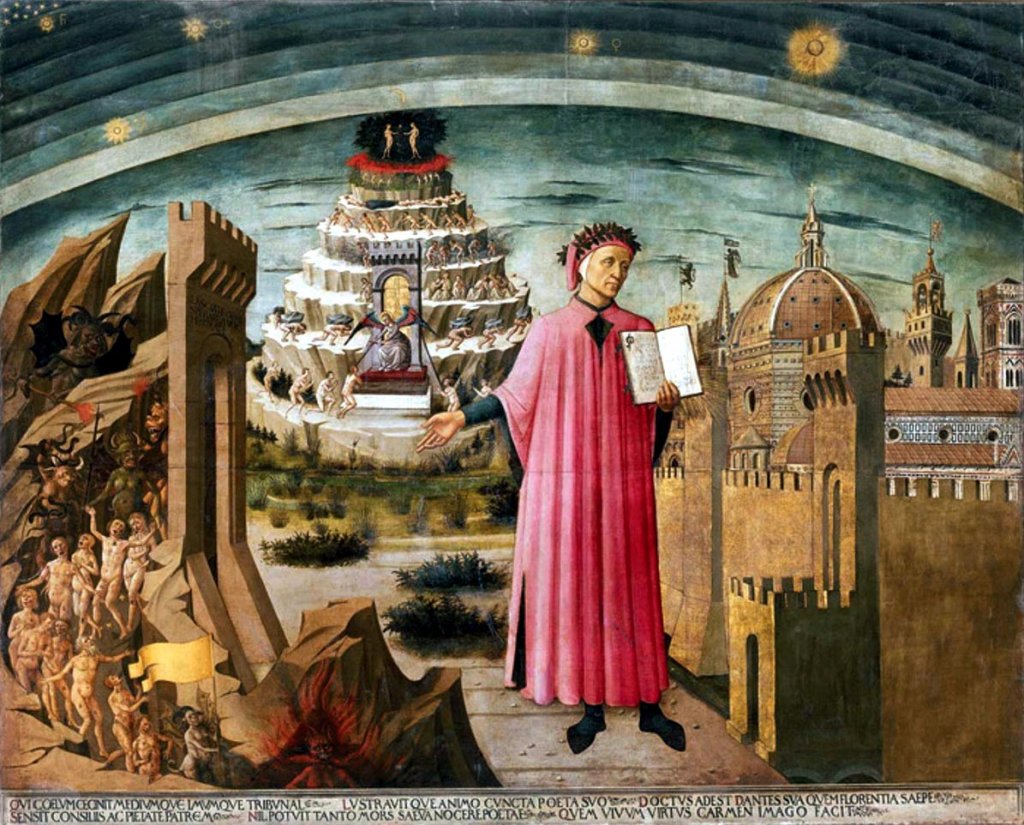
    An epiphany (from the ancient Greek ἐπιφάνεια, epiphaneia, “manifestation, striking appearance”) is an experience of sudden and striking realization. Generally the term is used to describe scientific breakthrough, religious or philosophical discoveries, but it can apply in any situation in which an enlightening realization allows a problem or situation to be understood from a new and deeper perspective.

    Maieutic concepts historically have their origin in Plato’s dialogues of Socrates.

    In The Symposium, Socrates repeats the words of the priestess or wise woman Diotima of Mantinea who suggested that the soul is pregnant and wants to give birth, but the delivery requires assistance. Thus according to Plato, the role of the philosopher is to assist in this delivery, as would a midwife. From this dialogue comes the word “maieutics”, the “spiritual midwife.” to give birth to wisdom

    In Theaetetus, Socrates is presented as a “spiritual midwife” and in Meno, by posing questions to a slave who never learned geometry, Socrates leads him to “remember” how a square is doubled.

    The human crisis of our time is immense. To meet this crisis, we need real thinkers and doers. We need people who are able to be persistent in asking good questions and willing to do the work needed to follow through, with great persistence, in seeking answers. We do not want everyone to merely be robots who only know how to memorize and regurgitate the popular talk of the day. We cannot afford to have millions of citizens who are too uninspired, unable or unaware to continue working persistently for the sake of their own understanding. We need to cultivate sapient beings capable of leading their lives with excellent and original thoughtfulness. Such people create original new talk and new doings that help all humanity create a future worth living.

    The art of living, not just for the Socratic method but as an art of all willful living, can be expressed as the art of asking and answering questions and then committing ourselves to live out the best of our understanding. In order to live well, there must be an art of living. Education that does not inspire and empower people to embrace the art of living is not fit for human consumption. The Socratic method of conversation, when properly conducted, strengthens that which is fundamental to all expressions of inquiry and creativity no matter what culture calls us her sons and daughters, no matter what historical time adorns us in the fabric of our living, no matter what purpose of questioning is pressing upon our hearts. The Socratic method is the king of exercises for keeping the beating heart of the human will to education alive and well.
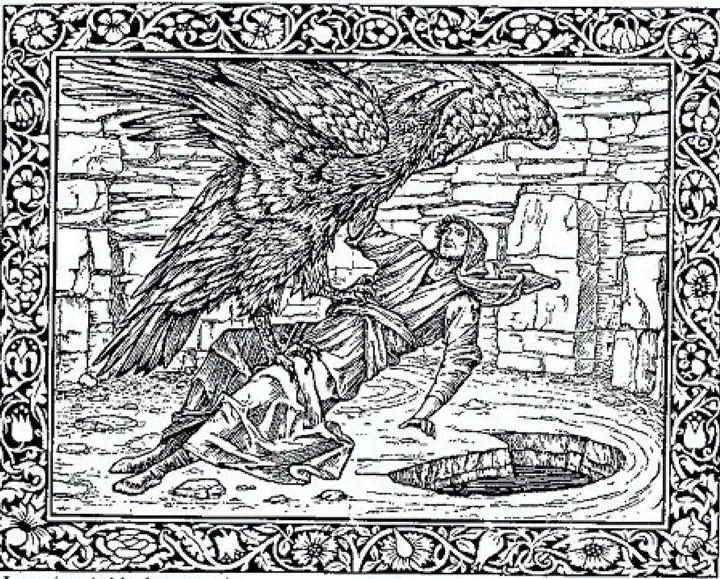
    Read here : A Disclosure of Wisdom

    Beauty Happens: Wisdom of animals

    Professor Richard Prum has spent a lifetime studying the variety and behaviour of birds. Now the Robertson Co-professor of Ornithology at the University of Yale, he argues in his best-selling book, The Evolution of Beauty (2018), that in order to account for the extraordinary variety of form that we see in the world, we need to return to an idea originally proposed by Darwin – that of  ‘mate choice’. This suggests that the subjective experiences of birds and animals – their aesthetic sensibilities– are the primary driver of evolution. In this interview,from Beshara magazine, he talks to Jane Clark about this groundbreaking theory and the research which supports it.

    Jane: You are a professional ornithologist, and your recent book, The Evolution of Beauty, [1] really comes out of the vast amount of research you, and your fellow ornithologists, have conducted over the past few decades.

    Rick: Yes, I am part of the Department of Evolutionary Biology at Yale, and at the moment I am involved in many research projects: far too many, really – in the low dozens – some going on for ten years and some for ten days.

    Jane:  The main point you make, as I understand it, is that what we might call the ‘orthodoxtheory of evolution – the neo-Darwinist approach which sees the survival of the fittest as the driving force of evolution – just cannot account for the huge variety of forms and decorative elements that we see in birds and other animals.

    Rick: My book is basically an argument against what I call ‘adaptationism’, which is a view that adaptation by natural selection is a strong force which dominates all events in evolution. This is a powerful idea, but it is not Darwinian as many people have been brought up to believe.

    It is true that Darwin put forward the idea of survival of the fittest in his first book The Origin of Species [2]. But in his second book, The Descent of Man [3], which was published a decade later in 1871, he proposed that there is another force, independent of natural selection, which is just as – maybe even more – important. This he calls ‘mate choice’. And it is this, in his view as well as in mine, which leads to things like the development of antlers in deer, or the extraordinary diversity of colour and ornamentation in birds.

    Title page of Darwin’s Descent of Man, first published in 1871

    Jane:  Mate choice means that some features or traits evolve simply because the opposite sex likes them, not because they confer any functional advantage?

    Rick: Yes. What was really revolutionary about Darwin’s proposal was the idea that the subjective experience of animals was a force in evolution. He suggested that the response and the sexual choice made, for example, by a female Great Argus pheasant when she watches the male display his beautiful tail could drive evolution in a way that is not commensurate with, or could not be reduced to, natural selection (see video right or below for the mating display of the Great Argus).

    Jane: In your book, you call mate choice ‘Darwin’s really dangerous idea’.

    Rick: In fact, it was so dangerous that it had to be kind of laundered out of the history of Darwinism, and this was done quite early on by people like St George Mivart and Alfred Wallace. Ever since The Descent of Man was published, people have been trying to ignore or minimise this view in order to get it under the control of natural selection. And they have been extremely successful in doing so.  The version of evolution that we now have is not really Darwin’s at all; it is Wallace’s, and we should really refer to it as Wallacian evolution.

    Jane: Why were people so threatened by the idea of mate choice?

    Rick: I think one factor was that many of Darwin’s early supporters had moved in their own lifetimes from monotheism – the belief in one God – to what I call ‘mono-ideaism’, that is, the belief that there is just one concept, one explanation, for everything that happens in the natural world. This led them to enthusiastically embrace the concept of adaptation, which seemed to do just that – explain everything. Then along comes Darwin saying that there is also another mechanism, and they just would not buy it.

    Secondly, I think they were very suspicious of anything which gave autonomy and choice to animals. They believed that animals were like little automata; they could see that there might be psychological or physical mechanisms going on, but they did not believe that animals were capable of making the kind of aesthetic judgements that Darwin was proposing.

    And lastly, I think there is no doubt that, culturally, there was a lot of misogyny. Mivart in particular was quite explicit in his refusal to accept that the choices of female animals – and in fact, females in general, including human beings (because Darwin of course was talking about humans in The Descent of Man) – could be a major force in evolution. But the same attitude is present in Wallace.

    I think all this made them unable to accept the richness of Darwin’s view, which was complicated, non-reductive, and emergent. He understood that the evolution of subjective experience would imply that animals have the capacity to control their own development and environment, just as humans can.

    The Great Argus pheasant in his mating display.

    Beauty Happens

    Jane: One of the ways in which the idea of mate choice was subverted was to suggest that beauty per se is not an evolutionary force, but that it is a kind of code for more utilitarian traits; that it indicates good genes, or good health, or good resistance to mites or whatever.

    Rick: Yes, within survival of the fittest models, beauty is understood to be evidence of some other correlated quality – some extrinsic quality – that is adaptive. This idea was developed quite early on in the history of Darwinism, and it was a subtle move, as it defuses the power of sexual selection so that it becomes just another version of adaptation.

    Jane: And how would you refute this argument?

    Rick: Well actually, it is quite a hard one to refute and in some ways it is impossible to do so. If we find a beautiful feature or an elaborate mating display for which we cannot identify the correlative adaptive quality trait, then it can always be said that we have simply not looked hard enough. We cannot prove that this trait is merely there because it is beautiful until we have tested every imaginable hypothesis to do with its function. And obviously that is impossible.

    In this way, the field has created an epistemological situation which makes the theory unfalsifiable. On the one hand this is unscientific, but on the other, it makes people absurdly confident about the ability of the theory to describe everything in the biological world.

    Jane: So you have countered this by proposing that we should be using a null hypothesis approach in evolutionary theory. And your proposed null hypothesis is: beauty happens.

    Rick: Yes. I propose that there is a kind of evolution which can be described broadly as ‘aesthetic evolution’. When animals make choices based upon what they like, and when this choice has some kind of connection with the way they reproduce, then what arises in nature is beauty.

    Jane: Could you explain further how a null hypothesis works?

    Rick: A null hypothesis is normally one which proposes that the special relationship that we are interested in does not happen, and the results we are seeing come about because of other events – usually less directive, more random, events.

    I use the metaphor of a rainbow to show how this works. Does a rainbow have value as a beautiful thing in itself, or does it have beauty because it leads to a pot of gold? That pot of gold to my colleagues is good genes, or no sexually transmitted diseases; in other words, something that confers extrinsic benefit. And if you have not found it, then you have simply not looked hard enough. But if you adopt my null hypothesis, then the burden of proof is upon them to show that the pot of gold is actually there, and that the rainbow is not just a rainbow, and its beauty is not just beauty, as itself.

    There are plenty of examples in other scientific fields where null hypotheses have been adopted in recent years. One is community ecology, where people are interested in the behaviour of species in an environment. You find certain types of pine at one altitude, and another at another, and people used to say, taking an adaptationist perspective: how interesting that these trees have evolved to live at these different levels. The assumption was that the process happened through natural selection and competition. But now you can only say that if you have refuted the null model of community assembly. 

    Jane: Which basically means that these variations can come about in other ways?

    Rick: Yes, they could be happening through other random mechanisms. The trees have altitudes that they prefer. They also have limits to how much variation they can tolerate, and that varies from species to species. And they don’t necessarily compete with one another, etc. etc.

    I don’t deny that natural selection happens; there is no doubt that it does and it is an interesting and important phenomenon. But it is not a strong force; meaning, it is not strong enough to completely control the subjective desires of animals.

    Two male Guianan Cock-of-the-rock fight for the right to mate in their lek.
    Click here for more information [/].

    Irrational Exuberance

    .

    Jane: But there must be some constraint placed on the process by the need to survive. How big a tail can a bird develop before it actually cannot fly, or obtain food, or breed?

    Rick: You would be surprised. I have an entire chapter in the book about decadence. Decadence happens. Decadence is a preference for traits that are so beautiful but at the same time so detrimental to performance that everyone in the population gets worse – both the choosers and the objects of their choice. So I don’t think that there is necessarily anything that prevents sexual selection from leading to extinction. We have mathematical population generation models which demonstrate this; this is one of my ongoing projects. It may be shocking, but we are finding that this is true of many of the beautiful features we see in the world around us. 

    Of course there is a natural limit, in that some developments will lead to extinction – but that is not relevant to my argument. Lots of species could be very far from optimal efficiency and still be thriving in terms of population growth. They could be doing even better if they spent less time on their subjective choices about mates – developing courtship dances or building elaborate nests and such like – but then they would have to stop experiencing beauty. And many of them have chosen not to do that.   

    Jane: I am very interested in the way that you equate these principles to the workings of things in the human world, such as stock markets, or housing bubbles.

    Rick: One of the most damaging consequences of adaptationism is its application to the free market theory of economics. The assumption is that markets, if left to themselves and given access to information, will naturally lead to the most efficient system, for example in pricing, productivity, etc. But our work on bird evolution indicates that often exactly the opposite happens, and this is because we place aesthetic value on certain things, such as gold.

    Jane: I suppose a good example of this would be the value placed upon tulips in the Ottoman Empire.

    Rick: Or the value placed upon certain features of houses in the run up to the 2008 crash in America. Nobody needs a squash court and a home cinema in their house, but money was available for people to install these things, so they did. And then their houses were worth more, so there was incentive to add even more features, etc., etc. It was a bubble which, like these things tend to, eventually crashed.

    Stock markets and asset bubbles are a great example of what I call irrational exuberance. In 2008, a group of supposedly rational people, making what they thought were rational choices, decided to take the economy over a cliff. And there is no reason to believe that animals are any more rational than we are.

    Nest of the Brown Gardener bowerbird in the Arfak Mountains, Papua New Guinea, Indonesia, showing decorations chosen by male.  Photograph: Ingo Arndt/Minden Pictures

    A Science of Beauty

    .

    Jane: In the book, your argument that ‘beauty happens’ is supported with a quote from Darwin, who said about the tail display of the Great Argus pheasant that:

    It affords good evidence that the most refined beauty may serve as a sexual charm, and for no other purpose (p.26).

    Darwin did not hesitate to use subjective, almost poetic, language to describe the behaviour of nature. He talks about the importance of “charm and sensory delight”, for example. So are you following in his footsteps in adopting the term ‘beauty’?

    Rick: I have been talking about these things for many years now, but without having much impact. So I decided that I would adopt Darwin’s language as well as his ideas. Once I took Darwin’s aesthetic perspective seriously, it just kept being more and more productive – I mean, productive scientifically. I realised that in his work, this is not just vocabulary or a quaint mode of Victorian expression. This was an intrinsic feature of his science – a statement about the natural world. Bringing beauty into the sciences is not worthwhile unless it improves science, and I have found that it does.

    Jane: But the word ‘beauty’ seems to me to be the right one because it is what we see in the natural world, is it not? When we look at the plumage of a colourful bird, or when we hear bird song, we are moved by their beauty.

    Rick: My scientific definition of beauty is that it is a co-evolved attraction where the form of the stimulus and the form of the preference have shaped each other over time. So female birds have evolved over time to be attracted to a certain song or a certain display because of the action of previous preference and the evolution of that display. So this correspondence is the nature of a scientific conception of beauty.

    But it also means that when we see a beautiful sunset or hear a beautiful bird song, this is a projection on our part. The sky has not evolved along with our preferences; the bird plumages know nothing of us. So although this is very important to us, and certainly I have devoted my life to studying birds because I find them beautiful, it is something different from my scientific concept of beauty.

    Jane: Well, surely this depends on how you define the nature of a human being?

    Rick: Yes, it is possible that we have evolved an intelligence which can appreciate types of beauty that we have not been agents in creating.

    Jane: Or you could say that we have an aesthetic sense that is inclusive of the aesthetic sense of everything else.

    Rick: Yes, you could also say that. It is certainly true that we have an aesthetic sense which is versatile and actually seeks out opportunities to appreciate beauty. It is part of our nature as human beings that we aestheticise the world.

    But the idea that animals are agents in their own evolution means that we are not the only ones doing this. Look at bowerbirds, and the way they create extraordinary nests to attract the females. They collect natural objects like flowers or seeds or bones to decorate their creations, turning them into a new kind of aesthetic and art work – a collage that they use in their social interactions (see video on the remarkable creations of the Vogelkop Bowerbird).

    Jane: In your book, you tell us that bowerbirds even have a sense of perspective. They will put the larger objects at the back to make the display look larger; then when the scientists take them away, they put them back in the same place, showing that they are really making deliberate choices in how they design their creations.

    Rick: This is the work of John Endler in Australia [4], and it is indeed fascinating. The sense of the optical illusion could work in different ways. It could be used to expand the size of the bird in a self-aggrandising way; but actually, it goes in the opposite direction. This shows that it is done for its own sake – for the sake of beauty.

    Jane: This seems to be an essential point: that beauty is created for its own sake. Also pleasure. You maintain that the female bird experiences pleasure when she hears the male bird sing or watches him dance, just as we take pleasure in music and ballet (see video on the dance of the blue manikins).

    Rick: Pleasure is another aspect of mate choice, and is an essential part of what drives the evolutionary process. The Wallacian view, by contrast, eliminates the concepts of pleasure and desire from the natural world. And unfortunately, that leaves us with few tools with which to understand these things, which means that we have few tools for understanding human sexuality, which is all about pleasure and desire.

    Blue manakins in Terosopolis, Rio de Janiero, Brazil. The males join forces to put on a group dance display to impress the female. Photograph: Joe Quental

    The Importance of Choice

    .

    Jane: Do you limit this ability for aesthetic choice only to birds and animals, or do you understand it to be happening at every level of creation? What about insects, or plants?

    Rick: One of the things I wanted to go into in the book was the relationship between bees and flowers, which I see as a case of co-evolution. Bees make choices, and over time, flowers have developed traits to make themselves  attractive to them. But my editors felt that the book was getting too long, and in the end I dropped the many passages where I discussed this. So yes – this phenomenon happens at every level. 

    Jane: One difference between the bird realm and others is that with birds, the driving force of evolution is predominantly female sexual desire, but in other species, such as human beings, it is more of a mutual situation where both sexes make choices.

    Rick: I would amend that a little bit. There are plenty of examples of birds where there is mutual mate choice – that is, where the male and the female are both selecting, and often on the same traits. Think of flamingos: both sexes are beautifully pink, and they are more or less identical. The males and females are different in subtle ways, but when it comes to display, they are both doing the same display with the same ornaments. Puffins are the same: both sexes have beautiful colourful beaks (see video of the flamingo mating dance).

    However, these species do not give rise to the kind of extreme traits which have interested me in my research. Many of the birds I describe in the book I term ‘aesthetic extremists’ because they are at the limits of what is possible. And these extremes almost always arise because of female choice.

    Flamingos in the Carmargue Ornithological Park, France. Photograph: Judy Kearns

    Jane: I thought that one of the most interesting discussions in your book is on the importance of female choice in general, not just in birds.

    Rick: What comes out of the research is that freedom of choice matters to animals in a very fundamental way. Whenever freedom of choice – by which I mean sexual choice – is restricted by coercion and violence, there are serious consequences. What this means is that sexual autonomy is not a concept invented by suffragettes and feminists, but it is a deeply evolved feature of the lives of socially sexual animals. 

    These ideas arose from research I did with a student, Patricia Brennan, into duck sex. [5] What we found was, on the one hand, deeply shocking, but on the other, amazingly rich. Female ducks mate for life, but they are also exposed to a high level of sexual coercion by male ducks who have not found a partner and consequently try to mate by force. What we discovered was that the females have evolved complex genital structures which allow them to reduce the impact of their loss of choice.

    Jane: You mean that they have a way of closing down so that no fertilisation takes place. 

    Rick: Yes; they have evolved a birth control device which is 98% successful. And this is very revealing about how important female choice is. At the other extreme, we have the case of bowerbirds. The bower is not a nest; the female bowerbird has her own nest and she raises her young by herself, without any help from the male. The bower is a seduction theatre, made by the male to attract the female. The females visit various nests, which have all sorts of ornamental features – sticks, and seeds and flowers, etc. – which have been created to please them.

    But it also has an architecture which protects the female from forced copulation. The female sits in the middle of the nest, and in order to get into the right position, the male has to pop out the back. This gives the female the chance to leave if she does not like the way things are going. So she can observe the male at an intimate distance, and at the same time retain complete control over her choice. We call this ‘aesthetic remodelling’. She has amended the behaviour of the male in a way which furthers her own capacity for sexual fulfilment, and at the same time prevents coercion.

    H88XB5 Great Bowerbird (Chlamydera nuchalis) male displaying in front of female in lek, Australia

    Great Bowerbird displaying to a female in his bower. Photograph: Minden Pictures / Alamy Stock Photo

    An Aesthetic View of Life

    .Jane: At the end of the book, you have four chapters where you venture beyond the mating habits of birds to those of human beings.

    Rick: Well, Darwin developed the idea of mate choice in The Descent of Man, and it was clear to me that adaptationism has been as damaging in the human sphere as it has been in ornithology, so I decided to have a go.

    The first thing I would say about human sexuality is that it is complicated. For one thing, you have both male choice and female choice; male competition and female–female competition; male coercion and female coercion. And on top of all that, you have culture. So it very easy to fall into false assertions.

    Jane: Can you nevertheless summarise your ideas?

    Rick: My basic assertion is that the same principles that we see in the animal world can be applied to human beings. This means, firstly, that we are deeply influenced by aesthetics – we select for traits and ornaments which are merely beautiful, without any adaptive advantage.

    Secondly, the preservation of choice and aesthetic remodelling are also important in the human realm. Indeed, the expansion of female sexual autonomy has probably been the most critical feature of the evolution of human beings. That might sound like a very radical claim, but I think that the predominance of the adaptive model has really blinded us to what has always been going on. The reintroduction of an aesthetic perspective into science is like a breath of fresh air, one which has the potential to completely change the way we understand things.

    Jane: You talk about this briefly in the final chapter of the book, where you start to expand these insights towards what you call ‘an aesthetic view of life’. So in the end it is not just about sex?

    Rick: No, it is much broader than that. I try to point the finger towards the rosy-fingered dawn of a new future where subjectivity is comfortable in the sciences and the humanities at the same time. What this means is that we have to get comfortable in intellectual life to the disciplines not being so walled off and different from each other; where, for example, there is a continuity between my study of bird song and the work of the music department at Yale; between my bird museum where I study the evolution of colour and the art department. 

    I have done additional work on aesthetic philosophy and such like that helps to bridge that gap. My view on aesthetics is co-evolutionary. I propose that art is a form which co-evolves with its evaluation. This means that the quality of an artwork is not inherent in the sensory impact it has on the observer, but in the interaction of the artwork and the viewer historically over time. That process in biology gives rise in the end to the peacock’s tail, but within a culture it gives rise to Michelangelo and Benjamin Britten and Andy Warhol, and everything else in between.

    This view also means a need to broaden our understanding of art in a post-human direction – coming to understand that there are other aesthetic agents in the world, like birds, bees and flowers. This greatly expands the ontological richness of our understanding. So, yes, all this is about much more than sex. It is about the pervasiveness of beauty in the world.

    Jane: Your book has been a best seller, I understand, so you have had a lot of interest in it.

    Rick: Yes, I have. I have given well over a hundred talks at signings and book clubs where there have been big audiences. But I have to say that the professional response has been mixed – or you might say mixed to negative. There are lots of terrible reviews out there from professional colleagues.

    Jane: Are there no allies in your profession?

    Rick: One or two reviews have been fairly supportive, and there are many people who tell me in private that they are prepared to give these ideas some space. The good sign is that there are actually not many arguments against the way I am discussing evolution, and even in the very bad reviews, no one has really landed a glove on me intellectually. It is more a question of what people’s education has been and how they are used to thinking. So they have just been responding to the rhetoric, and not really engaging with the ideas and evidence I was presenting.  So I think we are actually not very far away from refuting the Wallacian argument.

    Cartoon by Simon Blackwood

    For a one and a quarter hour presentation of some of these ideas watch the video
    The Evolution of Beauty by Prof. Richard Prum

    • The Wisdom of Animals

    William C. Chittick

    More than any other Muslim thinker, Ibn ¡Arabi dedicated his teachings to clarifying the presence of the divine wisdom in all things and the human necessity of conforming to that wisdom. The arguments he offers are at once metaphysical and scriptural, cosmological and psychological, scientific and ethical.

    He addresses every dimension of human and existence and speaks constantly of the inherent goodness of all of creation and the human duty to respect the rights (huq¬q) of all creatures – not simply the rights of God and the rights of our fellow beings.

    If there is a single scriptural theme to his writings, after tawhid, it is certainly the prophetic saying: “Give to each that has a right (haqq) its right”. He reads this in conjunction with the Quranic insistence that God created the universe and everything within it bi’l- haqq, that is, by means of and through the right, the real, the appropriate, the true. He understands this to mean that everything in the universe is right, true, and real. Human beings, however, are not necessarily given the insight to recognize the truth and rightness of all things. In order to achieve such recognition, they need prophetic guidance, and only then can they live a life that is right, true, and appropriate. That right and appropriate life demands that they respond rightly and appropriately to the rightness and appropriateness of all things – to the extent of human capacity. In other words, the divine wisdom that has created human beings has imposed upon them the duty of “giving to everything that has a right its right”.One of the many sides to Ibn ¡Arabi’s project of clarifying the rights and truths of all things is cosmology, that is, the explication of the nature of the universe, with its diverse types and sorts of creatures. One should not, of course, confuse the traditional notion of cosmology with what goes by this name in modern times. Today, when scientists speak of cosmology, they mean physical cosmography – that is, the structure of the universe as perceived by means of the technological tools and mathematical theories of modern physics.

    Physics can only deal with what is traditionally called the “visible” or “corporeal” realm, and the visible realm is the surface or skin of the cosmos. The cosmos, in Islamic terms, is not simply physical manifestation. Rather, the word cosmos (¡ålam) designates “everything other than God” (må siwa’llåh). It follows that “cosmology” in the proper sense of the word must explain not only the nature of the visible realm (shadåda), but also that of the invisible realms (ghayb), which are infinitely more extensive than what we can perceive with our senses, even if these are aided by the most sophisticated instruments. Read more here

    http://www.metmuseum.org/art/collection/search/451725

    The Pied Piper of Hamelin

    The Pied Piper of Hamelin (German: Rattenfänger von Hameln, also known as the Pan Piper or the Rat-Catcher of Hamelin) is the titular character of a legend from the town of Hamelin (Hameln), Lower Saxony, Germany. The legend dates back to the Middle Ages, the earliest references describing a piper, dressed in multicolored (“pied”) clothing, who was a rat-catcher hired by the town to lure rats away with his magic pipe. When the citizens refuse to pay for this service, he retaliates by using his instrument’s magical power on their children, leading them away as he had the rats. This version of the story spread as folklore and has appeared in the writings of Johann Wolfgang von Goethe, the Brothers Grimm, and Robert Browning, among others.

    The Pied Piper of Hamelin: The rats/mices that infest the town are symbolic of all the sins, corruption and false beliefs that plague the people. The Pied Piper is a man who comes to show the people the path to the light. He asks for a vast reward since he knows that this is the supreme test of the townspeople. If they have listened to his message, they will have no more need of their gold because they will have lost their materialistic greed and they will no longer worship money. They will be happy to pay him the agreed sum (symbolising that they have progressed from the materialistic to the spiritual plane). 

    The Piper succeeds in driving out the rats (the moral pollution) from the community, but it is a short-term success.

    When the time comes for the townspeople to pay the Piper, they are still wedded to their old greed and materialism and they don’t give him his due. The Pied Piper realises that these adults are incapable of changing their wicked ways, so he leads the children to salvation instead, ensuring that they are cut off forever from the malignant influence of the adults. This is symbolised by the magic mountain opening (the Koppenberg Mountain), the children going inside and then vanishing forever from the knowledge of the townspeople.

    The only child who fails to gain admission to paradise is the crippled boy (symbolising that he has been too badly injured by the beliefs and corruption of the townspeople to take the decisive step to Knowledge).

    Mawlānā Sheikh Nazim,Sufi Master of Naqshbandiya retells the story of the Pied Piper but with a beautiful ending. In such a way, Allāh ﷻ gives the Awliyā’ ( Saints)a divine music that no one can resist.