- Feast of the Ass

The Feast of the Ass (Latin: Festum Asinorum, asinaria festa; French: Fête de l’âne) was a medieval, Christian feast observed on 14 January, celebrating the Flight into Egypt. It was celebrated primarily in France, as a by-product of the Feast of Fools celebrating the donkey-related stories in the Bible, in particular the donkey bearing the Holy Family into Egypt after Jesus’s birth.[1]
This feast mLord of Misruleay represent a Christian adaptation of the pagan feast, Cervulus, integrating it with the donkey in the nativity story.[2] In connection with the biblical stories, the celebration was first observed in the 11th century, inspired by the pseudo-Augustinian Sermo contra Judaeos c. 6th century.
In the second half of the 15th century, the feast disappeared gradually, along with the Feast of Fools, which was stamped out around the same time. It was not considered as objectionable as the Feast of Fools. Read more Here

here the concert René Clemencic – La Fête de L’ Âne : Procession (IV)
- Lord of Misrule
In England, the Lord of Misrule – known in Scotland as the Abbot of Unreason and in France as the Prince des Sots – was an officer appointed by lot during Christmastide to preside over thttps://www.youtube.com/watch?v=lOJ0OrqyiZohe Feast of Fools. The Lord of Misrule was generally a peasant or sub-deacon appointed to be in charge of Christmas revelries, which often included drunkenness and wild partying. In the spirit of misrule, identified by the grinning masks in the corners, medieval floor tiles from the Derby Black Friary show a triumphant hunting hare mounted on a dog.
The Church in England held a similar festival involving a boy bishop.[1] This custom was abolished by Henry VIII in 1541, restored by the Catholic Mary I and again abolished by Protestant Elizabeth I, though here and there it lingered on for some time longer.[2] On the Continent it was suppressed by the Council of Basel in 1431, but was revived in some places from time to time, even as late as the eighteenth century. In the Tudor period, the Lord of Misrule (sometimes called the Abbot of Misrule or the King of Misrule)[1] is mentioned a number of times by contemporary documents referring to revels both at court and among the ordinary people.[3][4][5]


Boy bishop is the title of a tradition in the Middle Ages, whereby a boy was chosen, for example among cathedral choristers, to parody the adult Bishop, commonly on the feast of Holy Innocents on 28 December. This tradition links with others, such as the Feast of Fools and the Feast of Asses.
- Feast “Holy Innocents”
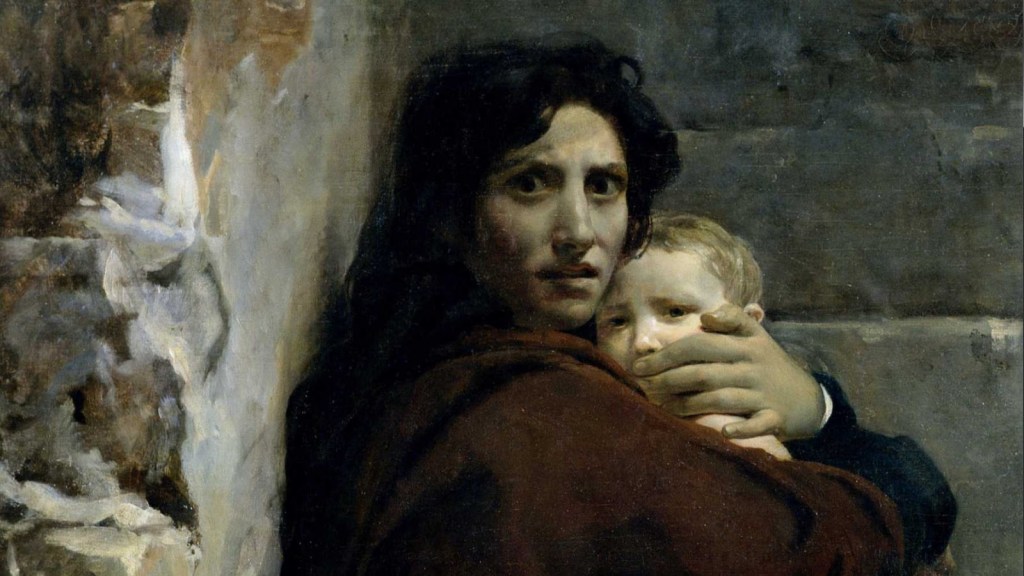
- The Massacre of the Innocents is the incident in the nativity narrative of the Gospel of Matthew (2:16–18) in which Herod the Great, king of Judea, orders the execution of all male children two years old and under in the vicinity of Bethlehem. The Catholic Church regards them as the first Christian martyrs, and their feast – Holy Innocents’ Day (or the Feast of the Holy Innocents) – is celebrated on 28 December.[3] A majority of Herod biographers, and “probably a majority of biblical scholars,” hold the event to be myth, legend, or folklore.[4]
The commemoration of the massacre of the Holy Innocents, traditionally regarded as the first Christian martyrs, if unknowingly so,[20][b] first appears as a feast of the Western church in the Leonine Sacramentary, dating from about 485. The earliest commemorations were connected with the Feast of the Epiphany, 6 January: Prudentius mentions the Innocents in his hymn on the Epiphany. Leo in his homilies on the Epiphany speaks of the Innocents. Fulgentius of Ruspe (6th century) gives a homily De Epiphania, deque Innocentum nece et muneribus magorum (“On Epiphany, and on the murder of the Innocents and the gifts of the Magi”).[c]
Today, the date of Holy Innocents’ Day, also called the Feast of the Holy Innocents or Childermas or Children’s Mass, varies. It is 27 December for West Syrians (Syriac Orthodox Church, Syro-Malankara Catholic Church, and Maronite Church) and 10 January for East Syrians (Chaldeans and Syro-Malabar Catholic Church), while 28 December is the date in the Church of England (Festival),[21] the Lutheran Church and the Roman Rite of the Catholic Church. In these latter Western Christian denominations, Childermas is the fourth day of Christmastide.[22] The Eastern Orthodox Church celebrates the feast on 29 December.[23]
From the time of Charlemagne, Sicarius of Bethlehem was venerated at Brantôme, Dordogne as one of the purported victims of the Massacre.[24]
In the Roman Rite, the 1960 Code of Rubrics prescribed the use of the red vestments for martyrs in place of the violet vestments previously prescribed on the feast of the Holy Innocents. The feast continued to outrank the Sunday within the Octave of Christmas until the 1969 motu proprio Mysterii Paschalis replaced this Sunday with the feast of the Holy Family.
In the Middle Ages, especially north of the Alps, the day was a festival of inversion involving role reversal between children and adults such as teachers and priests, with boy bishops presiding over some church services.[25] Bonnie Blackburn and Leofranc Holford-Strevens suggest that this was a Christianized version of the Roman annual feast of the Saturnalia (when even slaves played “masters” for a day). In some regions, such as medieval England and France, it was said to be an unlucky day, when no new project should be started.[26]
There was a medieval custom of refraining where possible from work on the day of the week on which the feast of “Innocents Day” had fallen for the whole of the following year until the next Innocents Day. Philippe de Commynes, the minister of King Louis XI of France tells in his memoirs how the king observed this custom, and describes the trepidation he felt when he had to inform the king of an emergency on the day.[27]
In Spain, Hispanic America, and the Philippines,[28] December 28 is still a day for pranks, equivalent to April Fool’s Day in many countries. Pranks (bromas) are also known as inocentadas and their victims are called inocentes; alternatively, the pranksters are the “inocentes” and the victims should not be angry at them, since they could not have committed any sin. One of the more famous of these traditions is the annual “Els Enfarinats” festival of Ibi in Alacant, where the inocentadas dress up in full military dress and incite a flour fight.[29]
Massacre of the Innocents (Bruegel):

See also Bruegel Tales of Winter – The Art of Snow and Ice
Bruegel: an Interpreter of Ultimate Reality and Meaning
- Tudor Lord of isrule: How Edward VI Resurrected a Raucous Christmas Tradition

Antiquary John Stowe wrote of the popular Medieval tradition of the Lord of Misrule, explaining that:
“In the feast of Christmas, there was in the King’s house, wheresoever he was lodged, a Lord of Misrule, or Master of merry disports, and the like had ye in the house of every noble man of honour, or good worship, were he spiritual or temporal.”
He went on to explain that the Mayor of London and his sheriff also had their Lords of Misrule and that these lords would begin their ‘rule’ and organise “the rarest pastimes to delight the beholders” on All Hallows Eve (Hallowe’en) and end their rule on the day after Candlemas Day, at the beginning of February. The revelry, Stowe explained, consisted of “fine and subtle disguisings, maskes and mummeries, with playing at cards for counters, nails and points in every house, more for pastimes than for gain.”
Oxford and Cambridge universities, and Lincoln’s Inn, would also appoint Lords of Misrule, as would the royal court, although their ‘rule’ tended to be limited to the 12 days of Christmas. Henry VII, the first Tudor monarch, continued the Medieval tradition, electing a Lord of Misrule for every Christmas of his reign. His son, Henry VIII, also embraced the tradition, going so far as to appoint a separate Lord of Misrule for the young Princess Mary’s household at Christmas, 1525. However, it was in the reign of Henry VIII’s son, the boy king Edward VI, that the tradition reached its zenith under the patronage of John Dudley, Duke of Northumberland, who was Lord President of the Privy Council from 1550 to 1553. The tradition had declined in the latter years of Henry VIII’s reign – an ambassador to Edward VI’s court remarked in January 1552 that a Lord of Misrule had not been appointed for “15 or 16 years” – but it was resurrected with great gusto at the royal court in the Christmas seasons of 1551-1552 and 1552-1553, the final Christmases of Edward’s reign.

Portrait miniature of Edward by an unknown artist, c. 1543–46
While the king’s uncle, Edward Seymour, Duke of Somerset and former Lord Protector, languished in the Tower of London awaiting execution as a traitor to the crown, the Duke of Northumberland sought to distract and divert both king and court with a programme of entertainment and revelry for the 12 days of Christmas. In December 1551, Northumberland appointed George Ferrers, a lawyer, courtier, MP, former servant of Somerset and a poet of some renown, as Lord of Misrule. Sir Thomas Cawarden, Master of the Revels, was informed of the appointment and asked to do all he could to aid Ferrers. Cawarden, who may well have felt slighted by the appointment of Ferrers instead of himself, had to be spurred into action by letters of complaint from both Northumberland and Ferrers regarding his inaction and the quality of items he had provided. In Cawarden’s defence, he was expected to provide a long list of apparel and items at very short notice indeed.
Although the Revels Accounts in the Loseley Manuscript are incomplete, they do show that the revels of these two Christmas seasons took the tradition of Lord of Misrule to new heights. Never before had the Lord of Misrule entered the City of London in a huge and elaborate procession that mimicked the procession of a monarch. Ferrers demanded a large retinue which, in January 1553, included no fewer than six councillors, a ‘dizard’ (talkative fool), jugglers, tumblers, a divine, a philosopher, an astronomer, a poet, a physician, an apothecary, a master of requests, a civilian, friars, two gentleman ushers and “suche other” as he needed. The fools included the “Lord Misrule’s ape”, his “heir apparent” and children.
Both of Edward VI’s final Christmases were spent at Greenwich Palace, the 15th century abode situated on the bank of the River Thames. Ferrers made his entry to the royal court at the palace under a canopy, presumably like a royal canopy of estate, and in one piece of pageantry at court he appeared “out of the moon”.
On 2 January 1552, Ferrers presided over a drunken mask at court for which he was furnished with eight “visars” (perhaps vizards or masks), eight swords and daggers, headpieces decorated with serpents and clubs that were full of “pykes” (spikes). The Christmas festivities also included the “Tryumphe of Horsemen”, in which 18 answerers ran six courses each against the Earl of Warwick, Henry Sidney, Sir Henry Gates and Sir Henry Neville as challengers. “Rich hangings” from the “King’s timber houses” were cut up and used for 12 bards for the challengers’ great horses, and caparisons and trappings for their eight light horses. A mock Midsummer Night festival was held that night and the furnishing of “as many Counterfett harnesses & weapons as ye may spare and hobby horsses” suggests that the entertainment included a mock joust. According to the Revels Accounts, other entertainment over the Christmas period included a mask of “Greek worthyes”, a mask of apes, a mask of bagpipes, a mask of cats and “a mask of medyoxes, being half man, half deathe.”

Two masked revellers by Jacob de Gheyn, circa 1595. Courtesy of the Rijksmuseum
On the night of 3 January 1552, there was a mock midsummer that required six hobby horses to be supplied, and then on 4 January the Lord of Misrule made his entry into the City of London. WR Streitberger points out that this entry was not only a parody of traditional royal entries into the capital but also “partly a burlesque of the power vested in royalty to dispense justice”. Diarist and merchant Henry Machyn gives a detailed contemporary account of Ferrers’ entry, writing of how Ferrers landed at Tower Wharf with a great number of young knights and gentlemen on horseback, “every man having a baldric of yellow and green about their necks”. They went first to Tower Hill, accompanied by a procession consisting of a standard of yellow and green silk with St George, guns and squibs, trumpet players, bagpipe players, flautists and other musicians, morris dancers, and the Lord of Misrule’s councillors in “gownes of chanabulle lyned with blue taffata and capes of the same”. Then came the Lord of Misrule, apparelled in a fur-trimmed cloth of gold gown, 50 men of the guard dressed in red and white, and a cart carrying a pillory, gibbet and stocks. The procession then made its way to the Cross at Cheapside where a great scaffold had been erected. There, a proclamation was made of Ferrers’ “progeny”, his “great household” and his “dignity”, before a beheading took place. Thankfully, it was a symbolic beheading; the ‘head’ of a hogshead of wine was “smitten out” for everyone to drink. After that, the Lord of Misrule enjoyed a sumptuous feast with the Lord Mayor before visiting the Lord Treasurer at Austin Friars and then taking a barge back from Tower Wharf to Greenwich.
As well as the pillory, gibbet and stocks described by Machyn as being part of the Lord of Misrule’s entry into London, the Revels Accounts list joints for a pair of stocks with hasps and staples, locks for the pillory and stocks, keys, manacles with a hanging locks, a “hedding ax” and “hedding block”. As well as symbolising the power of the monarch – or the Lord of Misrule at Christmas – to dispense justice, these items and the scaffold at Cheapside my well have alluded to the forthcoming execution of the Duke of Somerset.
On Twelfth Night 1552, a tourney was held during the day, and that evening, following a play performed by the King’s Players, there was a contest or feat of arms between Youth and Riches, with them arguing over which of them was better. It is thought to have been devised by Sir Thomas Chaloner, the statesman and poet. Sir Anthony Browne, Lord Fitzwater, Ambrose Dudley, Sir William Cobham and two other men fought on Youth’s side against Lord Fitzwarren, Sir Robert Stafford and four others on the side of Riches. “All these fought two to two at barriers in the hall. Then came in two apparelled like Almains [Germans]. The Earl of Ormonde and Jacques Granado, and two came in like friars, but the Almains would not suffer them to pass till they had fought. The friars were Mr Drury and Thomas Cobham.” It is not clear whether this contest between Germans (Protestants) and Catholic friars was, in fact, devised to ridicule the Catholic Church. This mock combat was followed by a mask of men and a mask of women, and then a banquet of 120 dishes. “This was the end of Christmas”, is how the account ends.

Two masked musicians perform for a noblewoman, by Jacob de Gheyn, circa 1595. Courtesy of the Rijksmuseum
The allusion to the Duke of Somerset’s scheduled execution was not the only controversial element of the Lord of Misrule’s programme of entertainment that year. Jehan Scheyfve, the imperial ambassador, recorded what he obviously saw as an anti-papist display. According to Scheyfve, a procession of mock priests and bishops “paraded through the Court, and carried, under an infamous tabernacle, a representation of the holy sacrament in its monstrance, which they wetted and perfumed in most strange fashion, with great ridicule of the ecclesiastical estate”. He wasn’t the only one upset about this affront to the Catholic Church; he wrote that “Not a few Englishmen were highly scandalised by this behaviour; and the French and Venetian ambassadors, who were at Court at the time, showed clearly enough that the spectacle was repugnant to them”. One can only assume, however, that the king was happy with this procession and the programme of festivities, for, as historian Jennifer Loach points out, the Revels Accounts show that the king took an active involvement in directing the entertainment and that changes were often made as “declared and commaunded by his highenes or his pryvie counsell” in order “to serve the kinge and his counsells pleasure and determinacion”. The King’s Printer, Richard Grafton, in writing about how well Ferrers was received at court as the Lord of Misrule, commented that he was “very well liked… But best of al by the yong king himselfe, as appered by his princely liberalitie in rewarding that service.” Ferrers was rewarded for his service with a payment of £50 from Northumberland and in September 1552 was appointed as Lord of Misrule for the 1552-1553 Christmas season.
The Christmas season of 1552-1553 began on with Ferrers sending his “solemn ambassador” to court, accompanied by a herald, trumpeter, “an orator speaking in a straunge language” and an interpreter. The ambassador’s mission was to speak to the king and ask for an audience for the Lord of Misrule. This audience was granted and the next day, Ferrers travelled to court along the Thames in the king’s brigantine, which was decorated in blue and white, escorted by other vessels and boys dressed as Turks and playing drums. At Greenwich, he was met by Sir George Howard, the Lord of Misrule’s Master of the Horse, who had come with a horse for Ferrers and who was accompanied by four pages of honour carrying Ferrers’ headpiece, shield, sword and axe. Ferrers writes of how he had taken Hydra, the serpent with seven heads, as his coat of arms, a holly bush as his crest and ‘Semper ferians’ (always keeping the holiday) as his motto.
Entertainments over Christmas and New Year included a pageant in which Ferrers emerged from “vastum vacuum” (a vast airy space), which must have been some kind of pageant car; a feat of arms; a mock midsummer show and joust of hobby horses, presumably like the previous year; a day of hunting and hawking, and masks of “covetus men with longe noses”, “women of Diana hunting”, “babions faces of tinsel black and tawny”, “pollenders”, “matrons” as well as soldiers.
University of Leicester Special Collections. ‘Lord of Misrule’ from: William Sandys, Christmastide: its History, Festivities and Carols, (London, [1852], SCM 12913.Ferrers ordered five different suits of apparel via Cawarden for the festive season: one to wear on both his entry to court and his entry into London, two for the next “hallowed daies”, another for New Year and a final one for Twelfth Night. He also ordered a fool’s coat and hood for John Smith, who was playing the Lord of Misrule’s “heir apparent”, a hunting costume consisting of a coat of cloth of gold decorated with red and green checkerwork, a cloth of gold hat decorated with green leaves, and six sets of outfits complete with horns for his attendants. Other items included “Irish apparel” for both a man and woman, costumes for members of his retinue, maces for his sergeant-at-arms, and hobby horses, one of which he ordered to be made with three heads.
Henry Machyn records the Lord of Misrule’s entry into London on 4 January 1553, writing that he was met at Tower Wharf by the Sheriff’s Lord of Misrule, who took a sword and bore it before Ferrers, who was dressed in royal purple velvet furred with ermine, his “robe braided with spangulls of selver full”. Ferrers was accompanied by a large retinue dressed in a livery of blue and white. As well as musicians, fools and morris dancers, there were once again gaolers armed with a pillory, stocks, an axe, shackles and bolts, and prisoners, presumably actors, who were “fast by the leges and sum by the nekes”. They processed through Gracechurch Street and Cornhill, and once again made their way to a scaffold. After a proclamation had been made, Ferrers gave the Sheriff’s Lord of Misrule a gown of gold and silver before knighting him. The two Lords of Misrule toasted each other and as they proceeded onwards, Ferrers’ cofferer distributed silver and gold. The day ended with a feast at the Lord Mayor’s home, a visit to the Sheriff’s house and a banquet course at the Lord Treasurer’s house.
Twelfth Night was celebrated with “The Triumph of Cupid, Venus and Mars”, which, according to Cawarden’s correspondence, was a play devised by Sir George Howard, who was also Master of the Henchmen. Enid Welsford believes that this play was an imitation of the Italian ‘trionfi’, a triumphal procession, and it appears that Venus did indeed enter in a triumphal chariot accompanied by a mask of ladies followed by the marshal and his band. Venus rescued Cupid from the marshal with some kind of mock combat, and at some point, Mars also made his triumphal entry. Thus ended the Twelve Days of Christmas. Once again, the King was pleased his Lord of Misrule and George Ferrers was granted an estate at Flamstead in Hertfordshire.
Although Sydney Anglo makes the point that few records survive detailing the Lord of Misrule’s entertainments in other years, we know from the accounts of Edward VI’s reign that £500 was spent on the revels of Christmas 1551-1552 and £400 on that of 1552-1553, compared to £150 in 1547-1548 and £11 in 1548-1549. The entertainment of George Ferrers’ time as Lord of Misrule was pageantry at its most lavish. Historian Ronald Hutton concludes that the spectacle of Ferrers’ entries into London, for example, “was one of the most elaborate in Tudor history”. It is a shame that the incomplete records only give us a tantalising glimpse into the revelry.
Return of Spring Sacrifice

The ancient custom of sacrificing divine kings is played out in both Bulgarian and Sardinian festivals in the Dionysian mode by distributing virtual fragments of their mutilated bodies over village fields, thus ensuring the return of a fertile spring. The tradition, which associates the sacrifice of the king or his children with a great scarcity of crops, points to the belief that the king is responsible for the weather and harvests. The spilled blood evokes rainfall for the parched earth, essential for collective survival. According to Frazer, when gods are killed, they take on the role of scapegoat, sweeping away disease, death, and sin from the community, and are eaten symbolically in order to be assimilated.
In the carnival enacted in Samugheo, Sardinia, a related character called S’urtzu-Dioniso, symbolizes the god to be sacrificed. He appears as a goat, which according to legend, is how Dionysus often appeared. Under the goat skin is a bladder filled with blood and water. When he is hit and falls, the bladder breaks and red blood soaks the ground. After this sacrifice, new life emerges.
Kukerovden, which translates as ‘Day of the Kukers’, is a Bulgarian mystery play within the festival, in which each player bears a strong symbolic connection to an archetypal aspect of nature. The Neolithic ritual is designed to bind heaven and earth together by telling a human story that echoes the greater, universal drama.

The wine-fueled Kukerovden ritual includes a tsar or king and a human couple along with a team of attendant kukeri. In an act of bawdy pantomime, the groom impregnates his bride as the kukeri charge, dance and interact with the crowd, jabbing, thrusting, and chasing girls with their long, red poles. Two kukeri are then yoked to a wooden plow, goaded by the tsar as they ritually till three concentric rings. The tsar scatters grain seeds symbolizing the sowing of fields.

The heated climax occurs when the tsar is struck down with the spindle of destiny. Raising his body announces the arrival of spring. By now the bride, a male disguised with kerchief and comically bulging dress is ready to give birth. When the child pops out, usually represented by an androgynous rag doll, the ceremony is complete.

The ritual seems to have originated as an initiation for young Kukeri, historically, boys and young bachelors. Through phallic thrusting and sowing movements. older men would convey the ways of the world and their community. Maimon is the name by which Dionysus is invoked in Sardinia. In Orotell, Maimones mime cultivation by dragging a plow behind them. The deep, indissoluble bond is indicated by ropes that bind the farmers to the yoke. It is no coincidence that Dionysus was especially adored by farmers who considered him the inventor of the plow and the one who had taught men how to lure oxen to ease their labour.


The Koukeri tradition recreates the connection between Nature and Man: earth – woman; ploughing the soil – taking the woman; sowing – inseminating; grain – semen; passing of winter – killing of the Tsar; coming of spring – the Tsar’s resurrection. The Koukeri’s moves bear the signs of sacral code: The stabbings with the red-painted swords represent the phallic copulation moves; the hopping and jumping are to make the wheat grow tall; the body swaying – to make the wheat sway with heavy grain; the rolling on the ground – for Man to take from Earth’s strength; the bells noise – to scare and chase away the evil spirits.
The Koukeri custom was part of the game cycle that prepared the young men for their future roles of husbands and land workers. It was an important rite-of-passage, which gave them the opportunity to learn about and experience life after marriage. A lad, who had not participated in the Koleda, Sourva and Koukeri games, would be considered a “second rate” marriage candidate, and would be put in the same group with the nwith the non-healthy and widowed men. He could only marry a “second rate’ woman – non-healthy, widowed, or one left by her husband.
The main actors of the Koukeri group are: a Tsar (king), a newly wedded couple or an elderly couple, koukeri. They have a chariot or a cart, in which they drive the Tsar around; a plough, with which they ritually till the soil; a wooden pot, full of grain, which the Tsar sows; wooden swords and a club, perceived as phallic symbols; a doll. Despite the regional variances, in the past, the ritual comprised the following sequence of actions: The Koukeri, only young single men, led by the Tsar, a man of respectable age and social standing – prosperous, with a family and children, gathered in the centre of the village, from where, with the musicians in front, they would go to all houses, offering blessings for health, fertility and prosperity. The Bride tries to sweep and clean up the front yard, but does it so clumsily that only causes disorder. The Hosts give the Koukeri food, wine and/ or money, and thank them cordially for the blessings. In turn, the Bride kisses the Host’s hand. After the house rounds have been completed, the Koukeri group, followed by villagers, return to the village square, where they perform their ancient ritual. First, they engage in a battle with the evil spirits by running around, waving arms and swords wildly, and making noise with their bells, thus chasing the evil forces away. The Groom / Old Man use the scuffle to “make love to and inseminate” the Bride / Old Woman. The Koukeri return from the battle and give their Tsar three pieces of bread. Then three circles of ritual ploughing take place. The Tsar walks behind the plough and sows grain, followed by the main group, who are jumping and waving their swords in the air. Upon completion of the tilling, the Tsar blesses the congregation for good health and prosperity, and is then killed by a Kouker. All Koukeri gather above him and resurrect him. The Bride/ Old Woman gives birth to a child, and the Koukeri celebrate with hopping and dancing. During the enactment of the custom, the Koukeri exchange jokes with the spectators. At the end, the Koukeri gather for a dinner with the food and wine, given to them by the villagers. It’s a joyous and elevating event.
In our days, the Koukeri Day is just a festive reminder of times gone by, a merry holiday, whose main importance is to gather people for a joyful celebration of life.
The Sardinian version of carnival is called Carrasecare,’meat carried in a cart to be dismembered’. But the term care does not mean meat for butchery, which is always called petta or petza. The term suggests human meat, revealing the arcane function of traditional Sardinia carnivals. Maskers continue to play out the roles, though with different intentions. They are sad events that require a victim or a stand-in effigy to be torn apart, incarnating the deity who had been eaten by Titans, then resurrected by his mother.

The cart also serves as the platform for enacting the consummation of the divine union between the Neolithic Great Mother and her consort-son in Bulgaria. They reappear in Minoan myth as either Demeter or Semele, depending upon the version, as the stand-in for the Great Mother and her consort- son, Dionysus in bull form, representing male virility.
Ensured through these mini-dramas is the fertility of the fields, fruit trees and grape vines, the source of the wine that keeps the excitement of the festivals alive. The magic of these long-repeated rituals seem to be regarded as guarantee for a rich harvest, health and fertility for humans and their domesticated animals with chaos subdued and evil spirits chased away. Read more here
- Nativity Fast
In Christianity, the Nativity Fast—or Fast of the Prophets in Ethiopian Orthodox Tewahedo Church and Eritrean Orthodox Tewahedo Church—is a period of abstinence and penance practiced by the Eastern Orthodox Church, Oriental Orthodox Church and Catholic Church in preparation for the Nativity of Jesus on December 25.[1] Ethiopian and Eritrean Orthodox Churches commence the season on November 24 and end the season on the day of Ethiopian Christmas, which falls on January 7.

The corresponding Western season of preparation for Christmas, which also has been called the Nativity Fast[2] and St. Martin’s Lent, has taken the name of Advent. The Eastern fast runs for 40 days instead of four (in the Roman Rite) or six weeks (Ambrosian Rite) and thematically focuses on proclamation and glorification of the Incarnation of God, whereas the Western Advent focuses on three comings (or advents) of Jesus Christ: his birth, reception of his grace by the faithful, and his Second Coming or Parousia.
The Byzantine fast is observed from November 15 to December 24, inclusively. These dates apply to the Eastern Catholic Churches, and Eastern Orthodox churches which use the Revised Julian calendar, which currently matches the Gregorian calendar. For those Eastern Orthodox churches which still follow the Julian calendar—the Greek Orthodox Patriarchate of Jerusalem, the Russian Orthodox Church, the Serbian Orthodox Church, the Georgian Orthodox Church, the Ukrainian Orthodox Church, the Macedonian Orthodox Church, Mount Athos, the Portuguese Orthodox Church, and all Old Calendarists, as well as some parishes of the Romanian Orthodox Church, of the Polish Orthodox Church, and of the Orthodox Church of America—the Winter Lent does not begin until November 28 (Gregorian) which coincides with November 15 on the Julian calendar. The Ancient Church of the East fasts dawn til dusk from December 1 until December 25 on the Gregorian calendar.

- January 14 is “Feast of the Ass” Day

- On January 14, medieval Christians celebrated Feast of the Ass Day, although perhaps not the type of “ass” you may be thinking of! It actually celebrated the various accounts in the Bible where a donkey (or ass) is mentioned, especially the one that supposedly carried Mary and the baby Jesus to Egypt.
Digging Deeper
Not surprisingly, like many or even most Christian holidays, the Feast of the Ass had its origins in Paganism, being derived from the religious feast called Cervulus.

Flight into Egypt by Gentile da Fabriano
During this bestial-based holy day, a ceremony often took place in which a girl with a baby (or a pregnant girl) was led through a village on a donkey, followed by churchgoers answering the priest with “hee-haws” during the related church service or Mass. In some accounts, the priest himself would bray.
Amazingly, this nifty holiday fell out of favor around 1500 along with its sister feast, the Feast of Fools. Apparently some thought the titles and actions of these two celebrations were less than “Christian.”

Perhaps they should bring this particular feast back and give people a valid excuse, at least one day a year, to make an “ass” / donkey of themselves and ourselves in church or everywhere else in life outside.
- Landscape as an Image of the Pilgrimage of Life :

Look at the donkey in The Rest on the Flight into Egypt of the “Holy Refugees” by Joachim Patinir…

..he is smiling in his heart…
It depends of the sturburness of our Ego, the Donkey.
In the Spiritual Land of Peace, the donkey, our ego is quiet, he submits totally to the “Holy Refugee” and eats the “Greenness” of the spiritual field of the Land watered by the Eternal Water of Life….
Corona or Covid- is like a rehab intervention that breaks the addictive hold of normality. To interrupt a habit is to make it visible; it is to turn it from a compulsion to a choice. The phenomenon follows the template of initiation: separation from normality, followed by a dilemma, breakdown, or ordeal, followed (if it is to be complete) by reintegration and celebration. Now the question arises: Initiation into what? What is the specific nature and purpose of this initiation? The popular name for the pandemic offers a clue: coronavirus. A corona is a crown. “Novel coronavirus pandemic” means “a new coronation for all.”
A Choice or a possible migration to the Spiritual Land of Peacet
To become a Refugee, a Holy Refugee through an emigration to Sincerity or uprightnees of Love
see:
- Landscape of the soul, as an Image of the Pilgrimage of Life
- Spiritual exercise for the “Refugee” of our Times
- To Become a “Refugee”: Emigration to Sincerity or “uprightness” of Love
We are not the first generation to know that we are destroying the world. But we could be the last that can do anything about it, not with the vanity of earthly knowledge and so called democratic solidarity and wisdom here on earth as the commercial of WWF wants to convince us, but with asking humbly the help of Divine Wisdom so realising in us the image of the man who painfully transcends his material ego: The birth of his soul. It is a test. It’s time to decide!

- Treatise on Unification by Ibn al Arabi
In the name of God, the Merciful, the Compassionate. Blessings
upon our master, Muhammad, and upon his family and companions. This is a noble treatise in which I have consigned a tremendous discourse.
From my incompleteness to my completeness, and from my inclination to my equilibrium
From my grandeur to my beauty, and from my splendour to my majesty
From my scattering to my gathering, and from my exclusion to my reunion
From my baseness to my preciousness, and from my stones to my pearls
From my rising to my setting, and from my days to my nights
From my luminosity to my darkness, and from my guidance to my straying
From my perigee to my apogee, and from the base of my lance to its tip
From my waxing to my waning, and from the void of my moon to its crescent
From my pursuit to my flight, and from my steed to my gazelle
From my breeze to my boughs, and from my boughs to my shade
From my shade to my bliss, and from my bliss to my wrath
From my wrath to my likeness, and from my likeness to my impossibility
From my impossibility to my validity, and from my validity to my deficiency.
I am no one in existence but myself, so –
Whom do I treat as foe and whom do I treat as friend?
Whom do I call to aid my heart, pierced by a penetrating arrow,
When the archer is my eyelid, striking my heart without an arrow?
Why defend my station? It matters little to me; what do I care?
For I am in love with none other than myself, and my very separation is my union.
Do not blame me for my passion. I am inconsolable over the one who has fled me.
In this book I never cease addressing myself about myself and returning in it to myself from myself.
From my heaven to my earth, from my exemplary practice to my religious duty,
From my pact to my perjury, from my length to my breadth.
From The Universal Tree and the Four Birds by Muhyiddin Ibn Arabi,


 Path to the Maypole of Wisdom

